
Bernatz R. Fourier Series and Numerical Methods for Partial Differential Equations
Подождите немного. Документ загружается.

12 INTRODUCTION
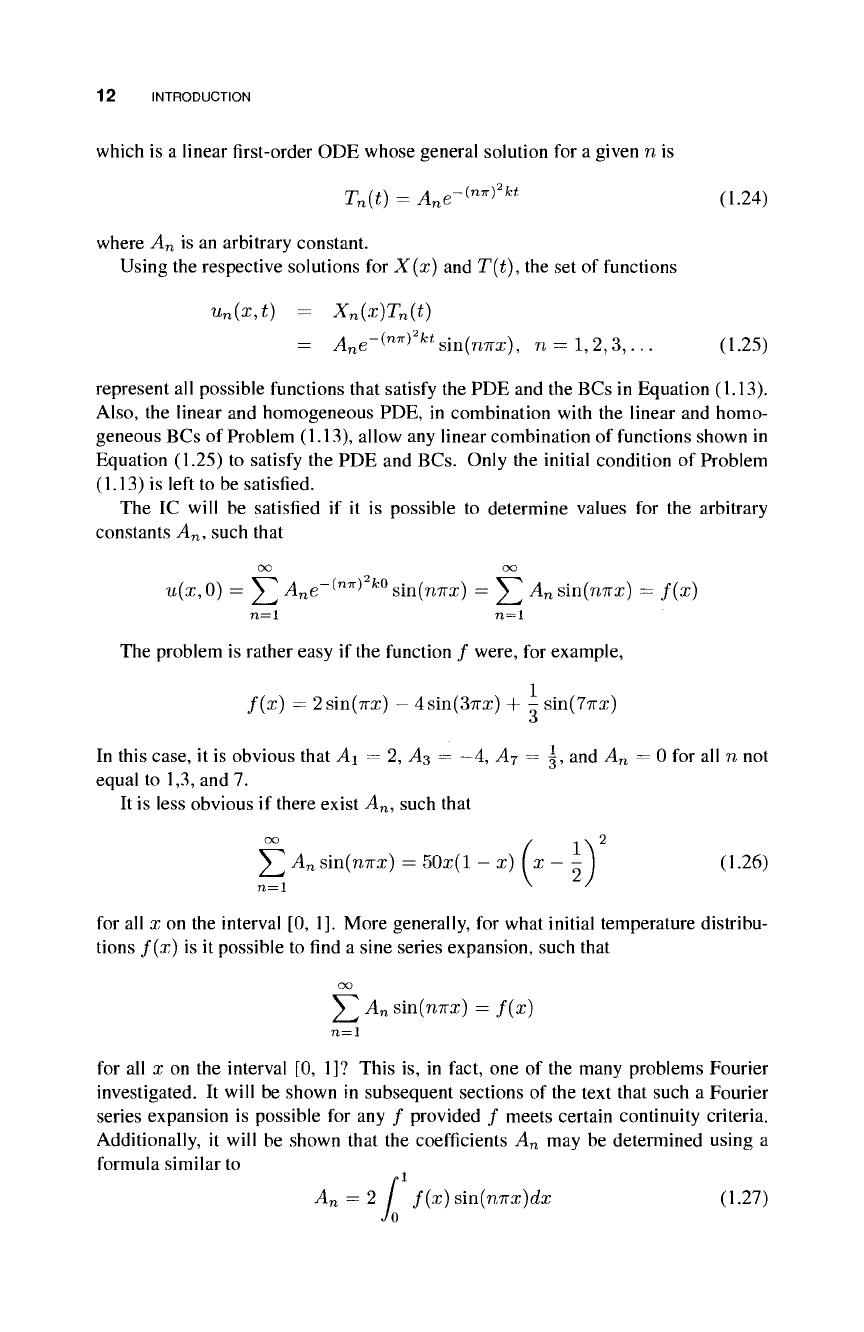
which is a linear first-order ODE whose general solution for a given n is
T
n
(t) =
A
n
e~^
2kt
(1.24)
where A
n
is an arbitrary constant.
Using the respective solutions for X(x) and T(t), the set of functions
U
n
{x,t)
= X
n
(x)T
n
(t)
= A
n
e-
{n7r)2kt
sm(nnx), n = 1,2,3,... (1.25)
represent all possible functions that satisfy the PDE and the BCs in Equation (1.13).
Also,
the linear and homogeneous PDE, in combination with the linear and homo-
geneous BCs of Problem (1.13), allow any linear combination of functions shown in
Equation (1.25) to satisfy the PDE and BCs. Only the initial condition of Problem
(
1.13) is left to be satisfied.
The IC will be satisfied if it is possible to determine values for the arbitrary
constants A
n
, such that
CO CO
u(x,0) = ]P
A
n
e~(
nn)2k0
sin(nnx) = ^ A
n
sin(mrx) = f(x)
n=l n—1
The problem is rather easy if the function / were, for example,
f(x) = 2sin(7HE)
—
4sin(37nr) + - sin(77rx)
ó
In this case, it is obvious that A\ = 2, As =
—4,
Aj = |, and A
n
= 0 for all n not
equal to 1,3, and 7.
It is less obvious if there exist A
n
, such that
co , ^2
2_"
A
n
δίη(ηπχ) = 50x(l
—
x) I x
—
- I (1.26)
n=l V
2
'
for all x on the interval [0, 1]. More generally, for what initial temperature distribu-
tions f(x) is it possible to find a sine series expansion, such that
CO
y^ A
n
sin(ri7rx) = f(x)
n=l
for all x on the interval [0, 1]? This is, in fact, one of the many problems Fourier
investigated. It will be shown in subsequent sections of the text that such a Fourier
series expansion is possible for any / provided / meets certain continuity criteria.
Additionally, it will be shown that the coefficients A
n
may be determined using a
formula similar to
A
n
= 2 / f(x)sm(rnrx)dx (1.27)
Jo
SEPARATION OF VARIABLES 13
As a way of completing this separation of variables example, suppose the initial
temperature distribution is that given by the formula
on the
right-hand side of Equation
(1.26).
Equation (1.27) is used to determine a formula for the Fourier coefficients so
that the initial condition is satisfied. Therefore, the solution for i¿(x, t) is given by
u(x,t)
n=l V
7
°
f(x) s'm(nnx)dx I e
0
-(mr)
2
/ct
sin
(
n7rx
)
(1.28)
This expression gives the value of u(x,t) for any x in the interval
[0,1],
and
any t > 0 as an infinite series. An approximate value for u at a given x and t
is determined by a partial sum of the infinite series. A visual indication of how
accurately a partial sum will approximate the infinite series can be accomplished by
comparing the partial sum of the series at time t = 0 and the initial temperature
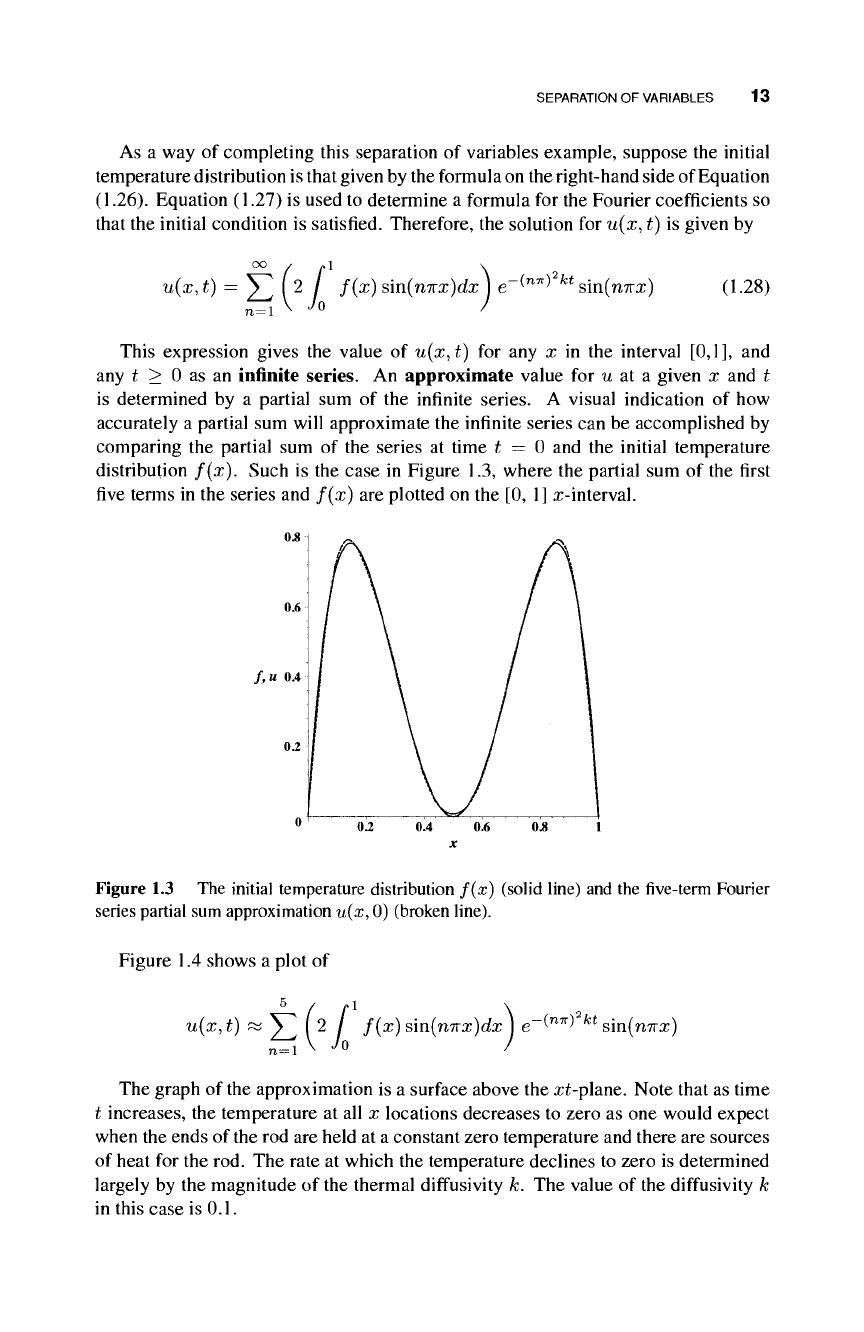
distribution /(#). Such is the case in Figure 1.3, where the partial sum of the first
five terms in the series and f(x) are plotted on the [0, 1] x-interval.
/,
u
0.4
Figure 1.3 The initial temperature distribution f(x) (solid line) and the
five-term
Fourier
series partial sum approximation u(x, 0) (broken line).
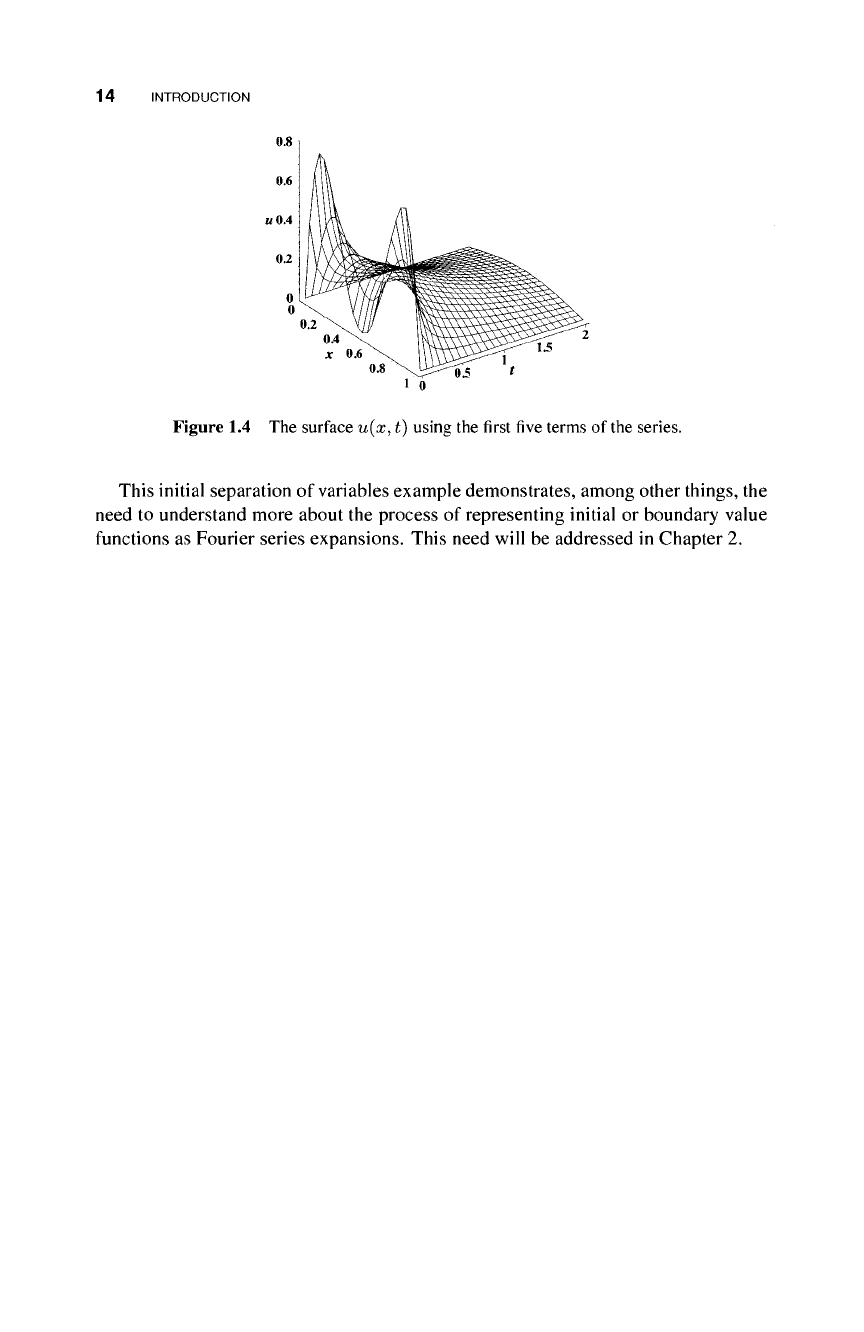
Figure 1.4 shows a plot of
iM-
f(x) s'm(nnx)dx ) e
(ηπ) kt
sin(nnx)
u(x,t)
The graph of the approximation is a surface above the xt-plane. Note that as time
t increases, the temperature at all x locations decreases to zero as one would expect
when the ends of
the
rod are held at a constant zero temperature and there are sources
of heat for the rod. The rate at which the temperature declines to zero is determined
largely by the magnitude of the thermal diffusivity k. The value of the diffusivity k
in this case is 0.1.
14 INTRODUCTION
Figure 1.4 The surface u(x, t) using the
first
five
terms of
the
series.
This initial separation of variables example demonstrates, among other things, the
need to understand more about the process of representing initial or boundary value
functions as Fourier series expansions. This need will be addressed in Chapter 2.
EXERCISES
15
EXERCISES
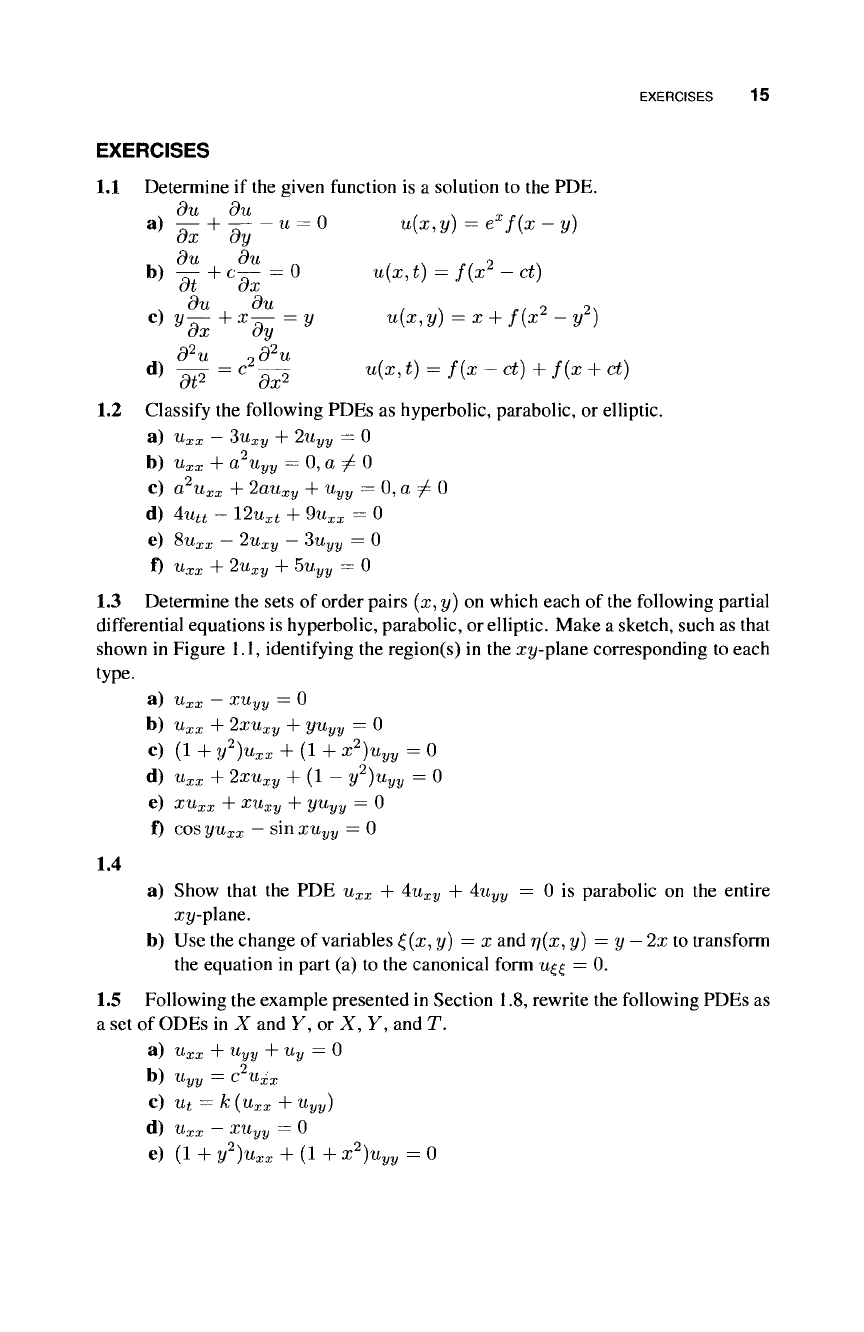
1.1
Determine
if
the given function
is a
solution
to the
PDE.
.
du du _ / \ x£t \
.
x
du du ,
χ
„, o
b)
-^ + c— = 0
M(X,
¿)
= f(x
2
- ct)
du du .
x
i./ 9 2\
d)
"¿T
= c2
¿
ω
(
χ
'*)
=
/(
χ
~
<*)
+
/(
χ
+
rf
)
1.2
Classify
the
following PDEs
as
hyperbolic, parabolic,
or
elliptic.
a)
b)
c)
d)
e)
f)
U
XX
^χχ
a
2
u
:
^Uu
óU
X
y
~Γ
¿Uyy
4-
a
2
Uyy
= 0, a φ
xx
i
¿O'U'xy
\ U'yy
- YlUxt
+
9u
xx
=
ÖWj;x ZU
X
y óUyy
-
^ΧΧ
+ ¿U
X
y
"h
OUyy
0
0
=
0,
=
0
=
0
0
α^
0
1.3
Determine
the
sets
of
order pairs
(x, y) on
which each
of
the following partial
differential equations is hyperbolic, parabolic,
or
elliptic. Make
a
sketch, such as that
shown
in
Figure
1.1,
identifying
the
region(s)
in the
xy-p\me corresponding
to
each
type.
*V
^χχ
XUyy
— U
b)
U
XX
4-
2XU
xy
+
yUyy
= 0
c)
(1 +
y
2
)u
xx
4- (1
4-
x
2
)u
yy
= 0
d)
u
xx
4-
2m¿
X2/
4- (1 -
y
2
)u
yy
—
0
Gj
XU
XX
4~ %U
X
y 4~
yUyy
= U
f) cos
í/n^
—
sin
xt^ = 0
1.4
a) Show that
the PDE u
xx
4-
4u
X2/
4- 4?/^ = 0 is
parabolic
on the
entire
x?/-plane.
b) Use the change
of
variables £(#,
y) = x and
ry(x, ?/)
= i/
—
2x to
transform
the equation
in
part
(a) to the
canonical form uçç
= 0.
1.5
Following the example presented
in
Section
1.8,
rewrite the following PDEs
as
a
set of
ODEs
in X and Y, or X, Y, and T.
*V
^XX 4" ^2/7/ I Wy = U
Ό)
Uyy
==
C U
XX
C)
U
t
= k(U
XX
+Uyy)
")
V*xx X^yy
=
^
e)
(1
4-
y
2
)u
xx
+
(14-
x
2
)u
yy
= 0
16 INTRODUCTION
1.6 Consider the B VP below with the four prescribed boundary conditions.
BVP{ "i„
=
3« + 7 (BCZ) (1-29)
%i ~T~ 2/2/
u
y
(x,0)
=
Ml,
2/)
=
u(x, 1) =
w(0,2/) =
= 3x-1
= 32/+ 7
-2y
2
- y
-1
4-2
(FDb)
(BC1)
(BC2)
(BC3)
(BC4)
We assume a solution of the form u(x, y) = Ax
2
+ 2?:n/ + C?/
2
+ Dx
-\-
Ey + F,
where constants A
—
F are to be determined.
a) What conditions on A
—
F are required so that the proposed form of u
satisfies the PDE.
b) If possible, determine values for A
—
F so that u satisfies each of the four
BCs.
1.7 The ID homogeneous wave equation is
Utt =
C
2
U
XX
where the constant c represents the intrinsic wave speed. Let u(x,t) = X(x)T(t)
and use the method of separation of variables with separation constant — λ to find the
two resulting ODEs (one in X and one in T) for the case of the ID wave equation.
1.8 Find the general solution for the following homogeneous ODEs
a) y"{t)-Ay\t)+Ay{t) =
V
b) y"{t) - 2y'(t) + 2y(t) = 0
c) 2/"(t)+42/(i) = 0
1.9 Solve the following first-order linear IVP using an appropriate integrating
factor.
a) y'(x) + y(x) = cosx, y(0) — 1
b) y'{x) + 2xy(x) = xe~
x
\ y(0) = -1
1.10 The purpose of this exercise is to introduce, or review, the method of variation
of parameters
2
for finding a particular solution to a second-order, linear, non-
homogeneous ODE, such as
y"(t)
+ p(t)y'(t) + q(t)y(t) = f(t) (1.30)
Suppose y i and y^ are linearly independent solutions to homogeneous form of Equa-
tion (1.30). We seek a particular solution of Equation (1.30) of the form
Vv =
u
m +u
2
y2 (1.31)
where u\ and u
2
are, generally, functions oft determined by requiring
u[yi +
u'
2
y
2
= 0
2
The French mathematician J.L. Lagrange is known to have used this method in 1774. Consequently, this
method is sometimes called the "Lagrange method."
EXERCISES 17
in addition to y
p
solving Equation (1.30). Under these requirements, show that
,
=
-V2Í ,
=
yif
Ul
W(
yi
,y
2
)
U2
W(y
u
y
2
)
where W(y\, y
2
) = 2/12/2
~~
2/Í2/2 is the Wronskian of y\ and y
2
. [Hint: Under the
given requirements, show that the following system of equations:
^Í2/l+^2l/2 = 0
u'iy'i+u'^ = f
results.]
1.11 Find the general solution to the following nonhomogeneous ODEs by the
method of
(i)
undetermined coefficients, and (ii) variation of parameters (see Exercise
1.10).
a) y"(t)-3y'(t) + 2y(t)=8uit
b) y"{t) - 2y'(t) - 3y(t) =t + l
c) y"(t) + 4y(t) = te
4t
1.12 Determine the solution to IBVP (1.13) for the various initial conditions f(x)
and thermal conductivity k given below. In each case, generate a 2D plot (e.g., Figure
1.3) of u(x, 0) and a 3D plot of u(x, t) for 0 < t < 2, such as that shown in Figure
1.4. Use a 50-term partial sum.
a) f(x) = cos πχ and k = 0.05
b) f(x) = e~
x
and k = 0.01
r 1 0.4<x<0.6
c) f(x) = I and k = 0.01
[ 0 otherwise
1.13 The function u(x, y) defined as
11 °°
u(x, y)
—
-x
2
—
-y
2
—
2x + V^
a
nV2 cos(nny) ΰθ8η(ηπ(2
—
x))
2
n=l
with
1 r
1
-—-- / (4(1 - y) - 2)V2cos(nny)dy n = 1, 2, 3,...
ΠΈ
smh{2nn)
is part of the solution to a steady-state problem that includes the required boundary
condition
-u
x
(0,y) = 4(l-j/)
Show that u(x, y) so defined satisfies the required boundary condition. Follow these
steps:
(i) Construct a 10-term approximation to u(x, y). (ii) Differentiate the result
in (i). (iii) Plot the result of part (ii) on the interval 0 < y < 1.
18 INTRODUCTION
1.14 Consider the IBVP
( u
t
= ku
xx
+ q{x, t) 0 < x < 1, t > 0 (PDE)
IBVP ^ w(x, 0) = f(x)
u(0,t) = h
1
(t
i w(i,t) = Λ
2
(ί;
(IC)
(BCl)
(BC2)
(1.32)
Assume u(x, t) = £/(x,
£)
4· i?(x, t), where i?(x, t) = A(t)x
4-
JB(Í),
and substitute
for u(x, t), in terms of U and i?, in the IBVP given in 1.32. In doing so, derive an
IBVP for U that has a nonhomogeneous PDE, with nonhomogeneous term q*(x, t).
Determine an expression for q*(x, t). Next, determine the initial condition /*(£) for
the IBVP for U. Then, determine conditions on A(t) and B(t) that give homogeneous
BCs for the IBVP in U.
1.15 Repeat the process described in Exercise 1.14, but for the nonhomogeneous
IBVP
( u
t
= ku
xx
+ q(x,t) 0 < x < 1, í > 0 (PDE)
IBVP<
u(x,0) = f(x)
u
x
(l,t)
= h
2
(t)
(IC)
(BCl)
(BC2)
(1.33)
1.16 Repeat the process described in Exercise 1.14, but for the nonhomogeneous
IBVP
u
t
= ku
xx
+q(x,t)
0<x<l,¿>0 (PDE)
IBVP
<
u(x, 0) = f(x)
u(0,t) -u
x
(0,t
u(l,t) +u
x
(l,t
hi(t
h
2
(t
(IC)
(BCl)
(BC2)
(1.34)
CHAPTER 2
FOURIER SERIES
The initial example of separation of variables presented in Section 1.8 demonstrated
the need to explore the Fourier series representation of functions that define initial
or boundary condition for IBVPs. That is the broad objective of this chapter. More
specifically, the primary question is what are necessary or sufficient characteristics of
a function / so that a Fourier sine, Fourier cosine, or general Fourier series expansion
accurately represents / on a given interval. To this end, the chapter begins with a
review of vector spaces, inner products, and orthogonality.
2.1 VECTOR SPACES
Recall that a vector space V is a nonempty set of objects (vectors) on which the
operations of vector addition and scalar multiplication are defined
so
that the following
10 axioms hold for all vectors u, v, and w in V, and for all scalars c and d in R.
1.
The sum of u and v, denoted by u + v, is in V.
2.
u + v = v-fu
3.
(u + v) + w = u + (v + w)
Fourier Series and Numerical Methods for Partial Differential Equations, 19
First Edition. By Richard Bernatz
Copyright © 2010 John Wiley & Sons, Inc.
20 FOURIER SERIES
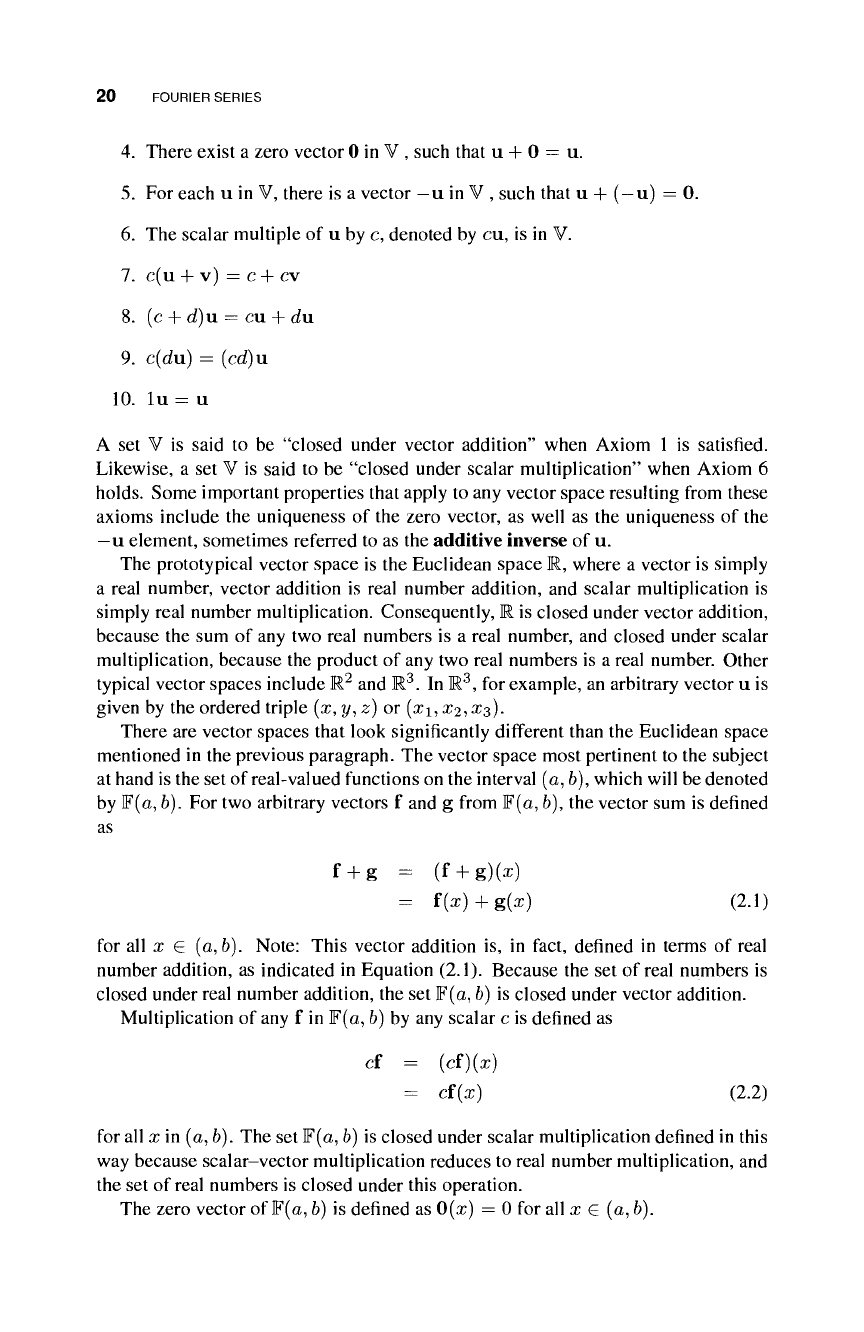
4.
There exist a zero vector 0 in V , such that u + 0 = u.
5.
For each u in V, there is a vector —u in V , such that u + (—u) = 0.
6. The scalar multiple of u by c, denoted by cu, is in V.
7.
c(u + v) = c + cv
8. (c + d)u = eu -f du
9. c(du) = (cd)u
10.
lu = u
A set V is said to be "closed under vector addition" when Axiom 1 is satisfied.
Likewise, a set V is said to be "closed under scalar multiplication" when Axiom 6
holds.
Some important properties that apply to any vector space resulting from these
axioms include the uniqueness of the zero vector, as well as the uniqueness of the
—u element, sometimes referred to as the additive inverse of u.
The prototypical vector space is the Euclidean space R, where a vector is simply
a real number, vector addition is real number addition, and scalar multiplication is
simply real number multiplication. Consequently, R is closed under vector addition,
because the sum of any two real numbers is a real number, and closed under scalar
multiplication, because the product of any two real numbers is a real number. Other
typical vector spaces include R
2
and R
3
. In R
3
, for example, an arbitrary vector u is
given by the ordered triple (x, y, z) or {x\,X2, xs).
There are vector spaces that look significantly different than the Euclidean space
mentioned in the previous paragraph. The vector space most pertinent to the subject
at hand is the set of real-valued functions on the interval (a, b), which will be denoted
by F(o, b). For two arbitrary vectors f and g from F(a, 6), the vector sum is defined
as
f + g = (f + g)(x)
= f(x) + g(x) (2.1)
for all x G (a, b). Note: This vector addition is, in fact, defined in terms of real
number addition, as indicated in Equation (2.1). Because the set of real numbers is
closed under real number addition, the set F (a,
b)
is closed under vector addition.
Multiplication of any f in F(a,
b)
by any scalar c is defined as
cî = (cf)(x)
= cf(x) (2.2)
for all x in (a, b). The set F(a,
b)
is closed under scalar multiplication defined in this
way because scalar-vector multiplication reduces to real number multiplication, and
the set of real numbers is closed under this operation.
The zero vector of F(a,
b)
is defined as 0(x)
—
0 for all x G (a, b).
VECTOR SPACES 21
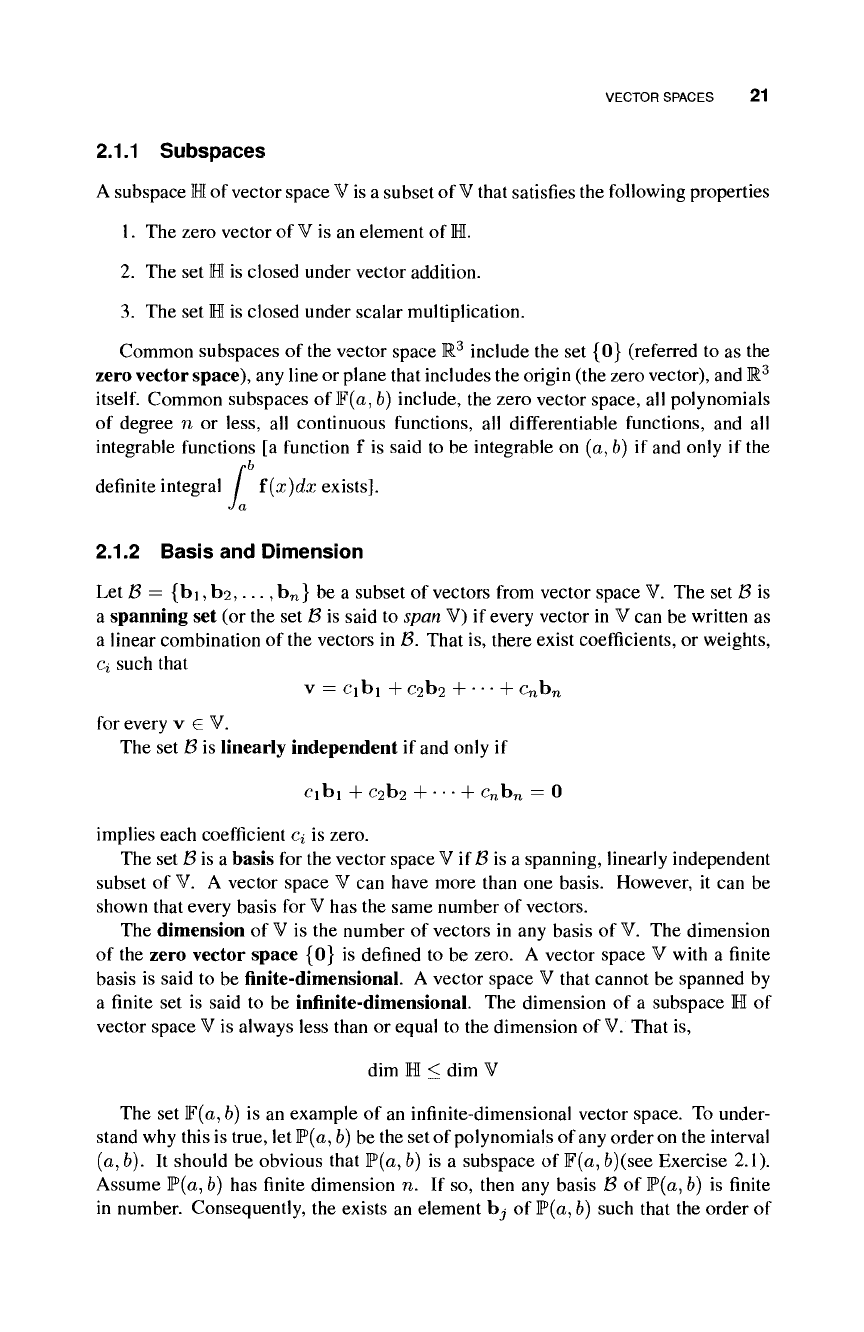
2.1.1 Subspaces
A subspace
EI
of vector space V is a subset of V that satisfies the following properties
1.
The zero vector of V is an element of
EL
2.
The set H is closed under vector addition.
3.
The set El is closed under scalar multiplication.
Common subspaces of the vector space R
3
include the set {0} (referred to as the
zero vector space), any line or plane that includes the origin (the zero vector), and R
3
itself.
Common subspaces of F(a,
b)
include, the zero vector space, all polynomials
of degree n or less, all continuous functions, all differentiable functions, and all
integrable functions [a function f is said to be integrable on (a,
b)
if and only if the
f
b
definite integral / î{x)dx exists].
Ja
2.1.2 Basis and Dimension
Let B = {bi,
b
2
,...,
b
n
} be a subset of vectors from vector space V. The set B is
a spanning set (or the set B is said to span V) if every vector in V can be written as
a linear combination of the vectors in B. That is, there exist coefficients, or weights,
Ci
such that
v = cibi + c
2
b
2
H
h c
n
b
n
for every v
G
V.
The set B is linearly independent if and only if
cibi + c
2
b
2
H
h c
n
b
n
= 0
implies each coefficient
c¿
is zero.
The set B is a basis for the vector space V if B is a spanning, linearly independent
subset of ¥. A vector space V can have more than one basis. However, it can be
shown that every basis for V has the same number of vectors.
The dimension of V is the number of vectors in any basis of V. The dimension
of the zero vector space {0} is defined to be zero. A vector space V with a finite
basis is said to be finite-dimensional. A vector space V that cannot be spanned by
a finite set is said to be infinite-dimensional. The dimension of a subspace El of
vector space V is always less than or equal to the dimension of
V.
That is,
dim H < dim V
The set F(a,
b)
is an example of an infinite-dimensional vector space. To under-
stand why this is true, let P(a,
b)
be the set of polynomials of
any
order on the interval
(a, b). It should be obvious that F(a,
b)
is a subspace of F(o, b)(see Exercise 2.1).
Assume P(o,
b)
has finite dimension n. If so, then any basis B of P(a,
b)
is finite
in number. Consequently, the exists an element bj of P(a, 6) such that the order of