
Bernatz R. Fourier Series and Numerical Methods for Partial Differential Equations
Подождите немного. Документ загружается.

42
FOURIER SERIES
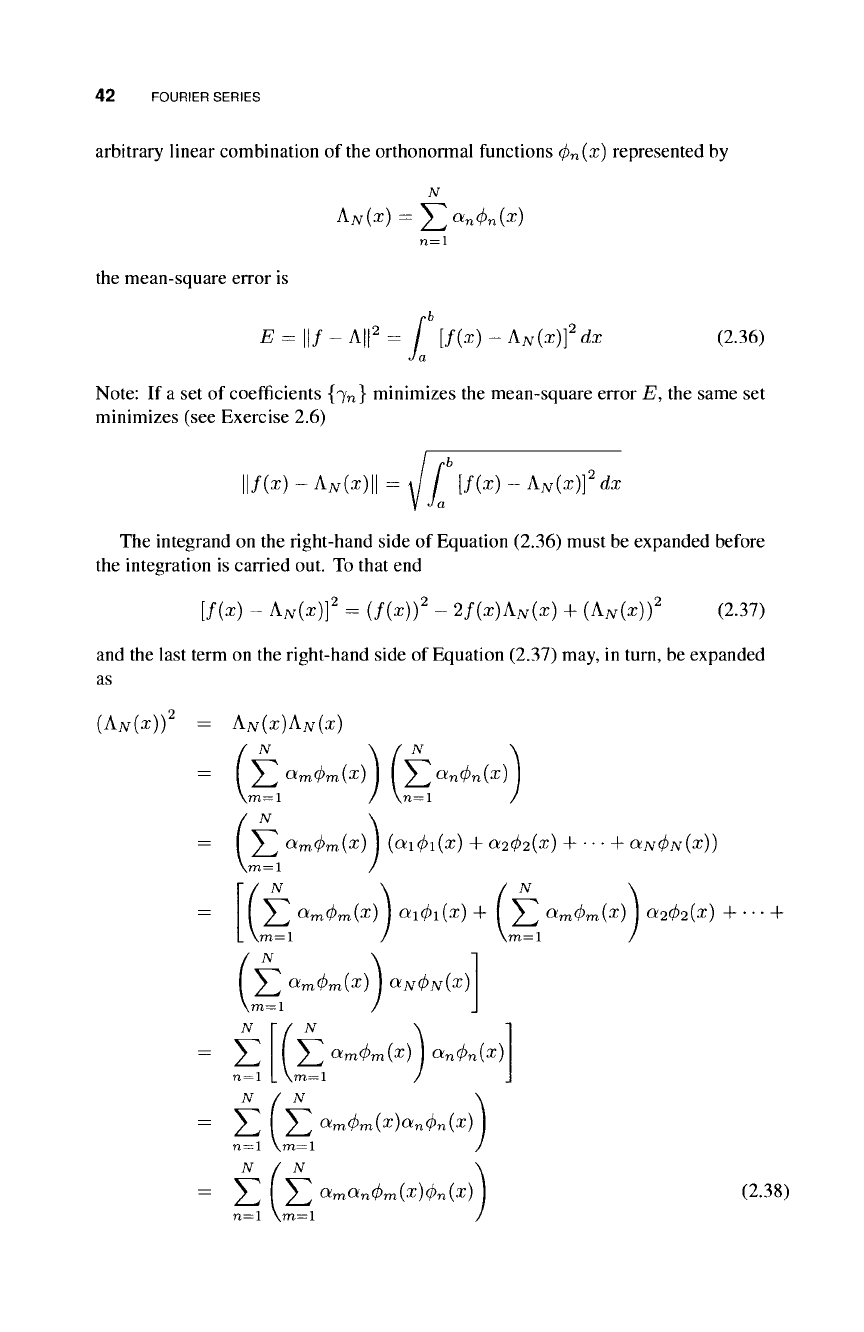
arbitrary linear combination of the orthonormal functions φ
η
(χ) represented by
N
Ajv(x)
= ^2α
η
φ
η
(χ)
n=l
the mean-square error is
E=\\f-
Λ||
2
= f [/(*) -
A
N
(x)}
2
dx
(2.36)
Ja
Note: If a set of coefficients {7
n
} minimizes the mean-square error E, the same set
minimizes (see Exercise 2.6)
||/(x)
-
AJV(X)||
= Jj* \f{x) -
AN(X)}
2
dx
The integrand on the right-hand side of Equation (2.36) must be expanded before
the integration is carried out. To that end
[/(*) -
A
N
(x)}
2
= (f(x)f - 2f(x)A
N
(x) + (A
N
(x)f (2.37)
and the last term on the right-hand side of Equation (2.37) may, in turn, be expanded
as
(ΛΛΓ(Χ))
2
= A
N
(x)A
N
(x)
=
I ]Γ)
α
™Φπι(χ) 1
I Σ
α
ηΦη(χ)
I
\ra=l
) \n=l /
= I 5Z
α
τηΦπι(χ) 1 (αιφι(χ) + «202^)
H
l· αΝφΝ(χ))
\m=l
/
5^
a
m
</>
m
(x) αι0ι(χ) + J^ (x) α
2
φ
2
{χ) + ··· +
m=:l
/ \ra=l /
AT
\ I
y^
«
m
^
m
(a;)
I
α
Ν
φ
Ν
(χ)
N
\
y^
a
m
(/)
m
(x)
I
α
η
0
η
(χ)
AT
Vm=l
Σ
n=l
\ra=l
N
/ N \
=
Σ I Σ
α
πιΦπι(χ)θίηΦη(χ)
j
n=l
\m=l /
N
/ N \
=
5Z ( Σ
α
™
α
η0™(ζ)<Μ#) I
(2.38)
BEST APPROXIMATION 43
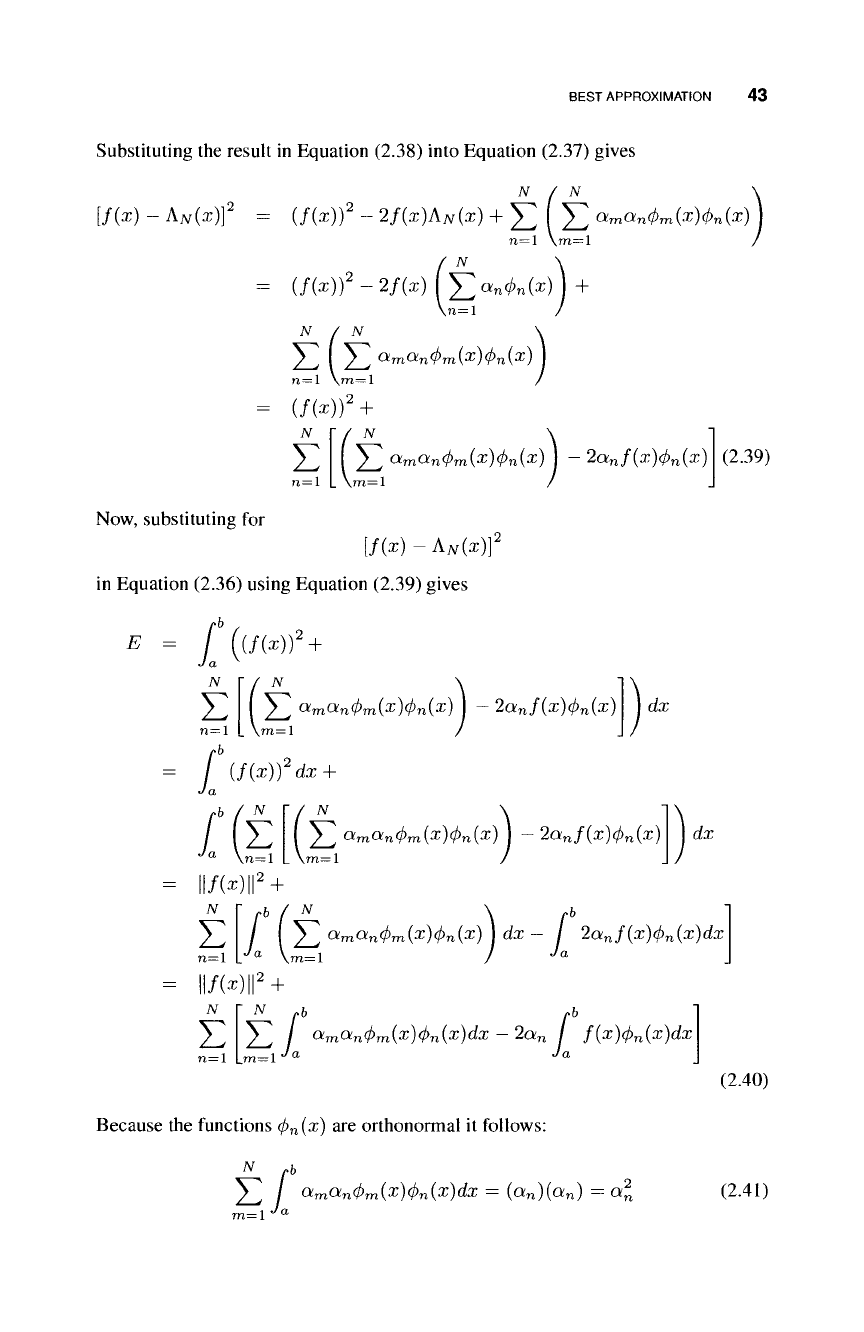
Substituting the result in Equation (2.38) into Equation (2.37) gives
N / N \
[f(x)-A
N
(x)}
2
= (¡(χ))
2
-2/(χ)Α
Ν
(χ) + ^2ΐγ^α
πι
α
η
φ
πι
(χ)φ
η
(χ)\
n=l \m=l /
= (ί(χ))
2
-2/(χ)\Υ^α
η
φ
η
(χή +
N / N
Σ ( Σ
α
πιΟίηΦπι(χ)Φη(χ)
n=l \ra=l >
(f(x)f +
N
Σ
71=1
N
Σ α
Ύη
α
η
φ
πι
(χ)φ
η
(χ) - 2α
η
/(χ)φ
η
(χ)
Vra=l
(2.39)
Now, substituting for
lf(x)-A
N
(x)}
2
in Equation (2.36) using Equation (2.39) gives
E
Ja
N
Σ
71=1
r
b
N
yZ α
τη
α
η
φ
πι
(χ)φ
η
(χ) I - 2α
η
/(χ)φ
η
(χ)
771=1
2
¿¿x
/
(/(*))
Ja
/
Σ
•
/o
\n=l
ll/(*)ll
2
+
<ix 4-
AT
J^ α
πι
α
η
φ
πι
{χ)φ
η
{χ) - 2α
η
/(χ)φ
η
(χ)
Vra=l
dx
N
Σ
71=1
n/o*
Σ
η=1
Λ6 / JV
/ Σ
α
^αη^τη(^)^η(^) \ dx - 2α
η
/(χ)φ
η
(χ)άα
iV .6
_ _ /»o /»o
^ / α
πι
α
η
φ
πι
(χ)φ
η
(χ)άχ - 2a
n
¡(χ)φ
η
{χ)άχ
m=l^
α
^
α
Because the functions </>
n
(x) are orthonormal it follows:
y^ / α
πι
α
η
φ
Ύη
(χ)φ
η
(χ)άχ = (a
n
)(a
n
m=l^
a
)=ocl
(2.40)
(2.41)
44 FOURIER SERIES
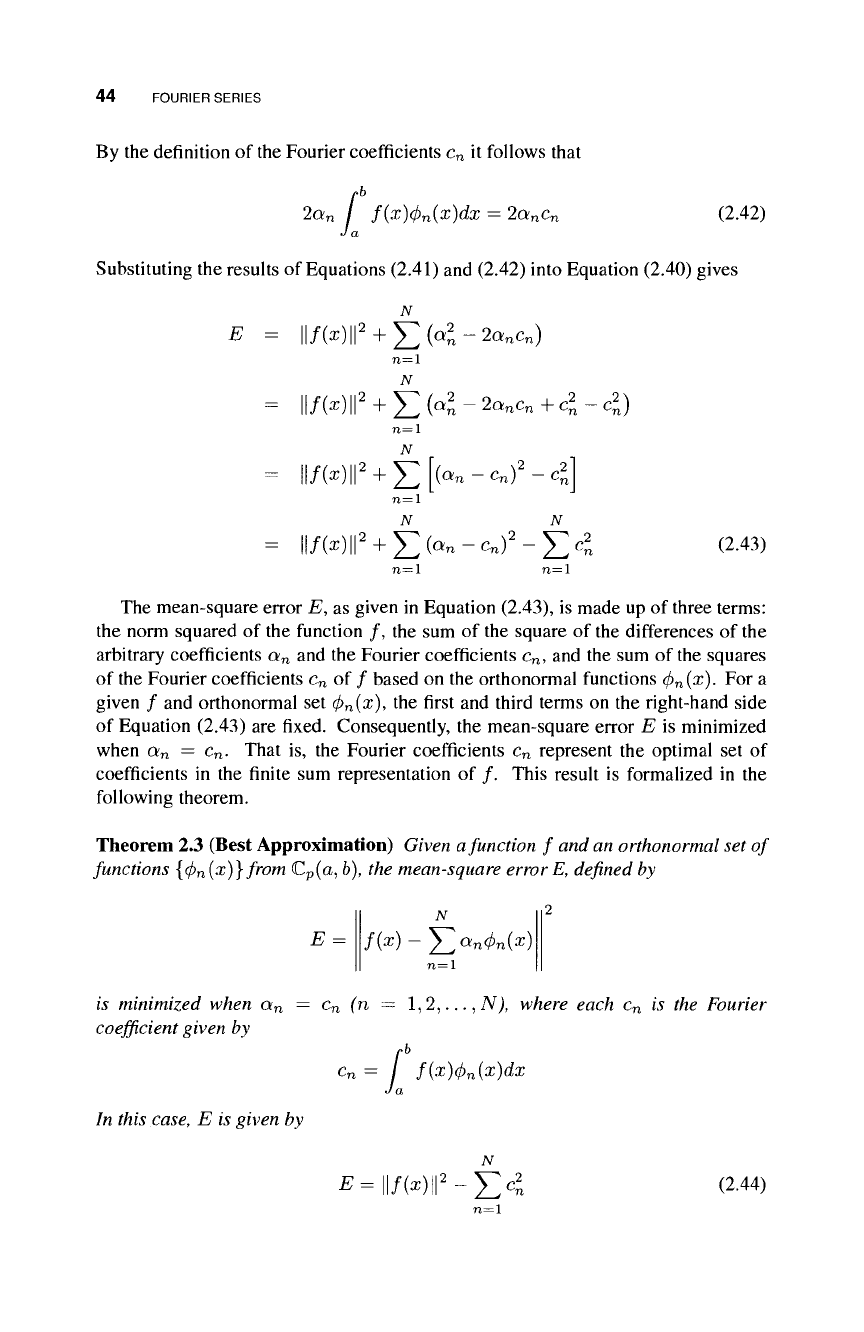
By the definition of the Fourier coefficients c
n
it follows that
rb
2a
n
/
ί{χ)φ
η
{.
Ja
x)dx
—
2a
n
c
n
(2.42)
Substituting the results of Equations (2.41) and (2.42) into Equation (2.40) gives
N
E =
\\f(x)\\
2
+ J2«-
2a
nCn)
n=l
N
=
\\f(x)\\
2
+
Y^(a
2
n
-2a
n
c
n
+ c
2
n
-c
2
n
)
n=l
N
= ¡i/(*)ii
2
+
E[(
a
«-
c
«)
2
-
c
n]
n=l
(2.43)
n=l n=l
The mean-square error E, as given in Equation (2.43), is made up of three terms:
the norm squared of the function /, the sum of the square of the differences of the
arbitrary coefficients a
n
and the Fourier coefficients c
n
, and the sum of the squares
of the Fourier coefficients c
n
of / based on the orthonormal functions φ
η
(χ)- For a
given / and orthonormal set φ
η
(χ), the first and third terms on the right-hand side
of Equation (2.43) are fixed. Consequently, the mean-square error E is minimized
when a
n
— c
n
. That is, the Fourier coefficients c
n
represent the optimal set of
coefficients in the finite sum representation of /. This result is formalized in the
following theorem.
Theorem 2.3 (Best Approximation) Given a function f and an orthonormal set of
functions {φ
η
(χ)} from C
p
(a,
b),
the mean-square error
E,
defined by
E
N
f(
x
) - ^θί
η
φ
η
{χ)
n=l
is minimized when a
n
= c
n
(n =
1,2,...
,iV), where each c
n
is the Fourier
coefficient given by
Cn = / /(χ)φ
η
(χ)άθί
Ja
In this case, E is given by
N
E=\\f(x)\\
2
~J2
C
n
(2.44)
BESSEL'S INEQUALITY 45
2.9 BESSEL'S INEQUALITY
A direct result of the material presented in Section
2.8 is
known
as
BessePs inequality.
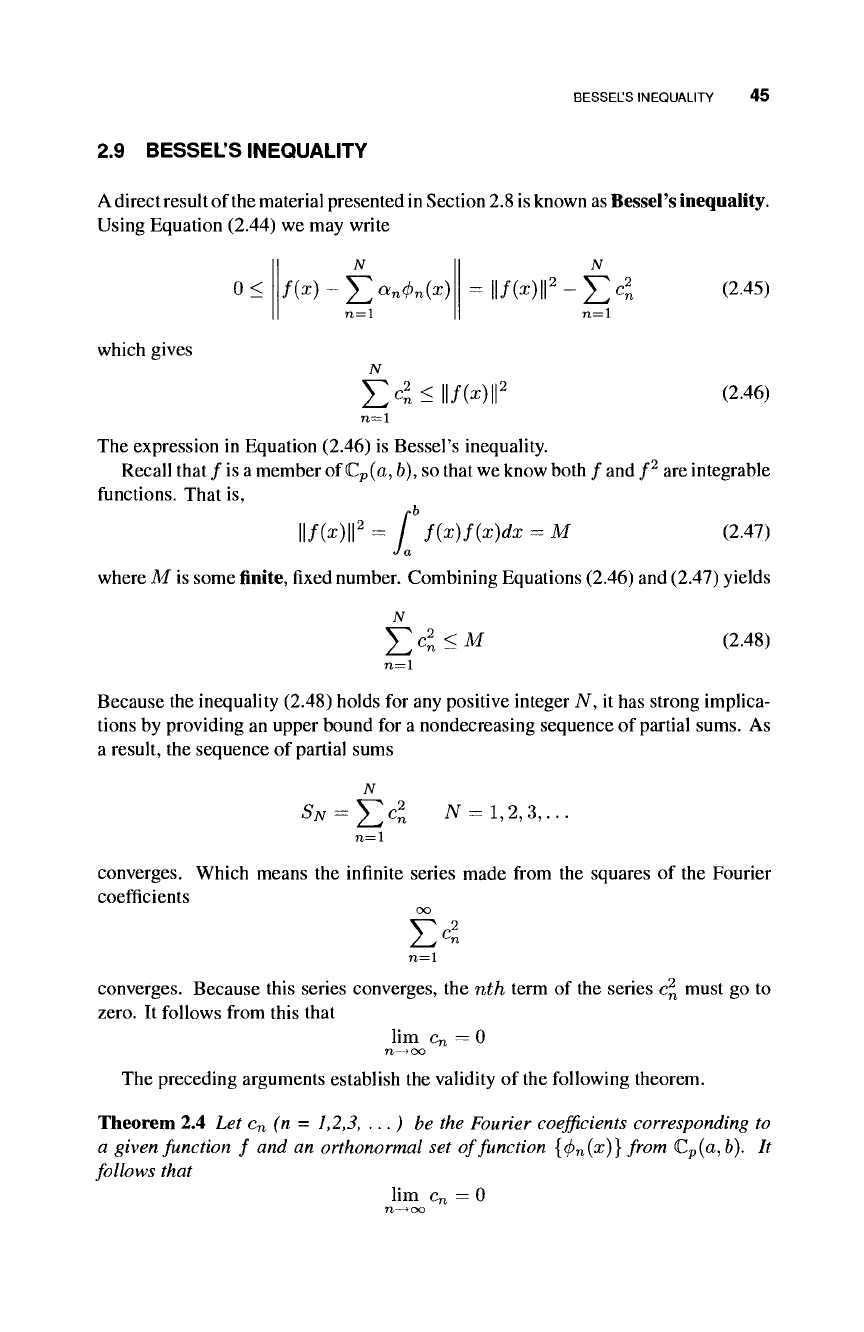
Using Equation (2.44) we may write
0<
TV
f(x) - Σα
η
φ
η
(χ)
which gives
n=l
N
N
ii/(*)ii
2
-E
c
»
<
2
·
45
)
n=l
E
C
n<ll/W
(2.46)
n=l
The expression in Equation (2.46) is Bessel's inequality.
Recall that / is a member of C
p
(a, 6), so that we know both / and f
2
are integrable
functions. That is,
\\f(x)\\
2
= / f(x)f(x)dx = M (2.47)
Ja
where M is some finite, fixed number. Combining Equations (2.46) and (2.47) yields
N
Σ^<Μ
(2.48)
n=l
Because the inequality (2.48) holds for any positive integer N, it has strong implica-
tions by providing an upper bound for a nondecreasing sequence of partial sums. As
a result, the sequence of partial sums
N
n=l
N =
1,2,3,...
converges. Which means the infinite series made from the squares of the Fourier
coefficients
E
c
«
converges. Because this series converges, the nth term of the series
(?
n
must go to
zero.
It follows from this that
lim c
n
—
0
The preceding arguments establish the validity of the following theorem.
Theorem 2.4 Let c
n
(n = 1,2,3, ...) be the Fourier coefficients corresponding to
a given function f and an orthonormal set of function {φ
η
(χ)} from C
p
(o,
b).
It
follows that
lim c
n
= 0
46 FOURIER SERIES
This general result may be applied to a specific case, such as the set of orthogonal
functions
^
) =
n
sin
(T)
on the interval (0, c). As shown in Section
2.5,
if / is
a
function belonging to C
p
(0, c)
then the Fourier sine series corresponding to / is
n=l
with
/(*)~X>ny-sin(^)
K =
j f{x)y¡\^^-)dx
/o
Applying the result of Theorem 2.4 gives
lim b
n
= 0
n—»oo
It is left as an exercise (Exercise 2.29) to show the Fourier cosine coefficients a
n
(n = 0,1,2,...) for the orthonormal functions
φ
0
(χ) = "7= Φη{ζ) = \ -
COS
( )
on the interval
[0,
c]
have limit zero as n goes to infinity.
2.10 PIECEWISE SMOOTH FUNCTIONS
The next objective of this chapter is to establish sufficient criteria on / from C
p
(a, b)
for convergence of its Fourier series correspondence to /. To that end, a subspace of
C
p
(a, b), the set of piecewise smooth functions, will be introduced.
Suppose / is an element of C
p
(a, 6), with discontinuities given by the set
{#i,
#2, · · ·, Xn}- Let Xk be an arbitrary number in (a,
b)
such that the right-hand
limit of / at Xk, denoted by /(xfc+), exists. The right-hand derivative of / at
Xk
is
defined by
f
R
(
Xk
)
= lirn
/W
-
/(
*
fc+)
(2.49)
provided the limit exists. The left-hand derivative of / at Xk is defined in a similar
way. That is, if f(xk~) exists, then
f
L
{xk)
= lim
f(x)
-_
f
(
Xk
-î
(2.50)
x—+x,
X %k
It is left as an exercise (Exercise 2.31) to show that if / is differentiate at Xk in its
domain, then both one-sided derivatives of / exist and are equal at
Xk-
PIECEWISE SMOOTH FUNCTIONS 47
EXAMPLE 2.5
Determine if the one-sided derivatives of / defined by
2x - 1 x < 1
f(\—( 2x
—
1 x < 1
exist at x = 1. Find the value of the one-sided derivative in the event it does
exist.
Right-hand case: Note that /(1+) = 0, so that it is possible for the right-
hand derivative to exist at x
=
1. Using Equation (2.49)
Ä
(., =
Ä
Ä^±I
lim
X-+1+
X — 1
1
= lim
i+ y/x-1
= oo
Consequently, the right-hand derivative of / does not exist at x = 1.
Left-hand case: Here, /(l—) = 1, so it is possible for the left-hand deriva-
tive of / at x
= 1
to exist. Using Equation (2.50)
/(*)-/(!-)
2x-
X
2x-
x -
2(x
x-1
-1-1
-1
-2
■1
-i)
/L(1)
= um
x—>1~
= lim
x-^l-
= lim
x—>1~
= lim
x-^l- X — 1
= 2
so the left-hand derivative of / at x
= 1
is 2.
The Example 2.5 implies that the function /' may fail to be piecewise continuous
even when the function / is piecewise continous.
A piecewise continuous function on the interval (a,
b)
is said to be piecewise
smooth on an interval (a,
b)
if the derivative /' of / is piecewise continuous on
(a, b). This subset of C
p
(a, b)is denoted by C^(a, b), and is a subspace of C
p
(a, 6)
because it is, after all, a collection of piecewise continuous functions,
The next theorem relates the one-sided limits of the derivative of /, should they
exist, and the one-sided derivatives of/, should they exist. That is to say, under what
circumstances are these quantities equal, provided both quantities exist.
48 FOURIER SERIES
Theorem
2.5 If f
is piecewise smooth of the interval
(a,
6),
then
at
every
x
k
in the
closed interval
[a,
b]
the
one-sided derivatives
off
(from
the
right only
at a and
left
only
at
b)
exist
and
are
equal
to the
corresponding one-side limits of
f.
Proof:
Because
/ is
piecewise smooth
on (a,
b)
we
know that
/' is
piecewise
continuous
on (a,
b).
Let
(x¿,
Xi+i)
be
an arbitrary representative of the finite number
of subintervals
of (a,
b)
on
which
/' is
continuous
and
both
f'(xi+)
and
f'(xi+i
— )
exist. Arguments will
be
presented
to
show that
the
theorem's conclusions hold
for
the interval (x¿, Xi+i). Because these arguments are valid
for
any of the finite number
of subintervals
of (a,
b),
the
result
may be
extended
to the
entire interval
(a, b).
Let
Xk
be an
interior point
of
(x¿,
x¿+i). Therefore
f'(xk)
exists, and by the result
of Exercise
2.31,
it
follows that
f'
L
{xk)
= f(xk) =
f
R
{xk)
Because
/' is
continuous
at x
k
we
have
\im
+
f(x)
=
f'(x
k
)
=
f
R
(x
k
)
x—+x
k
and
limJ'(x)
=
f'(x
k
)
=
f'
L
(x
k
)
x—*x
k
Now, consider
the
right-handed derivative
of / at x¿. The
value
of f(xi) is
involved
in
determining
the
limit
of the
difference quotient. Because
/ is, itself,
piecewise continuous
on (a,
b),
we may
represent
f(xi) as
/(x¿+). Doing
so
means
/
is
continuous
on [x^x] and
differentiable
on
(x¿,
x),
where
x is an
arbitrary point
such that Xi
< x <
x¿+i,
as
shown
in
Figure 2.12.
Now,
f
R
{Xi)
= km ——
(2.51)
χ-+χΤ
X Xi
-\—i
1 h-
Xi
C X
Xi+i
Figure 2.12 The relative positions
of
andxi+i.
Using
the
continuity
of / on
[xi,-x]
and the
differentiability
of / on
(x¿,#),
the
Mean Value theorem
for
derivatives
may be
applied
to
assert
the
existence
of
point
c
G
(xi,x) suchthat
f(x)
- f(Xj)
=
,
Substituting
for the
difference quotient using Equation (2.51) gives
f'
R
(xi)=
lim /'(c)
X—*X~¡
PIECEWISE SMOOTH FUNCTIONS 49
As right-hand endpoint x approaches xi from the right, it follows that the number c
will approach xi as well because Xi < c < x. Since the right-hand limit of /' exists
at Xi it follows
f'
R
(xi)=
lim /'(c) =/'(*«+)
Similar arguments establish the result for the right endpoint. That is,
f'
L
(x
i+1
)
= Jim f'(c) =
f'(x
i+1
-)
D
Theorem 2.5 states that the piecewise continuity of /' is sufficient to guarantee
the existence of the one-sided derivatives of /. The converse in not true, as shown in
the next example.
■ EXAMPLE 2.6
Suppose the function / is defined as
-A
»)=if-i :t°
0
The right-hand derivative of / at x = 0 is given by
, , , x
2
cos è
—
0
JRV*) —
=
=
0 < x cos
1
X
x^0+
X
—
0
9 1
x
z
cos^
lim
x^0+
X
lim x cos
—
x-*0+ X
< x for x Φ 0
Because
it follows
0 < lim x cos
—
< lim x
—
0
X-+0+
X x^0+
so that by the squeeze theorem we may conclude
lim x cos
—
= 0
x->0+
X
Similar analysis for the left-hand derivative of / at x
=
0 applies giving
f'
R
(0)=0
and /¿(0)=0
Next, the one-sided limits of /
;
at x
=
0 are considered. The formula for /'
is
f'(x)
—
2x
cos
—h sin
—
x x
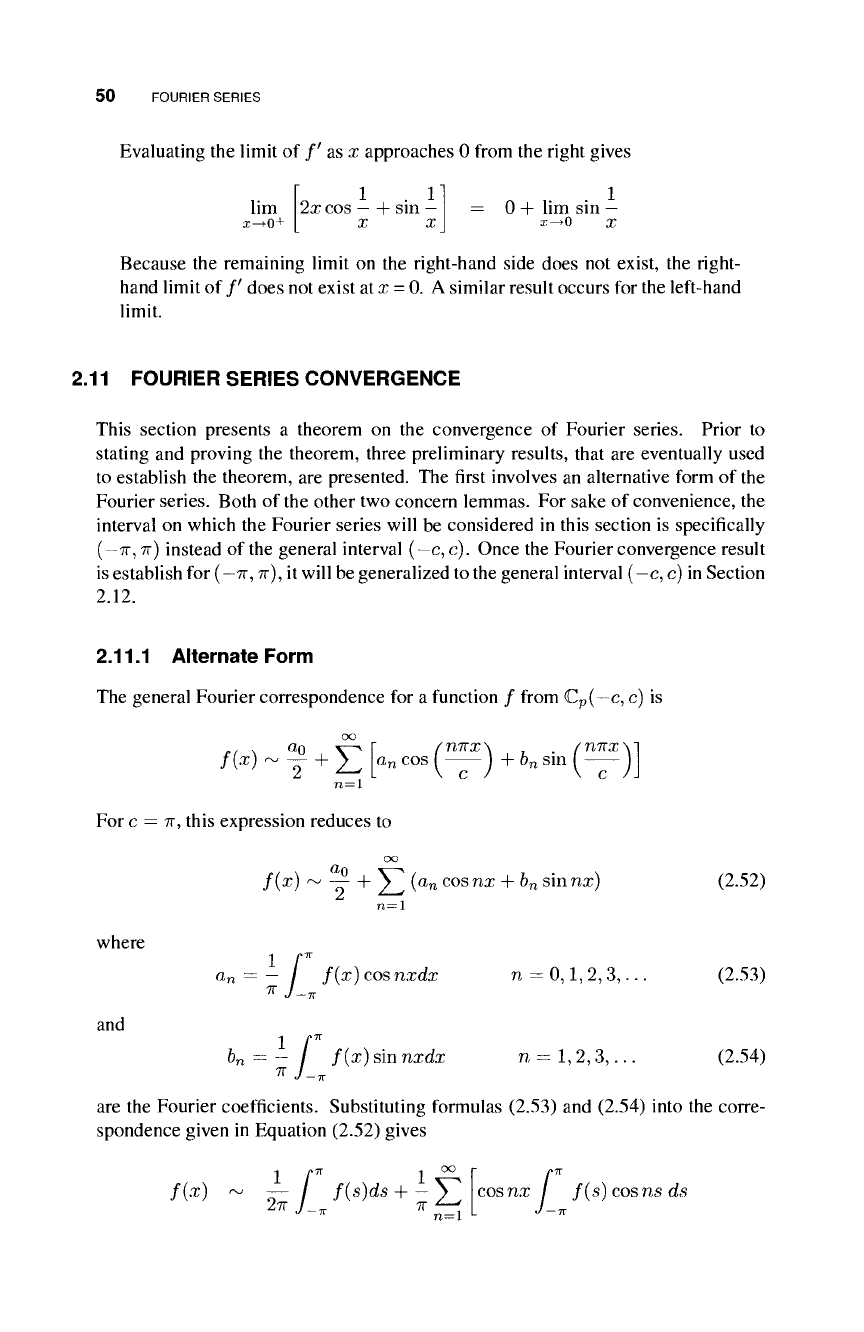
50 FOURIER SERIES
Evaluating the limit of /' as x approaches 0 from the right gives
lim
•-♦0+
1 1"
2x
cos
—h sin
—
X X
1
= 0 + lim sin
—
x-+0 x
Because the remaining limit on the right-hand side does not exist, the right-
hand limit of /' does not exist at x = 0. A similar result occurs for the left-hand
limit.
2.11 FOURIER SERIES CONVERGENCE
This section presents a theorem on the convergence of Fourier series. Prior to
stating and proving the theorem, three preliminary results, that are eventually used
to establish the theorem, are presented. The first involves an alternative form of the
Fourier series. Both of the other two concern lemmas. For sake of convenience, the
interval on which the Fourier series will be considered in this section is specifically
(—7Γ,
7Γ)
instead of the general interval (—c, c). Once the Fourier convergence result
is establish for (—π, π), it will be generalized to the general interval (—c, c) in Section
2.12.
2.11.1 Alternate Form
The general Fourier correspondence for a function / from C
p
(—c, c) is
oo
f(x) ~ — + 2^ [
a
n
COS
[ J +
b
n Sin (^ J j
n—1
For c =
7Γ,
this expression reduces to
oo
f(x)
rsj
— 4- V^ (a
n
cos
nx + b
n
sin nx)
where
n=l
and
1 Λ
ln = - /(·
x) cos nxc/x
x) sin nxcfa
n = 0,1,2,3,..
n =
l,2,3,...
(2.52)
(2.53)
(2.54)
are the Fourier coefficients. Substituting formulas (2.53) and (2.54) into the corre-
spondence given in Equation (2.52) gives
1 Γ
π
i _°°_ Γ Γ
π
f(x) ~ — / f(s)ds-\— 7 cosnx / f(s)cosnsds
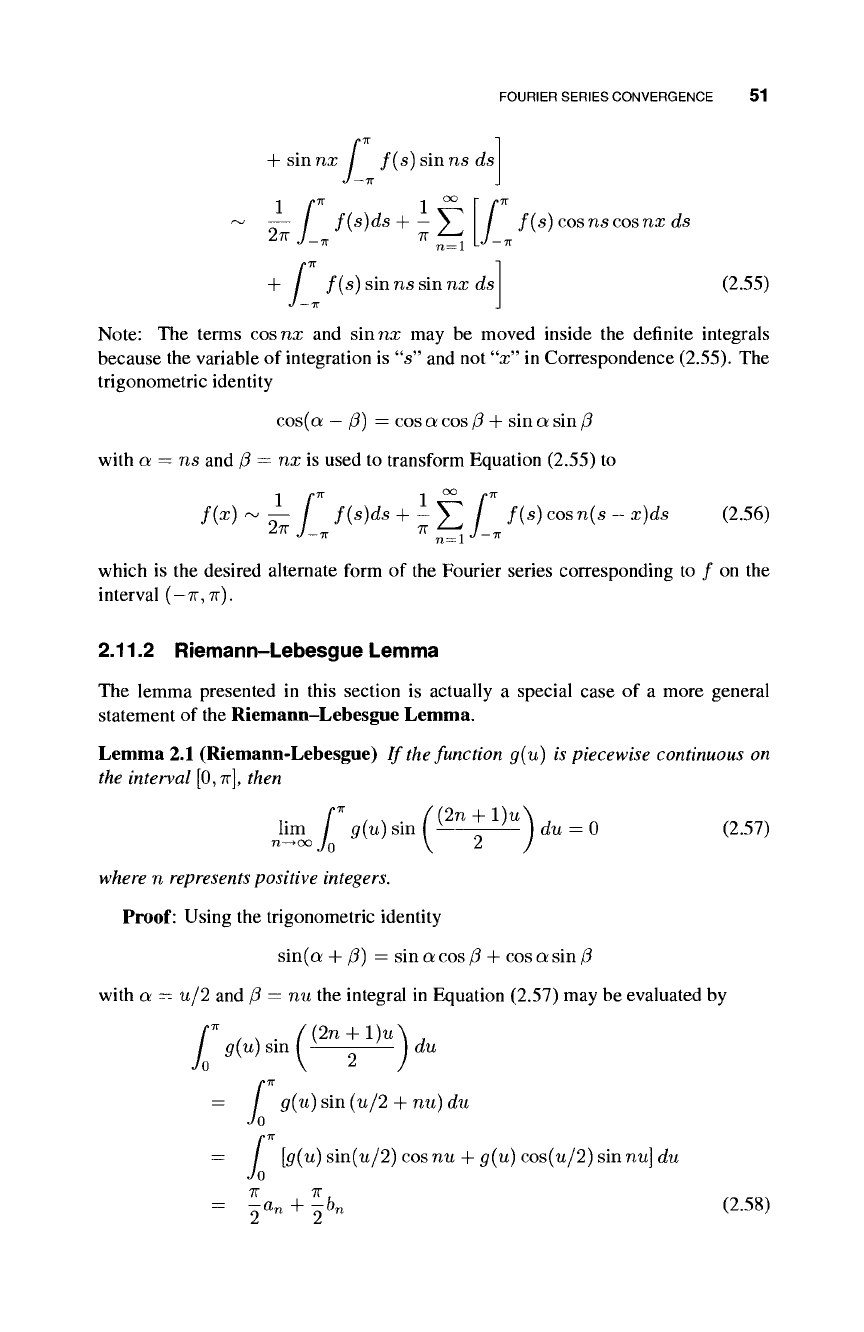
FOURIER SERIES CONVERGENCE 51
+ sinnx / f(s)sinnsds\
1 Γ^ 1 _°°_ Γ Γ^
~ —- / f(s)ds-\— /| / f (s) cosnscosnx ds
+ / /(s)sinnssinnx ds (2.55)
Note: The terms cosnx and sinnx may be moved inside the definite integrals
because the variable of integration is ' V and not "x" in Correspondence (2.55). The
trigonometric identity
cos(a
—
β) = cos a cos β 4- sin a sin β
with a = ns and β = nx is used to transform Equation (2.55) to
2π7_
π
^^
which is the desired alternate form of the Fourier series corresponding to / on the
interval (—π,π).
2.11.2 Riemann-Lebesgue Lemma
The lemma presented in this section is actually a special case of a more general
statement of the Riemann-Lebesgue Lemma.
Lemma 2.1 (Riemann-Lebesgue) If the function g(u) is piecewise continuous on
the interval
[0,
π],
then
lim Γ
g(u)sm(
{2n
+ 1)u
)du = 0 (2.57)
n-+ooj
0
\ 2 )
where n
represents
positive integers.
Proof:
Using the trigonometric identity
sin(a + ß) = sin a cos ß 4- cos a sin ß
with a
—
u/2 and ß = nu the integral in Equation (2.57) may be evaluated by
r ({2n + l)u\
J g(u) sin
I I
du
= / g(u) sin (u/2 + nu) du
Jo
= / [#(w) sin(u/2) cos nu + #(u) cos(u/2) sin nu] du
= |ûn + |δη (2.58)