
Bernatz R. Fourier Series and Numerical Methods for Partial Differential Equations
Подождите немного. Документ загружается.

22 FOURIER SERIES
bj is greater than or equal to the order of all vectors b¿ in the basis. Let m be that
maximum order. Now, consider the polynomial
p(rr) = a
0
+ a\x
Λ
h a
m
x
m
+ a
m+i
x
m+1
such that
a
m+
i
φ 0. With p defined in this way, it follows that p is not in the
set spanned by basis B, because there is no polynomial in B with order m H- 1.
Consequently, there is no finite basis B for P(a, 6), so dim P(a,
b)
is infinite. Because
P(a,
b)
is a subspace of F(a, 6), it follows that the dimension of F(a,
b)
is infinite as
well.
2.1.3 Inner Products
As a means of defining an inner or scalar product, on a vector space V, we begin by
defining a linear form on V. The function L : V
i—►
R is said to be a linear form on
Vif
L(au + /?v) = aL(u) + /?L(v)
for all u and v in V and a and β in R. The function a : V x V
t—►
R is said to be a
bilinear form on V if
α(·,
·) is a linear form in each of its components. That is,
a(w, au + /?v) = aa(w, u) + /3a(w, v)
and
a(au 4- /3v, w) = aa(u, w) + /3a(v, w)
A bilinear form is symmetric on the linear space V if
a(u, v) = a(v, u)
for all u and v belonging to V.
An inner product (u, v) on the vector space V is a bilinear form such that
(u, u) = a(u, u) > 0
for all nonzero elements u of V.
An inner product space is a vector space V on which an inner product is defined.
The usual inner product for the vector space R
3
is defined as
(u,v) = ((u
1
,u
2
,u
3
),(vuv
2
,vs))
=
U\Vi+
U2V2 + l¿3^3
Once an inner product is defined on a vector space V, the notions of length,
distance, and orthogonality may be defined. The length, or norm, of a vector u is
given as
||u|| = v
/
(u7uT
The distance between two vectors u and v is defined as
dist(u, v) = ||u
—
v||
THE INTEGRAL AS AN INNER PRODUCT 23
Two vectors u and v are said to be orthogonal if and only if
<u,v>=0
A set S = {ui, U2,..., u
n
} is said to be orthogonal if (u¿, Uj) =0 whenever
ίφό-
A set of nonzero, orthogonal vectors is linearly independent. To show this is true,
suppose
ciui +
c
2
u
2
H
h c
n
u
n
= 0 (2.3)
for a set of coefficients
c¿.
Forming the inner product of both sides of Equation (2.3)
with u¿, where i is an arbitrary index between
1
and n, gives
(u¿,
ciui +
c
2
u
2
+ · · · + c
n
u
n
) = (u¿, 0)
=> (u¿,CiUi) + (U¿,C
2
U
2
) + ..-(u
i
,C
i
U¿> + --(u
i
,C
n
U
n
) =0
=> ci(u¿,ui> + c
2
(u¿,u
2
)
H
Ci(u¿,u¿)
H
c
n
(u¿,u
n
) = 0
=Φ ci0 + c
2
0H Q(U¿,U¿)
H
c
n
0 = 0 (ui>u¿) = Oif
¿
^ j
=Φ Q(UÍ,U¿) = 0
=Φ c¿ = 0 u¿ ^ 0
Because i is an arbitrary index, it follows that all a in Equation (2.3) are zero.
Consequently, set S is linearly independent. This last result means that an orthogonal
set of nonzero vectors form an orthogonal basis for their span. Additionally, if
||u¿||
= 1 for 1 < i < n, the set is an orthonormal basis for the set of vectors
spanned by the set.
2.2 THE INTEGRAL AS AN INNER PRODUCT
The definite integral can be used to define an inner product for real-valued function
on an interval. Recall that any function f that is continuous on an interval [a,
b]
has a
unique definite integral
/
Ja
f(x)dx
Now, suppose f is continuous on (a, 6), and the one-sided limits from the interior of
(a,
b)
are finite at both a and
b.
That is, suppose
lim f(x) = L\ and lim î(x) = L
2
x—+a+
x-+b~
where L\ and L
2
are finite numbers. The function f* is defined as
( L\ x
—
a
f*(x)
f(x) a < x < b
L
2
x
—
b
24 FOURIER SERIES
is continuous on [a,
b]
and
*(x)dx
ί Π
Ja
exists.
Further, we may conclude
pb pb
j f(x)dx = /
(*(x)dx
Ja Ja
The continuity of f on (a,
b)
may be relaxed while preserving the integrability of
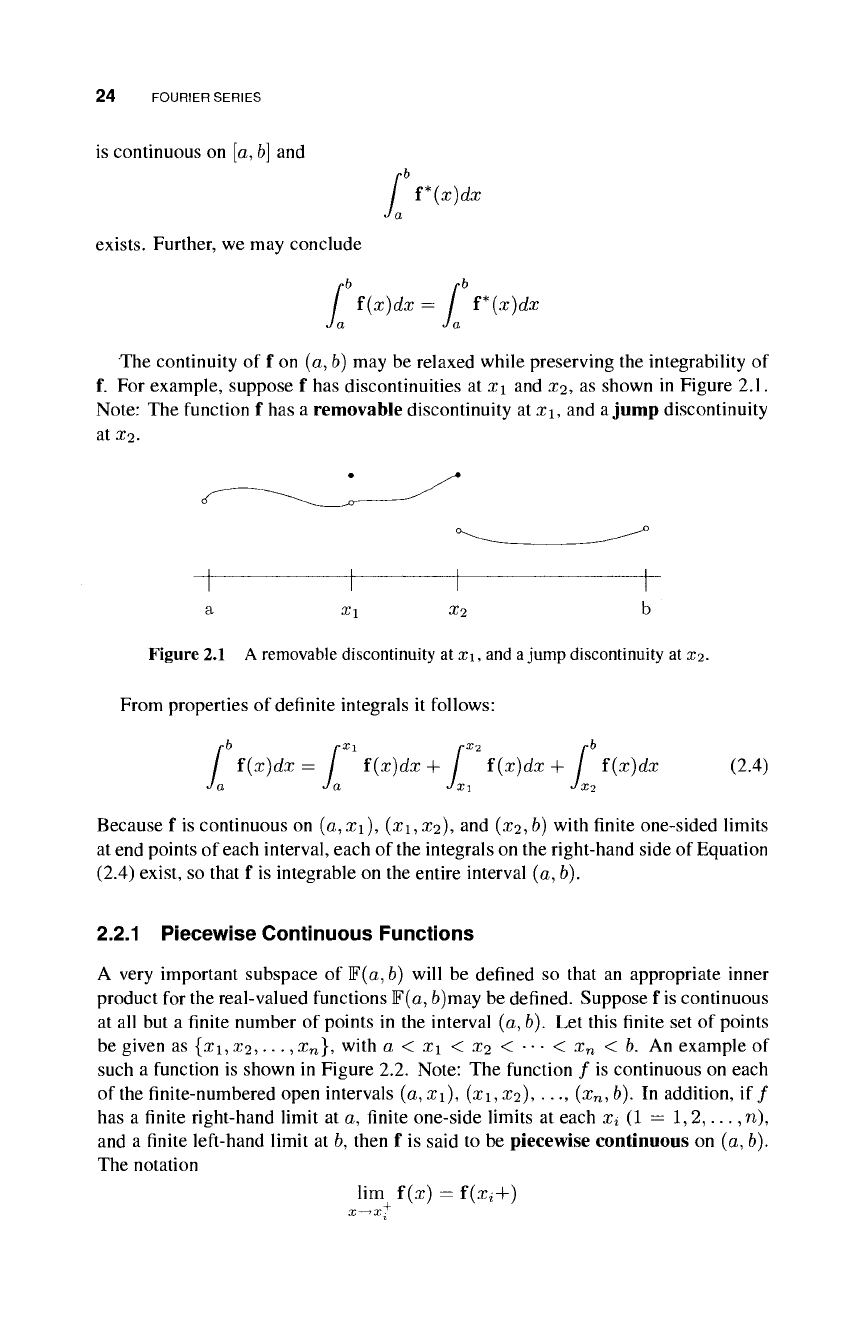
f. For example, suppose f has discontinuities at x\ and X2, as shown in Figure 2.1.
Note: The function f has a removable discontinuity at χχ, and
a
jump discontinuity
atx
2
.
a xi X2 b
Figure
2.1
A
removable discontinuity at x\, and
a jump
discontinuity at
X2.
From properties of definite integrals it follows:
rb
l î(x)dx = / f(x)dx + / f(x)dx + / f(x)dx (2.4)
Ja Ja J
x\
J X2
Because f is continuous on (a, #i), (xi,
X2)»
an
d (x2
5
b)
with finite one-sided limits
at end points of each interval, each of
the
integrals on the right-hand side of Equation
(2.4) exist, so that f is integrable on the entire interval (a, b).
2.2.1 Piecewise Continuous Functions
A very important subspace of F(a,
b)
will be defined so that an appropriate inner
product for the real-valued functions F(a, 6)may be defined. Suppose fis continuous
at all but a finite number of points in the interval (a, b). Let this finite set of points
be given as {xi,
X2,
· · ·, x
n
}, with a < x\ < X2 < · · · < x
n
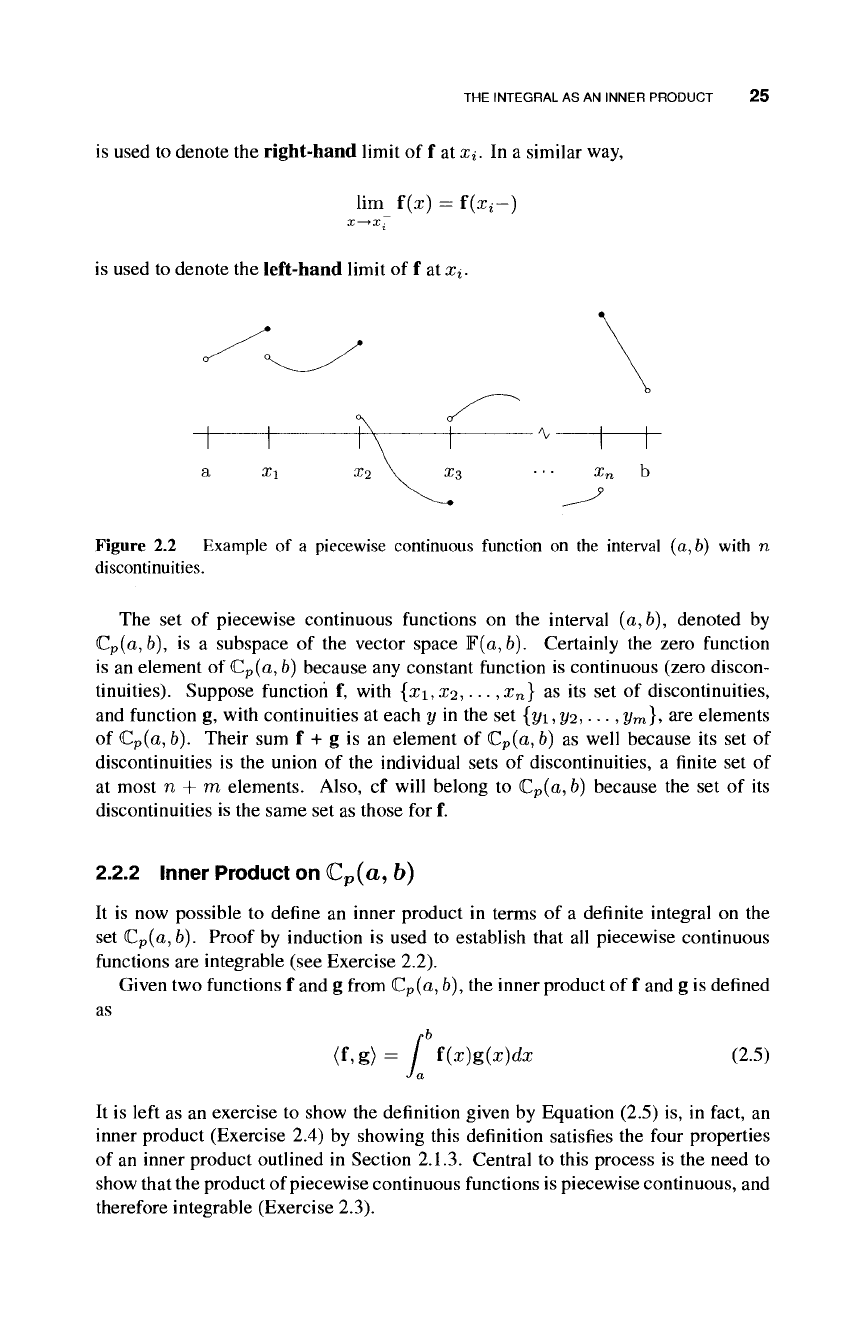
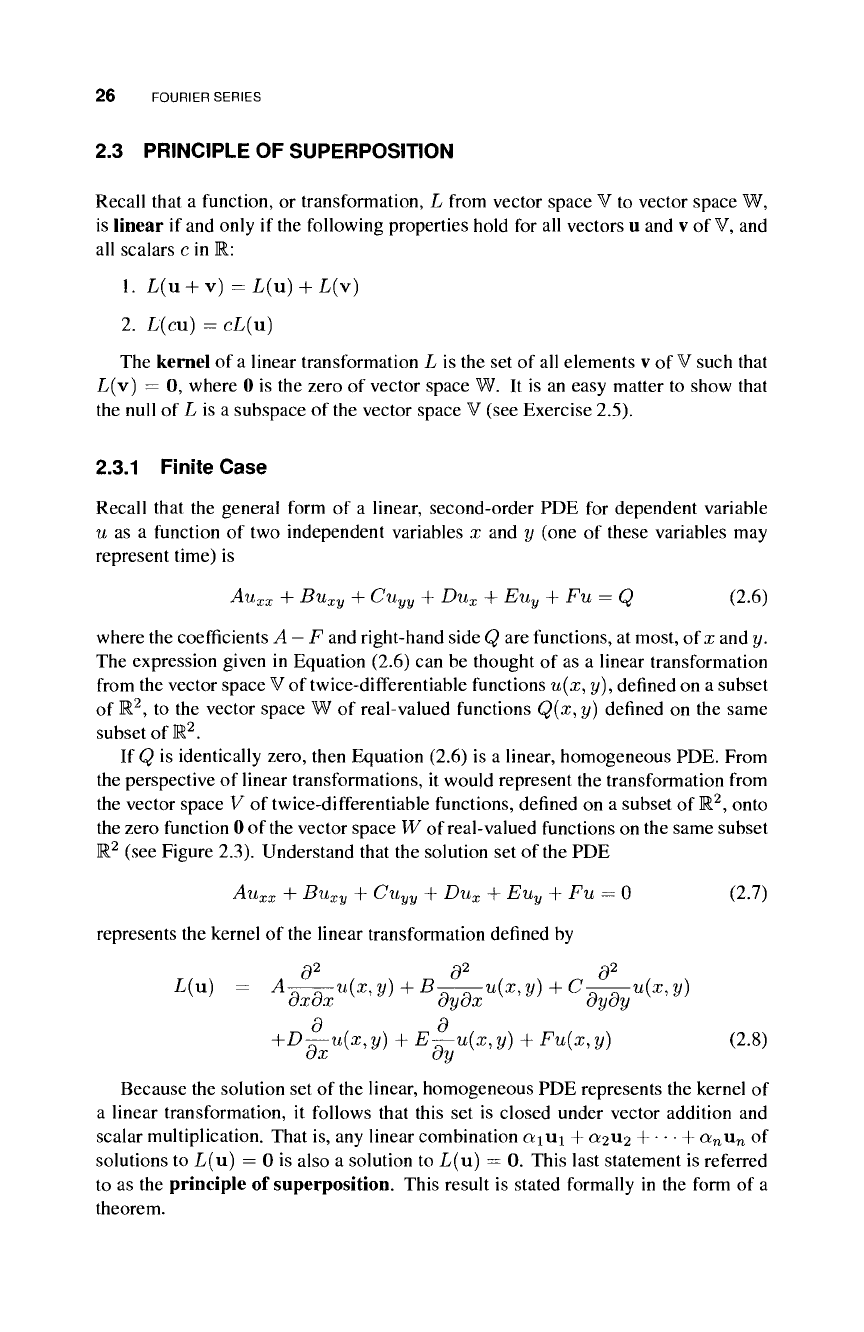
< b. An example of
such a function is shown in Figure 2.2. Note: The function / is continuous on each
of the finite-numbered open intervals (a, xi), (xi, X2),..., (x
n
, b). In addition, if /
has a finite right-hand limit at a, finite one-side limits at each x¿ (1 =
1,2,...,
n),
and a finite left-hand limit at 6, then f is said to be piecewise continuous on (a, b).
The notation
lim f (x) = f(xi+)
THE INTEGRAL AS AN INNER PRODUCT 25
is used to denote the right-hand limit of f at
x¿.
In a similar way,
lim f(x) = f(xi—)
x^xj
is used to denote the left-hand limit of f at x
¿
.
Figure 2.2 Example of a piecewise continuous function on the interval (a,b) with n
discontinuities.
The set of piecewise continuous functions on the interval (a, b), denoted by
C
p
(a, 6), is a subspace of the vector space F(a,6). Certainly the zero function
is an element of C
p
(a,
b)
because any constant function is continuous (zero discon-
tinuities). Suppose function f, with {x±,X2, · · · ,%n} as its set of discontinuities,
and function g, with continuities at each y in the set {t/i, y<i,..., y
m
}, are elements
ofCp(a, b). Their sum f + g is an element of C
p
(o,
b)
as well because its set of
discontinuities is the union of the individual sets of discontinuities, a finite set of
at most n + m elements. Also, cf will belong to C
p
(a,
b)
because the set of its
discontinuities is the same set as those for f.
2.2.2 Inner Product on C
p
(a, b)
It is now possible to define an inner product in terms of a definite integral on the
set C
p
(a, b). Proof by induction is used to establish that all piecewise continuous
functions are integrable (see Exercise 2.2).
Given two functions f and g from C
p
(a, b), the inner product of f and g is defined
as
(f,g>= / Î(x)g(x)dx (2.5)
Ja
It is left as an exercise to show the definition given by Equation (2.5) is, in fact, an
inner product (Exercise 2.4) by showing this definition satisfies the four properties
of an inner product outlined in Section
2.1.3.
Central to this process is the need to
show that the product of piecewise continuous functions is piecewise continuous, and
therefore integrable (Exercise 2.3).
26 FOURIER SERIES
2.3 PRINCIPLE OF SUPERPOSITION
Recall that a function, or transformation, L from vector space V to vector space W,
is linear if and only if the following properties hold for all vectors u and v of
V,
and
all scalars c in R:
1.
L(u + v) = L(u) + L(v)
2.
L'(cu) = cL(u)
The kernel of a linear transformation L is the set of all elements v of V such that
L(v) = 0, where 0 is the zero of vector space W. It is an easy matter to show that
the null of L is a subspace of the vector space V (see Exercise 2.5).
2.3.1 Finite Case
Recall that the general form of a linear, second-order PDE for dependent variable
u as a function of two independent variables x and y (one of these variables may
represent time) is
Au
xx
+ Bu
xy
4- Cuyy + Du
x
+ Euy + Fu = Q (2.6)
where the coefficients A —F and right-hand side Q are functions, at most, of x and y.
The expression given in Equation (2.6) can be thought of as a linear transformation
from the vector space V of twice-differentiable functions u(x, y), defined on a subset
of R
2
, to the vector space W of real-valued functions Q(x,y) defined on the same
subset of R
2
.
If Q is identically zero, then Equation (2.6) is a linear, homogeneous PDE. From
the perspective of linear transformations, it would represent the transformation from
the vector space V of twice-differentiable functions, defined on a subset of R
2
, onto
the zero function 0 of
the
vector space W of real-valued functions on the same subset
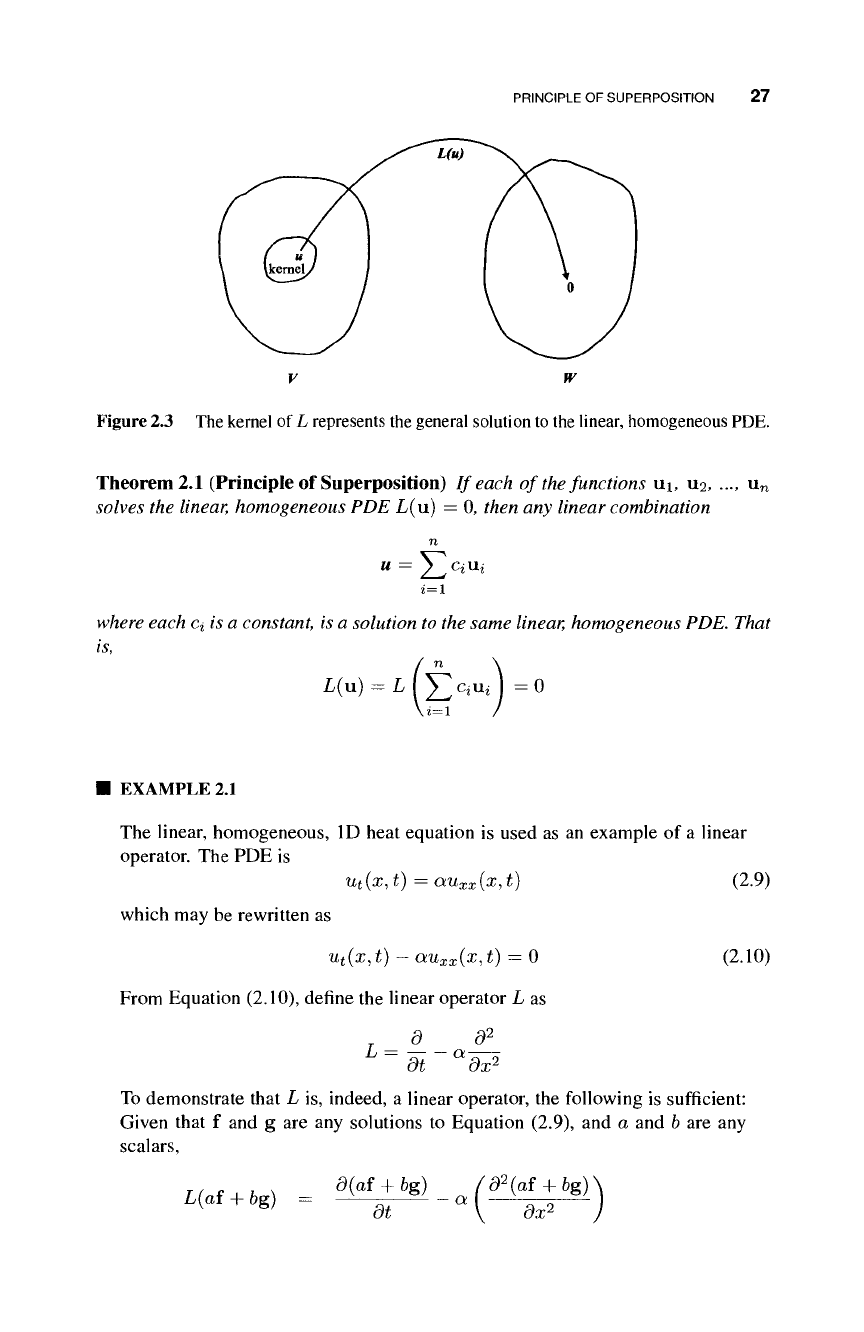
R
2
(see Figure 2.3). Understand that the solution set of the PDE
Au
xx
+ Bu
xy
+ Cuyy + Du
x
+ Euy + Fu
—
0 (2.7)
represents the kernel of the linear transformation defined by
L(U)
=
A
^
U{X
>
y)+B
Jydi
U{X
>
y)
+
C
4ñ
U{X
'
y)
d d
+D—u(x, y) + E—u(x, y) + Fu{x, y) (2.8)
Because the solution set of the linear, homogeneous PDE represents the kernel of
a linear transformation, it follows that this set is closed under vector addition and
scalar multiplication. That is, any linear combination a\\ii
4-
a
2
u
2
H
h
a
n
u
n
of
solutions to L(u) = 0 is also a solution to L(u) = 0. This last statement is referred
to as the principle of superposition. This result is stated formally in the form of a
theorem.
PRINCIPLE OF SUPERPOSITION 27
V W
Figure 2.3 The kernel of L represents the general solution to the linear, homogeneous PDE.
Theorem 2.1 (Principle of Superposition) If each of
the
functions ui, u
2
, ..., u
n
solves the
linear,
homogeneous PDE L(u) = 0, then any linear combination
n
i=l
where each
Ci
is a constant, is a solution to the same
linear,
homogeneous PDE. That
is,
L
(
u
)
=
L
^2°i
u
i
0
\i=l
EXAMPLE 2.1
The linear, homogeneous, ID heat equation is used as an example of a linear
operator. The PDE is
u
t
(x,t)
= au
xx
(x,
i) (2.9)
which may be rewritten as
u
t
(x,t)
-au
xx
(x,t) = 0 (2.10)
From Equation (2.10), define the linear operator L as
r
d d
2
L=
dt-
a
dx-i
To demonstrate that L is, indeed, a linear operator, the following is sufficient:
Given that f and g are any solutions to Equation (2.9), and a and b are any
scalars,
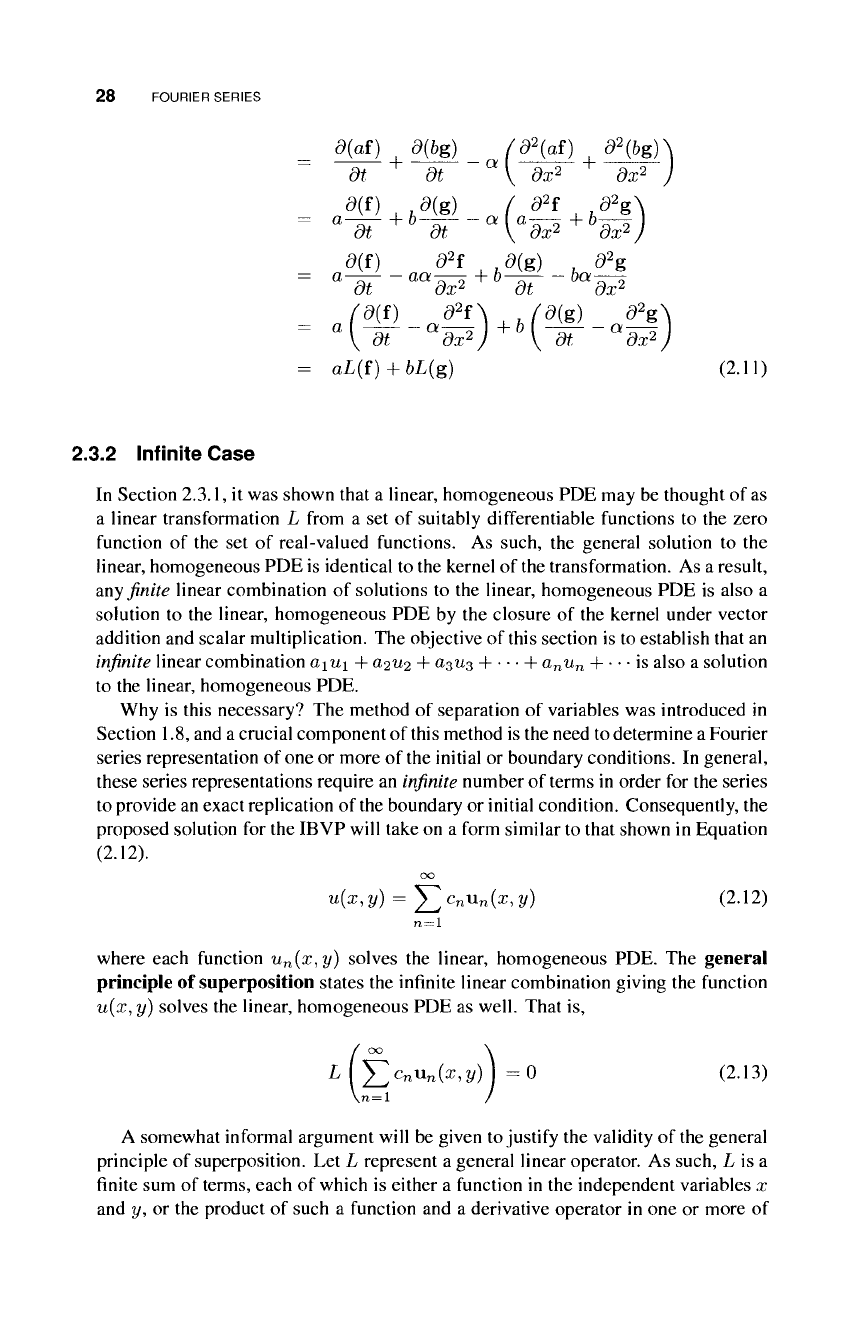
L(aî + bg)
d(af + bg) fd
2
(af + bg)
dt
fd
2
(af + b
g
)\
a
{ dx* )
28 FOURIER SERIES
2.3.2 Infinite Case
In Section
2.3.1,
it was shown that a linear, homogeneous PDE may be thought of as
a linear transformation L from a set of suitably differentiable functions to the zero
function of the set of real-valued functions. As such, the general solution to the
linear, homogeneous PDE is identical to the kernel of
the
transformation. As a result,
any finite linear combination of solutions to the linear, homogeneous PDE is also a
solution to the linear, homogeneous PDE by the closure of the kernel under vector
addition and scalar multiplication. The objective of
this
section is to establish that an
infinite linear combination a\U\
Λ-
(I2U2
+ «3^3
H
l· a
n
u
n
-\
is also a solution
to the linear, homogeneous PDE.
Why is this necessary? The method of separation of variables was introduced in
Section 1.8, and
a
crucial component of this method is the need to determine a Fourier
series representation of one or more of the initial or boundary conditions. In general,
these series representations require an infinite number of terms in order for the series
to provide an exact replication of
the
boundary or initial condition. Consequently, the
proposed solution for the IBVP will take on a form similar to that shown in Equation
(2.12).
00
u{x,y) = ^2c
n
u
n
(x,y) (2.12)
n=l
where each function u
n
(x,y) solves the linear, homogeneous PDE. The general
principle of superposition states the infinite linear combination giving the function
u(x, y) solves the linear, homogeneous PDE as well. That is,
¿ί]Γβ
η
η
η
(*,?/))
=0 (2.13)
A somewhat informal argument will be given
to
justify the validity of the general
principle of superposition. Let L represent a general linear operator. As such, L is a
finite sum of
terms,
each of which is either a function in the independent variables x
and y, or the product of such a function and a derivative operator in one or more of
d(af) d(bg)
dt
3(f)
3(f)
+ b
dt
3(g)
dt
d
2
f
3
2
(af)
+
3
2
(6g)
dx
2
dH
dx
2
ö
2
g
ÖL
(
a—- +b
ox
¿
ox
¿
v»
d
-f
dt
/3(f) 3
2
f\
"VW-"*?)
aL(f) + bL(g)
ba
32g
dx
2
9(g) d
2
g
dt
a
dx
2
(2.11)
PRINCIPLE OF SUPERPOSITION 29
the independent variables. A simple example is
L(u) = f(x,y)u + g(x,y)
du
dx
Now, let u(x, y) be defined by the convergent infinite series
oo
u(x,y) = y^c
n
u
n
(x,?/)
(2.14)
(2.15)
n=l
For the series to converge to u(x, y) on domain D of
M
2
,
it means that for each point
(x,
y) in D, the following holds
TV
u(x,y) = Jim y^c
n
u
n
(x,y) (2.16)
TV—»oo
*-—'
71=1
That is, the sequence of partial sums for each (x, y) converges to the real number
u[x,y).
The series in Equation (2.15) is differentiable with respect to the dependent
variable x if the partial du/dx exists, the partial derivatives du
n
/dx exist for all n,
and
du(x,y)
dx
= Σ°η
du
n
(x,y)
dx
TV
= lim >^ c
n
du
n
{x,y)
dx
(2.17)
_ ..
.
_ r/x
n=l n=l
for all (x, y) with the domain D. If this resulting series in Equation (2.17) is
differentiable with respect to x as well, then the initial series in Equation (2.15) is
twice differentiable with respect to x.
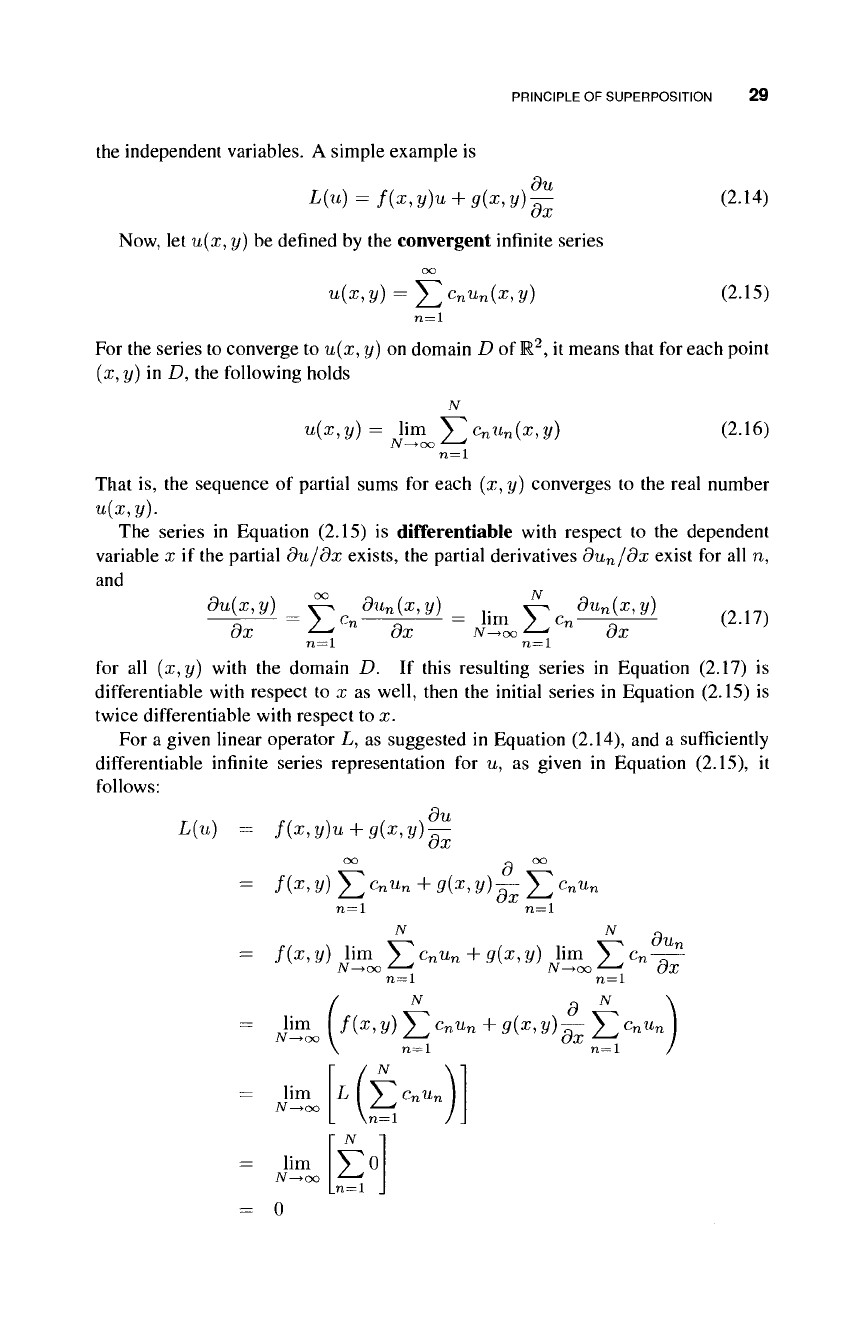
For a given linear operator L, as suggested in Equation (2.14), and a sufficiently
differentiable infinite series representation for u, as given in Equation (2.15), it
follows:
du
L(u) = f(x,y)u + g(x,y)-
dx
d
du
n
= /(x, y) Y^ c
n
u
n
+ g(x, y)w-^2
CnUn
n=l n=l
TV
- /(z,y) Jim V c
n
w
n
+ #(x, y) Jim Vc
n
N-+00
z
—'
TV—>oo
L
—' OX
n=l n=l
(
N
d
N λ
=
N
[
™oo
\ ^' ^ Σ
CnUn
+
#(
X
'
^
¿Γ
Σ
CnWn
^ n=l
L
l
2^
CnUn
\n=l /
TV
1
Σ»
TV
n=l
= lim
TV—>oo
lim
TV—>oo
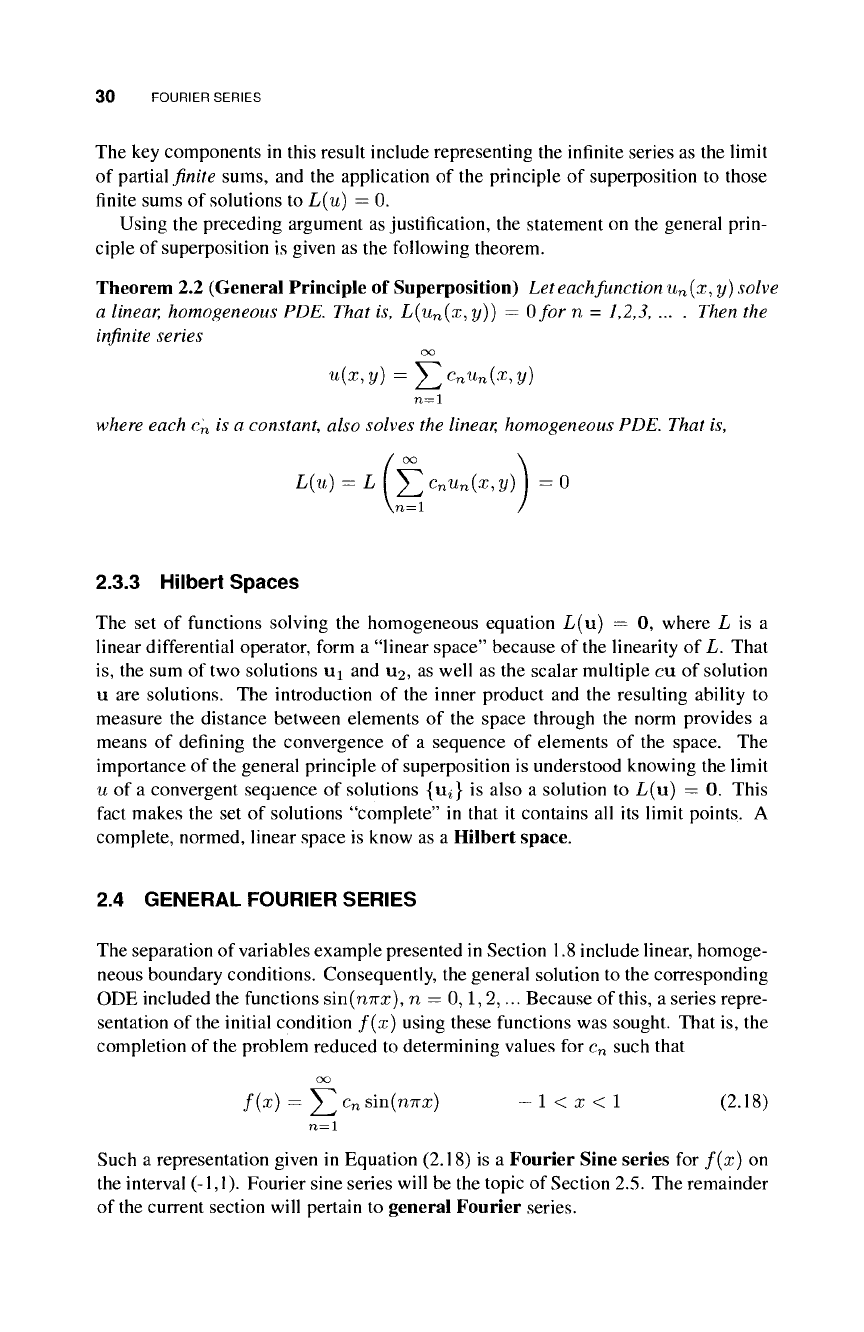
n=l
30 FOURIER SERIES
The key components in this result include representing the infinite series as the limit
of partial finite sums, and the application of the principle of superposition to those
finite sums of solutions to L(u)
—
0.
Using the preceding argument as justification, the statement on the general prin-
ciple of superposition is given as the following theorem.
Theorem 2.2 (General Principle of Superposition) Let each function u
n
(x, y) solve
a
linear,
homogeneous PDE. That
is,
L(u
n
(x,y)) = Ofor n = 1,2,3, ... . Then the
infinite series
oo
u(x,y) = Y^CnU
n
(x,y)
n=l
where each c
n
is a constant, also solves the
linear,
homogeneous PDE. That is,
L(u)
= L
I
γ^
c
nu
n
{x,
y) I
= o
2.3.3 Hilbert Spaces
The set of functions solving the homogeneous equation L(u) = 0, where L is a
linear differential operator, form a "linear space" because of the linearity of L. That
is,
the sum of two solutions ui and
112,
as well as the scalar multiple cu of solution
u are solutions. The introduction of the inner product and the resulting ability to
measure the distance between elements of the space through the norm provides a
means of defining the convergence of a sequence of elements of the space. The
importance of the general principle of superposition is understood knowing the limit
u of a convergent sequence of solutions {u¿} is also a solution to L(u) = 0. This
fact makes the set of solutions "complete" in that it contains all its limit points. A
complete, normed, linear space is know as a Hilbert space.
2.4 GENERAL FOURIER SERIES
The separation of variables example presented in Section 1.8 include linear, homoge-
neous boundary conditions. Consequently, the general solution to the corresponding
ODE included the functions sin(n7nr), n = 0,1,2,... Because of
this,
a series repre-
sentation of the initial condition f{x) using these functions was sought. That is, the
completion of the problem reduced to determining values for c
n
such that
00
f(x) = 2Z
c
n sm(nnx)
—
1 < x < 1 (2.18)
71=1
Such a representation given in Equation (2.18) is a Fourier Sine series for f(x) on
the interval (-1,1). Fourier sine series will be the topic of Section 2.5. The remainder
of the current section will pertain to general Fourier series.
FOURIER SINE SERIES ON (0, C) 31
Let f(x) be an element of C
p
(a, b). If coefficients c
n
can be determined for
real-valued functions φ
η
(χ) such that
oo
Ϊ{χ) = Σο
η
φ
η
{χ) (2.19)
n=l
is true for all but a finite number of x on [a,
6],
then Equation (2.19) is said to be a
Fourier series representation for f(x) on (a, 6). In addition, we say the Fourier
series for / is valid on (a, b).
Prior to determining if such a representation is valid for a given /, c
n
, and φ
η
(χ),
the unique (see Exercise 2.19) Fourier series corresponding to / constructed from
φ
η
is denoted as
oo
/(χ)~Σ<ν^
η
(χ) (2.20)
n=l
For a given set of functions 0
n
, there may be various methods for determining the
coefficients c
n
. The determination of c
n
is particularly simple, in theory, if the set of
functions φ
η
{χ) is orthonormal. A set of functions from an inner product space V
is orthonormal if and only if
(φ
η
(χ),φ
η
(χ)) =
{ X%ZVn
(2
·
21)
That
is,
a set of orthogonal functions, each of which has norm one, is an orthonormal
set. For an orthonormal set, it follows that
(φ
η
(χ),
f{x)) = ( φ
η
{χ), Σ (X)
\ m=l I
oo
771=1
OO
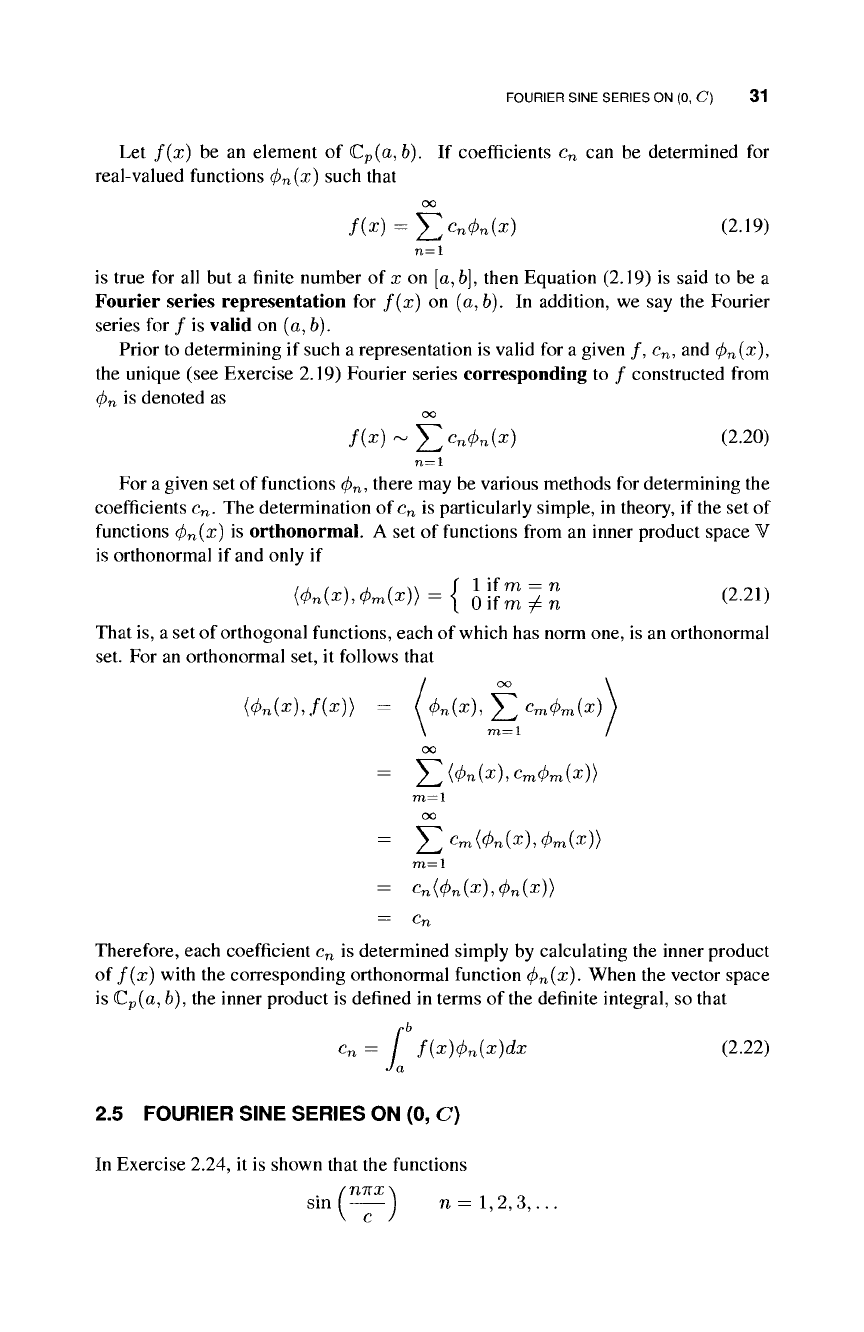
= Σ °™(Φη(χ),Φπι(χ))
m=l
= ο
η
(φ
η
(χ),φ
η
(χ))
Therefore, each coefficient c
n
is determined simply by calculating the inner product
of f(x) with the corresponding orthonormal function φ
η
(χ). When the vector space
is C
p
(a, b), the inner product is defined in terms of the definite integral, so that
c
n
= ¡(χ)φ
η
(χ)άχ (2.22)
Ja
2.5 FOURIER SINE SERIES ON (0, C)
In Exercise 2.24, it is shown that the functions
. /ηπχ\
sini J n = 1,2,3,...