
Bernatz R. Fourier Series and Numerical Methods for Partial Differential Equations
Подождите немного. Документ загружается.

2 INTRODUCTION
The partial derivative of u with respect to t is defined in a similar way. Another way
of representing the partial of u with respect to x is
du
ox
A partial differential equation is an equation involving one or more partial deriva-
tives of a dependent variable u. An example of such is the one-dimensional (ID)
diffusion equation
ut = ku
xx
(1.2)
where u
t
represents the first partial of u with respect to t, k is a constant diffusion
coefficient, and u
xx
represents the second partial of u with respect to x. That is,
u
x
(x + h,t) -u
x
(x,t)
u
xx
= hm (1.3)
h-*0 h
Some applications of PDEs may include a mixed partial, such as u
xy
, where
u
x
(x,y + h,t)-u
x
(x,y,t)
u
xy
= hm (1.4)
h^o h
with u
—
u(x,y,t).
It is common for the dependent variable u to be a function of three spatial variables
x, y, and z, as well as time t. The general form of a PDE for u in this case may be
expressed as
" \%i y i
%·>
^"i
W")
^i) ^yi ^Ζΐ ^ti ^χχι ^xyi ^J/XÎ ^yy> ' ' '
>
^tti · · · ) — ^ v
*
*^/
1.2 CLASSIFICATION
The order of a PDE is the highest order derivative in Equation (1.5). The order of
the most common PDEs in science and engineering applications is two or less. In the
event that u = u(x, y), Equation (1.5) may be expressed as
Au
xx
+ Bu
xy
4- Cuyy + Du
x
+ Euy + Fu = Q (1.6)
The PDE is said to be linear if each coefficient A
—
Q is at most a function of x
or y. Otherwise, the equation is nonlinear. A nonlinear equation is quasilinear if
it is linear in its highest order derivatives. Examples of PDEs with identification of
their order and linearity are given in Table 1.1. If the term Q on the right-hand side
of Equation (1.6) is zero, the PDE is said to be homogeneous. Otherwise the PDE is
classified as nonhomogeneous.
Suppose Equation (1.6) is linear. All equations of this form may be further
classified as parabolic, hyperbolic, or elliptic. Heat flow and diffusion problems
are typically described by parabolic forms of Equation (1.6). These equations have
coefficients A, B, and C satisfying the property B
2
—
AAC
—
0. Hyperbolic forms of
CANONICAL FORMS
Table 1.1 PDEs: Order and Linearity.
PDE
UyU
x
+ au
y
= 2
u
xx
+ auuy = 0
xu
x
+ au
y
= u
2
+ 1
XU
X
+ OiUy — 1
U
xx
-f Myy = C0S(X
2
+ y)
1¿1¿
XX
+
OLUy
= 0
u
ÏX
-f uu
y
—
0
Order
1st
1st
1st
1st
2nd
2nd
2nd
Linearity
nonlinear
quasilinear
quasilinear
linear
linear
nonlinear
quasilinear
the equation are those for which B
2
—
4AC > 0. Common equations of this type are
associated with vibrating systems and wave motion. Finally, when B
2
—
4AC < 0,
the equation is elliptic. Equations of this type typically represent steady-state (time
independent) phenomena.
If any of the coefficients A, B, or C are functions of x or y, the characterization
of the equation as parabolic, hyperbolic, or elliptic may be a function of location in
the xy-plane. As an example, consider the PDE
y Μχχ + Λ/ΧΙ
Xy
-T~
Uyy ~Γ ¿U
X
U
(1.7)
The expression B
2
—
AAC is equal to x
—
4y
2
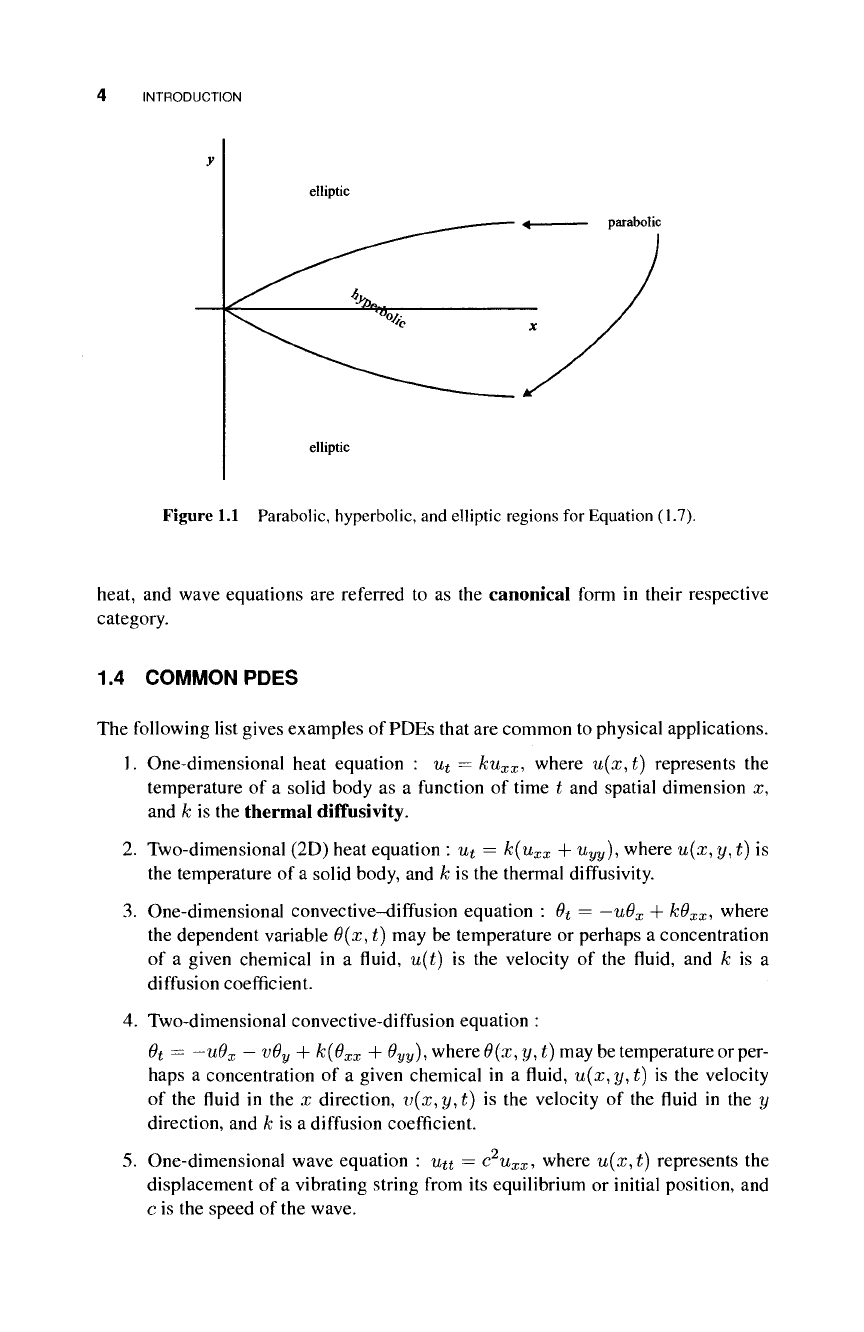
for Equation (1.7). Consequently, the
equation is parabolic on the curve x = 4y
2
, hyperbolic for points (x, y) such that
x > Ay
2
, and elliptic for ordered pairs (x, y) that satisfy Ay
2
> x and x > 0. These
regions are depicted in Figure 1.1.
1.3 CANONICAL FORMS
For the case where the dependent variable u is a function of at most two independent
variables, as indicated in Equation 1.6, there are three common types of
PDEs.
The
Laplace equation is u
xx
4- u
yy
— 0, and is elliptic on the entire xy-plane. The heat
equation has the form u
t
—
u
xx
= 0, where the independent variable t represents time
and x represents a spatial dimension. The heat equation is parabolic on the entire xy-
plane. The wave equation u
u
—
u
xx
—
0 is hyperbolic on the entire xi/-plane. Here,
the dependent variable u represents the displacement or wave height as a function of
time t and location x.
It can be shown that with a smooth, nonsingular change of coordinates, the sign of
the discriminant B
2
—4AC will not
change.
Therefore, it
is
possible to make
a
change
of coordinate transformation in which an elliptic PDE is transformed to a Laplace
equation, a parabolic PDE is transformed to the heat equation, and a hyperbolic
equation is transformed into the wave equation form. Consequently, the Laplace,
4 INTRODUCTION
4 parabolic
Figure 1.1 Parabolic, hyperbolic, and elliptic regions for Equation (1.7).
heat, and wave equations are referred to as the canonical form in their respective
category.
1.4 COMMON PDES
The following list gives examples of PDEs that are common to physical applications.
1.
One-dimensional heat equation : u
t
= ku
xx
, where u(x,t) represents the
temperature of a solid body as a function of time t and spatial dimension x,
and k is the thermal diffusivity.
2.
Two-dimensional (2D) heat equation : u
t
= k(u
xx
+ u
yy
), where i¿(x, y, t) is
the temperature of a solid body, and k is the thermal diffusivity.
3.
One-dimensional convective-diffusion equation : 9
t
= — u6
x
+ k9
xx
, where
the dependent variable 0(x, t) may be temperature or perhaps a concentration
of a given chemical in a fluid, u(t) is the velocity of the fluid, and k is a
diffusion coefficient.
4.
Two-dimensional convective-diffusion equation :
9
t
= -u6
x
- v9
y
+ k{0
xx
+ 9yy), where
<9(x,
y, t) may be temperature or per-
haps a concentration of a given chemical in a fluid, u(x, y, t) is the velocity
of the fluid in the x direction, v(x,y,t) is the velocity of the fluid in the y
direction, and
&
is a diffusion coefficient.
5.
One-dimensional wave equation : u
u
—
c
2
u
xx
, where u(x,t) represents the
displacement of a vibrating string from its equilibrium or initial position, and
c is the speed of the wave.
CAUCHY-KOWALEVSKI THEOREM 5
6. Two-dimensional wave equation : u
u
= c
2
(u
xx
+ u
yy
), where u(x, y, t) rep-
resents the displacement of
a
vibrating membrane from its equilibrium or initial
position, and c is the speed of the wave.
7.
Two-dimensional Laplace equation : V
2
u = u
xx
+ u
yy
= 0, where u(x,y)
may be the temperature of a solid plate.
8. Two-dimensional Poisson's equation : V
2
u = u
xx
+ u
yy
—
f(x,y),
where
u(x, y) may be an electrostatic field property.
9. Berger's equation in E
1
: u
t
+ uu
x
= 0, where u(x, t) is the velocity of a
stream of particles or fluid flow with zero viscosity.
10.
Schrödinger equation in
IR
3
: u
t
= i \S7
2
u + Vu], where u(x, y, z, t) is veloc-
ity and V(x,y,z) denotes the potential, with application
to
quantum mechanics.
1.5 CAUCHY-KOWALEVSKI THEOREM
The Cauchy-Kowalevski theorem on existence and uniqueness of solutions to systems
of PDEs is stated in this section. The theorem establishes sufficient conditions on the
individual PDEs of the system, as well as the initial conditions, called Cauchy data.
No proof of the theorem is given in this text. The interested reader may consult [26]
for a proof for the case of
a
system of linear PDEs. A proof for the case of quasilinear
systems may be found in [17]. Note: Later in the text general nonlinear systems may
be reduced to quasilinear systems by differentiation. Yet another valuable reference
is Volume II of the classic works by Courant and Hubert [14].
Suppose i¿i, U2, ..., UM are dependent variables of time t and spatial variables
.xi, X2, ··, XN- The general expression for a second-order PDE of variable u
m
(1 < m < M) is
d
k
-Um „ Λ &xn \
at*™ \ optóte
X\...O3
N
XN
)
(1.8)
where 1 < I < M and jo +
j\
+ · · · 4- JN = j < k
m
and
j
0
< k
m
. The notation
reflects the requirement that the PDE for an arbitrary dependent variable u
m
be such
that the /c
m
th partial derivative of u
m
with respect to t may be isolated on the left-
hand side of the equation. The right-hand side of the equation is a function F
m
of
the independent variables t, xi,... XN, the dependent variables i¿i,...,
UM,
and the
partial derivatives of
the
dependent variable, with order less than or equal to the order
k
m
. The order of any partial derivative of u
m
with respect to any spatial variable x¿
is a non-negative integer
j¿.
Finally, the order
j
0
of the partial of u
m
with respect to
t must be an integer strictly less than the order km
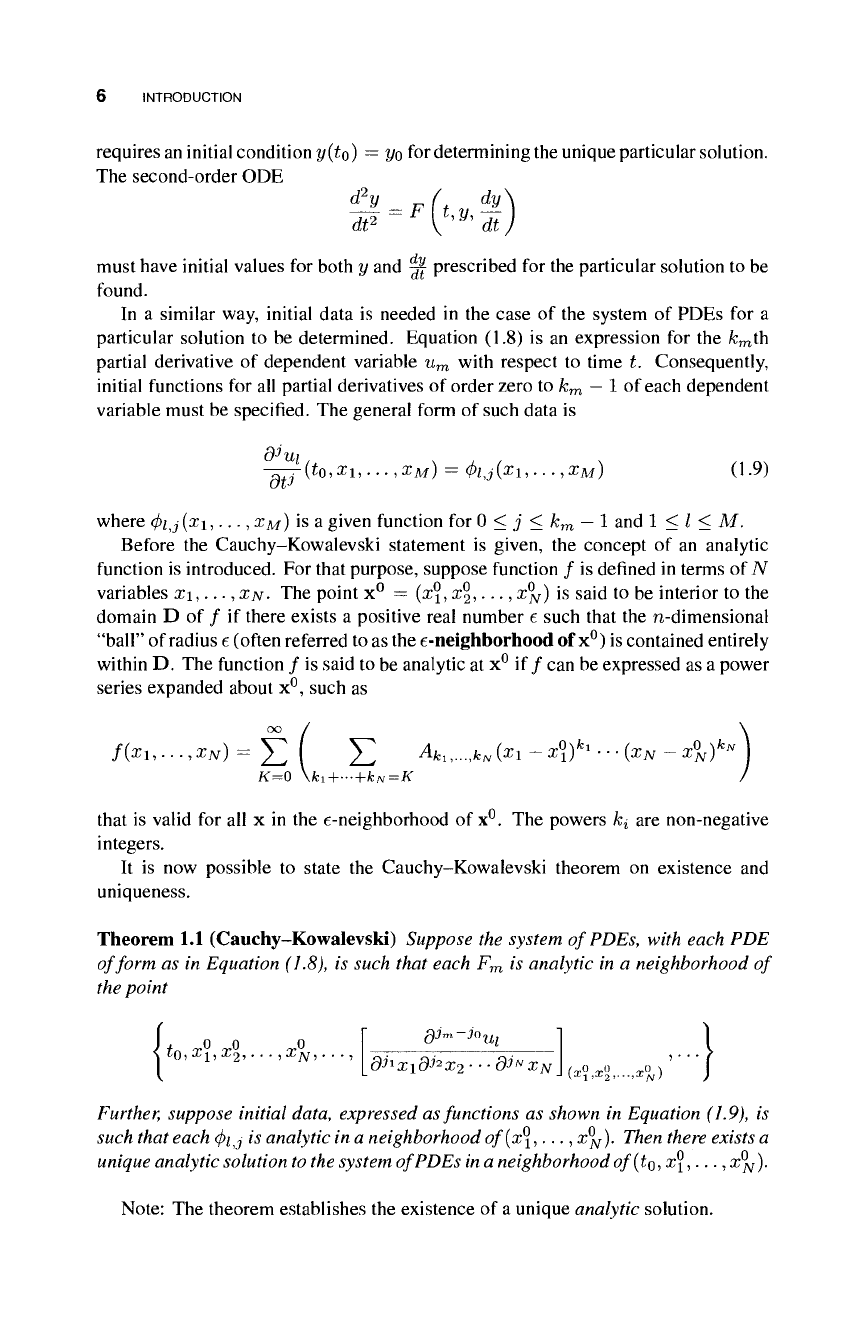
Recall from experience with ODEs that a first-order equation
I-™
6 INTRODUCTION
requires an initial condition y (to) =
yo
for determining the unique particular solution.
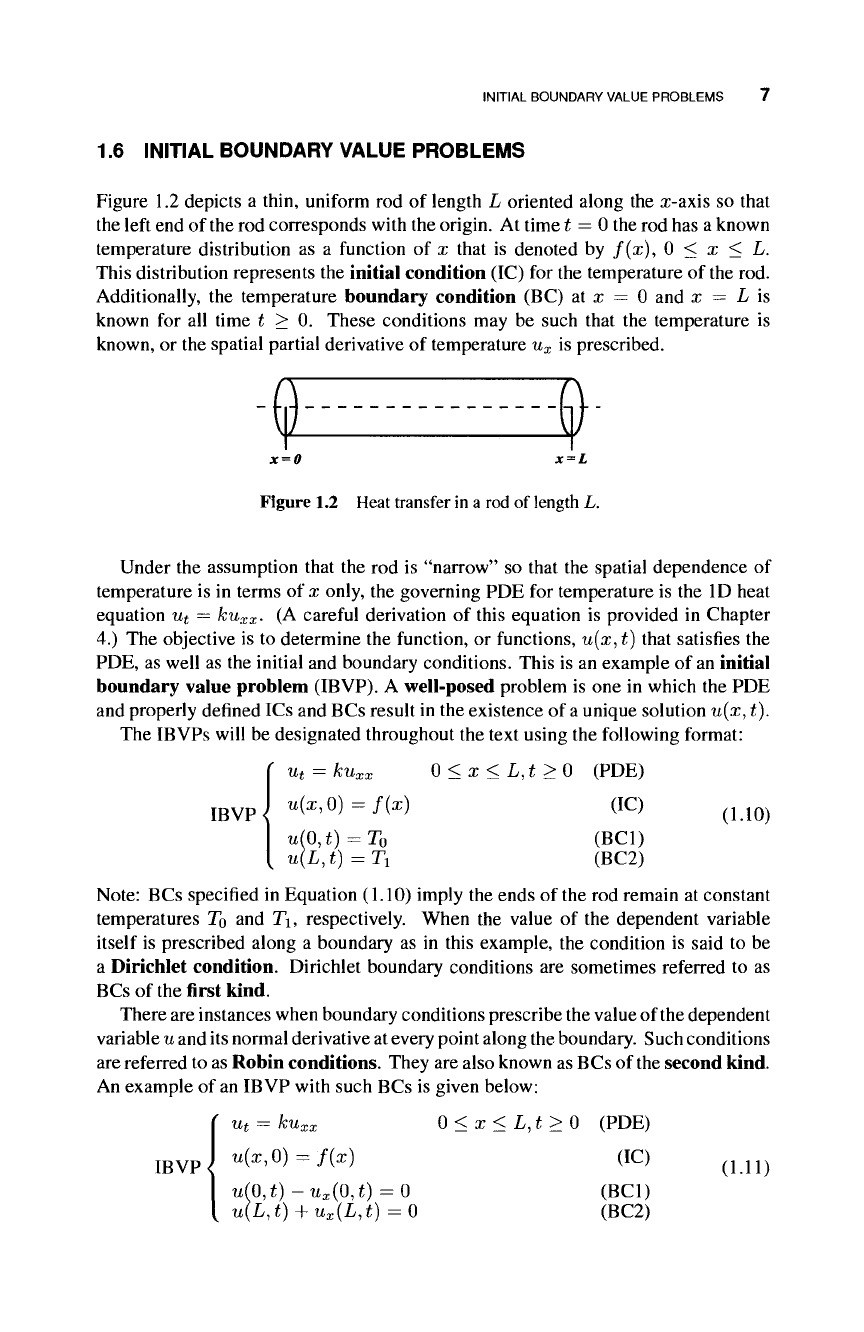
The second-order ODE
must have initial values for both y and ^ prescribed for the particular solution to be
found.
In a similar way, initial data is needed in the case of the system of PDEs for a
particular solution to be determined. Equation (1.8) is an expression for the /c
m
th
partial derivative of dependent variable u
m
with respect to time t. Consequently,
initial functions for all partial derivatives of order zero to k
m
—
1 of each dependent
variable must be specified. The general form of such data is
-^—(¿o,xi,.. ·
,XM)
=
<l>ij(xi,
· · · ,XM) (1.9)
where (j)i,j(x\, ..., XM) is a given function for 0 < j < k
m
—
1 and 1 < I < M.
Before the Cauchy-Kowalevski statement is given, the concept of an analytic
function is introduced. For that purpose, suppose function / is defined in terms of
TV
variables xi,...,
XN-
The point x° = (x?, x®,..., x%) is said to be interior to the
domain D of / if there exists a positive real number e such that the n-dimensional
"ball" of radius
e
(often referred to as the e-neighborhood of x°) is contained entirely
within D. The function / is said to be analytic at x° if / can be expressed as a power
series expanded about x°, such as
/(*!,...,**)=£ ( Σ
A
ki,.:.,kA*i-4)
kl
-'^XN-x%)
k
A
that is valid for all x in the e-neighborhood of x°. The powers ki are non-negative
integers.
It is now possible to state the Cauchy-Kowalevski theorem on existence and
uniqueness.
Theorem 1.1 (Cauchy-Kowalevski) Suppose the system of PDEs, with each PDE
of form as in Equation
(1.8),
is such that each F
m
is analytic in a neighborhood of
the point
£(b
x
li
x
2i · ' '
'
%? ·
*
· ·
dJm-J0
Ul
d^x
1
d^x
2
"-d^
N
x
N
\
χ
1 ι
χ
2">"">
Χ
Ν'
Further, suppose initial data, expressed as functions as shown in Equation
(1.9),
is
such that each φι^ is analytic in a neighborhood of(x®,..., x%). Then there exists a
unique analytic solution to the system of PDEs
in
a neighborhood of
(to,
x\,...,
x%).
Note: The theorem establishes the existence of a unique analytic solution.
INITIAL BOUNDARY VALUE PROBLEMS 7
1.6 INITIAL BOUNDARY VALUE PROBLEMS
Figure 1.2 depicts a thin, uniform rod of length L oriented along the x-axis so that
the left end of the rod corresponds with the origin. At time t
—
0 the rod has a known
temperature distribution as a function of x that is denoted by f(x), 0 < x < L.
This distribution represents the initial condition (IC) for the temperature of the rod.
Additionally, the temperature boundary condition (BC) at x — 0 and x — L is
known for all time t > 0. These conditions may be such that the temperature is
known, or the spatial partial derivative of temperature u
x
is prescribed.
5>
x = L
Figure 1.2 Heat transfer in a rod of
length
L.
Under the assumption that the rod is "narrow" so that the spatial dependence of
temperature is in terms of x only, the governing PDE for temperature is the ID heat
equation u
t
— ku
xx
. (A careful derivation of this equation is provided in Chapter
4.) The objective is to determine the function, or functions, i¿(x, t) that satisfies the
PDE, as well as the initial and boundary conditions. This is an example of an initial
boundary value problem (IBVP). A well-posed problem is one in which the PDE
and properly defined ICs and BCs result in the existence of a unique solution u(x, t).
The IBVPs will be designated throughout the text using the following format:
IBVP<
' Ut =
u(x
«(0,
- kh
0)
J
XX
=
m
= T
0
0<:
v<L,t >0 (PDE)
(IC)
(BC1)
(BC2)
(1.10)
Note: BCs specified in Equation (1.10) imply the ends of the rod remain at constant
temperatures T
0
and ΤΊ, respectively. When the value of the dependent variable
itself is prescribed along a boundary as in this example, the condition is said to be
a Dirichlet condition. Dirichlet boundary conditions are sometimes referred to as
BCs of the first kind.
There are instances when boundary conditions prescribe the value of the dependent
variable u and its normal derivative
at
every point along the
boundary.
Such conditions
are referred to as Robin conditions. They are also known as BCs of the second kind.
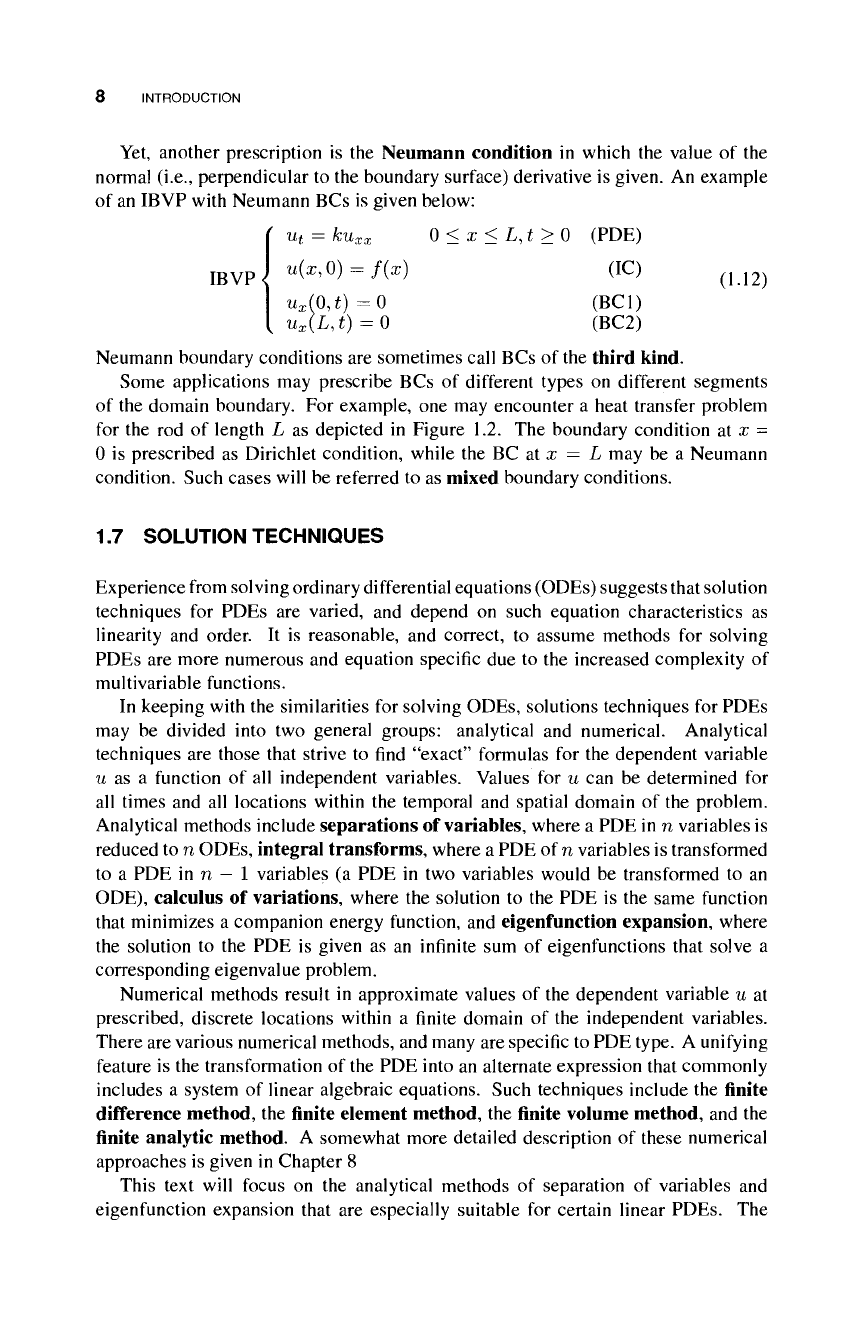
An example of an IBVP with such BCs is given below:
Ut =
u(x
u(0,
— I\i Uu
XX
0) =
t)-
,t) +
fix)
u
x
(0,t)
=
u
x
(L,t)
-
--0
= 0
0<x< L,t >0 (PDE)
(IC)
(BC1)
(BC2)
IBVP< -v-»-y-JV-; v-w
(U1)
8 INTRODUCTION
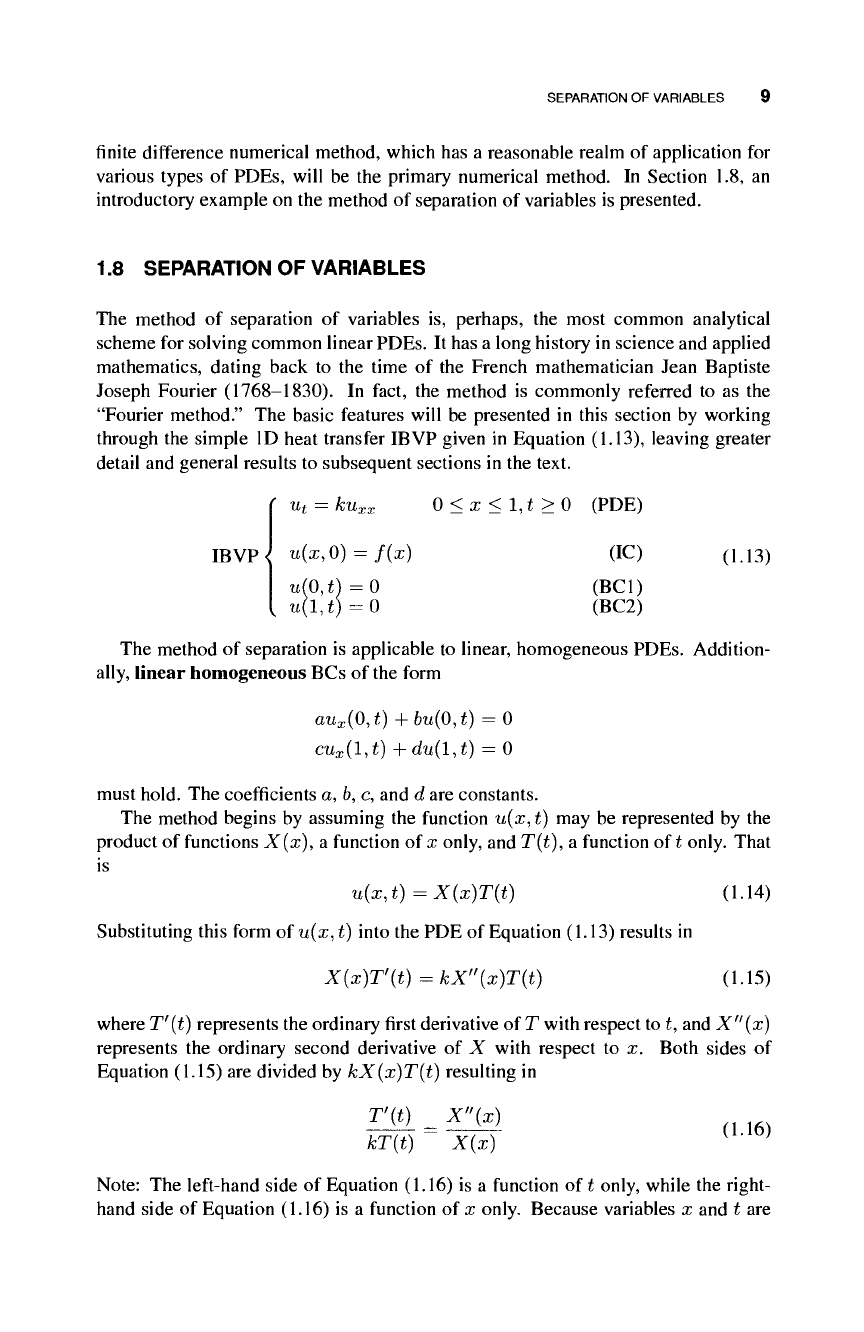
Yet, another prescription is the Neumann condition in which the value of the
normal (i.e., perpendicular to the boundary surface) derivative is given. An example
of an IBVP with Neumann BCs is given below:
u
t
= ku
xx
0 < x < L, t > 0 (PDE)
u(x,0) = f(x) (IC)
(L12)
u
x
(0,t)=0 (BC1)
u
x
(L,t)=0 (BC2)
IBVP<
Neumann boundary conditions are sometimes call BCs of the third kind.
Some applications may prescribe BCs of different types on different segments
of the domain boundary. For example, one may encounter a heat transfer problem
for the rod of length L as depicted in Figure 1.2. The boundary condition at x =
0 is prescribed as Dirichlet condition, while the BC at x — L may be a Neumann
condition. Such cases will be referred to as mixed boundary conditions.
1.7 SOLUTION TECHNIQUES
Experience from solving ordinary differential equations (ODEs) suggests that solution
techniques for PDEs are varied, and depend on such equation characteristics as
linearity and order. It is reasonable, and correct, to assume methods for solving
PDEs are more numerous and equation specific due to the increased complexity of
multivariable functions.
In keeping with the similarities for solving ODEs, solutions techniques for PDEs
may be divided into two general groups: analytical and numerical. Analytical
techniques are those that strive to find "exact" formulas for the dependent variable
was a function of all independent variables. Values for u can be determined for
all times and all locations within the temporal and spatial domain of the problem.
Analytical methods include separations of variables, where a PDE in n variables is
reduced to n ODEs, integral transforms, where a PDE of n variables is transformed
to a PDE in n - 1 variables (a PDE in two variables would be transformed to an
ODE),
calculus of variations, where the solution to the PDE is the same function
that minimizes a companion energy function, and eigenfunction expansion, where
the solution to the PDE is given as an infinite sum of eigenfunctions that solve a
corresponding eigenvalue problem.
Numerical methods result in approximate values of the dependent variable u at
prescribed, discrete locations within a finite domain of the independent variables.
There are various numerical methods, and many are specific to PDE type. A unifying
feature is the transformation of the PDE into an alternate expression that commonly
includes a system of linear algebraic equations. Such techniques include the finite
difference method, the finite element method, the finite volume method, and the
finite analytic method. A somewhat more detailed description of these numerical
approaches is given in Chapter 8
This text will focus on the analytical methods of separation of variables and
eigenfunction expansion that are especially suitable for certain linear PDEs. The
SEPARATION OF VARIABLES 9
finite difference numerical method, which has a reasonable realm of application for
various types of PDEs, will be the primary numerical method. In Section 1.8, an
introductory example on the method of separation of variables is presented.
1.8 SEPARATION OF VARIABLES
The method of separation of variables is, perhaps, the most common analytical
scheme for solving common linear
PDEs.
It has a long history in science and applied
mathematics, dating back to the time of the French mathematician Jean Baptiste
Joseph Fourier (1768-1830). In fact, the method is commonly referred to as the
"Fourier method." The basic features will be presented in this section by working
through the simple ID heat transfer IBVP given in Equation (1.13), leaving greater
detail and general results to subsequent sections in the text.
u
t
= ku
xx
0 < x < 1, t > 0 (PDE)
IBVP { u(x,0) = f(x) (IC) (1.13)
u(0,t)=0 (BC1)
t u{l,t) =0 (BC2)
The method of separation is applicable to linear, homogeneous PDEs. Addition-
ally, linear homogeneous BCs of the form
au
x
(0,t) + bu(0,t) = 0
cu
x
(l,t) + du(l,t) = 0
must hold. The coefficients a,b,c, and d are constants.
The method begins by assuming the function u(x, t) may be represented by the
product of functions X(x), a function of x only, and T(t), a function oft only. That
is
u(x,t) = X(x)T(t) (1.14)
Substituting this form of u(x, t) into the PDE of Equation (1.13) results in
X(x)T'(t) = kX"{x)T{t) (1.15)
where T
f
{t) represents the ordinary first derivative of T with respect to t, and X"{x)
represents the ordinary second derivative of X with respect to x. Both sides of
Equation (1.15) are divided by kX{x)T(t) resulting in
T'(t)
=
Χ^ή
kT(t) X(x)
K
'
;
Note: The left-hand side of Equation (1.16) is a function of t only, while the right-
hand side of Equation (1.16) is a function of
a;
only. Because variables x and t are
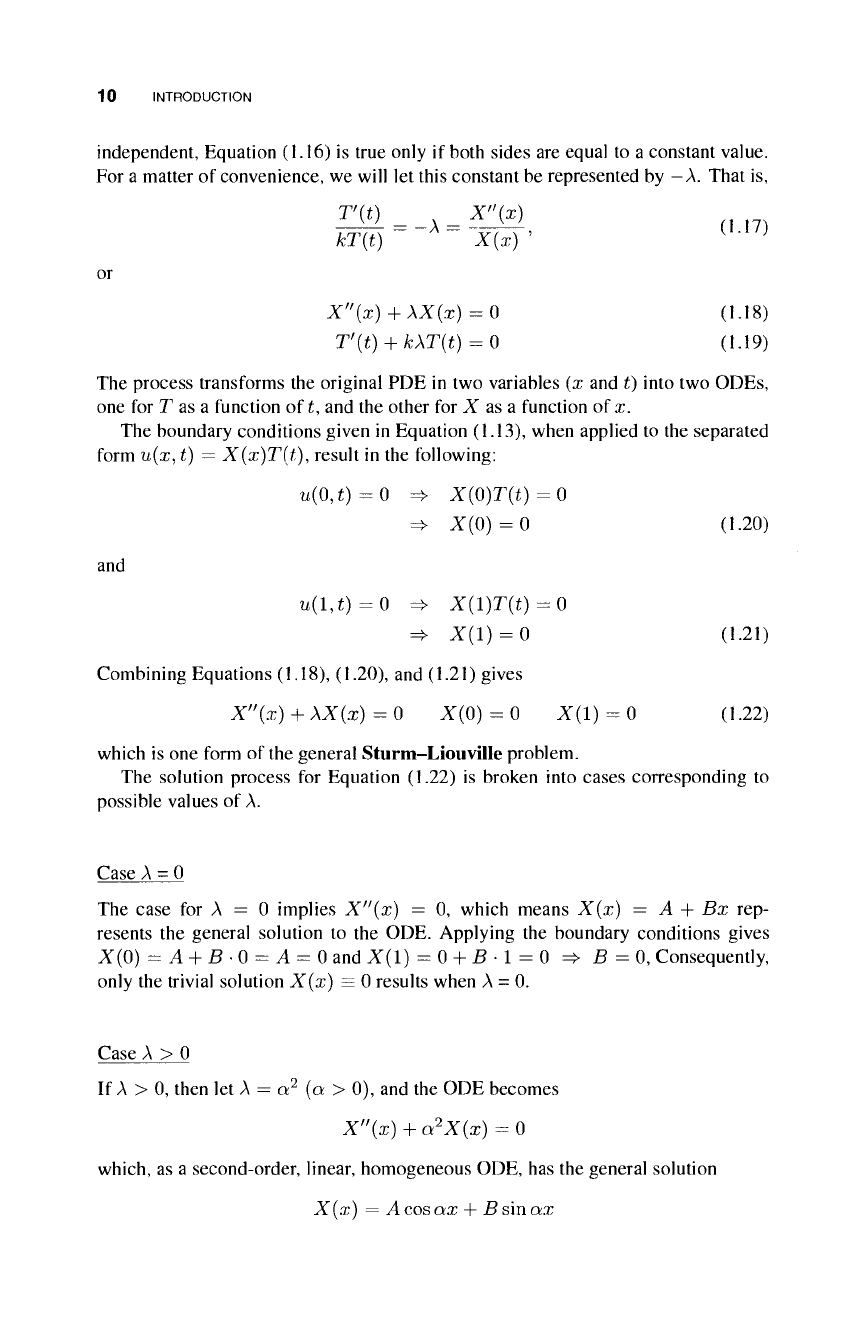
10 INTRODUCTION
or
independent, Equation (1.16) is true only if both sides are equal to a constant value.
For a matter of convenience, we will let this constant be represented by
—A.
That is,
T{t) _ X"{x)
WiT)~~
X
-~X{x)'
(M7)
X"{x)+\X{x)=Q (1.18)
T'(t) + k\T(t) = 0 (1.19)
The process transforms the original PDE in two variables (x and t) into two ODEs,
one for T as a function of t, and the other for X as a function of x.
The boundary conditions given in Equation (1.13), when applied to the separated
form u(x, t) = X(x)T(t), result in the following:
u(0,t)=0 => X(0)T(t)=0
=> X(0) = 0 (1.20)
and
u(l,t)=0 => X(l)T(t)=0
=> X(1) = 0 (1.21)
Combining Equations (1.18), (1.20), and (1.21) gives
X"(x)+\X(x)=0 X(0) = 0 X(1)=0 (1.22)
which is one form of the general Sturm-Liouville problem.
The solution process for Equation (1.22) is broken into cases corresponding to
possible values of
A.
Case
A
= 0
The case for A = 0 implies X
N
{x) = 0, which means X(x) = A + Bx rep-
resents the general solution to the ODE. Applying the boundary conditions gives
X(0) = A + B'0 = A = 0and X(l) = 0 + B · 1 = 0 => B = 0, Consequently,
only the trivial solution X(x) =0 results when
A
= 0.
Case
A
> 0
If
A
> 0, then let
A
= a
2
(a > 0), and the ODE becomes
X"{x)
+ a
2
X{x) = 0
which, as a second-order, linear, homogeneous ODE, has the general solution
X{x) = A cos ax 4- B sin ax
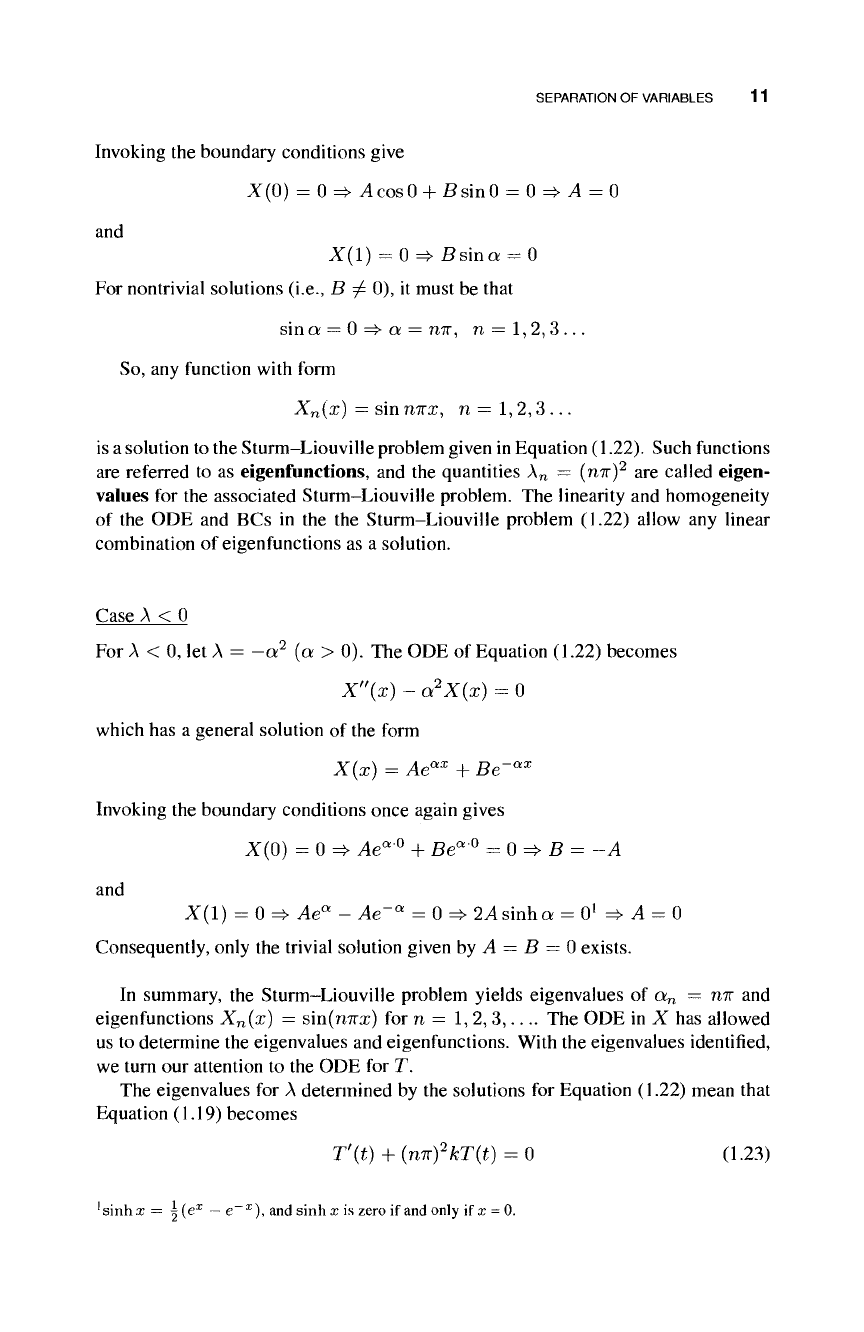
SEPARATION OF VARIABLES
11
Invoking the boundary conditions give
X(0)
= 0
=> AcosO
+
£sinO
= 0
=>
A = 0
and
X(l)
=
0=> J5sina
= 0
For nontrivial solutions (i.e.,
B φ
0), it must be that
sin
a = 0
=>
a =
ηπ,
n =
1,2,3...
So,
any function with form
X
n
(x)
=
βίηηπχ,
n =
1,2,3...
is a solution to the Sturm-Liouville problem given in Equation (1.22). Such functions
are referred to as eigenfunctions, and the quantities
λ
η
=
(ηπ)
2
are called eigen-
values for the associated Sturm-Liouville problem. The linearity and homogeneity
of the ODE and BCs
in
the the Sturm-Liouville problem (1.22) allow any linear
combination of eigenfunctions as a solution.
Case
Λ
< 0
For
λ <
0, let
λ = -a
2
(a
> 0). The ODE of Equation (1.22) becomes
X"(x)
- a
2
X(x) = 0
which has a general solution of the form
X(x)=Ae
ax
+Be-
ax
Invoking the boundary conditions once again gives
X(0)
= 0
=Φ
Ae
œ0
+
Be
a0
=
0=>5
= -i
and
X(l)
= 0
=>
Ae
a
- Ae~
a
= 0
=» 2ylsinha
=
0
1
=>
A = 0
Consequently, only the trivial solution given by
A = B
—
0 exists.
In summary, the Sturm-Liouville problem yields eigenvalues
of a
n
= ηπ
and
eigenfunctions
X
n
(x) =
8ΐη(ηπχ) for
n =
1,2,3, The ODE in
X
has allowed
us to determine the eigenvalues and eigenfunctions. With the eigenvalues identified,
we turn our attention to the ODE for
T.
The eigenvalues for
λ
determined by the solutions for Equation (1.22) mean that
Equation (1.19) becomes
T'(t) + (nn)
2
kT(t) = 0
(1.23)
'sinhir
—
\{e
x
—
e~
x
),
and sinha? is zero if and only if
x
= 0.