
Bernatz R. Fourier Series and Numerical Methods for Partial Differential Equations
Подождите немного. Документ загружается.

52 FOURIER SERIES
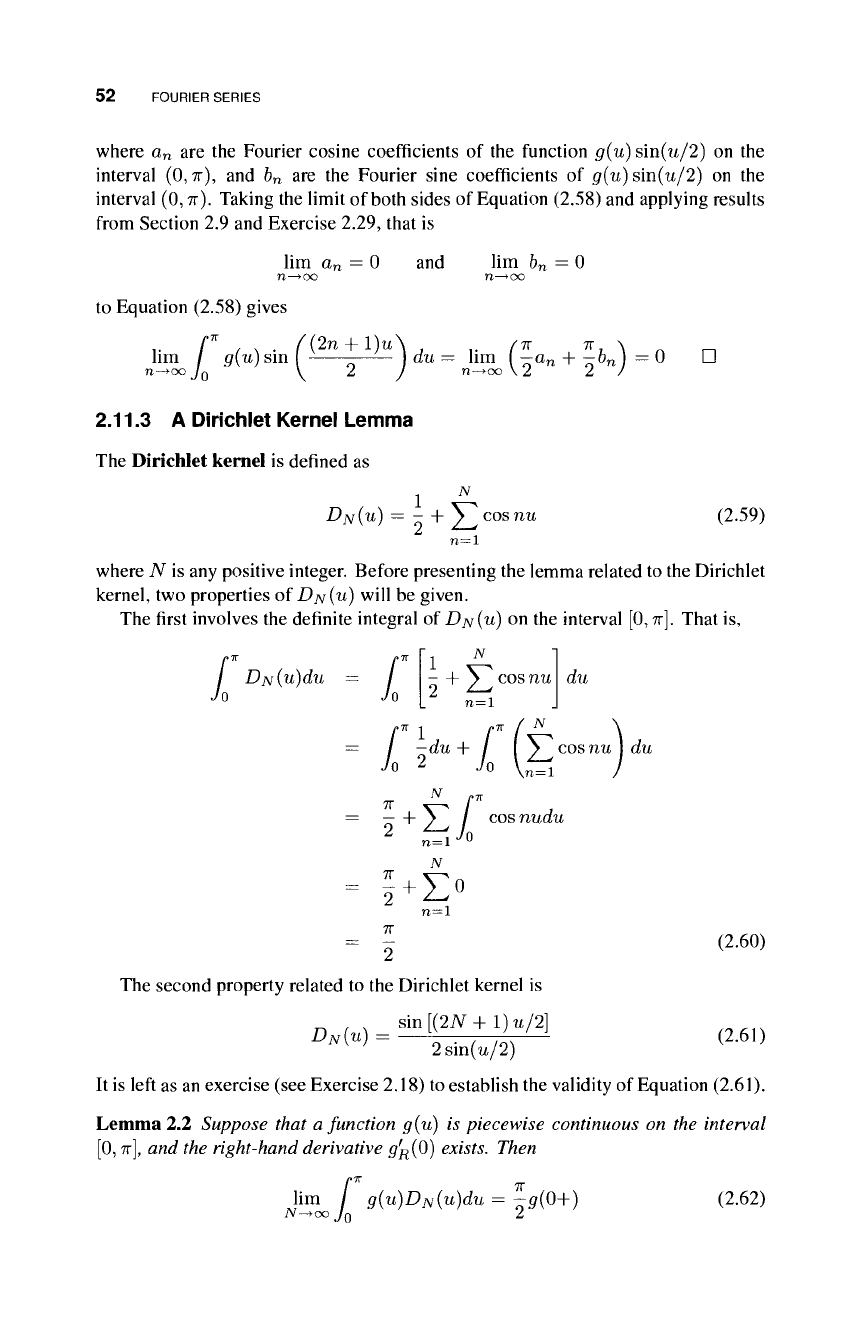
where a
n
are the Fourier cosine coefficients of the function g(u) sin(u/2) on the
interval (0, π), and b
n
are the Fourier sine coefficients of g(u)sm(u/2) on the
interval (0, π). Taking the limit of both sides of Equation (2.58) and applying results
from Section 2.9 and Exercise 2.29, that is
lim a
n
= 0
and
lim b
n
—
0
to Equation (2.58) gives
Γ .
x
. /(2n + l>\ , i. (* 7Γ, \
Λ π
km / g(u) sin du = lim -a
n
+ -b
n
)
= 0 U
n—>oo JQ \ 2 J n^oo \ ¿ Z /
2.11.3
A
Dirichlet Kernel Lemma
The Dirichlet kernel is defined as
1
N
(2.59)
71=1
where N is any positive integer. Before presenting the lemma related to the Dirichlet
kernel, two properties of DN(U) will be given.
The first involves the definite integral of DN(U) on the interval
[0,
π].
That is,
cosmx
/»7Γ /»7Γ -1 -'
v
/ D
N
(u)du = / - + Σ<
Jo J
o I
2
„=i
= / -du+ I I > cos nul du
Jo
2 Jo \h )
eos nudu
N
n=l
π
2
The second property related to the Dirichlet kernel is
sin[(2AT + lW2]
JUN{U)
=
(2.60)
(2.61)
2sin(i¿/2)
It is left as an exercise (see Exercise 2.18) to establish the validity of Equation (2.61).
Lemma 2.2 Suppose that a function g(u) is piecewise continuous on the interval
[0,
π],
and the right-hand derivative g'
R
(0) exists. Then
Γ π
Jim / g(u)D
N
(u)du = -#(0+)
(2.62)
FOURIER SERIES CONVERGENCE 53
where
DJSÍ{U)
is the Dirichlet kernel
DN(U)
= 1 + J2
N
cos
nu
n=l
Í
Jo
Proof:
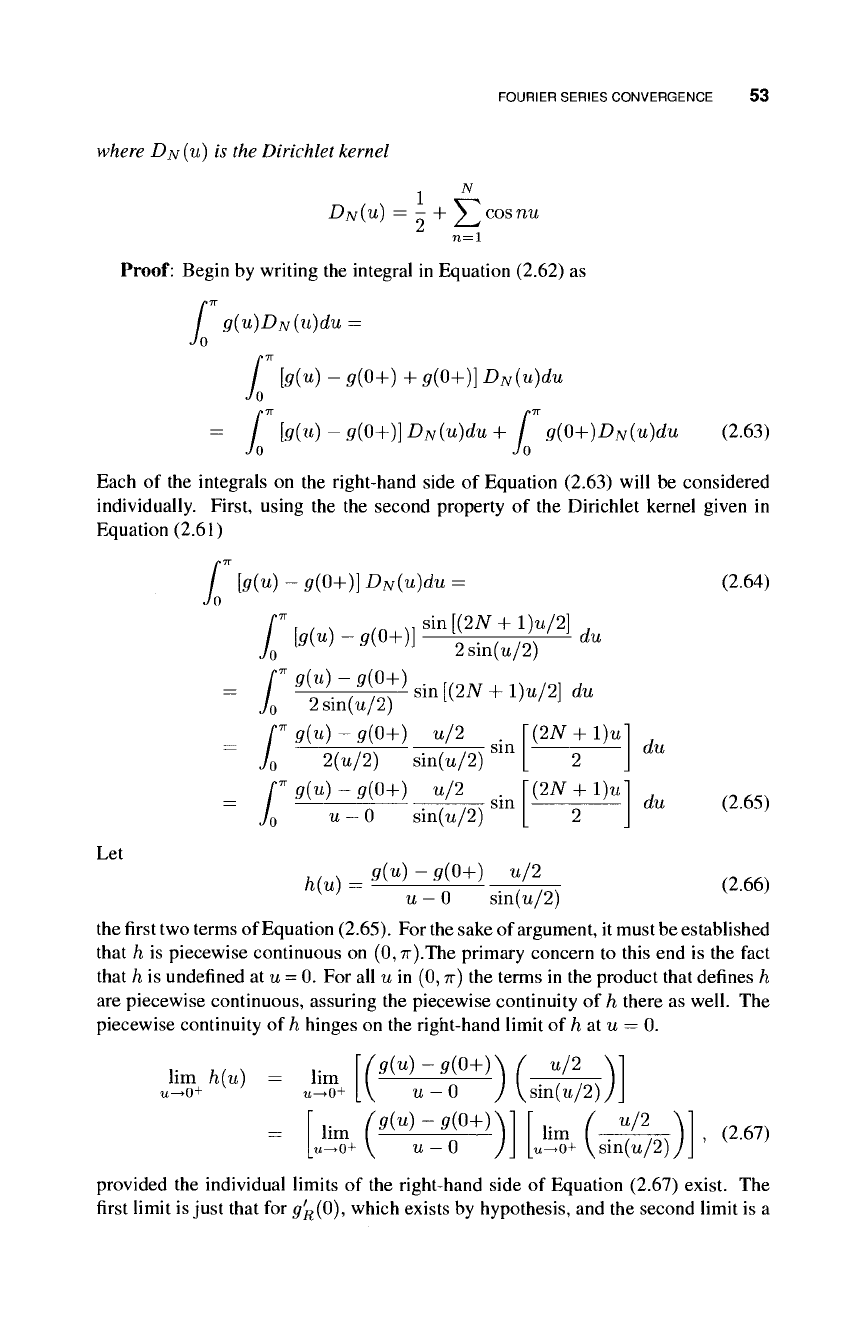
Begin by writing the integral in Equation (2.62) as
g(u)DN(u)du =
[ [g(u) - 0(0+) + ^(0+)] D
N
(u)du
Jo
/»7Γ /»7Γ
= / \g(u)-g(0+)]D
N
(u)du+ g(0+)D
N
(u)du (2.63)
Jo Jo
Each of the integrals on the right-hand side of Equation (2.63) will be considered
individually. First, using the the second property of the Dirichlet kernel given in
Equation (2.61)
f
Jo
[g{u) - g(0+)} D
N
(u)du =
Γ . . . ,
n
.. sin U2N + l)«/2] ,
Jo 2sin(u/2)
(2.64)
Γ 9(u) - 9(0+)
J
0
2sin(w/2)
Γ g{u) -
g
(0+) u/2
J
0
2{u/2) sin(«/2)
r
g
(u)-g(0+) u/2
JO
sin[(27V + l)i//2] du
(2ΛΓ + l)u
u
—
0 sin(u/2)
sin
sin
(27V + l)u
du
du
Let
h{u) =
g(u) - 0(0+) u/2
(2.65)
(2.66)
w —
0 sin(u/2)
the first two terms of Equation (2.65). For the sake of argument, it must be established
that h is piecewise continuous on (0,7r).The primary concern to this end is the fact
that h is undefined at u
=
0. For all u in (0, π) the terms in the product that defines h
are piecewise continuous, assuring the piecewise continuity of h there as well. The
piecewise continuity of h hinges on the right-hand limit of h at u = 0.
lim h(u) — lim
u->0+ u->0+
lim
g(u)-g(0+)\
( u/2
u-0 ) \sm{u/2)
g(u)-g(0+)\
u-0 )
u/2
lim . . . . ,
u->o+
\sm(u/2)
, (2.67)
provided the individual limits of the right-hand side of Equation (2.67) exist. The
first limit is just that for 0^(0), which exists by hypothesis, and the second limit is a
54 FOURIER SERIES
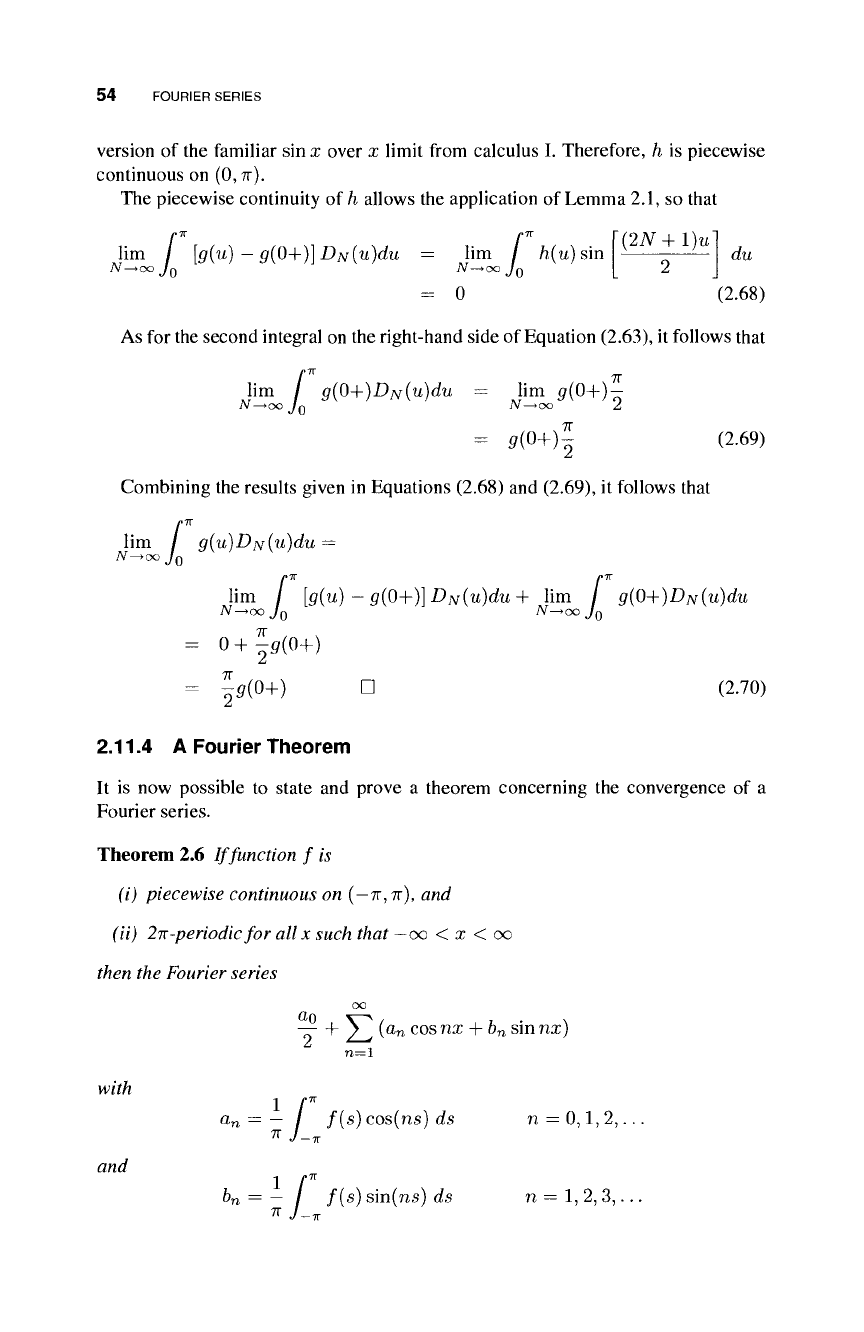
version of the familiar sin x over x limit from calculus I. Therefore, h is piecewise
continuous on (0, π).
The piecewise continuity of h allows the application of Lemma
2.1,
so that
(27V + l)u
du
/»7Γ /»7Γ
lim / [g(u)
—
#(()+)] Djy(u)du — lim / h(u) sin
N->oo J
0
ÍV-+00 JQ
= 0 (2.68)
As for the second integral on the right-hand side of Equation (2.63), it follows that
Jim / g(0+)D
N
(u)du = lim 0(0+)-
= ff(0+)| (2.69)
Combining the results given in Equations (2.68) and (2.69), it follows that
lim / g(u)DN(u)du
—
lim / [g(u) - g(0+)]D
N
(u)du+ lim / g(0+)D
N
(u)du
=
o
+ ^(o+)
= ^(0+) D (2.70)
2.11.4 A Fourier Theorem
It is now possible to state and prove a theorem concerning the convergence of a
Fourier series.
Theorem 2.6 If function f is
(i) piecewise continuous on (—π, π), and
(ii) 2π-periodic for all x such that — oo < x < oo
ί/îen i/îe Fourier series
oo
— + /_^ (a
n
cos
nx + b
n
sin nx)
2
n=l
with
1 /*
π
n = 0,l,2,...
1 Γ
a
n
= — / /(s) cos(ns) ds
1 /*
π
bn = — f(s) sin(ns) ds
^ J-7T
and
1 Γ
n= 1,2,3,...
FOURIER SERIES CONVERGENCE 55
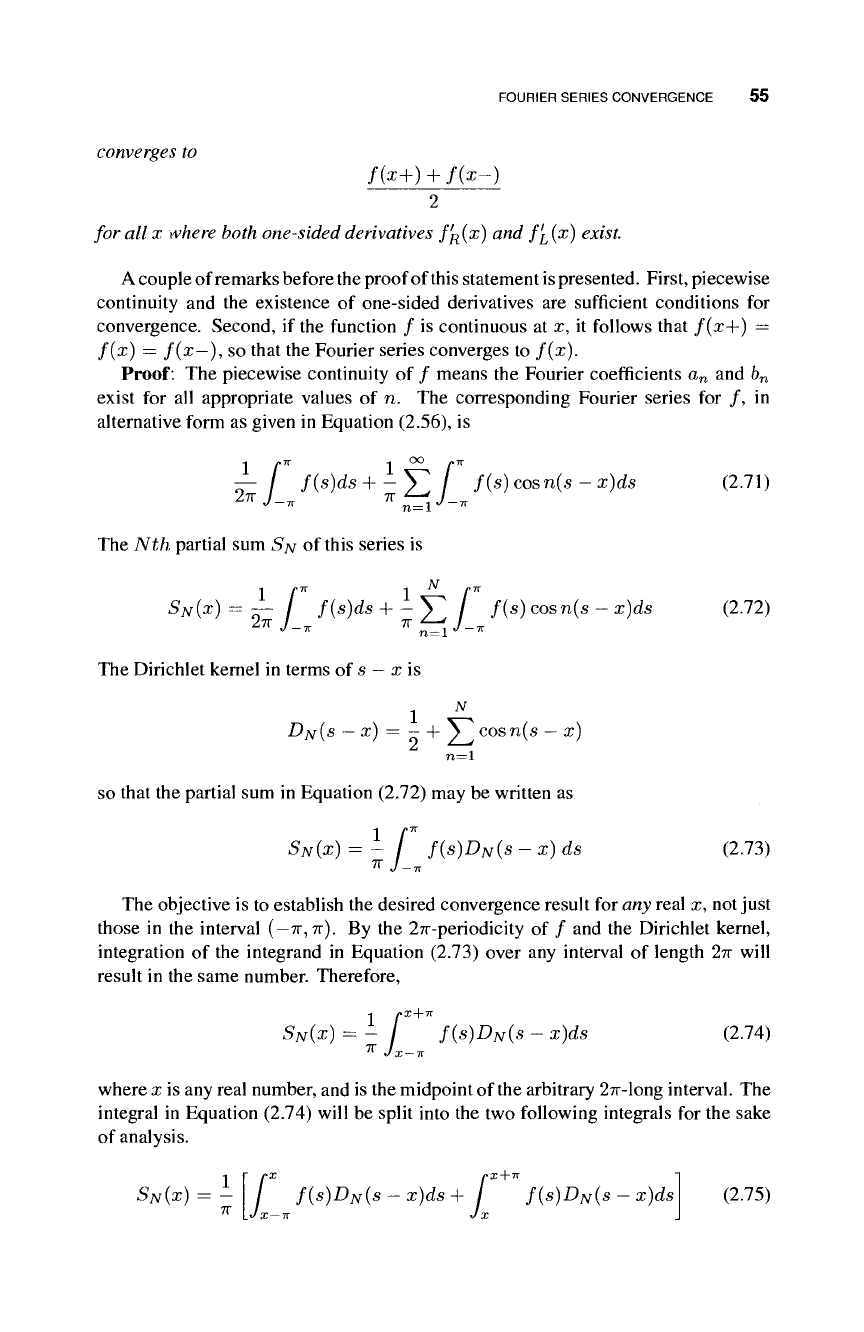
converges to
/(s+)+/(x-)
2
for all x where both one-sided derivatives
f'
R
(x)
and
f'
L
(x)
exist.
A couple of remarks before the proof of this statement
is
presented. First, piecewise
continuity and the existence of one-sided derivatives are sufficient conditions for
convergence. Second, if the function / is continuous at x, it follows that f(x+) —
jf (x) =
f(x-),
so that the Fourier series converges to f(x).
Proof:
The piecewise continuity of / means the Fourier coefficients a
n
and b
n
exist for all appropriate values of n. The corresponding Fourier series for /, in
alternative form as given in Equation (2.56), is
1 Γ
π
1 _°°_ Γ^
— / f(s)ds + -^T f(s) cos n(s-x)ds (2.71)
The Nth partial sum S^ of this series is
S
N
(x)=.—
f f(
s
)ds + -y* [ f(s)cosn(s-x)ds (2.72)
The Dirichlet kernel in terms of s
—
x is
1
N
DN
(S
—
x) = - 4-
2_.
cos
n(s
—
x)
2
n=l
so that the partial sum in Equation (2.72) may be written as
1 Γ
S
N
(x) = - \
f{s)D
N
(s - x) ds (2.73)
The objective is to establish the desired convergence result for any real x, not just
those in the interval (—π, π). By the 27r-periodicity of / and the Dirichlet kernel,
integration of the integrand in Equation (2.73) over any interval of length 2π will
result in the same number. Therefore,
S
N
(x) = - [ f(s)D
N
(s - x)ds (2.74)
π
Jx-π
where x is any real number, and is the midpoint of the arbitrary 27r-long interval. The
integral in Equation (2.74) will be split into the two following integrals for the sake
of analysis.
S
N
(x) = - i Í f(s)D
N
(s - x)ds + / f{s)D
N
(s - x)d
^
{.Jx—TV
Jx
(2.75)
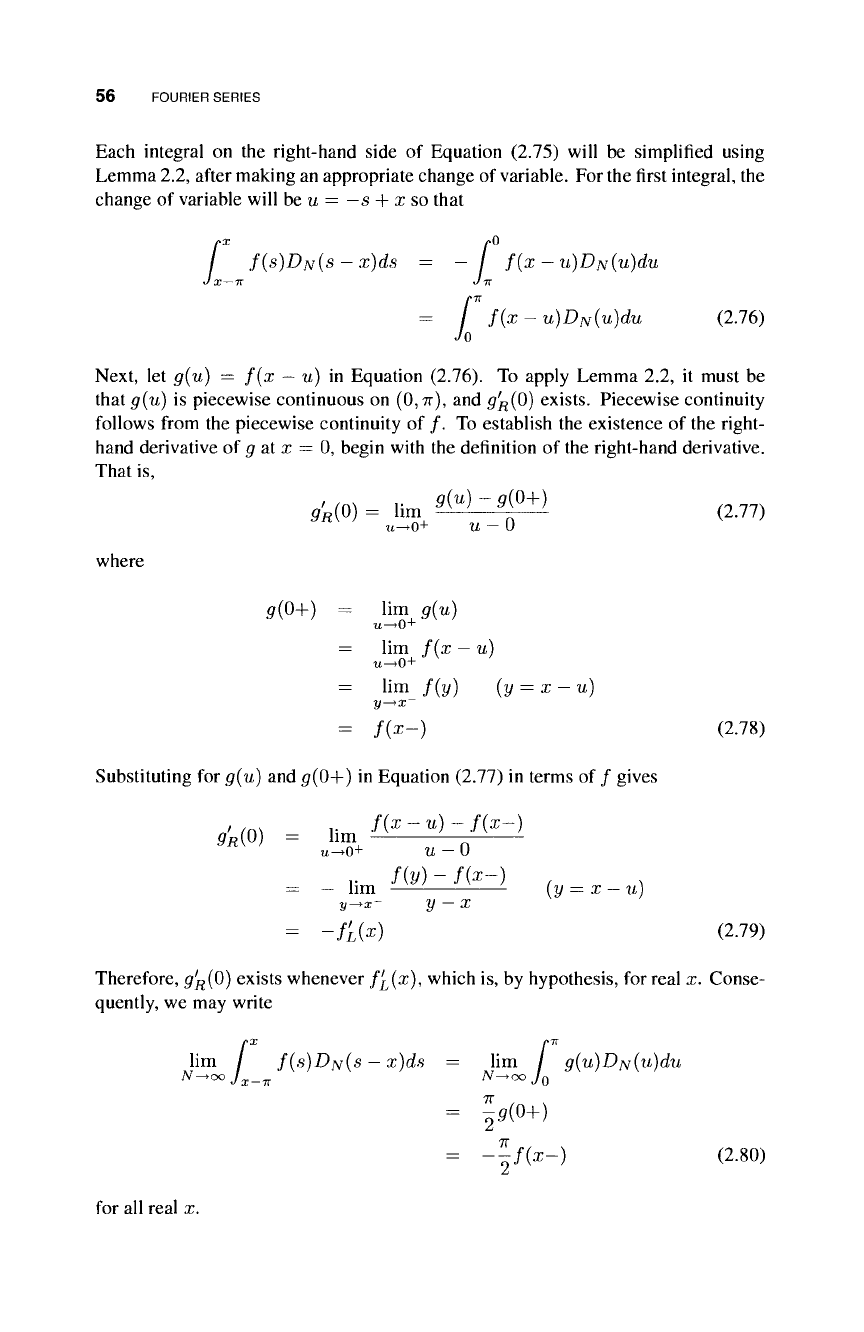
56 FOURIER SERIES
Each integral on the right-hand side of Equation (2.75) will be simplified using
Lemma 2.2, after making an appropriate change of
variable.
For the first integral, the
change of variable will be u = -s + xso that
/
f(s)DN(s
—
x)ds = — I f(x
—
U)DN(U)CIU
J X — 7Γ J TV
f(x-u)D
N
(u)du (2.76)
/"
Jo
Next, let g(u) = f(x
—
u) in Equation (2.76). To apply Lemma 2.2, it must be
that g{u) is piecewise continuous on (Ο,π), and g'
R
(0) exists. Piecewise continuity
follows from the piecewise continuity of /. To establish the existence of the right-
hand derivative of g at x — 0, begin with the definition of the right-hand derivative.
That is,
where
g(0+) = limj(u)
u—>0+
= lim f (x
—
u)
= lim f(y) (y = x-u)
y-*x~
= f(x-) (2.78)
Substituting for g(u) and 5(0+) in Equation (2.77) in terms of / gives
g'
R
(0)
= lim /(* - ") - /(*-)
yñV ;
„^0+ w-0
= - lim
f{y)
-
f{x
-
]
(y = x-u)
V-+X- y - x
= -fí(x)
(2.79)
Therefore, g
f
R
(0) exists whenever
f'
L
(x),
which is, by hypothesis, for real x. Conse-
quently, we may write
lim / f(s)D]y(s
—
x)ds = lim / g{u)D]sr(u)du
= >+)
=
-\fix-)
(2.80)
for all real x.
FOURIER SERIES CONVERGENCE 57
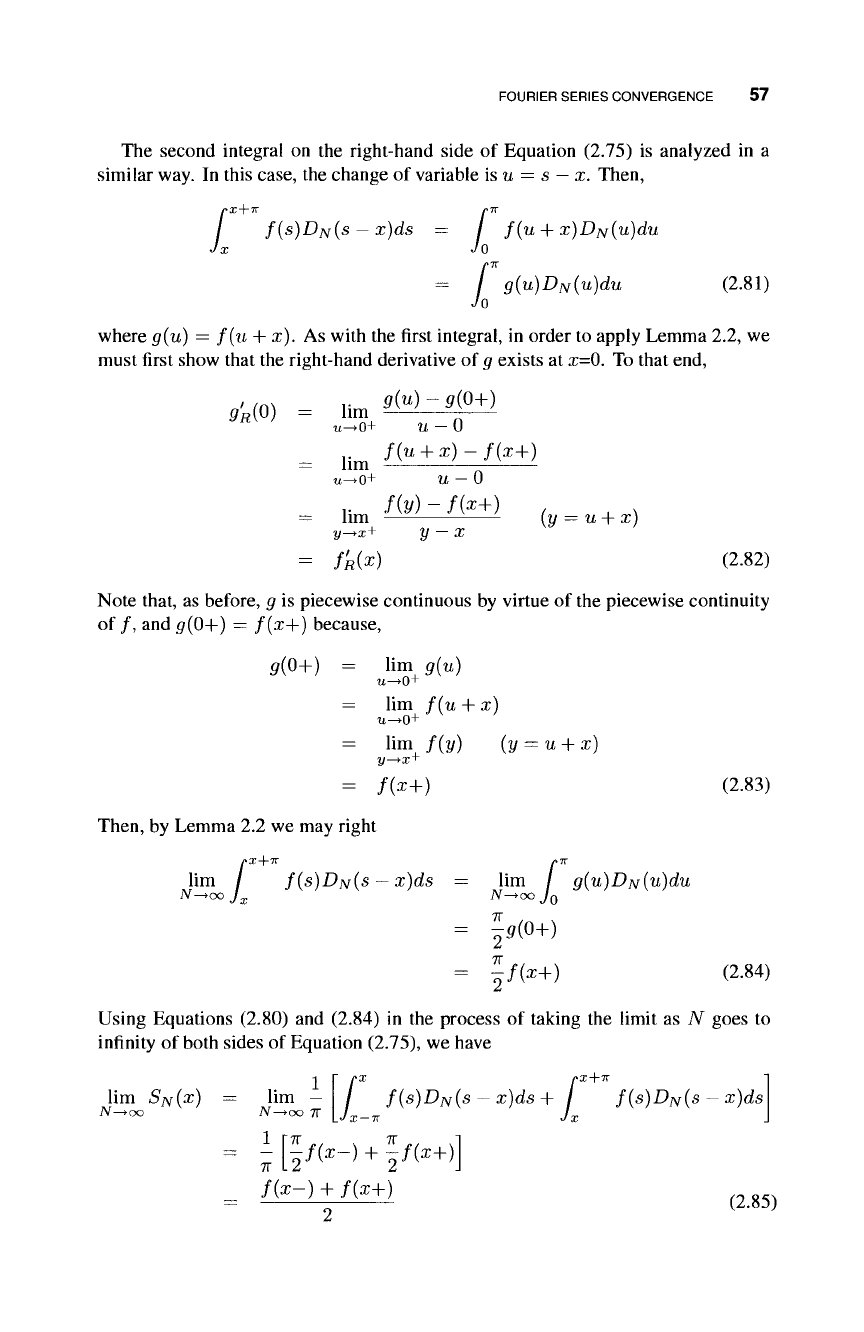
The second integral on the right-hand side of Equation (2.75) is analyzed in a
similar way. In this case, the change of variable is u
—
s
—
x. Then,
ρχ+π ρπ
¡ f{s)D]sf{s
—
x)ds = / f(u + x)D]y(u)du
Jx JO
f
Jo
g(u)D
N
(u)du (2.81)
where g(u) = f(u + x). As with the first integral, in order to apply Lemma 2.2, we
must first show that the right-hand derivative of g exists at x=0. To that end,
¿(0) =
M*tiM
u-^0+ U — 0
=
i
im
/(" + *)-/(*+)
u-»0+ U — 0
,. f(y) - /(*+) , ^ ,
= lim (y = u + x)
y->x+ y-x
=
f'
R
{x)
(2.82)
Note that, as before, g is piecewise continuous by virtue of the piecewise continuity
of/, and #(0+) = /(#+) because,
0(0+) = limo(u)
u->0+
= lim f(u + x)
u-+0+
= lim f(y) (y = u + x)
y-+x+
= f(x+) (2.83)
Then, by Lemma 2.2 we may right
rx+π ρπ
lim / f(s)D]sf(s
—
x)ds = lim / g{u)DN(u)du
^
00
Jx
N->oo
J
0
= |.(o
+
)
= |/(x+) (2-84)
Using Equations (2.80) and (2.84) in the process of taking the limit as
TV
goes to
infinity of both sides of Equation (2.75), we have
lim SN(X) = lim — / f(s)D
N
(s
—
x)ds + / f(s)D
N
(s
—
x)ds
N^oo
N-^oo π |_Λ-
π
Jx
[In*-) +
£/(*+)]
/(*-)+/(*+)
(2.85)
58 FOURIER SERIES
That
is,
the sequence of partial sums of the Fourier series corresponding to / converges
to the average of the one-sided limits of / wherever the one-sided derivatives of /
exist. D
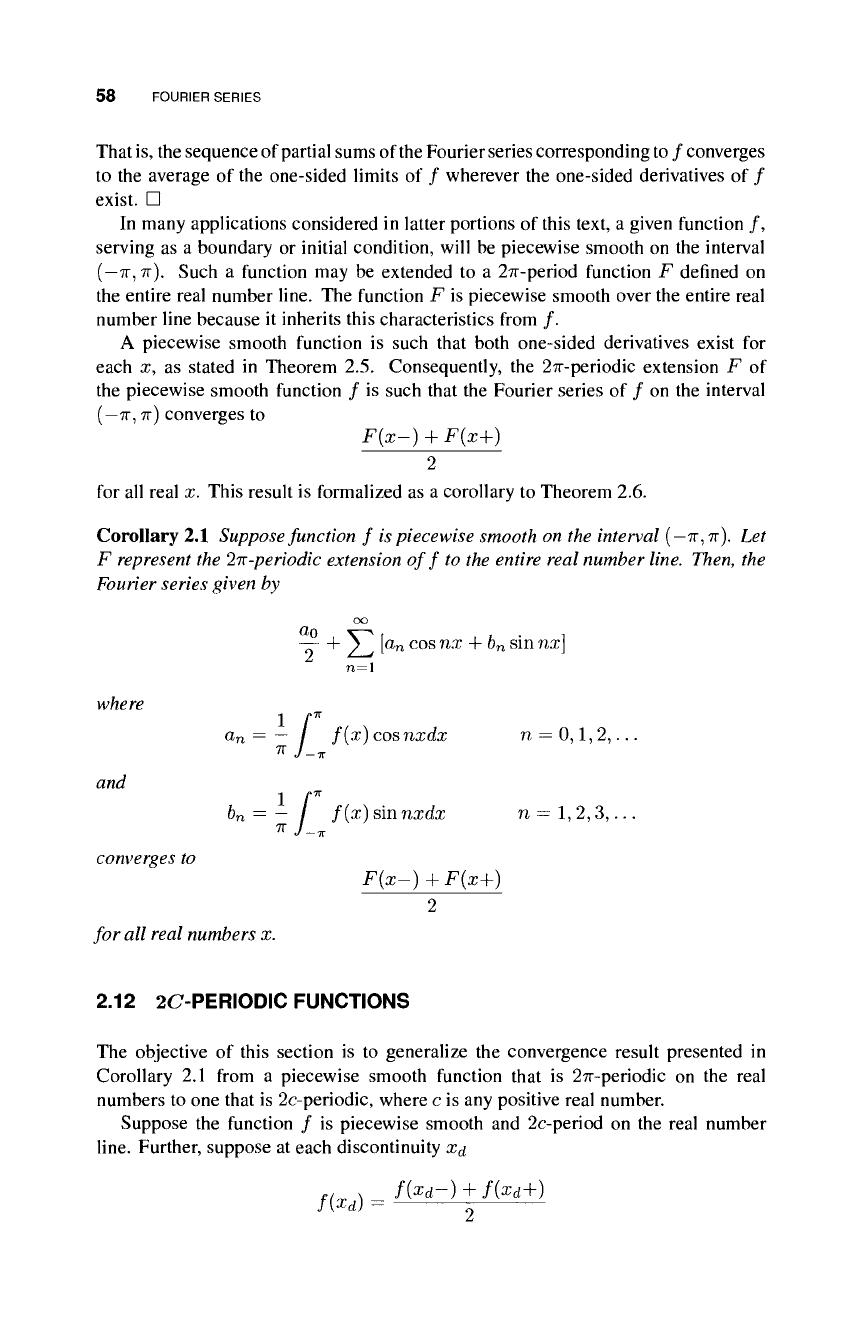
In many applications considered in latter portions of this text, a given function /,
serving as a boundary or initial condition, will be piecewise smooth on the interval
(—7Γ,
π). Such a function may be extended to a 27r-period function F defined on
the entire real number line. The function F is piecewise smooth over the entire real
number line because it inherits this characteristics from /.
A piecewise smooth function is such that both one-sided derivatives exist for
each x, as stated in Theorem 2.5. Consequently, the 27r-periodic extension F of
the piecewise smooth function / is such that the Fourier series of / on the interval
(—7Γ,
π) converges to
F(x-) + F(x+)
2
for all real x. This result is formalized as a corollary to Theorem 2.6.
Corollary 2.1 Suppose function f is piecewise smooth on the interval (—π, π). Let
F represent the 2π-periodic extension of f to the entire real number
line.
Then, the
Fourier
series given by
oo
— + 2_\ [
a
n
cos
nx -f b
n
sin nx]
2
n=l
where
and
1 Γ
a
n
— — I f(x)cosnxdx
1 Γ
b
n
=
—
/ f(x)sinnxdx
π J-TT
n = 0,1,2,...
n
—
1,2,3,...
converges to
F(x-)+F(x+)
2
for all real numbers x.
2.12 2C-PERIODIC FUNCTIONS
The objective of this section is to generalize the convergence result presented in
Corollary 2.1 from a piecewise smooth function that is 27r-periodic on the real
numbers to one that is 2c-periodic, where c is any positive real number.
Suppose the function / is piecewise smooth and 2c-period on the real number
line.
Further, suppose at each discontinuity x¿
f{
Xd
) = n**-)+f(**+)
2C-PERI0DIC FUNCTIONS 59
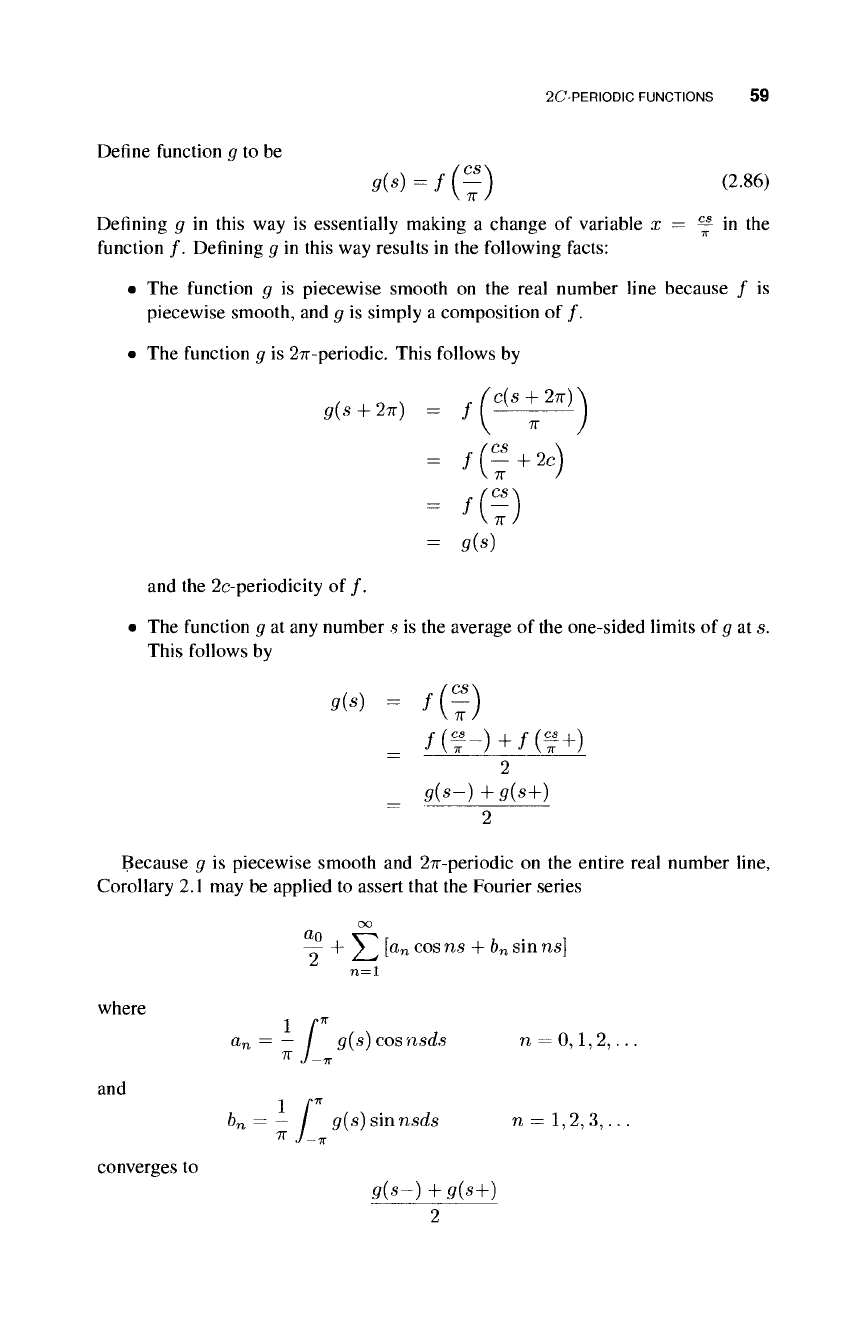
Define function g to be
g(s) = f (") (2.86)
Defining g in this way is essentially making a change of variable x = — in the
function /. Defining g in this way results in the following facts:
• The function g is piecewise smooth on the real number line because / is
piecewise smooth, and g is simply a composition of /.
• The function g is 27r-periodic. This follows by
/■ « N , /φ + 2π)
g(s + 2n) = f
1 K }
)
9(s)
and the 2c-periodicity of /.
• The function g at any number s is the average of the one-sided limits of
g
at 5.
This follows by
9is) = /(f)
2
g(s-)+g(s+)
Because g is piecewise smooth and 2π-periodic on the entire real number line,
Corollary 2.1 may be applied to assert that the Fourier series
where
and
— + 2_, \
a
n
cos ns
+ b
n
sin
ns]
2
n=l
1 Γ
a
n
=
—
/ g(s) cos nsds
π J-7T
1 Γ
K = - / g(s)
n = 0,l,2,...
converges to
sinnsds n
—
1,2,3,...
60 FOURIER SERIES
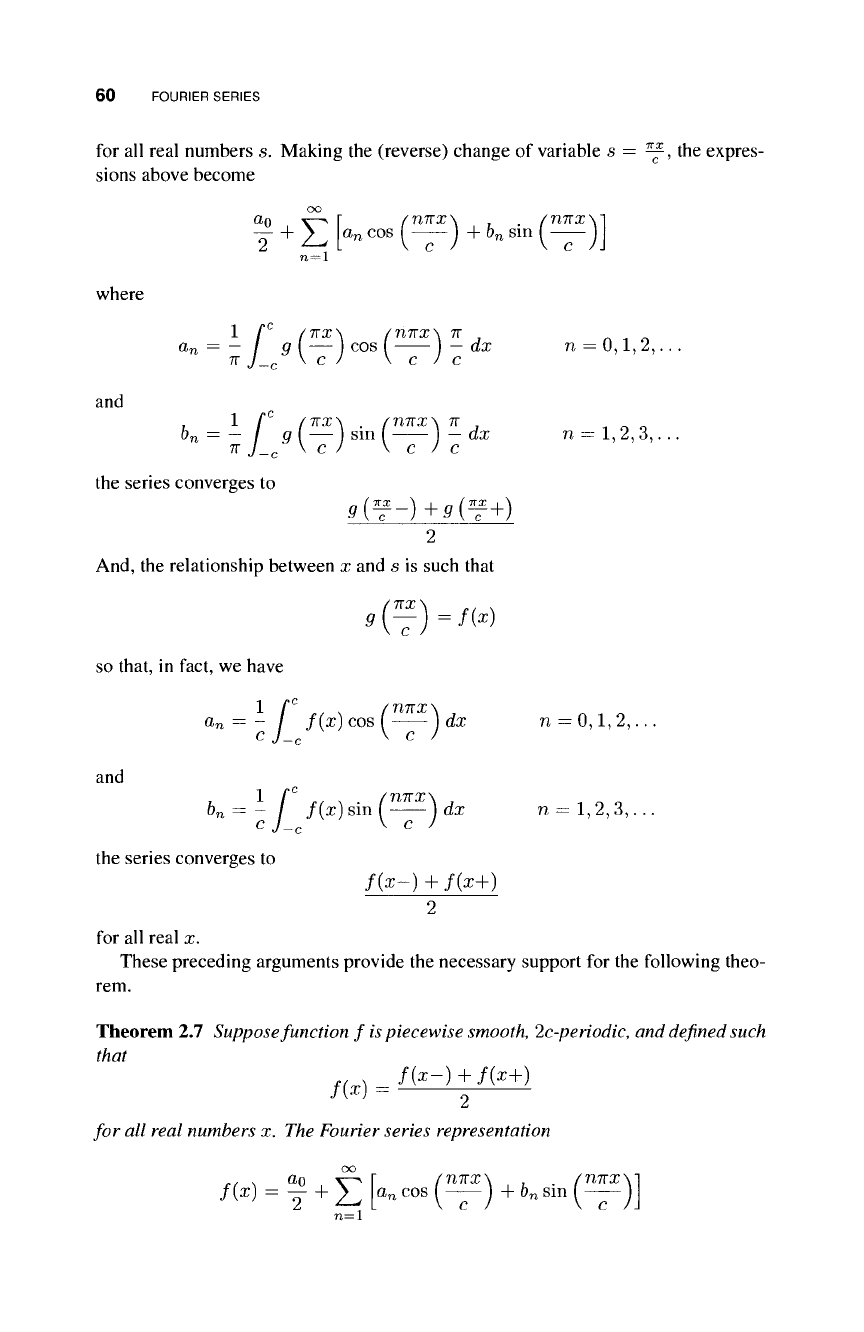
for all real numbers s. Making the (reverse) change of variable s = ^f, the expres-
sions above become
oo
y
+
Σ,
r
n
cos
V~
J
+
6n
sm
V~JJ
n=l
where
1 /*
c
/πχ\ /ηπχ\ π
Ί
Λ
.
η
α
η
=
—
/ g I—J cos
(
)
—
αχ η = 0,1,2,...
η = 1,2,3,.
and
_ 1 í
c
/πχ\ . /ηπχ\ π ,
6
"
=
π/_
ο
ητ)
8ΐη
Ι—Jc
dx
the series converges to
0(ΊΓ-)+0ΟΓ+)
2
And, the relationship between x and 5 is such that
so that, in fact, we have
«n = - / f(x)
COS
( J dx
and
b
n
= - f(x) sin f J dx
the series converges to
/(s-)+/(s+)
2
for all real x.
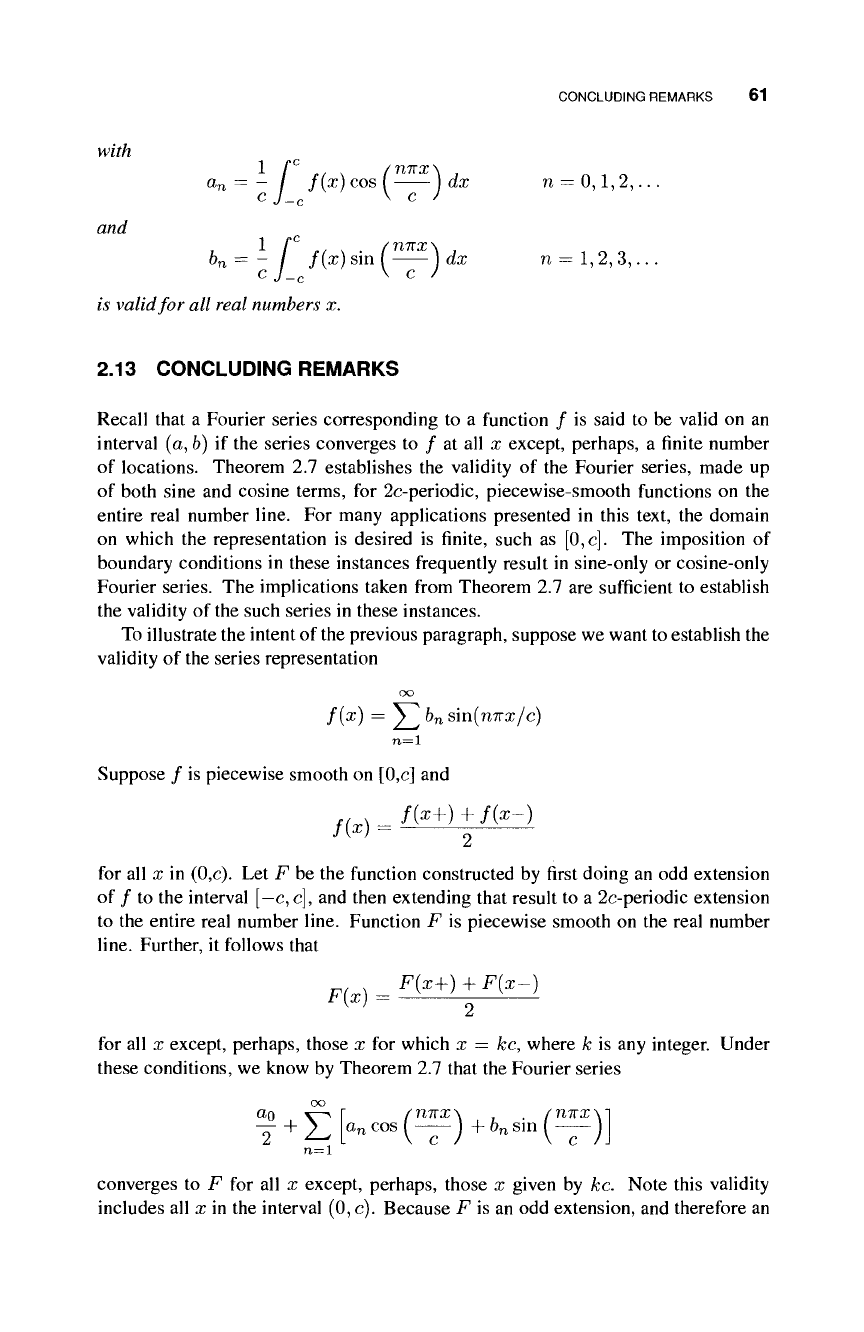
These preceding arguments provide the necessary support for the following theo-
rem.
Theorem 2.7 Suppose function f ispiecewise
smooth,
2c-periodic, and
defined
such
that
/or a//
retf/
numbers x. The Fourier series representation
oo
/(x) = — + 2^ [
α
η cos ^ J + b
n
sm ^—■ J J
n=l
n = 0,l,2,...
n = 1,2,3,...
CONCLUDING REMARKS 61
with
and
1 f
/TL7TX\
a
n
= - I f(x)cos[ ) dx n
—
0,1,2,.
b
n
= - / f(x) sin ( j dx
\ c )
n= 1,2,3,...
is valid for all real numbers x.
2.13 CONCLUDING REMARKS
Recall that a Fourier series corresponding to a function / is said to be valid on an
interval (a,
b)
if the series converges to / at all x except, perhaps, a finite number
of locations. Theorem 2.7 establishes the validity of the Fourier series, made up
of both sine and cosine terms, for 2c-periodic, piecewise-smooth functions on the
entire real number line. For many applications presented in this text, the domain
on which the representation is desired is finite, such as
[0,c].
The imposition of
boundary conditions in these instances frequently result in sine-only or cosine-only
Fourier series. The implications taken from Theorem 2.7 are sufficient to establish
the validity of the such series in these instances.
To illustrate the intent of
the
previous paragraph, suppose we want to establish the
validity of the series representation
oo
f(x) = 2_\ b
n
sin(mrx/c)
n=l
Suppose / is piecewise smooth on [0,c] and
/(χ)=
/(χ+)+ /(*-)
for all x in (0,c). Let F be the function constructed by first doing an odd extension
of / to the interval [—c,
c],
and then extending that result to a 2operiodic extension
to the entire real number line. Function F is piecewise smooth on the real number
line.
Further, it follows that
Fix) =
^+Η^*-)
for all x except, perhaps, those x for which x = kc, where k is any integer. Under
these conditions, we know by Theorem 2.7 that the Fourier series
oo
αο ν^ Γ /ηπχ\ . . /ηπχλΐ
Y
+ ^[a„cos(—J+6
n
sin(—jj
converges to F for all x except, perhaps, those x given by kc. Note this validity
includes all x in the interval (0, c). Because F is an odd extension, and therefore an