
Bernatz R. Fourier Series and Numerical Methods for Partial Differential Equations
Подождите немного. Документ загружается.

32 FOURIER SERIES
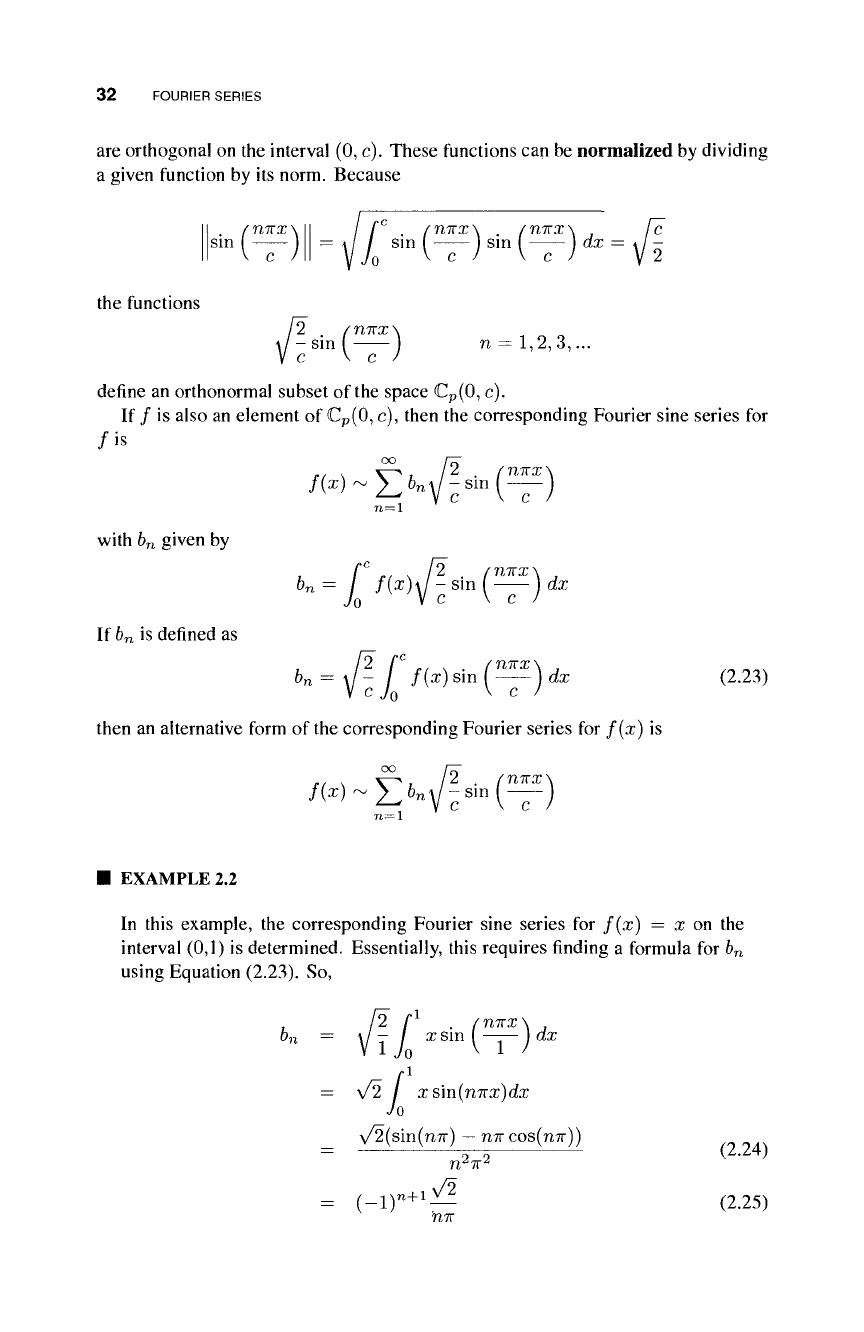
are orthogonal on the interval (0, c). These functions can be normalized by dividing
a given function by its norm. Because
/ηπχ\\\
/ f
c
/ηπχ\ /ηπχ\ [c
sm
{—JIr
vi,
S1
H—J
sin
l—)
dx
= \i2
the functions
19.
/
Τ7.7ΓΤ
\
n
=
1,2,3,...
/
2
/ηπχ\
c
Sm
\—)
define an orthonormal subset of the space C
p
(0, c).
If
/
is also an element of C
p
(0, c), then the corresponding Fourier sine series for
/is
71=1
with b
n
given by
If b
n
is defined as
/*
C
/2 /T17TX\
K=
f(x)\ -
sin
dx
Jo V
c \ c J
b
n
=
^J° f{x)sm(^)dx
(2.23)
then an alternative form of the corresponding Fourier series for
f(x)
is
/(x)-^6
n
W-sm^-—J
n=l
EXAMPLE 2.2
In this example, the corresponding Fourier sine series for
f(x) = x
on the
interval (0,1) is determined. Essentially, this requires finding a formula for b
n
using Equation (2.23). So,
2
f
1
. /ηπχ\ ,
U
xsm
\—)
dx
y/2
/
xsin(rarx)dx
Jo
y/2(sin(nn)
—
ηποοβ(ηπ))
f-l)
n+1
- (2.25)
'ηπ
FOURIER SINE SERIES ON (0, C) 33
and the corresponding series is
^2 ~ (_l)n+l
x ~ — > vzsminnx)
n—l
~ — > sm(nnx)
π ¿-^ n
v y
n=l
(2.26)
The formula for b
n
show in Equation (2.25) was actually determined with the
aid of a Maple worksheet.
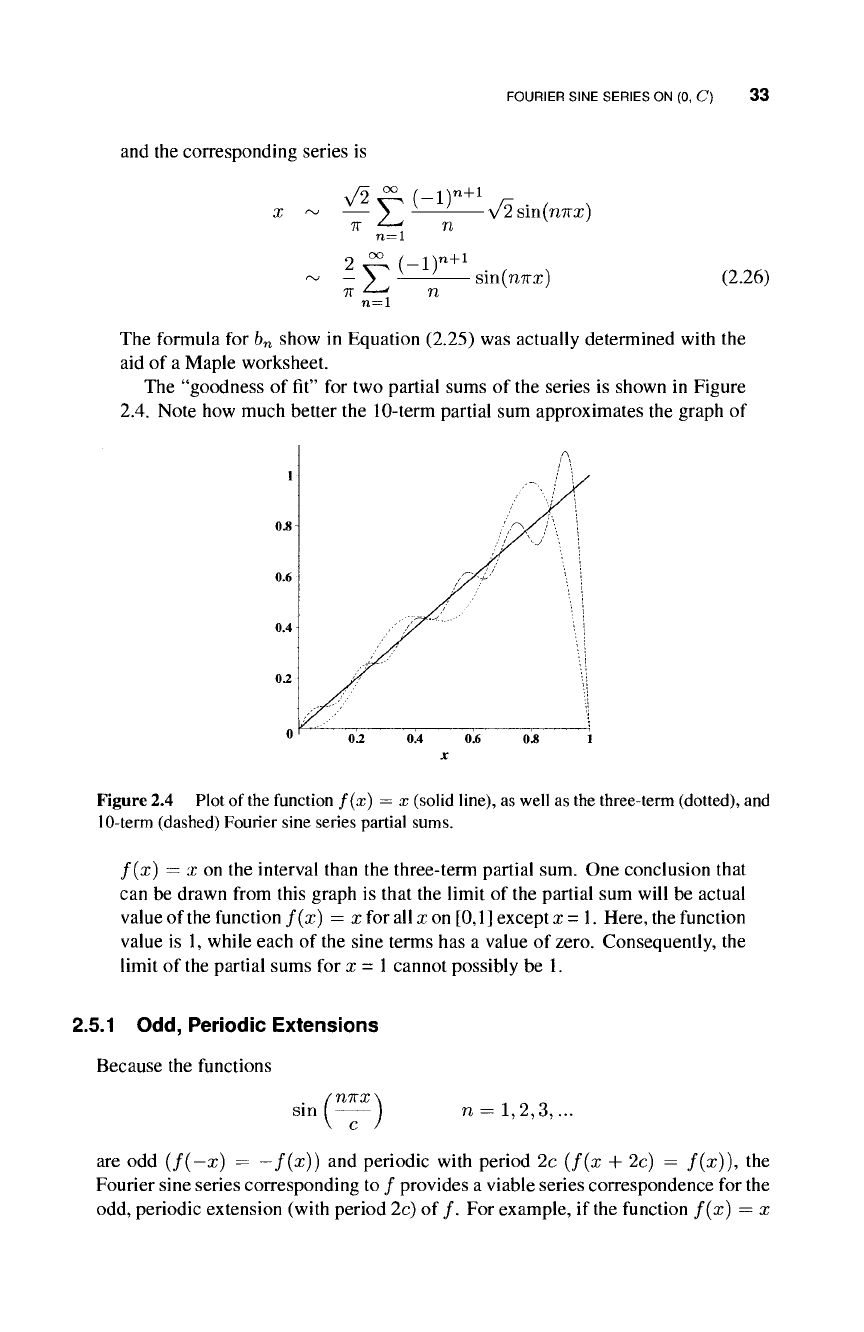
The "goodness of fit" for two partial sums of the series is shown in Figure
2.4. Note how much better the 10-term partial sum approximates the graph of
Figure 2.4 Plot of
the
function f(x)
—
x (solid
line),
as well as the three-term (dotted), and
10-term (dashed) Fourier sine series partial sums.
f(x)
—
x on the interval than the three-term partial sum. One conclusion that
can be drawn from this graph is that the limit of the partial sum will be actual
value of the function f(x)
—
x for all x on [0,1] except x - 1. Here, the function
value is 1, while each of the sine terms has a value of
zero.
Consequently, the
limit of the partial sums for x -
1
cannot possibly be 1.
2.5.1 Odd, Periodic Extensions
Because the functions
. /ηπχ\
Sm
{
—
)
n = 1,2,3,
are odd
(/(—x)
= —/(#)) and periodic with period 2c (f(x 4- 2c) = /(#))» the
Fourier sine series corresponding to / provides a viable series correspondence for the
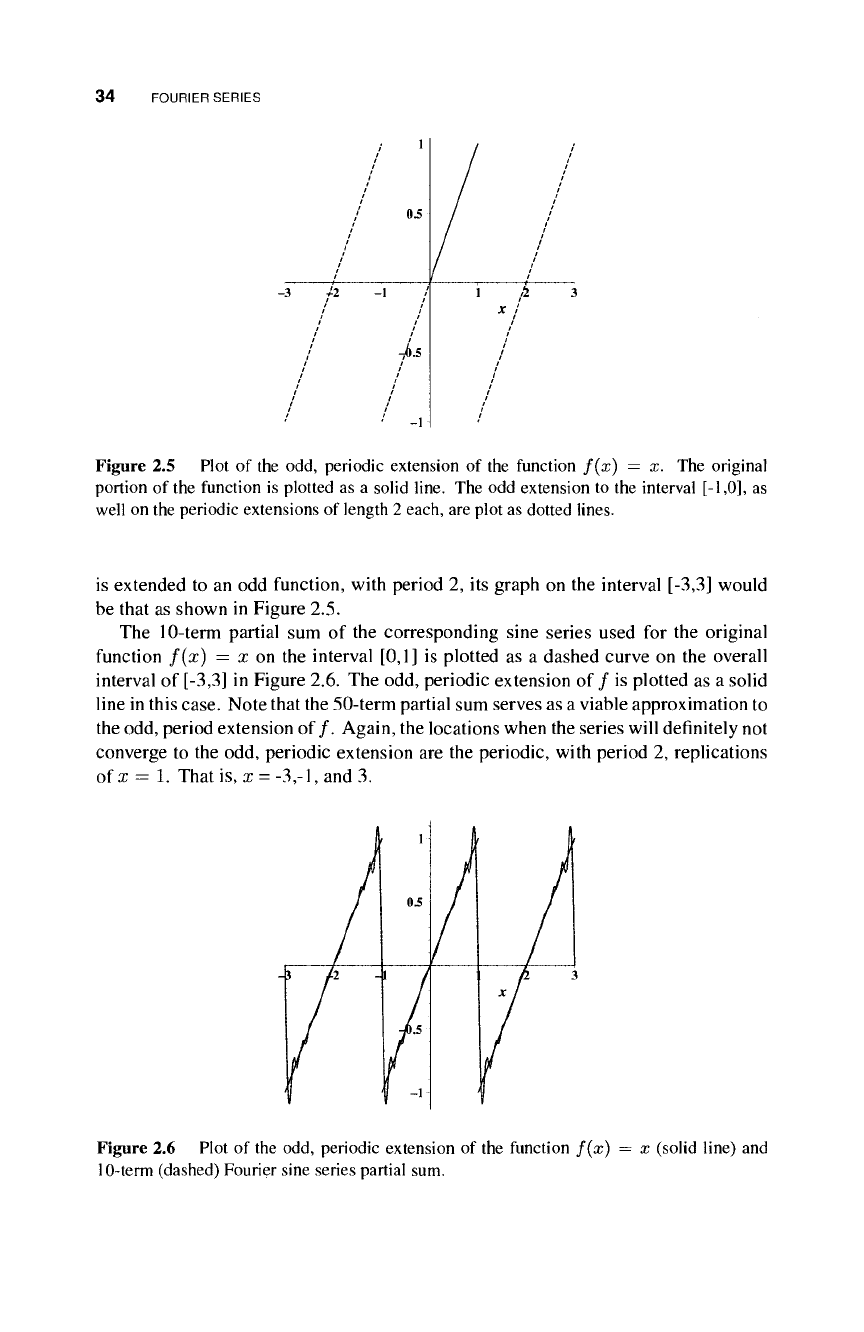
odd, periodic extension (with period 2c) of /. For example, if the function f(x) = x
34 FOURIER SERIES
Figure
2.5
Plot
of the odd,
periodic extension
of the
function
f(x) = x. The
original
portion
of
the function
is
plotted
as a
solid line.
The odd
extension
to the
interval [-1,0],
as
well
on
the periodic extensions
of
length 2 each, are plot as dotted lines.
is extended
to an odd
function, with period
2, its
graph
on the
interval
[-3,3]
would
be that
as
shown
in
Figure
2.5.
The 10-term partial
sum of the
corresponding sine series used
for the
original
function
f(x) — x on the
interval
[0,1] is
plotted
as a
dashed curve
on the
overall
interval
of [-3,3] in
Figure 2.6.
The odd,
periodic extension
of / is
plotted
as a
solid
line
in
this case. Note that the 50-term partial
sum
serves
as a
viable approximation
to
the odd, period extension
of/.
Again,
the
locations when the series will definitely
not
converge
to the odd,
periodic extension
are the
periodic, with period
2,
replications
of
x
—
1.
That is,
x
=
-3,-1,
and 3.
Figure
2.6
Plot
of the odd,
periodic extension
of
the function
f(x) = x
(solid line)
and
10-term (dashed) Fourier sine series partial
sum.
FOURIER COSINE SERIES ON (0, C) 35
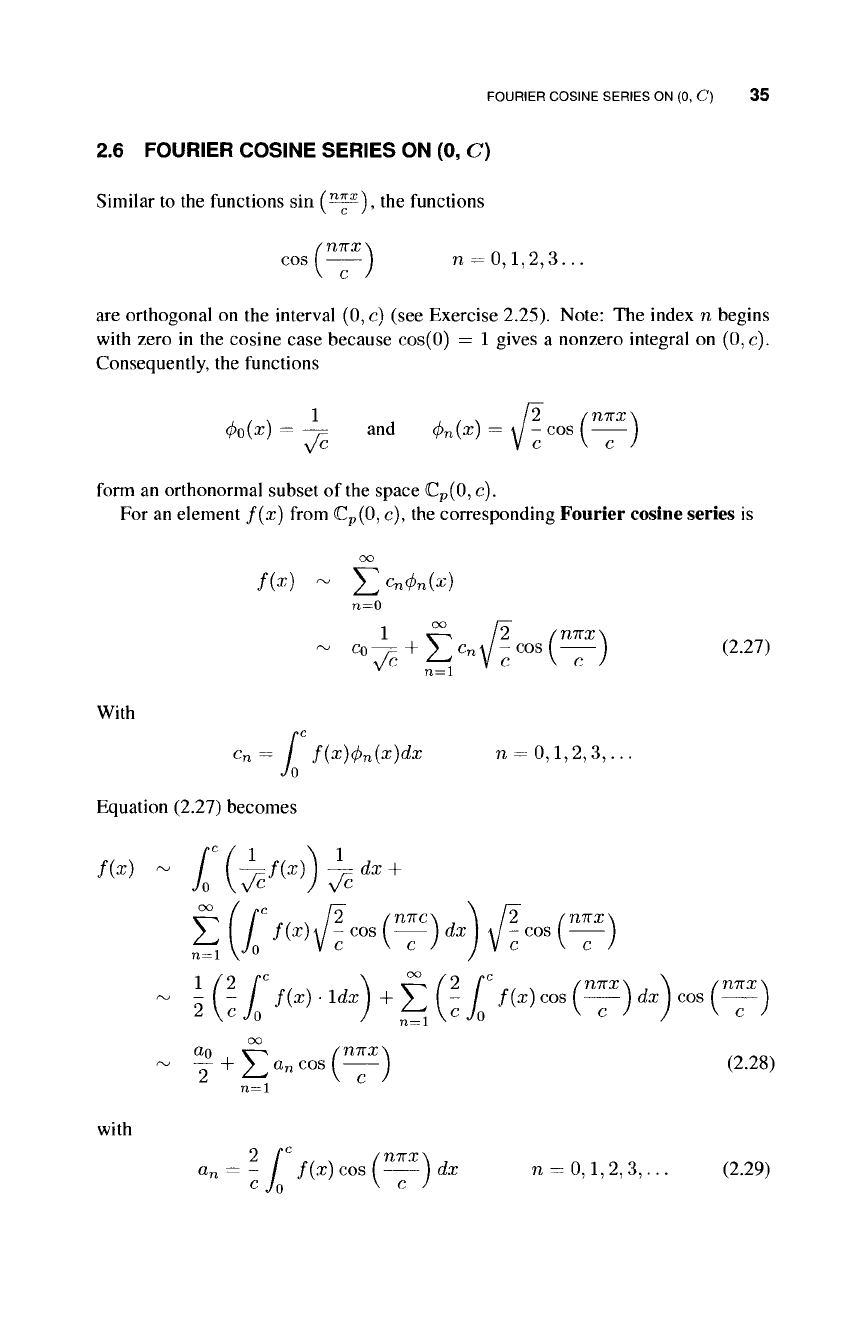
2.6 FOURIER COSINE SERIES ON (0, C)
Similar to the functions sin (!*££), the functions
(
ΤΪ7ΓΧ
\
J n = 0,l,2,3...
are orthogonal on the interval (0, c) (see Exercise 2.25). Note: The index n begins
with zero in the cosine case because cos(0) = 1 gives a nonzero integral on (0, c).
Consequently, the functions
φο(χ) = — and φ
η
(χ) = J- cos ( J
form an orthonormal subset of the space C
p
(0, c).
For an element f(x) from C
p
(0, c), the corresponding Fourier cosine series is
CO
f(
x
) ~
Υ^ο
η
φ
η
(χ)
n=0
-,
+ E
c
«Vc
cos
(—)
(2
·
27)
Co
r
V
C
1
v
n—\
With
c
n
= / ί{χ)φ
η
{χ)άχ η = 0,1,2,3,...
Jo
Equation (2.27) becomes
/(*) ~ £^f(x))^=dx
1
K
^/C
J
^' ) y/c
i(!jf/w-".)
+
Ê(!jf/w«(^)*)c-(^)
CO
a
n
cos Í j (2.28)
CO
Oo
y
n=l
with
2 f
C
/
ΤΙΊΤΧ
\
a
n
= - f(x)cos(—-Jdx n = 0,1,2,3,... (2.29)
36 FOURIER SERIES
EXAMPLE 2.3
Here the Fourier cosine series is determined for the function
f(x)
=xon the
interval (0,1). As with the sine series, this is accomplished by finding values
for the coefficients c
n
using Equation (2.29). The results are
2
f
1
ao
— - I x
· \dx
1 Jo
=
1
2
f
1
/ηπχ\
Ί
a
n
= -
x cos
I
—-—
1
ax
2(-l+
(-!)")
η
2
π
2
-4
(2n
-
1)
2
7Γ
2
Using these results, corresponding cosine series for x is
.n
=
1,2,3,...
n = 1,2,3,... (2.30)
i
OO
Λ
1
.
v
-4
*~2
+
^(2n-l)^
COS((2n
~
1)7nr)
n=l
v y
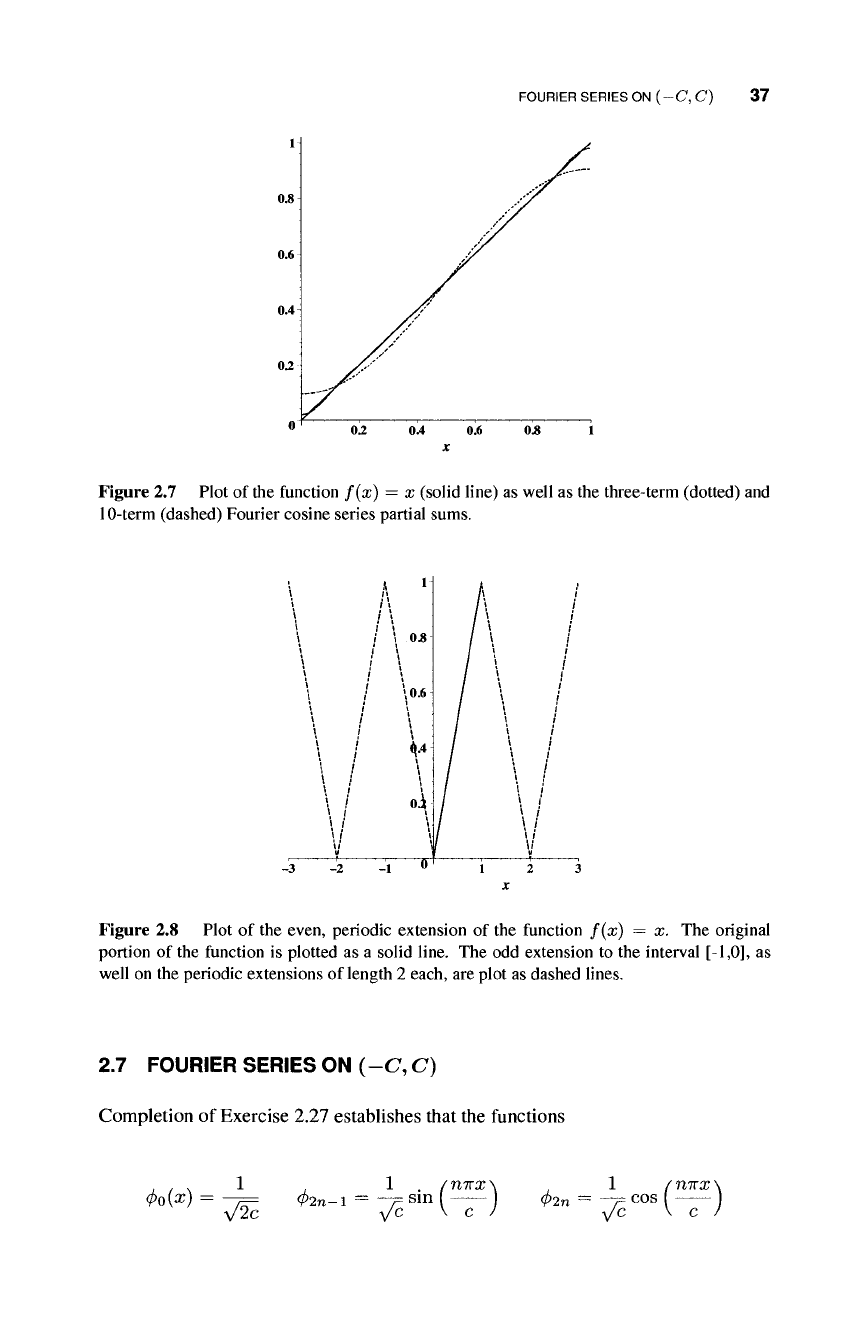
Figure 2.7 shows the plots of x as well as the three-term and 10-term cosine
series partial sums for
x.
The 10-term partial sum gives
a
rather accurate
approximation to the graph of x on the interval (0,1). As with the sine series
case,
Figure 2.7 suggests that the cosine series for x will converge to f(x)
—
x
for points in the interval (0,1). Note: In the present case, it seems as though
the full series will converge to
f(x)
=
x
at the end points as well. In the sine
series example, convergence at
x
= 1
seems doubtful (refer to Figure 2.4).
2.6.1 Even, Periodic Extensions
Just as it seems reasonable that the Fourier sine series provides a viable correspon-
dence to an odd, periodic extension of
a
given function
/
on (0,1), the Fourier cosine
series provides a viable series correspondence for the even, periodic extension of /.
Any function
/
defined on the interval [0,c] may be extended in an even, periodic
(with period 2c) fashion by requiring f(—x)
= f(x)
and
f(x
4- 2c)
= f(x)
The
even extension of x, with period 2, is graphed in Figure 2.8.
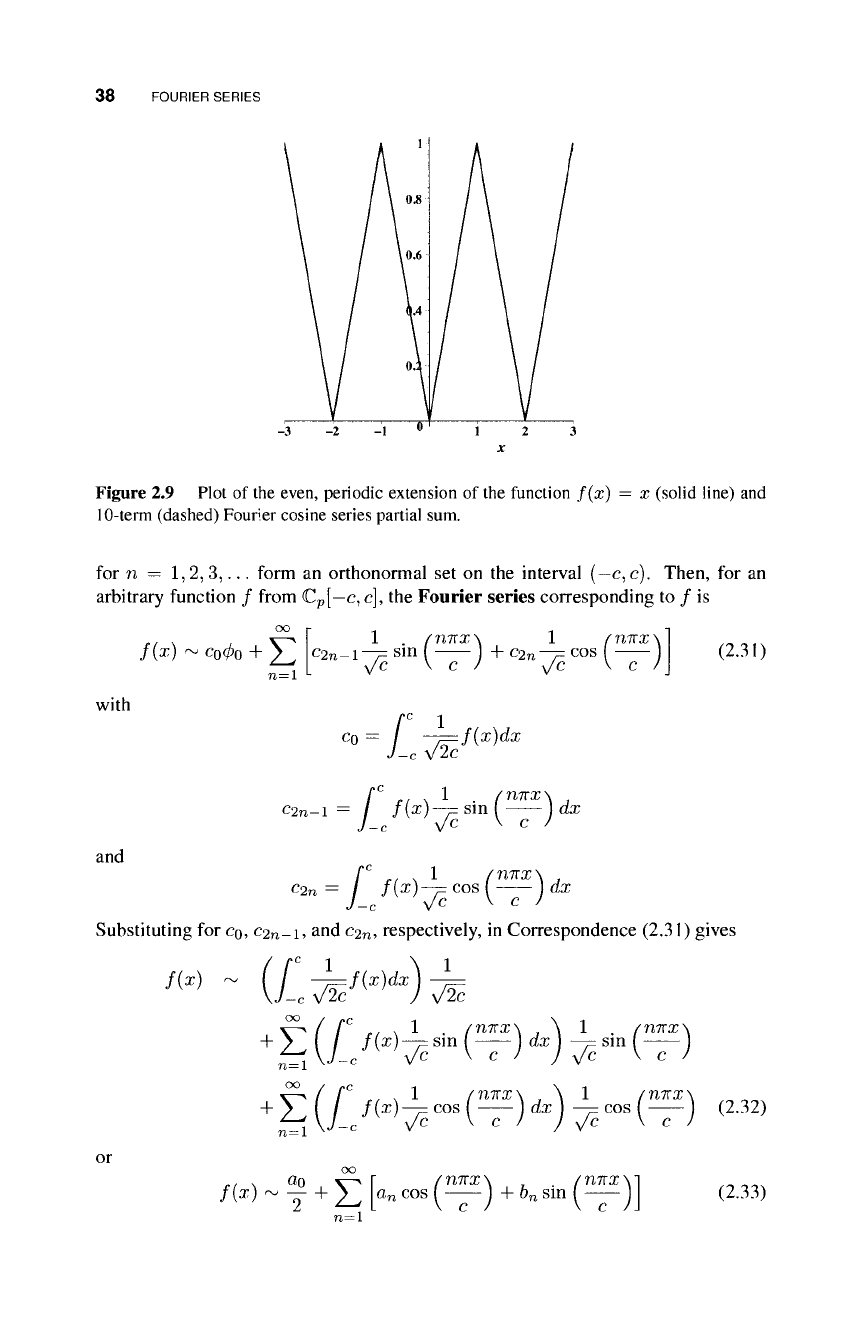
The 10-term cosine partial sum corresponding to the even, periodic extension of
f(x)
—
x
oven the interval
[-3,3]
is shown in Figure 2.9. The plot provides greater
evidence for the hope of series convergence at points
x
=
-3,-1,1,
and 3. Again, this
was not the case for the sine series, as shown in Figure 2.6.
FOURIER SERIES ON (-C, C) 37
Figure 2.7 Plot of the function f(x) = x (solid line) as well as the three-term (dotted) and
10-term (dashed) Fourier cosine series partial sums.
A
/ \
l\
1 1
/
1
0.8
\ 0.6
\
1
\
oi
t
A
/ \
1
* '
/ \
,;
/ * '
/ \ '
/ * '
/
\ /
V
1 2
X
Figure 2.8 Plot of the even, periodic extension of the function f(x) = x. The original
portion of the function is plotted as a solid line. The odd extension to the interval [-1,0], as
well on the periodic extensions of length 2 each, are plot as dashed lines.
2.7 FOURIER SERIES ON (-C, C)
Completion of Exercise 2.27 establishes that the functions
. , v 1 , 1 /ηπχ\ . 1 /ηπχ\
Φθ{Χ) = -7= Ψ2η-1 = —F
Sm
l
<P2n
= —F
COS
ί )
38 FOURIER SERIES
Figure 2.9 Plot of the even, periodic extension of the function f(x) = x (solid line) and
10-term (dashed) Fourier cosine series partial sum.
for n = 1,2,3,... form an orthonormal set on the interval (—c,
c).
Then, for an
arbitrary function / from C
p
[—c,
c],
the Fourier series corresponding to / is
with
r/
. . ^ Γ 1 . /ηπχ\ 1 /ηπχ\
f{x) ~ C
O
0O + 2^ \C2n-l-7= Sin ^ J + C
2n
-y=
COS
^ J
Γ i
Co = / -
7
==f{x)dx
J-c
V2c
/
1 /
Τ17ΓΧ
\
J
{x)
^fc
Shi
\—)
dx
(2.31)
and
/
C
1 / 7Ί7ΓΧ \
/(#)—=cos(^ J dx
Substituting for
Co,
C2
n
_i, and C2
n
, respectively, in Correspondence (2.31) gives
/(*)
-==f(x)dx I —7=
'Se
;
y x/2¿
or
/ Γ^ 1 / TÍ7TX \ \ 1 /
ΊΊ7ΓΊΓ
\
+
Σ (j-/
(x)
v?
sin
W
ώ
)
7¿
sin
("TV
+
|(£/(,)-Lcos(^)^)±cos(^)
(
,
32
)
/(*)
~
? + Σ
h
cos
(^)
+ K sin
(^)l
(2
·
33)
FOURIER SERIES ON (-C, C) 39
where
In = - / f(x)
COS
( j dx,
1 /" / 7Ί7ΓΧ \
b
n
= - I f(x) sin f ) dx n =
1,2,3,..
n = 0,1,2,3,...
and
EXAMPLE 2.4
Find the Fourier series corresponding to the function
/(*) = { 1
-1 <x <0
x 0<x < 1
As with the other Fourier series examples, the primary object is to determine
formulas for the required coefficients. Therefore,
a
0 = 7 / J\X)dX
\j
f(x)da
= / 1
·
dx + / (1 - x)dx
3
2
1 /* /
T17TX
\
a
n
= - f(x) cos
(^-j—J
dx
= / 1
·
cos (ηπχ) dx + / (1
—
x) · cos (mrx) dx
(2n - 1)
2
π
2
n =
1,2,3,...
and
1 /* /
7Ζ7ΓΧ
\
6
n
= - / /(x) sin (^—— J dx
= / 1 · sin(mrx)(ix + / (1
—
x) sin(nnx)da
-i + (-i)
n
+
i
ηπ ηπ
(-l)
n
^
J
— n =
1,2,3,...
ηπ
40 FOURIER SERIES
Substituting these coefficient formulas in Correspondence (2.33) gives
/(*)~ΐ +
Σ
n=l
2 (-l)
n
-K-T:
cos ((2n
—
1)πχ)
H
sin(mrx)
(2n - 1)
2
π
2
ηπ
(2.34)
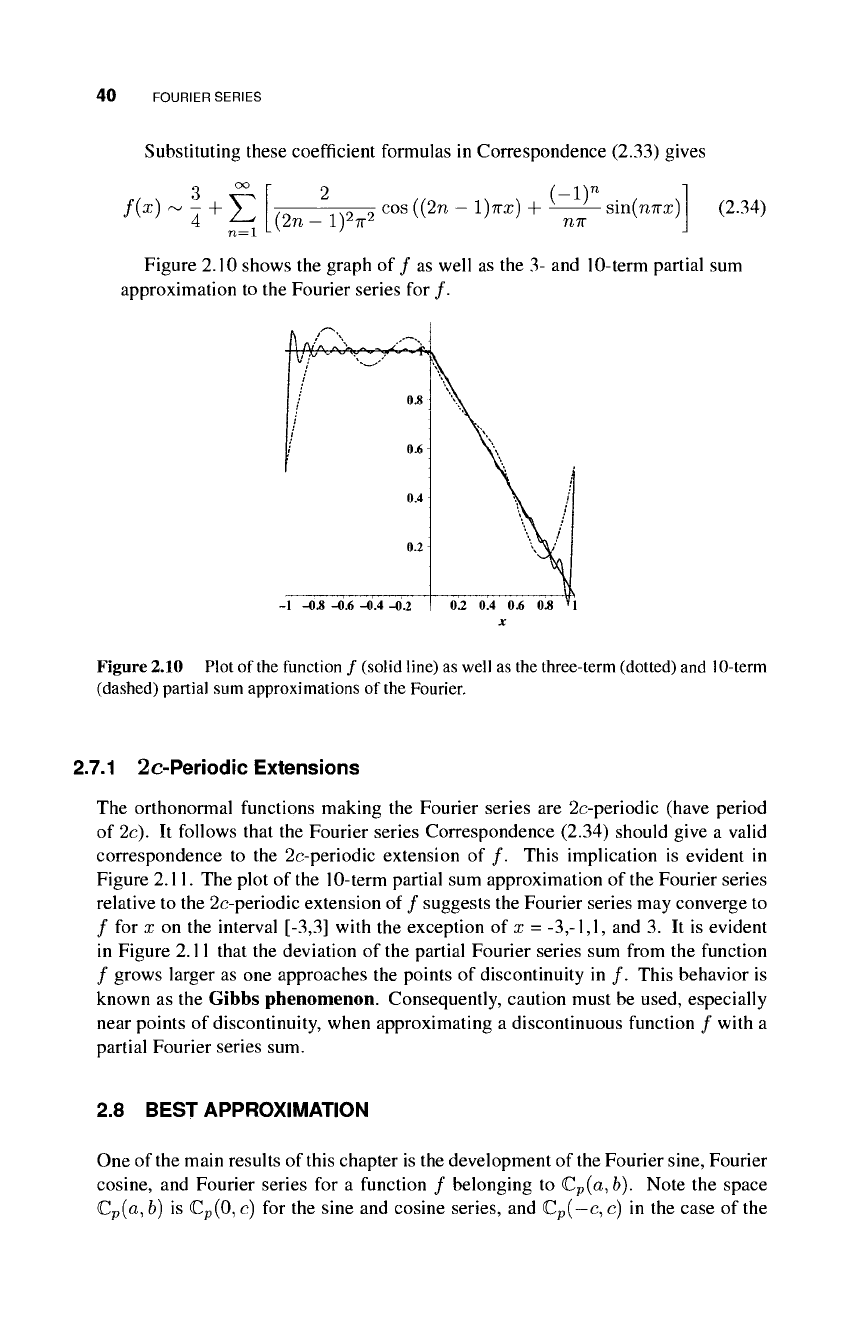
Figure 2.10 shows the graph of / as well as the 3- and 10-term partial sum
approximation to the Fourier series for /.
MfrvOy^v^
-1 -0.8 -0.6 -0.4 -0.2
Figure 2.10 Plot of
the
function / (solid line) as well as
the
three-term (dotted) and 10-term
(dashed) partial sum approximations of
the
Fourier.
2.7.1 2c-Periodic Extensions
The orthonormal functions making the Fourier series are 2c-periodic (have period
of 2c). It follows that the Fourier series Correspondence (2.34) should give a valid
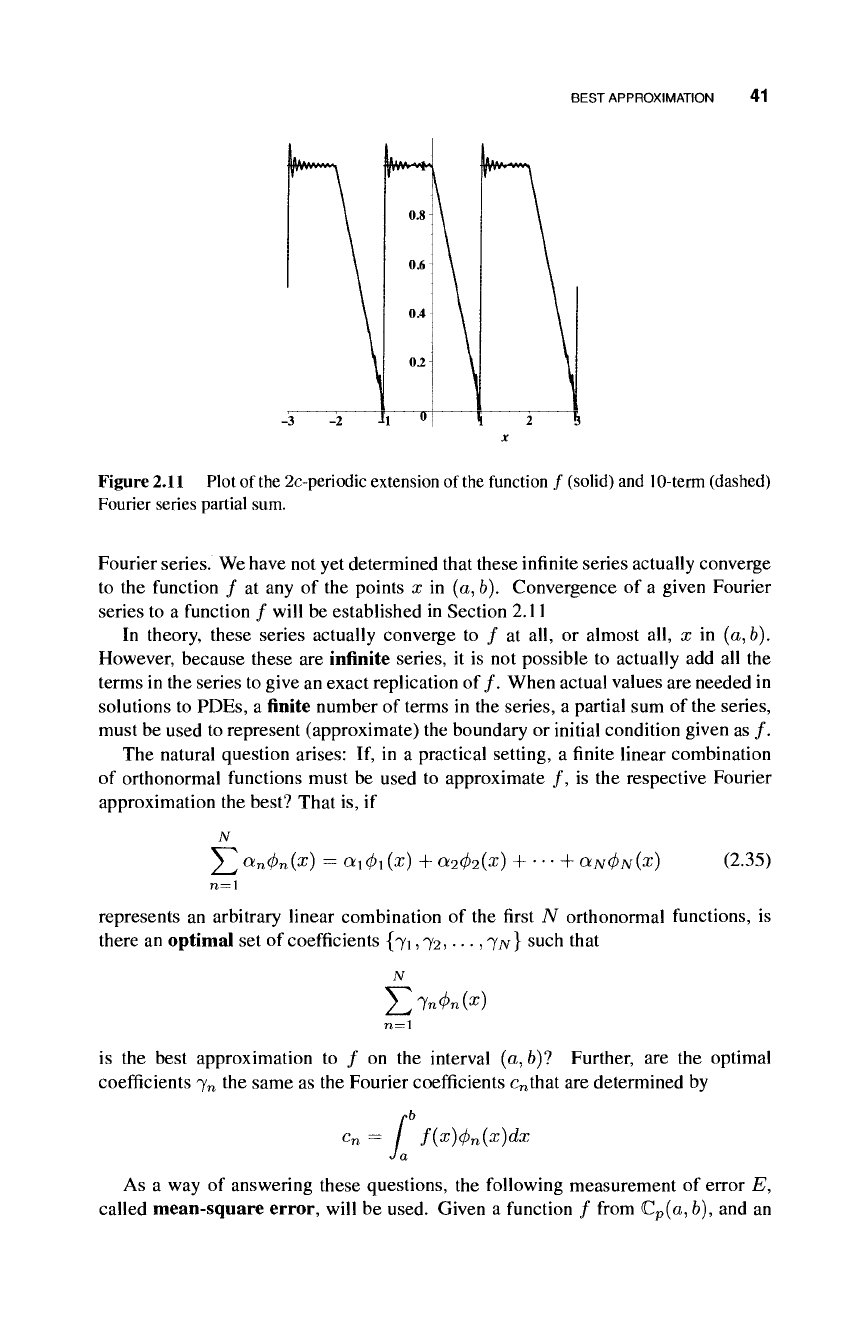
correspondence to the 2c-periodic extension of /. This implication is evident in
Figure
2.11.
The plot of the 10-term partial sum approximation of the Fourier series
relative to the 2c-periodic extension of / suggests the Fourier series may converge to
/ for x on the interval
[-3,3]
with the exception of x =
-3,-1,1,
and 3. It is evident
in Figure 2.11 that the deviation of the partial Fourier series sum from the function
/ grows larger as one approaches the points of discontinuity in /. This behavior is
known as the Gibbs phenomenon. Consequently, caution must be used, especially
near points of discontinuity, when approximating a discontinuous function / with a
partial Fourier series sum.
2.8 BEST APPROXIMATION
One of
the
main results of
this
chapter is the development of
the
Fourier sine, Fourier
cosine, and Fourier series for a function / belonging to C
p
(a,
b).
Note the space
C
p
(a,
b)
is C
p
(0, c) for the sine and cosine series, and
C
p
(—c,
c) in the case of the
BEST APPROXIMATION 41
\ 0.8
\ 0.6
\ °'
4
-3 -2 II »
Figure
2.11
Plot of
the
2c-periodic extension of
the
function / (solid) and 10-term (dashed)
Fourier series partial sum.
Fourier series. We have not yet determined that these infinite series actually converge
to the function / at any of the points x in (a,
b).
Convergence of a given Fourier
series to a function / will be established in Section 2.11
In theory, these series actually converge to / at all, or almost all, x in (a, b).
However, because these are infinite series, it is not possible to actually add all the
terms in the series to give an exact replication of /. When actual values are needed in
solutions to PDEs, a finite number of terms in the series, a partial sum of the series,
must be used to represent (approximate) the boundary or initial condition given as /.
The natural question arises: If, in a practical setting, a finite linear combination
of orthonormal functions must be used to approximate /, is the respective Fourier
approximation the best? That is, if
N
Υ^α
η
φ
η
{χ)
=αιφι(χ) 4-α
2
0
2
(^)
Η
-\-α
Ν
φ
Ν
(χ) (2.35)
n=l
represents an arbitrary linear combination of the first N orthonormal functions, is
there an optimal set of coefficients {71,72, ·. ·,
7N}
such that
N
n=l
is the best approximation to / on the interval (a, b)l Further, are the optimal
coefficients η
η
the same as the Fourier coefficients c
n
that are determined by
C
n
= ¡(χ)φ
η
{χ)άχ
Ja
As a way of answering these questions, the following measurement of error E,
called mean-square error, will be used. Given a function / from C
p
(a, 6), and an