
Bernatz R. Fourier Series and Numerical Methods for Partial Differential Equations
Подождите немного. Документ загружается.

212 NUMERICAL METHODS: AN OVERVIEW
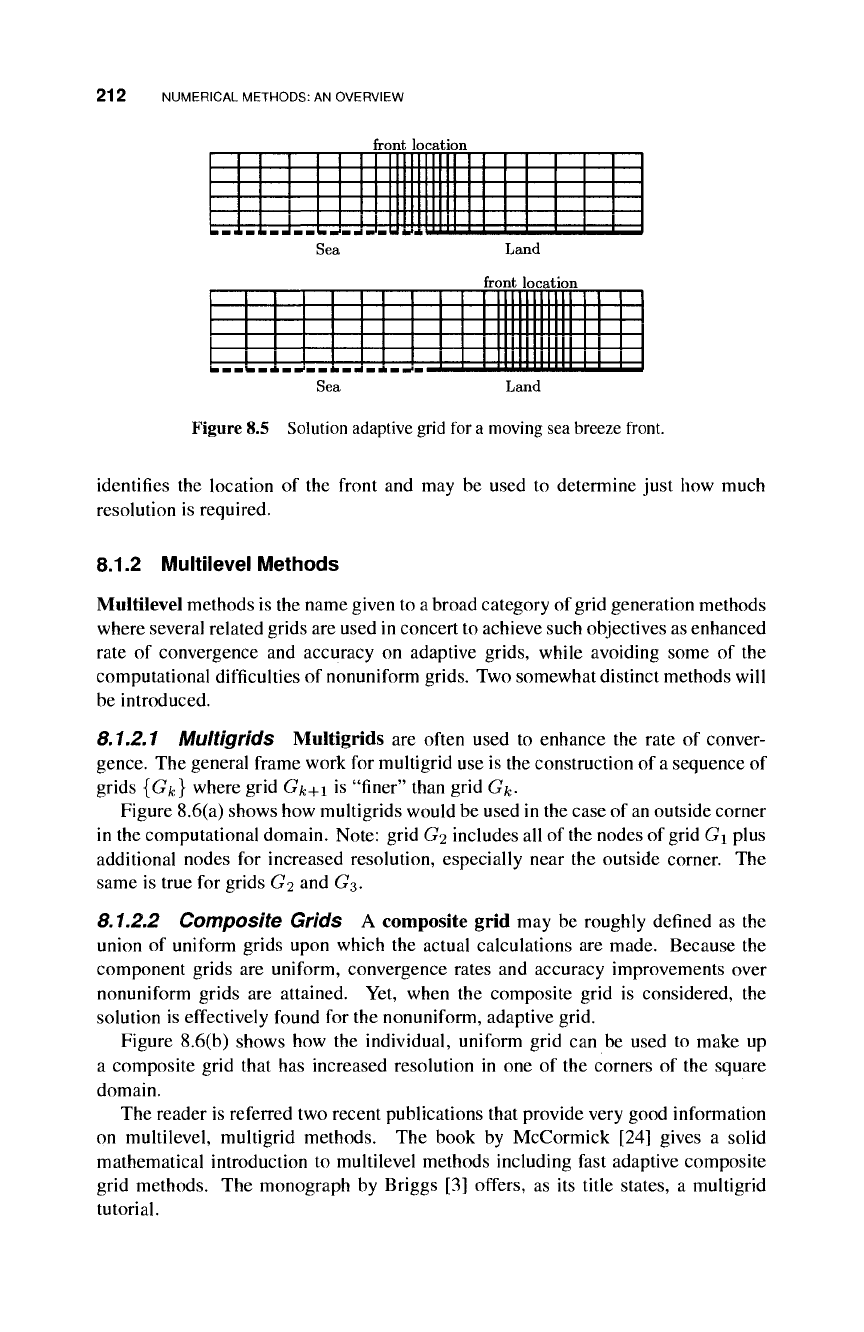
front location
Sea Land
front location
Sea Land
Figure 8.5 Solution adaptive grid for
a
moving sea breeze front.
identifies the location
of
the front and may
be
used
to
determine just how much
resolution is required.
8.1.2 Multilevel Methods
Multilevel methods is the name given to a broad category of grid generation methods
where several related grids are used in concert to achieve such objectives as enhanced
rate
of
convergence and accuracy
on
adaptive grids, while avoiding some
of
the
computational difficulties of nonuniform grids. Two somewhat distinct methods will
be introduced.
8.1.2.1
Multigtids Multigrids are often used
to
enhance the rate
of
conver-
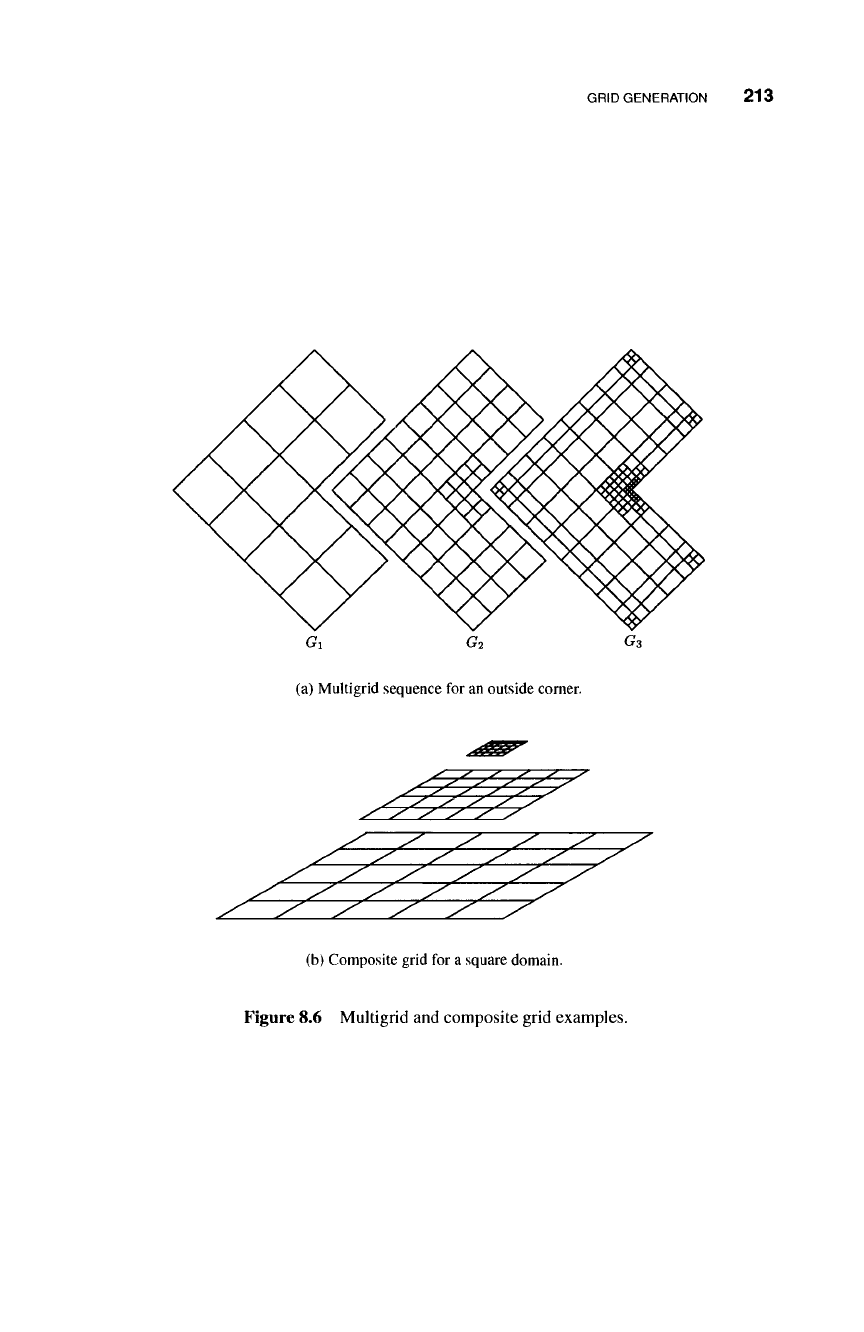
gence. The general frame work for multigrid use is the construction of a sequence of
grids {Gk} where grid Gfc+i is "finer" than grid Gk·
Figure
8.6(a)
shows how multigrids would be used in the case of
an
outside corner
in the computational domain. Note: grid G2 includes all of
the
nodes of grid G\ plus
additional nodes
for
increased resolution, especially near the outside corner.
The
same is true for grids G2 and G3.
8.1.2.2
Composite Grids
A
composite grid may be roughly defined as the
union of uniform grids upon which the actual calculations are made. Because the
component grids are uniform, convergence rates and accuracy improvements over
nonuniform grids are attained. Yet, when the composite grid
is
considered,
the
solution is effectively found for the nonuniform, adaptive grid.
Figure
8.6(b)
shows how the individual, uniform grid can be used
to
make up
a composite grid that has increased resolution
in
one
of
the corners
of
the square
domain.
The reader is referred two recent publications that provide very good information
on multilevel, multigrid methods. The book
by
McCormick [24] gives
a
solid
mathematical introduction to multilevel methods including fast adaptive composite
grid methods. The monograph by Briggs [3] offers, as its title states,
a
multigrid
tutorial.
GRID GENERATION 213
Gi
(a) Multigrid sequence for an outside corner.
yy-yyyy
y'y'y'y'y'y'
y y y ^yl
J
(b) Composite grid for
a
square domain.
Figure 8.6 Multigrid and composite grid examples.
214 NUMERICAL METHODS: AN OVERVIEW
8.2 NUMERICAL METHODS
There are three to eight different numerical methods one may use to solve a PDE
depending on the details of classification and the type of equation. Each method has
advantages and disadvantages depending on, among other considerations, the type of
equation and the nature of the boundary conditions. Additionally, the method used
by a practitioner may depend on the personal knowledge of that method. A brief
introductory description to three of these methods is given in this section.
Suppose -F((/>) = g(x, y) represents a general PDE, where φ is a function of x and
y,
and F is the partial differential operator. The steps in developing the associated
algebraic counterpart Ό(φ
ί
^) = gi¿ ori an arbitrary element of the computational
domain are outlined below as a means of introduction and comparison of the three
methods.
8.2.1 Finite Difference Method
The finite difference (FD) numerical method is, historically, the first attempt at a
numerical solution for a PDE. As the name implies, derivative terms in the PDE are
approximated by differences in the respective variable over finite differences in the
independent variable.
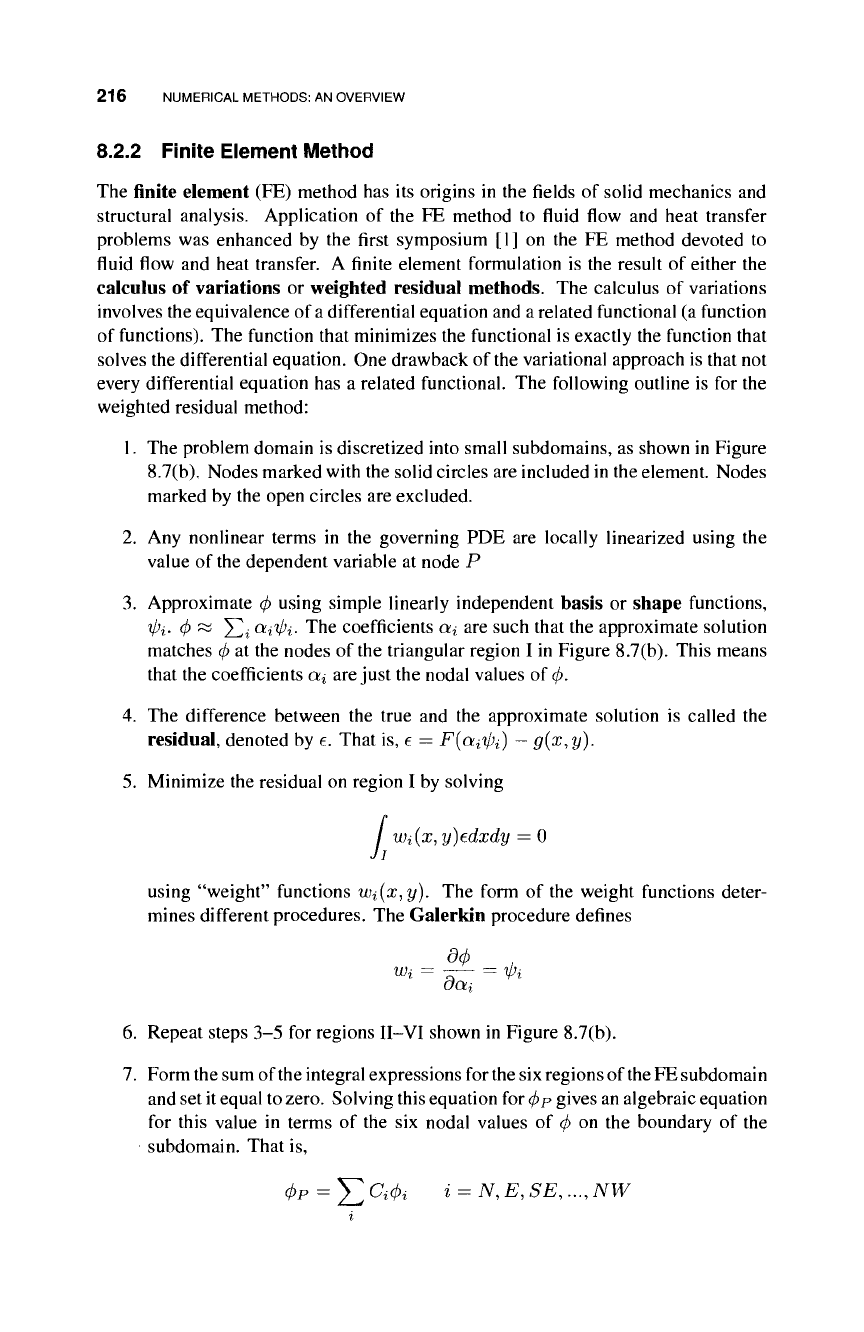
1.
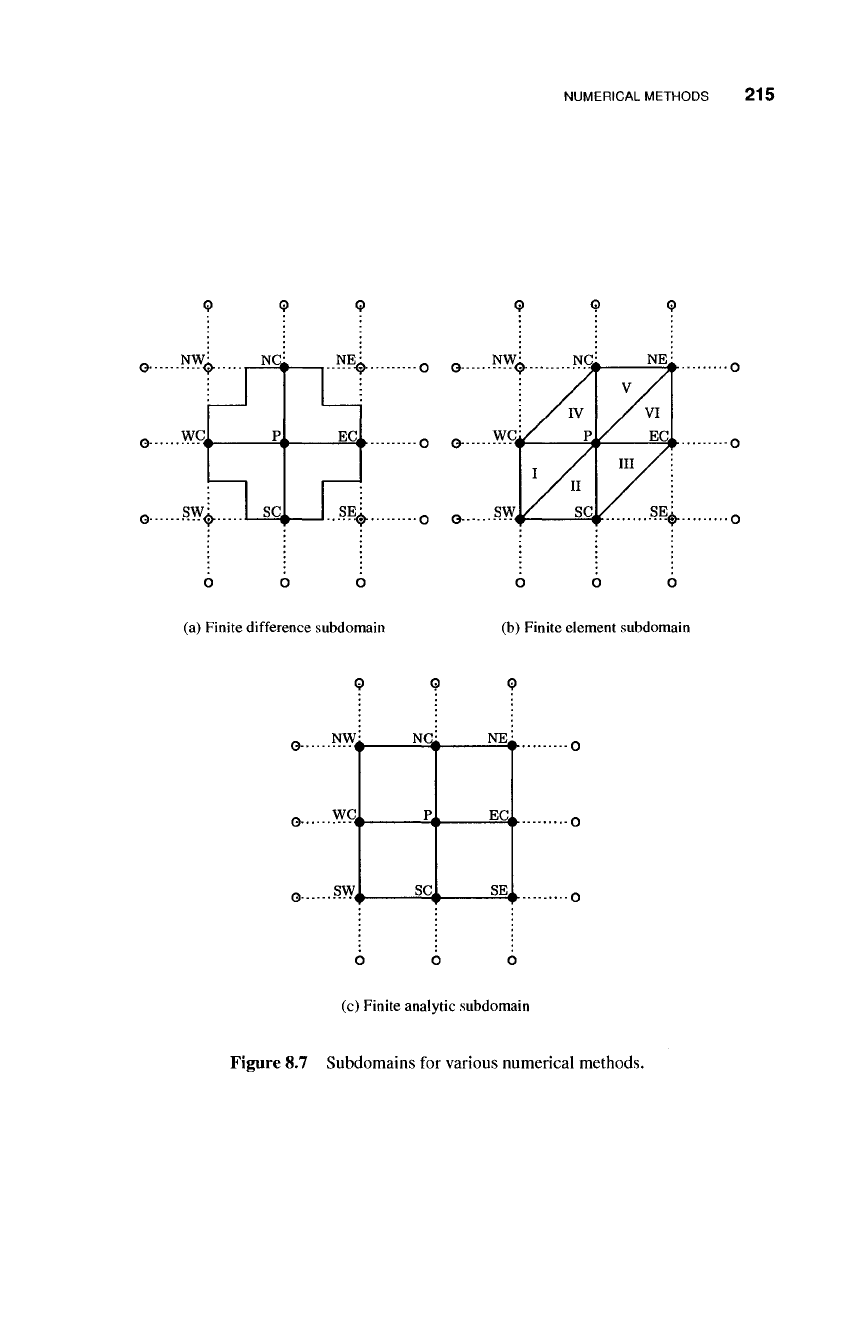
The problem domain is discretized into small elements, as shown in Figure
8.7(a). The nodes marked by the solid circles are included in the element. The
node labeled with "P" is the center, or interior, node of the element. The eight
near-neighbor nodes are labeled "NE" (North East), "EC" (East Central), "SE"
(South East), and so on. The nodes with open circles are excluded from the
FD element.
2.
Any nonlinear terms in F are linearized on the element using the value of the
dependent variable at node P.
3.
Derivative terms in F are replaced with finite difference expressions.
4.
The four nodes on the subdomain boundary are used to express φ at node P as
a function of the value of φ at those nodes. That is,
ΦΡ
=
C
N
c<t>NC
+
ΟΕΟΦΕΟ
+ θ3οΦβο + ΟννοΦννο
The coefficients
CNCICEC,·-
m
this equation are functions of the nodal
spacing only.
The primary advantage of the FD method is the ease in constructing the algebraic
equation to the PDE. A major disadvantage of the FD method is that the resulting
algebraic equation does not incorporate values of φ at the four corner nodes, NW,
NE, SE, and SW. This may cause serious problems in convective flow situations
when flow runs askew of the coordinate directions. Chapter 9 provides added detail
on the FD method where the algebraic equation is derived for several PDEs using
various finite difference formulas.
NUMERICAL METHODS 215
O O O
(a) Finite difference subdomain
ooo
(b) Finite element subdomain
WG
SWl SCI SE,
O NWi NCj NE
f
EG
0 0 0
(c) Finite analytic subdomain
Figure 8.7 Subdomains for various numerical methods.
216 NUMERICAL METHODS: AN OVERVIEW
8.2.2 Finite Element Method
The finite element (FE) method has its origins in the fields of solid mechanics and
structural analysis. Application of the FE method to fluid flow and heat transfer
problems was enhanced by the first symposium [1] on the FE method devoted to
fluid flow and heat transfer. A finite element formulation is the result of either the
calculus of variations or weighted residual methods. The calculus of variations
involves the equivalence of
a
differential equation and a related functional (a function
of functions). The function that minimizes the functional is exactly the function that
solves the differential equation. One drawback of the variational approach is that not
every differential equation has a related functional. The following outline is for the
weighted residual method:
1.
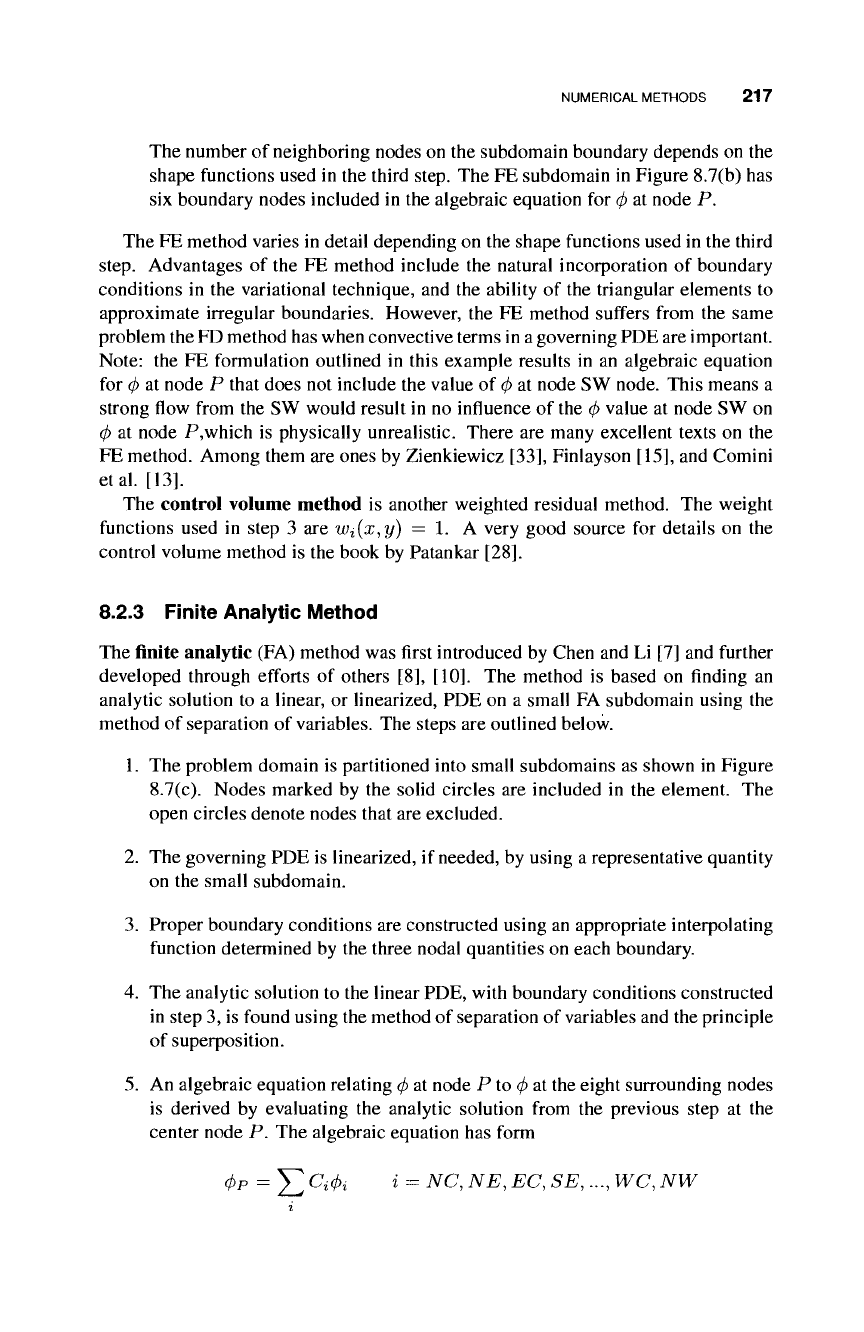
The problem domain is discretized into small subdomains, as shown in Figure
8.7(b). Nodes marked with the solid circles are included in the element. Nodes
marked by the open circles are excluded.
2.
Any nonlinear terms in the governing PDE are locally linearized using the
value of the dependent variable at node P
3.
Approximate φ using simple linearly independent basis or shape functions,
Ψί·
Φ
~ Σΐ
α
ίΨί-
The coefficients ai are such that the approximate solution
matches φ at the nodes of the triangular region I in Figure 8.7(b). This means
that the coefficients a¿ are just the nodal values of φ.
4.
The difference between the true and the approximate solution is called the
residual, denoted by e. That is, e = jF(a^) - g(x, y).
5.
Minimize the residual on region I by solving
Wi(x,y)edxdy = 0
using "weight" functions Wi(x,y). The form of the weight functions deter-
mines different procedures. The Galerkin procedure defines
θφ
Wi = ^— = ψΐ
OOíi
6. Repeat steps 3-5 for regions II-VI shown in Figure 8.7(b).
7.
Form the sum of the integral expressions for
the
six regions of the FE subdomain
and set it equal to
zero.
Solving this equation for φρ gives an algebraic equation
for this value in terms of the six nodal values of φ on the boundary of the
subdomain. That is,
ΦΡ
= Σ
C
^ i = N,E, SE,...,
NW
,
NUMERICAL METHODS 217
The number of neighboring nodes on the subdomain boundary depends on the
shape functions used in the third step. The FE subdomain in Figure
8.7(b)
has
six boundary nodes included in the algebraic equation for φ at node P.
The FE method varies in detail depending on the shape functions used in the third
step.
Advantages of the FE method include the natural incorporation of boundary
conditions in the variational technique, and the ability of the triangular elements to
approximate irregular boundaries. However, the FE method suffers from the same
problem the FD method has when convective terms in a governing PDE are important.
Note: the FE formulation outlined in this example results in an algebraic equation
for φ at node P that does not include the value of φ at node SW node. This means a
strong flow from the SW would result in no influence of the φ value at node SW on
φ at node
P,
which is physically unrealistic. There are many excellent texts on the
FE method. Among them are ones by Zienkiewicz [33], Finlayson [15], and Comini
etal. [13].
The control volume method is another weighted residual method. The weight
functions used in step 3 are Wi(x,y) = 1. A very good source for details on the
control volume method is the book by Patankar [28].
8.2.3 Finite Analytic Method
The finite analytic (FA) method was first introduced by Chen and Li [7] and further
developed through efforts of others [8], [10]. The method is based on finding an
analytic solution to a linear, or linearized, PDE on a small FA subdomain using the
method of separation of variables. The steps are outlined below.
1.
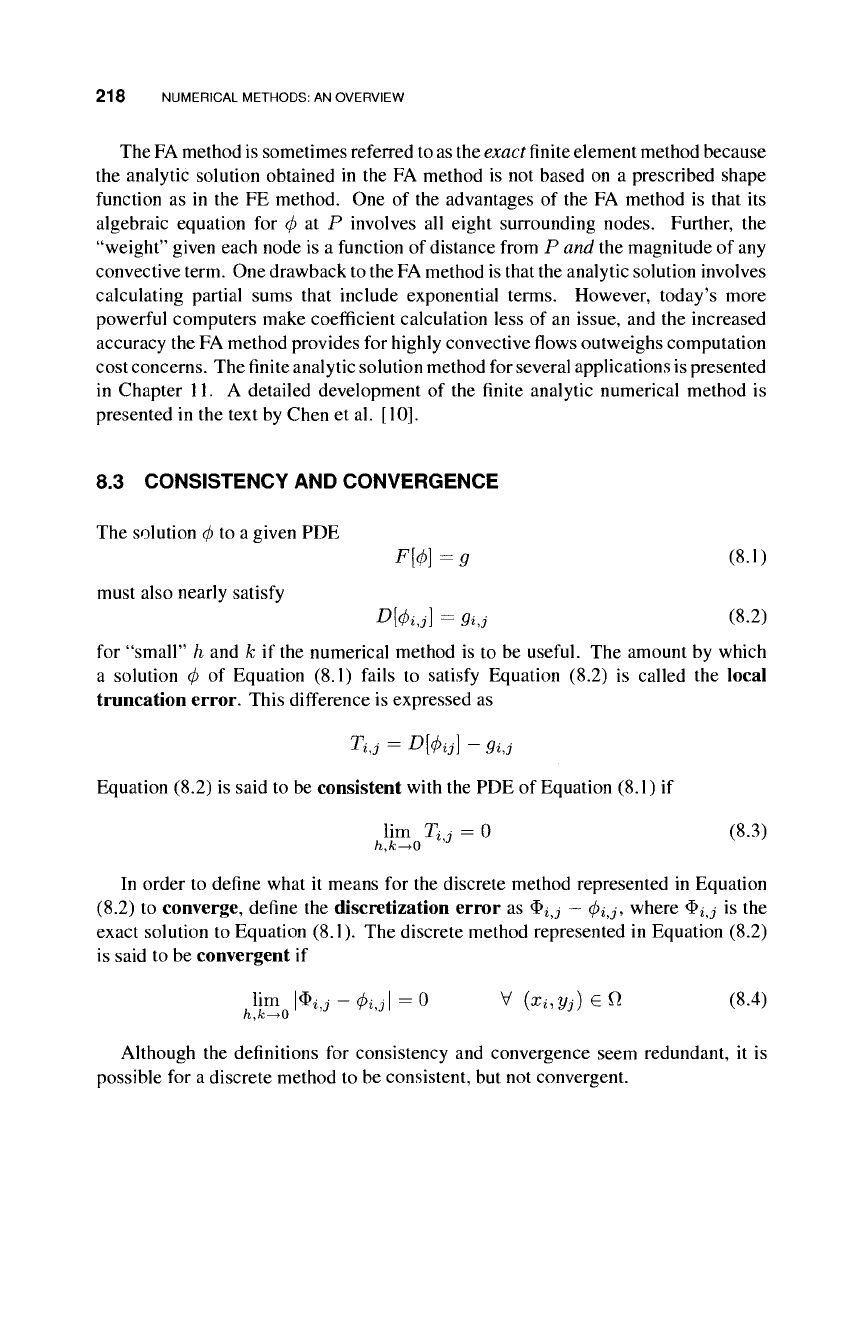
The problem domain is partitioned into small subdomains as shown in Figure
8.7(c). Nodes marked by the solid circles are included in the element. The
open circles denote nodes that are excluded.
2.
The governing PDE is linearized, if needed, by using a representative quantity
on the small subdomain.
3.
Proper boundary conditions are constructed using an appropriate interpolating
function determined by the three nodal quantities on each boundary.
4.
The analytic solution to the linear PDE, with boundary conditions constructed
in step 3, is found using the method of separation of variables and the principle
of superposition.
5.
An algebraic equation relating φ at node P to φ at the eight surrounding nodes
is derived by evaluating the analytic solution from the previous step at the
center node P. The algebraic equation has form
φ
Ρ
= ]Γ
Ci<t>i
i = NC, NE, EC, SE,..., WC, NW
218 NUMERICAL METHODS: AN OVERVIEW
The
FA
method is sometimes referred to as the exact
finite
element method because
the analytic solution obtained in the FA method is not based on a prescribed shape
function as in the FE method. One of the advantages of the FA method is that its
algebraic equation for φ at P involves all eight surrounding nodes. Further, the
"weight" given each node is a function of distance from P and the magnitude of any
convective term. One drawback to the
FA
method is that the analytic solution involves
calculating partial sums that include exponential terms. However, today's more
powerful computers make coefficient calculation less of an issue, and the increased
accuracy the FA method provides for highly convective flows outweighs computation
cost
concerns.
The
finite
analytic solution method for several applications
is
presented
in Chapter 11. A detailed development of the finite analytic numerical method is
presented in the text by Chen et al. [10].
8.3 CONSISTENCY AND CONVERGENCE
The solution φ to a given PDE
F[<l>]=g (8.1)
must also nearly satisfy
Dttij]
= 9ij (8.2)
for "small" h and k if the numerical method is to be useful. The amount by which
a solution φ of Equation (8.1) fails to satisfy Equation (8.2) is called the local
truncation error. This difference is expressed as
Tij = Ό[φ
ίά
) - gij
Equation (8.2) is said to be consistent with the PDE of Equation (8.1) if
lim Ti
Ί
-,
= 0 (8.3)
In order to define what it means for the discrete method represented in Equation
(8.2) to converge, define the discretization error as Φ^
—
φ^, where Φ^ is the
exact solution to Equation (8.1). The discrete method represented in Equation (8.2)
is said to be convergent if
lim \Φ
{
4 - φ^\ =0 V (xuVj) G Ω (8.4)
h,k—>0
Although the definitions for consistency and convergence seem redundant, it is
possible for a discrete method to be consistent, but not convergent.
CHAPTER 9
THE FINITE DIFFERENCE METHOD
Finite difference methods are introduced in this chapter. The connection of finite
difference methods to the definition of the derivative and Taylor's theorem is devel-
oped. Formulas for backward, centered, and forward differences are introduced, and
a discussion of the accuracy of the methods is presented. Formulas for higher order
derivatives are given as well. The chapter concludes with the development of the
finite difference formula for several PDEs.
9.1 DISCRETIZATION
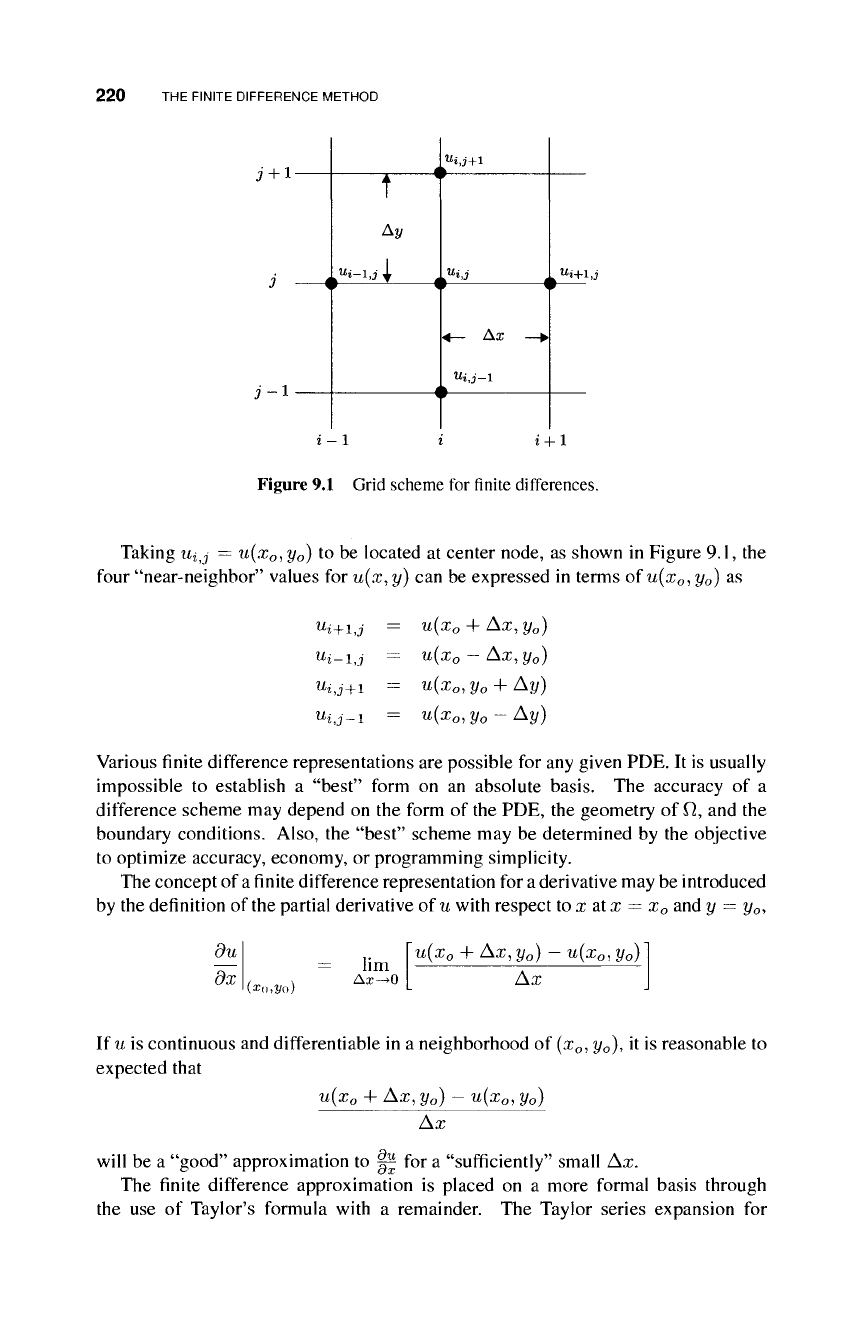
Suppose the objective is to solve a PDE on the domain Ω where u is a function of
x and y. The first step in a finite difference procedure is to replace the continuous
problem domain by a grid, or mesh, of discrete locations on Ω. Values for u(x, y)
at nodal locations are represented by UÍJ,UÍ+I¿, ... as indicated in Figure
9.1.
The
notation is understood as
Uij = u(xi,yj) = u((i - 1)Δχ, (j - I)Ay)
Fourier Series and Numerical Methods for Partial Differential Equations, 219
First Edition. By Richard Bernatz
Copyright © 2010 John Wiley & Sons, Inc.
220 THE FINITE DIFFERENCE METHOD
i
f
\u>i,j+l
Î '
Ay
k *'
J
4
^¿+1
L—
Ax —J
Ui,j-l
A 1
w
i
— 1
¿
2
+ 1
Figure
9.1
Grid scheme for
finite
differences.
Taking Uij = u(x
0
, y
0
) to be located at center node, as shown in Figure 9.1, the
four "near-neighbor" values for u(x, y) can be expressed in terms of u(x
0
, y
0
) as
Ui+ij = u(x
0
+ Ax,y
0
)
Ui-ij = u(x
0
- Ax,y
0
)
Uij+i = u{x
0
,y
0
-\- Ay)
Uij-i = u(x
0
,y
0
-Ay)
Various finite difference representations are possible for any given PDE. It is usually
impossible to establish a "best" form on an absolute basis. The accuracy of a
difference scheme may depend on the form of the PDE, the geometry of Ω, and the
boundary conditions. Also, the "best" scheme may be determined by the objective
to optimize accuracy, economy, or programming simplicity.
The concept of
a
finite
difference representation for a derivative may be introduced
by the definition of the partial derivative of u with respect to x at x = x
0
and y
—
y
0
,
u(x
0
+ Ax, y
0
) - u(x
01
y
ö
)
1
Δχ
J
If u is continuous and differentiable in a neighborhood of (x
0
, y
0
), it is reasonable to
expected that
u{x
0
+ Ax, y
0
) - u(x
0
, y
0
)
Ax
will be a "good" approximation to || for a "sufficiently" small Δχ.
The finite difference approximation is placed on a more formal basis through
the use of Taylor's formula with a remainder. The Taylor series expansion for
du
dx
(τ.ίΛ.ΊΙΐΛλ
lim
Δζ->0
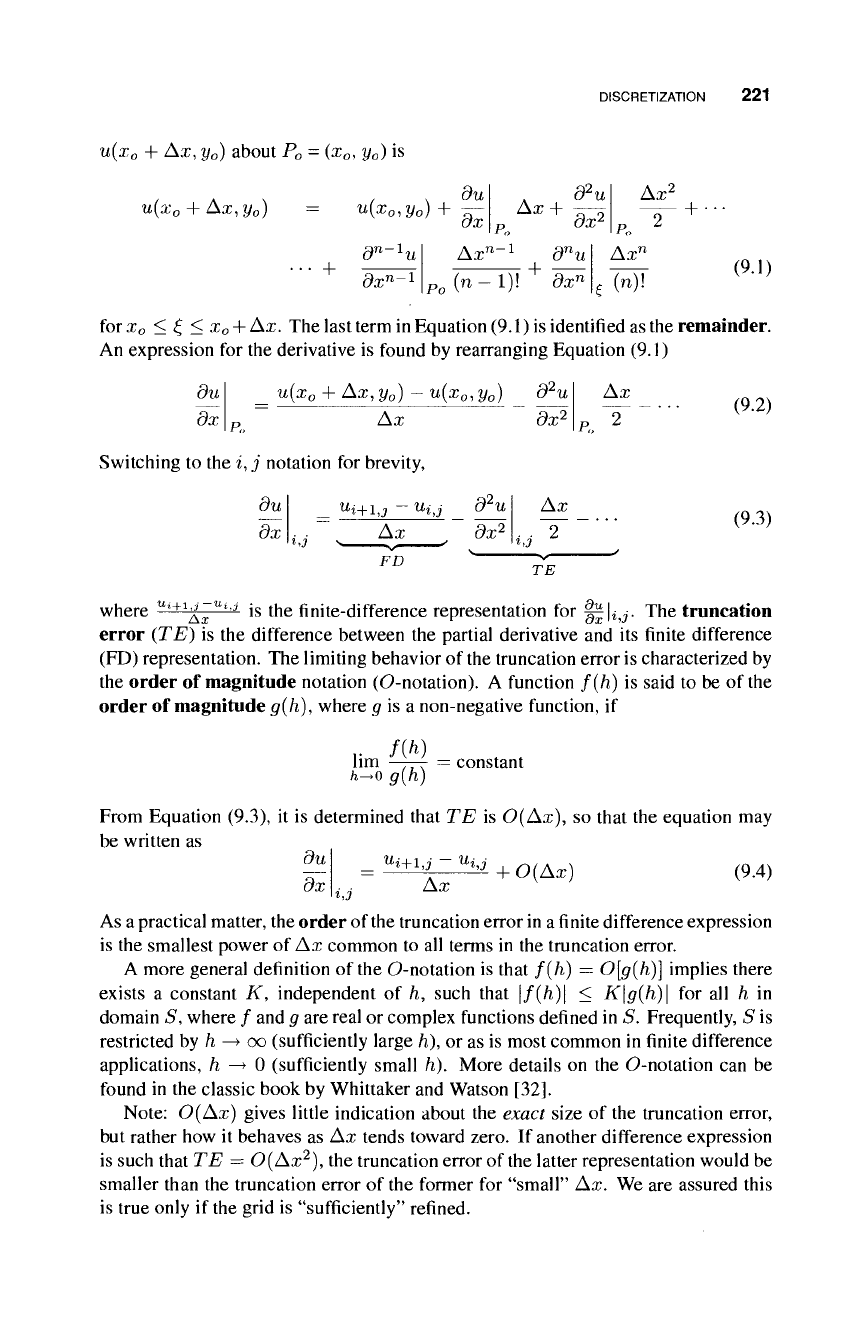
DISCRETIZATION 221
u(x
0
+ Δχ, y
0
) about P
0
= (χ
θ9
y
0
) is
/AX / x 9u
u(x
0
+ Δχ, y
0
) = u(x
0
, y
0
) + ^-
+
d
n
~
l
u
dx
n
~
l
Pa
Ax*
1
'
1
d
2
u
Ax
+dx~
2
Ax
2
+ ...
+
<9
n
u
Po
(n-l)!
9x
n
Ax
n
Γ
(n)!
(9.1)
for x
0
< ξ < x
0
+ Ax. The last term in Equation
(9.1 )
is identified as the remainder.
An expression for the derivative is found by rearranging Equation
(9.1
)
du
dx
U
Pa
(x
0
+ Δχ, y
0
) - u(x
Ax
Switching to the
¿,
j notation for brevity,
du
dx
J
""-
,L
-s/—
-
FD
where
Ui
+^'
u
Ax
^ is th(
o,y
0
)
d
2
U
dx
2
^-- <9.2»
d
2
u
dx
2
i.i
Δ
TE
ι finite-difference represente ition foi
§^kj·
^
ne
truncation
error (T£^) is the difference between the partial derivative and its finite difference
(FD) representation. The limiting behavior of the truncation error is characterized by
the order of magnitude notation (O-notation). A function f(h) is said to be of the
order of magnitude g(h), where g is a non-negative function, if
fc-o g(h)
constant
From Equation (9.3), it is determined that TE is O
(Ax),
so that the equation may
be written as
du
dx
M»+I,.
*j
Ax
+ O(Ax)
(9.4)
As a practical matter, the order of the truncation error in a
finite
difference expression
is the smallest power of Ax common to all terms in the truncation error.
A more general definition of the O-notation is that f(h) = 0[g(h)] implies there
exists a constant K, independent of h, such that
\f(h)\
<
K\g(h)\
for all h in
domain 5, where / and g are real or complex functions defined in S. Frequently, S is
restricted by h
—>
oo (sufficiently large h), or as is most common in finite difference
applications, h
—>
0 (sufficiently small h). More details on the O-notation can be
found in the classic book by Whittaker and Watson [32].
Note: O (Ax) gives little indication about the exact size of the truncation error,
but rather how it behaves as Ax tends toward zero. If another difference expression
is such that TE
—
0(Δχ
2
), the truncation error of the latter representation would be
smaller than the truncation error of the former for "small" Ax. We are assured this
is true only if the grid is "sufficiently" refined.