
Bernatz R. Fourier Series and Numerical Methods for Partial Differential Equations
Подождите немного. Документ загружается.

202 WAVE EQUATION
EXERCISES
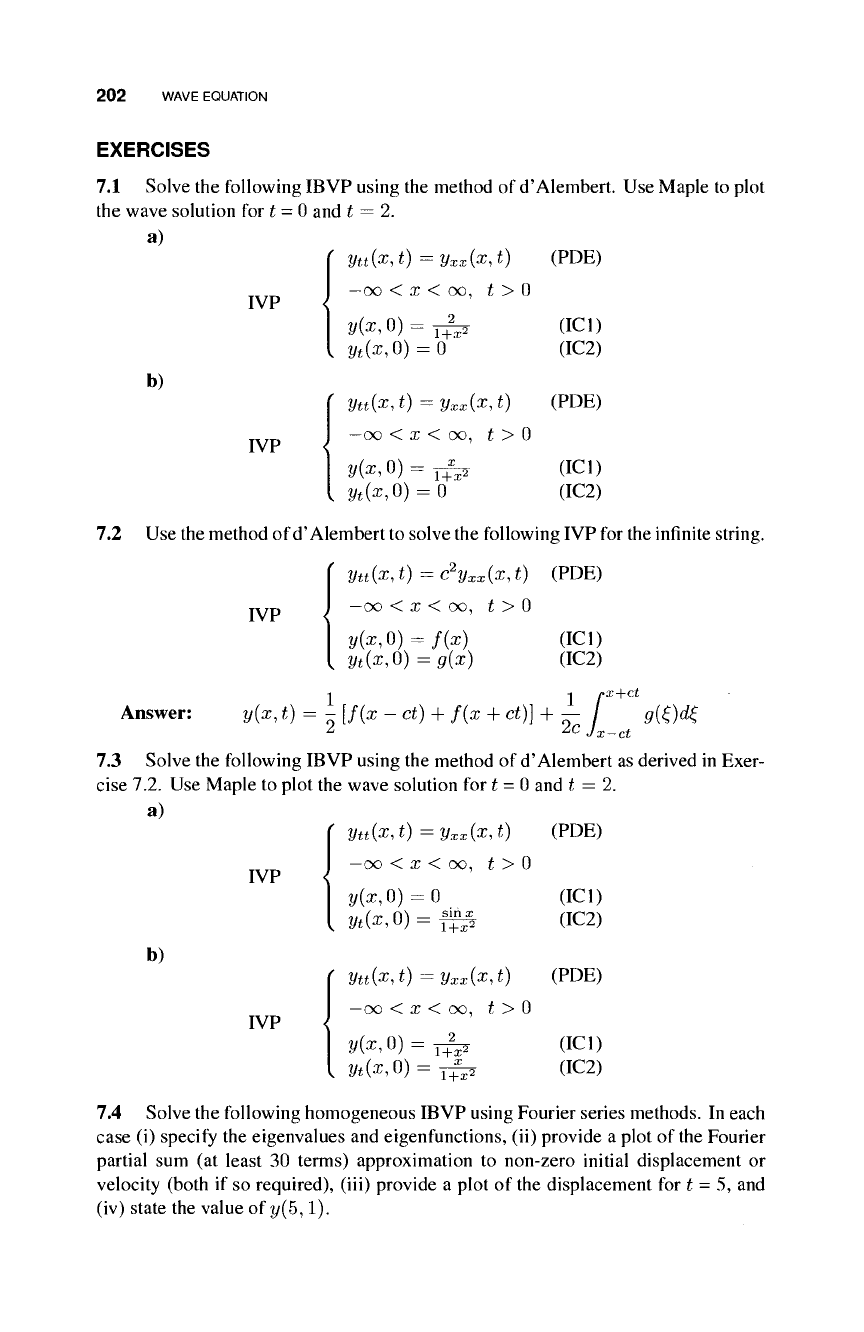
7.1 Solve the following IBVP using the method of d'Alembert. Use Maple to plot
the wave solution for t
=
0 and t = 2.
a)
f ytt(x,t)=y
xx
(x,t) (PDE)
-oo < x < oo, t > 0
2
IVP
2/t(M) = 0
(ICI)
(IC2)
b)
IVP
y
tt
(x,
t) =
y
xx
(x,
t) (PDE)
—oo < x < oo, t > 0
î/(*>°) = W
2/t(*,0) = 0
(ICI)
(IC2)
7.2 Use the method of d'Alembert to solve the following IVP for the infinite string.
[
y
tt
{x,t)
=c
2
y
xx
(x,t) (PDE)
—oo < x < oo, t > 0
IVP
2/(χ,0) = /(χ)
I Vt(x,0) =g(x)
(ICI)
(IC2)
1 1 /*
x
+
c
*
Answer: 2/(ar, t) = - [f(x - ct) + f(x + ct)} + — /
¿
5(0^
7.3 Solve the following IBVP using the method of d'Alembert as derived in Exer-
cise 7.2. Use Maple to plot the wave solution for t
=
0 and t = 2.
a)
y
u
(x,t)
=y
xx
(x,t) (PDE)
#
—oo < x < oo, í > 0
b)
IVP
y(x,0) = 0
Vt(x,0) = f^
y
tt
(x,t)
=
y
xx
(x,t)
—oo < x < oo, í > 0
y(z,o) = i^
(ici)
(IC2)
(PDE)
(ICI)
(IC2)
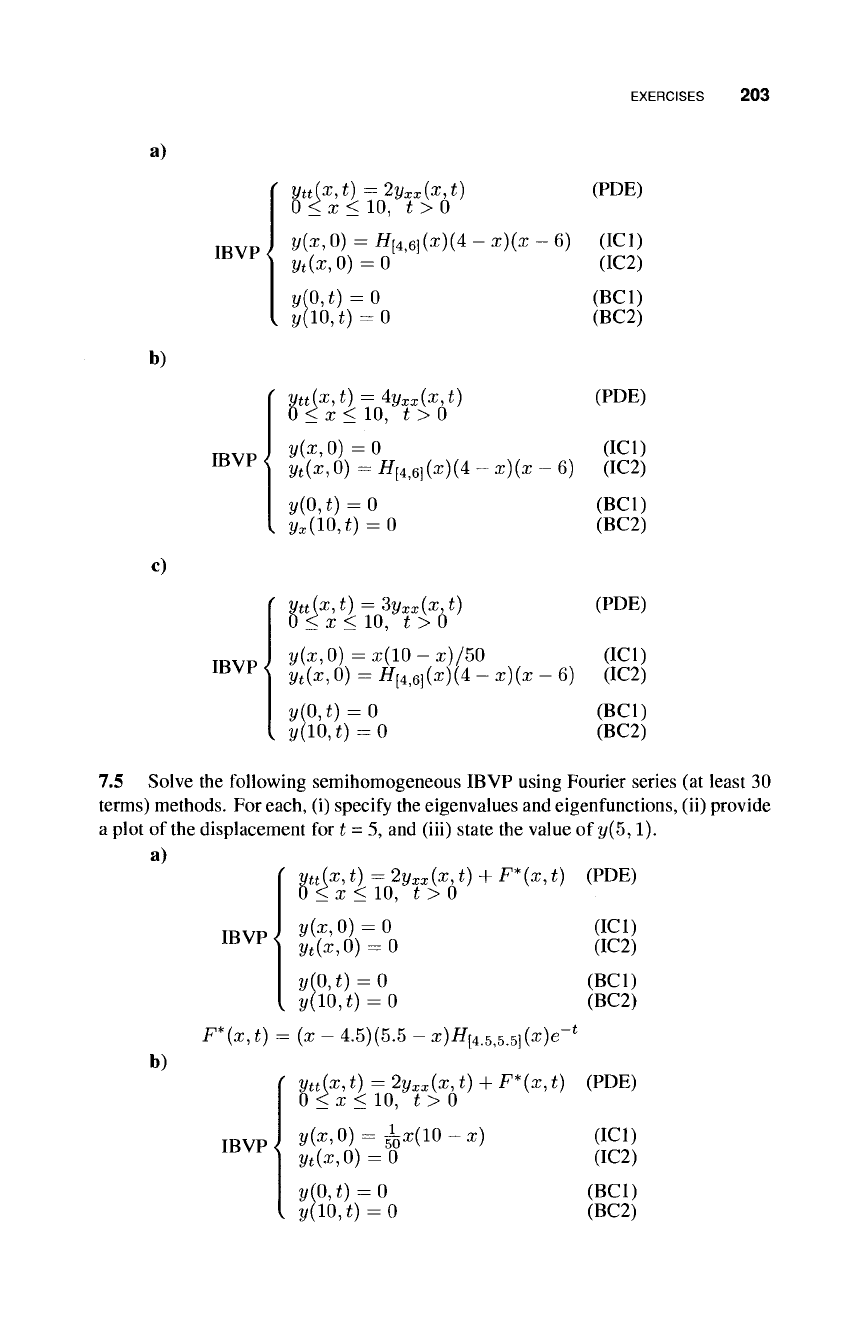
7.4 Solve the following homogeneous IBVP using Fourier series methods. In each
case (i) specify the eigenvalues and eigenfunctions, (ii) provide a plot of the Fourier
partial sum (at least 30 terms) approximation to non-zero initial displacement or
velocity (both if so required), (iii) provide a plot of the displacement for t = 5, and
(iv) state the value of 2/(5,1).
EXERCISES
203
a)
IBVP^
( ytt(x,t)
=
2y
xx
(x,t)
I
0 < x < 10, t > 0
y(x,0)
=
i/
[4>6]
(x)(4
- x)(x
t/t(x,0)
= 0
y(0,t)
= 0
y(10,t)=0
b)
IBVP¿
c)
IBVP¿
6)
yttjx, t) =Jy
xx
(x
x
t)
<
10, t > 0
2/(0,i)=0
y
x
(W,t)
= 0
m{x,t) = 3y
xx
(x,t)
3 < x < 10, t > 0
y(0,t)
= 0
y(l0,t)
= 0
(PDE)
(ICI)
(IC2)
(BC1)
(BC2)
(PDE)
y(x,o)
=
o
(ici)
2/
t
(x,
0)
=
iï
[4
,
6]
(x) (4
-
x) (x
- 6) (IC2)
(BC1)
(BC2)
(PDE)
y(x,0) =x(10-x)/50
(ICI)
y
t
(x,0)
=
Η[
4
,β](χ)(4
- x)(x - 6) (IC2)
(BCD
(BC2)
7.5 Solve
the
following semihomogeneous IBVP using Fourier series
(at
least
30
terms) methods. For each, (i) specify the eigenvalues and eigenfunctions, (ii) provide
a plot
of
the displacement
for t - 5, and
(iii) state the value
of
y(5,1).
a)
f
y
tt
(x,t)
=
2y
xx
(x,t)
+
F*(x,t)
(PDE)
0
< x < 10, t > 0
b)
IBVP ·{
!/(x,0)
= 0 (ICI)
îfc(x,0)=0
(IC2)
y(0,t)=0
(BC1)
I y(10,t)=0 (BC2)
F*(x,t) = (x - 4.5)(5.5 - x)//
[
4.
5
,5.5](x)e-
t
f Wx,i) = 2y
xx
(x,t) + F*(x,t) (PDE)
1
0 < x < 10, t > 0
TRVP/ 2/(
χ
'°)
=
1^(10-χ)
1 î/t(x,0)
= 0
,
y(o,í) = o
l y(10,í)=0
(ici)
(IC2)
(BCl)
(BC2)
204
WAVE EQUATION
F*
= 4(x -
2)(3
-
x)if
[2
,
3
](x) sin*
- 4(x -
7)(8
-
x)H
[7
¿](x) siní
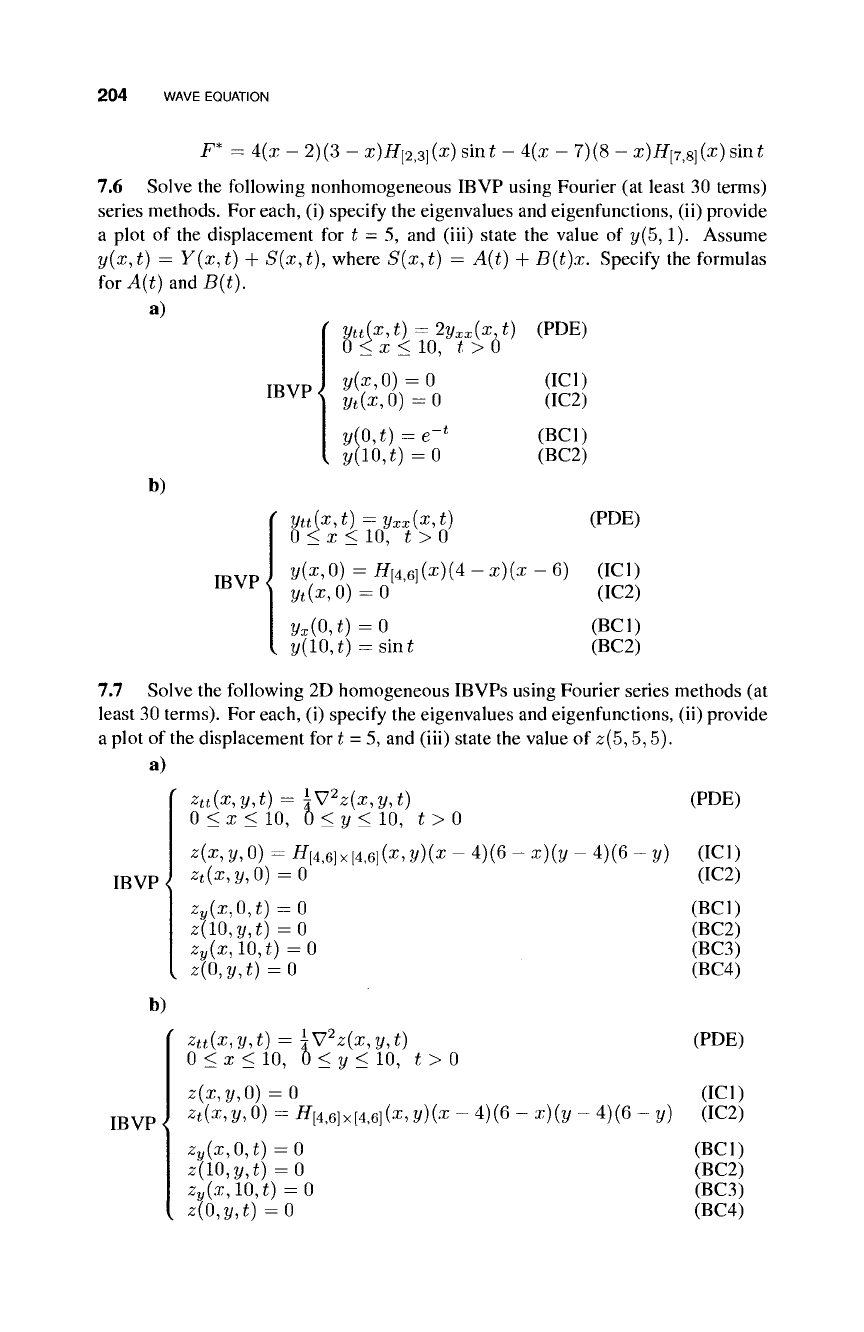
7.6 Solve
the
following nonhomogeneous IBVP using Fourier
(at
least
30
terms)
series methods. For each,
(i)
specify the eigenvalues and eigenfunctions, (ii) provide
a plot
of the
displacement
for t = 5, and (iii)
state
the
value
of
y(5,1).
Assume
y(x,t)
=
Y(x,t)
+
S(x,t),
where S(x,t)
= A(t) +
B(t)x. Specify
the
formulas
for
A(t)
and
B(t).
a)
IBVP<
ytt(x,t)
.
~
< x < 10, t > 0
0
2/(x,0)=0
îfe(*,0)=0
y(o,t)
= e-*
2/(10,i)
= 0
2
fe
(x,¿)
(PDE)
(ICI)
(IC2)
(BCl)
(BC2)
b)
IBVP<
ytt[x,t)
=
y
xx
{x,t)
(PDE)
0
< x < 10, ¿ > 0
2/(x, 0)
=
ίΤ
[4ϊ6
](χ)(4
- *)(x - 6) (ICI)
2/t(*,0)
= 0 (IC2)
y
x
(0,£)=0
(BCl)
2/(10,
í) =
sint
(BC2)
7.7 Solve the following 2D homogeneous IBVPs using Fourier series methods
(at
least 30 terms). For each, (i) specify the eigenvalues and eigenfunctions, (ii) provide
a plot
of
the displacement
for t
=
5,
and (iii) state the value
of z(b,
5,5).
a)
Ztt(x,y,t)
=
{V
2
z(x,y,t)
(PDE)
0
< x < 10, 0 < y < 10, t > 0
2(x,î/,0)
=
ff
[4
,6]x
[4,6]
(*,!/)(*
-
4)(6
- x)(y -
4)(6
- y) (ICI)
zt(x,y,0)
= 0 (IC2)
z
y
(x,0,t)
= 0 (BCl)
2(10,y,f)=0
(BC2)
z
y
(x,10,t)
=0 (BC3)
^(0,í/,í)
= 0 (BC4)
IBVP<
b)
IBVP<
z
tt
(x,y,t)
=
{V
2
z(x,y,t)
(PDE)
0
< x < 10, 0 < y < 10, t > 0
*(*,y,0)=0
(ICI)
ZÉ(X,2/,0)
= #[
4
,6]χ[4,6](*,2/)(* - 4)(6 - x)(y - 4)(6 - y) (IC2)
z
y
(x,0,t)
= 0 (BCl)
4l0,î/,i)=0
(BC2)
z
y
(x, 10,
t) =0 (BC3)
*(0,î/,i)
= 0 (BC4)
EXERCISES 205
c)
IBVP<
z
tt
(x,y,t) = 2V
2
z{x,y,t) (PDE)
0 < x < 20, 0 < y < 10, t > 0
*(x,2/,0) = H
mxm
(x,y)(x - 4)(6 - x)fo - 4)(6 - y) (ICI)
zt(x,y,0) = 0 (IC2)
(BC1)
(BC2)
(BC3)
(BC4)
Zy(X,0,t) = 0
z
x
foo,y,t) =0
z
y
(x,10,t) =0
[ z(0,î/,t) = 0
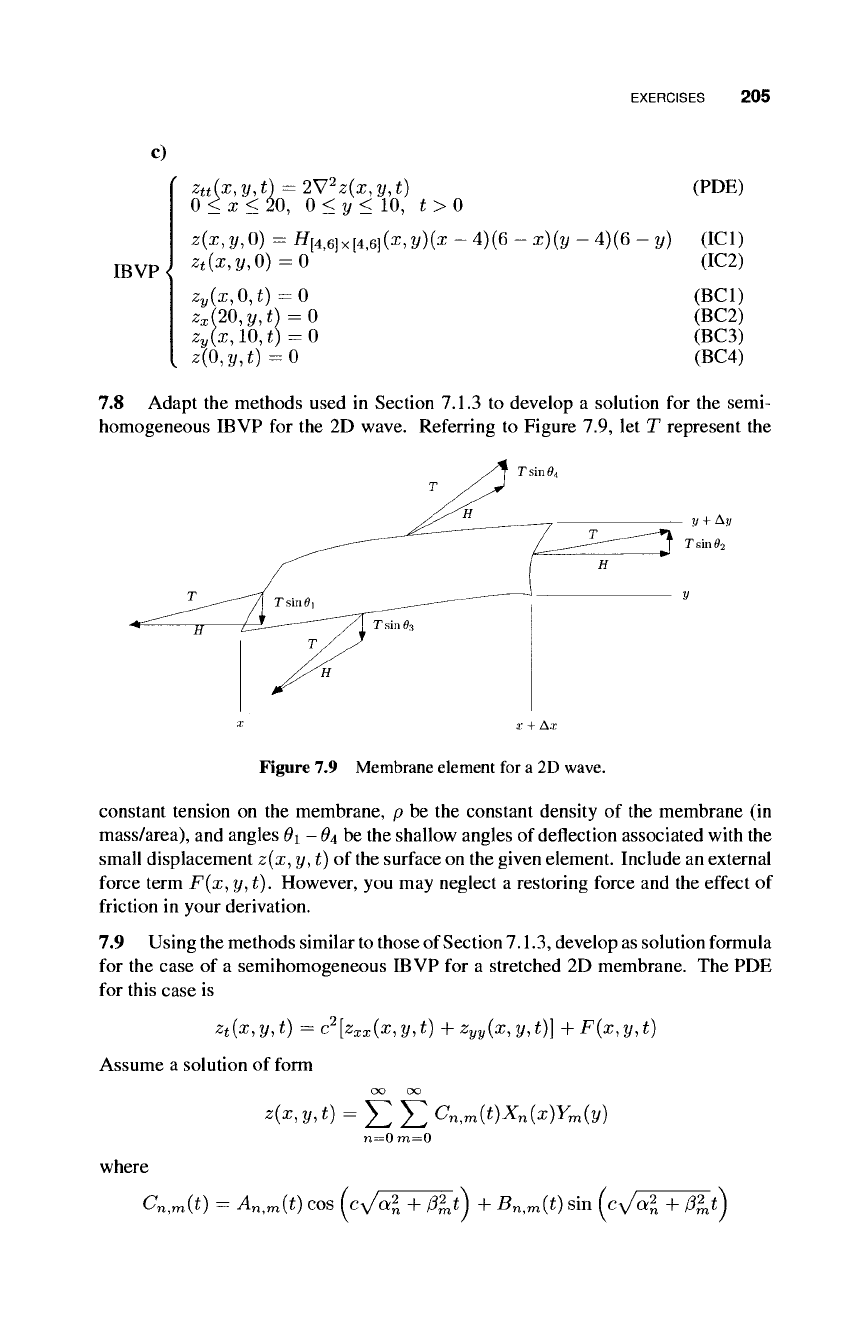
7.8 Adapt the methods used in Section 7.1.3 to develop a solution for the semi-
homogeneous IBVP for the 2D wave. Referring to Figure 7.9, let T represent the
x x
+
Ax
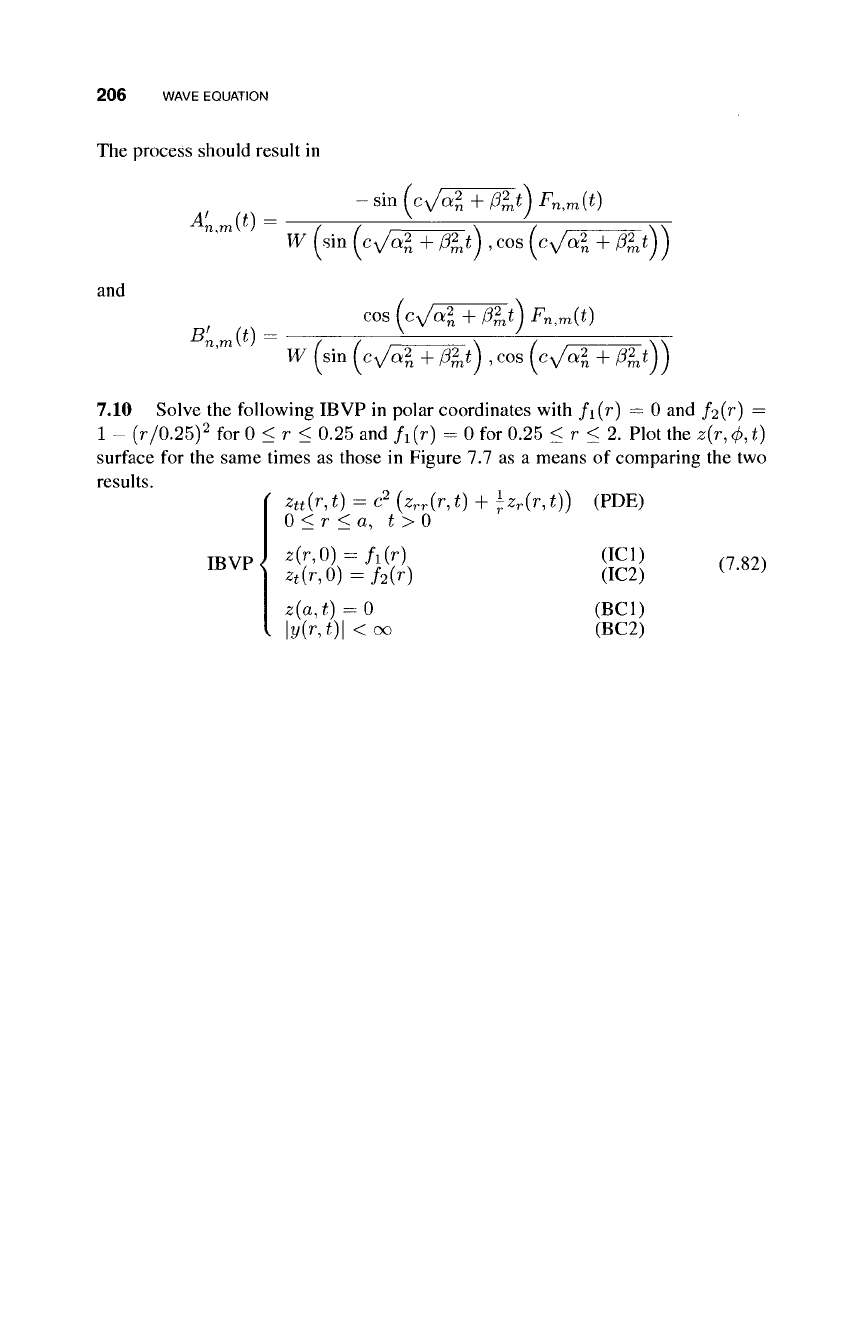
Figure 7.9 Membrane element for
a
2D wave.
constant tension on the membrane, p be the constant density of the membrane (in
mass/area), and angles θ\ -
θ±
be the shallow angles of deflection associated with the
small displacement z(x, y, t) of
the
surface on the given element. Include an external
force term F(x,y,i). However, you may neglect a restoring force and the effect of
friction in your derivation.
7.9 Using the methods similar
to
those of Section
7.1.3,
develop as solution formula
for the case of a semihomogeneous IBVP for a stretched 2D membrane. The PDE
for this case is
z
t
{x,y,t) =c
2
[z
xx
(x,y
1
t) + z
yy
(x,y,t)] + F{x,y,t)
Assume a solution of form
where
Z{x,y,t) = ΣΣ Cn,m{t)Xn(x)Ym(y)
n=0 ra=0
C
n
,m(t)
= A
n
,
m
(t) COS [C^/al + ßlS) +
B
n,m(t) SHI \Cy/a\ + ß^tj
206
WAVE EQUATION
The process should result in
A
n
,m\t)
-sin [cy/a^ + ß^t) F
ni
m(t)
and
Β'η,τηίϊ)
W (sin (cy/al + fai) ,cos (cy/a*+fat))
COS
[Cy/ofa + ß^t) F
n
,
m
(í)
W (sin (cy^T^i) ,cos (cy/al + fat))
7.10 Solve the following IBVP in polar coordinates with /i(r) = 0 and /2ΟΌ =
1 - (r/0.25)
2
for 0 < r < 0.25 and ^(r) = 0 for 0.25 < r < 2. Plot the z(r, </>,£)
surface for the same times as those in Figure 7.7 as a means of comparing the two
results.
( z
tt
(r, t) = c
2
(z
rr
(r, t) + ±z
r
(r, t)) (PDE)
0 < r < a, t > 0
IBVP<
*(r,0) = /i(r)
**(r,0)=/
2
(r)
z(a,i) = 0
|2/(r,i)|
< 00
(ICI)
(IC2)
(BCl)
(BC2)
(7.82)
CHAPTER 8
NUMERICAL METHODS: AN OVERVIEW
The PDEs associated with most science and engineering applications are often impos-
sible,
or impractical, to solve using analytic methods, such as separation of variables
and Fourier series. Numerical solution methods provide a reasonable alternative
in many of these situations. The purpose of this chapter is to provide a general,
brief overview of numerical methods. Common features and terminology associated
with many of the various numerical methods are introduced, as well as the basic
fundamental principals of three such methods.
Numerical methods typically begin by dividing, or discretizing, the problem
domain into a number of small subdomains, or elements, defined by grid lines.
Dependent variable values are determined for a finite number of domain locations
called grid points, mesh points, or nodes. Nodes located at the intersection of grid
lines are called cell vertex nodes, while those located inside the elements defined
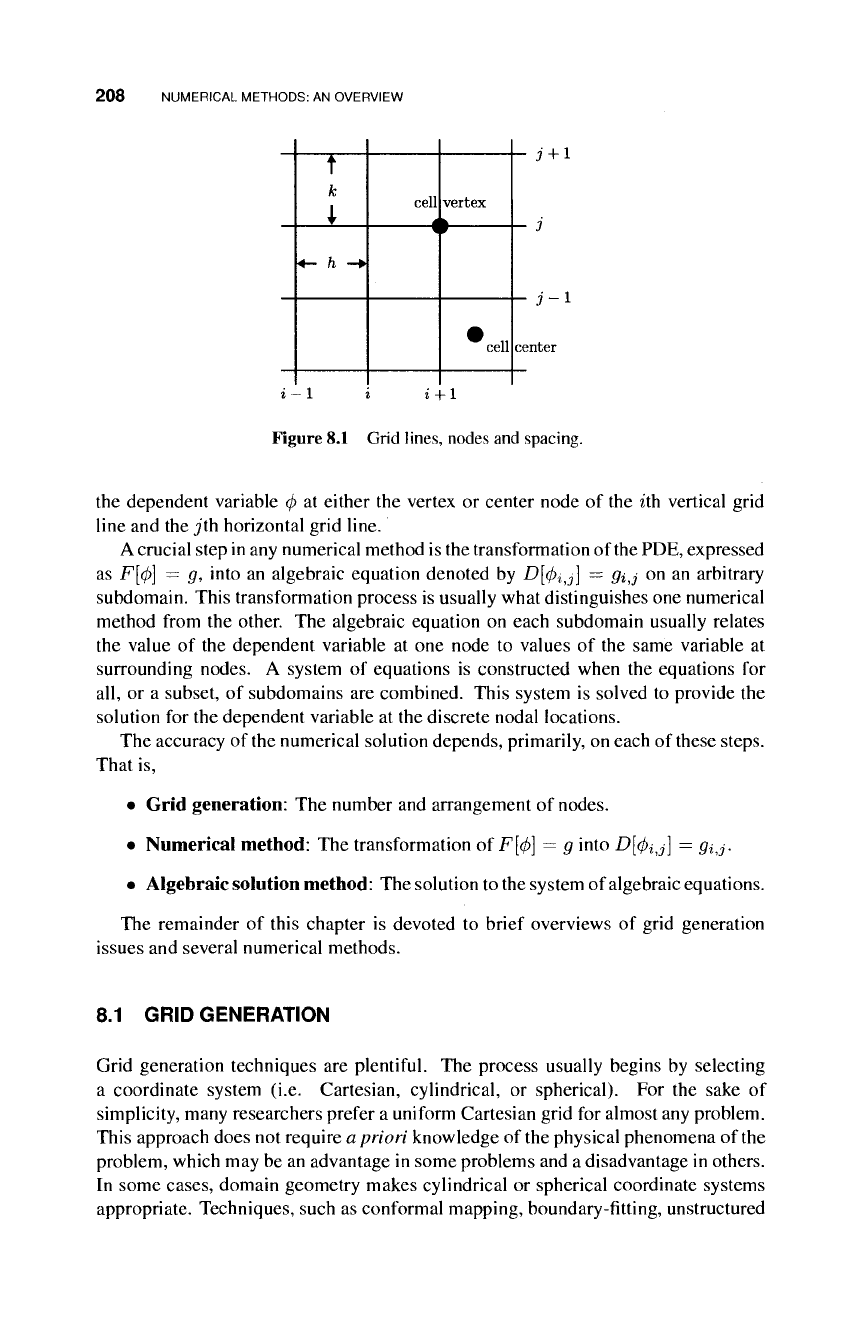
by the grid lines are classified as cell center nodes, as indicated in Figure 8.1. The
distance between consecutive grid lines is called the grid spacing, denoted by "/i"
and "fc" in Figure
8.1.
The spacing is said to be uniform in the horizontal direction if
h is constant, and uniform in the vertical direction if k is constant. If h
—
k, the grid
is said to be square. The grid lines and associated nodes are referenced by indices
such as "i" and
"j"
shown in Figure 8.1. Consequently, φι^ represents the value of
Fourier Series and Numerical Methods for Partial Differential Equations, 207
First Edition. By Richard Bernatz
Copyright © 2010 John Wiley & Sons, Inc.
208 NUMERICAL METHODS: AN OVERVIEW
t
k
i
L-
h -*
cell vertex
Γ
cell
i
—
1
¿
¿
+ 1
Figure
8.1
Grid lines, nodes and spacing.
the dependent variable
φ at
either the vertex
or
center node
of
the
úh
vertical grid
line and the
j\h
horizontal grid line.
A crucial step in any numerical method is the transformation of the
PDE,
expressed
as F[</>]
= g,
into
an
algebraic equation denoted
by Ό[φ^]
—
gi¿ on an
arbitrary
subdomain. This transformation process is usually what distinguishes one numerical
method from
the
other. The algebraic equation
on
each subdomain usually relates
the value
of
the dependent variable
at one
node
to
values
of
the same variable
at
surrounding nodes.
A
system
of
equations
is
constructed when
the
equations
for
all,
or a
subset,
of
subdomains are combined. This system
is
solved
to
provide
the
solution
for
the dependent variable
at
the discrete nodal locations.
The accuracy of
the
numerical solution depends, primarily, on each of these steps.
That is,
• Grid generation: The number and arrangement
of
nodes.
• Numerical method: The transformation
of
F[</>]
= g
into Dfyij]
= gij.
• Algebraic solution
method:
The solution to the system of algebraic equations.
The remainder
of
this chapter
is
devoted
to
brief overviews
of
grid generation
issues and several numerical methods.
8.1 GRID GENERATION
Grid generation techniques
are
plentiful. The process usually begins
by
selecting
a coordinate system
(i.e.
Cartesian, cylindrical,
or
spherical).
For the
sake
of
simplicity, many researchers prefer a uniform Cartesian grid for almost any problem.
This approach does not require a priori knowledge
of
the physical phenomena of the
problem, which may be an advantage in some problems and a disadvantage in others.
In some cases, domain geometry makes cylindrical
or
spherical coordinate systems
appropriate. Techniques, such as conformai mapping, boundary-fitting, unstructured
GRID GENERATION 209
grids,
multigrids, or adaptive
grids,
may be used for "irregular" geometries or complex
flow characteristics as well.
A key objective in many grid generation efforts is to assure a boundary in the
computational domain corresponds to a boundary in the physical domain. This goal
may be referred to as geometric adaptation. Additionally, it may be desired to
include greater nodal resolution in the physical domain where a dependent variable
changes quickly. This process may be referred to as solution adaptation. It may
be desirable to increase grid resolution in regions where a dependent variable has a
large gradient change during the solution process. The steep-gradient region(s) may
change location as the solution evolves. Grid processes that change grid resolution
may be referred to as automatic or dynamic solution adaptation. This technique
may be useful, for example, in the case of
a
moving internal boundary corresponding
to a phase change.
The computational grid should be constructed with the following objectives:
A. Minimize numerical error. Grid resolution and orientation with respect to
flow direction may impact sources of numerical error, such as round-off and
truncation error.
B.
Provide numerical stability. The stability (to be discussed later) of some
numerical methods depends on the size of the discretization element.
C. Provide computational economy. Obviously, more computation is required as
the number of grid nodes increases.
D.
Provide ease in handling boundary conditions. Boundary conditions may
involve normal derivatives in some applications. Consequently, it is advanta-
geous for certain grid lines to adjoin the boundary in a normal fashion.
Some objectives in the list above are at odds with each other. For example,
objective C suggests the need for fewer nodes while objectives A and B seem to
require more nodes. Indeed, the tension between too few and too many nodes is often
at the center of the grid generation issue. The overall objective is the optimal grid;
the most sparse grid system that provides the desired accuracy.
The principles outlined below may be used to attain one or more of the stated
objectives. The objectives addressed by a given principle are listed in parentheses.
1.
The problem geometry aligns with the coordinate system. (A, C, and D)
2.
Flow and heat flux vectors should run parallel to the coordinate lines. (A)
3.
In the case of nonuniform grid spacing, the ratio (larger to smaller) of spacing
for two adjacent cells should be < 2. (A and B)
4.
The coordinate system should be orthogonal or nearly orthogonal whenever
possible. (A and B)
5.
Node density should be proportional to the gradient of a dependent variable.
(A and B)
210 NUMERICAL METHODS: AN OVERVIEW
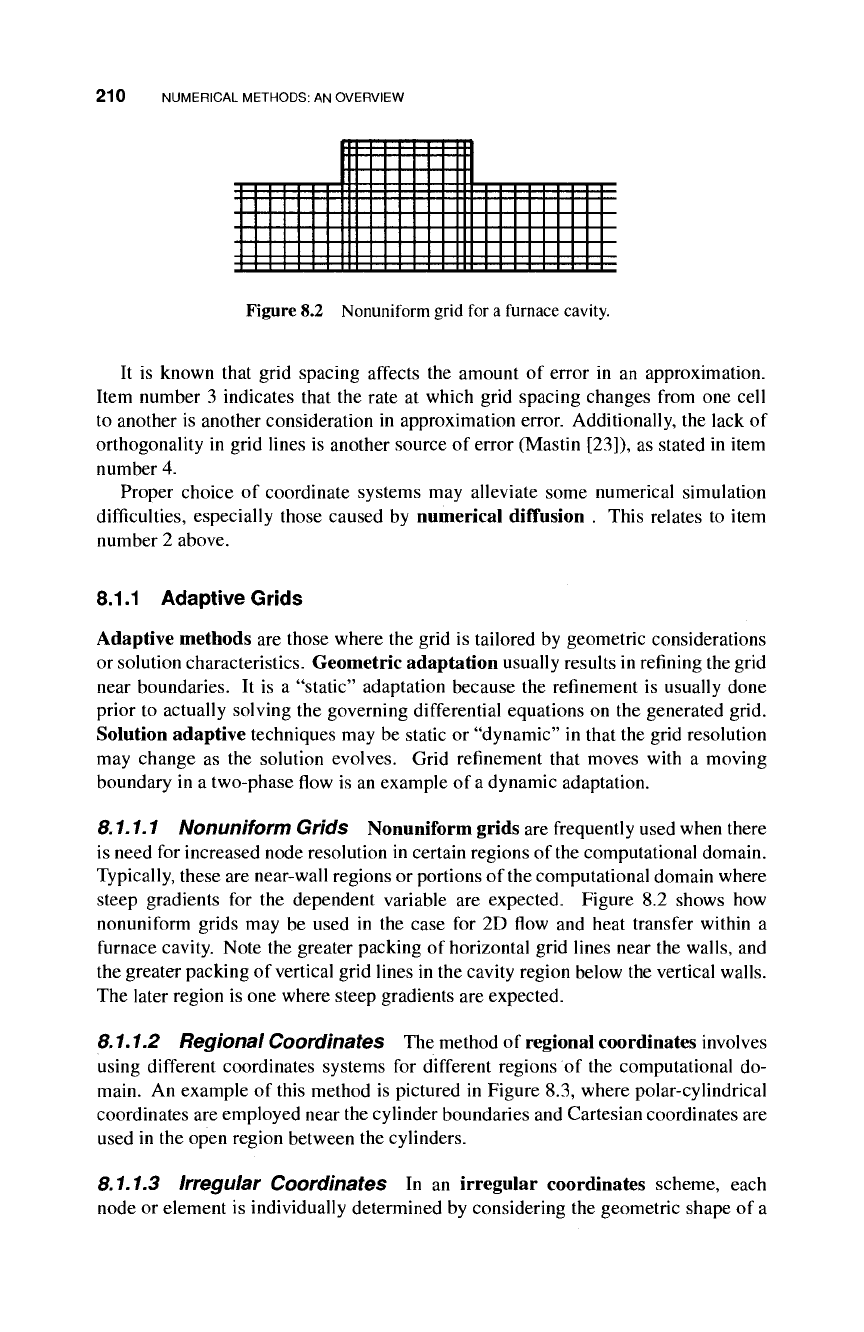
Figure 8.2 Nonuniform grid for
a
furnace cavity.
It is known that grid spacing affects the amount of error in an approximation.
Item number 3 indicates that the rate at which grid spacing changes from one cell
to another is another consideration in approximation error. Additionally, the lack of
orthogonality in grid lines is another source of error (Mastín [23]), as stated in item
number 4.
Proper choice of coordinate systems may alleviate some numerical simulation
difficulties, especially those caused by numerical diffusion . This relates to item
number 2 above.
8.1.1 Adaptive Grids
Adaptive methods are those where the grid is tailored by geometric considerations
or solution characteristics. Geometric adaptation usually results in refining the grid
near boundaries. It is a "static" adaptation because the refinement is usually done
prior to actually solving the governing differential equations on the generated grid.
Solution adaptive techniques may be static or "dynamic" in that the grid resolution
may change as the solution evolves. Grid refinement that moves with a moving
boundary in a two-phase flow is an example of a dynamic adaptation.
8.1.
1.
1
Nonuniform Grids Nonuniform grids are frequently used when there
is need for increased node resolution in certain regions of the computational domain.
Typically, these are near-wall regions or portions of the computational domain where
steep gradients for the dependent variable are expected. Figure 8.2 shows how
nonuniform grids may be used in the case for 2D flow and heat transfer within a
furnace cavity. Note the greater packing of horizontal grid lines near the walls, and
the greater packing of vertical grid lines in the cavity region below the vertical walls.
The later region is one where steep gradients are expected.
8.1.1.2 Regional Coordinates The method of regional coordinates involves
using different coordinates systems for different regions of the computational do-
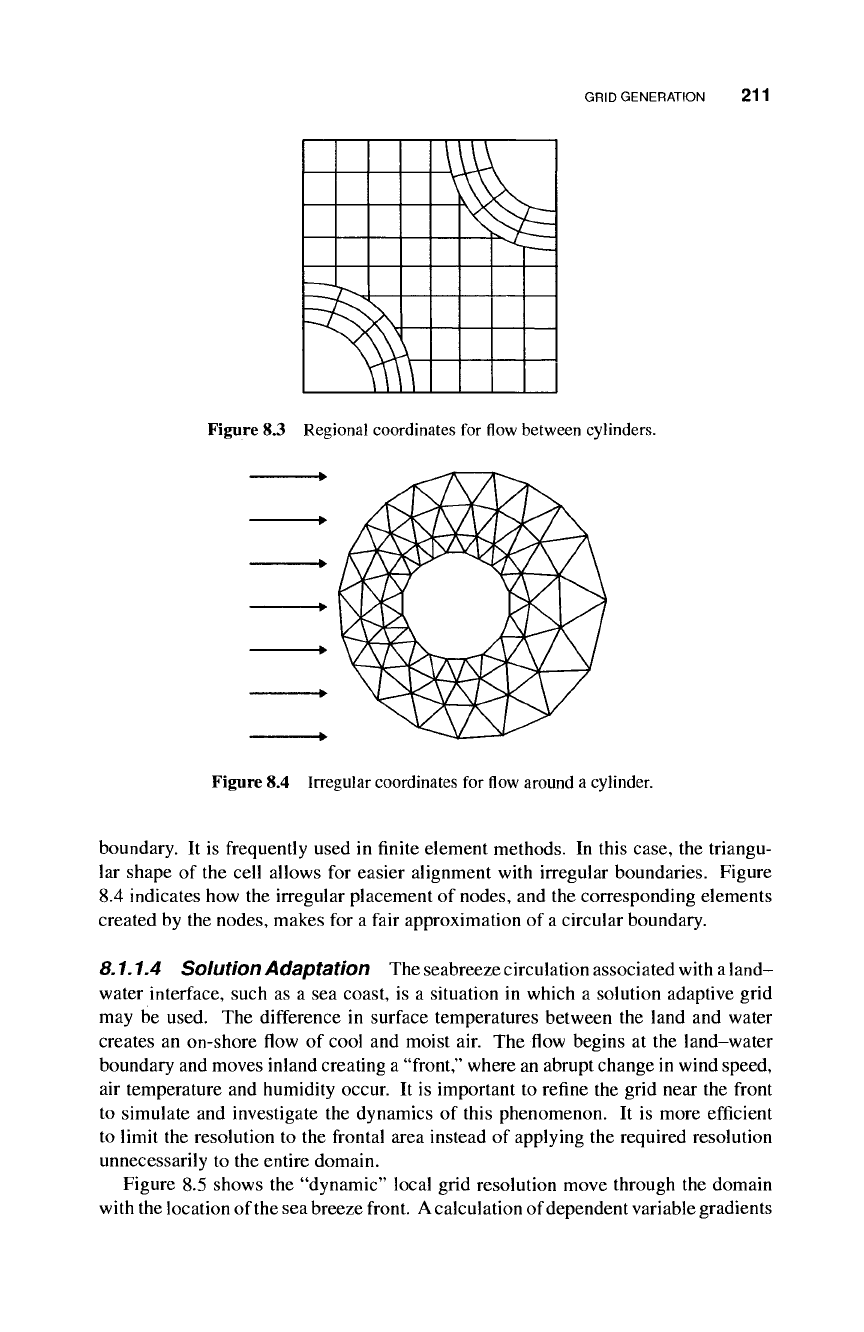
main. An example of this method is pictured in Figure 8.3, where polar-cylindrical
coordinates are employed near the cylinder boundaries and Cartesian coordinates are
used in the open region between the cylinders.
8.1.1.3 Irregular Coordinates In an irregular coordinates scheme, each
node or element is individually determined by considering the geometric shape of a
GRID GENERATION 211
Figure 8.3 Regional coordinates for
flow
between cylinders.
Figure 8.4 Irregular coordinates for
flow
around a cylinder.
boundary. It is frequently used in finite element methods. In this case, the triangu-
lar shape of the cell allows for easier alignment with irregular boundaries. Figure
8.4 indicates how the irregular placement of nodes, and the corresponding elements
created by the nodes, makes for a fair approximation of a circular boundary.
8.1.1.4
Solution Adaptation The Seabreeze circulation associated with
a
land-
water interface, such as a sea coast, is a situation in which a solution adaptive grid
may be used. The difference in surface temperatures between the land and water
creates an on-shore flow of cool and moist air. The flow begins at the land-water
boundary and moves inland creating a "front," where an abrupt change in wind speed,
air temperature and humidity occur. It is important to refine the grid near the front
to simulate and investigate the dynamics of this phenomenon. It is more efficient
to limit the resolution to the frontal area instead of applying the required resolution
unnecessarily to the entire domain.
Figure 8.5 shows the "dynamic" local grid resolution move through the domain
with the location of the sea breeze front.
A
calculation of dependent variable gradients