
Bernatz R. Fourier Series and Numerical Methods for Partial Differential Equations
Подождите немного. Документ загружается.

222 THE FINITE DIFFERENCE METHOD
9.2 FINITE DIFFERENCE FORMULAS
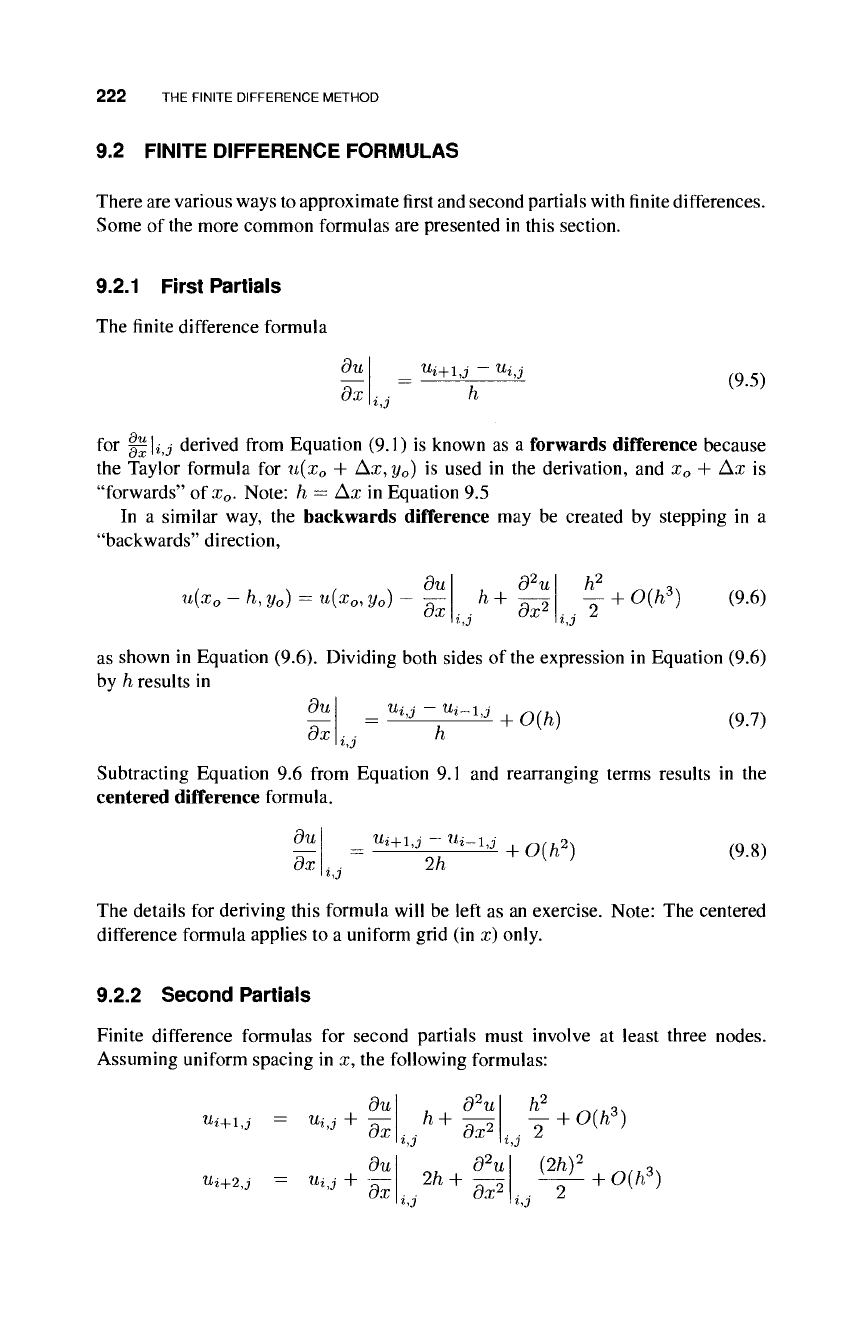
There are various ways to approximate first and second partíais with finite differences.
Some of the more common formulas are presented in this section.
9.2.1 First Partiais
The finite difference formula
du
dx
^i-\-l,j ^i,j
h
(9.5)
for Qfe\ij derived from Equation (9.1) is known as a forwards difference because
the Taylor formula for u(x
0
+ Δχ, y
0
) is used in the derivation, and x
0
+ Ax is
"forwards" of x
0
. Note: ft = Ax in Equation 9.5
In a similar way, the backwards difference may be created by stepping in a
"backwards" direction,
u(x
0
- ft, y
0
) = u(x
0
, y
0
) - —
ft +
2j
&u_
dx
2
^+0(ft
3
) (9.6)
as shown in Equation (9.6). Dividing both sides of the expression in Equation (9.6)
by ft results in
du
dx
ft
+ O(ft)
(9.7)
Subtracting Equation 9.6 from Equation 9.1 and rearranging terms results in the
centered difference formula.
du
dx
2ft
+ 0(ft
2
)
(9.8)
The details for deriving this formula will be left as an exercise. Note: The centered
difference formula applies to a uniform grid (in x) only.
9.2.2 Second Partíais
Finite difference formulas for second partíais must involve at least three nodes.
Assuming uniform spacing in x, the following formulas:
du
Ui+lj =
U
itj
+ —
ft +
*
5
j
U
i+
2,j
= Uij +
du\
dx\
2ft+
(Pu
dx
2
d
2
u
ft
2
, 2
+ 0(ft
3
)
(2ft)
2
i,3
dx
2
+ 0(ft
3
)
t>,3
1D HEAT EQUATION 223
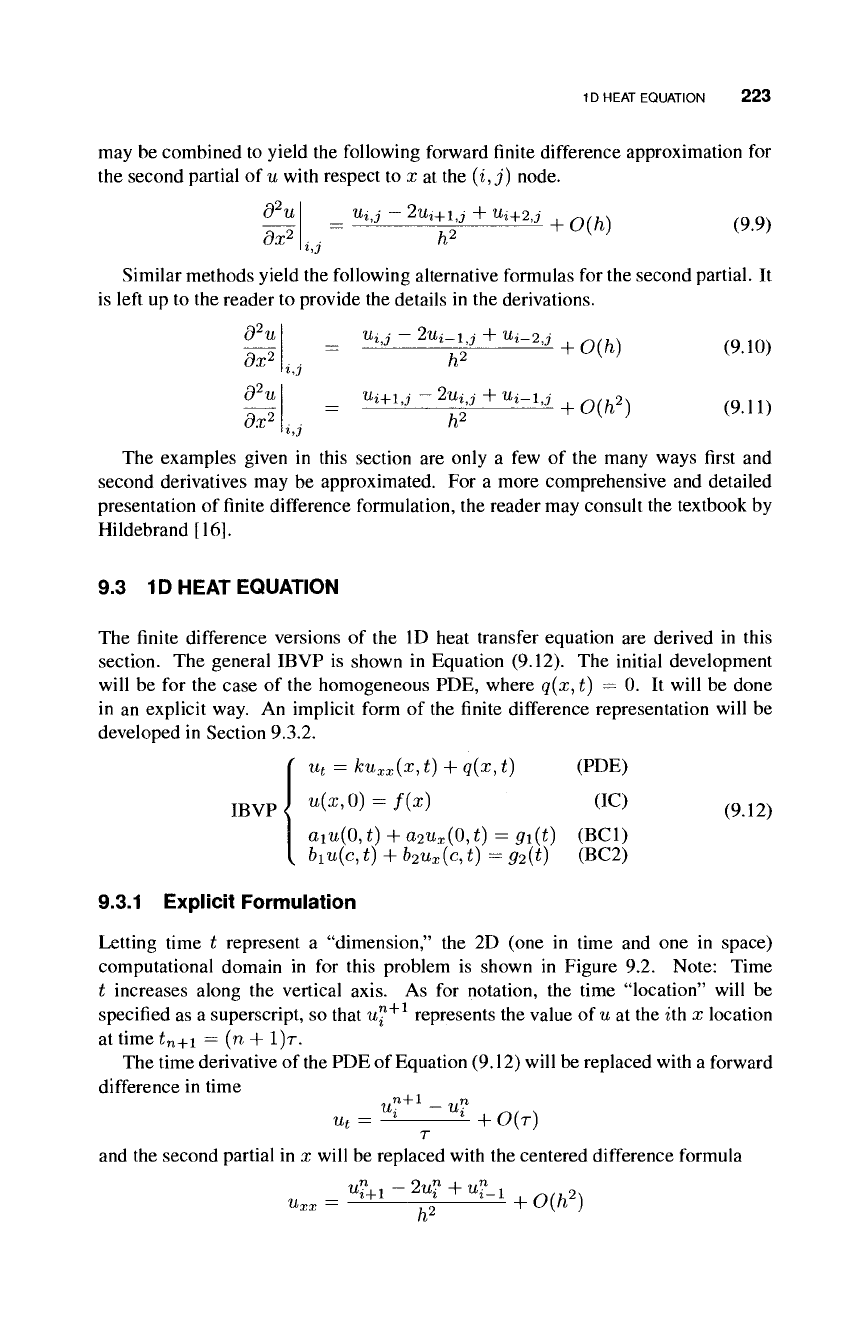
may be combined to yield the following forward finite difference approximation for
the second partial of u with respect to x at the
(¿,
j) node.
d
2
u\
dx
2
*"i,J
— 2Un
hj
+ 1J + Uj+2j
h
2
+ 0(h)
(9.9)
Similar methods yield the following alternative formulas for the second partial. It
is left up to the reader to provide the details in the derivations.
d
2
u\
dx
2
d
2
u
dx
2
*i,3
2Uj-ij +Uj-
2
,j
i>,3
1,3
h
2
O(h)
Uj+ij - 2ujj + Uj-
h
2
i^+0(/i
2
)
(9.10)
(9.11)
The examples given in this section are only a few of the many ways first and
second derivatives may be approximated. For a more comprehensive and detailed
presentation of finite difference formulation, the reader may consult the textbook by
Hildebrand [16].
9.3 1D HEAT EQUATION
The finite difference versions of the ID heat transfer equation are derived in this
section. The general IBVP is shown in Equation (9.12). The initial development
will be for the case of the homogeneous PDE, where g(rr, t) = 0. It will be done
in an explicit way. An implicit form of the finite difference representation will be
developed in Section 9.3.2.
ut = ku
xx
(x, t) + q(x,t) (PDE)
u(x,0) = /(x) (IC)
IBVP< (9.12)
aiu(0,
t) + a
2
u
x
(0, t) = gi(t)
biu(c,t) 4- b
2
u
x
(c,t) = g
2
(t)
(BC1)
(BC2)
9.3.1 Explicit Formulation
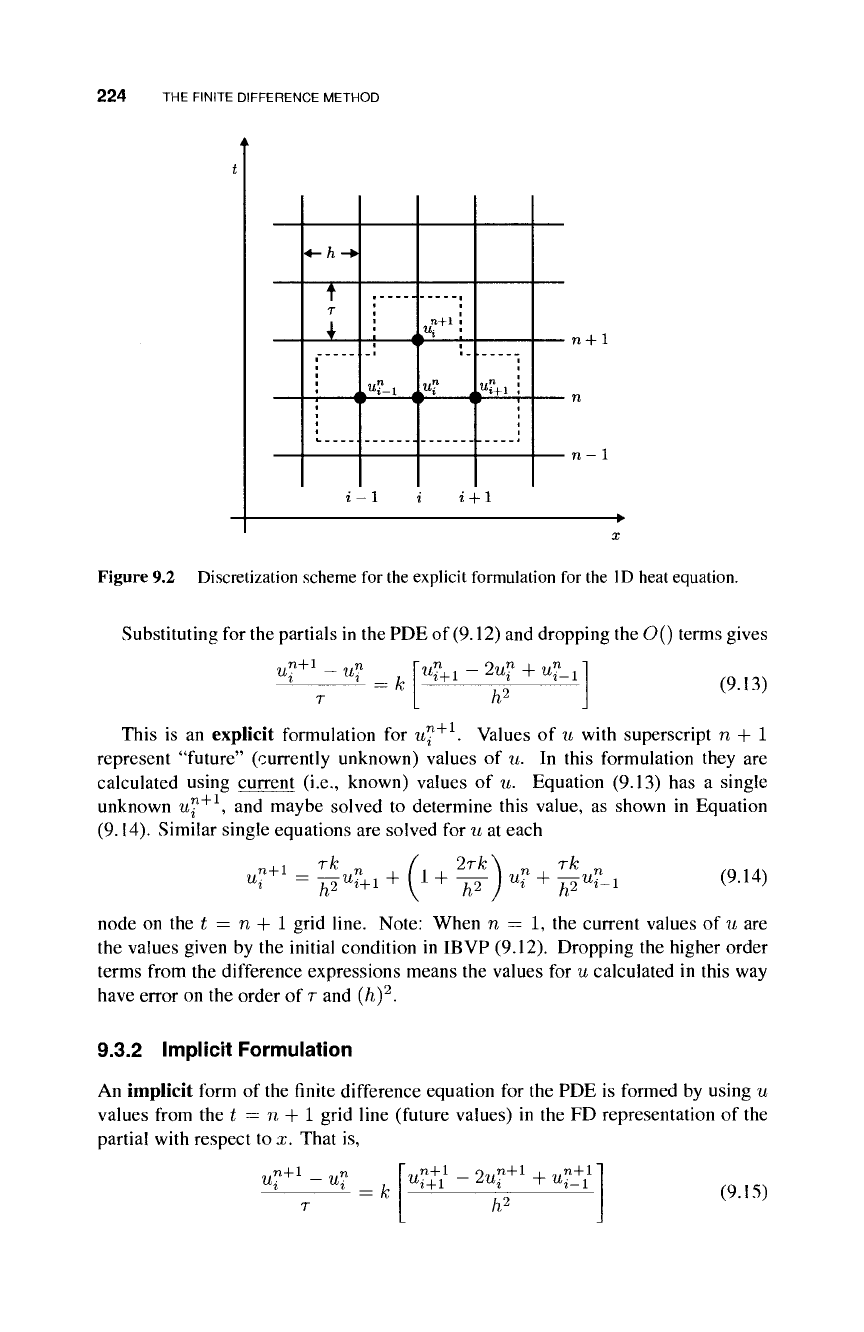
Letting time t represent a "dimension," the 2D (one in time and one in space)
computational domain in for this problem is shown in Figure 9.2. Note: Time
t increases along the vertical axis. As for notation, the time "location" will be
specified as a superscript, so that u^
+1
represents the value of u at the ith x location
at time t
n
+i = (n + l)r.
The time derivative of the PDE of Equation (9.12) will be replaced with a forward
difference in time
u
t
u
n+1
+ 0(T)
and the second partial in x will be replaced with the centered difference formula
h
2
O(h')
224 THE FINITE DIFFERENCE METHOD
n + l
"W
n-1
i-1
t + 1
Figure 9.2 Discretization scheme for the explicit formulation for the
1D
heat equation.
Substituting for the partíais in the PDE of (9.12) and dropping the OQ terms gives
u?
+1
- u«
i+l
2u?
+
u?_
-1
/l
2
(9.13)
This is an explicit formulation for u
n+l
Values of i¿ with superscript n + l
represent "future" (currently unknown) values of u. In this formulation they are
calculated using current (i.e., known) values of u. Equation (9.13) has a single
unknown i¿™
+1
, and maybe solved to determine this value, as shown in Equation
(9.14).
Similar single equations are solved for u at each
»r«
-
£«
—K
+1
+ [ i +
Irk rk
(9.14)
node on the t = n + 1 grid line. Note: When n = 1, the current values of u are
the values given by the initial condition in IBVP (9.12). Dropping the higher order
terms from the difference expressions means the values for u calculated in this way
have error on the order of r and (h)
2
.
9.3.2 Implicit Formulation
An implicit form of the finite difference equation for the PDE is formed by using u
values from the t = n + 1 grid line (future values) in the FD representation of the
partial with respect to x. That is,
(9.15)
<
+1
-
T
<
= k
u
i+l
-2<
+1
+
<ΛΊ
h
2
1D H EAT EQUATION
225
where each u term with superscript n +1 is an unknown value. Rearranging Equation
(9.15) so that all unknown quantities are on the left side gives
—au,
n+l
+ βύ.
n+l
au,
n+l
■*+i
(9.16)
where
rk
β = 1 4- 2α
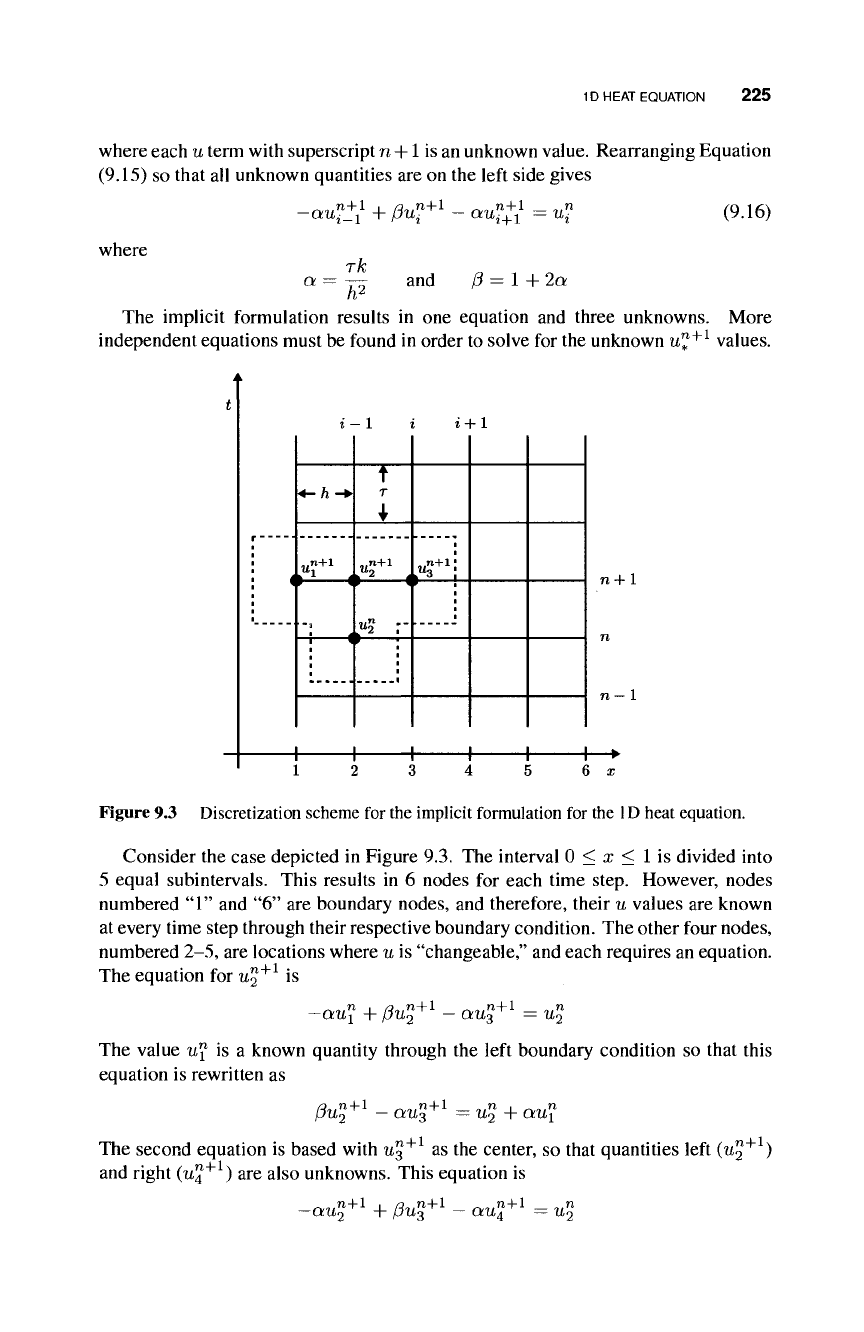
The implicit formulation results in one equation and three unknowns. More
independent equations must be found in order to solve for the unknown u*
+1
values.
A
\ \
i -
*-h-*
<
+1
1 i
w
%
•
-a
A
1 \
1
1
-1
t
T
fi
+1
t
f
„n
u
2
9
*
I
tH
«r
1
!
9 !
hi
n + l
n-1
Figure 9.3 Discretization scheme for the implicit formulation for the ID heat equation.
Consider the case depicted in Figure 9.3. The interval 0 < x < 1 is divided into
5 equal subintervals. This results in 6 nodes for each time step. However, nodes
numbered
"1"
and "6" are boundary nodes, and therefore, their u values are known
at every time step through their respective boundary condition. The other four nodes,
numbered 2-5, are locations where u is "changeable," and each requires an equation.
n+l
The equation for
u%
is
-cm
n
+ /?^2 -
au
s
„«+1 - ,
The value w
n
is a known quantity through the left boundary condition so that this
equation is rewritten as
ßu%
+1
- au^
1
= u£ 4- cm?
The second equation is based with u%
+1
as the center, so that quantities left (u^
1
)
and right (t¿
n+1
) are also unknowns. This equation is
226 THE FINITE DIFFERENCE METHOD
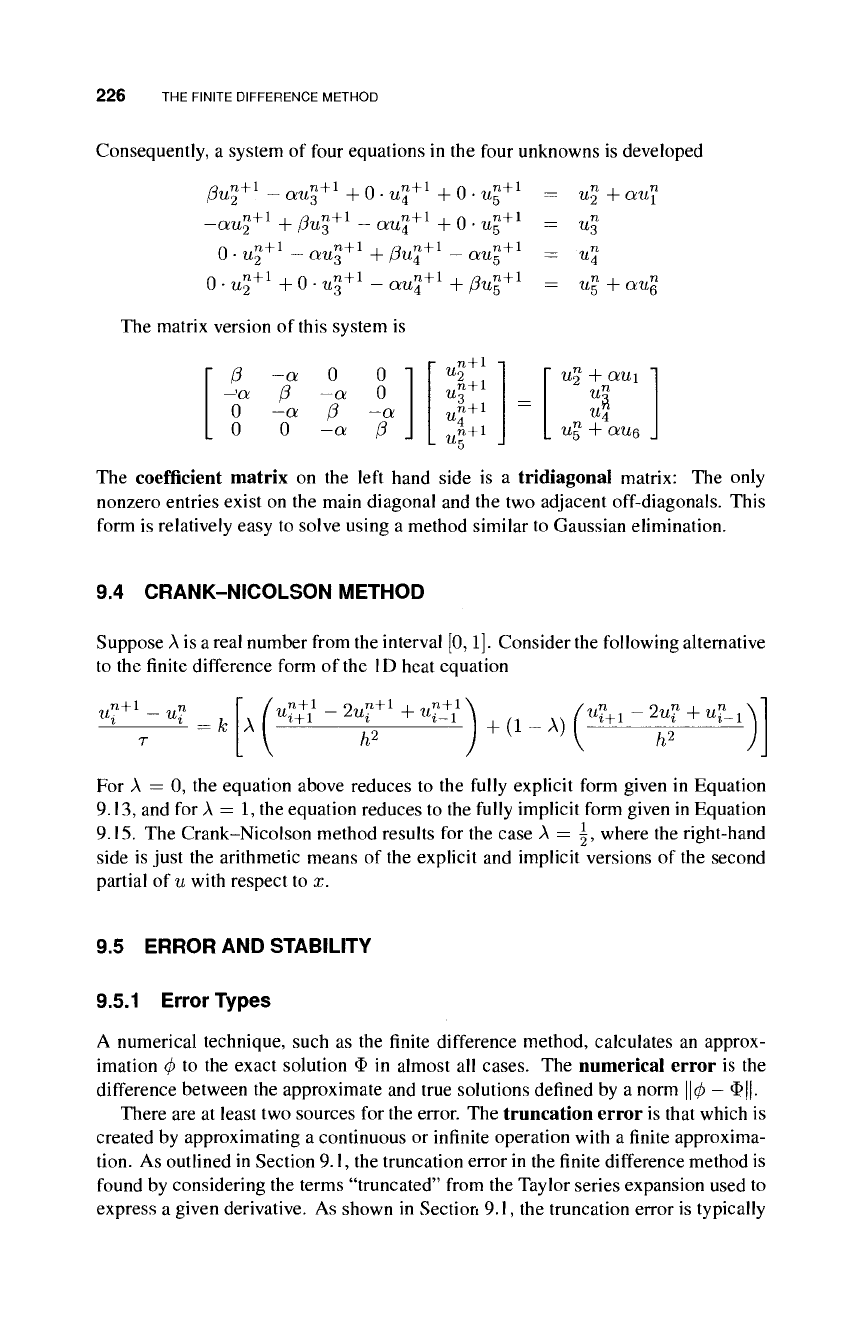
Consequently, a system of four equations in the four unknowns is developed
ßu:
n+l
2 ■
au
n+l
,n+l
0 · U^
L
+ 0 · <
n+l
t¿2 + au"
-au
n+l
+
ßu%
+1
au
,
n+1
+ 0 . <
+1
=
0-u:
n+l
,n+l
+ /K
+1
-au£
+1
= <
0
·
^
+1
+ 0
-
^
+1
- a<
+1
+ /3<
+1
= υξ + α<
The matrix version of this system is
ß
-
y
a
0
0
—a
ß
—a
0
0
—a
ß
—a
0
Ü
—c
ß
i¿5 + ai¿6 J
The coefficient matrix on the left hand side is a tridiagonal matrix: The only
nonzero entries exist on the main diagonal and the two adjacent off-diagonals. This
form is relatively easy to solve using a method similar to Gaussian elimination.
9.4 CRANK-NICOLSON METHOD
Suppose λ is
a
real number from the interval
[0,1].
Consider the following alternative
to the finite difference form of the ID heat equation
,n+l
k λ
.n+l
2u?
+
x
4- u
r
:
n+l
h
2
+ (1-λ)
x
i+l
2u? + u\
-1
h
2
For λ = 0, the equation above reduces to the fully explicit form given in Equation
9.13,
and for λ = 1, the equation reduces to the fully implicit form given in Equation
9.15.
The Crank-Nicolson method results for the case λ = |, where the right-hand
side is just the arithmetic means of the explicit and implicit versions of the second
partial of u with respect to x.
9.5 ERROR AND STABILITY
9.5.1 Error Types
A numerical technique, such as the finite difference method, calculates an approx-
imation φ to the exact solution Φ in almost all cases. The numerical error is the
difference between the approximate and true solutions defined by a norm \\φ
—
Φ||.
There are at least two sources for the error. The truncation error is that which is
created by approximating a continuous or infinite operation with a finite approxima-
tion. As outlined in Section
9.1,
the truncation error in the finite difference method is
found by considering the terms "truncated" from the Taylor series expansion used to
express a given derivative. As shown in Section 9.1, the truncation error is typically
ERROR AND STABILITY 227
proportional to a positive integer power of
the
temporal step size r or spatial step size
A.
Roundoff error results when the available number of decimal places used to
represent
a
number
is
less than the places required (representing | by 0.3333333, e.g.).
The storage capacity for number representation in modern computing machinery
usually means round-off errors are relatively small compared to truncation error.
However, it is possible that the effect of round-off error becomes very significant as
the number of calculations increase. Consequently, care must be used in decreasing
step size (either spatially or temporally) in an effort to reduce truncation error.
Numerical algorithms usually involve many steps or iterations in which truncation
error, round-off error, and other inaccuracies may accumulate. This type of error
is frequently referred to as accumulation error. Accumulation error is difficult to
isolate and measure. It is conceivable that different sources of error may offset each
other instead of simply combining to increase the error.
9.5.2 Stability
The stability of a numerical method concerns how any form of error (truncation or
rounding, etc.) or perturbation (in boundary conditions, initial conditions, or problem
parameters, etc) behaves as the numerical procedure continues. A precise definition
and formal treatment of stability is beyond the scope of this book. An interest reader
may consider the text by Linz [20] as a more in depth source.
At
a
more pedestrian level, a numerical method is said to be stable if the maximum
value of \φ^
—
Φι^
|
over the computation domain goes to zero as the maximum error
introduced at each grid point goes to zero. Likewise, the maximum of \φ^
—
Φ^·|
does not grow exponentially as the number of calculations grow.
The stability of a finite difference representation of a given PDE with prescribed
boundary conditions may be investigated in at least two different ways. One method
is to consider the finite difference representation of both the PDE and boundary
condition in a matrix form for which eigenvalue analysis is used to study stability.
A second method uses Fourier series representation of error to track its behavior
with respect to the finite difference representation of the PDE only. This analysis
technique is often referred to as the von Neumann method. The latter approach is
simpler to use, but does not account for instability effects from boundary conditions.
9.5.2.1 Explicit Case The von Neumann method is used in this section to
analyze the stability of the explicit form of the FD formulation for the ID heat
equation. The error E is due primarily to truncation in the algebraic representation
for the PDE, and may be thought of
as
a function of space and time. We do not know
a formula for E(x, t), but will assume it may be expressed as a Fourier series in both
x and another Fourier series in t. Let
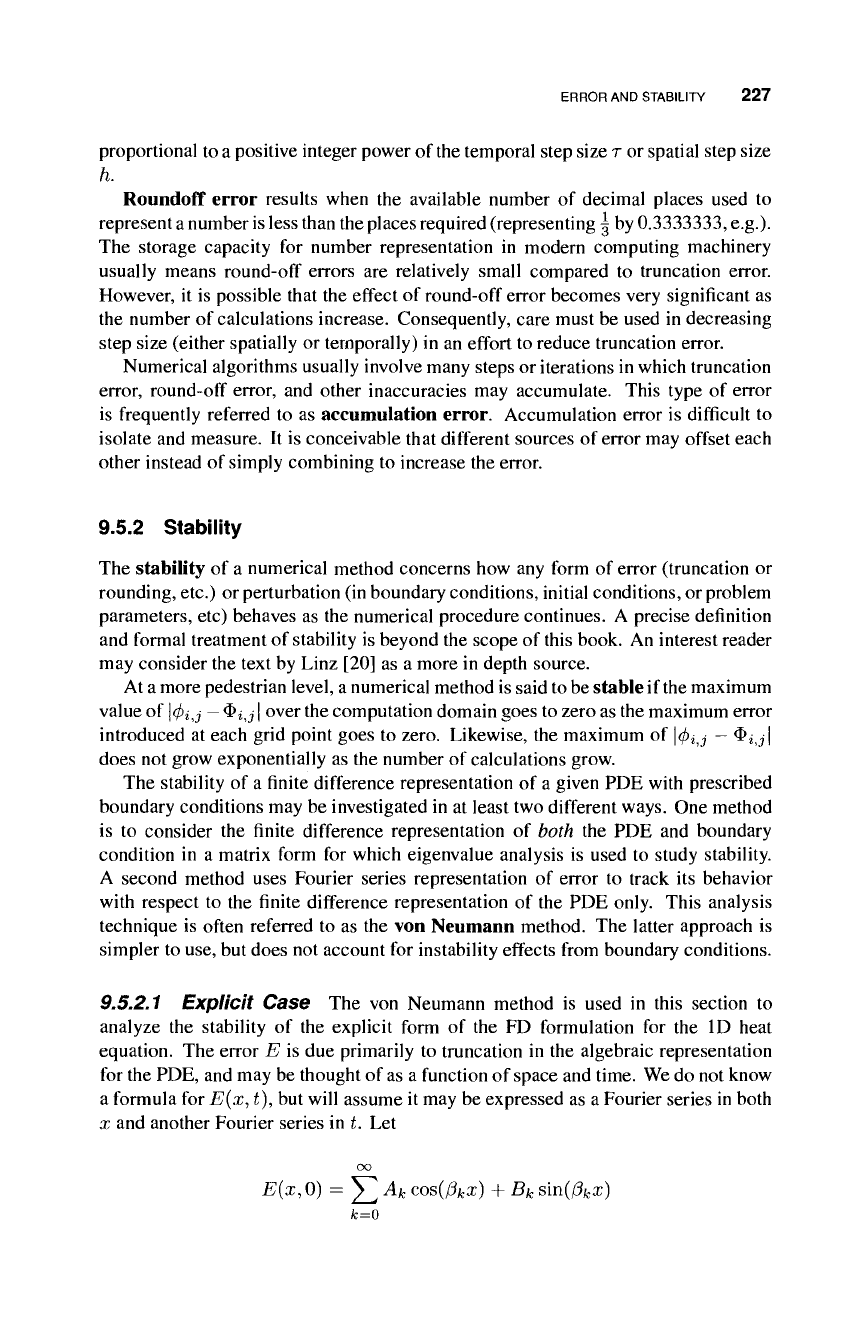
oo
E(x, 0) = ]p A
k
cos(/?
fc
x) + B
k
sin(/?
fc
x)
k=0
228 THE FINITE DIFFERENCE METHOD
be the Fourier series representation for an initial error. Because the difference
equations (and the original PDE itself) are linear, we can analyze the behavior of the
total error by tracking the behavior of an arbitrary kth component
E
k
{x,
0) = A
k
cos(/3/ex) + B
k
sm(ß
k
x)
Because A
k
and B
k
are constants, we do not have to drag them along in our analysis.
Also,
instead of considering the behavior of the error for x in general, we will isolate
our analysis to an arbitrary node represented by jh. Using Euler's formula we may
represent the initial error at this arbitrary node as
Ej =
e
ißUh)
For our analysis, we may express in a similar way the time dependent behavior of
the single component initial error and arrive at the following expression for E^
n
at
an arbitrary, discrete time t = nr
Ej,n = e
7(nr)
·
e
ißüh)
= ξ
η
·
e
ißüh)
(9.17)
where 7, in general, is complex, and ξ =
e
7At
.
The norm |£| represents the time-
dependent amplitude of the initial error, and that error will not increase as time
increases if
1*1
<i
Any error that develops during the finite difference process is part of the finite
difference solution and it, too, must solve the finite difference algebraic equation.
Because the finite difference equations are linear, we may treat the error portion
separately. Consequently, the error expression given in Equation (9.17) must solve
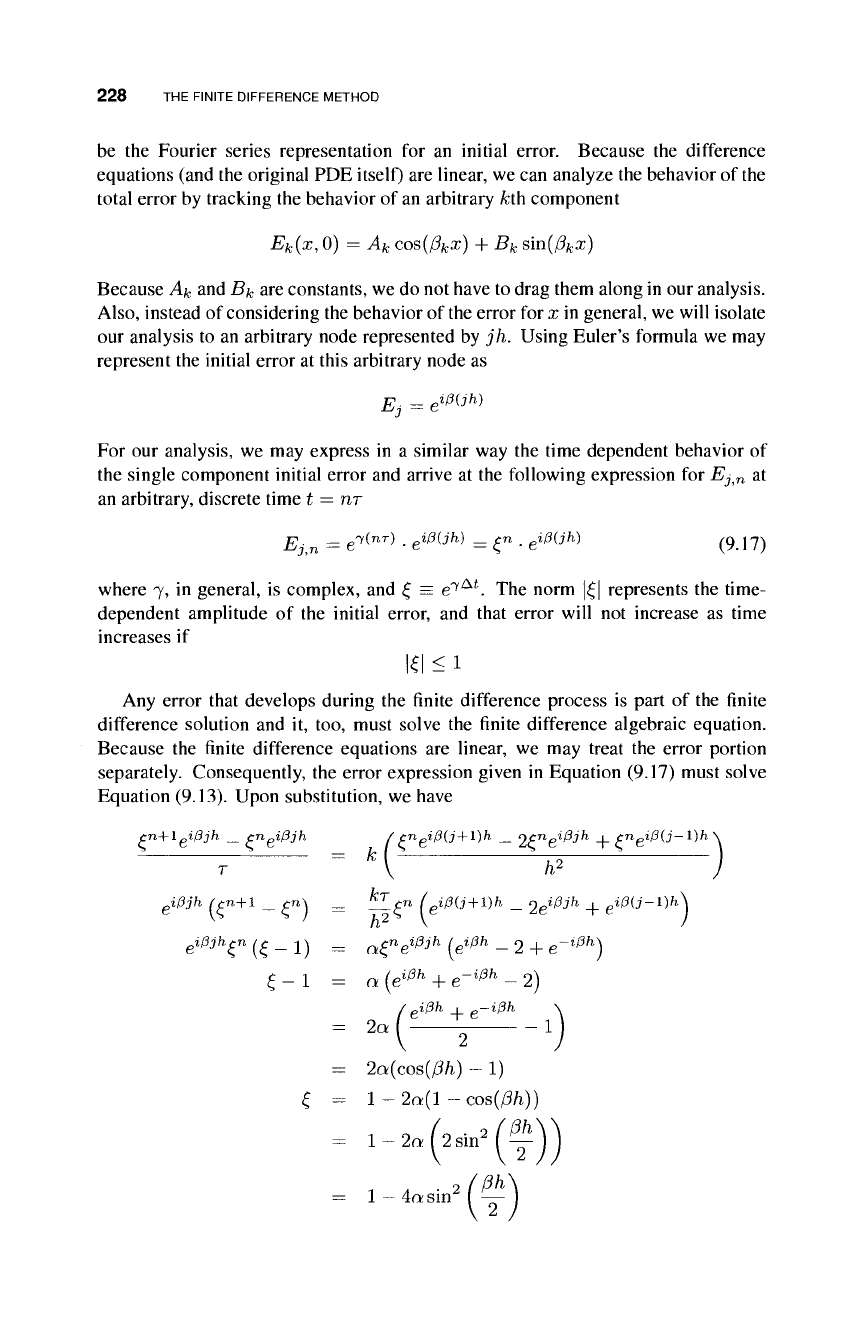
Equation (9.13). Upon substitution, we have
tn+l
e
ißjh _ tn
e
ißjh / un
e
iß(j + l)h _
2£
n
e
i
ßJ
h
4. un
e
iß(j-l)h
τ
=
k
{ ft*
e
ißjh Un+1 _ ξη\
=
^ϋξη fiß{j+l)h _ ^ißjh
+ e
%ß(j-l)h\
jßjhcn (ξ _ 1)
=
aCe
ißjh
(e
ißh
- 2 +
e~
ißh
)
ξ-l = a(e
ißh
+
e~
ißh
-2)
(
p
ißh 1
p
-ißh
—T—'
= 2a(cos(/3/i) - 1)
ξ = 1 - 2α(1 - cos(ßh))
l-2a(2ún
2ÍÍ5h
1
—
4α sin
2
2
βΚ
ERROR AND STABILITY 229
2
1
ßh
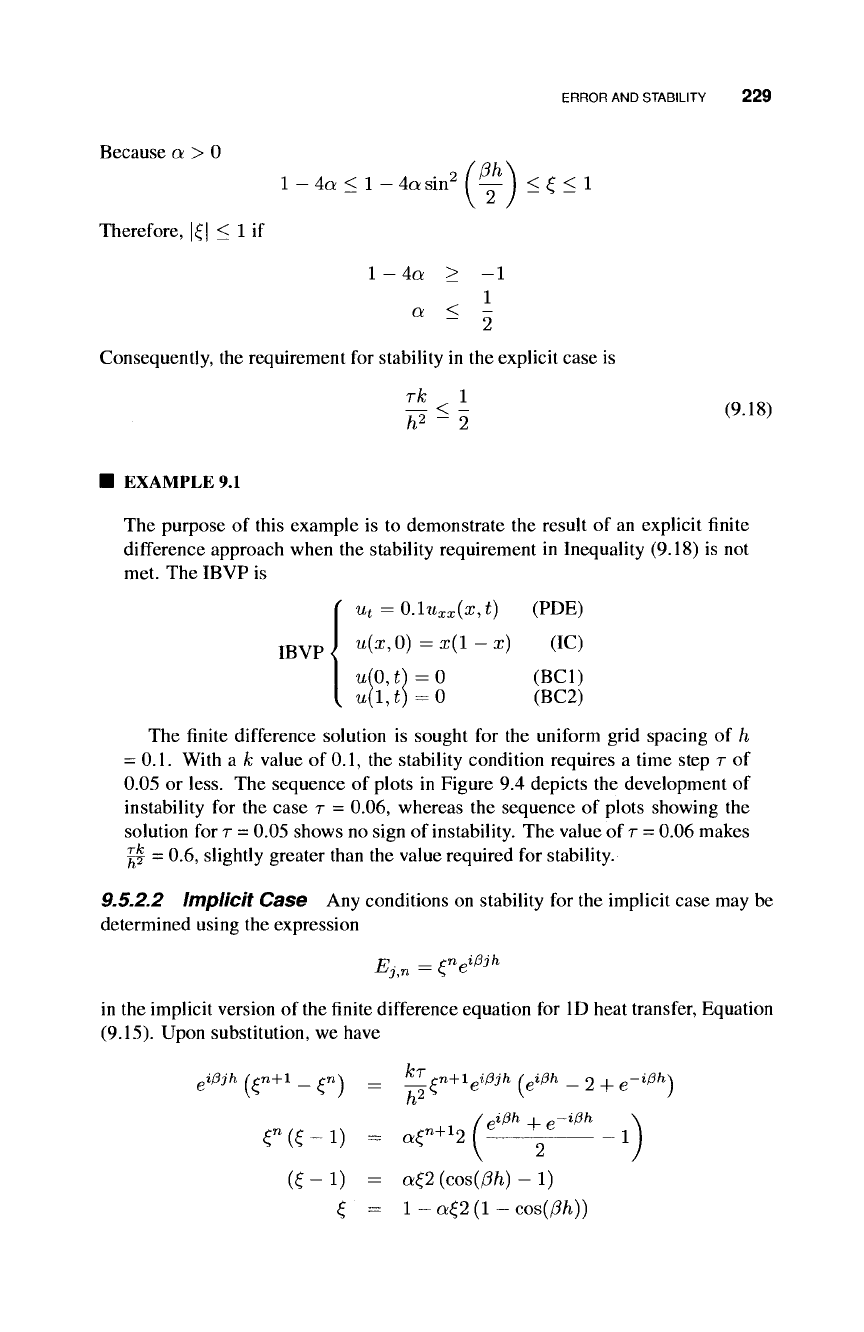
Because a > 0
1 - 4α < 1 - 4asin
z
I ^- I < ξ < 1
Therefore, |£| < 1 if
1 - 4a > -1
Consequently, the requirement for stability in the explicit case is
t
<-1
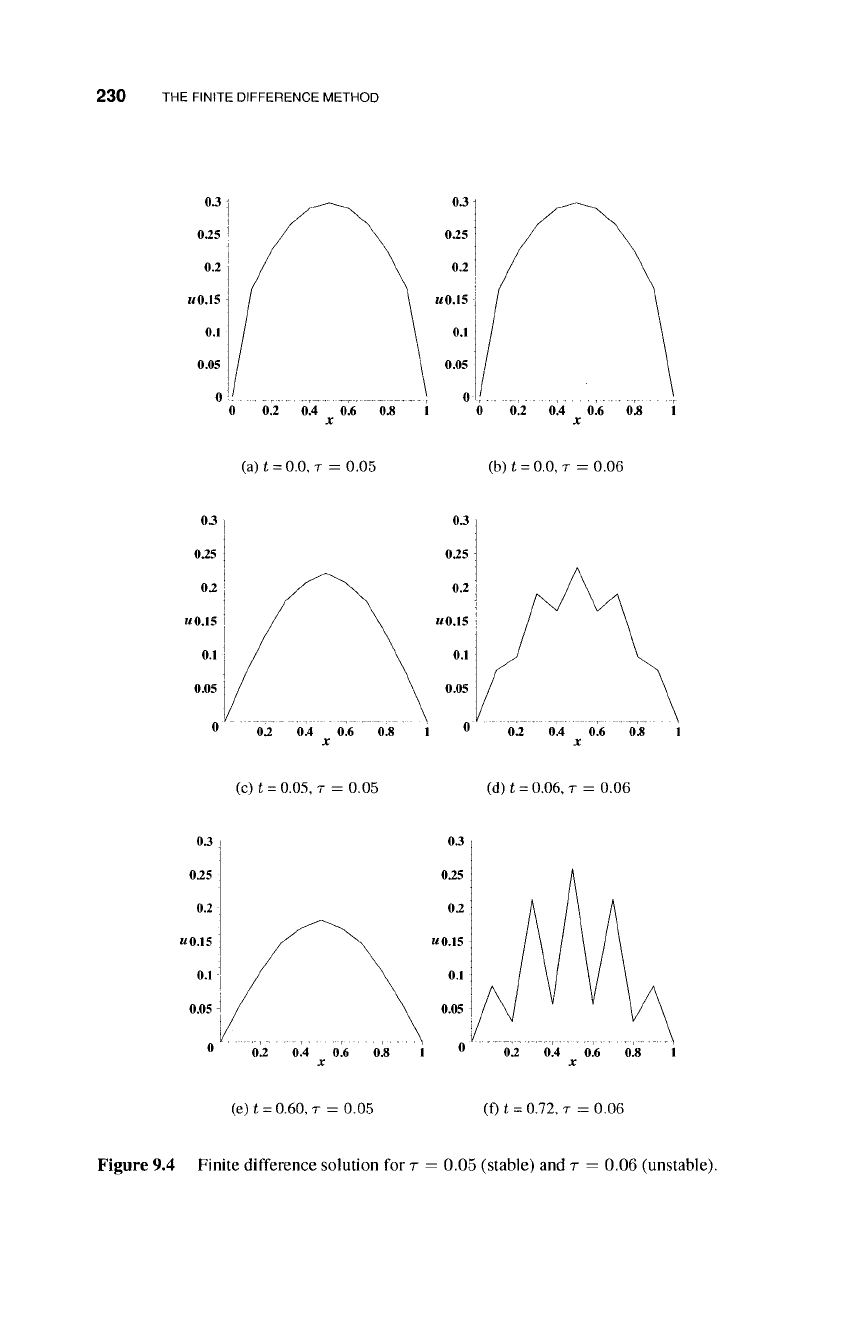
EXAMPLE 9.1
The purpose of this example is to demonstrate the result of an explicit finite
difference approach when the stability requirement in Inequality (9.18) is not
met. The IBVP is
IBVP
ut = 0.1u
xx
(x,t) (PDE)
u(x,0) =x(l -x) (IC)
w(0,t) = 0 (BC1)
u{l,t) = 0 (BC2)
The finite difference solution is sought for the uniform grid spacing of h
= 0.1. With a k value of
0.1,
the stability condition requires a time step r of
0.05 or less. The sequence of plots in Figure 9.4 depicts the development of
instability for the case r = 0.06, whereas the sequence of plots showing the
solution for r = 0.05 shows no sign of instability. The value of r = 0.06 makes
$
=
0.6, slightly greater than the value required for stability.
9.5.2.2 Implicit Case Any conditions on stability for the implicit case may be
determined using the expression
E
jin
= £
n
e
ißjh
in the implicit version of the finite difference equation for ID heat transfer, Equation
(9.15).
Upon substitution, we have
e
ißjh /Vn+l _ ¿n\
=
^tn+l
e
ißjh ijßh _ 2 +
e~
ißh
)
h
2
ißh i „ — ißh
' pipn _L p-
rtè-i) = ^
n+1
2(^— 1
(ξ-1) = αξ2 (cos(ßh) - 1)
ξ = l-a£2(l-co8(ßh))
230 THE FINITE DIFFERENCE METHOD
0.3
0.25
0.2
iiO.15
0.1
0.05
0
0.2 0.4 0.6 0.8 1 0 0.2 0.4 0.6 0.8 1
X x
(a) t
=
0.0, r = 0.05 (b) t
=
0.0, T = 0.06
(c) t
=
0.05,
r = 0.05 (d) t
=
0.06, T = 0.06
02 0.4 0.6 0.8 1
02 0.4 0.6 0.8 1
(e)t = 0.60,T = 0.05 (f) t = 0.72, r = 0.06
Figure 9.4 Finite difference solution for r = 0.05 (stable) and r = 0.06 (unstable).
CONVERGENCE IN PRACTICE 231
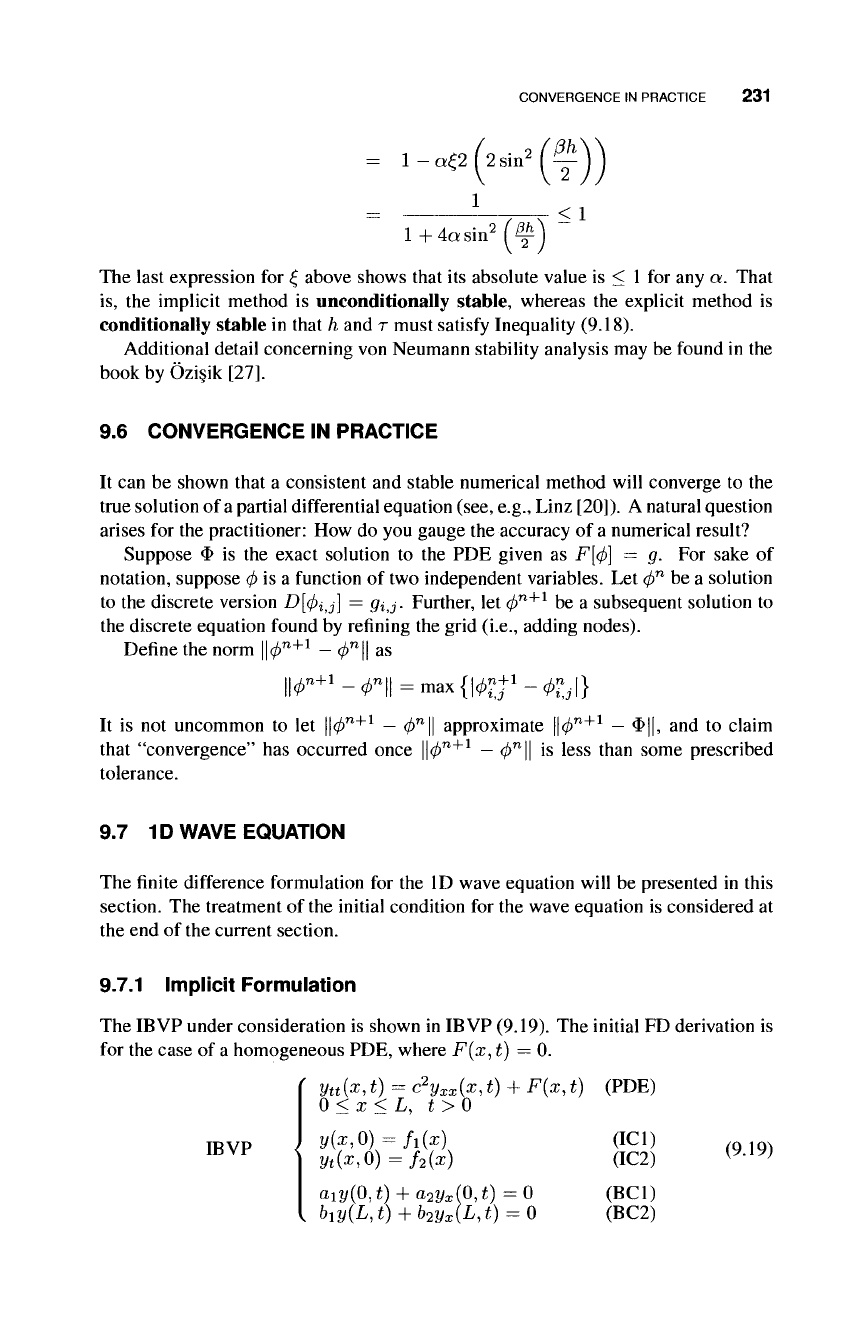
- .-^(w(?))
1
<1
1 + 4a sin
in
2
(f )
The last expression for ξ above shows that its absolute value is <
1
for any a. That
is,
the implicit method is unconditionally stable, whereas the explicit method is
conditionally stable in that h and τ must satisfy Inequality (9.18).
Additional detail concerning von Neumann stability analysis may be found in the
bookbyÖzi§ik[27].
9.6 CONVERGENCE IN PRACTICE
It can be shown that a consistent and stable numerical method will converge to the
true solution of
a
partial differential equation (see, e.g., Linz [20]). A natural question
arises for the practitioner: How do you gauge the accuracy of a numerical result?
Suppose Φ is the exact solution to the PDE given as
F[<ß]
= g. For sake of
notation, suppose φ is a function of two independent variables. Let φ
η
be a solution
to the discrete version Ό[φ^\
—
gij. Further, let 0
n+1
be a subsequent solution to
the discrete equation found by refining the grid (i.e., adding nodes).
Define the norm
||0
η+1
—
φ
η
\\ as
\\φ
η+1
-φ
η
\\=τη^{\φΙ+
1
-φ^\}
It is not uncommon to let
||0
n+1
—
φ
η
\\ approximate ||(/>
n+1
—
Φ||, and to claim
that "convergence" has occurred once ||</>
n+1
—
φ
η
\\ is less than some prescribed
tolerance.
9.7 1D WAVE EQUATION
The finite difference formulation for the ID wave equation will be presented in this
section. The treatment of the initial condition for the wave equation is considered at
the end of the current section.
9.7.1 Implicit Formulation
The IBVP under consideration is shown in IBVP (9.19). The initial FD derivation is
for the case of a homogeneous PDE, where F(x, i) = 0.
y
tt
(x,
t) = c
2
y
xx
(x, t) + F(x, t) (PDE)
0 < x < L, t>0
IBVP
!/(x,0) = /i(x) (ICI)
rQ1Q
.
tft(x,0) = /
2
(x) (IC2)
(9
'
19)
αιΐ/(0,ί)+α
2
ΐ/χ(0,ί) = 0 (BCl)
b
iy
{L,t) + b
2
y
x
{L,t) =
Q
(BC2)