
Bernatz R. Fourier Series and Numerical Methods for Partial Differential Equations
Подождите немного. Документ загружается.

232 THE FINITE DIFFERENCE METHOD
Centered differences will be used for both second partíais in the PDE. The spatial
domain (0<x<l)is divided into N equal subintervals. The length of each
interval is h
—
1/N. The time-independent boundary conditions at x = 0 and x = 1
mean new values for y need to be calculated for y^
%
— 2, 3, ... N
—
1 and N
only. See Figure 9.5 for details.
¿=123...
N N + 1
—I—I—I—I—I—I—I—I—I—I—I—I
►
x= 0 ... 1
Figure 9.5 Node indexing for the ID wave equation.
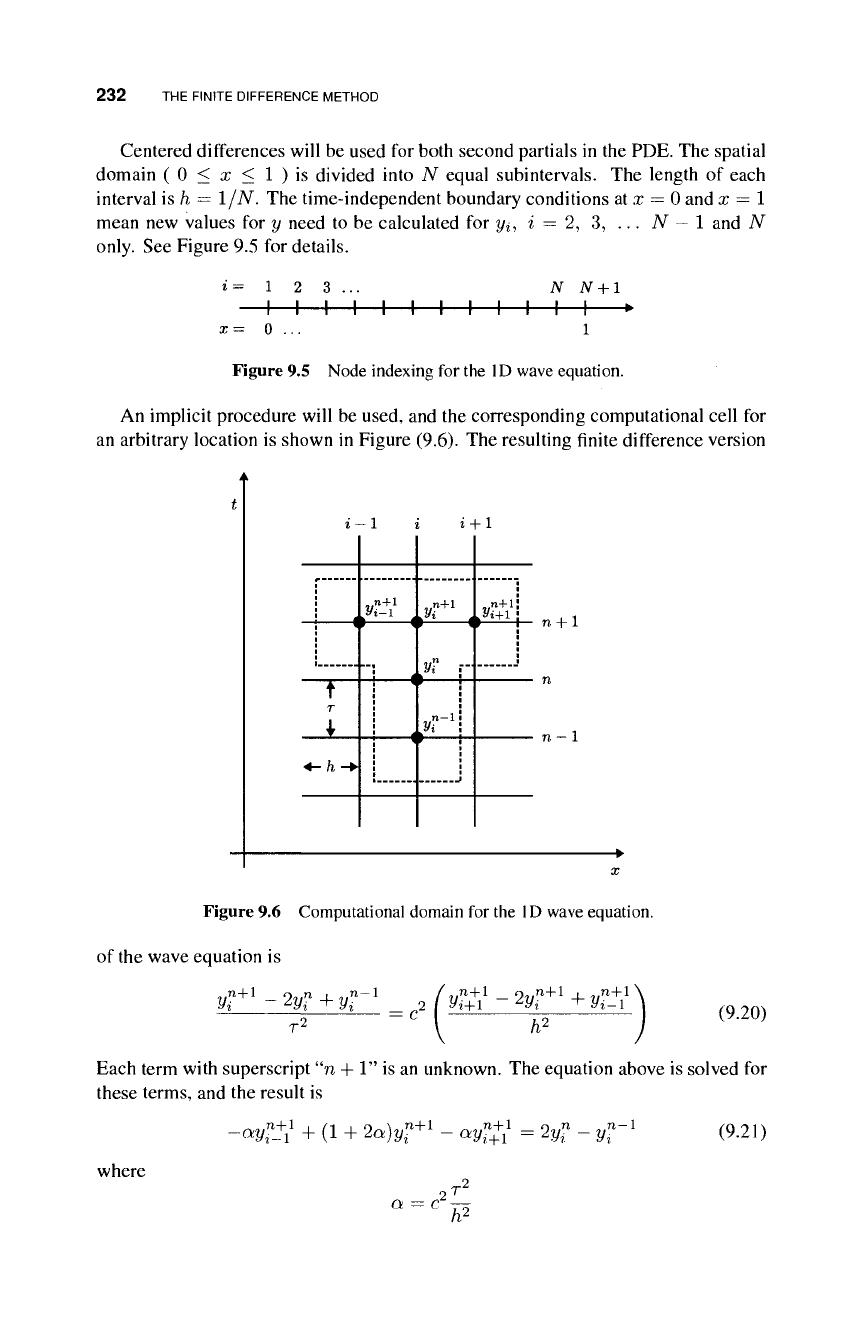
An implicit procedure will be used, and the corresponding computational cell for
an arbitrary location is shown in Figure (9.6). The resulting finite difference version
i-1
»
+ 1
T
r
7/
n+l
Vi-1
y'i
y?-
1
f- n+1
n-1
Figure 9.6 Computational domain for the ID wave equation.
of the wave equation is
r
2
M h
2
)
(9.20)
Each term with superscript "n + 1" is an unknown. The equation above is solved for
these terms, and the result is
,n+l ^„,
n
+l
o».
n
n
,
n
~
1
OÎ/Γ-Τ + (1 + MvT" - ÛÎ/Γ+Τ =
2
y? - y
r
i
(9.21)
where
a = c
h
2
1D WAVE EQUATION 233
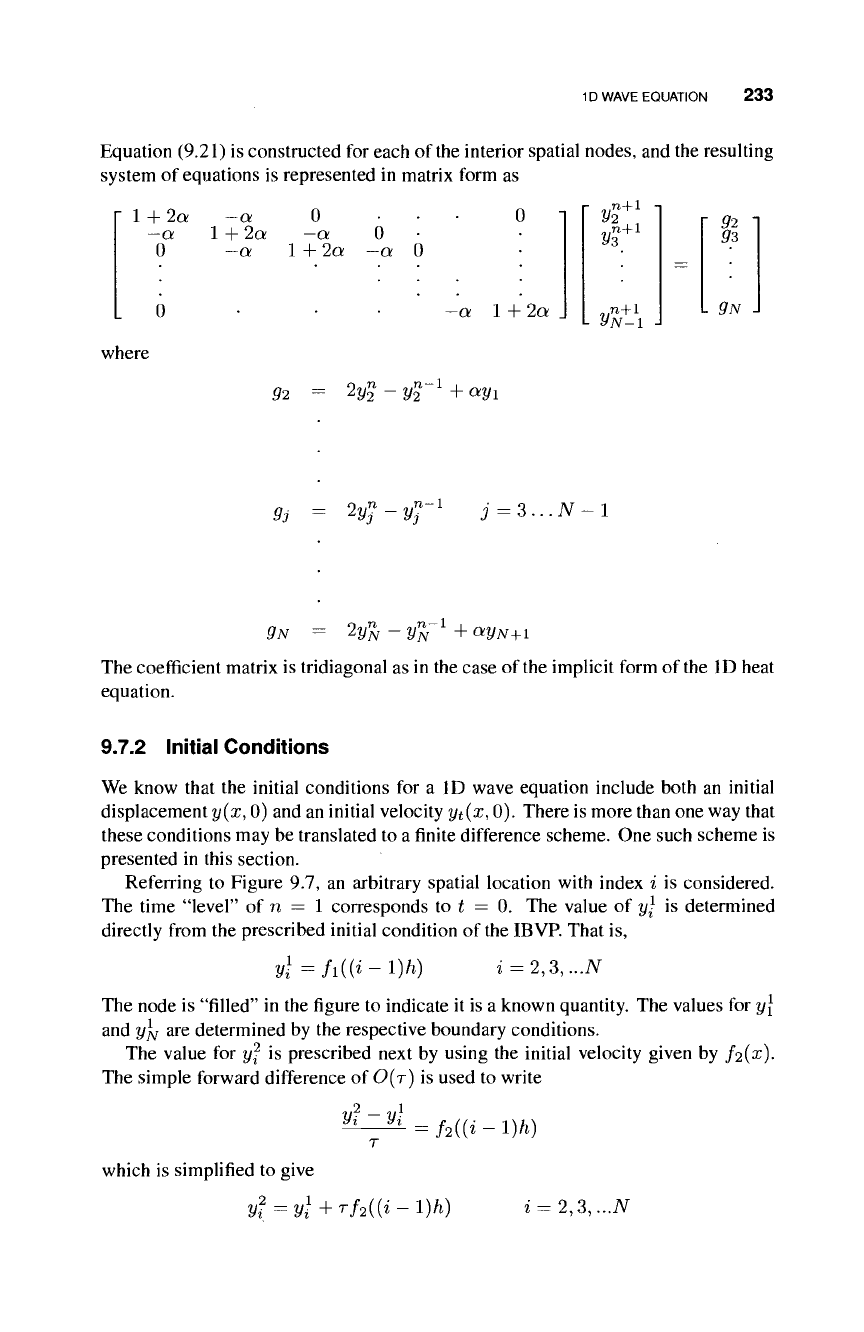
Equation (9.21) is constructed for each of the interior spatial nodes, and the resulting
system of equations is represented in matrix form as
1 + 2a -a 0 ·
-a 1 + 2a -a 0
0 -a 1 4- 2a -a 0
where
0
-a
1
+ 2a J
92 = 2yZ-y%-
i
+ay
1
vT
1 Ί
y^
1
L i/jv-i
92
9s
9N
9j = 2y?-j£
j = 3...JV-l
9N
= ZVN - VN
l
+
a
2/iv+i
The coefficient matrix is tridiagonal as in the case of the implicit form of the ID heat
equation.
9.7.2 Initial Conditions
We know that the initial conditions for a ID wave equation include both an initial
displacement y(x, 0) and an initial velocity yt(x, 0). There is more than one way that
these conditions may be translated to a finite difference scheme. One such scheme is
presented in this section.
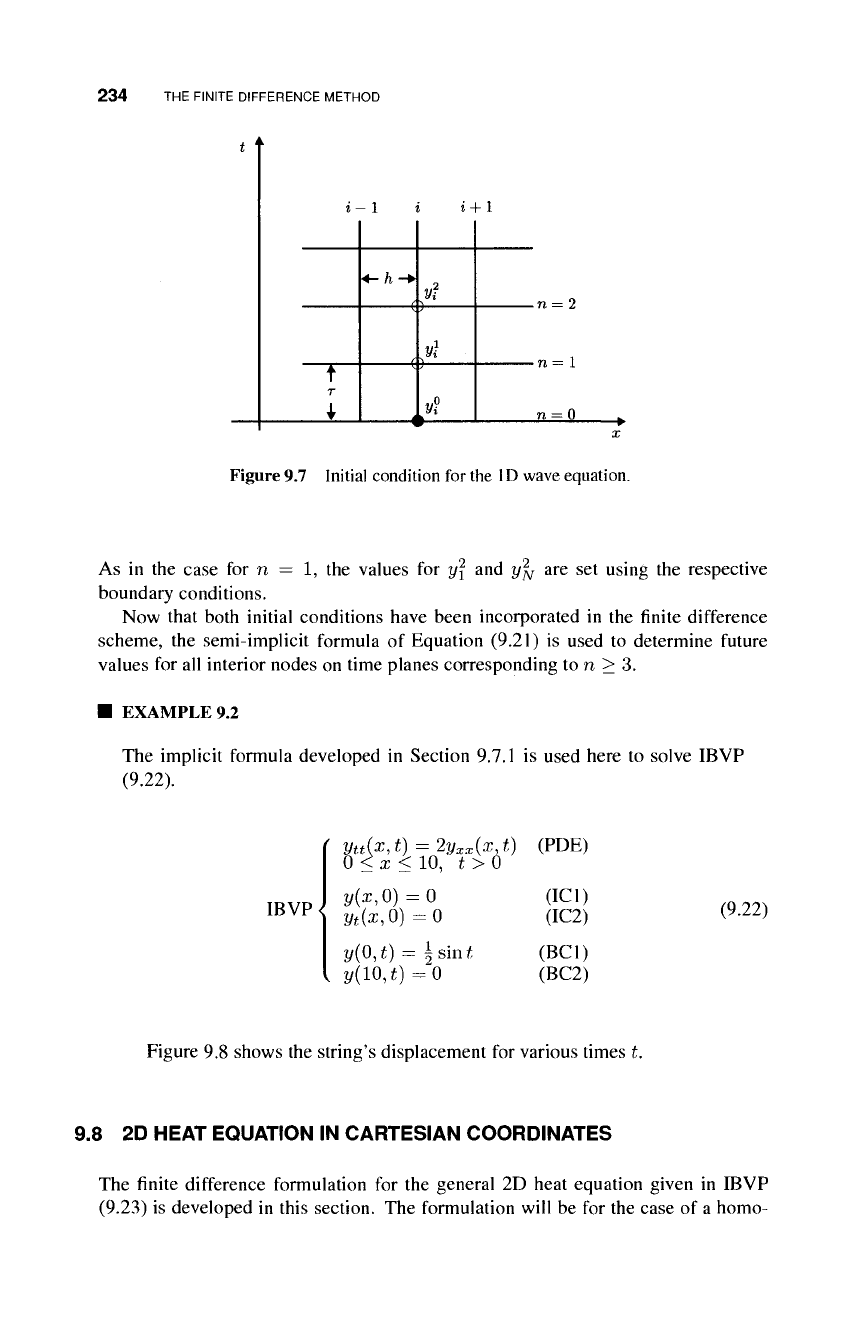
Referring to Figure 9.7, an arbitrary spatial location with index i is considered.
The time "level" of n = 1 corresponds to t — 0. The value of y\ is determined
directly from the prescribed initial condition of the IB
VP.
That is,
Ι/ί=Λ((<-1)Λ)
2,3,
...AT
The node is "filled" in the figure to indicate it is a known quantity. The values for y\
and y
l
N
are determined by the respective boundary conditions.
The value for yf is prescribed next by using the initial velocity given by /^(^)·
The simple forward difference of 0(r) is used to write
T
which is simplified to give
VÏ = Vi + rf
2
((i - 1)Λ)
-1)Λ)
i
:2,3,..JV
234 THE FINITE DIFFERENCE METHOD
i-l
t + 1
Yvt
-Φ-
■
n = 2
T
r
-Φ-
Ltf
[iff
■n= 1
n = 0
Figure 9.7 Initial condition for the ID wave equation.
As in the case for n = 1, the values for y\ and y\ are set using the respective
boundary conditions.
Now that both initial conditions have been incorporated in the finite difference
scheme, the semi-implicit formula of Equation (9.21) is used to determine future
values for all interior nodes on time planes corresponding to n > 3.
■ EXAMPLE 9.2
The implicit formula developed in Section 9.7.1 is used here to solve IBVP
(9.22).
(
y
tt
(x,t)
= 2y
xx
{x,t) (PDE)
0 < x < 10, t > 0
IBVP<
y(*,o) = o (ici)
î/t(:r,0)=0 (IC2)
2/(0,
ί) = ^sint (BC1)
l 2/(10,í) = 0 (BC2)
(9.22)
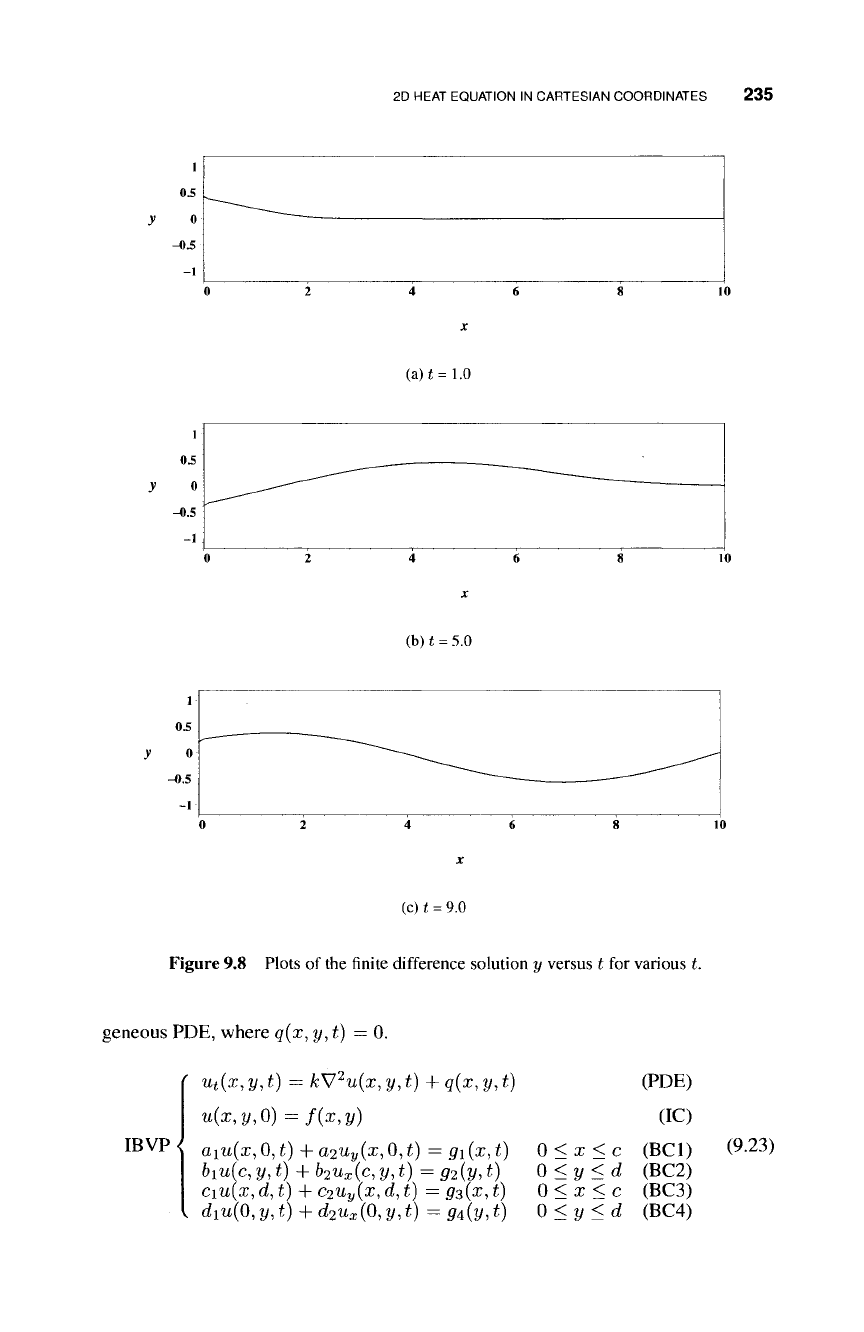
Figure 9.8 shows the string's displacement for various times t.
9.8 2D HEAT EQUATION IN CARTESIAN COORDINATES
The finite difference formulation for the general 2D heat equation given in IBVP
(9.23) is developed in this section. The formulation will be for the case of a homo-
2D HEAT EQUATION IN CARTESIAN COORDINATES
1
0.5
y o
-0.5
-1
10
(a)t=1.0
■(b) i = 5.0
(c) t
=
9.0
Figure 9.8 Plots of
the
finite
difference solution y versus t for various t.
geneous PDE, where q(x,y,t)
—
0.
u
t
(x, y, t) = fcV
2
w(x, y, t) + g(x, y, Í)
u(x,2/,0) = /(x,2/)
(PDE)
(IC)
IBVP<
aiw(x, 0, t) + α2%(#,0,ί) = g\{x,t) 0<#<c (BCl)
fritte, y, t) + 6
2
i¿x(c, y,í) = #
2
(^¿) 0 < y < d (BC2)
c\u(x,d,t)+ C2Uy{x,d,t) = g${x,t) 0<x<c (BC3)
diw(0,j/,i)+d
2
wx(0,y,i) = </4(y,i) 0<y<d (BC4)
(9
236 THE FINITE DIFFERENCE METHOD
We begin by considering the explicit finite difference form of the 2D, unsteady
heat equation. Replacing the partíais in the PDE above with centered differences in
space and forward differences in time gives
i ,3 i, 3
M-lj
2?y
n
·
ZU
i,3
-1,3
h
2
+
\j+l
2
<3
h
2
y-i
(9.24)
where uniform grid spacing in both the x and y directions is assumed. The dependent
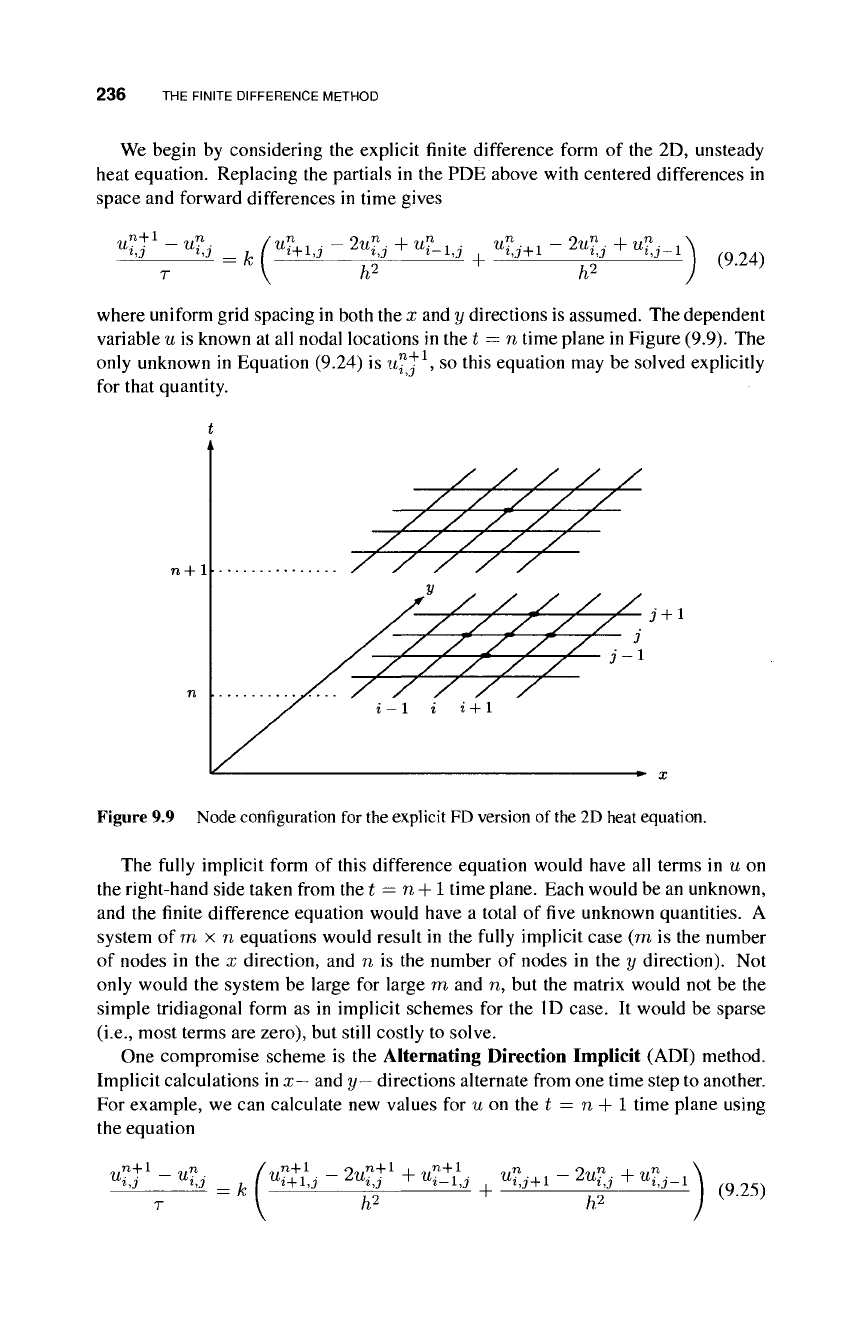
variable u is known at all nodal locations in the t = n time plane in Figure (9.9). The
only unknown in Equation (9.24) is u^j
1
, so this equation may be solved explicitly
for that quantity.
n
+ l
y y y y y
y y y y y
y y y y y
y y y y y
/ / / / /
/ y y y y y
'
y
/ y /
y
s
y y y y y' y . \
y y y y y y
J 1
y.. / / / / /
/ i-\ i z+1
i + i
Figure 9.9 Node configuration for the explicit
FD
version of
the
2D heat equation.
The fully implicit form of this difference equation would have all terms in u on
the right-hand side taken from the t
—
n +
1
time plane. Each would be an unknown,
and the finite difference equation would have a total of five unknown quantities. A
system ofmxn equations would result in the fully implicit case (m is the number
of nodes in the x direction, and n is the number of nodes in the y direction). Not
only would the system be large for large m and n, but the matrix would not be the
simple tridiagonal form as in implicit schemes for the ID case. It would be sparse
(i.e.,
most terms are zero), but still costly to solve.
One compromise scheme is the Alternating Direction Implicit (ADI) method.
Implicit calculations in x— and
y—
directions alternate from one time step to another.
For example, we can calculate new values for u on the t = n 4- 1 time plane using
the equation
?y
n+1
- υ
η
■
^ffij-K*
1
+
«£?-*,,
|
<,
j+1
-2<¿
%j-i
h? h?
(9.25)
2D HEAT EQUATION IN CARTESIAN COORDINATES 237
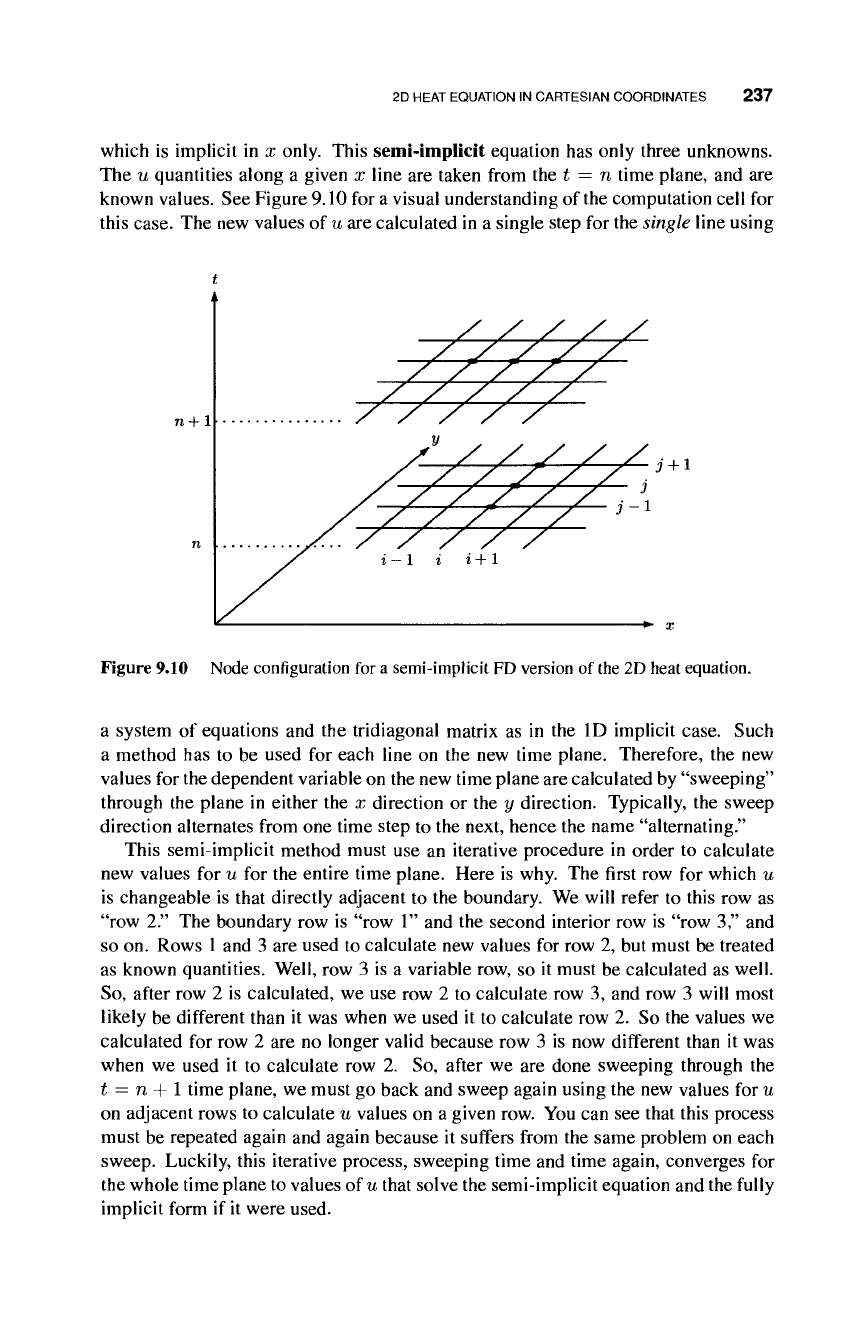
which is implicit in x only. This semi-implicit equation has only three unknowns.
The u quantities along a given x line are taken from the t = n time plane, and are
known values. See Figure 9.10 for a visual understanding of the computation cell for
this case. The new values of u are calculated in a single step for the single line using
n-f
1
/ / / / /
y
+· x
Figure 9.10 Node configuration for a semi-implicit
FD
version of
the 2D
heat equation.
a system of equations and the tridiagonal matrix as in the ID implicit case. Such
a method has to be used for each line on the new time plane. Therefore, the new
values for the dependent variable on the new time plane are calculated by "sweeping"
through the plane in either the x direction or the y direction. Typically, the sweep
direction alternates from one time step to the next, hence the name "alternating."
This semi-implicit method must use an iterative procedure in order to calculate
new values for u for the entire time plane. Here is why. The first row for which u
is changeable is that directly adjacent to the boundary. We will refer to this row as
"row 2." The boundary row is "row 1" and the second interior row is "row 3," and
so on. Rows 1 and 3 are used to calculate new values for row 2, but must be treated
as known quantities. Well, row 3 is a variable row, so it must be calculated as well.
So,
after row 2 is calculated, we use row 2 to calculate row 3, and row 3 will most
likely be different than it was when we used it to calculate row 2. So the values we
calculated for row 2 are no longer valid because row 3 is now different than it was
when we used it to calculate row 2. So, after we are done sweeping through the
t = n + l time plane, we must go back and sweep again using the new values for u
on adjacent rows to calculate u values on a given row. You can see that this process
must be repeated again and again because it suffers from the same problem on each
sweep. Luckily, this iterative process, sweeping time and time again, converges for
the whole time plane to values of u that solve the semi-implicit equation and the fully
implicit form if it were used.
238 THE FINITE DIFFERENCE METHOD
The iterative process described above cannot continually use u values from the
previous time step (the nth time level) in the iterative process to determine u values in
the n
4-1
time
plane.
Instead, intermediate iterative
values,
denoted by the superscripts
m and
m4-1
in Equation 9.26, are used in the semi-implicit
process.
New intermediate
quantities are denoted with the m +
1
superscript. Values determined in the previous
iteration within this time step calculation are denoted with the "m" superscript.
-aut\j + (1 + 4a)u™
+1
- au^ij = au&
+1
+ au™^ + u^ (9.26)
The iterative process for calculating u vales on the n 4-1 time plane continues until
\\uZ
+1
-u™\\<e
where e is a small, positive real number serving as a convergence criteria. Once the
convergence criteria has been satisfied in the iterative process, the w^t
1
= u™^
1 anc
*
calculation for u values on the next time plane begins with the iterative process and
a line-by-line sweep in the alternate direction.
■ EXAMPLE 9.3
The semi-implicit finite difference formulation derived in Section 9.8 is applied
to a semi-homogenous Dirichlet heat problem in this section. The specifics of
the problem are given in IBVP (9.27).
IBVP^
In order to demonstrate the accuracy of the time-dependent solution, we
begin with the function
u(x,y,t) — 10(x
—
x
2
)(y
2
—
y) sint
which satisfies the given initial condition and boundary conditions in (9.27),
and substitute for u in the PDE. Doing so will determine the source function q.
In this case,
q(x, y, t) = 10(x - x
2
){y
2
- y) cost - 10
♦
0.1(2x
+ 2y- 2x
2
- 2y
2
) sint.
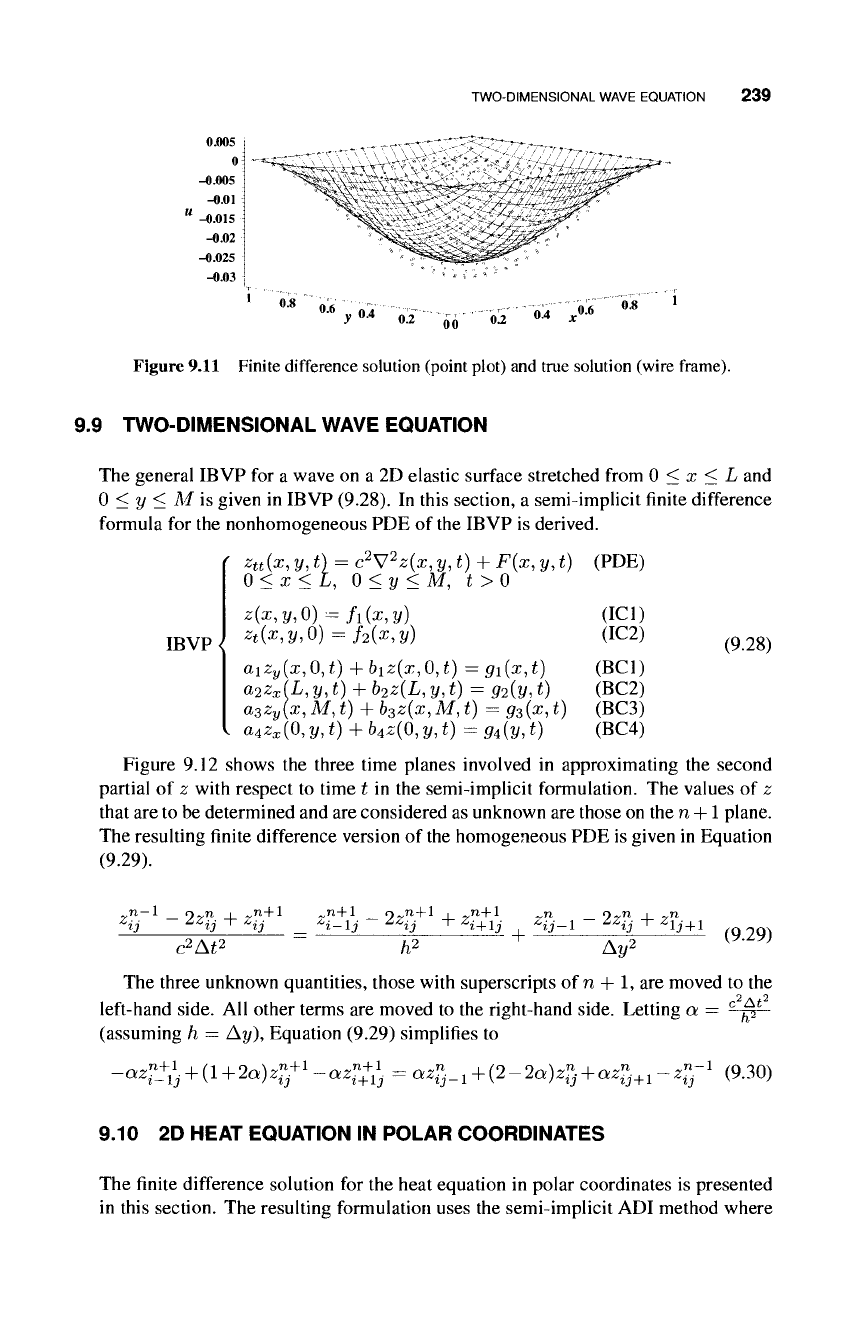
The finite difference solution for u is plotted in Figure 9.11 using a spherical
symbol for nodal values. The finite difference solution was calculated on a
spatial grid with uniform spacing of
0.05.
The time step size in the calculation
process was
0.1.
The true solution u(x, y, t) is plotted in the wire frame. Both
are surfaces are for time t = 3.1. The finite difference solution surface matches
the true solution quite well, even after
31
time steps. However, it does lag (i.e.,
is lower than) the true solution surface.
u
t
(x,y,t)=0AV<
u(x,y,0) =0
u(x,0,t) = 0
tUl,î/,*) = 0
u(x, l,i) = 0
u(0,y,t) = 0-
l
u(x
y
t)
+
q(x
y
t)
0<£< 1
0<y < 1
0<x < 1
0< y< 1
(PDE)
(IC)
(BC1)
(BC2)
(BC3)
(BC4)
(9.27)
TWO-DIMENSIONAL WAVE EQUATION
239
-0.005
-0.01
-0.015
-0.02
-0.025
-0.03
0.8
0.6
0.4
0.2
00
02
0.4
0.8
Figure 9.11 Finite difference solution (point plot) and true solution (wire frame).
9.9 TWO-DIMENSIONAL WAVE EQUATION
The general IBVP
for a
wave on
a
2D elastic surface stretched from
0 < x < L
and
0
< y < M
is given in IBVP (9.28).
In
this section,
a
semi-implicit finite difference
formula
for
the nonhomogeneous PDE
of
the IBVP
is
derived.
IBVP<
z
tt
(x,y,t)--
0
< x < L,
--c
2
V
2
z(x,y,t)+F(x,y,t)
0
< y < M, t > 0
z(x,y,0)
=
fi(x,y)
z
t
(x,y,0)
=
f
2
(x,y)
aiZy(x,0,t)
+
biz(x,0,t)
=
gi(x,t)
a
2
z
x
(L,
y, t) +
b
2
z(L,
y, t) = g
2
(y, t)
a
3
Zy(x, M,
t) +
b
3
z(x,
M,
t) = g
3
(x, t)
^4^(0,
y, t) +
b
4
z(0,
y, t) = g
4
(y, t)
(PDE)
(ICI)
(IC2)
(BC1)
(BC2)
(BC3)
(BC4)
(9.28)
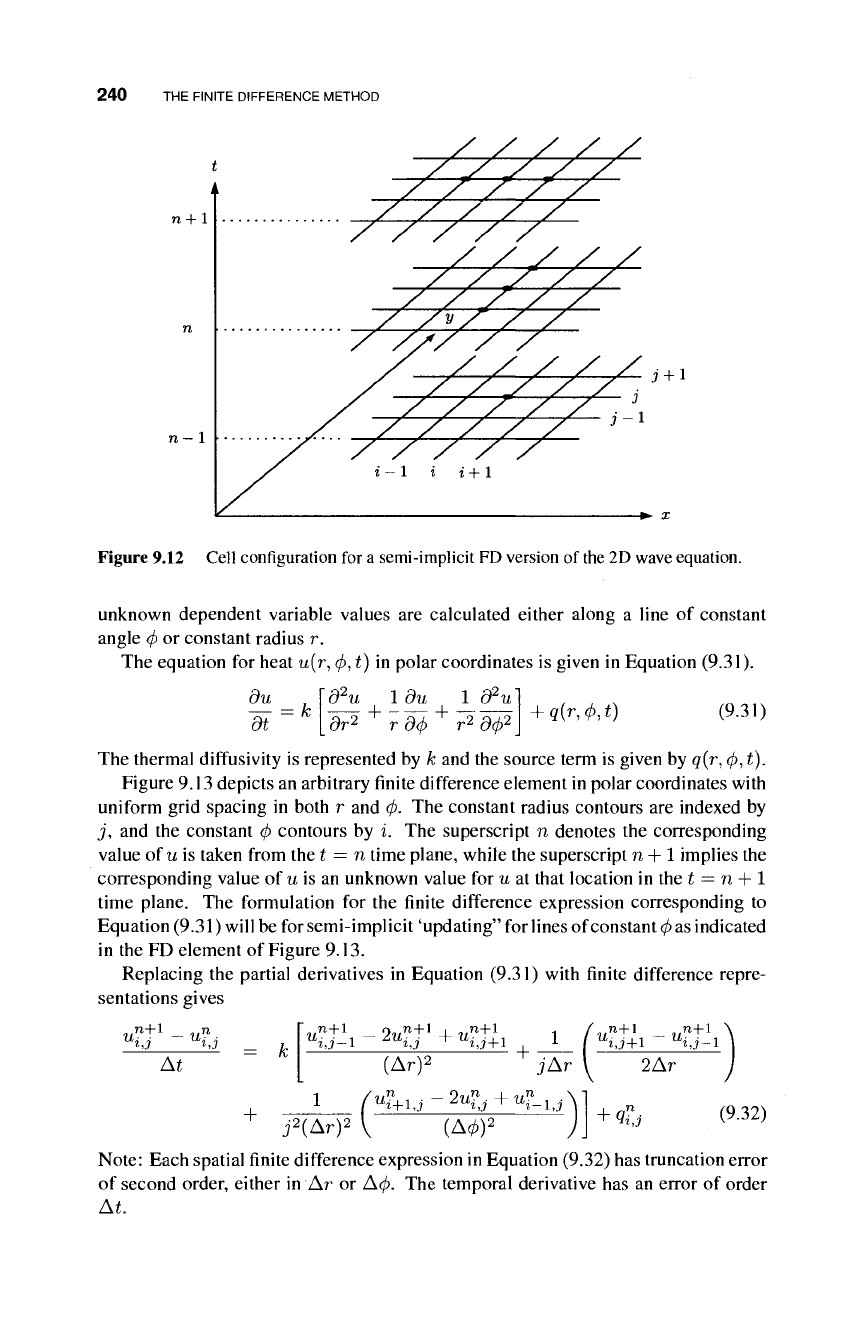
Figure
9.12
shows
the
three time planes involved
in
approximating
the
second
partial
of z
with respect
to
time
t in
the semi-implicit formulation. The values
of z
that are to be determined and are considered as unknown are those on the
n
+1 plane.
The resulting finite difference version
of
the homogeneous PDE is given in Equation
(9.29).
z
jj
2z
5
+ z
tj
n+l
„n+1
-2z"
n+l
C
2
At
2
h
2
r
n+l
Z
i+lj
+
-1
LZ
ij ^
Z
lj+l
Ay
2
(9.29)
The three unknown quantities, those with superscripts
of n
left-hand side. All other terms are moved
to
the right-hand side. Letting
a
(assuming
h = Ay),
Equation (9.29) simplifies
to
1,
are moved to the
c
2
At
2
h?
az^. +
(l
+
2a)zZ
n+l
az
i+ij
α4_
1
+
(2-2α)4 +
α4
+1
-4-
1
(9.30)
9.10 2D HEAT EQUATION IN POLAR COORDINATES
The finite difference solution
for
the heat equation
in
polar coordinates
is
presented
in this section. The resulting formulation uses the semi-implicit ADI method where
240 THE FINITE DIFFERENCE METHOD
n+1
n-1
//////
2—1
2 2+1
Figure 9.12 Cell configuration for
a
semi-implicit
FD
version of
the
2D wave equation.
unknown dependent variable values
are
calculated either along
a
line
of
constant
angle
φ
or constant radius
r.
The equation
for
heat u(r, 0, t) in polar coordinates
is
given
in
Equation (9.31).
1
d
2
u]
r
2 βφ2
du
~dt
=
k
d
2
u 1
du
dr
2
r δφ r*
+
q(r,<l>,t)
(9.31)
The thermal diffusivity is represented by
k
and the source term is given by q(r, φ,
t).
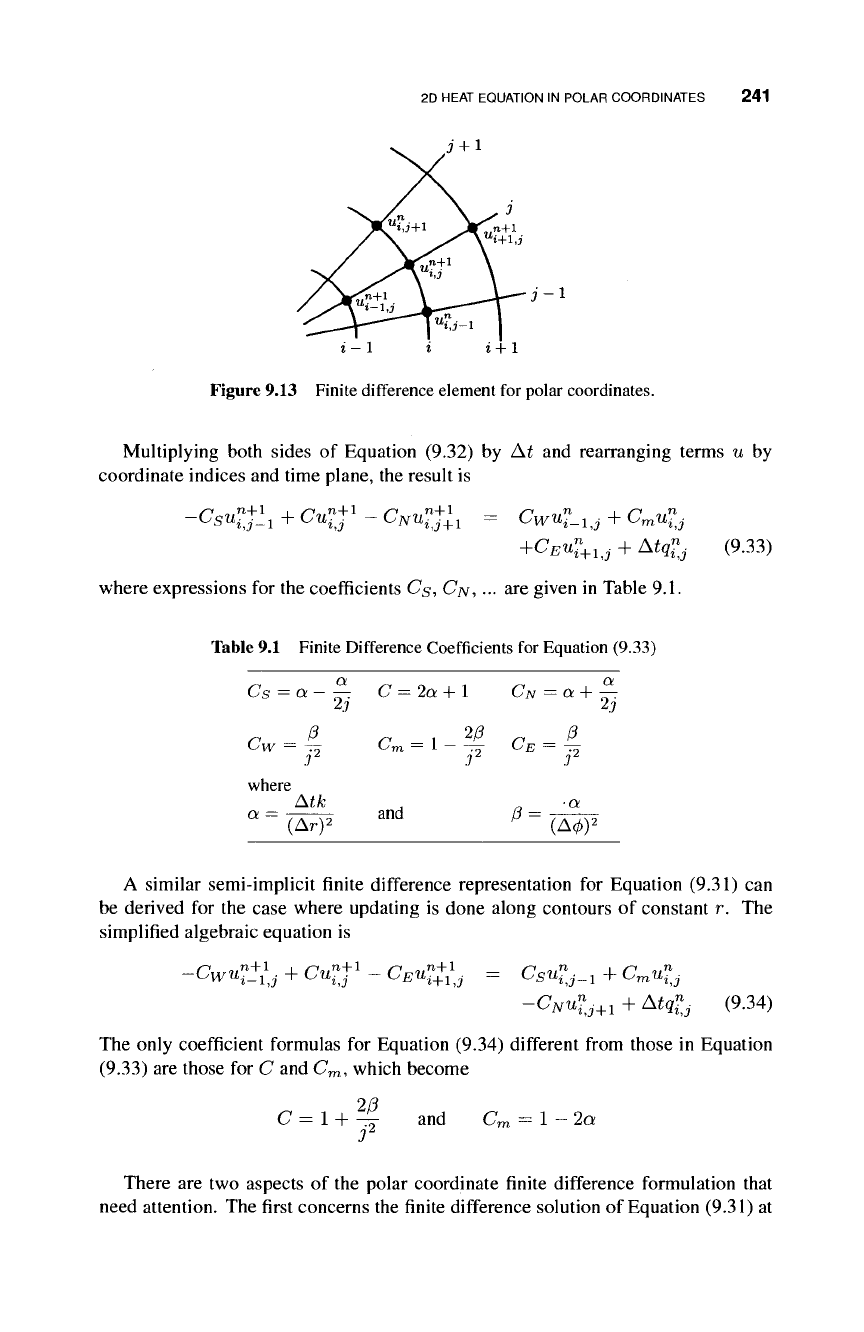
Figure 9.13 depicts an arbitrary finite difference element in polar coordinates with
uniform grid spacing
in
both
r
and
φ.
The constant radius contours are indexed
by
j,
and the
constant
φ
contours
by i The
superscript
n
denotes
the
corresponding
value of u is taken from the
t = n
time plane, while the superscript
n +
1
implies the
corresponding value
of u
is an unknown value
for u at
that location in the
t = n + 1
time plane.
The
formulation
for the
finite difference expression corresponding
to
Equation (9.31) will be for semi-implicit 'updating" for
lines
of constant φ
as
indicated
in the FD element
of
Figure 9.13.
Replacing
the
partial derivatives
in
Equation (9.31) with finite difference repre-
sentations gives
,.η+ι
i>>3
At
k
1#
n+l
9
?/
n+l i
?/
n+l
.n+1
%j+l
■Ui
n+1
j-l
+
1
j
2
(Ar)
2
(Ar)
2
jAr
(Αφ)
2
2Ar
+
€
i,3
(9.32)
Note: Each spatial finite difference expression in Equation (9.32) has truncation error
of second order, either
in Ar or Αφ.
The temporal derivative has
an
error
of
order
At
2D HEAT EQUATION IN POLAR COORDINATES 241
.i + i
,n+l
'»+1.J
¿
— i ¿ ¿4-1
Figure 9.13 Finite difference element for polar coordinates.
Multiplying both sides of Equation (9.32) by At and rearranging terms u by
coordinate indices and time plane, the result is
-CSU^+CU^-CNU^ = CwuUj + Cmuli
+C
E
K
+hj
+ Atq^j (9.33)
where expressions for the coefficients Cs, CN, ... are given in Table 9.1.
Table 9.1 Finite Difference Coefficients for Equation (9.33)
a
r
ß
r
where
Atk
a
(Ar)
2
C = 2a + 1
c -i
2ß
and
a
CN
—
OÍ
4- —
¿3
r
ß
r
β-
α
* (Δ0)
2
A similar semi-implicit finite difference representation for Equation (9.31) can
be derived for the case where updating is done along contours of constant r. The
simplified algebraic equation is
-CWU^IJ + CU^-CEU^ = Csu^+Cmuîj
The only coefficient formulas for Equation (9.34) different from those in Equation
(9.33) are those for C and C
m
, which become
w
C = 1 + -hr and C
m
= 1 - 2a
J
2
There are two aspects of the polar coordinate finite difference formulation that
need attention. The first concerns the finite difference solution of Equation (9.31) at