
Bernatz R. Fourier Series and Numerical Methods for Partial Differential Equations
Подождите немного. Документ загружается.

242
THE FINITE DIFFERENCE METHOD
the center location given by r = 0. Division by r = 0 may be avoided by using the
Cartesian version of the 2D heat equation on the rectangular element defined by the
nearest nodes situated on the x- and ?/-axes. The center node value
UQ
+1
for time
n + 1 is updated once the temperatures are updated for all other nodes. The finite
difference correspondence of Equation (9.31) in this case is
,.η+1
At
,n+l
2%
n+l
„n+l
,n+2
(Ar)
2
+
■2u\
n+l
+
U
n+l
(Ar)
2
-QÔ
(9.35)
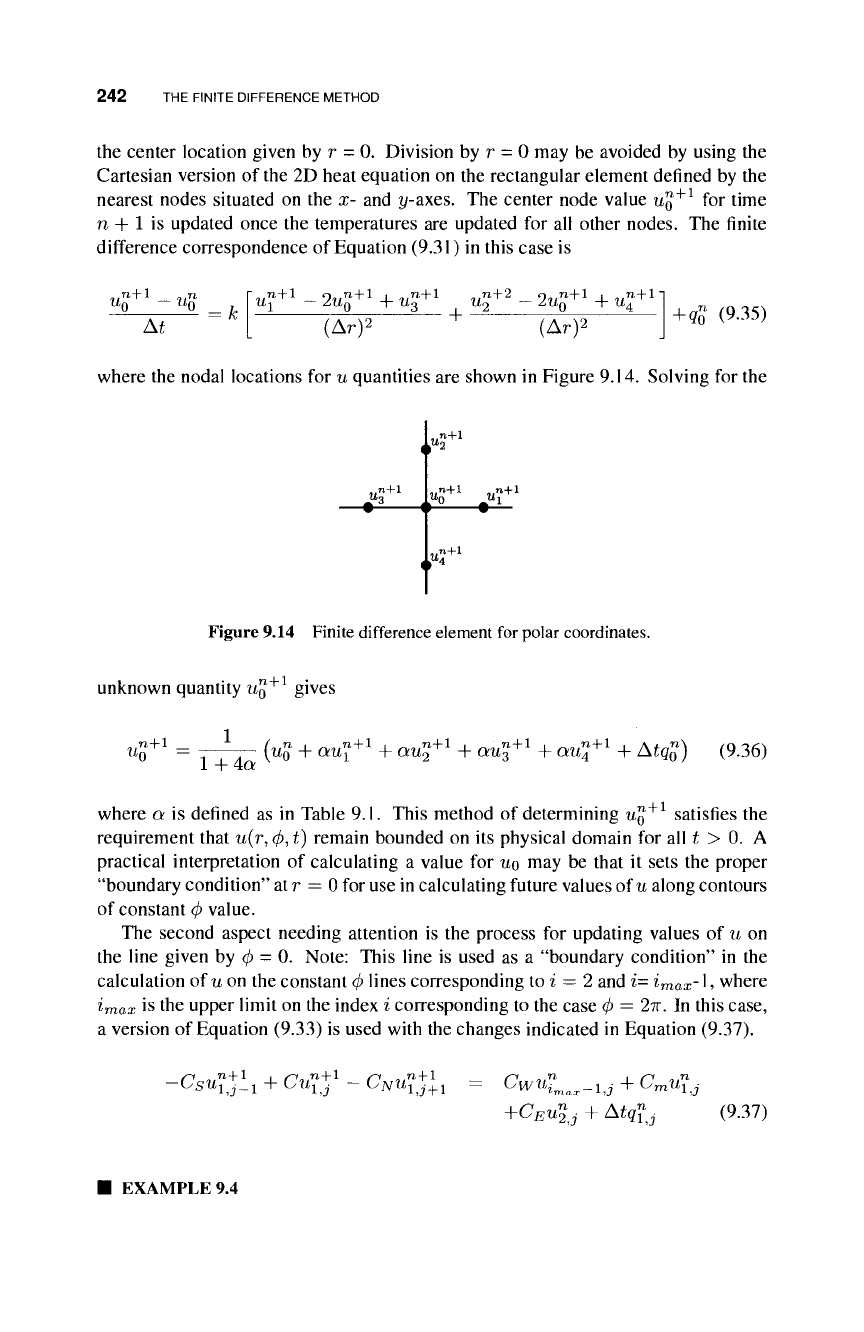
where the nodal locations for u quantities are shown in Figure 9.14. Solving for the
,n+l
Figure 9.14 Finite difference element for polar coordinates.
n+l
unknown quantity
UQ
gives
n+l
_
1
1 + 4a
(υξ + α<
+1
+ au^
1
+ au^
1
+ cm
n+1
+ Atq%) (9.36)
where a is defined as in Table 9.1. This method of determining t¿o
+1
satisfies the
requirement that u(r, φ, t) remain bounded on its physical domain for all t > 0. A
practical interpretation of calculating a value for
UQ
may be that it sets the proper
"boundary condition" at r = 0 for use in calculating future values of u along contours
of constant φ value.
The second aspect needing attention is the process for updating values of u on
the line given by φ = 0. Note: This line is used as a "boundary condition" in the
calculation of u on the constant φ lines corresponding to i
—
2 and i= ¿
ma
x-l, where
imax is the upper limit on the index i corresponding to the case φ
—
2π« In this case,
a version of Equation (9.33) is used with the changes indicated in Equation (9.37).
-c
s
<+l
1
+
c<+
1
CNU^I,
+C
E
u\
3
+ Atqlj
(9.37)
■ EXAMPLE 9.4
2D HEAT EQUATION IN POLAR COORDINATES 243
The finite difference solution process for 2D heat transfer in polar coordinates
outlined in this section is used to solve the nonhomogeneous IBVP given as
' ut = 0.1 [u
rr
+ \η
φ
4- ^υ,φφ] - 0.3cos(/> (PDE)
M
(r, ψ,0) = 0 (IC)
IBVP^ u(l,<M) = 0 0<φ<2π (BCl)
|u(r,<M)| < oo (BC2)
u(r, 0, t) = u(r, 2π, i) 0 < r < 1 (BC3)
η
φ
{τ, 0, ί) = η
φ
(ν, 2π, ί) 0 < r < 1 (BC4)
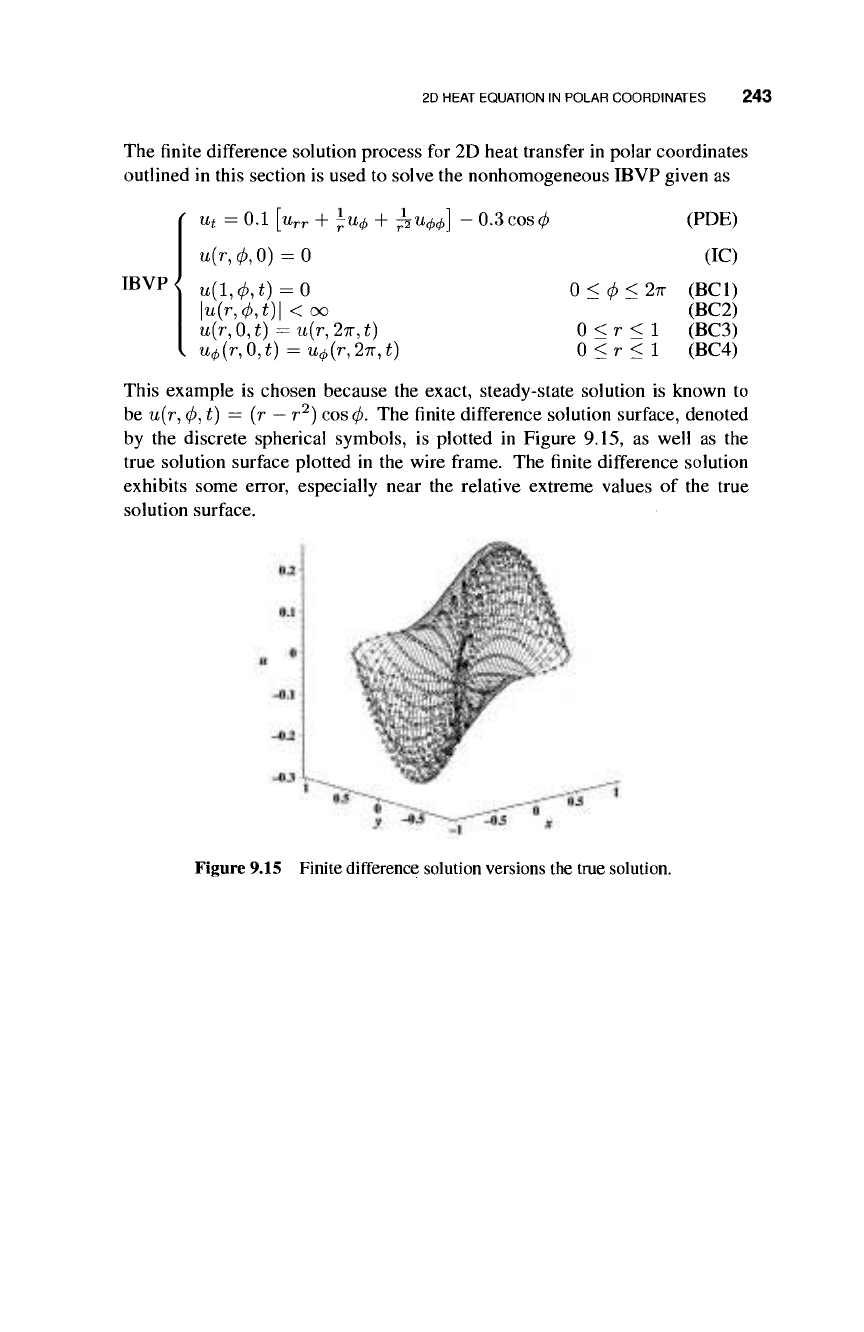
This example is chosen because the exact, steady-state solution is known to
be u(r, φ, t) = (r
—
r
2
) cos^. The finite difference solution surface, denoted
by the discrete spherical symbols, is plotted in Figure 9.15, as well as the
true solution surface plotted in the wire frame. The finite difference solution
exhibits some error, especially near the relative extreme values of the true
solution surface.
Figure 9.15 Finite difference solution versions the true solution.
244 THE FINITE DIFFERENCE METHOD
EXERCISES
9.1 Use the Taylor series expansion for u(x
—
ft) and for u(x
—
2ft) to derive a
backward difference formula for u"(x). Determine n for 0(h
n
) for this case.
9.2 Using notation similar to that for the finite difference expressions used in
Section 9.2, give a formulation for u'(x) for a forward difference that is at least
O
(ft
2
).
When and why would you have a need for such a formulation? (Hint:
Consider certain types of boundary conditions.)
9.3 The ID convection-diffusion equation for the scalar quantity θ(χ, t) is
Ot
+ ηθ
χ
= k9
xx
where u is the constant convective speed of motion along the x direction, and k is the
constant diffusion coefficient. Using notation similar to that of Section 9.3, derive
an implicit finite difference formulation of the PDE. The spacing in x is a uniform ft,
and the spacing in t is a uniform r. Use i and n for indices for x and t, respectively.
9.4 Modify Equation (9.16) to include a nonhomogeneous term in the ID heat
transfer IBVR
9.5 Consider the IBVP for ID heat conduction shown below:
u
t
= 0Au
xx
(x,t) (PDE)
IBVP I
u
(
x
' °)
= 2
sin(7rx) (
IC
)
u(0,t) = 0 (BC1)
w(l,í) = 0 (BC2)
a) Use an appropriate software application to solve this problem numerically
with a uniform nodal spacing of ft = 0.05 and a time step size of r = 0.1.
b) Solve this problem using separation of variables and Fourier series methods.
The correct solution will have a single term.
c) Plot the Fourier series solution and the finite difference solution (plotted
in point style) on the same graph for t = 0, 0.2 and 2.0.
d) Repeat part 9.5.a for the same IBVP, but revise the method to use a centered
difference formula of 0(r
2
) for u
t
(x,t). Next, repeat part 9.5.c for this
case.
e) Describe any differences in the behavior, over time, of the error between
the two numerical solutions (0(r) and
0(τ
2
)).
Provide an explanation for
what you observe.
9.6 The general form of the ID heat IBVP is shown below.
u
t
= ku
xx
(x, t) + q(x,
£),
0 < x < c (PDE)
w(x,0) = /(x) (IC)
IBVP
<
oiu(0,i) + a
2
u
x
(0,t) =
9l
(t) (BC1)
b
lU
(c,t) + b
2
u
x
(c,t) = g
2
(t) (BC2)
EXERCISES 245
Use an appropriate software application to solve the following IBVPs. Unless stated
otherwise, q(x, t), f(x), ai, a
2
, &i, b
2
, g\, and g2(t) are all zero.
a) c
=
1, k = 0.1, q(x,t) = e
_
2 sin(7rx), f(x) = 1, a\ — 1, b\ = \,
g±
= 1,
and g2(t) = cost.
b) c= l,fc = 0.1,g(x,£) = e~íií[0.4,0.6] W^i = 1, &i = 0.2,
£>
2
= 0.4, pi =
l,and#
2
(t) = 2.
c) c= 1,
fc
=
0.1,
q{x,t) = x(l + t)~
2
, /(x) = x - x
2
, ai = 1,
¿>i
= 1, #i =
l,andy2(i) = *(l+*)
_1
·
d) c= l,/c = 0.1,c(x,¿) =x(Hi)-
2
,/W = x-x
2
, a
2
= 1, &i = l,^i =
l,and^
2
(*)=i(l + t)"
1
.
9.7 Recall the Robin boundary condition for the ID heat transfer equation at the
right boundary of the medium is given as
du
r Ί
where η is the surface heat transfer coefficient, κ is the heat transfer coefficient for
the medium, and g(t) is the time-dependent temperature of the surrounding material.
Derive a finite difference expression for this boundary condition. Let i
maa;
be the
index of the right boundary point and h represent the spacing between the boundary
point and the first interior node, whose index is given as i
max
—
1.
9.8 Make modifications to appropriate software code to incorporate the Crank-
Nicolson method for the case of ID heat transfer. Repeat the solution process
outlined for items listed in Exercise 9.5 and compare results.
9.9 The general form of a ID wave IBVP is shown below.
IBVP
yu(x,t)
0 < x < L,
C Vxx\
t >
x,t)
y{x,0)--
yt(x,o)
h(x\
--
Λ(χ)
aiy(0,t) + a
2
y
x
(0,t) = gi(t)
b
x
y{L, t) + b
2
y
x
(L, t) = g
2
(t)
(PDE)
(ICI)
(IC2)
(BC1)
(BC2)
Use an appropriate software application to solve the following ID wave IBVP. Use
a nodal spacing of h = 0.02 and τ = 0.1. Provide plots for y(x,t) on the interval
0 < x < L for t = 0.1, 1.0 and 3.0. Unless stated otherwise, assume /i(x), /bO^)»
αχ, a
2
, &i, b
2
, gi, and g
2
(t) are all zero.
a) c= 1/2, L
=
1, f
2
(x) = 8ΐη(πχ), a\ = b\ = 1
b) c= 1/2, L = 10, /i(x) = jff
[4
,
6]
(x)(x - 4)(6 - x), α
λ
= h = 1
c) c=v
/
3,L=10,/
1
(x)=x(10-x)/50,/
2
(x)=F
[
4,6](^)(x-4)(6-x),
ai = b\ — 1
9.10 What is the order of
the
FD version of the 1D wave equation given in Equation
(9.20) in space? in time? Demonstrate these relationships between the error and the
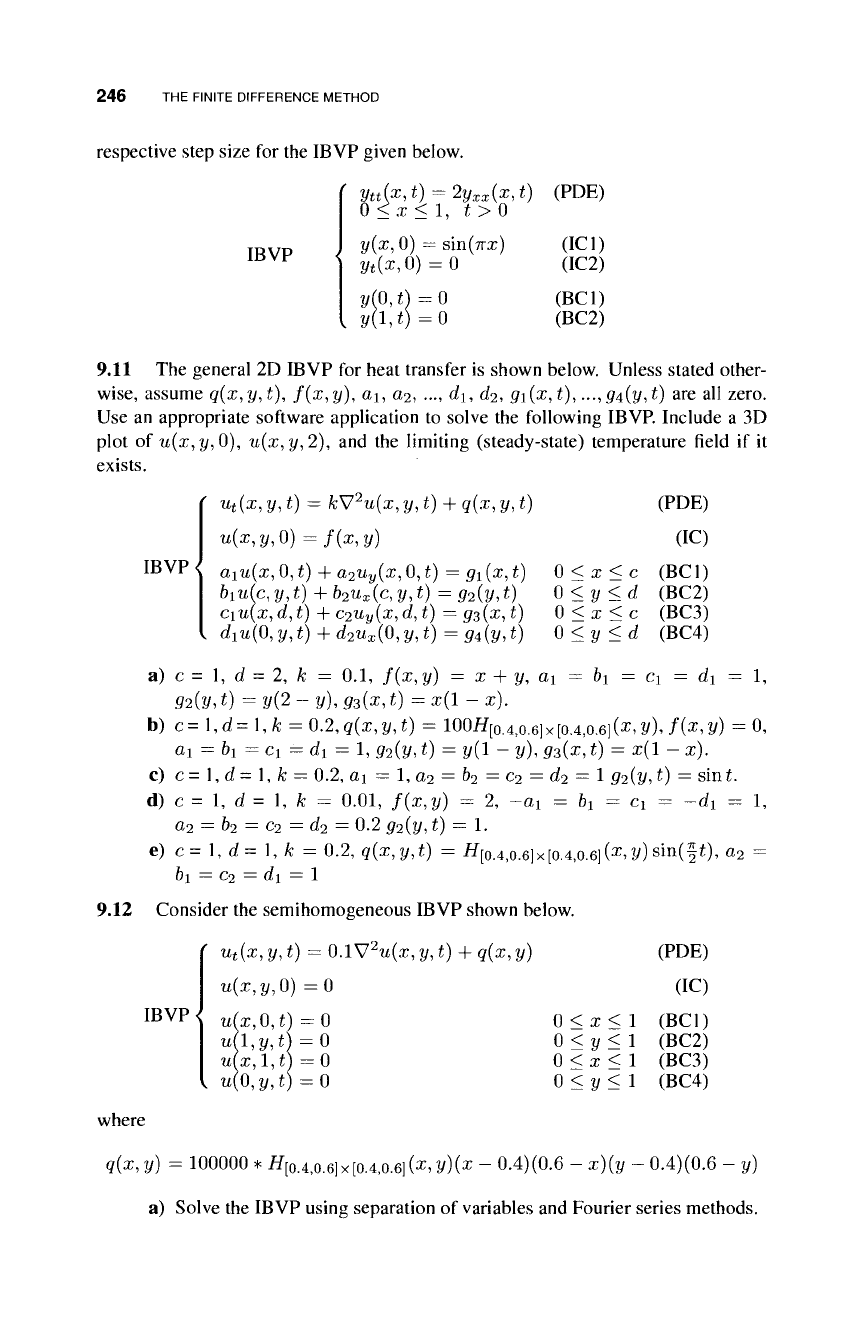
246 THE FINITE DIFFERENCE METHOD
respective step size for the IBVP given below.
IBVP
f
y
tt
(x,t)
= 2y
xx
{x,t) (PDE)
0 <x < 1, ¿ >0
2/(x,0) = sin(7rx) (ICI)
2/t(x,0)=0 (IC2)
î/(0,t)=0 (BC1)
l 2/(1,*) =0 (BC2)
9.11 The general 2D IBVP for heat transfer is shown below. Unless stated other-
wise,
assume q(x, y, t),
f(x,y),
oi,
c&2,
..., di, ¿2» ^i(x,
t),...,
^4(2/,
t) are all zero.
Use an appropriate software application to solve the following IBVP. Include a 3D
plot of u(x,y,0), u(x,y,2), and the limiting (steady-state) temperature field if it
exists.
( u
t
(x,y,t) = kV
2
u{x,y,t) + q{x,y,t)
u(x,y,0) = f(x,y)
(PDE)
(IC)
IBVP<
a\u{x, 0,t) + (i2Uy{x,Q,t) = gi(x,t) 0<x<c (BC1)
hu(c,y, t) + &2^x(c,y, t) = #2(2/,¿) 0 <y <d (BC2)
c\u{x,d,
t) + C2U
y
(x, d, t) = gs(x,t) 0<x<c (BC3)
l d
l
u{Q,y,t)+d
2
u
x
{Q,y,t)=g
A
(y,t) 0<7/<d (BC4)
a) c = 1, d = 2, fc = 0.1, /(x,
2/)
= x + 2/, ai = &i = ci = d\ = 1,
£2(2/,
t) = 2/(2 - 2/), g
3
(x, t) = x(l - x).
b) c=l,d=l,fc = 0.2,g(x,2/,i) = 100iï[o.4,o.6]χ[o.4,o.6](ζ,
2/)»
/(x,2/) = 0.
ai = 61 = ci = di = 1,
512(2/,
£)
= 2/(1 - 2/), 9s(x, t) = x(l - x).
c) c=l,d=l,fc = 0.2, ai = 1, a2 =
&2
=
C2
= d2 = 1
#2(2/,
¿)
=
sini.
d) c = 1, d = 1, k = 0.01, /(x,2/) = 2, -ai = 61 = a = -d
x
= 1,
a
2
= i>2 = c
2
= d
2
= 0.2 #
2
(2/, t) = 1.
e) c= 1, d= 1, fc = 0.2, q{x,y,t) =
#[0.4,0.6] x [0.4,0.6]
(^,
2/)
sin(§*)> «2 =
61 = c
2
= di = 1
9.12 Consider the semihomogeneous IBVP shown below.
( u
t
(x,y,t) = 0AV
2
u(x
1
y,t)+q(x,y)
u(x,y,0) =0
IBVP<
(PDE)
(IC)
u(x, 0,£) = 0
i¿fl,2/,
t) = 0
u(x, Ι,ί) =0
L w(0,2/,í) = 0
0 < x < 1 (BC1)
0 < y < 1 (BC2)
0 < x < 1 (BC3)
0 < y < 1 (BC4)
where
ç(x,2/) = 100000 *
ff
[0
.4,o.6]x[0.4,0.6](x,
2/)(x - 0.4)(0.6 - x)(y - 0.4)(0.6 - 2/)
a) Solve the IBVP using separation of variables and Fourier series methods.
EXERCISES 247
b) Solve the IBVP using finite difference methods. Begin with uniform grid
spacing of h = 1/20. Refine the grid and reach
a
grid-independent solution.
c) Compareyoursolutions(steady-statevalue)atthelocation(x,2/) = (0.5,0.5).
Comment on what you discover.
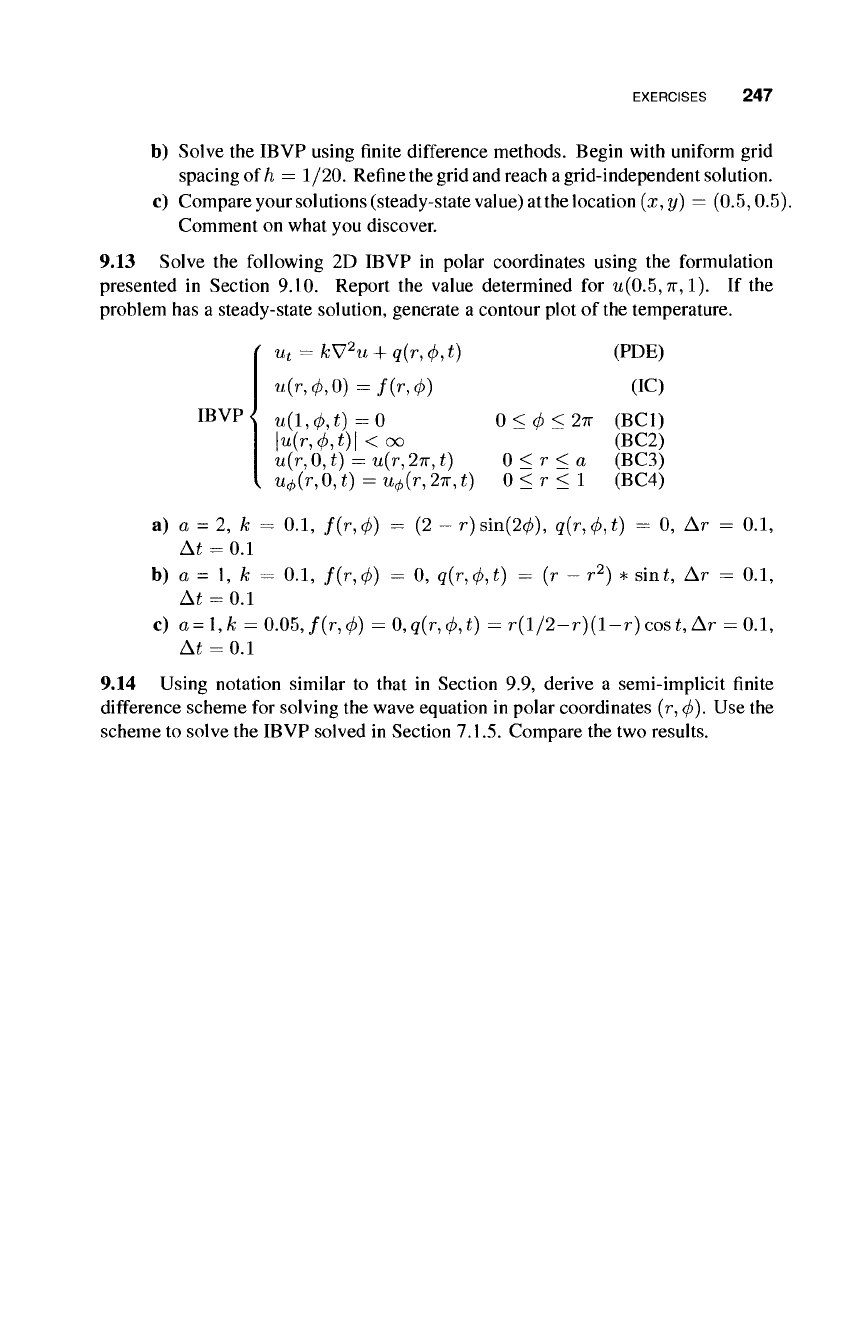
9.13 Solve the following 2D IBVP in polar coordinates using the formulation
presented in Section 9.10. Report the value determined for
u(0.5,
π, 1). If the
problem has a steady-state solution, generate a contour plot of the temperature.
IBVP<
u
t
= kV
2
u + q(r,(j),t)
u(r,</>,0)
=
f(r,<f>)
u(l,<M) = 0
\u(r,<fi,t)\
< oo
u(r,0,i) =u(r,2n,t)
U0(r,O,i) = u¿(r,27r,t)
(PDE)
(IC)
0 < φ < 2π (BC1)
(BC2)
0 < r < a (BC3)
0 < r < 1 (BC4)
a) a = 2, k = 0.1, /(r,0) = (2 - r)sin(20), g(r,0,t) = 0, ΔΓ = 0.1,
Δί = 0.1
b) α = 1, k = 0.1, /(r,0) = 0,
q(r,</>,t)
= (r - r
2
) * sint, ΔΓ = 0.1,
At = 0.1
c) a=l,fe = O.O5,/(r,0) =0,g(r,<M) = r(l/2-r)(l-r)cosi,Ar = 0.1,
Δί = 0.1
9.14 Using notation similar to that in Section 9.9, derive a semi-implicit finite
difference scheme for solving the wave equation in polar coordinates (r, φ). Use the
scheme to solve the IBVP solved in Section 7.1.5. Compare the two results.

This Page Intentionally Left Blank
CHAPTER 10
FINITE ELEMENT METHOD
An introductory look at methods of finite elements, a general class of techniques for
approximating solutions to initial and boundary value problems for
PDEs,
is provided
in this chapter. A general framework is provided first as a way to understand the basic
notions of finite element approaches to approximating a PDE solution. Then, the
specific details are developed for three specific equations. The initial consideration is
a simple second-order differential equation in one spatial variable. The simple nature
of the introductory problem allows the development of the solution principles to be
understood with minimal complication associated with required manipulations. A 2D
Poisson problem is considered next, where the development details are minimized
because of their similarity to the ID case covered in Section 10.2. Section 10.4
provides an understanding of the nature of the error associated with certain finite
element methods. This chapter concludes with a presentation of the finite element
methodology applied to ID parabolic IBVP.
Fourier Series and Numerical Methods for Partial Differential Equations, 249
First Edition. By Richard Bernatz
Copyright © 2010 John Wiley & Sons, Inc.
250 FINITE ELEMENT METHOD
10.1 GENERAL FRAMEWORK
The general framework
of
finite element methodologies applied to
a
general BVP
will be explained in this section. The general boundary value problem (BVP) is
( Du =
f (PDE)
l
u\
dÇÎ
= g (BC)
The differential operator D may
be,
for
example,
defined as D
=
—d
2
/dx
2
—d
2
/dy
2
.
The domain Ω is bounded and open, and the value of the solution u restricted to the
boundary
<9Ω
is prescribed by function g, making this a Dirichlet problem.
The crux of the
finite
element method is the use of
a
reformulation of the BVP given
in BVP (10.1).
It
can be shown that,
if
the operator
D
satisfies certain conditions,
the solution
u
to BVP (10.1)
is
the solution to
a
related variation problem.
The
variational problem involves
a
functional
/
whose domain
is a
set
V of
functions
having certain properties, such as continuity and differentiability on Ω, and value g
on the boundary 9Ω of domain Ω. In the case of elliptical operators, the functional
I is defined as
I(v) = ^(Dv,v)-(f,v)
(10.2)
where (·, ·)
is a
scalar product defined on the linear space
V. It
is evident by the
definition
of /
given in Equation (10.2) that
/
maps elements
v of V
into the real
number set R. The solution
u
to the variational problem is the function
u
G
V
that
minimizes
I
on Ω. That is,
I(u) < I(v)
V
v
G
V.
As with real-valued functions
from R into R, the minimizing "point"
u
is a stationary point of the functional
I.
So,
the reformulation of the BVP results in a variational problem where the objective is
to determine
u
such that
δΙ(ύ)
=
0
(10.3)
The symbol δ represents a process similar to finding the "derivative" or "variation"
of the functional with respect to functional inputs
v.
When the operator D is of required form, the standard form of
the
functional given
in Equation (10.2) may be transformed to an equivalent form
I(v) =
(Dv,v)
- (f,v)
(10.4)
by the application of Green's theorem.
The minimizing function u
eV
ofI(v), where
V
is likely an infinite-dimensional
space would require, generally, determining an infinite number of
parameters.
Alter-
natively, one may approximate
u
by finding
Uh
of a finite dimensional subspace Vh
of
V
that satisfies the minimization requirement. Suppose the set {φι} represents
a
basis for the subspace V^. An arbitrary element
VH
G Vh is given by
Vh
Σ«
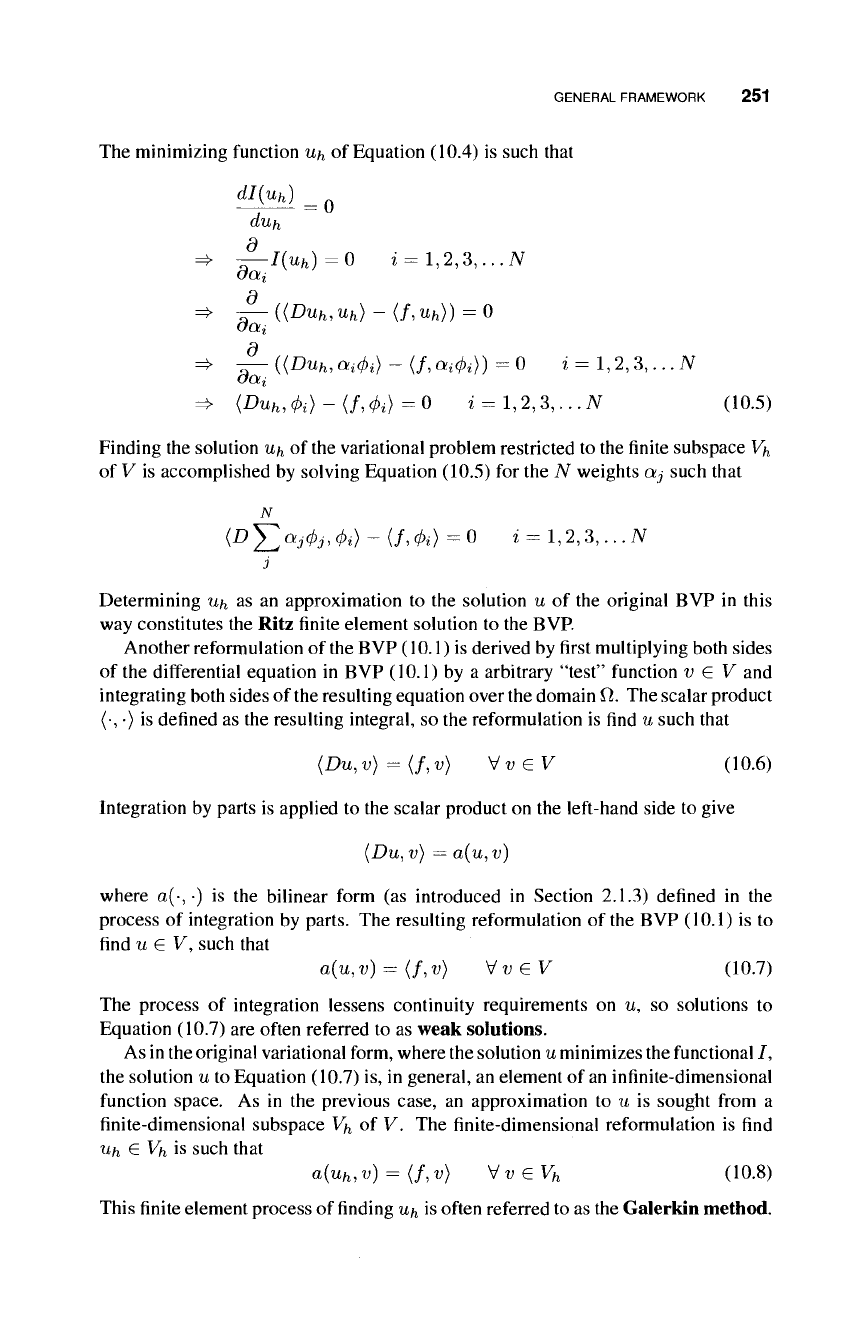
GENERAL FRAMEWORK
251
The minimizing function
Uh
of
Equation (10.4)
is
such that
dl{uh)
=0
du
h
=> —l(u
h
)=0
i =
l,2,3,...N
OOLi
=> -—((Du
h
,u
h
}-{f,u
h
))
= 0
doti
=>
—
((Dtt
h
,
α^) - (/,
a¿0¿))
=0 i =
1,2,3,...
AT
aai
=> (Du
h
^
i
)-(f^
i
)=0
i =
1,2,3,...
N
(10.5)
Finding the solution
ι^
of the variational problem restricted to the finite subspace Vh
of
V is
accomplished by solving Equation (10.5)
for
the
TV
weights
OLJ
such that
N
(Ό^2α^,φ
τ
)-(/,φ
ί
}=0
t =
1,2,3,...JV
Determining i¿/¿
as an
approximation
to the
solution
u of
the original BVP
in
this
way constitutes the Ritz finite element solution to the BVP.
Another reformulation of the BVP
(
10.1 ) is derived by first multiplying both sides
of the differential equation
in
BVP (10.1)
by a
arbitrary "test" function
v
G
V and
integrating both sides of the resulting equation over the domain Ω. The scalar product
(·,
·)
is defined as the resulting integral, so the reformulation
is
find
u
such that
(Du,v)
= (f,v)
VveV (10.6)
Integration by parts
is
applied to the scalar product on the left-hand side to give
(Du,v)
=
a(u,v)
where a(·,·)
is the
bilinear form
(as
introduced
in
Section 2.1.3) defined
in the
process
of
integration
by
parts. The resulting reformulation
of
the BVP (10.1)
is to
find u G
V,
such that
a(u,v)
= (f,v)
VveV (10.7)
The process
of
integration lessens continuity requirements
on w, so
solutions
to
Equation (10.7) are often referred to as weak solutions.
As in the original variational form, where the solution u minimizes the functional
/,
the solution
u
to Equation (10.7) is, in general, an element
of
an infinite-dimensional
function space.
As in the
previous case,
an
approximation
to u is
sought from
a
finite-dimensional subspace Vh
of V. The
finite-dimensional reformulation
is
find
Uh £ Vh IS
sucn
that
a(u
h
,v)
= (f,v)
VveV
h
(10.8)
This finite element process
of
finding
Uh
is often referred to as the Galerkin method.