
Bernatz R. Fourier Series and Numerical Methods for Partial Differential Equations
Подождите немного. Документ загружается.

262 FINITE ELEMENT METHOD
as that by Johnson [18] or that by Mitchell and Wait [25]. The discussion presented
here is limited to the case of elliptic ID and 2D boundary value problems. For the
sake of easier reference, three related problems will be restated next.
The first is the original boundary value problem on the bounded, open domain Ω.
That is,
( Du = f (PDE)
BVP^
(10.21)
I u\an = 9 (BC)
where D is an elliptic differential operator on the set V of admissible functions. The
weak reformulation of BVP (10.21) is: find ueV, such that
a(u,v) = (/,v) VveV (10.22)
The Galerkin approximation to Equation (10.22) is: find Uh
G
V^, such that
o(u
h
,v) = (/,v)
VVGV^
(10.23)
The following theorem is stated without
proof.
Theorem 10.1 Let u be the solution to Equation (10.22) and Uh be the solution to
(10.23).
Then there exist a positive constant C, such that
||u-u
h
||v<C||u-v||v
for all v
<G
V^.
The norm || · ||y is based on a bilinear form defined on the space V. The first remark
relative to the theorem is that, of all the elements v of V/¿, Uh provides the best
approximation for u. Further, an upper bound for the distance between Uh and u
may be determined by selecting any single function v of V^.
Perhaps the most convenient function to be used for v is u, the function that
interpolates to u at the nodal locations defined by the discretization elements of
Ω. For example, the finite element solution to the example presented in Section
10.2.3,
and depicted in Figure 10.7 matches the true solution u at the nodal locations.
The basis functions φι in that example are continuous, piecewise linear functions.
Consequently, the the interpolating function
N
Ü
= Σ
OLi
^
i
i
provides a piecewise linear approximating function that matches the value of u at the
nodal locations x¿. Note that the graph of ü is depicted in Figure 10.7 as well. Using
an interpolating function based on the basis functions of V^ allows one to first gauge
the difference between u and ü on an arbitrary element, and then expand that result
to a global estimate.
Without providing the details, which may be found in a numerical analysis source
such as Atkinson [2], the resulting bound for the global norm of u
—
Uh is
||u - UhHv < ||u - u||v < Ä7i
2
max|u"(x)| (10.24)
ERROR ANALYSIS 263
0.15
0.05
Figure 10.7 True solution u and the linear interpolation function ü.
where h is the length of the (uniform) grid spacing, K is an unknown positive
constant, and the maximum absolute value of the second derivative of u is taken over
the entire interval 0 < x < 1. The conclusion drawn from this result is that the
finite element solution constructed from piecewise linear basis functions has a global
truncation error on the order of h
2
. The length h is either the uniform node spacing,
or the maximum node spacing in the case nonuniform spacing is used. Additionally,
the finite element approximation u^ converges to the true solution u as h tends to
zero provided the second derivative of u is bounded.
The results above may be shown to be true for the more general case of an elliptic
operator D on a 2D open, bounded domain Ω. That is, if the finite element solution
u^ is found using subspace V^ of piecewise linear functions, then there exists a real
number K such that
lu
—
uJ|v < Kh max
d
2
u\
2
fd
2
uY
dx\)
+
\dx
2
J
1/2
(10.25)
where the maximum is taken over the entire domain Ω. In the 2D case, the value
used for h is the largest length of any line connecting nodes of a given element.
Further, if the subspace V^ of V is comprised of piecewise polynomials of degree
r > 1, then the result given in Inequality (10.25) generalizes to
|u-u^||
v
<i^/i
r+1
max
(9
r+1
u
δχγ
1
(9
r+1
u
dxY
1
:-|l/2
(10.26)
264 FINITE ELEMENT METHOD
10.5 1D PARABOLIC EXAMPLE
Finite element methods for solving a 1D, nonhomogeneous heat equation IBVP are
described in the section. The weak form of the IBVP is developed in a way very
similar to the steady-state case. An approximate solution to the weak formulation is
identified from the finite dimensional subspace of functions that are piecewise linear
on the finite elements of the problem domain. However, the weights needed for
expressing the approximate solution as a combination of basis functions must vary
in time because the solution varies in time. How the time-dependency is included in
the solution process is one distinguishing feature of various finite element methods
for this class of
problems.
Two such means methods will be described in the material
of this section. A statement of the IBVP and its weak formulation are given next.
10.5.1 Weak Formulation
The IBVP is
( u
t
—
ku
xx
(x, t) = q{x,
£),
a < x <b, t > 0 (PDE)
u(x, 0) = /(x), a < x < b (IC) (io.27)
IBVP<
u(a,t)=0, t>0 (BCl)
t u(b,t) -0, t >0 (BC2)
The solution u is from the set V of functions differentiate in ¿, for t > 0 and twice
differentiate in x, for a < x < b. The weak form of the PDE in IBVP (10.27) is
{u
u
v) + ka(u, v) = (q, v) (10.28)
where
(u
u
v)
rb pb
I u
t
(x,t)v(x,t)dx (f,v) = / q(x,t)v(x,t)da
Ja Ja
and
pb nb
a(u,v) =
—
/ u
xx
{x,t)v(x,t)dx = / u
x
{x,t)v
x
{x,i)di
Ja Ja
The set Vh is the subspace of V consisting of continuous functions that are
piecewise linear on the uniform elements that partition the interval [a,
b]
as defined
in Section
10.2.3.
As in the previous case, a basis for
Vh
is the set {0i, 02, · · ·,
</>m}>
such that
(j>i(xj)
— lfoxi=j and 0 otherwise. The points Xj represent the nodes of
the discretization of [a,
b].
The finite element solution from Vh has the form
n
u
h
(x,t)
=
y]vi(t)<i>i(x)
i=l
and substitution in Equation (10.28) gives
Mrf(t) + kKrf(t) = b(t) (10.29)
1D PARABOLIC EXAMPLE
265
where
r
b
Mu
=
and
no
po
ij
= /
φι{χ)φ
ό
{χ)άχ
Kij = /
φ\{χ)φ^{χ)άχ
Ja
Ja
bi(t)
= /
ς(χ,ί)φ
ί
(χ)άχ
Ja
Equation (10.29) offers
a
semidiscretization
of
Equation (10.28)
in
that no time
discretization is employed. Section 10.5.2 presents the method of lines in which
Equation (10.29)
is
integrated with respect to time resulting in
a
formula for the
time-dependent vector f}(t) in terms of the other quantities.
10.5.2 Method of Lines
The matrix
M
in Equation (10.29) is tridiagonal and invertible with inverse repre-
sented by
M~
l
.
Multiplying both sides of the equation by M"
1
gives
ff(t)+Af¡(t)=g(t)
(10.30)
where
B
=
kM~
l
K
and
g(t) = M~
l
b{t)
Equation (10.30) is a system of linear, nonhomogeneous ODEs that may be solved,
in a way similar to a single ODE, using the integrating factor
Bt
.
π
EH
2
BH
S
B
n
t
n
It is left as an exercise (see Exercise 10.7) to show that
*ψ-
= BA
(10.31)
at
The result for if(t) using the integrating factor A(i) is
r*
/o
where
ff(t)
=
e
-
Bt
rf(0)
+ /
e-
B
^-
s)
g(s)ds (10.32)
Jo
η%(0)
= /
ς{χ,0)φ
ί
(χ)άχ
Ja
Although Equation (10.32) provides a formula for the weights
ff(t),
the practicality
of the formula is in question because, among other reasons, the matrix
B
is not sparse
because
it
is formed using the inverse of M, which is not sparse. Another means
for determining the finite element approximation to the solution of IBVP (10.27) is
described in Section
10.5.3.
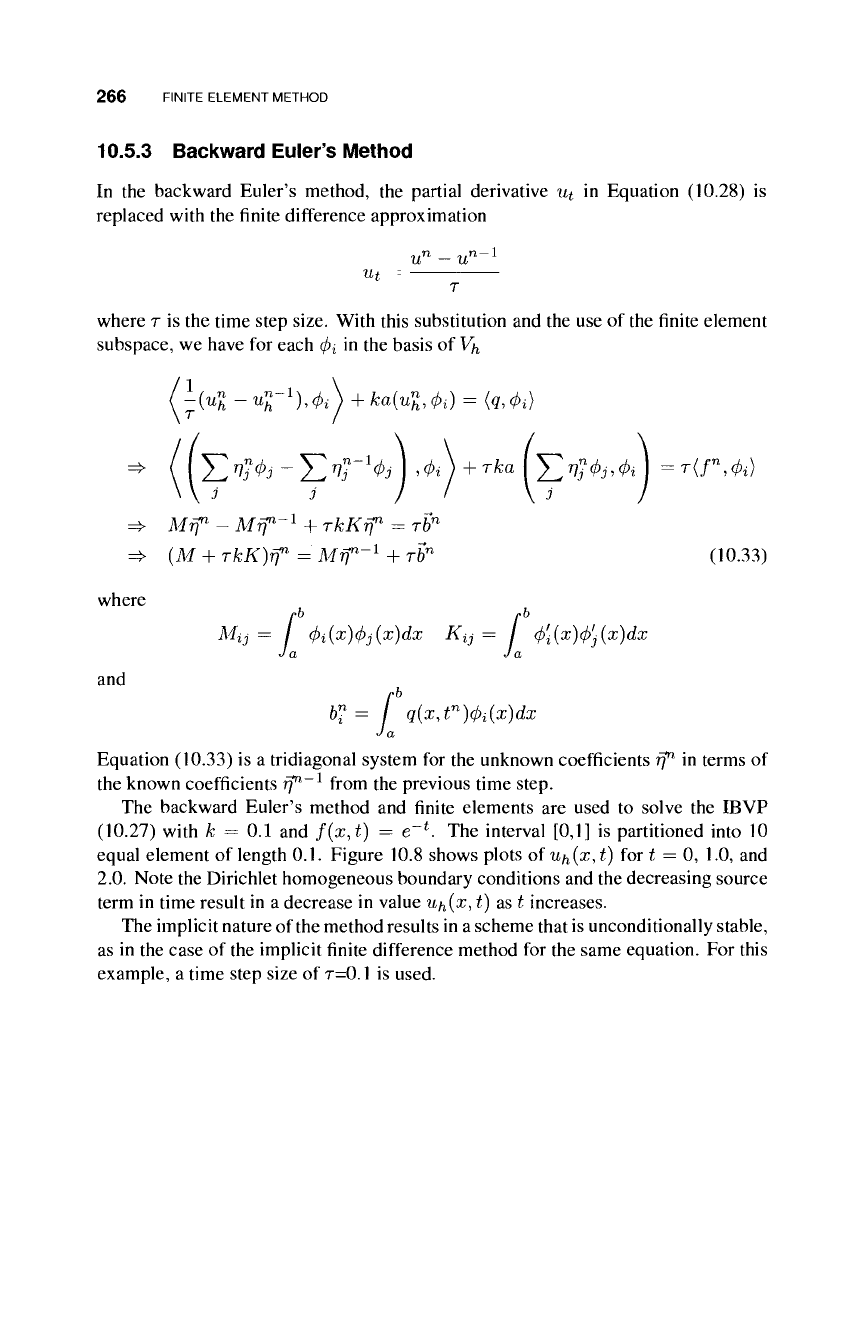
266 FINITE ELEMENT METHOD
10.5.3 Backward Euler's Method
In the backward Euler's method, the partial derivative u
t
in Equation (10.28) is
replaced with the finite difference approximation
u
n _
u
n-l
U
t
where r is the time step size. With this substitution and the use of the finite element
subspace, we have for each φ
ί
in the basis of
Vh
(l« -η^,φλ
+ka{u
n
h
,4>i)
=
(q,4>i)
Σ
Wi - Σ
<
-1
^
)
></>*)+
Tka
(
Σ ^
& ) =
T
(f
n
> &>
=Φ-
Mff
1
- Mrp-
1
+
TkKff
1
= rb
n
=*■ (M + TkK)fT =
Mff
1
'
1
+ rb
n
(10.33)
where
¡>b pb
Mij = / 4)i{x)(¡)j{x)dx Kij = / φ[{χ)φ^{χ)άχ
Ja Ja
b?= í q(x,t
n
)4>i(x)dx
Ja
Equation (10.33) is a tridiagonal system for the unknown coefficients rf
1
in terms of
the known coefficients rf
1-1
from the previous time step.
The backward Euler's method and finite elements are used to solve the IBVP
(10.27) with k = 0.1 and f(x,t) = e~
l
. The interval [0,1] is partitioned into 10
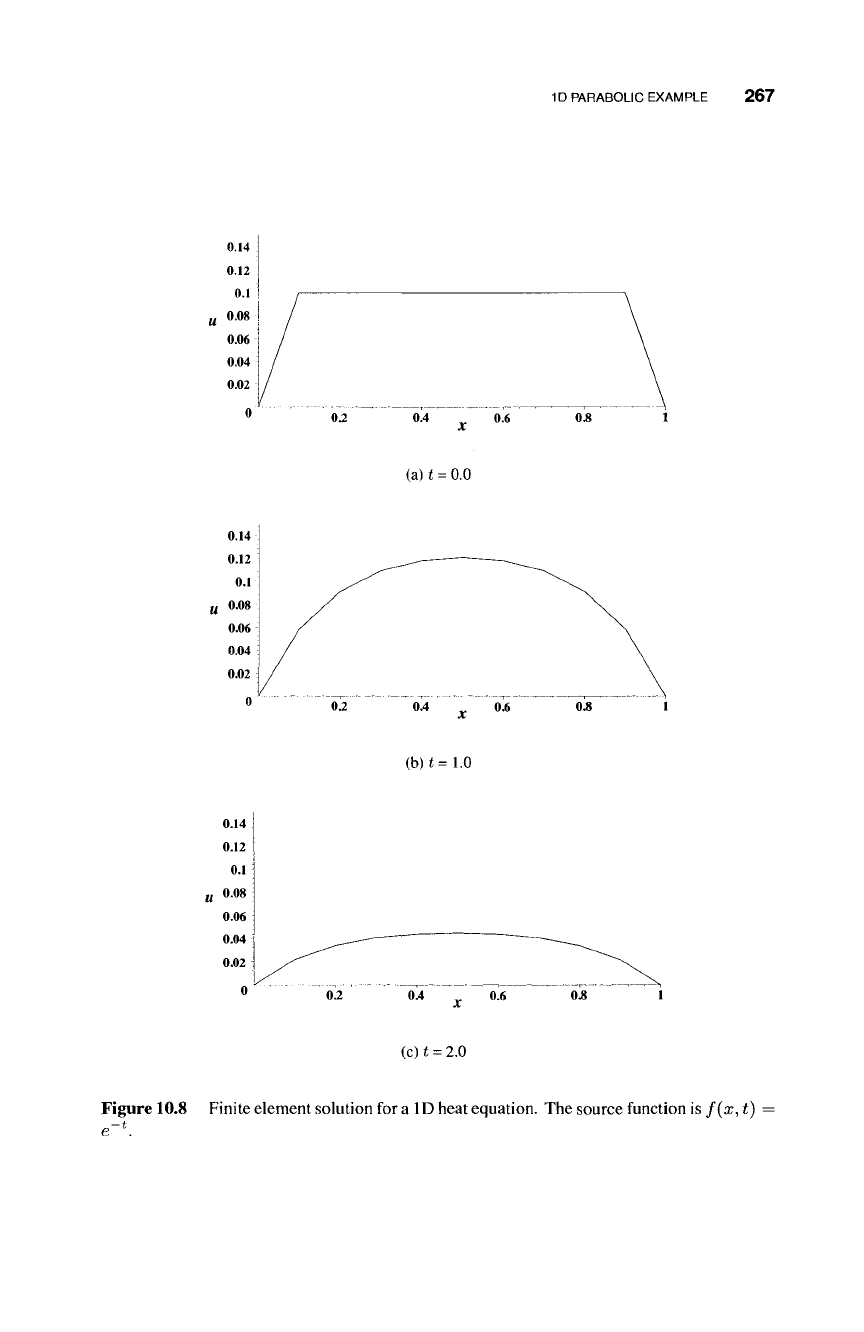
equal element of length 0.1. Figure 10.8 shows plots of Uh(x, t) for t
—
0, 1.0, and
2.0.
Note the Dirichlet homogeneous boundary conditions and the decreasing source
term in time result in a decrease in value w^(x, t) as t increases.
The implicit nature of the method results in a scheme that is unconditionally stable,
as in the case of the implicit finite difference method for the same equation. For this
example, a time step size of r=0.1 is used.
and
1D PARABOLIC EXAMPLE 267
0.14
0.12
0.1
0.08
0.06
0.04
0.02
0.4 0.6
0.8
(a)
t
=
0.0
(b)i=1.0
0.14
0.12
0.1
0.08
0.06
0.04
0.02
0.4 0.6
(c)
t
=
2.0
Figure 10.8 Finite element solution for a
1D
heat equation. The source function is f(x, t)
-t
268 FINITE ELEMENT METHOD
EXERCISES
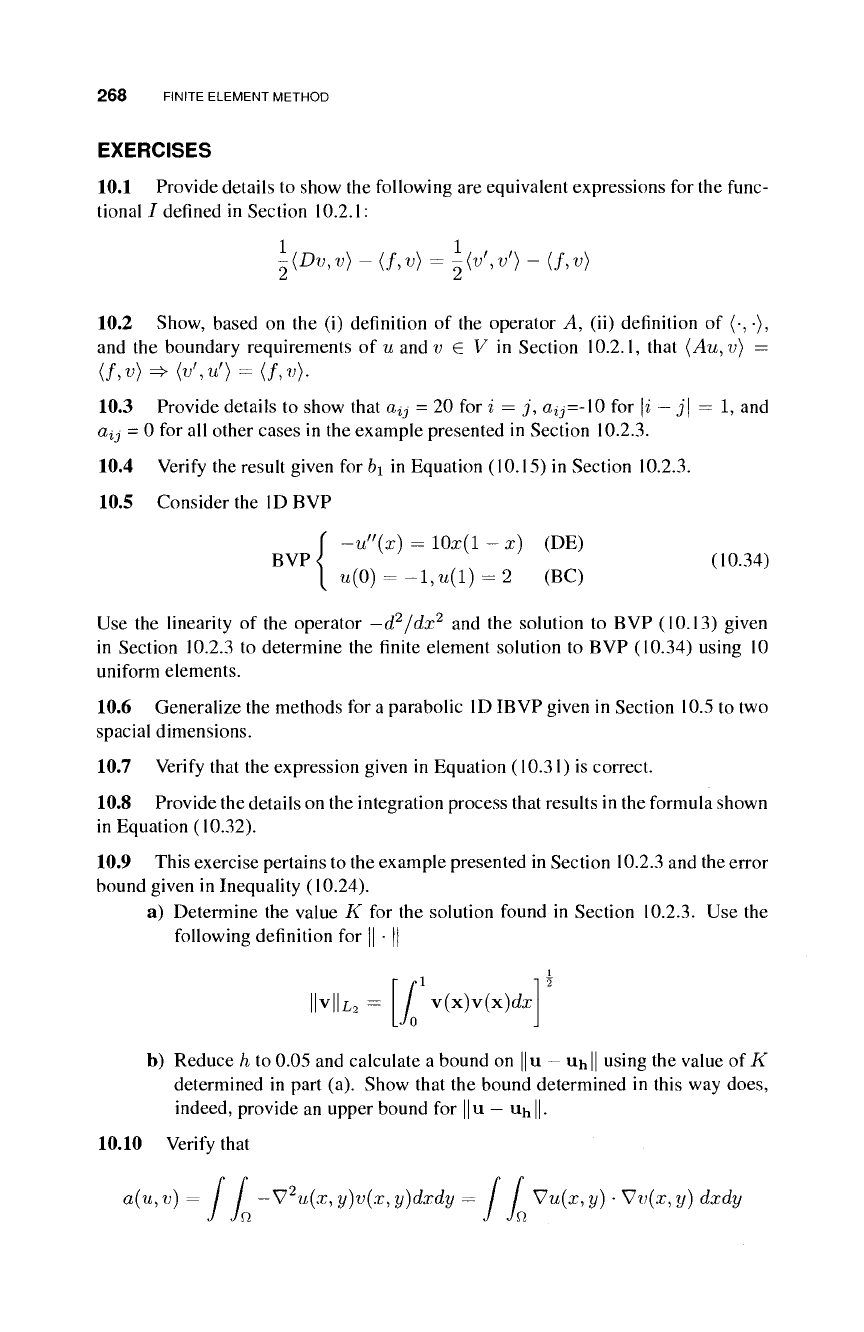
10.1 Provide details to show the following are equivalent expressions for the func-
tional
/
defined
in
Section
10.2.1
:
1
-(Dv,v)-(f,v) = ±(v
,
y)-(f,v)
10.2 Show, based
on the (i)
definition
of
the operator
A, (ii)
definition
of
(·,·),
and
the
boundary requirements
of u
and
v G V in
Section
10.2.1,
that (Au,v)
—
(f,v)^(v',u')
=
(f,v).
10.3 Provide details
to
show that
α^ =
20
for i =
j,
a^=-10
for \i
—
j\
= 1, and
dij
= 0 for
all other cases
in
the example presented
in
Section
10.2.3.
10.4 Verify the result given
for
b\ in Equation (10.15)
in
Section
10.2.3.
10.5 Consider the ID BVP
( -u"(x)
=
10x(l-x)
(DE)
BVP<^ (10.34)
[
u(0) =
-l,u(l)
= 2 (BC)
Use
the
linearity
of
the operator —d
2
/dx
2
and the
solution
to
BVP (10.13) given
in Section 10.2.3
to
determine
the
finite element solution
to
BVP (10.34) using
10
uniform elements.
10.6 Generalize the methods
for
a parabolic ID IBVP given in Section 10.5 to two
spacial dimensions.
10.7 Verify that the expression given
in
Equation
(10.31 )
is correct.
10.8 Provide the details on the integration process that results in the formula shown
in Equation (10.32).
10.9 This exercise pertains to the example presented in Section 10.2.3 and the error
bound given
in
Inequality (10.24).
a) Determine
the
value
K for
the solution found
in
Section
10.2.3.
Use
the
following definition
for || · ||
V
L
2
y
Jo
v(x)v(x)(¿£
b) Reduce
h
to 0.05 and calculate a bound on
||u
— Uh ||
using the value
of K
determined
in
part (a). Show that the bound determined
in
this way does,
indeed, provide
an
upper bound
for ||u
—
Uh||.
10.10 Verify that
a(u,v)
= / /
—V
2
u(x,y)v(x,y)dxdy=
/ /
Vu(x,y) -\7v(x,y) dxdy
J
Jn J Jn
EXERCISES 269
as stated in Section
10.3.1.
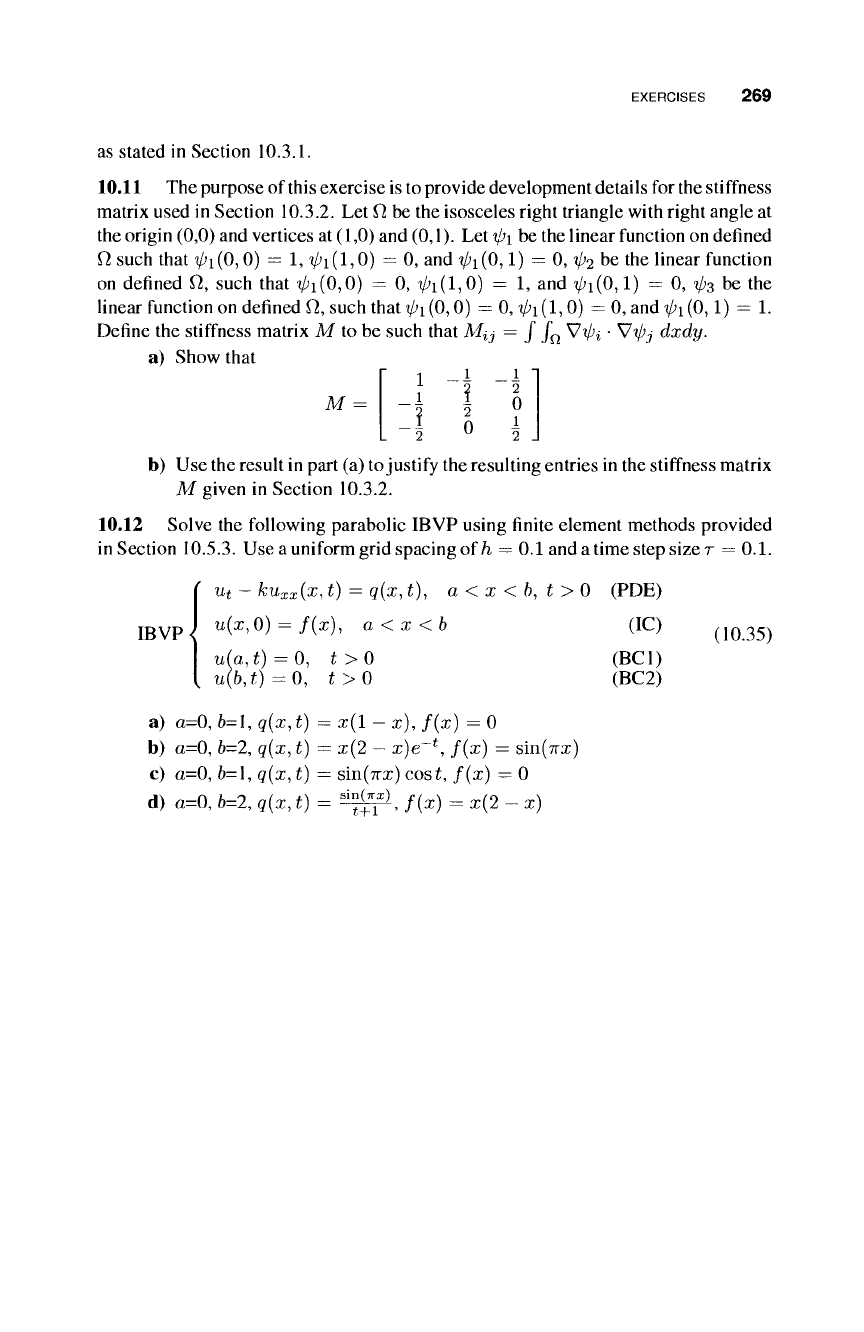
10.11 The purpose of this exercise is to provide development details for the stiffness
matrix used in Section 10.3.2. Let
Ω
be the isosceles right triangle with right angle at
the origin (0,0) and vertices at
(
1,0) and (0,1). Let ψι be the linear function on defined
Ω such that ^i(0,0) = 1, φι(1,0) = 0, and ^>i(0, 1) = 0, ^2 be the linear function
on defined Ω, such that ^i(0,0) = 0, ^i(l,0) = 1, and ^i(0,1) = 0, ψ
3
be the
linear function on defined Ω, such that φ\ (0,0) = 0, ^i(l,0) = 0, and^i(0,1) = l.
Define the stiffness matrix M to be such that M¿¿ = / /
Ω
νψι · Vtpj dxdy.
a) Show that
1 _I _I
1 2 2
-- - 0
2
2 y
-- 0 -
2
U
2
M
b) Use the result in part (a) to j ustify the resulting entries in the stiffness matrix
M given in Section 10.3.2.
10.12 Solve the following parabolic IBVP using finite element methods provided
in Section
10.5.3.
Use a uniform grid spacing of h = 0.1 and a time step size r = 0.1.
IBVP<
u
t
—
ku
xx
{x, t) = q(x, £), a < x < b, t > 0 (PDE)
u(x,0) = f(x), a<x<b (IC)
(10.35)
u(a,t) = 0, t>0
tfc(M)=0, t>0
(BC1)
(BC2)
a) a=0, 6=1, q(x,t) = x(l - x), f{x) = 0
b) a=0, 6=2, q(x, t) = x(2
—
x)e~
t
, f(x) = sin(7rx)
c) a=0, 6=1, q(x,t)
—
sin(7rx) cos
¿,
f(x) = 0
d) a=0, 6=2, q(x, t) = ^g^, f{x) = x(2 - x)

This Page Intentionally Left Blank
CHAPTER 11
FINITE ANALYTIC METHOD
The finite analytic (FA) method for the ID and 2D transport equations is presented
in this chapter. Because the transport equation for scalar quantities includes both
a convection term and a diffusion term, it is often referred to as a "convection-
diffusion" equation. The development of the FA method for the transport equations
is more general than that offered in previous chapters on the finite difference and
finite element methods. The resulting formulations reduce to the heat equation in ID
and 2D, as well as Poisson's and Laplace's equations in 2D.
The central concept of the FA method, introduced by Chen and Li [7], is the
use of separation of variables and Fourier series solutions on a locally linearized
version of the nonlinear convection-diffusion equation. Boundary conditions for each
FA element are constructed using the value of the dependent variable at the nodal
locations on the element boundary. Once the boundary functions are determined,
the Fourier series general solution is used to represent the boundary functions. The
Fourier coefficients determined in this process are expressed in terms of
the
boundary
nodal values, and a function for the dependent variable results. This function is
evaluated for the center of the element that gives the new value of the dependent
variable there in terms of the boundary node values. The coefficients for these nodal
locations are the finite analytic coefficients.
Fourier Series and Numerical Methods for Partial Differential Equations, 271
First Edition. By Richard Bernatz
Copyright © 2010 John Wiley & Sons, Inc.