
Bernatz R. Fourier Series and Numerical Methods for Partial Differential Equations
Подождите немного. Документ загружается.

272 FINITE ANALYTIC METHOD
11.1 1D TRANSPORT EQUATION
The derivation of the FA coefficients for the case of the ID transport equation is
presented in this section in some detail. The equation for the dependent variable
φ(χ,ί) is given in Equation (11.1),
Φι
+
u<f>x
= μΦχχ + /(x,£) (11.1)
where φ is the dependent variable, u is the media velocity, / is the source term,
and a is the appropriate diffusion coefficient. Equation (11.1) is used to model
various quantities including heat (0=temperature) or momentum (φ=η) transfer. The
equation can be made non-dimensional by introducing representative values L for
length, T for time, and Φ for the dependent variable φ. Non-dimensional quantities
are defined by
1
=T
X
=L
U =
T
φ
=Φ
Subbing the nondimensional expressions in Equation (11.1), rearranging terms, and
dropping the ^-superscript results in the nondimensional form of the ID transport
equation
Rfa + ηηφ
χ
= φ
χχ
+ Rf(x,t) (11.2)
where the parameter R is given by
UL L
R= with U = —
μ Τ
Burgers' equation is a simple model for the ID fluid flow obtained from Equation
(11.2) with u
—
φ, R = Re (Reynolds number), and / = 0. The governing equation
for transient heat conduction is obtained from Equation (11.2) by setting u = 0,
R = Pe (Pe= the Peclet number) and / = 0.
The problem domain D is divided into many small subdomains, or elements. The
size of an arbitrary element is 2ft- x r, where ft = Ax, and r = At. If need be,
Equation (11.2) is linearized on each of the small elements. Then, an analytic solution
is sought for the linear equation within each small element. A typical one-time step
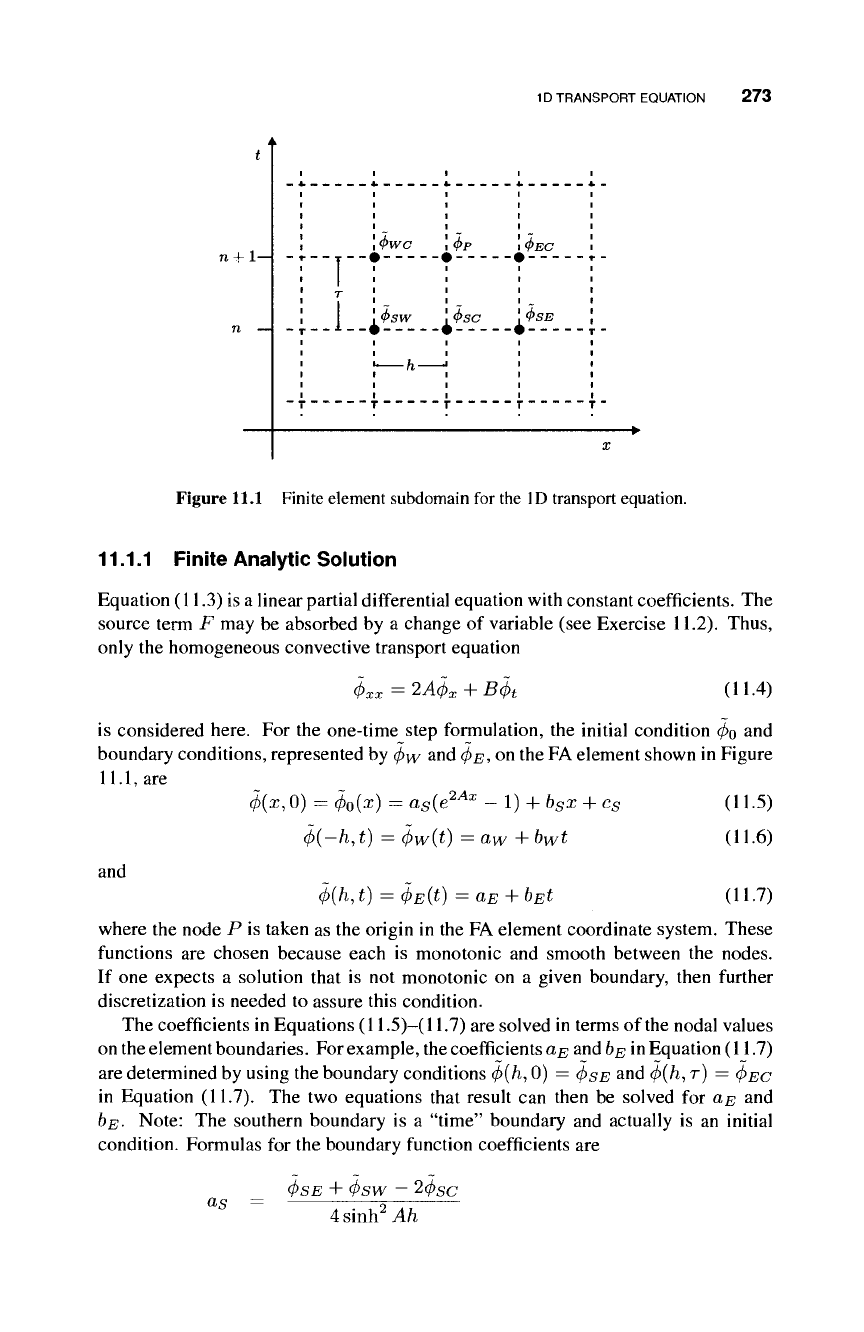
FA element is shown in Figure 11.1, including node P and its neighboring nodal
points WC, EC, SW, SC
9
and SE.
Complex initial and boundary conditions on the small element may be approx-
imated by simple initial and boundary functions so that an analytic solution for φ
can be derived on the element. However, even for such simple initial and boundary
conditions, the analytic solution may still be difficult to obtain due to the complicated
dependence of u and / on independent or dependent variables. In this situation, the
ID transport equation is linearized by approximating the convective velocity as a
constant over the small element. Then, Equation (11.2) becomes
2Αφ
χ
+ Βφ
Ε
= φ
χχ
+ F (11.3)
where A — \RU, B = R, and U and F are representative constant values of u and
Rf, respectively, over the FA element.
1D TRANSPORT EQUATION 273
n-l· l—\
1
T -
7 -
1
T
.1.
\<t>wc
\<l>sw
"7
1
1
1
1
1
\φρ
1
1
\<I>SC
1
1
1
1
- 7
1
1
1
1
1
\<j>EC
1
1
1
1 _
!
<t>SE
1
1
1
1
1
1
■
- 7
Figure 11.1 Finite element subdomain for the ID transport equation.
11.1.1 Finite Analytic Solution
Equation (11.3) is
a
linear partial differential equation with constant coefficients.
The
source term
F
may
be
absorbed
by a
change
of
variable (see Exercise 11.2). Thus,
only the homogeneous convective transport equation
2Αφ
χ
+
B4>
t
(11.4)
is considered here. For the one-time step formulation, the initial condition φο and
boundary conditions, represented by φ\γ and
ΦΕ,
on the FA element shown in Figure
11.1,
are
φ(χ, 0) = φ
0
(χ) = a
s
(e
2Ax
- 1) + b
s
x + c
s
(11.5)
and
φ(—Η,ί) = φνγ{ί)
= a
w
~\~
bwt
φ(Η,
t) = ΦΕ{Ϊ) =
CLÉ 4-
b
E
t
(11.6)
(11.7)
where the node P is taken as the origin in the FA element coordinate system. These
functions are chosen because each is monotonie and smooth between the nodes.
If one expects a solution that is not monotonie on a given boundary, then further
discretization is needed to assure this condition.
The coefficients in Equations (11.5)—(11.7) are solved in terms of
the
nodal values
on the element
boundaries.
For
example,
the coefficients
CLE
and
bE
in Equation (11.7)
are determined by using the boundary conditions 0(/i, 0) =
4>SE
and
</>(/i,
r) =
<J>EC
in Equation (11.7). The two equations that result can then be solved for ÜE and
bE- Note: The southern boundary is a "time" boundary and actually is an initial
condition. Formulas for the boundary function coefficients are
as
<I>SE
+ Φβ\¥ -
2(j>SC
4 sinh
2
Ah
274 FINITE ANALYTIC METHOD
cs
=
4>sc
, 4>SE
-
4>sw
-
coth
Ah(4>sE
+
4>sw
-
2</>sc)
=
~ 2ft
Q>w
— ΦΞ\¥
,
<ßwc
-
(ßsw
b
w
=
r
a>E =
4>SE
and
6
B
=
^
EC
~^
g
(11.8)
r
Equation
(
11.4),
with Equations
(
11.5)-(
11.7),
is solved analytically by the method
of separation of
variables.
Details of
the
process are given in Appendix
A.
Evaluating
the solution
for
point
P
will result
in a
six-point FA algebraic equation giving
the
nodal value
φρ as a
function
of
its neighboring nodal values,
as
shown
in
Equation
(Π.9).
ΦΡ
= ΟννοΦννο +
ΟΕΟΦΕΟ
+ Csw</>sw +
CSS^SÍ;
+
^ΖΟΦΒΟ
(H-9)
The coefficients
in
Equation (11.9), determined
by
evaluating
the
local analytic
solution at point
P,
are given by
Cwc
= e Si CEC
—
e~ S\ Csw = e S
2
C
SE
=
e~
Ah
S
2
and C
SC
=
4Ah cosh(Ah) coth(Ah)P
2
where
Bh
2
51
=
(P2-Q2)+Ql
T
Bh
2
5
2
= (Q
2
- P
2
) -
2Ahcoth(Ah)P
2
T
p
2
= 2^
- \{AhY +
{\
m
h)
oo.
Q
- V
(-V
m+1Xmh
(¿-12)
F„.
Α
2
+
\1
B
'
(2m
-
1)π)
2h
The
FA
coefficient formulas involve three infinite sums, Qi,Q
2
, and P
2
. However,
it is possible to derive closed-form formulas
for Qi
and
Q
2
,
Ql
" e
Ah
+ e
-Ah
1D TRANSPORT EQUATION 275
and
Q
2
e
Ah _
e
-Ah
2Ah(e
Ah
+
e~
Ah
)
2
Formulas similar to Equation (11.9) can be used to calculate new values for φ at
each node of the domain. Ultimately, a system of algebraic equations is assembled
to calculate φ values for all nodes at the new (or current) time step. Equation (11.9)
is rewritten in Equation (11.10) to clarify the implicit nature of the computation. The
nodal values φρ,
4>wc>
and
(¡>EC
are unknown quantities from the current time step,
and are designated as such with the "n + 1" superscript. The nodal values
-CwcïÏÏè + ΦΡ
+1
- CEcfitc = Cswfàw + CSE4%E + Csc^sc 01-10)
<Asw> Φβο, and φ$Ε are known from the previous time step, and are denoted with
the "n" superscript. The tridiagonal matrix associated with the system of algebraic
equations formed from Equation (11.9) is easily solved to give values of φ at the
current time step [19].
11.1.2 FA and FD Coefficient Comparison
A comparison between the FA and FD solutions for the ID heat equation is given
in this section. The finite difference solution of the heat equation φ
χχ
= φ
ι
[A =
0, B = 1 in Equation (11.4)] can be cast in the form of Equation (11.9). In this
formulation, finite difference approximations of the derivatives are substituted into
the heat equation, resulting in the following formulas for the coefficients CEC,
CWC>
Csci Csw, and CSE (see Section 9.3):
[l-2A(l-fl)]
CsC
= 1 +
2ΧΘ
(1UI)
C
sw
=C
SB
= -c
n
^X0)
(1U2)
and
\θ
CWC = CEC =
1JT2X0)
(1U3)
For these formulas, λ
—
τ/h
2
and
Θ
is an implicit-explicit parameter [9]. For
example, when 0 = 0, Equation (11.9), with coefficients defined in Equations
(11.11)-(
11.13),
gives an explicit finite difference formula. When Θ — \, the
Crank-Nicolson (CN) formula is obtained. An implicit formula results for
Θ
— 1.
When θ = (6λ - 1)/12λ, the Forsythe and Wasow (FW) formula is obtained.
First, consider the explicit FD method
(Θ
= 0). The coefficients in Equations
( 11.11 )-(
11.13)
for this case are obtained using a forward difference in the temporal
derivative φι, and a central difference in the spatial derivative φ
χχ
. The coefficients
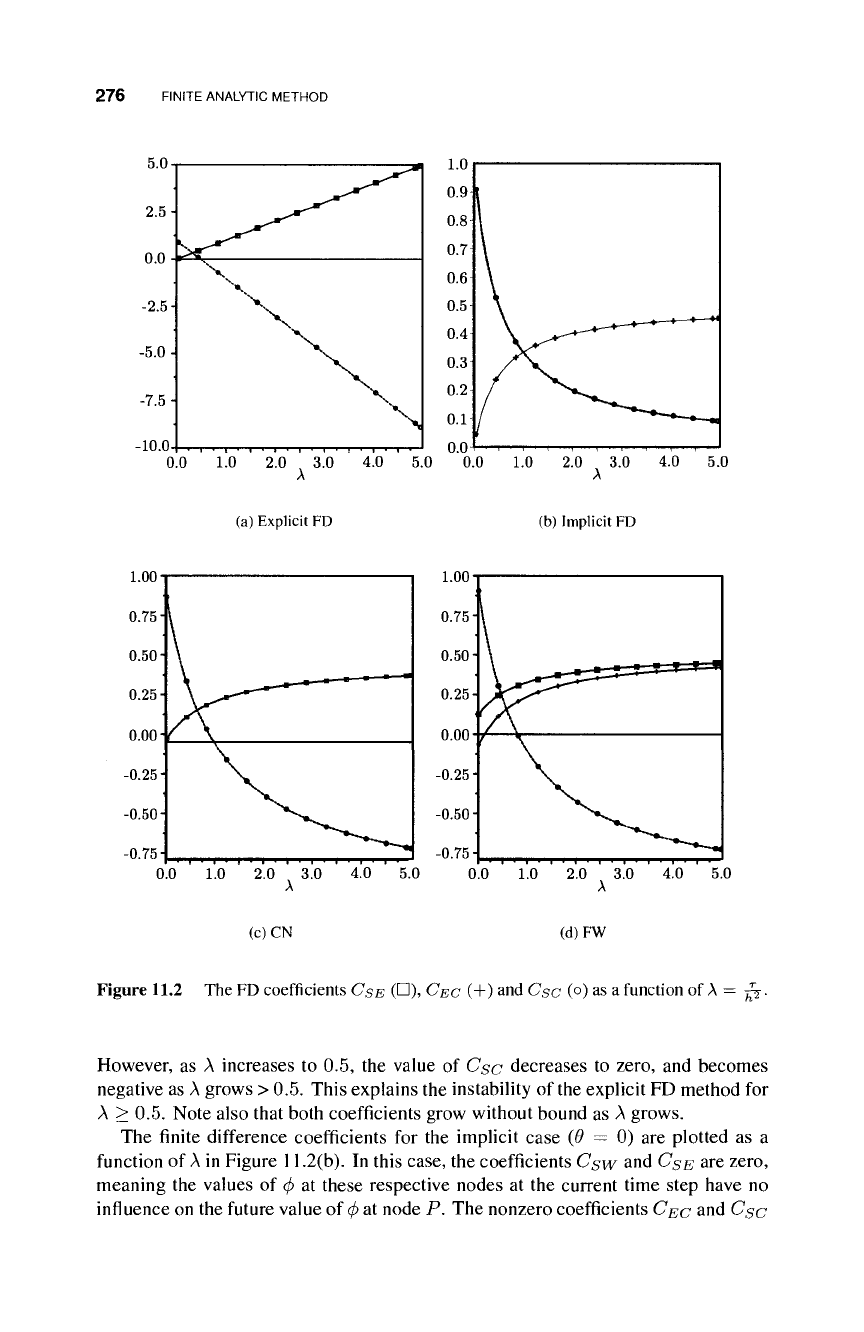
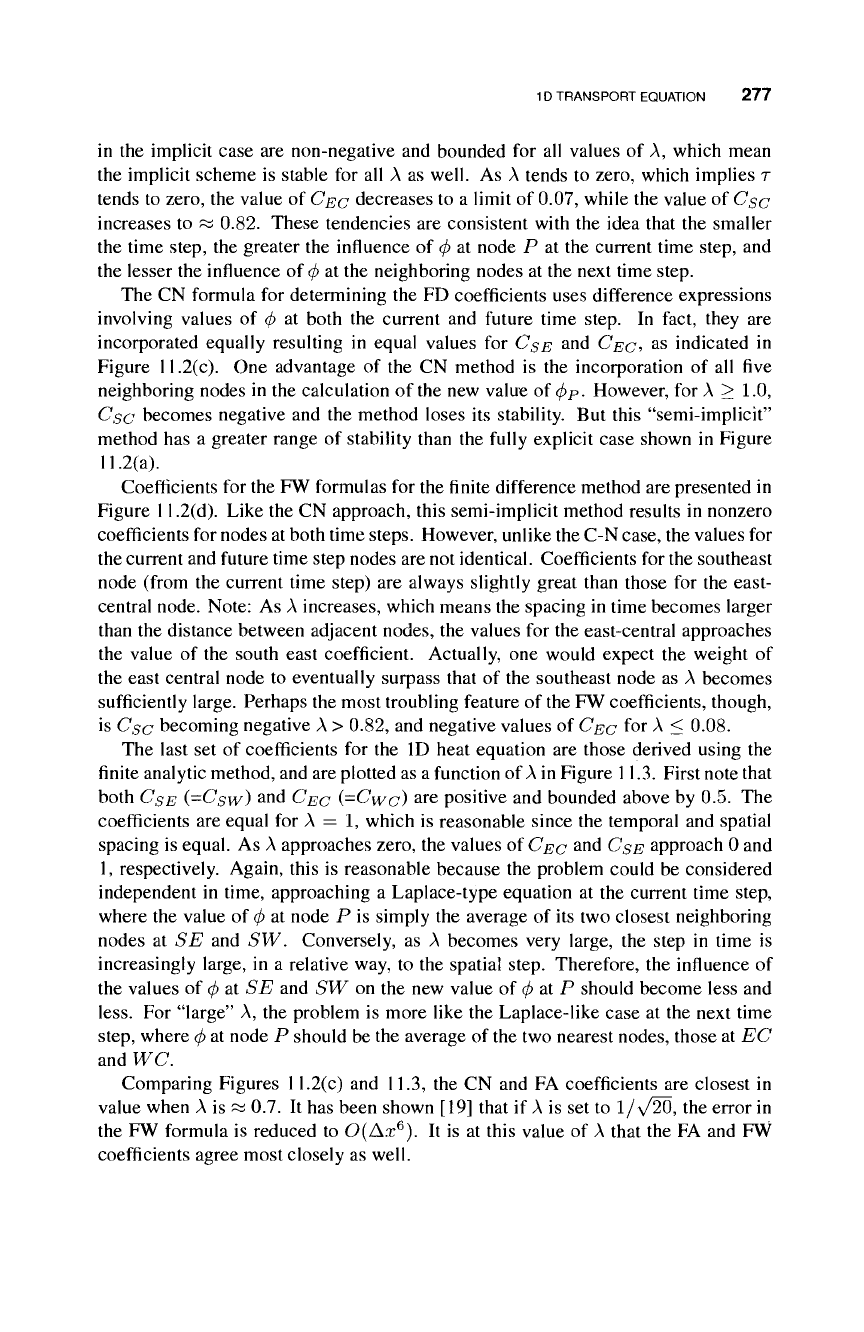
for CSE (= Csw) and Csc for the explicit FD method are shown in Figure 11.2(a).
Note from Equation 11.13 that both Cwc and CEC are zero in this case. The explicit
finite difference technique is a suitable method for the ID heat equation for λ < 0.5.
276 FINITE ANALYTIC METHOD
5.0
2.5
0.0
-2.5
-5.0
-7.5
-10.0
u^^i
J x
H—«—r—«—r—·—i—«—r-·—i—·■
i
»
i—>—r—«—i—«—'
0.0 1.0 2.0 3.0 4.0 5.0 0.0 1.0 2.0 3.0 4.0 5.0
Λ Λ
(a) Explicit FD (b) Implicit FD
I ' I ' I ' I ' I ■ I ' I ' I ' I '
0.0 1.0 2.0 3.0 4.0 5.0
Λ
> I · I · I · I > I · I ■ I ' I ·
0.0 1.0 2.0 3.0 4.0 5.0
λ
(c)CN
(d)FW
Figure 11.2 The
FD
coefficients CSE
(□), CEC
(+) and Csc (°) as a function of λ =
-ξ?
However, as λ increases to 0.5, the value of Csc decreases to zero, and becomes
negative as
À
grows > 0.5. This explains the instability of the explicit FD method for
λ > 0.5. Note also that both coefficients grow without bound as λ grows.
The finite difference coefficients for the implicit case
(Θ
= 0) are plotted as a
function of
Λ
in Figure 11.2(b). In this case, the coefficients Csw and CSE are zero,
meaning the values of φ at these respective nodes at the current time step have no
influence on the future value of φ at node P. The nonzero coefficients CEC and Csc
1D TRANSPORT EQUATION
277
in
the
implicit case
are
non-negative and bounded
for all
values
of λ,
which mean
the implicit scheme
is
stable
for all λ as
well. As
λ
tends
to
zero, which implies
r
tends to zero, the value
of
CEC decreases to
a
limit
of
0.07, while the value
of Csc
increases
to «
0.82. These tendencies are consistent with the idea that the smaller
the time step, the greater the influence
of φ at
node
P at
the current time step,
and
the lesser the influence
of
φ at the neighboring nodes
at
the next time step.
The CN formula
for
determining the FD coefficients uses difference expressions
involving values
of φ at
both
the
current
and
future time step.
In
fact, they
are
incorporated equally resulting
in
equal values
for CSE and
CEC,
as
indicated
in
Figure 11.2(c). One advantage
of
the
CN
method
is the
incorporation
of all
five
neighboring nodes in the calculation
of
the new value
of φρ.
However,
for λ > 1.0,
Csc becomes negative and the method loses
its
stability. But this "semi-implicit"
method has
a
greater range
of
stability than the fully explicit case shown
in
Figure
11.2(a).
Coefficients for the FW formulas for the finite difference method are presented
in
Figure 11.2(d). Like the CN approach, this semi-implicit method results
in
nonzero
coefficients for nodes at both time steps. However, unlike the C-N case, the values for
the current and future time step nodes are not identical. Coefficients for the southeast
node (from the current time step)
are
always slightly great than those
for
the east-
central node. Note: As
λ
increases, which means the spacing in time becomes larger
than the distance between adjacent nodes, the values
for
the east-central approaches
the value
of
the south east coefficient. Actually,
one
would expect the weight
of
the east central node
to
eventually surpass that
of
the southeast node
as λ
becomes
sufficiently large. Perhaps the most troubling feature of the FW coefficients, though,
is
Csc
becoming negative
λ >
0.82, and negative values
of
CEC
for
A
<
0.08.
The last
set of
coefficients
for
the
ID
heat equation
are
those derived using
the
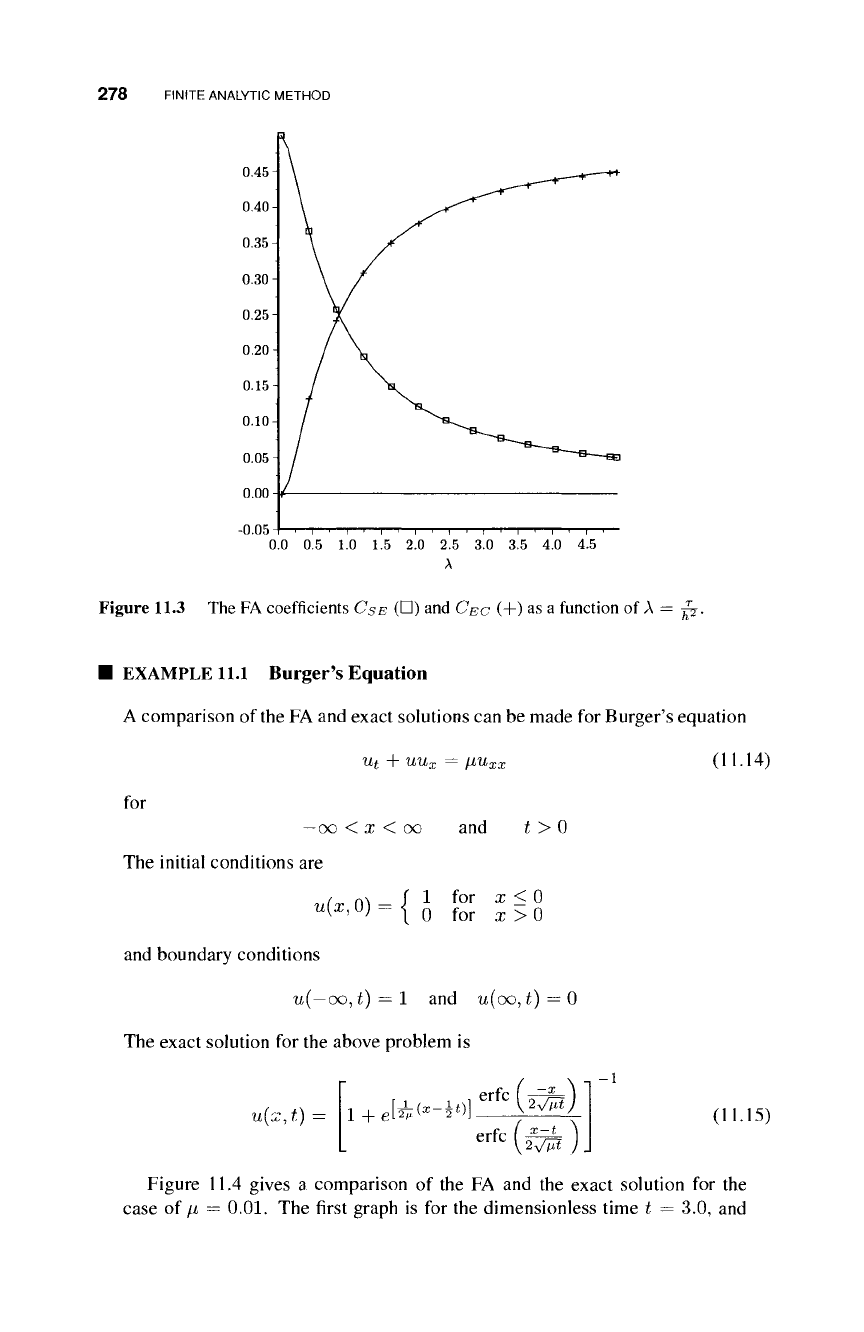
finite analytic method, and are plotted as a function of λ in Figure 11.3. First note that
both
CSE (=CSW)
and
CEC (=CWC)
are positive and bounded above by 0.5.
The
coefficients are equal
for λ = 1,
which
is
reasonable since the temporal and spatial
spacing is equal. As
λ
approaches zero, the values
of
CEC and CSE approach
0
and
1,
respectively. Again, this
is
reasonable because the problem could be considered
independent
in
time, approaching
a
Laplace-type equation
at
the current time step,
where the value
of
φ
at
node
P is
simply the average
of
its two closest neighboring
nodes
at SE and SW.
Conversely,
as λ
becomes very large,
the
step
in
time
is
increasingly large,
in a
relative way,
to
the spatial step. Therefore, the influence
of
the values
of φ at SE
and
SW on
the new value
of
φ
at P
should become less and
less.
For "large"
λ,
the problem
is
more like the Laplace-like case
at
the next time
step,
where
φ
at node
P
should be the average of the two nearest nodes, those
at EC
and
WC.
Comparing Figures 11.2(c)
and
11.3,
the
CN and FA coefficients
are
closest
in
value when
λ is «
0.7.
It
has been shown [19] that
if λ is
set to l/>/2Ü, the error in
the FW formula
is
reduced
to
0(Δ.τ
6
).
It is at
this value
of λ
that the FA and FW
coefficients agree most closely as well.
278 FINITE ANALYTIC METHOD
-I 1 1 1 1 1 1 1 1 1 1 1 1 1 r
0.0 0.5 1.0 1.5 2.0 2.5 3.0 3.5 4.0 4.5
Figure 11.3 The
FA
coefficients CSE (□) and
CEC
(+) as a function of λ = -^.
EXAMPLE 11.1 Burger's Equation
A comparison of the FA and exact solutions can be made for Burger's equation
ut + uu
x
= μη
χχ
for
—oo < x < oo and t > 0
The initial conditions are
Φ, °) = { o for x > 0
and boundary conditions
t¿(—oo,£) = 1 and u(oo,t) = 0
The exact solution for the above problem is
u(x,t)
i +
e
[¿(*-e*)]
erfc
(2^)
erfc
_, -1
\2y/m )\
(11.14)
(11.15)
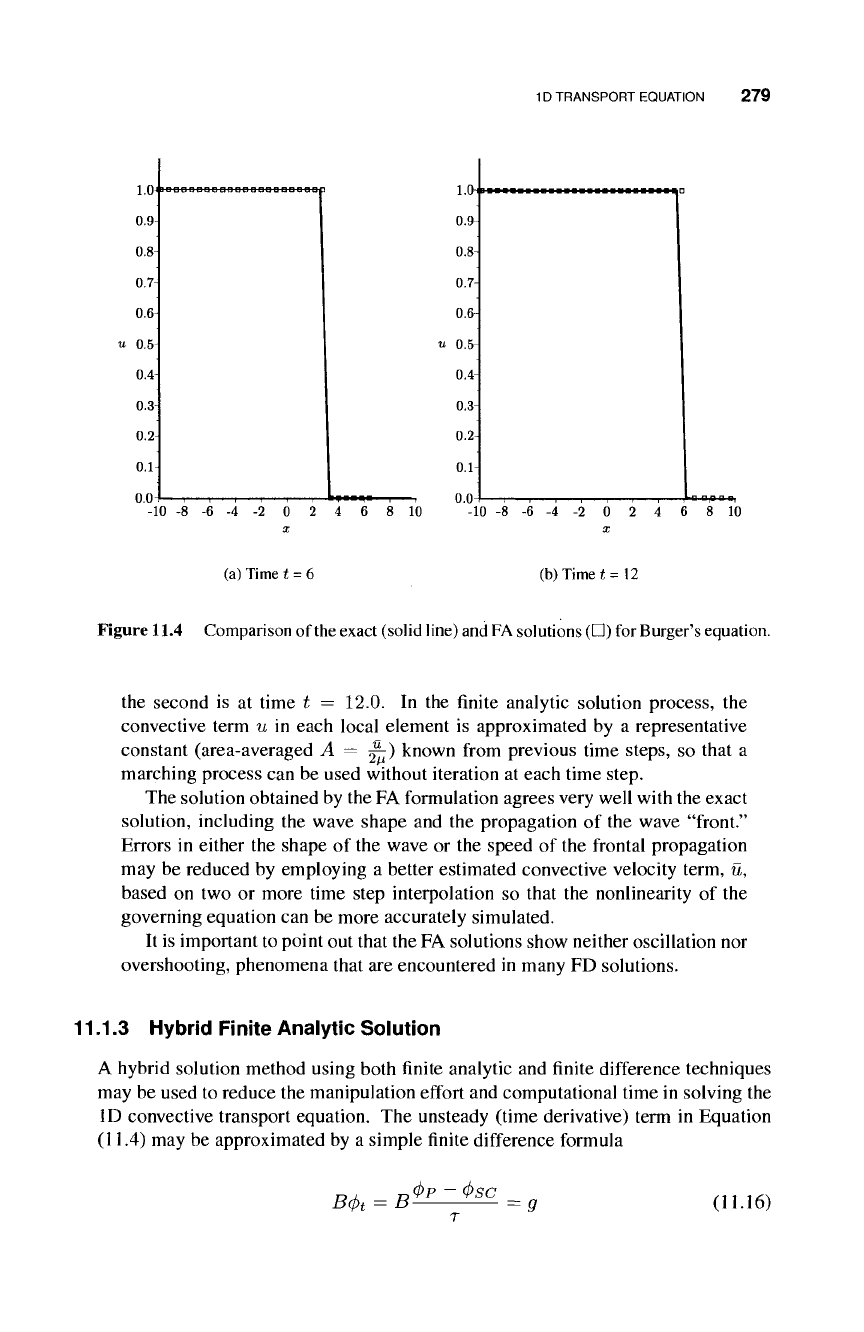
Figure 11.4 gives a comparison of the FA and the exact solution for the
case of μ = 0.01. The first graph is for the dimensionless time t — 3.0, and
1D TRANSPORT EQUATION 279
1 0Αοαααπποπαοοαπποππαααρ
0.9
0.8
0.7
0.6
u 0.5
0.4
0.3
0.2
0.1
0.0
-10 -8 -6 -4 -2 0 8 10 -10 -8 -6 -4 -2 0 2 4 6 8 10
(a) Time t = 6
(b)Timei=12
Figure 11.4 Comparison of
the
exact (solid
line)
and
FA
solutions (D) for
Burger's
equation.
the second is at time t = 12.0. In the finite analytic solution process, the
convective term u in each local element is approximated by a representative
constant (area-averaged A — ^-) known from previous time steps, so that a
marching process can be used without iteration at each time step.
The solution obtained by the FA formulation agrees very well with the exact
solution, including the wave shape and the propagation of the wave "front."
Errors in either the shape of the wave or the speed of the frontal propagation
may be reduced by employing a better estimated convective velocity term, t¿,
based on two or more time step interpolation so that the nonlinearity of the
governing equation can be more accurately simulated.
It is important to point out that the FA solutions show neither oscillation nor
overshooting, phenomena that are encountered in many FD solutions.
11.1.3 Hybrid Finite Analytic Solution
A hybrid solution method using both finite analytic and finite difference techniques
may be used to reduce the manipulation effort and computational time in solving the
ID convective transport equation. The unsteady (time derivative) term in Equation
(11.4) may be approximated by a simple finite difference formula
Βφι = B = g
(11.16)
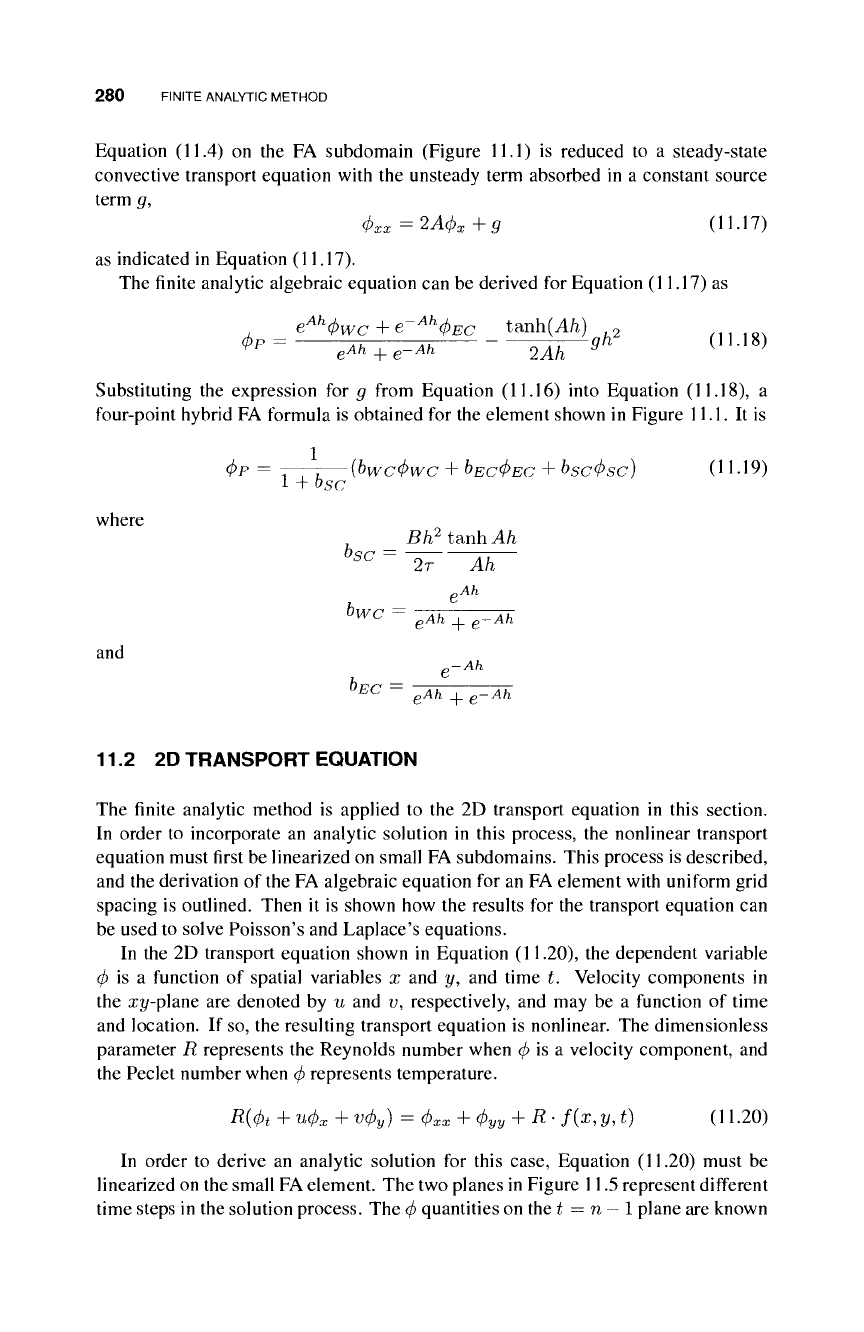
280 FINITE ANALYTIC METHOD
Equation (11.4) on the FA subdomain (Figure 11.1) is reduced to a steady-state
convective transport equation with the unsteady term absorbed in a constant source
term g,
(j)
xx
= 2A(t)
x
+g (11.17)
as indicated in Equation (11.17).
The finite analytic algebraic equation can be derived for Equation (11.17) as
, e
Ah
<f>
wc
+ e-
Ah
(j>
EC
tanh(Aft)
u2
Φρ
= e*» + e-*»
2JÖT
ah
(1U8)
Substituting the expression for g from Equation (11.16) into Equation (11.18), a
four-point hybrid FA formula is obtained for the element shown in Figure 11.1. It is
ΦΡ =
^——r—{bwc<t>wc
+
^ΕΟΦΕΟ
+
b
S
c(£>sc)
(11.19)
1 4- bsc
where
Bh
2
tanh Ah
e
Ah
b
wc=
eAh + e
_
Ah
and
P
-Ah
bsc
Ah _i_
ß—Ah
11.2 2D TRANSPORT EQUATION
The finite analytic method is applied to the 2D transport equation in this section.
In order to incorporate an analytic solution in this process, the nonlinear transport
equation must first be linearized on small FA subdomains. This process is described,
and the derivation of the FA algebraic equation for an FA element with uniform grid
spacing is outlined. Then it is shown how the results for the transport equation can
be used to solve Poisson's and Laplace's equations.
In the 2D transport equation shown in Equation (11.20), the dependent variable
φ is a function of spatial variables x and y, and time t. Velocity components in
the x?/-plane are denoted by u and v, respectively, and may be a function of time
and location. If so, the resulting transport equation is nonlinear. The dimensionless
parameter R represents the Reynolds number when φ is a velocity component, and
the Peclet number when φ represents temperature.
η{φι + ηφ
χ
+ νφ
υ
) = φ
χχ
+ φ
υυ
+ ΙΙ' /(χ,y,t) (l 1.20)
In order to derive an analytic solution for this case, Equation (11.20) must be
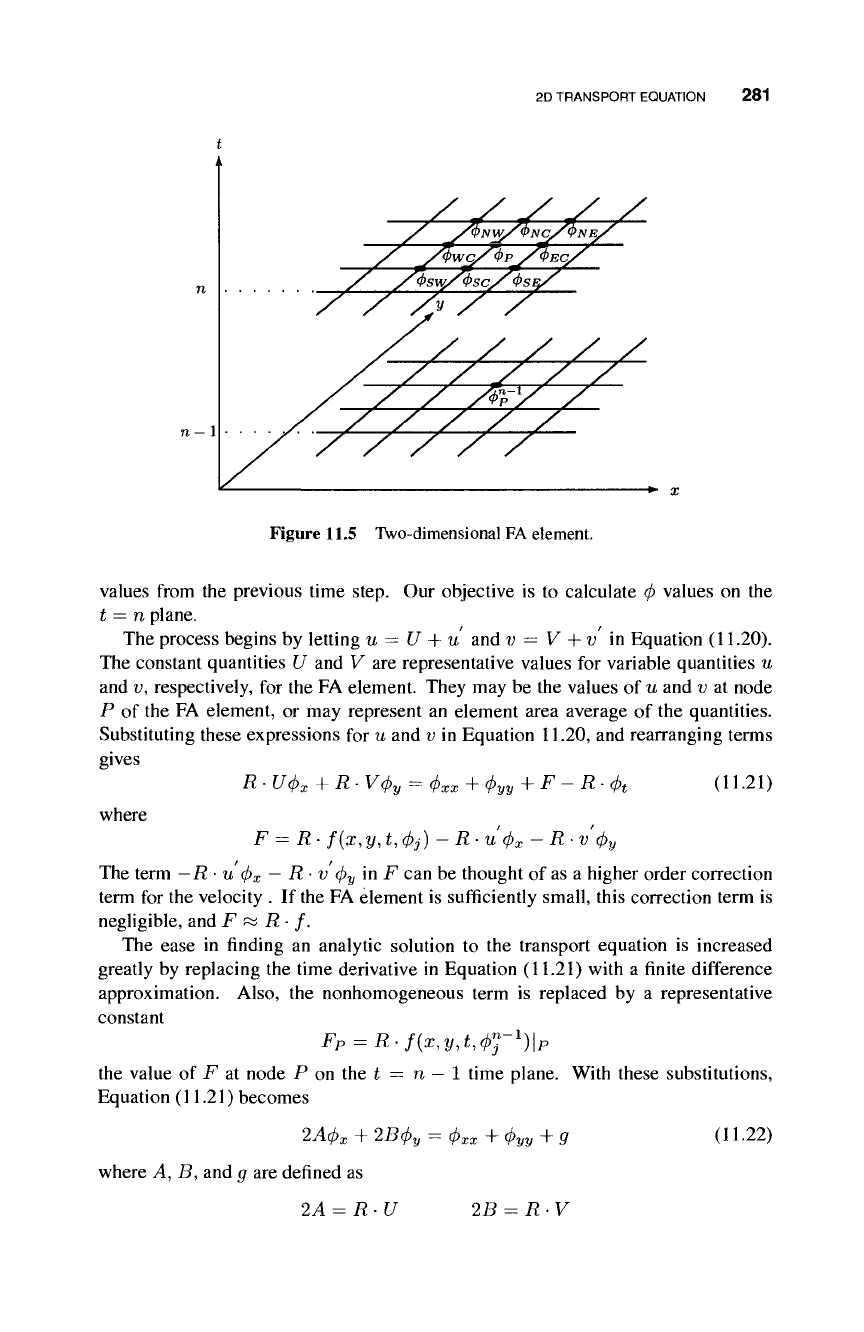
linearized on the small FA element. The two planes in Figure 11.5 represent different
time steps in the solution process. The φ quantities on the t = n
— 1
plane are known
2D TRANSPORT EQUATION 281
n-1
i
1 / ^/^NW/^N^/^NE/^
1 / _S$W<^$P_/^>EC/
1 / X9S\^/^>SC/1>SEX
y y y y y y
y y y y y y
y y y Λν y
y y y y y y
\y y y y y y
Figure 11.5 Two-dimensional
FA
element.
values from the previous time step. Our objective is to calculate φ values on the
t
—
n plane.
The process begins by letting u — U + u and v — V + v in Equation (11.20).
The constant quantities U and V are representative values for variable quantities u
and v, respectively, for the FA element. They may be the values of u and v at node
P of the FA element, or may represent an element area average of the quantities.
Substituting these expressions for u and v in Equation 11.20, and rearranging terms
gives
R
-
ϋφ
χ
+ R · νφ
υ
= φ
χχ
+ φ
νν
4- F - R . φ
ι
(11.21)
where
F = R- /(χ, ν,ί,Φί) - Ru φ
χ
- Rv φ
υ
The term -R · u φ
χ
—
R · υ φ
ν
in F can be thought of as a higher order correction
term for the velocity . If the FA element is sufficiently small, this correction term is
negligible, and F « Rf.
The ease in finding an analytic solution to the transport equation is increased
greatly by replacing the time derivative in Equation (11.21) with a finite difference
approximation. Also, the nonhomogeneous term is replaced by a representative
constant
F
P
= R-f{x,yX4>
n
i
-
1
)\
P
the value of F at node P on the t = n
—
1 time plane. With these substitutions,
Equation (11.21) becomes
2Αφ
χ
4- 2Βφ
υ
= φ
χχ
+ φ
νν
Η-
g
where A, B, and g are defined as
2 A = R
·
U 2B = R
.
V
(11.22)