
Bernatz R. Fourier Series and Numerical Methods for Partial Differential Equations
Подождите немного. Документ загружается.

282 FINITE ANALYTIC METHOD
ΦΝ\¥
Φ"
<t>sw
ΦΝ(Χ)
-Φτ-
PNC ΨΝΕ
ΦΡ ΦΕΟ
φ
ΦβΟ ΦβΕ
'(*)
τ
Φ-Μ-
Φ- —
i
L—
h —4«— h —H
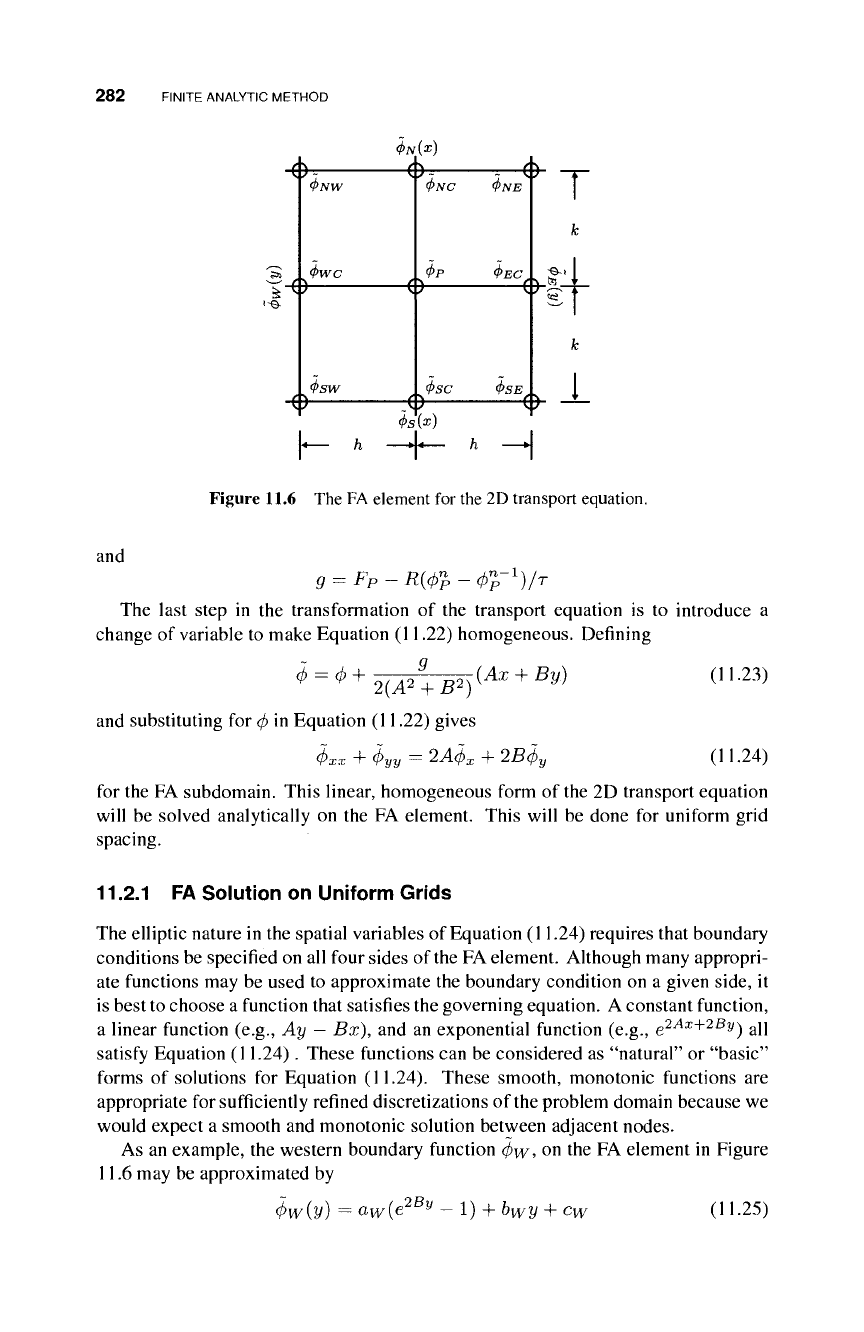
Figure 11.6 The FA element for the 2D transport equation.
and
g = F
P
-R(<t>
n
P
-<t>
n
p
-
1
)/r
The last step in the transformation of the transport equation is to introduce a
change of variable to make Equation (11.22) homogeneous. Defining
9
■
+
-(Ax + By)
2(A
2
+ B
2
)
and substituting for φ in Equation (11.22) gives
Φχχ -f
4>yy
= 2Αφ
χ
+
2B(j)y
(11.23)
(11.24)
for the FA subdomain. This linear, homogeneous form of the 2D transport equation
will be solved analytically on the FA element. This will be done for uniform grid
spacing.
11.2.1 FA Solution on Uniform Grids
The elliptic nature in the spatial variables of Equation (11.24) requires that boundary
conditions be specified on all four sides of the FA element. Although many appropri-
ate functions may be used to approximate the boundary condition on a given side, it
is best to choose a function that satisfies the governing equation. A constant function,
a linear function (e.g., Ay
—
Bx), and an exponential function (e.g.,
e
2Ax
+
2B
v)
a
ll
satisfy Equation (11.24). These functions can be considered as "natural" or "basic"
forms of solutions for Equation (11.24). These smooth, monotonie functions are
appropriate for sufficiently refined discretizations of
the
problem domain because we
would expect a smooth and monotonie solution between adjacent nodes.
As an example, the western boundary function φ\γ, on the FA element in Figure
11.6 may be approximated by
lw(y) = a
w
(e
2By
- 1) + b
w
y + c
w
(11.25)
2D TRANSPORT EQUATION 283
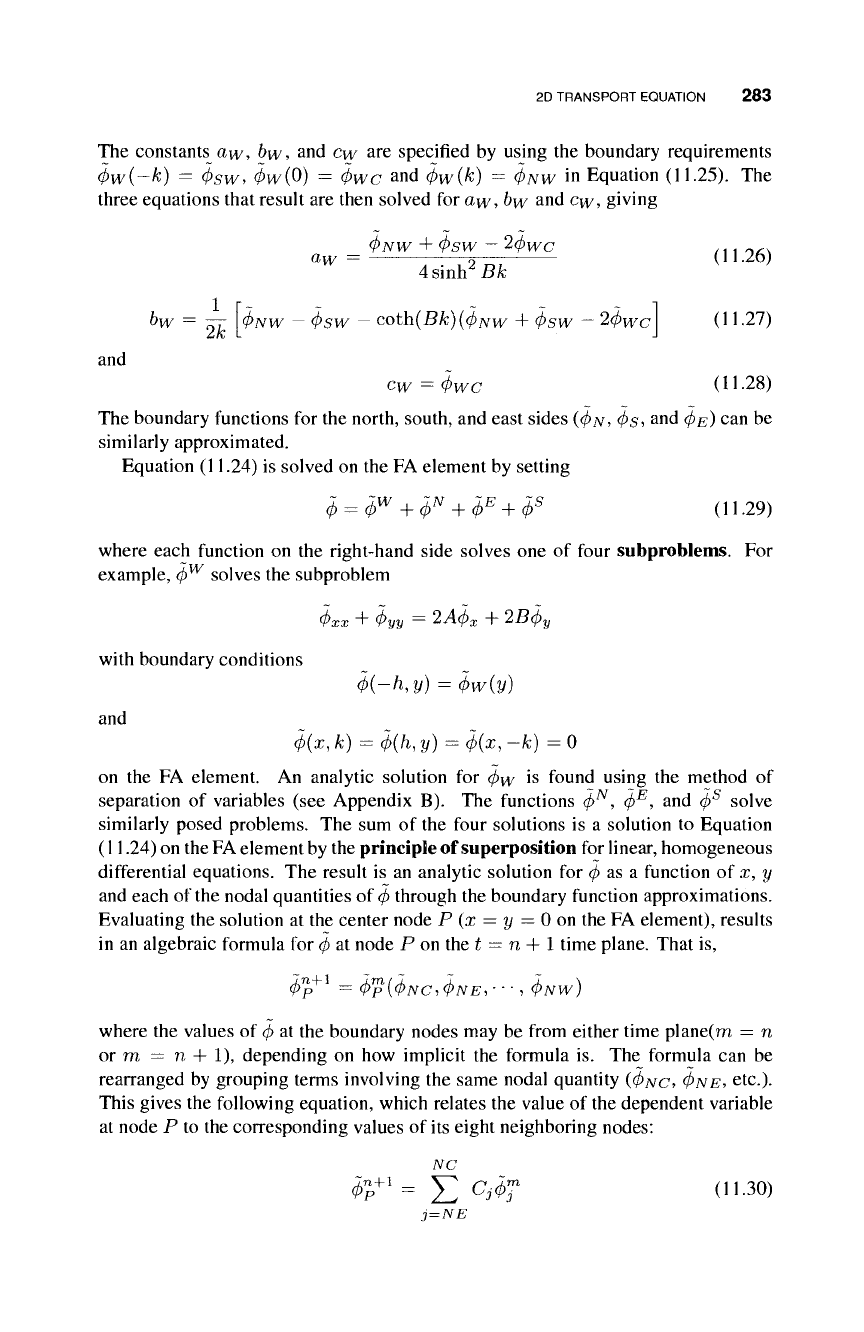
The constants aw, bw, and cw are specified by using the boundary requirements
4>w(—k) =
4>sw,
4>w(0)
— 4>wc and </>ty(fc) =
4>NW
in Equation (11.25). The
three equations that result are then solved for aw, bw and cw, giving
aw
t>N\v
+
<fisw
- 2φ\νο
bw
2k
and
4sinh
2
jBA:
f>NW
-
4>sw
- coth(Bk)((f)
N
w +
4>sw
-
2(¡>wc
Cw =
(¡>WC
(11.26)
(11.27)
(11.28)
The boundary functions for the north, south, and east sides (ΦΝ,
ΦΞ,
and φβ) can be
similarly approximated.
Equation (11.24) is solved on the FA element by setting
ϊ™+φ
Ν
+ φ
Ε
+
<
(11.29)
where each function on the right-hand side solves one of four subproblems. For
example,
(¡)
W
solves the subproblem
+
.
2Αφ
χ
+ 2Βφ
υ
with boundary conditions
4>{-h,y) = 4>w(y)
and
φ(χ, k)
—
φ(Η,
y)
—
φ(χ, —k) = 0
on the FA element. An analytic solution for
(¡>w
is found using the method of
separation of variables (see Appendix B). The functions φ
Ν
, φ
Ε
, and φ
δ
solve
similarly posed problems. The sum of the four solutions is a solution to Equation
(11.24) on the FA element by the principle of superposition for linear, homogeneous
differential equations. The result is an analytic solution for φ as a function of x, y
and each of the nodal quantities of φ through the boundary function approximations.
Evaluating the solution at the center node P (x = y = 0 on the FA element), results
in an algebraic formula for φ at node P on the t = n 4-1 time plane. That is,
Ip
1
ΦΡ{ΦΝΟ,ΦΝΕ>·
^Nw)
where the values of φ at the boundary nodes may be from either time plane(m = n
or m = n -f 1), depending on how implicit the formula is. The formula can be
rearranged by grouping terms involving the same nodal quantity
(<J>NC>
ΦΝΕ, etc.).
This gives the following equation, which relates the value of the dependent variable
at node P to the corresponding values of its eight neighboring nodes:
NC
p
+1
- Σ ^ 3^3
(11.30)
j=NE
284
FINITE ANALYTIC
METHOD
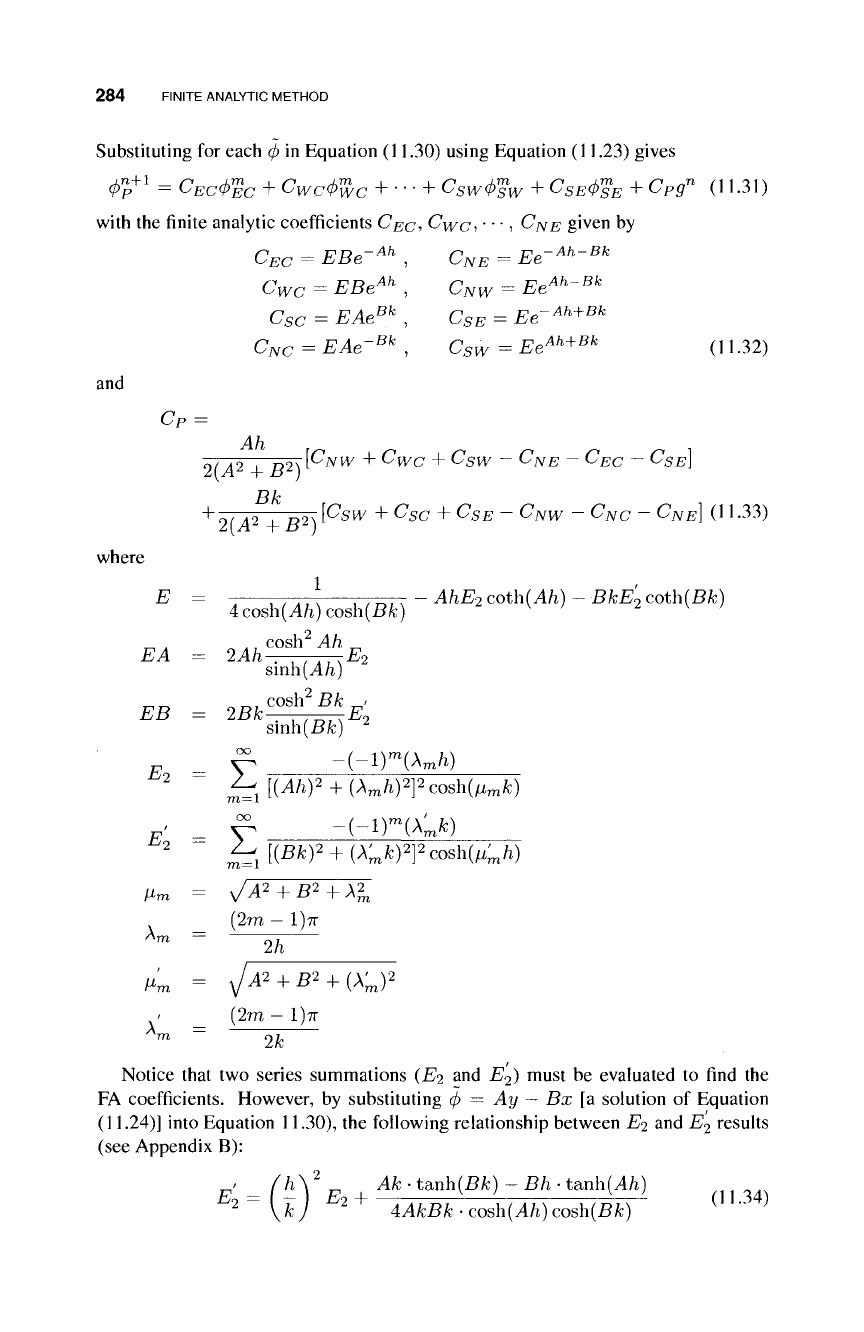
Substituting for each φ in Equation (11.30) using Equation (11.23) gives
Φ^
1
=
ΟΕΟΦΈΟ
+ CwcVbc +
- - ·
+ CswtFSw +
CSEVSE
+
C
P
g
n
(11.31)
with the finite analytic coefficients CEC,
CWCI
' "
·>
CNE given by
C
E
c = EBe~
Ah
, C
NE
= Ee~
Ah
-
Bk
&wc
=
EBe ,
CJSÍW
— Ee
Csc = ^4e
ßfe
, C
5
^ = Ee~
Ah+Bk
C
NC
= EAe~
Bk
, CW = Ee
Ah
+
Bk
(11.32)
and
Cp =
Ah
0( Δ2 ι R2\ [CNW +
CiyC
+ C$W ~ CJSJE ~ CEC ~ CSE]
Bk
+ / ,
2
p
2
x [Cgw + Csc + Cs£
—
Cjviy
—
Cjvc
—
CNE] (11.33)
where
E = - —— ——— - AhE
2
coth( Ah) - BkE
2
coth( Bk)
4 cosh( Ah) cosh(Bk)
v ;
2 v ;
^ . ,, cosh τ4/ι _
smh(Ah)
^^ ~^, cosh
2
Bk t
EB = 2Bk—Γ-τ^ττΕο
sinh(JBfc)
2
E2 = Σ
-(-l)
m
(X
m
h)
'
i
P/i)2 + (A
m
/
1
)
2
]
2
cosh(
Mm
fc)
ü = Σ
-(-ir(A
m
/e)
'
1
[(ßfc)2 + (Ä
m
fc)2]2
cos
h(
Mm
/
l
)
/x
m
= ^
2
+
¿?
2
+ x
2
m
_ (2m - 1)π
(2m - 1)π
A.
2k
Notice that two series summations (E2 and E
2
) must be evaluated to find the
FA coefficients. However, by substituting φ = Ay
—
Bx [a solution of Equation
(11.24)] into Equation 11.30), the following relationship between
E<¿
and E
2
results
(see Appendix B):
F
' - (
h
V
F
, ^ · tanh(gfc) - Bfe
■
tanhjAh)
2
\k)
2
4AkBk-cosh(Ah)cosh(Bk)
K
"
;
2D TRANSPORT EQUATION 285
Hence, only E2 needs to be evaluated numerically, and then E
2
can be found using
Equation(l
1.34).
Additionally, it has been found that for most applications, 10 terms
of the summation are sufficient to achieve an accuracy of 10
-6
.
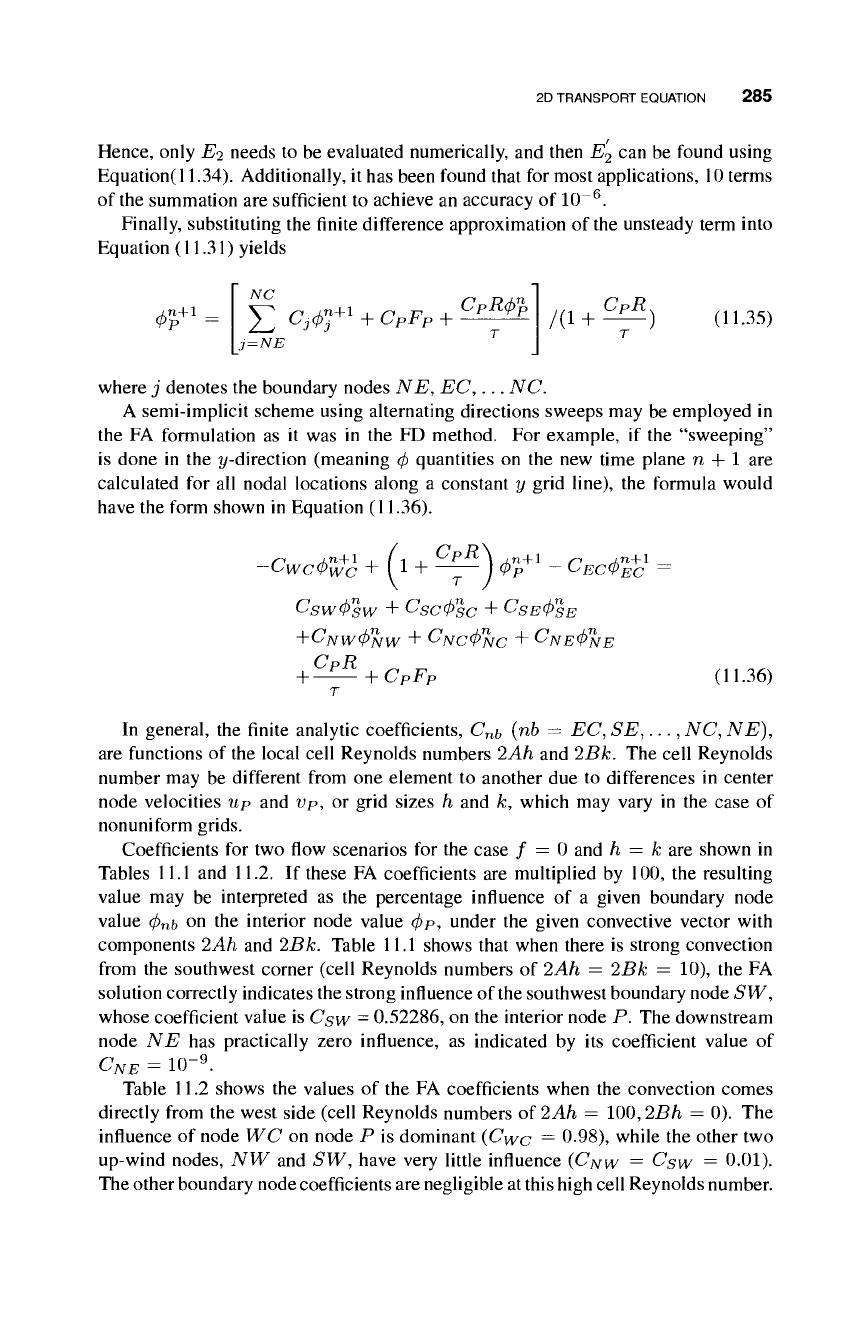
Finally, substituting the finite difference approximation of the unsteady term into
Equation (11.31) yields
b
P
+1
Σ c^r
1
+C
P
F
P
+^^
3 = NE
/(1 + ^) (11.35)
where j denotes the boundary nodes NE, EC,... NC.
A semi-implicit scheme using alternating directions sweeps may be employed in
the FA formulation as it was in the FD method. For example, if the "sweeping"
is done in the ^/-direction (meaning φ quantities on the new time plane n + 1 are
calculated for all nodal locations along a constant y grid line), the formula would
have the form shown in Equation (11.36).
-CwC</>wc + (
1 H
~ ) ^P
+1
~
C
EC<\>
n
E~C
=
-\-&Ν\νφ
7
Ν\ν +
^ΝΟΦ'ΝΟ
+
^'ΝΕΦ'ΝΕ
4-^^+CpFp (11.36)
r
In general, the finite analytic coefficients, C
n
b (nb = EC, SE,..., NC, NE),
are functions of the local cell Reynolds numbers 2Ah and 2Bk. The cell Reynolds
number may be different from one element to another due to differences in center
node velocities up and vp, or grid sizes h and k, which may vary in the case of
nonuniform grids.
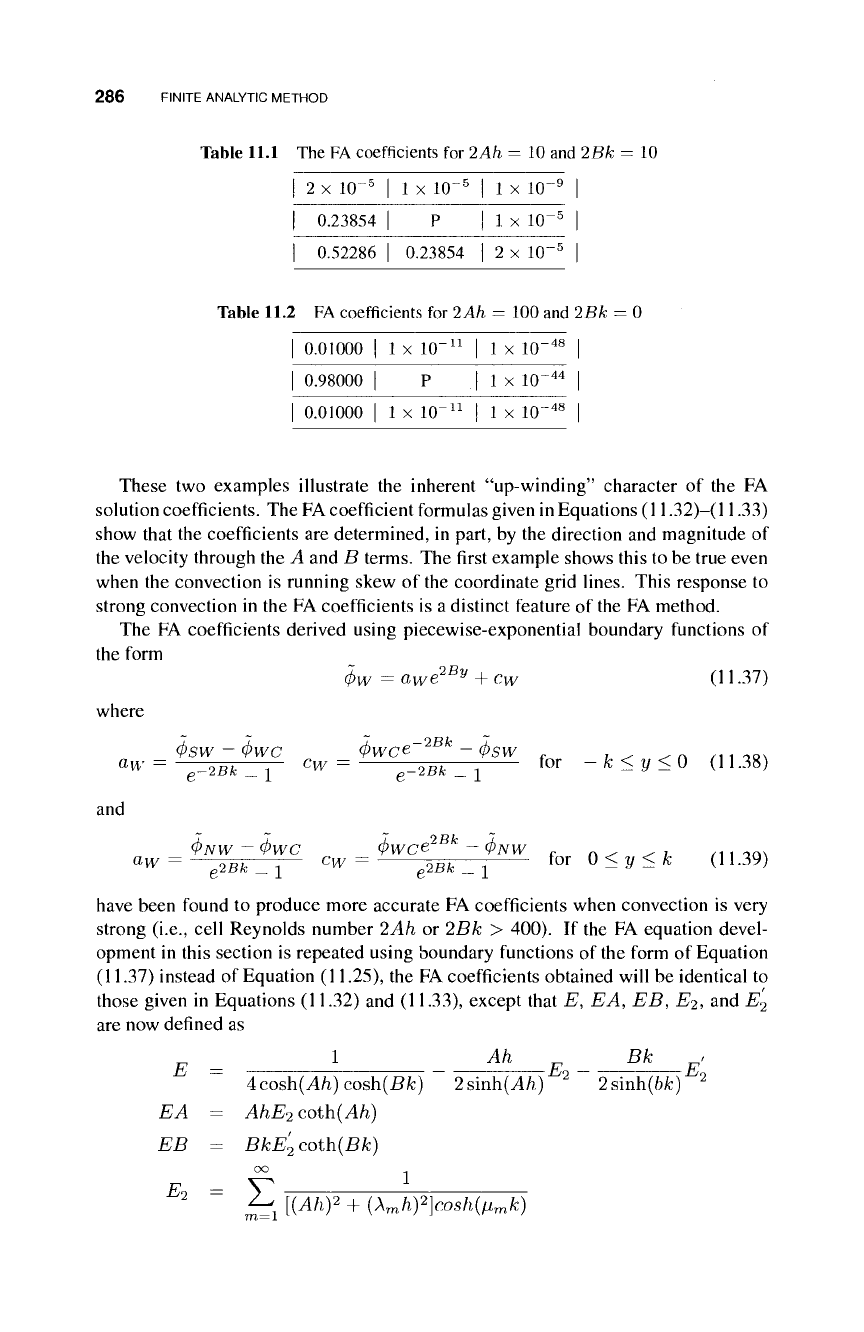
Coefficients for two flow scenarios for the case / = 0 and h = k are shown in
Tables 11.1 and 11.2. If these FA coefficients are multiplied by 100, the resulting
value may be interpreted as the percentage influence of a given boundary node
value
φ
η
ι>
on the interior node value φρ, under the given convective vector with
components 2Ah and 2Bk. Table 11.1 shows that when there is strong convection
from the southwest corner (cell Reynolds numbers of 2Ah = 2B k = 10), the FA
solution correctly indicates the strong influence of
the
southwest boundary node SW
9
whose coefficient value is Csw = 0.52286, on the interior node P. The downstream
node NE has practically zero influence, as indicated by its coefficient value of
C
NE
= IO-
9
.
Table 11.2 shows the values of the FA coefficients when the convection comes
directly from the west side (cell Reynolds numbers of 2Ah = 100,2Bh — 0). The
influence of node WC on node P is dominant (Cwc — 0.98), while the other two
up-wind nodes, NW and SW, have very little influence (CNW = Csw — 0.01).
The other boundary node coefficients are negligible at this high cell Reynolds number.
286 FINITE ANALYTIC METHOD
Table 11.1 The
FA
coefficients for 2Ah = 10 and 2Bk =
10
| 2
x
10~
5
|
1
x
10~
5
|
1
x
10~
9
|
I 0.23854
| P |
1
x
10~
5
|
| 0.52286
|
0.23854
|
2
x
10~
5
|
Table 11.2
FA
coefficients for 2Ah = 100 and 2Bk =
0
0.01000
|
1
x
10"
11
|
1
x
10~
48
0.98000
| P |
1
x
10~
44
0.01000
I
1
x
10"
11
|
1
x
10"
48
These
two
examples illustrate
the
inherent "up-winding" character
of
the
FA
solution coefficients. The FA coefficient formulas given in Equations (11.32)—(11.33)
show that the coefficients are determined, in part, by the direction and magnitude of
the velocity through the
A
and
B
terms. The first example shows this to be true even
when the convection
is
running skew
of
the coordinate grid lines. This response
to
strong convection in the FA coefficients is a distinct feature
of
the FA method.
The FA coefficients derived using piecewise-exponential boundary functions
of
the form
4>w
=a
w
e
2By
+ c
w
(11.37)
where
4>sw-4>wc 4>wce~
2Bk
-4>sw
ç
, . .
n nl
.n,
a
*'
=
e
-2Bk_
1
°w =
e
-2Bk
_ !
for
~
k
<y<Q (H-38)
and
4>NW -
4>wc
4>wce
2Bk
- 4>NW ,
n
, . j
nnm
a
W
=
e
2Bk
_ !
C
^ =
e
2Bk
_ !
f0r
°<y<
k
(H·
39
)
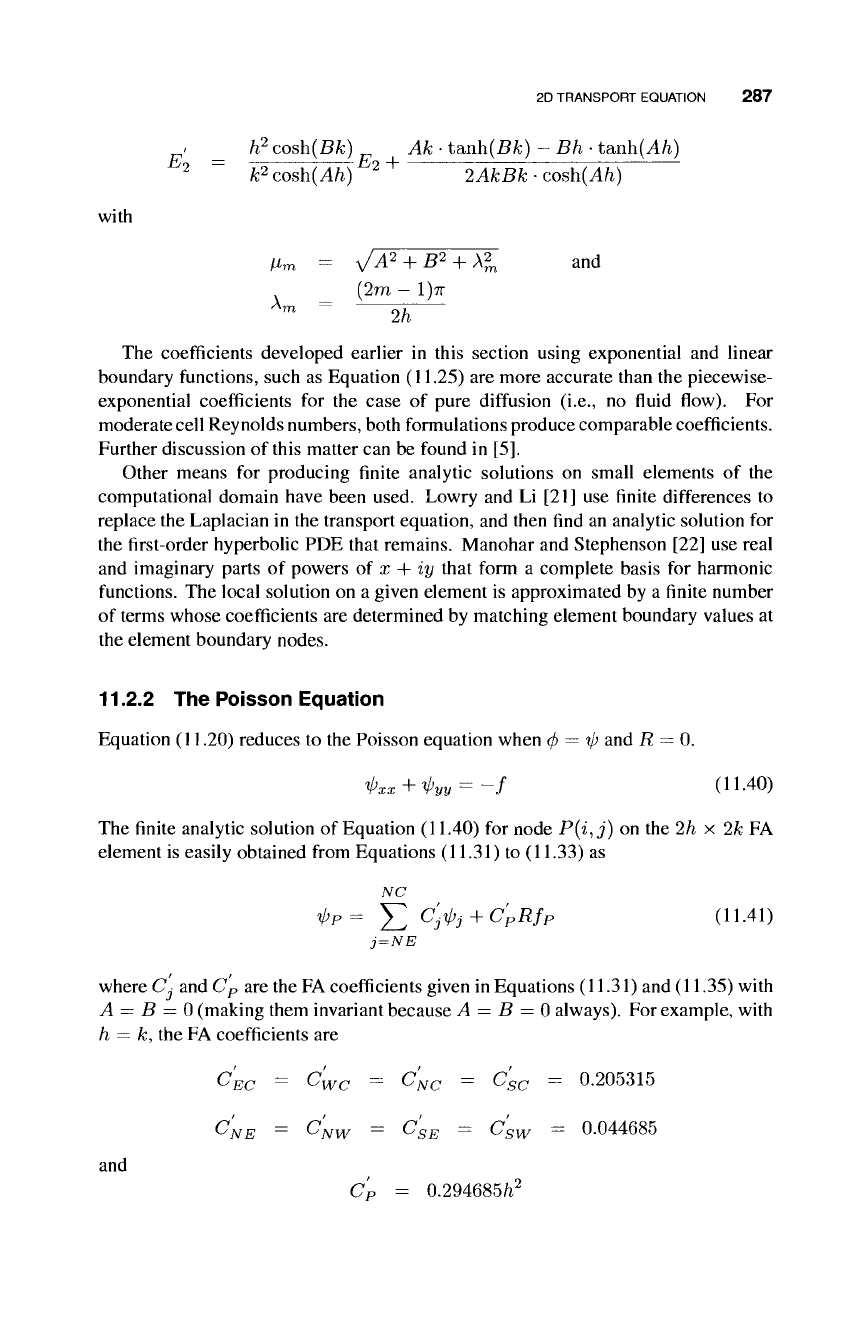
have been found to produce more accurate FA coefficients when convection
is
very
strong (i.e., cell Reynolds number
2Ah or 2Bk >
400).
If
the FA equation devel-
opment in this section is repeated using boundary functions of the form of Equation
(11.37) instead of Equation (11.25), the FA coefficients obtained will be identical
to
those given
in
Equations (11.32) and (11.33), except that
E, EA, EB, E
2
,
and
E
2
are now defined as
E
=
1 Ah _ Bk .
Acosh(Ah)cosh(Bk) 2sinh(A/i)
2
2sinh(Wfe)
2
EA
=
AhE
2
coth(Ah)
EB
=
BkE
2
coth(Bk)
E,
= Σ
; {(Ah)
2
+
(X
m
h)
2
]cosh(ß
m
k)
2D TRANSPORT EQUATION 287
/ _ h
2
cosh(Bk) Ak · tcinh(Bk) - Bh · tanh(Aft)
2
~ k
2
cosh(Ah)
2+
2AkBk · cosh(Ah)
with
/i
m
=
yjA
2
+ B
2
+ X
2
m
and
_ (2m - 1)π
m
" 2h
The coefficients developed earlier in this section using exponential and linear
boundary functions, such as Equation (11.25) are more accurate than the piecewise-
exponential coefficients for the case of pure diffusion (i.e., no fluid flow). For
moderate cell Reynolds numbers, both formulations produce comparable coefficients.
Further discussion of this matter can be found in [5].
Other means for producing finite analytic solutions on small elements of the
computational domain have been used. Lowry and Li [21] use finite differences to
replace the Laplacian in the transport equation, and then find an analytic solution for
the first-order hyperbolic PDE that remains. Manohar and Stephenson [22] use real
and imaginary parts of powers of x + iy that form a complete basis for harmonic
functions. The local solution on a given element is approximated by a finite number
of terms whose coefficients are determined by matching element boundary values at
the element boundary nodes.
11.2.2 The Poisson Equation
Equation (11.20) reduces to the Poisson equation when φ = φ and R = 0.
The finite analytic solution of Equation (11.40) for node P(i,j) on the 2h x 2k FA
element is easily obtained from Equations (11.31) to (11.33) as
NC
Ψ?= Σ
Cjuj+CpRfp
(11.41)
3=NE
where
C¿
and C
P
are the FA coefficients given in Equations (11.31) and (11.35) with
A = B = 0 (making them invariant because A = B = 0 always). For example, with
h
—
k, the FA coefficients are
CEC
— C
wc
— C
NC
= C
sc
= 0.205315
C
NE
=
C
NW =
C
SE =
c
sw = 0.044685
and
C
P
= 0.294685ft
2
288 FINITE ANALYTIC METHOD
EXAMPLE 11.2 Poisson's Equation
The finite analytic method is used to solve the Poisson problem shown in BVP
(11.42).
A uniform grid spacing in x and y oí h
—
0.05 was used.
BVP
-V
2
u(x, y) = -2{y{l - y) + x(l - x)) (PDE)
u(x,2/)|an=0 (BC)
(11.42)
The true solution to this BVP is u(x, y) = (x
—
x
2
)(y
—
y
2
), and is used to
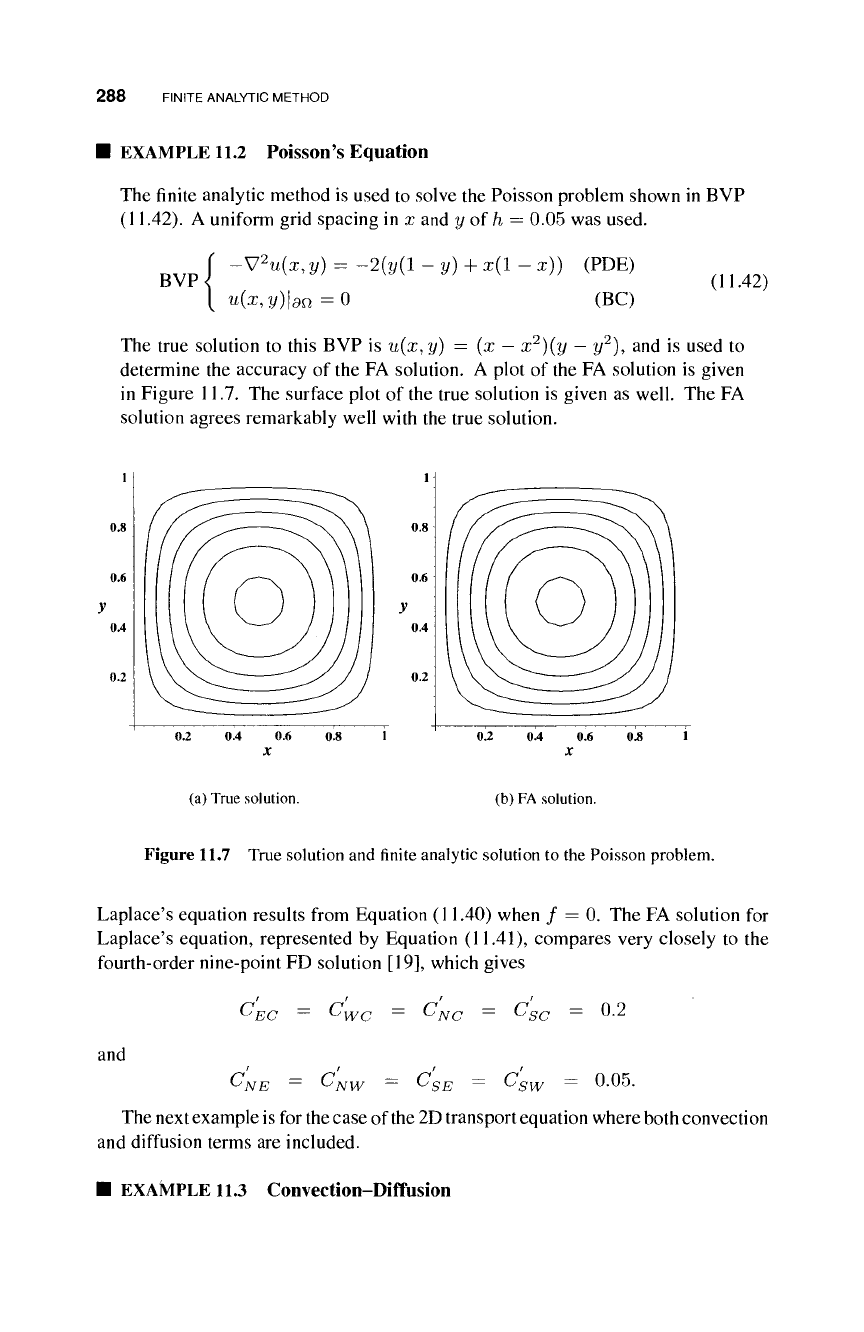
determine the accuracy of the FA solution. A plot of the FA solution is given
in Figure 11.7. The surface plot of the true solution is given as well. The FA
solution agrees remarkably well with the true solution.
0.2 0.4 0.6 0.8
x
0.8
0.2 0.4 0.6 0.8 1
X
(a) True solution. (b) FA solution.
Figure 11.7 True solution and
finite
analytic solution to the Poisson problem.
Laplace's equation results from Equation (11.40) when / = 0. The FA solution for
Laplace's equation, represented by Equation (11.41), compares very closely to the
fourth-order nine-point FD solution [19], which gives
C
EC
C
}
wc
C
NC
c
sc
and
C
NE
c
NW
c
SE
c,
sw
0.2
0.05.
The next example is for the case of the 2D transport equation where both convection
and diffusion terms are included.
■ EXAMPLE 11.3 Convection-Diffusion
2D TRANSPORT EQUATION 289
The example solved here is for the case of heat transfer with both convection
and diffusion terms in the equation, as in Equations (11.20). The domain is
the unit square with homogeneous Dirichlet boundary conditions on each of
the four boundaries. The source term f(x,y) is defined as zero for all pairs
(x,
y) except for the square region given by [0.4, 0.6] x [0.4, 0.6] where it
has the constant value of 1. The velocity field components u and v, which
appear in the convective terms in Equation (11.20), are constant with the added
characteristic of u
—
v.
The domain is partitioned into uniform square elements of width 0.05. Be-
cause the source term and velocity components are constant in time, there exists
a steady-state solution. Three separate cases are considered in the example.
x x
0 0.2 0.4 0.6 0.8 l 0 02 0.4 0.6 0.8 l
1
0.8
0.4
02
1
0.8
0.6
0.4
0.2
0
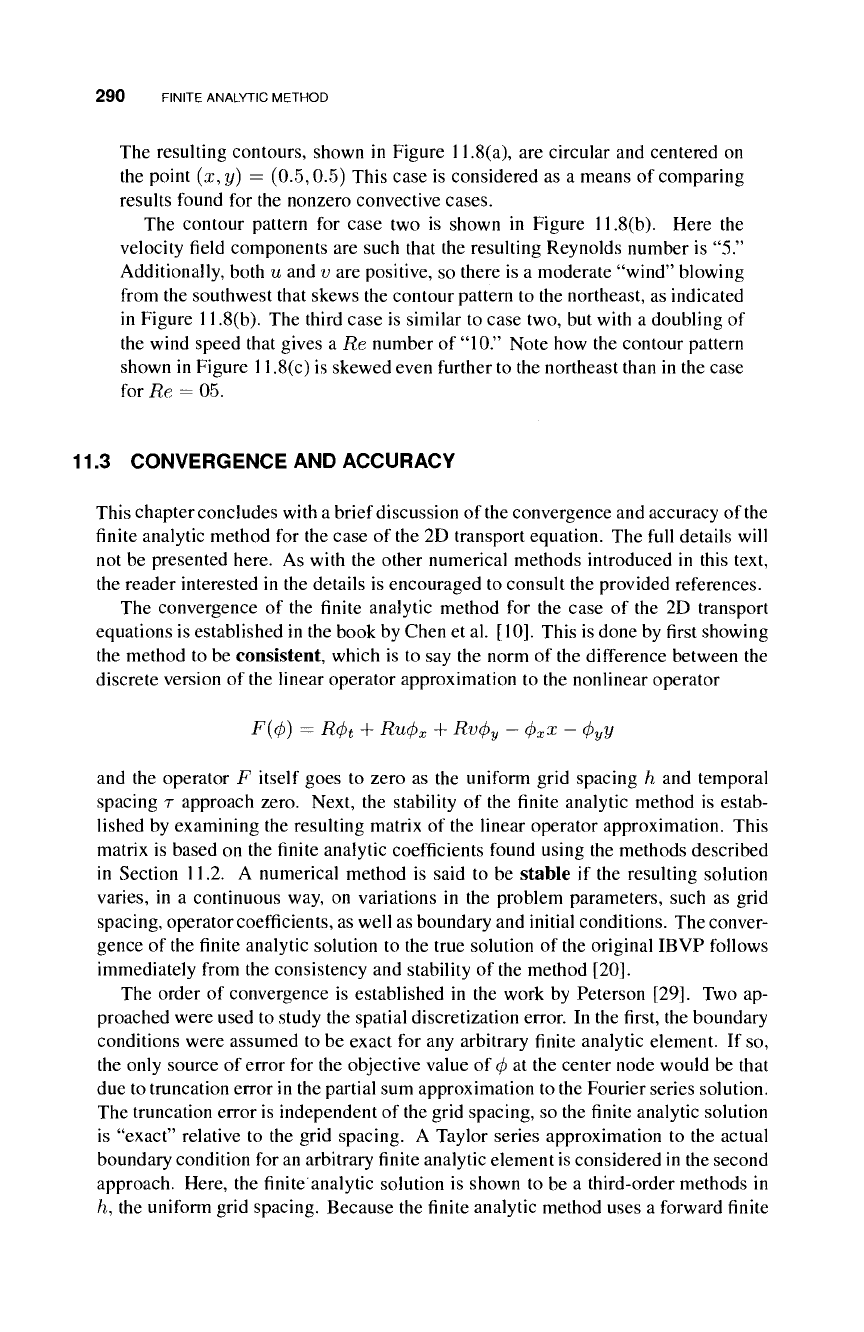
(a) Re
=
0 (b) Re
=
5
0 0.2 0.4 0.6 0.8 1
1
0.2
0
(c)Re= 10
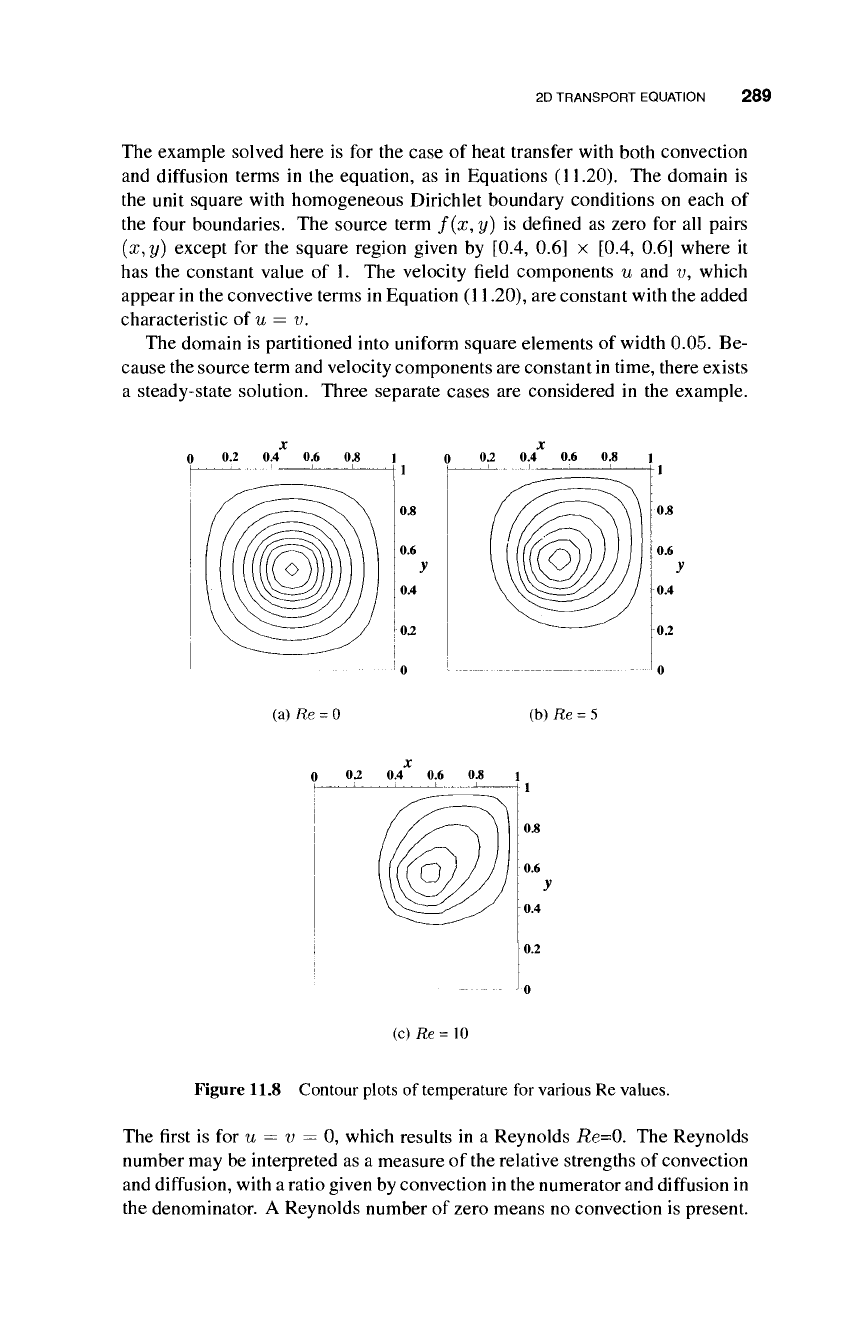
Figure 11.8 Contour plots of temperature for various Re values.
The first is for u = v = 0, which results in a Reynolds Re=0. The Reynolds
number may be interpreted as a measure of the relative strengths of convection
and diffusion, with a ratio given by convection in the numerator and diffusion in
the denominator. A Reynolds number of zero means no convection is present.
290 FINITE ANALYTIC METHOD
The resulting contours, shown in Figure 11.8(a), are circular and centered on
the point (x, y) = (0.5,0.5) This case is considered as a means of comparing
results found for the nonzero convective cases.
The contour pattern for case two is shown in Figure 11.8(b). Here the
velocity field components are such that the resulting Reynolds number is "5."
Additionally, both u and v are positive, so there is a moderate "wind" blowing
from the southwest that skews the contour pattern to the northeast, as indicated
in Figure 11.8(b). The third case is similar to case two, but with a doubling of
the wind speed that gives a Re number of
"10."
Note how the contour pattern
shown in Figure 11.8(c) is skewed even further to the northeast than in the case
for Re = 05.
11.3 CONVERGENCE AND ACCURACY
This chapter concludes with a brief discussion of
the
convergence and accuracy of the
finite analytic method for the case of the 2D transport equation. The full details will
not be presented here. As with the other numerical methods introduced in this text,
the reader interested in the details is encouraged to consult the provided references.
The convergence of the finite analytic method for the case of the 2D transport
equations is established in the book by Chen et al. [10]. This is done by first showing
the method to be consistent, which is to say the norm of the difference between the
discrete version of the linear operator approximation to the nonlinear operator
F(</>)
=
R<t>
t
+ Ru(f)
x
+
Rv<t>y
- φ
χ
χ - φ
υ
ν
and the operator F itself goes to zero as the uniform grid spacing h and temporal
spacing r approach zero. Next, the stability of the finite analytic method is estab-
lished by examining the resulting matrix of the linear operator approximation. This
matrix is based on the finite analytic coefficients found using the methods described
in Section 11.2. A numerical method is said to be stable if the resulting solution
varies, in a continuous way, on variations in the problem parameters, such as grid
spacing, operator coefficients, as well as boundary and initial conditions. The conver-
gence of the finite analytic solution to the true solution of the original IBVP follows
immediately from the consistency and stability of the method [20].
The order of convergence is established in the work by Peterson [29]. Two ap-
proached were used to study the spatial discretization error. In the first, the boundary
conditions were assumed to be exact for any arbitrary finite analytic element. If so,
the only source of error for the objective value of φ at the center node would be that
due to truncation error in the partial sum approximation to the Fourier series solution.
The truncation error is independent of the grid spacing, so the finite analytic solution
is "exact" relative to the grid spacing. A Taylor series approximation to the actual
boundary condition for an arbitrary finite analytic element is considered in the second
approach. Here, the finite analytic solution is shown to be a third-order methods in
h,
the uniform grid spacing. Because the finite analytic method uses a forward finite
EXERCISES
291
difference
in
time
to
approximate
the
temporal derivative,
the
resulting convergence
is first order
in r.
Earlier work
by
Vanka
[31]
explored, experimentally,
the
accuracy
of the
finite
analytic method through calculations
of
multidimensional scalar transport.
The
velocity field
was
assumed
to be
uniform
and
directed
in a
skewed fashion
to the
grid lines. Results showed
the FA
method
to be
superior
to
results found
by
finite
difference methods.
The FA
method
did
show appreciable error
is
regions
of
steep
gradients, large grid Peclet numbers,
and
cases
of
skewed flow streamlines.
The
difficulty with steep gradients
is
usually overcome with increases nodal density
in
the direction
of
the gradient (perpendicular
to
physical boundaries, e.g.). Instead
of
using uniform grid with higher density throughout
the
domain,
it is
more efficient
to
use non-uniform spacing. Consequently,
the
finite analytic coefficient formulas
are
derived
for
such nonuniform spacing.
The
reader
is
referred
to
Chen
et al. [6] for
details
on the
method
for
nonuniform grids.
EXERCISES
11.1 Provide
the
details
in
transforming Equation (11.1) into
its
nondimensional
form, given
in
Equation (11.2), through
the use of
reference quantities
T, L, and Φ
for time, length,
and the
scalar quantity
φ,
respectively.
11.2 Using
the
change
of
variable
r
. (2Ax + Bt)F
Φ
= Φ
~ 4Α1 + Β*
show that Equation (11.4) results from Equation (11.3).
11.3 Use the hybrid FA method present in Section 11.1.3
to
solve Berger's equation
as presented
in
Section 11.1.
Use a
uniform spatial grid with
h =
0.01
and a
step size
of
r =
0.1.
Compare your results with those presented
in
Section 11.1.
11.4 Figure
11.9
shows
the
problem domain
for a
general
2D
Laplace
BVP on a
rectangular domain.
The
four boundary conditions
of
various types are prescribed
in
each of the exercises below. Solve each of the examples using an appropriate software
application. Your solution must include
(i) a
specification
of
all subproblems whose
sum equals
the
original
BVP, (ii) a
contour plot
of the
steady-state temperature
surface,
(iii)
plots that verify each
of the
four
BCs are
satisfied,
and (iv) the
value
W{c/2,d/2).
a)
c = 1, d
=
1,
BC1:
W = 0,
BC2:
W
x
=
0,
BC3:
W = x(l - x), BC4:
W
x
=0
b)
c
=
1, d
=
1,
BC1:
-W
y
+ W
=
0,
BC2:
W
=
0,
BC3:
W = x(l - x),
BC4:
W = 0
c) c=l,d=l,BCl:
-W
y
+ W
=
0,BC2:
W =
0,BC3:
W
y
+ W = x,
BC4:
W
x
=0
d)
c
=
1, d
=
1,
BC1:
-W
y
= x - \,
BC2:
W
=
0,
BC3:
W
y
= 0, BC4:
W
x
=0