
Bernatz R. Fourier Series and Numerical Methods for Partial Differential Equations
Подождите немного. Документ загружается.

292 FINITE ANALYTIC METHOD
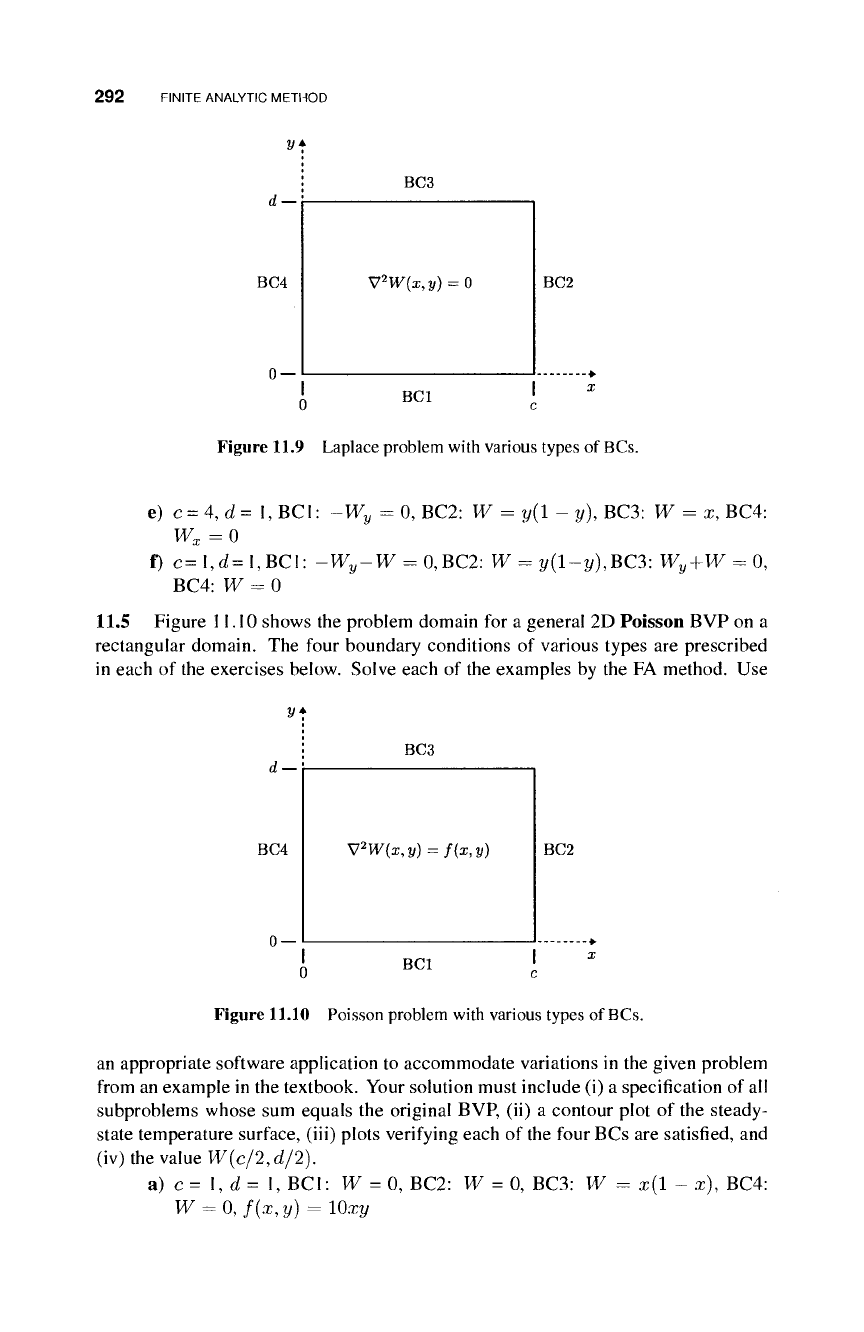
y
+
BC4
BC3
V
2
W(x,y)
= 0
BC1
BC2
Figure 11.9 Laplace problem with various types of
BCs.
e) c = 4,d= 1,BC1: -W
y
= 0, BC2: W = y (I - y), BC3: W = x, BC4:
f)
c
=l,d=l,BCl: -W
y
-W = 0,BC2: W = 2/(l-y),BC3:
W
y
+W
= 0,
BC4:
W = 0
11.5 Figure 11.10 shows the problem domain for a general 2D Poisson BVP on a
rectangular domain. The four boundary conditions of various types are prescribed
in each of the exercises below. Solve each of the examples by the FA method. Use
y+
BC4
BC3
V
2
W(x,y)
= f(x,y)
BC1
BC2
Figure 11.10 Poisson problem with various types of
BCs.
an appropriate software application to accommodate variations in the given problem
from an example in the textbook. Your solution must include (i) a specification of all
subproblems whose sum equals the original BVP, (ii) a contour plot of the steady-
state temperature surface, (iii) plots verifying each of the four BCs are satisfied, and
(iv) the value W{c/2,d/2).
a) c
=
1, d = 1, BC1: W = 0, BC2: W = 0, BC3: W = x(l - x), BC4:
W =
0,f(x,y)
= 10xy
EXERCISES 293
b) c
=
1, d = 1, BC1: W = 0, BC2: W
x
= 0, BC3: W = x(l - x), BC4:
jy
x
=0,/(x,y) = 5x + 5y
c) c = 1, d = 1, BC1: W = x, BC2: W
x
= 0, BC3: W = 0, BC4:
-W
x
+ W = 0,/(x,y) = 10xy
d) c = 2, d = 1, BC1: W = 0, BC2: W
x
= y - |, BC3: VF = 0, BC4:
W
x
=0,/(x,y) = x(2-x)
e) c= l,d= 1,BC1: W = 0, BC2: W^ = 0, BC3: W* = 0, BC4: W
x
= 0,
/(x,y) = 10(x-±)(±-y)
11.6 The general 2D IBVP for heat transfer is shown below. Unless stated oth-
erwise, assume a(x,y,¿), /(x,y), a
l9
a
2
, .·., di, d
2
, gi(x,t),...,g
4
(y,t) are all
zero.
Use an appropriate software application to solve the following IBVP by the FA
method. Include a 3D plot of u(x, y, 0), u(x, y, 2), and the limiting (steady-state)
temperature field if it exists.
u
t
(x, y, t) = kV
2
u(x, y, t) + g(x, y, t)
u(x,y,0) = f(x,y)
IBVP<
(PDE)
(IC)
ait¿(x,0, t) + a
2
u
y
(x,0,t) = gi(x,t) 0<x<c (BC1)
biu(c, y, t) + b
2
u
x
(c, y, t) = g
2
(y, t) 0 < y < d (BC2)
c\u(x,d,
t) +
c
2
u
y
(x,d,
t)
—
gs(x,t) 0<x<c (BC3)
diu(0,y,t)+d
2
Mx(0,y,í) = <7
4
(í/,í) 0<y<d (BC4)
a) c = 1, d = 2, k = 0.1, f(x,y) = x H- y, ai = &i = ci = di = 1,
#2(2/,
¿) = 2/(2 - y), 03(z, ¿) = z(l - a).
b) c = 1, d = 1, k = 0.2, g(x, y, t) = 100#
[0
.
4
,ο.6]
χ [0.4,0.6]
0,2/), /(s,
2/)
= 0,
ai = &ι = ci =di = l,g
2
(y,t) = 2/(1 -y),gz{x,t) = x(l -x).
c) c= 1, d= 1,
fc
= 0.2, ai = 1, a2 =
&2
=
C2
= d2 = 1 92(y,t)
—
sin t.
d) c = 1, d = 1, fc = 0.01, /(x,y) = 2, -a
x
= &i = ci = -di = 1,
¿2 =
¿>2
= c
2
= d
2
= 0.2 g
2
(y, t) = 1.
e) c= 1, d= 1, k = 0.2, q(x,y,t) = ¿ï[o.4,o.6]x[o.4A6](s,y)sin(§t), a
2
=
&i = C2 = di = 1
11.7 Use the FA method to solve the following 2D transport problem. Include a
3D plot of
</>(x,
y, 0), φ(χ, y, 2), and the limiting (steady-state) temperature field if it
exists.
Take each parameter below to be zero unless otherwise specified.
IBVP<
Φί
+
ν>φ
χ
+ νφ
υ
= W
2
</> + g(x, y, t)
0(x,y,O) = /(x,y)
αι^(χ,Ο,ί) + a
2
</>
2/
(x,0,¿) = yi(x,¿)
bi<¡)(c,
y, t) +
&2<Mc,
2/,
¿) =
02(2/,
i)
ci0(x, d, t) +
ο
2
φ
υ
(χ,
d, t) = y
3
(x, t)
di0(O,y,¿) +d
2
0x(O,y,t) = ^4(2/,*)
(PDE)
(IC)
0 < x < c (BC1)
0 < y < d (BC2)
0 <x < c
0<y <d
(BC3)
(BC4)
a) c = 1, d = 2, t¿=0.2, fc = 0.1, g(x, y,
£)
= x + y, ai = b\
—
c\
—
d\ — 1.
b) c = 1, d = 2, u=0.2, v = -0.2, fc = 0.05, /(x, y, t) - (x - x
2
)(y - y
2
),
«1 = &2 = ci = d2 = 1.

This Page Intentionally Left Blank
APPENDIX A
FA 1D CASE
The finite analytic solution for the ID transport equation,
φ
χχ
= 2Αφ
χ
+ Βφ
ι
(A.l)
is detailed in this appendix. For the one-time step formulation, the initial condition
φι and boundary conditions, φ\γ and
ΦΕ
are
φ(χ, 0) = φ!(χ) = a
s
(e
2Ax
- 1) + b
s
x + c
s
(A.2)
φ(—h,t) = φνν(ί)
— a>w
+ bwt (A.3)
and
where
0(ft,
¿)
= <M¿) = α
£
(ί) = a
E
4- M (A.4)
as — O
4 sinrT Aft
cs = ΦΞΟ
t>SE
-
ΦΞνν
- coth AhtysE + <?W - 205c)
2ft
Fourier Series and Numerical Methods for Partial Differential Equations, 295
First Edition. By Richard Bernatz
Copyright © 2010 John Wiley & Sons, Inc.
bs
296 FA 1D CASE
r
&E = ΦβΕ
_ ΦΕΟ -
ΦβΕ
aw = Çsw
, 0W/C* -
4>SW
b
w
and
&£
τ
With the introduction of a change of variable
0 = we
Ax
~^
1
the convective transport Equation (A.l), Initial Condition (A.2), and Boundary Con-
ditions (A.3) and (A.4) are transformed to
w
xx
= Bw
t
(A.5)
w(x, 0) = a
s
e
Ax
+ b
s
xe~
Ax
+ (c
s
- a
5
)e"
A:E
= </>(x) (A.6)
w{-h,
t) = e-
AhJr
^
l
{aw + b
w
t) = </>w(¿) (Α.7)
w(h,
t) = e-
Ah
+^\a
E
+ b
E
t) = <M¿) (Α.8)
The solution of Equation (A.5) for w can be obtained by superposition of solutions
w
—
wl + w% where wl solves
(A.9)
(A. 10)
(A.11)
(A. 12)
and iu2 solves
(A. 13)
(A.
14)
(A. 15)
(A. 16)
The solution wl is obtained using the method of separation of variables. Assuming
wl = X(x)T(t), and substituting for wl in Equation (A.9), we may separate the
variables as
x"
τ'
— = B-— = constant = -λ
2
(A.
17)
X x
Two ordinary differential equations result for Equation
(A.
17),
X"+X
2
X
= 0
(A.
18)
\2
Γ +—Τ = 0 (A.19)
JD
Wlxx =
wl(x,0) =
wl(-M) =
wl(h,t) =
WZ
XX
-
w2(x,0) --
w2(-h,t) =
w2(ft,t) =
= ß.wlt
= ΦΙ(Χ)
= 0
= 0
= B
·
w2
t
= 0
= <l>w(t)
= <M¿)
FA 1D CASE
297
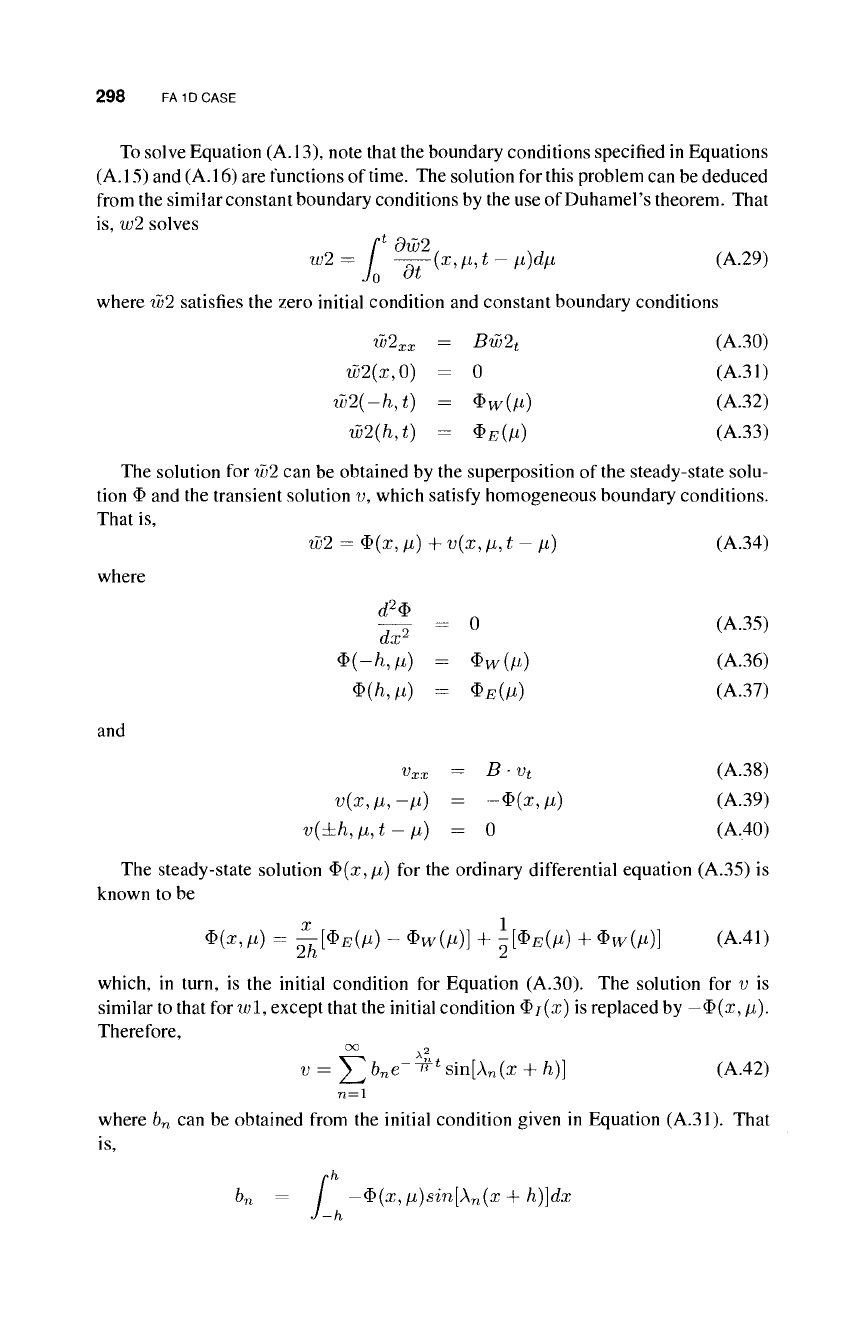
with boundary conditions on
X
given by
X(-h) = X{h) = 0 (A.20)
The boundary conditions specified in Equation (A.20) stipulate solution to Equation
(A.
18)
having form
X(x) = a
n
sin[A
n
(x 4- h)] (A.21)
where λ
η
= ^
(n
=
1,2, 3,... ). The solution to Equation
(A.
19)
has the form
T{t)=b
n
e-^
t
(A.22)
Using the principle of superposition, the general solution for wl can be written as
oo
0
wl(x,t)
=
2^a
n
e""ß"
i
sin[A
n
(x
+
/i)] (A.23)
n=l
where the coefficients a
n
can be determined by applying the initial conditions given
in Equation
(A.
10)
as
oo
wl(x,0)
=
Φ(χ) =
Σ
αη
sin
t
A
n(^
+
h)] (A.24)
n=l
Invoking the orthogonality condition of
the
sine function, this initial condition results
1
f
h
-
/
Φ(χ) sin[A
n
(x 4- h)]da
"
J-h
-h
asEon
+
b
s
hE
ln
4- (c
5
-
as)£2n (Α.25)
where
1
/
,/l
E
0n
= -
e
Ax
sm[X
n
(x + h)]dz
n
J-h
;[e-
Ah
-(-l)
n
e
Ah
] (A.26)
^nh
t.-Ah (
Λ
\η„ΑΗΛ
(Ah)
2
+
(X
n
h)
2
'
1
/"
Ei
n
— T2 I
xe~
Ax
sm[\
n
(x + h)]dx
(_1)«
β
-
ΛΛ
]
2(Ah)(X
n
h
Ah t
Λλη
^
ΑΗλ
(Ah)
2
+
(X
n
h)
2[
[e
Ah
+
(-l)
n
e-
Ah
]
(A.27)
^n,h
,Ah , i
-¡\n-Ahi
(Ah)
2
+
(X
n
h)
2
1
f
h
E2n
= T /
e"
Ax
sin[A
n
(a: 4- ft)]cte
λτιΛ
[e
Ah
-
(-l)
n
e-
Ah
]
(A.28)
μΛ)2
+
(λ
η
Λ)
21
298 FA 1D CASE
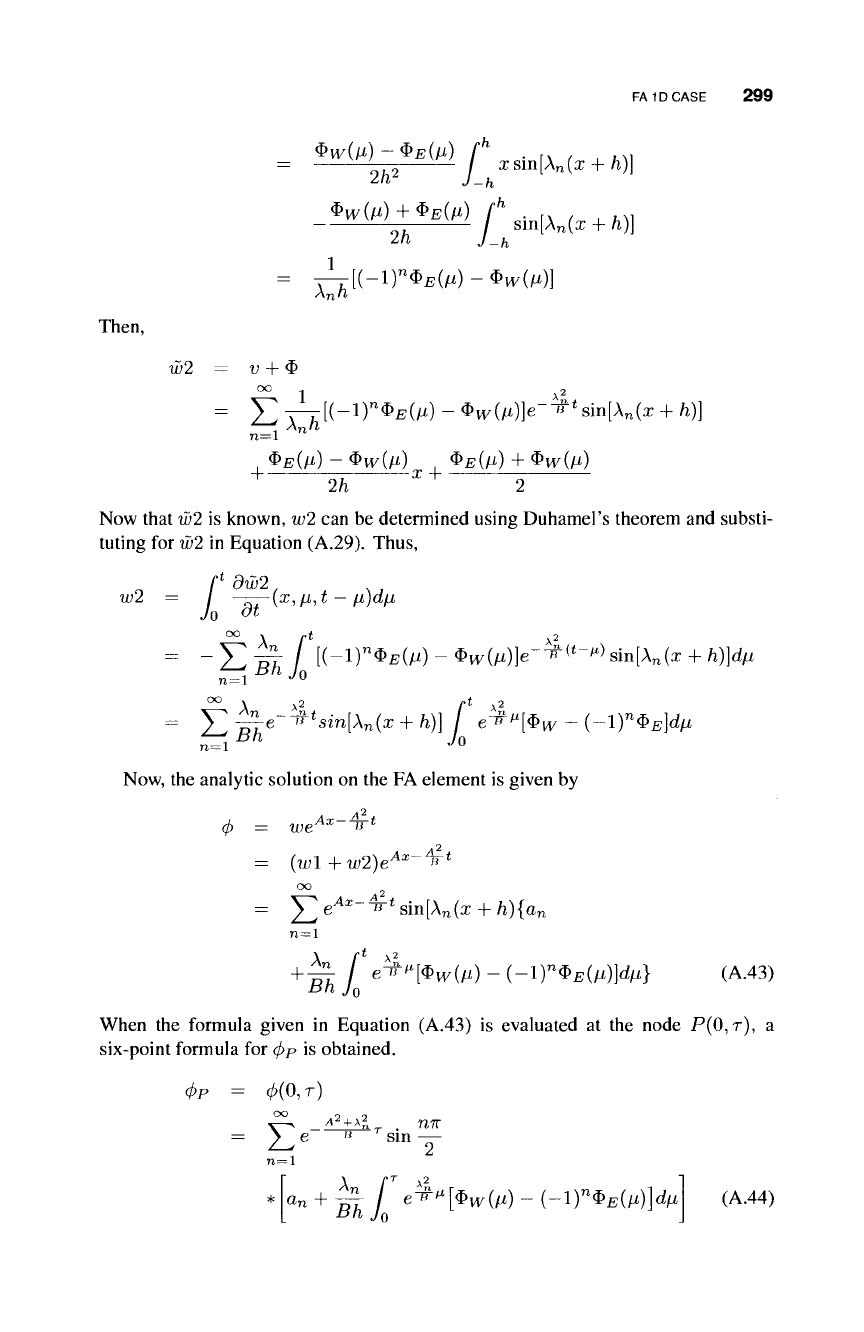
To solve Equation
(A.
13),
note that the boundary conditions specified in Equations
(A.
15)
and
(A.
16)
are functions of
time.
The solution for this problem can be deduced
from the similar constant boundary conditions by the use of Duhamel's theorem. That
is,
w2 solves
w2 = [ -J^ (x, μ, t - μ)άμ (Α.29)
where w2 satisfies the zero initial condition and constant boundary conditions
w2
xx
= Bw2
t
(A.30)
w2(x,0) = 0 (A.31)
w2(-h,t) =
Φ\ν{μ)
(Α.32)
w2(h,t) = Φ
Ε
(μ) (Α.33)
The solution for w2 can be obtained by the superposition of the steady-state solu-
tion Φ and the transient solution v, which satisfy homogeneous boundary conditions.
That is,
w2 = Φ(χ, μ) + υ(χ, μ, t - μ) (Α.34)
where
0 (Α.35)
ά
2
Φ
dx
2
Φ(-Λ,μ) = Φνν(μ) (Α.36)
Φ(Λ,μ) = Φ
Ε
(μ) (Α.37)
and
Vxx = B'Vt (A.38)
ν(χ,μ,-μ) - -Φ(χ,μ) (Α.39)
ν(±ή,μ,ί-μ) = 0 (Α.40)
The steady-state solution Φ(χ, μ) for the ordinary differential equation (A.35) is
known to be
Φ(Χ,/Χ) =
¿
[Φ£;(μ)
~
Φ
^
(μ)] +
2
[ΦΕ(Μ)
+ Φ
^
(μ)] (Α,41)
which, in turn, is the initial condition for Equation (A.30). The solution for v is
similar to that for it;
1,
except that the initial condition Φ/(χ) is replaced by — Φ(χ, μ).
Therefore,
v =
Σ
bne
~~^
1 s[n
[^n(x + h)} (A.42)
n=l
where b
n
can be obtained from the initial condition given in Equation (A.31). That
is,
b
n
= / —Φ{χ,μ)8ΐη[\
η
(χΛ-}ι)]άχ
J-h
FA 1D CASE 299
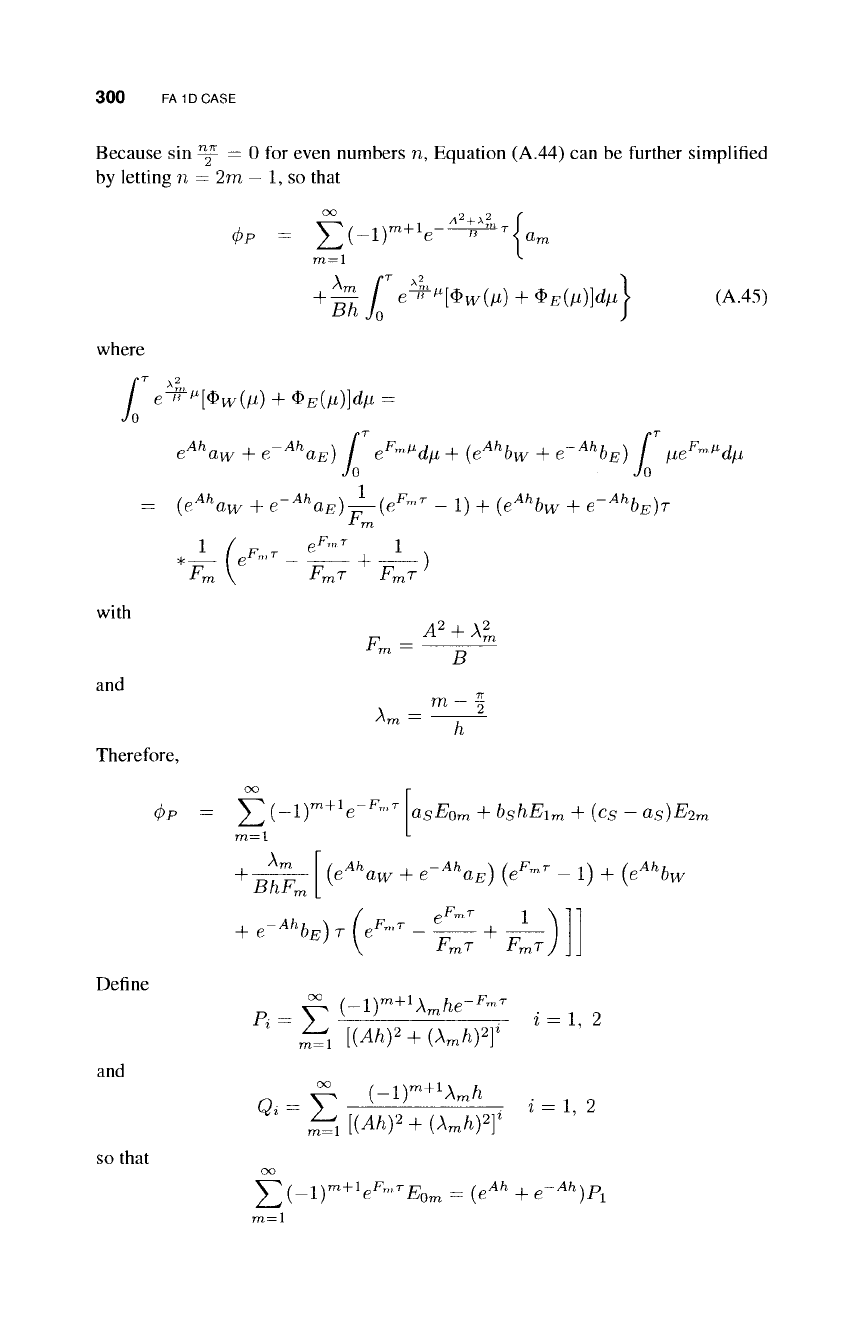
Then,
X
n
n
w2 = v + Φ
00
1 A
2
= Σ TTK-ir^W - «M/*)]e-#* sin[A
n
(x 4- ft)]
Φ
Ε
(μ) - Φτν(μ) , Φ#(μ) +
Φ\γ(μ)
+
2ft *
+
2
ύ)2 is known, w2 can be determined using Duhamel's theorem and substi-
w2 in Equation (A.29). Thus,
Now that w2 is known, w2 can be detei
tuting for w2 in Equation (A.29). Thus
w2 = /
——
(χ,μ,ί-
μ)άμ
OO x »f
n=l
00
_/x)
sin[A
n
(x + ft)]d/i
00
λ Γ*
= - Σ M l [(-!)
η
Φ
Β
(μ) - <Μμ)]β-
^β-^*«η[λ„(χ + ft)] y* eT"[
$
„ - (-1)"Φ
Β
]φ
the FA element is given by
Σ
71=1
Now, the analytic solution on
= we
J
= (wl+w2)e
Ax
-^
00
= ]P
eAX AR l sin
[
A
nO + h){a
n
n=l
+
M f
e
^^
w
^ -
{-ν
η
*Ε{μ)]άμ}
(Α.43)
When the formula given in Equation (A.43) is evaluated at the node P(0, r), a
six-point formula for φρ is obtained.
φ
Ρ
= φ(0,τ)
OO 00
« > A
2
+\±
ηπ
= Ye
^ 2
Λ
'+Κ.
τ
. ηπ
B
sin —
n=l
L + ^ f e^^M - (-1)
η
Φ
β
(μ)]φΙ (A.44)
300
FA 1D CASE
Because sin ^ =0 for even numbers n, Equation (A.44) can be further simplified
by letting n = 2ra
—
1, so that
]Γ(-1Γ
+Ι
β w^Uom
m=l ^
+ ^ £ β^[Φ
]ν
(μ) + Φ
Ε
(μ)]άμ^
(A.45)
where
./o
e^aw + er
Ah
a
E
) Γ ε
ρ
™
μ
άμ + (e
Ah
b
w
+ e'
Ah
b
E
) Γ μβ
ρ
™
μ
άμ
Jo Jo
= {e
Atl
a
w
+
e
-
Ah
a
E
)~(e
F
-
T
- 1) + (e
Ah
b
w
+ β~
Α
Η
Ε
)τ
■F
m.
„Ah,
F
n
,T
0
F
m
r
+ -ΕΓ-)
F mT -t
i
mT
with
and
2.
\2
A
2
+ A:
B
Λγη.
— ;
Therefore,
Σ(-ΐ)
BhFrr
m+1 -F
m
r
asEom + bshEi
m
4- (cs
—
as)E
2
m
+ e-
Ah
b
E
)
(e
Ah
a
w
+
e-
Ah
a
E
)
(e
F
™
T
- l) + (e
Ah
b
w
Fm.r i
T e
4-
m
'
x
m
i
Define
and
so that
*
=
Σ
^ (-ir+
l
\
m
he-
F
^
\ [(Ah)
2
+ (X
m
hy
i = 1, 2
oo
5](-ir+
1
e
i
'™^
m
= (e
Ah
+
e-
Ah
)P,
FA 1D CASE
301
ra=l
¿
(-l)
m+1
e
FmT
E
lm
=
2Ah(e
Ah
+
e~
Ah
)P
2
-
{e
Ah
-
e~
Ah
)P
1
OO
5^
(-l)
m+1
e
F
™
T
E
2m
=
(e
Afc
+
e-^JPx
771=1
5>i
r
+V^-=^(e*»'-l)
V Jzirí^Ln-e-
Qi-Pi
5>ι
Γ
+ν-
m=l
BhFr,
-(e
i
+
Γ mT
FmT
^ (-i)">+iA
m
fe
_
Bff_
y,
(-l)-+iA
m
/i(l
-
e-
F
-
T
)
2^
C4M2 -4-C\...M2
T Z>
^ (^Λ)2
+
(A
m
ft)2
T
JDU2
=
Qi
(Q2-P2)
r
ra=l
[(A/l)
2
+
(A
m
/l)2]2
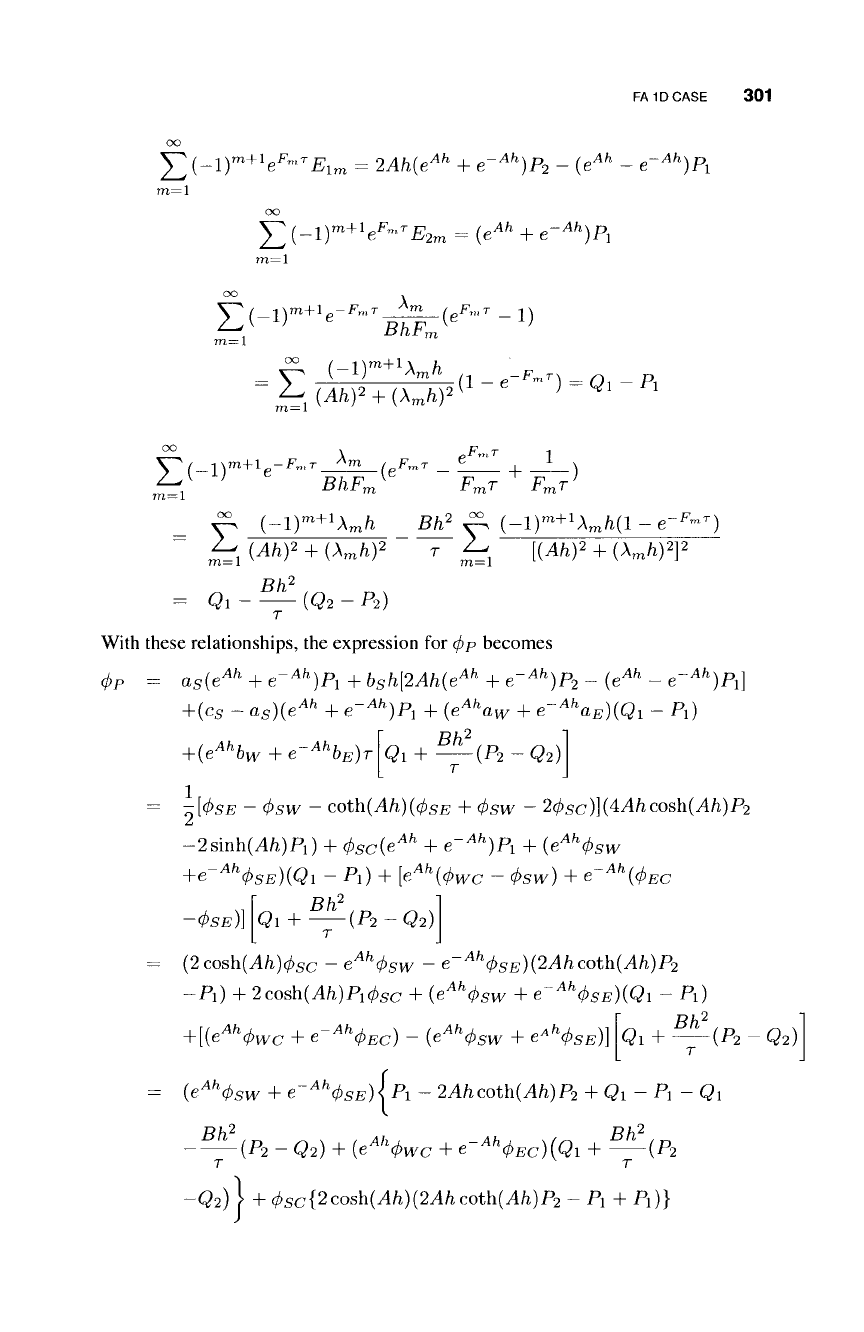
With these relationships, the expression for φρ becomes
φ
Ρ
=
asie^ + e-^P^bshpAhie^ + e-^Pi-ie^-e-^Pi]
+(c
s
-
a
s
)(e
Ah
+
e~
Ah
)P
x
+ (e
Ah
a
w
+ e-
Ah
a
E
){Q
1
-
P
1
)
Bh
2
+ (e
Ah
b
w
+ e-
Ah
b
E
)r
1
Qi + —(P2-Q2)
[Φβε
-
Φβιν
-
coth(Ah)WsE +
Φβητ
-
2</><?c)](4Ahcosh(Ah)P
2
-2sinh(Ah)Pi)
+
^sc(e
A/l
+
e~
Ah
)P
x
+ (ε^φβιν
+e-
A
^
SE
)(Qi
-
Pi)
+
[e
Ah
Wwc
-
Φβ\ν) + ε~
ΑΗ
{φΕα
-Φβε)}
fíh
2
Qi + (P2-Q2)
T
(2cosh(i4ft)0
sc
-
e
Ah
<f>
sw
-
e-
Ah
φsE)(2Ahcoth(Ah)P2
-Pi)
+
2cosh(A/i)Piφ
8α
+ (e
A
^sw + e-
A
^
SE
)(Qi
-
Pi)
+[(e
A
^wc +
β~
ΑΗ
φ
Ε
ο)
-
(e
A
^sw +
e^
SE
)]
Qi +
—
(P2-Q2)
T
= (e
Ah
4>sw
+
e-
Ah
φsE){Pι
-
2Ahcoth(Ah)P
2
+ Q
Í
-P
1
-Q
1
-
—
(P
2
-
Q2) + (e
A
'^wc
+
e-
A
^Ec){Qi +
—
(P
2
-Q2)
[ +
<^sc{2cosh(A/i)(2A/icoth(yl/i)P
2
-
Pj
+
Pj)}