
Boults Е. Illustrated history of landscape design
Подождите немного. Документ загружается.

117
17th CENTURY / JAPAN / EDO PERIOD
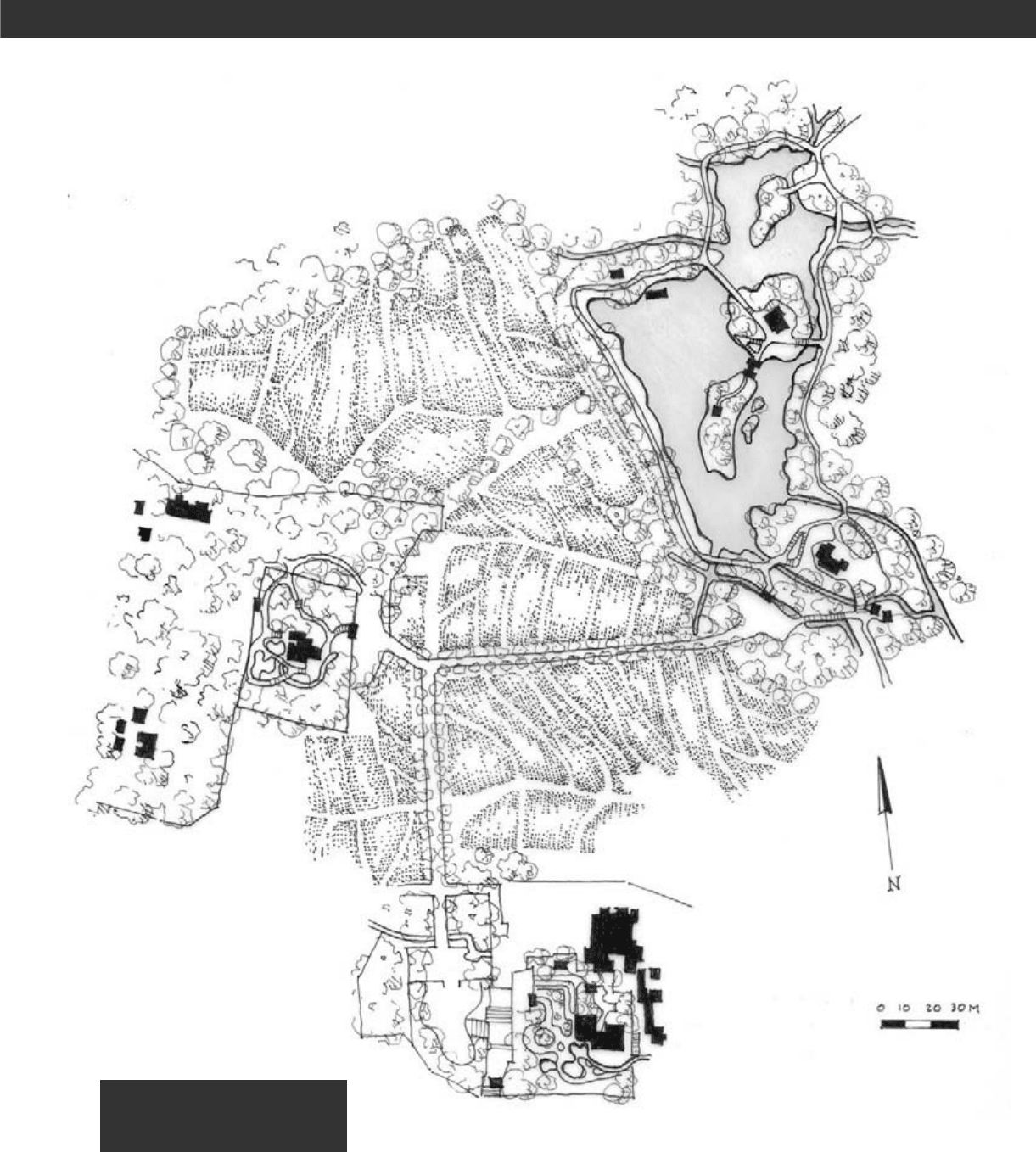
SITE PLAN: The compound at
Shugaku-in encompasses three
separate villas.
118
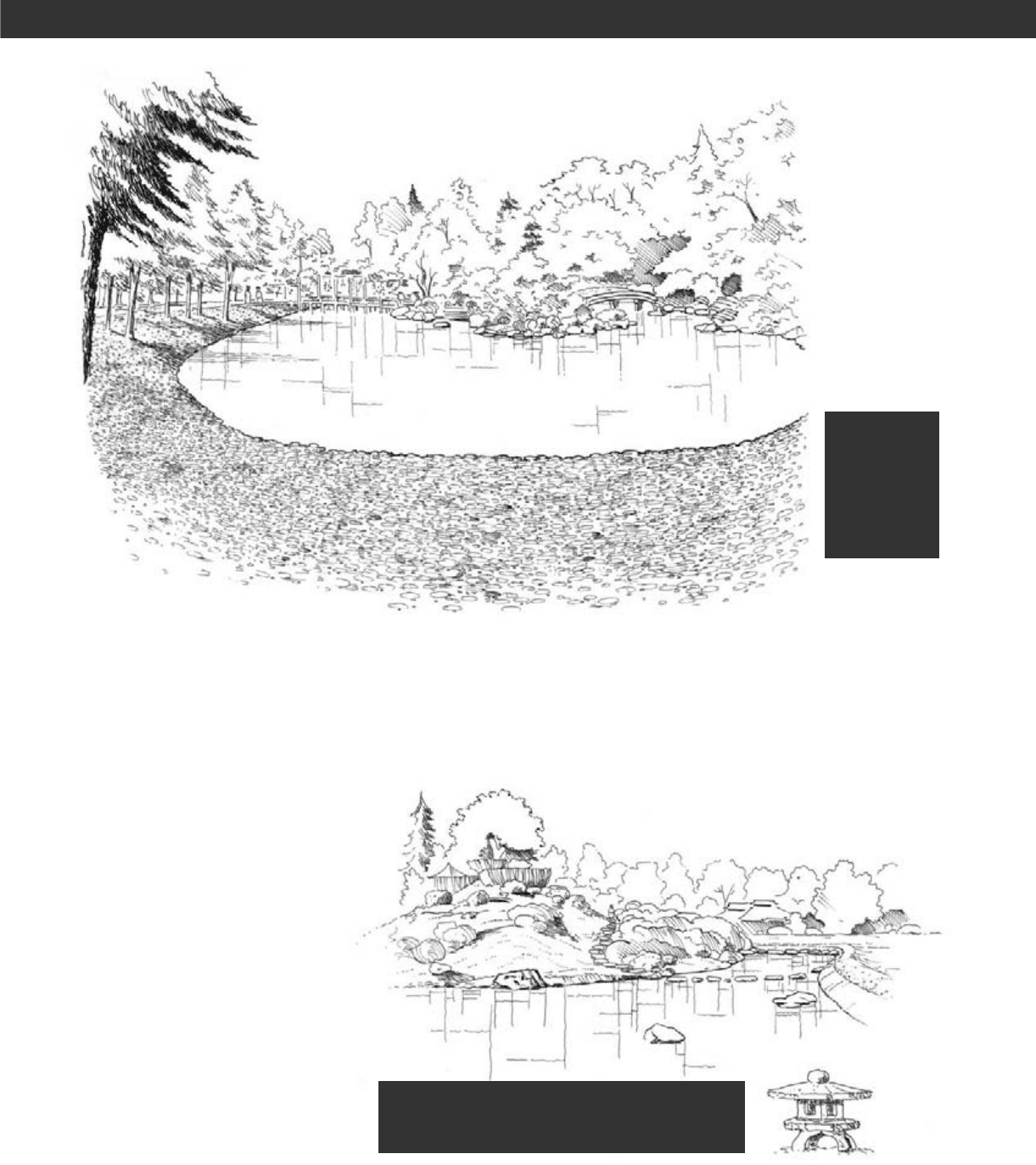
SENTO GOSHO
Gomizuno-o abdicated early; Sento
Gosho is the retirement villa he planned
with Kobori Enshu in 1634. The gar-
den surrounds a lake and stream and
contains a waterfall. Deep bays and
peninsulas subdivide the lake, creat-
ing a dynamic shifting of space as the
visitor moves through the garden. Sento
Gosho is distinguished by its pebbled
beach, turtle island, and earth bridge.
ESTATES OF THE
DAIMYOS
KOISHIKAWA KORAKUEN,
TOKYO
Korakuen was a pleasure park built by the
Tokugawa daimyo Yorifusa Mito in 1629.
The garden was dedicated to Confucius,
whose teachings were esteemed by the
Tokugawa shoguns. Chinese infl uences
can be seen in several features of the
garden, such as the Full Moon Bridge
(Engetsu-kyo), and a 30-foot-high artifi -
cial mountain, called Lu Shan. The garden
contains a lake, a large turtle island with
a distinctive vertical “head” stone, various
bridges, and many imported rocks. Scenes
from famous Kyoto temple gardens, as
well as scenes from famous Hangzhou
gardens are reproduced here. Korakuen
became a model for other daimyo estates
which, consistent with the new emphasis
on Confucian order, contained more overt
interpretations of poetic themes rather
than subtle allusions.
17th CENTURY / JAPAN / EDO PERIOD
SENTO GO-
SHO: River-
washed rocks
form the bank
of the lake in
the “stone
coast” style.
KORAKUEN: Shrubs were clipped to look like rocks:
low broad lanterns harmonize with the horizontality
of the lake.
119
The Mughal empire at its height
stretched from the base of the Hima-
layas to the Bay of Bengal, covering
territories in present day Afghanistan
and northwest India. The landscape
differs widely in these regions, from
dry desert plains to lush river valleys.
Garden forms were adapted to changes
in climate and terrain.
Mughal art forms were a blend of Per-
sian, Central Asian, and Indian styles.
When Timur conquered Iran in the 14th
century, expanding his Central Asian
empire, the nomadic Mongols adopted
Persian cultural traditions. Persian
styles, including the chahar bagh form,
were carried to India after Timur’s de-
scendent Babur captured Delhi in 1526,
forming the Mughal dynasty. Babur’s
grandson Akbar (1542–1605) expanded
the Mughal empire when he invaded
Kashmir in the late 16th century. Sev-
enteenth-century Mughal art shows the
infl uence of both Hindu and Islamic cul-
tures: aspects of a Buddhist aesthetic
based on organic patterns and sculp-
tural ornamentation were combined with
the Islamic sense of mathematical order
and geometry. These infl uences can be
seen in the architectural features and
built forms of Mughal gardens, and in
the painted miniatures produced dur-
ing this period. The tomb garden was
a distinctive combination of landscape
and architecture that joined aspects
of the Islamic paradise garden with the
Central Asian tradition of garden burial.
Construction of a tomb garden began
during an emperor’s lifetime; it was used
as a park before his death and as a
temple ground after.
The greatest Mughal gardens date
from the reigns of Akbar’s son, Jah-
angir (1569–1627), and grandson, Shah
Jahan (1592–1666).
SACRED SYMMETRIES
17th CENTURY / THE MUGHAL EMPIRE
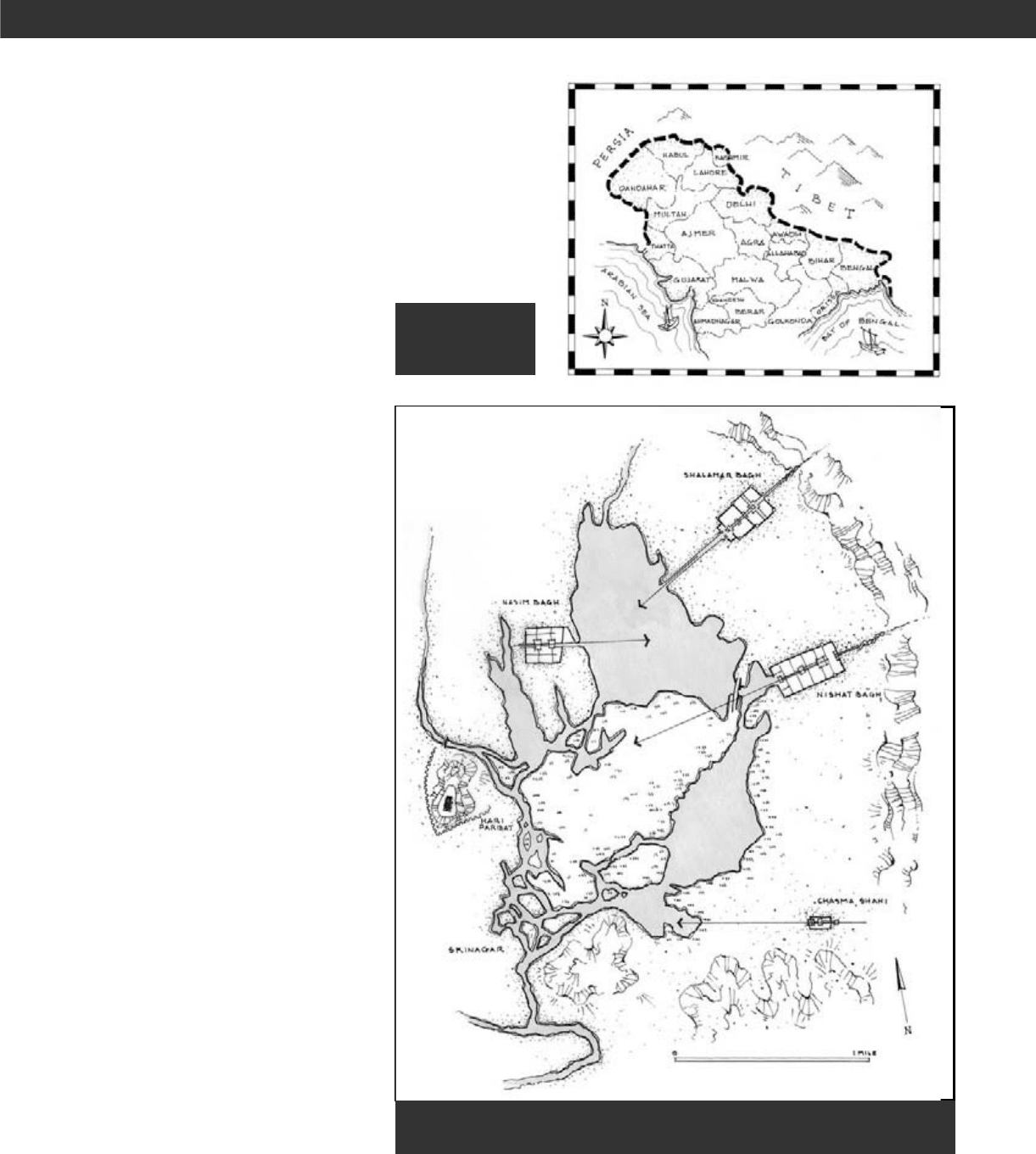
The Mughal
Empire in the mid-
17th century.
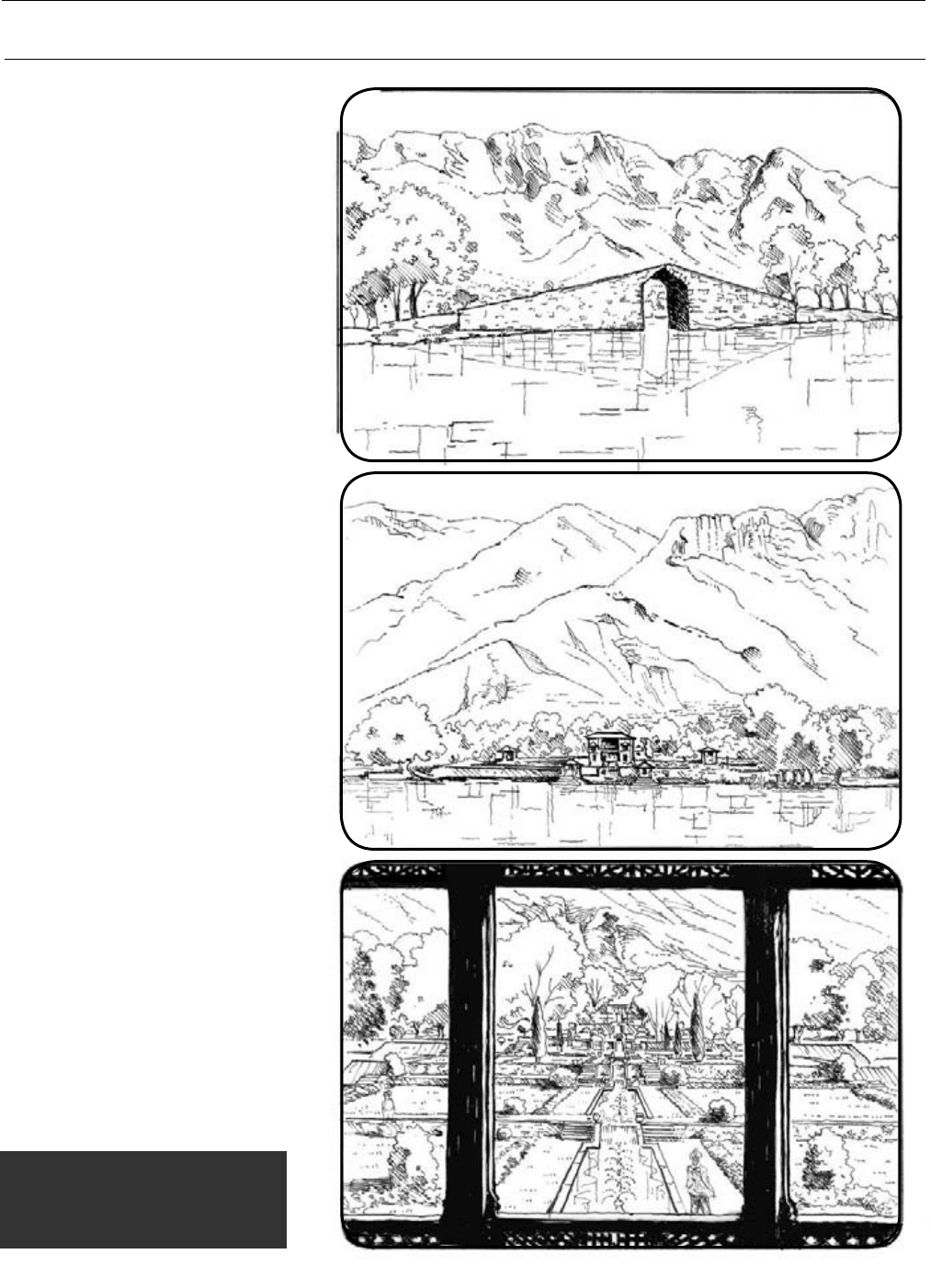
LAKE DAL, KASHMIR: Hundreds of gardens were believed to have been built
around Lake Dal and the town of Srinagar during Jahangir’s rule.
120
17th CENTURY / MUGHAL GARDENS
THE CELEBRATION
OF WATER
The lush valley of Kashmir is about 90
miles long. Extant gardens illustrate how
the abundance of mountain streams and
springs were exploited by the emphatic use
of water in Mughal gardens. On these slop-
ing grounds, water fl owed with great pomp
along a central axis. No longer confi ned
to still pools and narrow rills, water fell in
sheets over chini-kanas and down chadars.
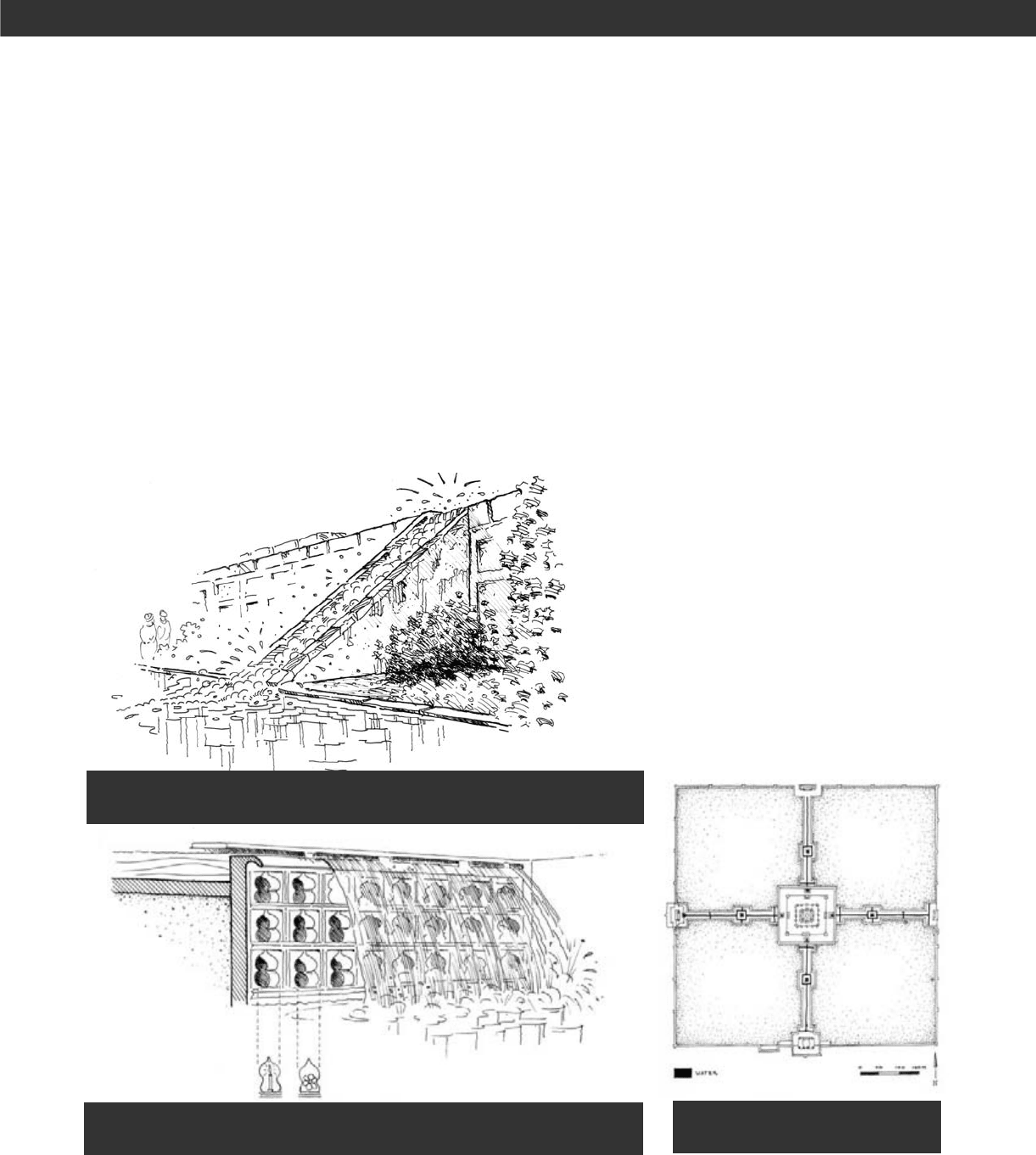
A chini-kana is a low wall with niches, like
a dovecote; a chadar is a sloped surface
with patterns carved in relief. In addition,
raised platforms, called chabutras, pro-
vided cool resting spots at the intersec-
tions of the water channels.
Open pavilions or summerhouses, called
baradari, built into corners of walled
terraces provided comfortable overlooks.
Terraces planted with shade-bestowing
chenars (plane trees), fruit trees, and
fragrant fl owers re-created the sights
and sounds of an imagined heaven.
Shah Jahan enjoyed the Kashmir valley,
but he also appreciated the landscape
of the northern plains, perhaps as a
reminder of his Rajput heritage.
13
He built
gardens in Lahore and Delhi, both named
Shalamar Bagh. His great contribution
to landscape history was the Taj Mahal,
the tomb garden built for his wife in Agra.
Shah Jahan also had an impact on the
history of city planning, building the city-
fort at Agra and the Red Fort in Delhi.
TOMB GARDENS
AND PLEASURE
PALACES
In addition to the Taj Mahal, other
representative examples of 17th century
Mughal gardens include Akbar’s tomb
garden at Agra, and the pleasure pal-
aces of Shalamar and Nishat Bagh on
Lake Dal.
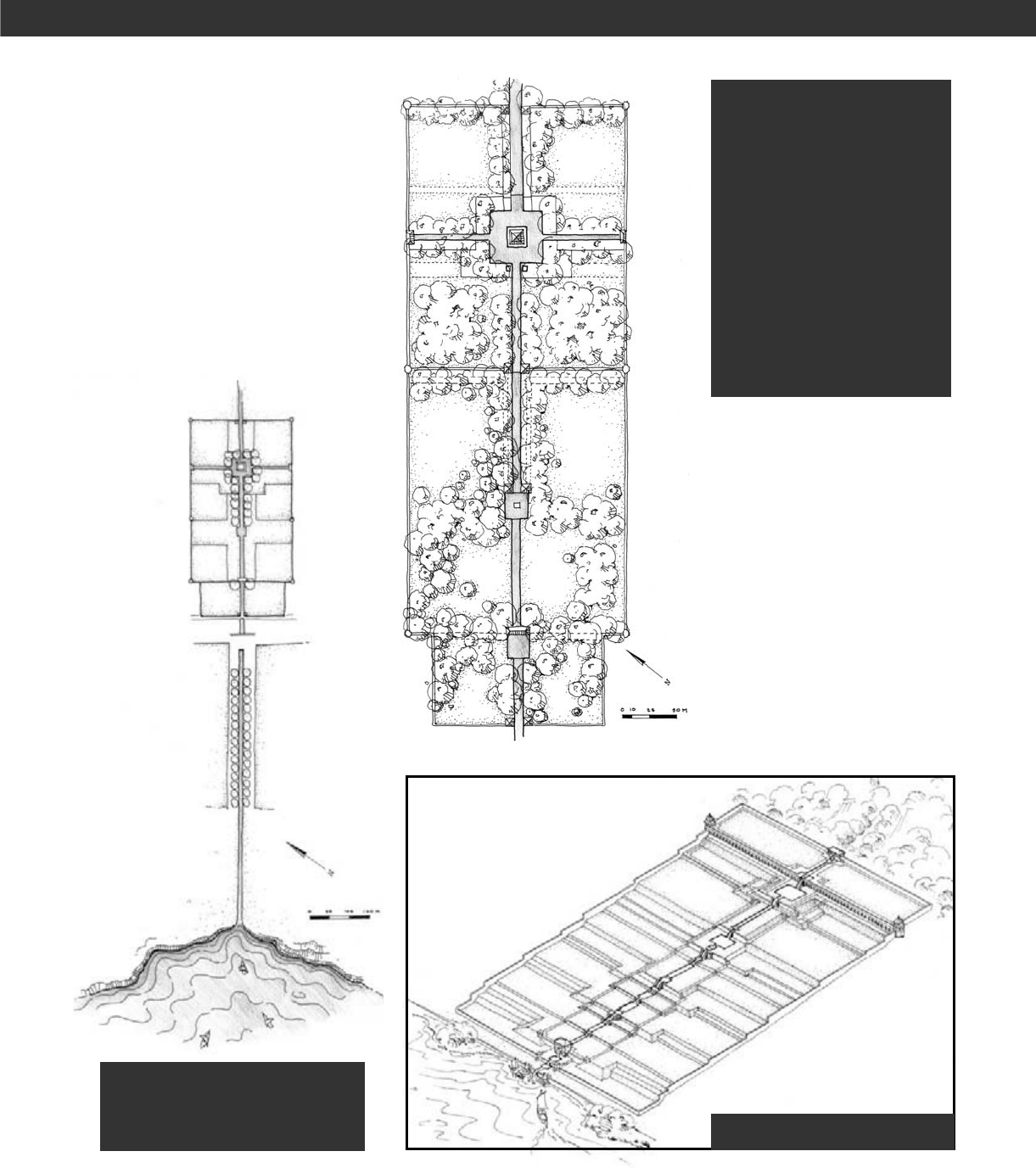
AKBAR’S TOMB,
SIKANDRA (AGRA)
Completed in 1632, this large mauso-
leum sits atop the center of the two
crossing water axes like a monumental
chabutra. The tomb is built as a series
of concentric rectangles: the fi rst
three stories are made of red sand-
stone, the top level is white marble.
Four raised causeways subdivide the
char bagh. Water fl owed across the
fl at platforms in narrow, shallow run-
nels from four central basins. Cypress
trees (representing death) lined the
avenue. Fruit trees (representing life)
fi lled the terraces.
CHINI-KANA: Candles or fl owers placed in the niches enhanced the effect of the
falling water.
CHADAR: Patterns carved on the surface of the water chute created different
effects in the cascade.
AKBAR’S TOMB: The grounds of the
tomb garden typify the char-bagh form.
121
17th CENTURY / MUGHAL GARDENS
SHALAMAR, KASHMIR
Shalamar, built as a summer pal-
ace along the shores of Lake Dal by
Jahangir in 1619, was expanded by
Shah Jahan in 1630. Set in a wide
ravine and framed by the mountains,
Shalamar consists of three terraces
connected by a central axis of water
punctuated with jets. The main canal
is bordered by pathways on both sides,
shaded by chenar trees. Turf, fl owers,
and fruit trees grew on the terraces.
At each level change, shallow falls were
highlighted by chini kanas.
THROUGH FLOATING ISLANDS:
Shalamar was approached by boat
from a long canal cut through the
marshes.
NISHAT BAGH, KASHMIR
Nishat Bagh was built in 1620, most
likely by a relative of Jahangir’s wife,
hence it had no offi cial function.
Twelve terraces (representing the
astrological signs) climbed up the
slope, visually uniting with the dis-
tant mountains. Unlike the hierarchi-
cal division of space at Shalamar,
the terraces at Nishat Bagh formed
a large pleasure garden with a sepa-
rate zenana at the top.
HIERARCHICAL PLAN OF
SHALAMAR, KASHMIR: The
lowest level contained the public
audience hall. The middle level was
known as the emperor’s garden
and contained a private audience
hall. A pathway crossed the main
axis to create a quadripartite
division of space. The uppermost
level was the zenana, or women’s
garden, and contained the black
marble pavilion, thought to be a
banqueting hall.
14
The pavilion was
surrounded on all four sides by
fountains; a lateral canal subdi-
vided the terrace.
NISHAT BAGH: Axonometric view.
122
VISUAL NARRATIVE: Nishat Bagh
BUOYANT APPROACH: The garden
was entered directly from an inner
lagoon separated from Lake Dal by an
arched bridge.
A 13-foot-wide canal, lined with jets,
bisects the stepped terraces. Changes
in level are marked by narrow chadars,
steps, pools, and chabutras. A tall,
arcaded retaining wall forms the base
of the zenana terrace. Three-story
baridari are located at each end of
the wall. The watercourse passes right
through the pavilion at the top of the
zenana.
123
17th CENTURY / MUGHAL GARDENS
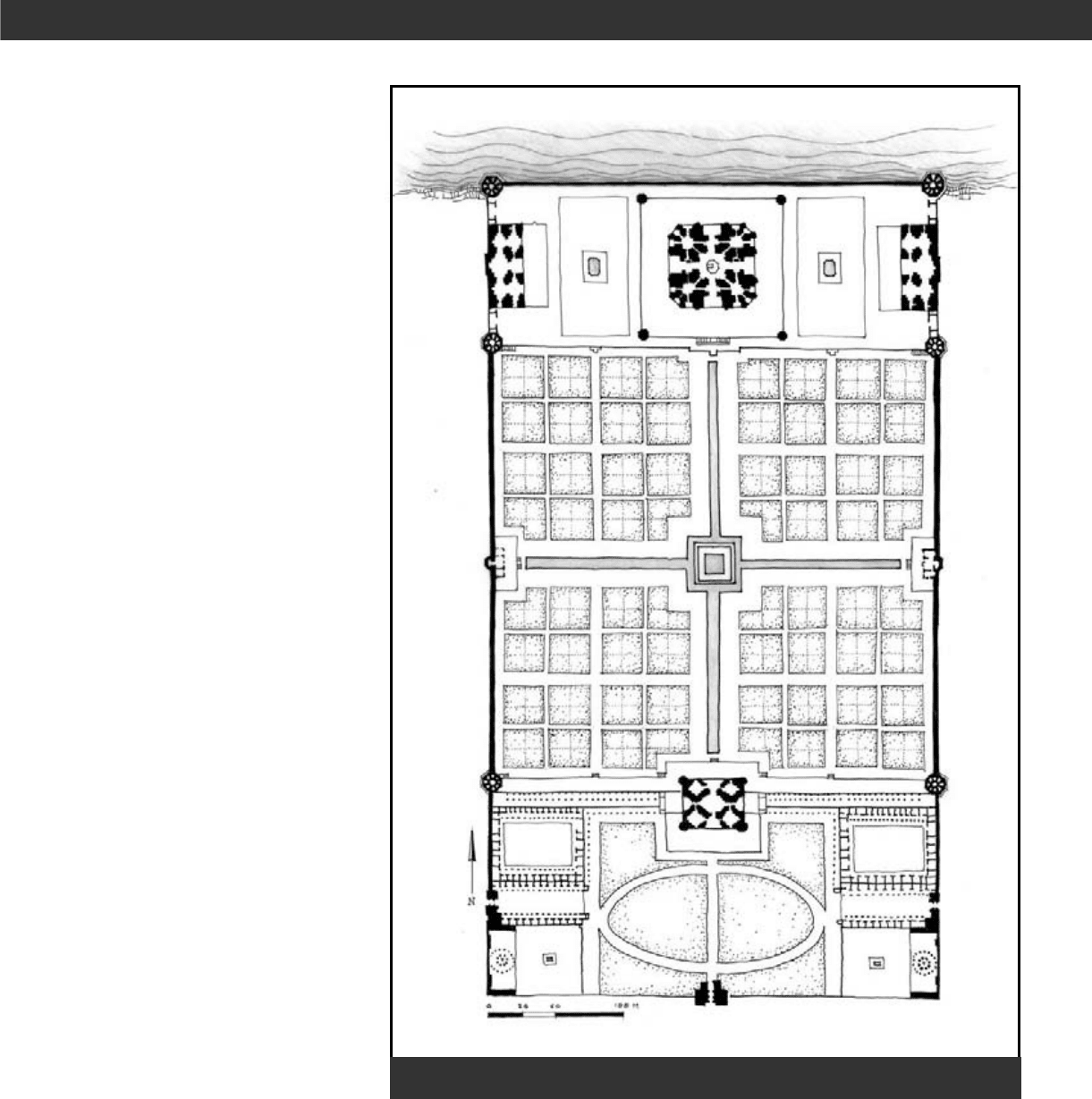
TAJ MAHAL, AGRA
The tomb garden for Shah Jahan’s
wife, Mumtaz Mahal, was begun in
1632 and completed in 1648. It is an
enormous char bagh, unique in that
the tomb is located at the far end of
the garden, above the Yamuna river,
rather than at the intersection of
the water canals. Legend has it that
Shah Jahan had one day hoped to
build his tomb garden (out of black
marble) as a mirror image on the
opposite side of the river. Thus the
river itself would form the cross-axis,
and both tombs would occupy the
center.
15
As it is, a raised tank of water
marks the center of the garden at
the Taj Mahal, refl ecting the white
marble dome and its minarets.
Tree-lined canals divide the garden
into the typical four-square pattern.
Trees and fl owers once graced each
parterre.
The tomb stands isolated on a
terrace paved with black-and-white
wave patterns. Minarets stand
at the corners of the elevated
terrace, countering the bulk of
the architecture and creating a
restful void space. The mosque and
assembly hall at either side of the
tomb are made from red sand-
stone, as is the entry gatehouse
and the two small pavilions at the
end of the cross-axis. The entire
20-acre garden is walled. The
round dome over the tomb rests on
a squarish octagon; the octagon
is symbolic of the union of heaven
(the circle) and earth (the square).
The number 8 is also signifi cant
in Islamic cosmology, represent-
ing the levels of paradise and the
number of angels supporting the
throne of God.
TAJ MAHAL: Historic plans show additional subdivisions of space within each quadrant.
16
Shah Abbas I (1571–1629), the great-
grandson of Shah Ismail, came to rule
in 1587 and led the Safavid dynasty to
its height of power. Decisive victories
in the fi rst decade of the 17th cen-
tury gave Iran control over much of
the Near East. Wealth accumulated
through increased trade fostered by
Abbas I’s liberal immigration poli-
cies and his acceptance of European
diplomats. The Safavid empire declined
after Abbas I’s death, but Safavid rule
lasted in some form until Abbas III was
defeated in 1736.
Strong geometries, squares, and
straight lines signifi ed the order of the
Islamic universe. Early Persian hunting
parks were divided into quadrants, with
a pavilion placed at the intersection.
Walled Persian gardens shut out the
harsh desert and provided an earthly
paradise of shade, water, and color-
ful fl owers. Water was used to irrigate
plants and control microclimates,
and was always contained in channels
and pools. On the dry Iranian plateau,
17th CENTURY
/
PERSIA
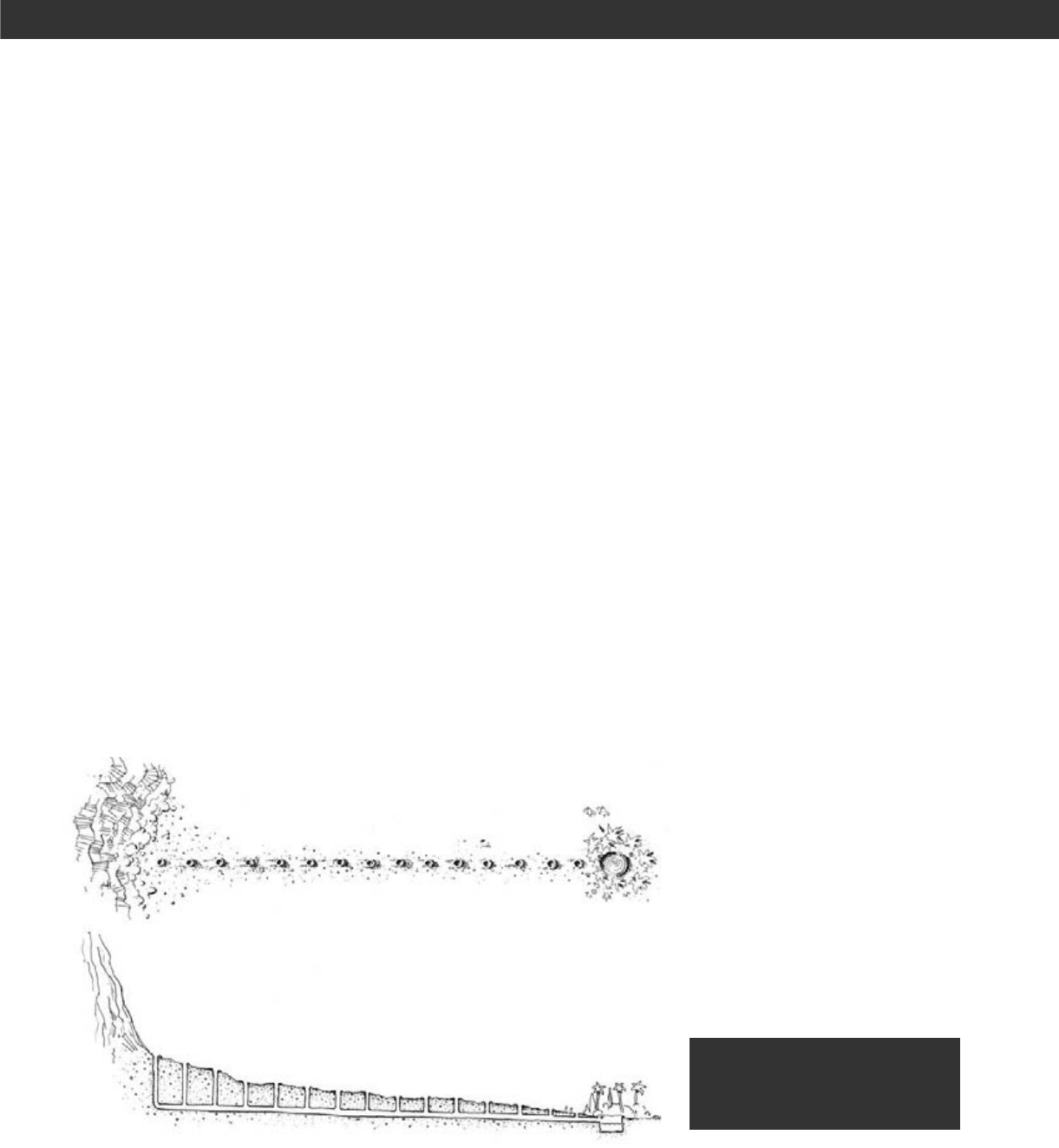
qanats, or subsurface tunnels, carried
water from sources in the surround-
ing foothills. The form of a garden was
determined by its irrigation patterns.
Based on traditional garden prec-
edents, the Shah created a splendid
imperial city at Esfahan.
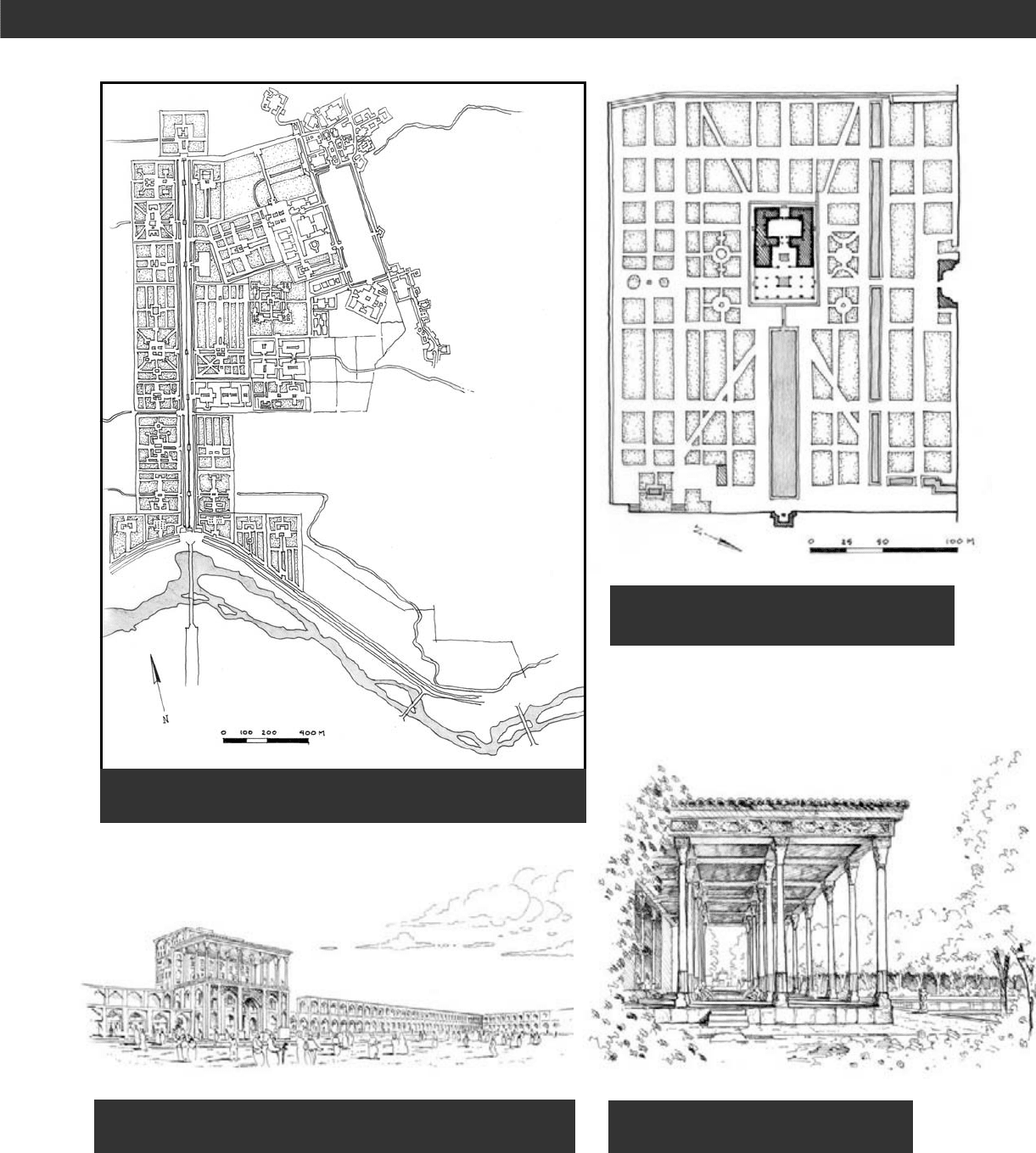
THE URBAN
GEOMETRY OF
ESFAHAN
Shah Abbas I moved the capital to
the mile-high city of Esfahan in 1598.
By the mid-17th century the city had
over half a million inhabitants.
17
Private
pleasure gardens continued uninter-
rupted along both sides of the mile-long
promenade between the gate to the
royal palace grounds and the Zayandeh
river. Called Chahar Bagh Avenue, a
central canal lined with onyx formed the
axis, which was planted with eight rows
of plane trees and poplars. A galleried
bridge built on arched piers continued
the main axis over the river, leading to
additional royal gardens and parks.
One royal park at the far south end
of Chahar Bagh Avenue, called Hezar
Jarib, was described in the travel jour-
nals (1686) of French jeweller Sir John
Chardin as consisting of 12 ascending
terraces covering 1 square mile.
18
The shah’s construction of Esfahan
included the addition of a colos-
sal public square, called the maidan,
an imperial mosque, and extensive
gardens. The maidan measures about
1500 feet by 500 feet and is defi ned
by a two-story arcade. Shops occu-
pied the ground fl oor, while the upper
arcade served as a gallery for the
events and spectacles that took place
there. A monumental gateway known
as the Ali Qapu overlooks the space on
the western edge. Its two-story talar,
or covered porch, is raised two stories
above the ground and supported by 18
wooden columns. The elevated, shady
porch captured breezes, providing
a comfortable spot for the shah to
preside over activities in the maidan.
Directly opposite the Ali Qapu on the
eastern edge of the courtyard was the
women’s mosque. The imperial mosque
terminated the southern end of the
maidan, although it assumed its own
alignment toward Mecca. The Ali Qapu
acted as a threshold to the shah’s
private gardens located behind the
structure.
GARDENS OF PARADISE
QANAT: Circular air vents formed
linear patterns in the landscape
and indicated the presence of a
qanat.
124
125
ALI QAPU: The six-story pavilion contained a throne room, royal apart-
ments, and reception rooms.
CHEHEL SOTOON: The pavilion occupied the near
center of a densely planted 12-acre garden.
TALAR: Stone lions spouted water into a
white marble basin within the porch.
ESFAHAN, IRAN: A grand boulevard of gardens distinguishes the
capital city.
17th CENTURY
/
PERSIAN GARDENS
126
Farther west of the maidan, between
the Ali Qapu and Chahar Bagh Avenue,
a royal pavilion known as Chehel Sotoon
was reconstructed by Shah Abbas II in
1647. The 20 tall wooden columns of the
talar were refl ected in a long rectangu-
lar pool enfronting the pavilion, hence
the name chehel sotoon (40 columns).
Overall, the vocabulary used in the royal
gardens and pavilions at Esfahan are
typical of Persian gardens. Architec-
tural features and garden geometries
create an interpenetration of space
that is both symbolic and functional.
The planting, decoration, and thoughtful
use of water combined to create a true
paradise on earth.
SEASIDE
PALACES
Shah Abbas I also built palaces and
gardens on the southern coast of the
Caspian Sea. The well-watered marshy
landscape, 100 feet below sea level, pre-
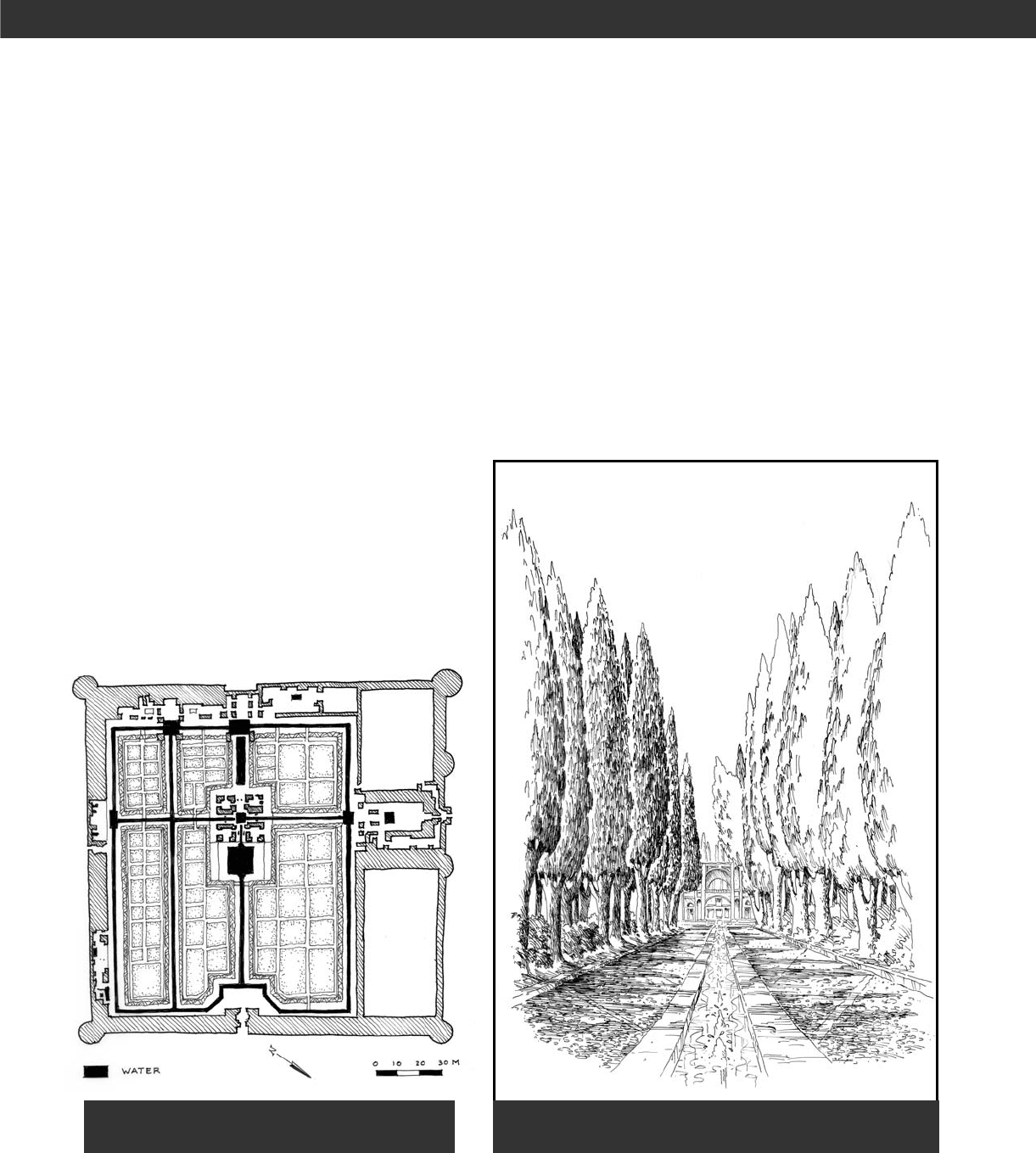
reservoir that feeds the garden by grav-
ity. Other canals irrigate the surrounding
fi elds and farms.
20
From a monumental
gateway in the outer wall, a wide avenue
containing a runnel leads to a central
pool and pavilion, and continues to
another pavilion at the far end of the
axis. A cross-channel of water emanat-
ing from the central pavilion divides the
space into four. Pebble-paved paths fl ank
the channels. Interior plots are planted
with fruit trees. The sights and sounds
of the garden experienced beneath a
cover of dense shade create a lush, sen-
suous oasis. A perimeter canal collects
the runoff and delivers it to the village.
17th CENTURY
/
PERSIAN GARDENS
BAGH-E FIN: The existing structures date from the
18th century; the garden was restored again in 1935.
sented a completely different environ-
ment in which to construct gardens. To
ease the arduous journey across the
desert plains, he had the 300-mile-long
route paved, and built resting lodges
along the way. The Bagh-e Fin in Kashan
(south of Tehran) was the site of a
reception for Shah Ismail in the early
16th century. Abbas I improved the
gardens in 1587, and Abbas II visited
there in 1659.
19
BAGH-E FIN, KASHAN
A high wall encloses the 6-acre garden.
A natural spring and qanat supply a
SHADY TUNNELS: Four-hundred-year-old cypresses shade runnels
lined with turquoise tiles and abundant bubblers at Bagh-e Fin.