
Boults Е. Illustrated history of landscape design
Подождите немного. Документ загружается.

97
The civil strife between the Houses of
York and Lancaster, known as the War
of the Roses, ended when Henry Tudor
defeated Richard III and assumed the
throne as King Henry VII. The most
signifi cant garden advancements came
during the reign of Henry VIII (ruled
1509–1547), whose rivalry with French
King Francis I motivated his interest in
the arts and in gardening.
11
When Henry VIII was unable to obtain
a divorce under Catholic church policy,
he severed ties with Rome and appro-
priated the landholdings of Catholic
monasteries. His actions had two im-
portant effects: a landed gentry class
developed, establishing an enduring
pattern of land tenure in the English
countryside, and northern Europe,
rather than Italy, became the source
of design infl uence. Dutch styles had a
particular impact on English garden de-
sign in the second half of the 16th cen-
tury. Interest in gardening escalated;
ornamental gardens fl ourished at the
country houses of the aristocracy.
The small outdoor rooms of Tudor and
Elizabethan gardens (Elizabeth ruled
1558–1603) related to the lines of the
house. Sited on a slight rise, to ensure
good drainage, they were characterized
by intricate ground plane patterns vis-
ible from the piano nobile or second-fl oor
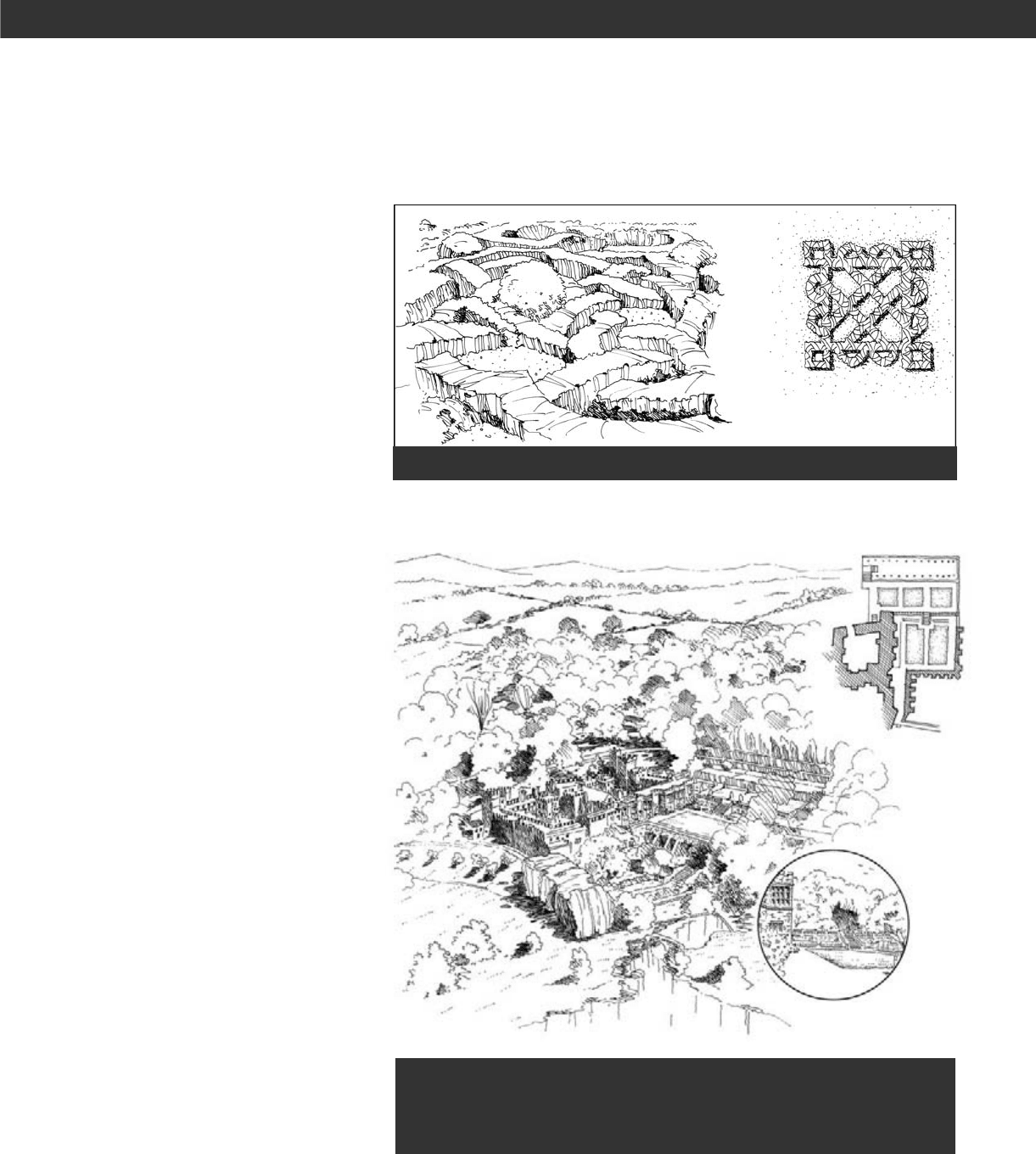
level of the house. Mazes, mounts, and
knot gardens were common elements.
Flowers fi lled the internal shapes cre-
ated by “closed” knot gardens; colored
gravel fi lled “open” knot gardens.
TUDOR AND ELIZABETHAN GARDENS
IN ENGLAND
KNOT GARDENS: Low, clipped evergreen shrubs and aromatic herbs formed “knots.”
HADDON HALL, DERBYSHIRE: The terraces on the south side of the house date
from the Tudor period. The stone balustrade on the second terrace shows Italian
infl uence. The “forthright”—a straight, wide path for walking—became a common
garden element.
12
16th CENTURY
/ ENGLAND
98
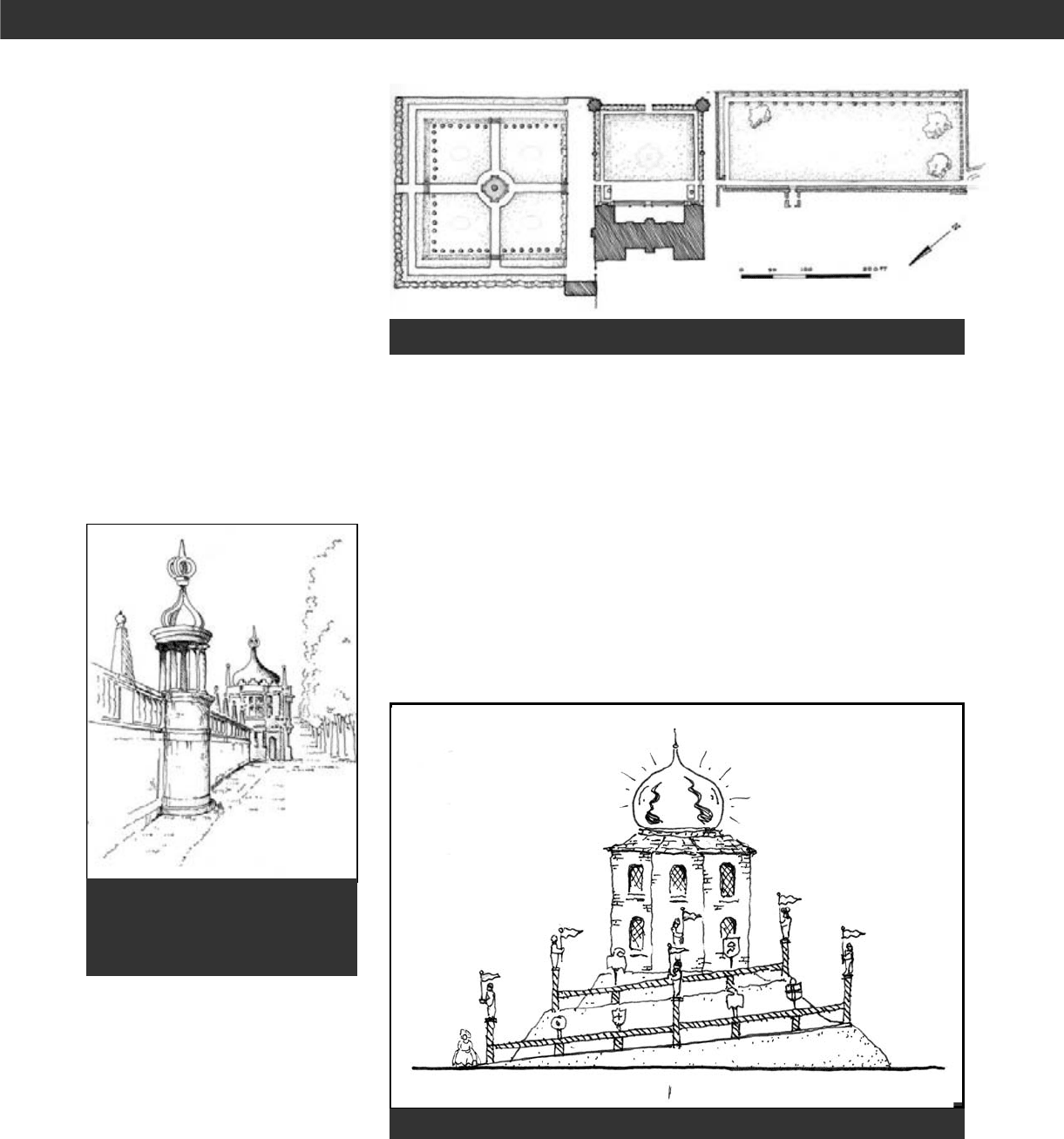
The sunken garden on the northeast
side of the house is an Italian-style
compartment garden with an English
infl uence. Paths radiating from a central
fountain divide the garden into four
squares.
ARRIVAL COURT: Stone pavilions
decorate the walled terrace, and
“banqueting houses” mark the far cor-
ners of the forecourt at Montacute.
KING’S MOUNT: Henry VIII’s summerhouse at Hampton Court.
16th CENTURY
/ ENGLAND
HAMPTON COURT, MIDDLESEX
Henry VIII assumed control of Hamp-
ton Court in 1531. He immediately
enlarged the palace compound to in-
clude thousands of acres of parkland
and hunting grounds to the north. The
Pond Garden and Privy Garden date
from his reign. The neat, rectangular
Pond Garden included knot gardens,
turf banks, arbors, covered walkways,
a central fountain, and a banqueting
house.
MONTACUTE, SOMERSET
This Elizabethan garden dates from
1580; its garden compartments
cross the straight line of sight cre-
ated by the entry road and allée.
Made from local stone, the steps
and balustraded walls of the fore-
court create a unified architectural
ensemble. An 18th-century addition
to the northwest facade of the house
reversed its orientation. The fore-
court is now considered to be at the
back of the house.
MONTACUTE, SOMERSET: Garden terraces relate to the lines of the house.
The sunken Privy Garden contained
colored gravel parterres, topiary, a
maze, and a circular pool with raised
turf banks. Most spectacular was the
hedged path that spiraled around the
mount, crowned by a three-story sum-
merhouse.
13
Painted heraldic beasts,
placed throughout the gardens and
parks, posed atop poles and held aloft
pennants. The design of Hampton
Court changed with each successive
monarch; the evolution of the garden
is illustrated in the following chapter.

99
16th CENTURY
/ THE EARLY BOTANIC GARDEN
AN ENCYCLOPEDIA OF PLANTS
ORTO BOTANICO,
PADUA: “Gardens
of the simples” were
typically oriented to
the cardinal direc-
tions, and contained
a central well. The
organization of
the planting beds
refl ected the order
of the universe.
At Padua, circular
beds are located in
square compart-
ments; the four-
square compart-
ments are confi ned
within a larger circle.
In the 16th century, the number of
known plants increased twentyfold.
14
Sunfl owers, marigolds, sassafras,
tobacco, and the potato all entered
Europe from the Americas. The fi rst
botanic gardens, established in Pisa
and Padua around 1543, were still
organized as physic gardens, their
purpose being to provide useful knowl-
edge about the medicinal, not orna-
mental, uses of plants. Early botanic
gardens also had religious overtones:
it was believed that by assembling all
the plants of God’s creation one could
reconstruct the Garden of Eden.
15
Botanical scholarship was contained in
the many herbals published during the
period, which were indexed by ailment. Pi-
etro Andrea Mattioli wrote Commentarii
in sex libros pedacii dioscorides in 1544,
summarizing all of Dioscorides’s insights
from the 1st century and supplementing
this knowledge with his own observations.
The book, which included woodcut illustra-
tions, was widely infl uential, as it coincided
with the 16th-century boom in printing.
As Enlightenment science evolved in
the following centuries, the “garden of
the simples” developed into the modern
botanic garden devoid of its sacred
meanings.
100
16TH CENTURY
/ EARLY MUGHAL GARDENS
PERSIAN ART FORMS TRAVEL EAST
As a young man, Babur (1483–1530)
visited the cities of his Timurid
ancestors and was impressed by
the artistic ideals expressed there
through traditional Persian art forms
and gardens. He created gardens in
his most beloved city of Kabul and in
northern India, based on precedents
established at Samarkand and
Herat. Babur conquered Delhi in 1526,
establishing the Mughal empire. The
nomadic ruler traveled throughout his
empire, building alliances and con-
solidating his power. The royal court
camped out in orchards, vineyards,
and flower plantations, which were
watered by springs channeled to the
gardens. Babur loved nature and the
outdoors. His gardens were conceived
of as open-air palaces, with mosques,
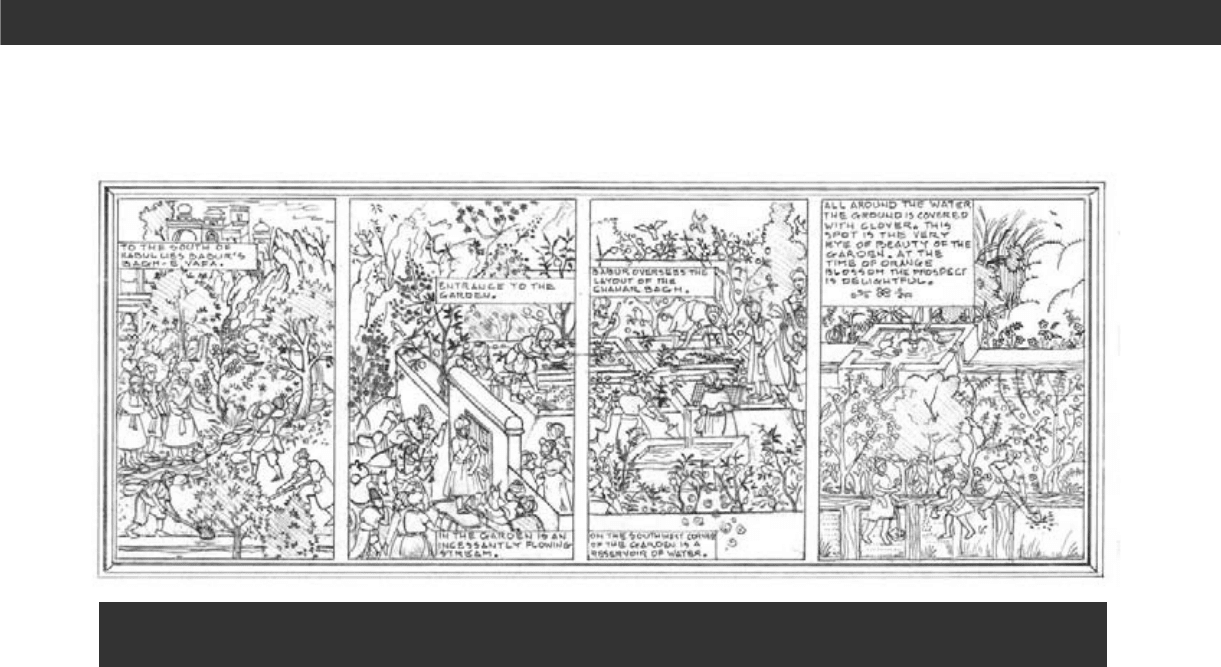
BAGH-E VAFA, AFGHANISTAN: The beautiful miniatures contained in Babur’s memoirs illustrate his love of gardens and his
involvement with their layout.
baths, pavilions, and raised platforms
for tents.
16
Built on a south-facing rise of land,
the emperor’s Garden of Fidelity,
the Bagh-e Vafa, assumed the typi-
cal quadripartite form, the chahar
bagh. Babur described the numerous
varieties of fruit trees planted there
and mentioned its water courses.
The exact location of this garden is
unknown, but the remains of a garden
near Jalalabad exhibit many similar
features.
17
The Ram Bagh located along the
banks of the river Yamuna at Agra is
believed to be Babur’s first garden in
India. Babur described the ordering of
the harsh, dry landscape through the
digging of wells, the establishment of
water tanks, and the construction of
the symmetrical avenues, plantings,
and pavilions that constituted the
char bagh (chahar [“four”] became
char in Hindi).
The forms of Mughal gardens adapted
to variations in climate and terrain.
Mughal style became characterized
by a fusion of Central Asian, Per-
sian, and Indian influences. Babur’s
grandson Akbar expanded the Mughal
empire in the late 16th century. The
lush, open-terraced water gardens
of Kashmir date from the 1600s
and are discussed in the following
chapter.
101
16th CENTURY
/ JAPAN
THE MOMOYAMA ERA (1569–1603)
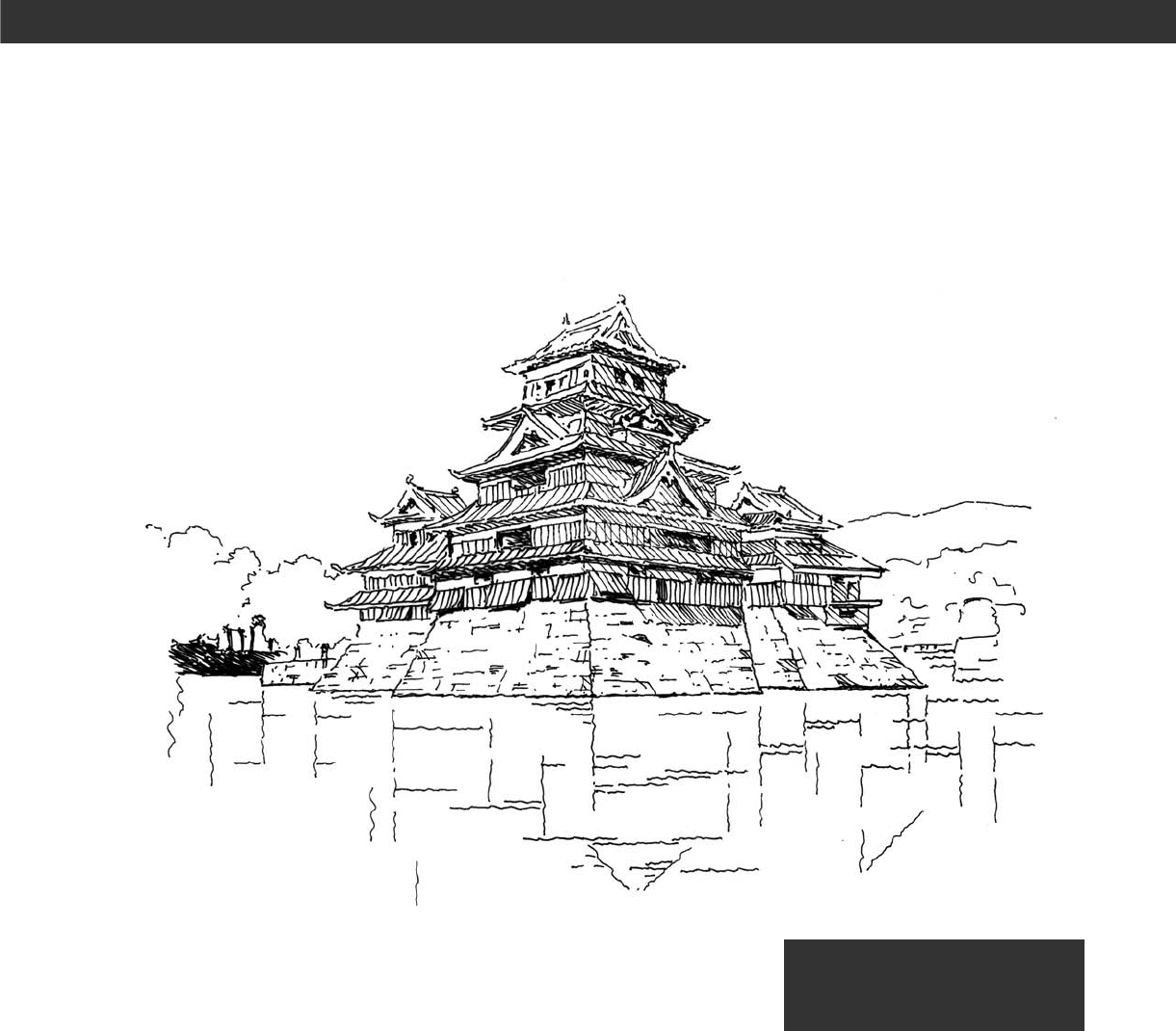
MATSUMOTO CASTLE, KYOTO: Cas-
tles were built by wealthy daimyos
during the Momoyama period.
During the Muromachi period, the shoguns moved their political operations back to Kyoto, reestablishing ties with
the imperial court that were severed during the Kamakura era. A century of internal confl icts fi nally ended with
the successive reigns of three generals who were able to establish order throughout the country. Oda Nobunaga
(1534–1582) seized Kyoto in 1568. To legitimize his power with the cultural elite of Kyoto he had to prove his
sophistication. He turned to the preeminent aesthetician and tea master Sen no Rikyu (1521–1591) for advice.
18
When Nobunaga was murdered in 1582,
Toyotomi Hideyoshi (1536–1598) be-
came shogun. He developed a reputation
as an extravagant dictator, perhaps to
compensate for his peasant upbring-
ing. Hideyoshi built a castle at Fushimi,
south of Kyoto, called Momoyama
(Peach Hill). Hence, the latter half of
the 16th century became known as the
Momoyama period.
During the civil wars, wealthy daimyos
built fortifi ed castles and used architec-
ture to express their power. Hierarchi-
cally arranged castle towns developed
as trading centers, and gained a degree
of economic independence. A new urban
society arose; religion no longer moti-
vated cultural production.
A colorful and fl amboyant painting style
developed in the early 16th century,
distinguished by its use of gold-leaf
backgrounds. Works were now executed
by professional artists (such as Kano
Masanobu, 1434–1530, founder of the
Kano school), not by priests or scholars.
Also, a new form of poetry emerged,
one particularly descriptive of remote
landscape imagery.
19
Opposing expressions of culture
characterized the Momoyama period.
Against a backdrop of decadence and
the ostentatious display of wealth, a
ritual of refi ned etiquette known as the
tea ceremony was perfected. The nos-
talgic appeal of a rustic retreat in the
mountains, which in a way the tea hut
symbolizes, might have been infl uenced
by the new forms of landscape poetry
and the need to provide new venues for
social interaction and parameters for
social stability.
20
102
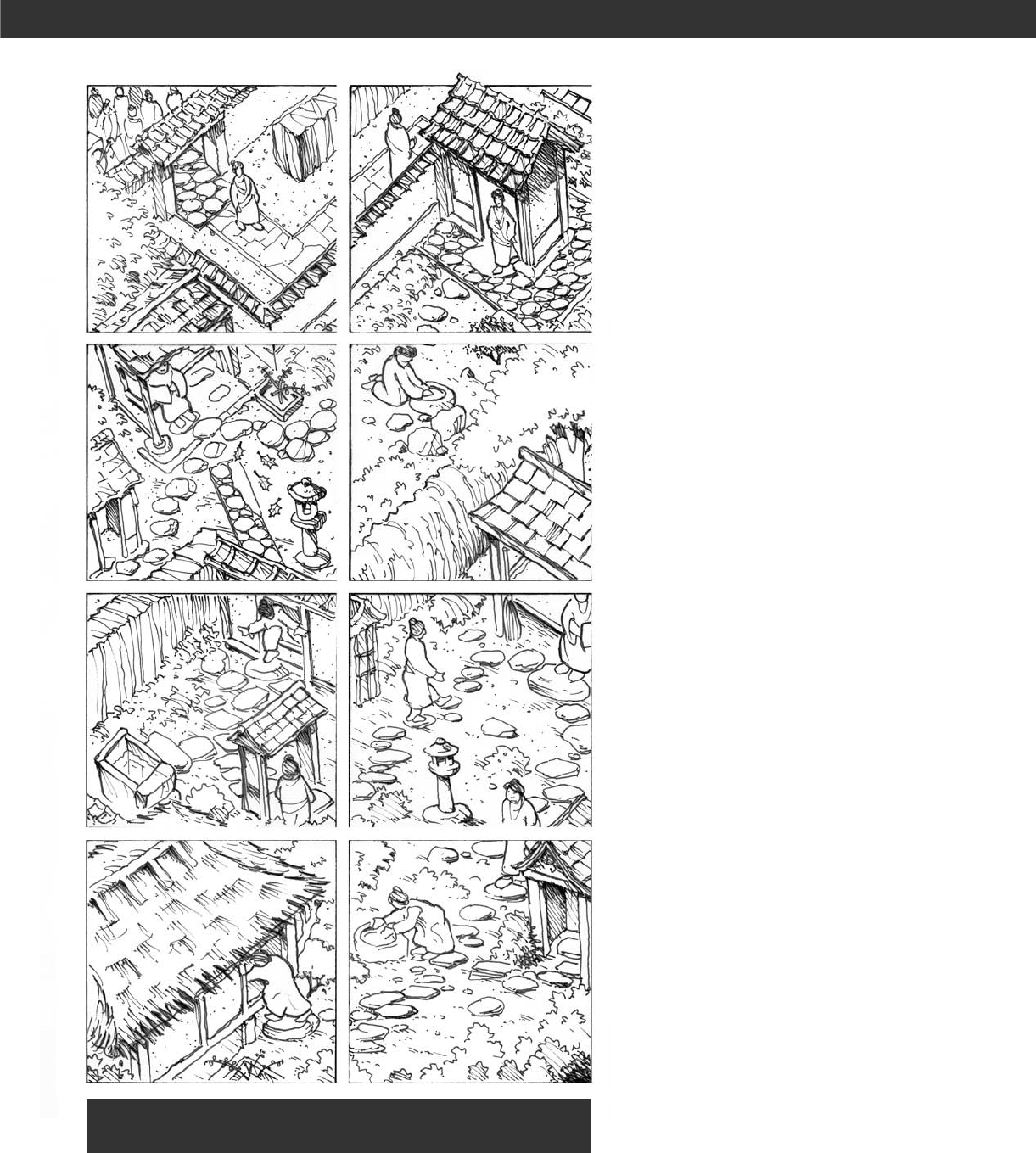
THE CONCEPT
OF THE TEA
CEREMONY
Zen Buddhists drank tea to help them
stay alert while meditating, a practice
also embraced by the samurai elite.
One of the first tearooms was built by
Yoshimasa at Ginakaku-ji. Later, during
the 16th century, Hideyoshi popularized
the tea ceremony, promoting its as-
pects of hospitality and social display
rather than its religious functions.
The tea ceremony, or cha no yu, involves
the performance of specifi c movements
and behaviors in a particular setting, the
tea garden, known as cha niwa or roji.
Roji is a reference to the “dewy path” of
rebirth in Buddhist doctrine, suggest-
ing that the tea ceremony itself is more
about the journey than the destination.
The physical form of a tea garden is
secondary to its purpose as a place of
aesthetic experience. Divided into outer
and inner areas, it facilitates the tran-
sition from an outer world of distraction
to an inner state of composure.
Everything about the tea ceremony is
contrived—the proportion of evergreen
plants to deciduous plants in the gar-
den, the number of nails in the door, the
type of utensils used in the tea hut. Tea
gardens became gardens of suggestion,
where individual leaves and single flow-
ers were carefully displayed, hinting at
the perfection of nature unattainable
by humans.
The austere principles of the tea cere-
mony were codified by Sen no Rikyu, who
upheld its virtues of polite restraint
and rustic simplicity. The folk aesthetic
represented the gracious beauty found
within everyday existence. The tea
ceremony was practiced by people at
all levels of society: Merchants, priests,
nobles, and townspeople were all equal
within the realm of tea.
16th CENTURY
/ JAPAN
AESTHETIC JOURNEY: A carefully prescribed path facilitates the pas-
sage from outer world to inner world in a Japanese tea garden.
103
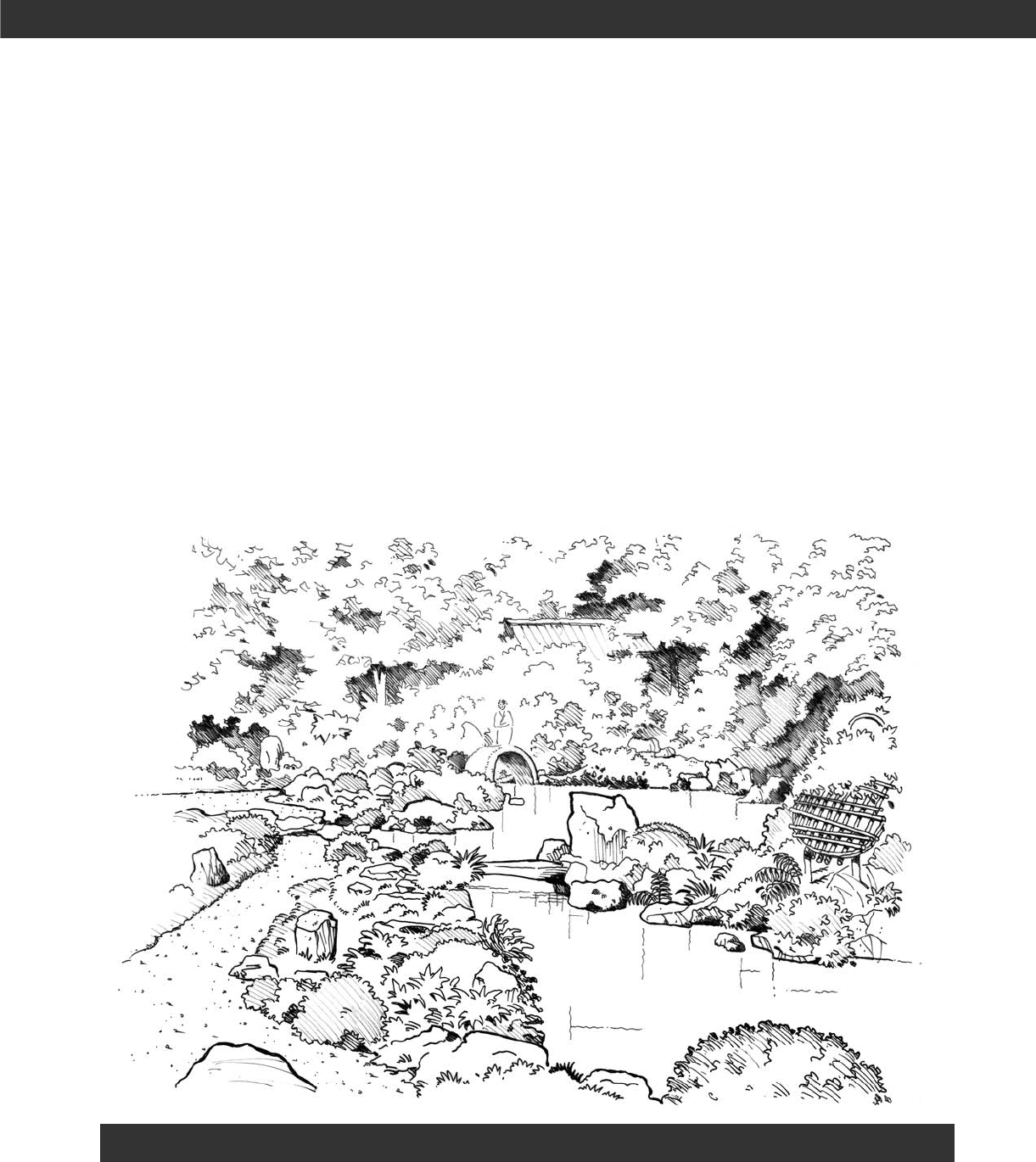
FORMS AND
ELEMENTS OF
THE TYPICAL
TEA GARDEN
Tea gardens were small spaces fi t
into confi ned property boundaries.
Stepping stones, the physical repre-
sentation of roji, regulated speed and
direction of movement, while landing
stones served to direct attention to
a particular feature. The articulation
of the path infl uenced the design of
the stroll gardens of the Edo period,
discussed in the next chapter.
Wells, basins, gates, and lanterns
were prevalent in tea gardens. These
elements were points of reference
along the path, and had specific func-
tions in the tea ceremony. Guests
washed their hands and rinsed their
mouths at a basin. Rustic gateways
became symbolic thresholds between
inner and outer spaces. The types
and styles of lanterns, fences, and
even stones were carefully chosen to
set the tone of the experience.
The floor plan of a typical tea hut ac-
commodated four and a half tatami
mats, a tatami measuring 6 feet by
3 feet. A low door provided entry and
forced a humble posture. Decoration
was limited to a scroll or subdued flo-
ral arrangement within the tokonoma.
The detached teahouse brought the
essence of the countryside into the
city, providing sophisticated urban
dwellers an escape to an ideal of
romanticized nature.
21
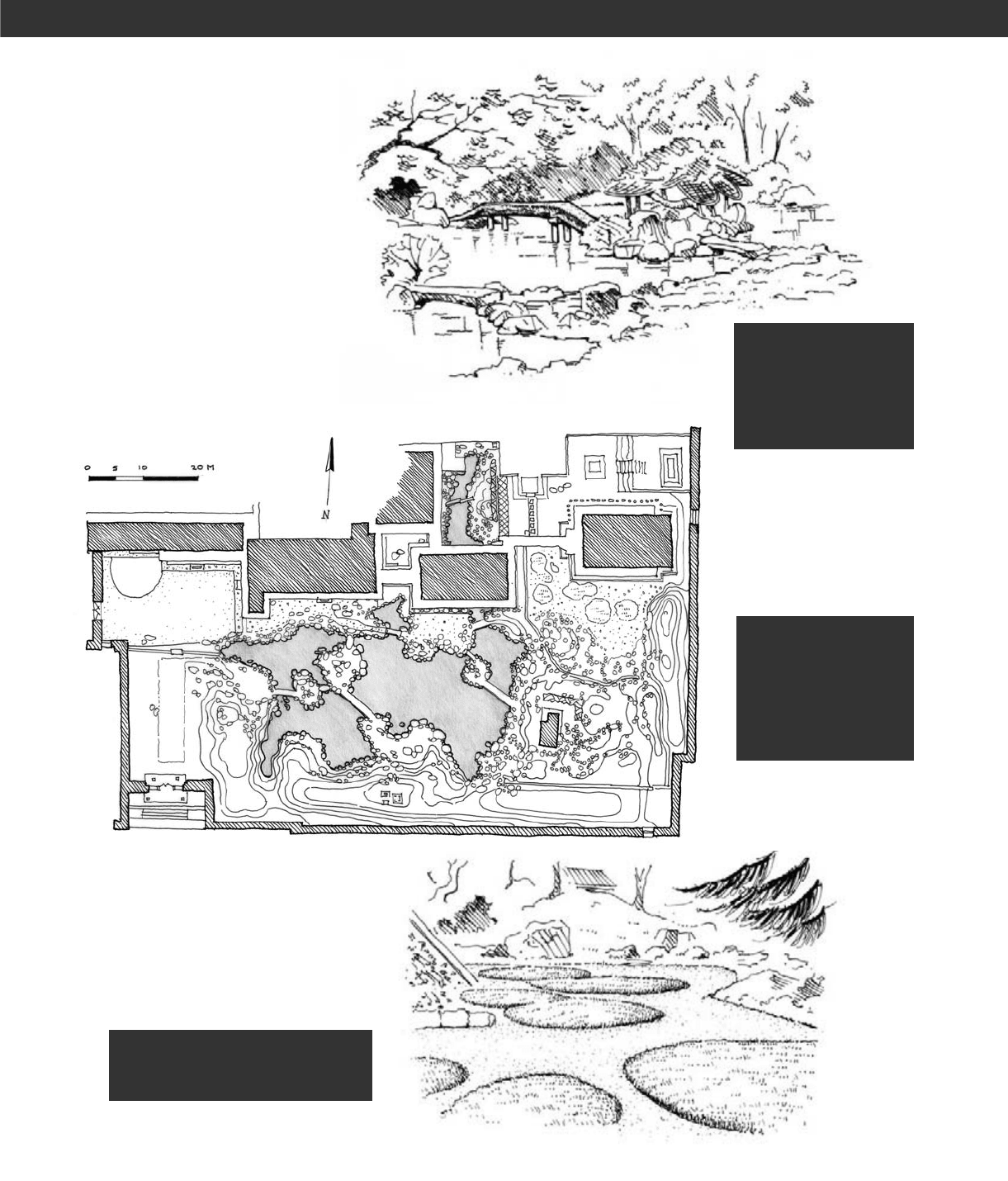
SAMBO-IN, KYOTO
Legend has it that the renovation,
in 1598, of the garden at Sambo-in,
a former Heian paradise garden
within the Daigo-ji temple complex,
was motivated by the sudden desire
of Hideyoshi to host a cherry blos-
som festival. The garden is known for
its lavish display of more than 700
stones, which are used to defi ne shore-
lines, form islands, and activate the
fl at expanses of ground plane. Islands
and bridges subdivide the pond into 3
distinct areas. A waterfall is tucked
back into a deeply recessed bay, visible
from the shoin. The garden is meant to
be seen from the veranda.
SAMBO-IN, KYOTO: Momoyama gardens are characterized by their exaggerated, highly embellished compositions.
16th CENTURY
/ JAPAN
104
Unique characteristics of Momoyama
gardens include earth bridges, lakes
with highly convoluted shorelines, and
the abundant use of large rocks. One
such rock at Sambo-in has a glamor-
ous provenance; its history sums up
the values and ideals of the Momoyama
era. Called the Fujito stone, the large
rock was fi rst appreciated by Nobunaga,
who had it placed in the shogun’s palace
with great pomp and circumstance.
When Nobunaga died, Hideyoshi had
the stone moved to his own palace, and
later transported it to Sambo-in.
EARTH BRIDGE DEBUT:
Sambo-in contained
one of the fi rst earth
bridges—wooden posts
supported logs covered
with soil and grass.
ADDITIVE SCENOGRA-
PHY: The sequencing
of space around scenic
events at Sambo-in
marked an important
stage in the evolution of
the stroll garden.
ATTENTION TO THE GROUND PLANE:
Moss in a sea of sand creates gourd
patterns at Sambo-in.
16th CENTURY
/
JAPAN
105
SUMMARY
In the 16th century people began to call into question the many assumptions they had made about the way the world worked.
Creative forms fl ourished. Renaissance design principles became manifest in Italian art, architecture, and gardens. Other cul-
tures claimed the landscape in signifi cant ways through similar uses of geometry, water, and the idealization of nature.
16 TH CENTURY/ CONCLUSION
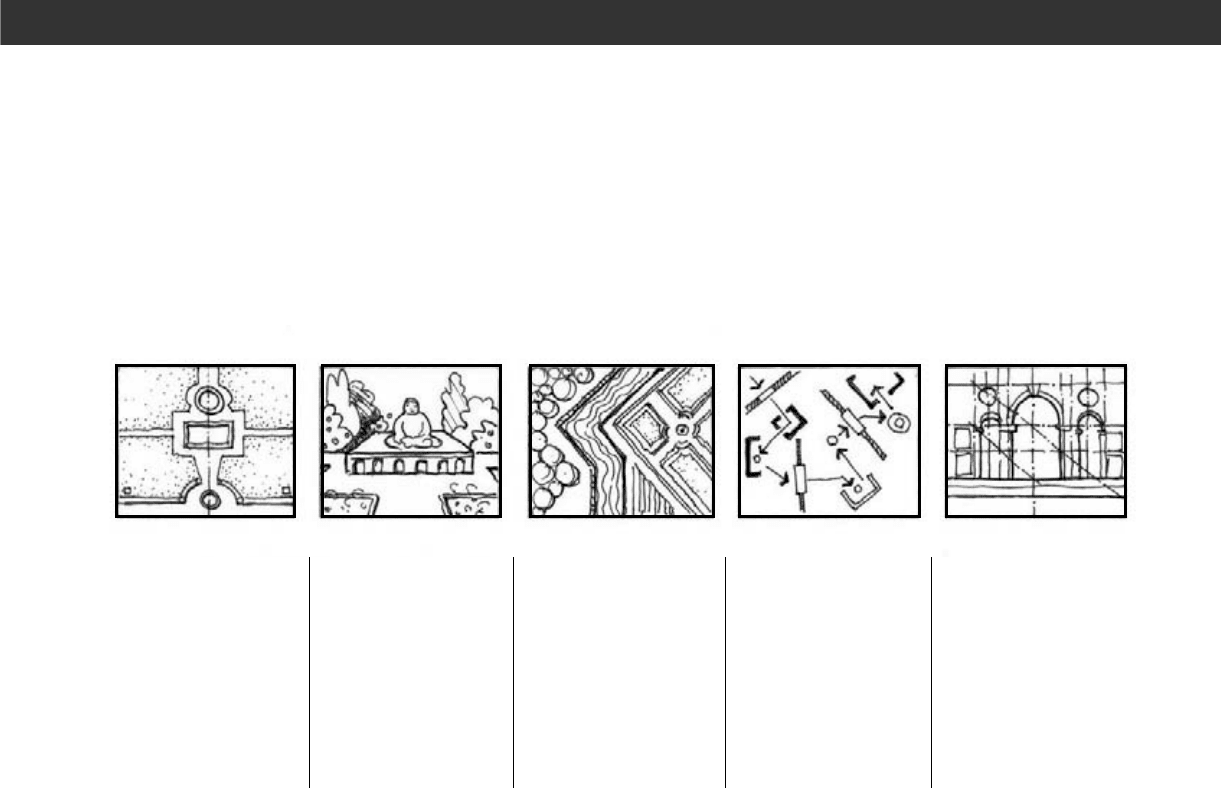
AXIAL SYMMETRY
Italian Renais-
sance gardens were
organized along
central lines of sight,
creating a geometric
ordering of space.
OCCUPYING SPACE
Timurid and Mughal
gardens provided
spaces for passive
enjoyment of the
landscape, either
on Persian carpets
or on flat, elevated
platforms called
chabutras.
BOUNDARY
French gardens were
edged by moats,
canals, and galleried
walkways, defining
ordered ground planes
within an untamed
landscape.
TRANSITION
The sequence and
progression of space
in a Japanese tea
garden represents a
psychological as well
as physical transi-
tion.
HARMONY
Palladio’s work dem-
onstrates how all
parts correspond to
each other through
harmonic ratios.
DESIGN PRINCIPLES
106
16 TH CENTURY/ CONCLUSION
DESIGN VOCABULARY
BOOKS
B
ABURNAMA (THE MEMOIRS OF BABUR)
T
HE ENCHANTRESS OF FLORENCE, by Salman Rushdie
“T
HE HISTORIES,” by William Shakespeare
T
HE LIFE OF GARGANTUA AND OF PANTAGRUEL, by Francois
Rabelais
T
HE LIVES OF THE ARTISTS, by Giorgio Vasari
O
RLANDO FURIOSO, by Ludovico Ariosto
T
HE SIXTEEN PLEASURES, by Robert Hellenga
U
TOPIA, by Thomas More
FILMS
T
HE AGONY AND THE ECSTASY (1965)
A
NNE OF THE 1000 DAYS (1969)
E
LIZABETH (1998)
T
HE RETURN OF MARTIN GUERRE (1982)
PAINTINGS AND SCULPTURE
D
AVID, by Michelangelo (1501)
M
ONA LISA, by Leonardo da Vinci (1503)
G
ARDEN OF EARTHLY DELIGHTS, by Hieronymous Bosch (1510)
T
HE SCHOOL OF ATHENS, by Raphael (1510)
S
ISTINE CHAPEL, ceiling frescos by Michelangelo (1511)
L
AURENTIAN LIBRARY (VESTIBULE AND STEPS), by Michelangelo
(1524–58)
B
AHRAM GUR IN THE TURQUOISE PAVILION, Safavid manuscript
(1524)
P
ORTRAIT OF HENRY VIII, by Hans Holbein the Younger
(1540)
S
ALT CELLAR, by Benevenuto Cellini (1540)
T
HE FOUR ACCOMPLISHMENTS, by Kano Motonobu (c. 1550)
R
ETURN OF THE HUNTERS, by Pieter Brueghel the Elder
(1565)
R
APE OF THE SABINE WOMAN, by Giovanni Bologna (1583)
F
o
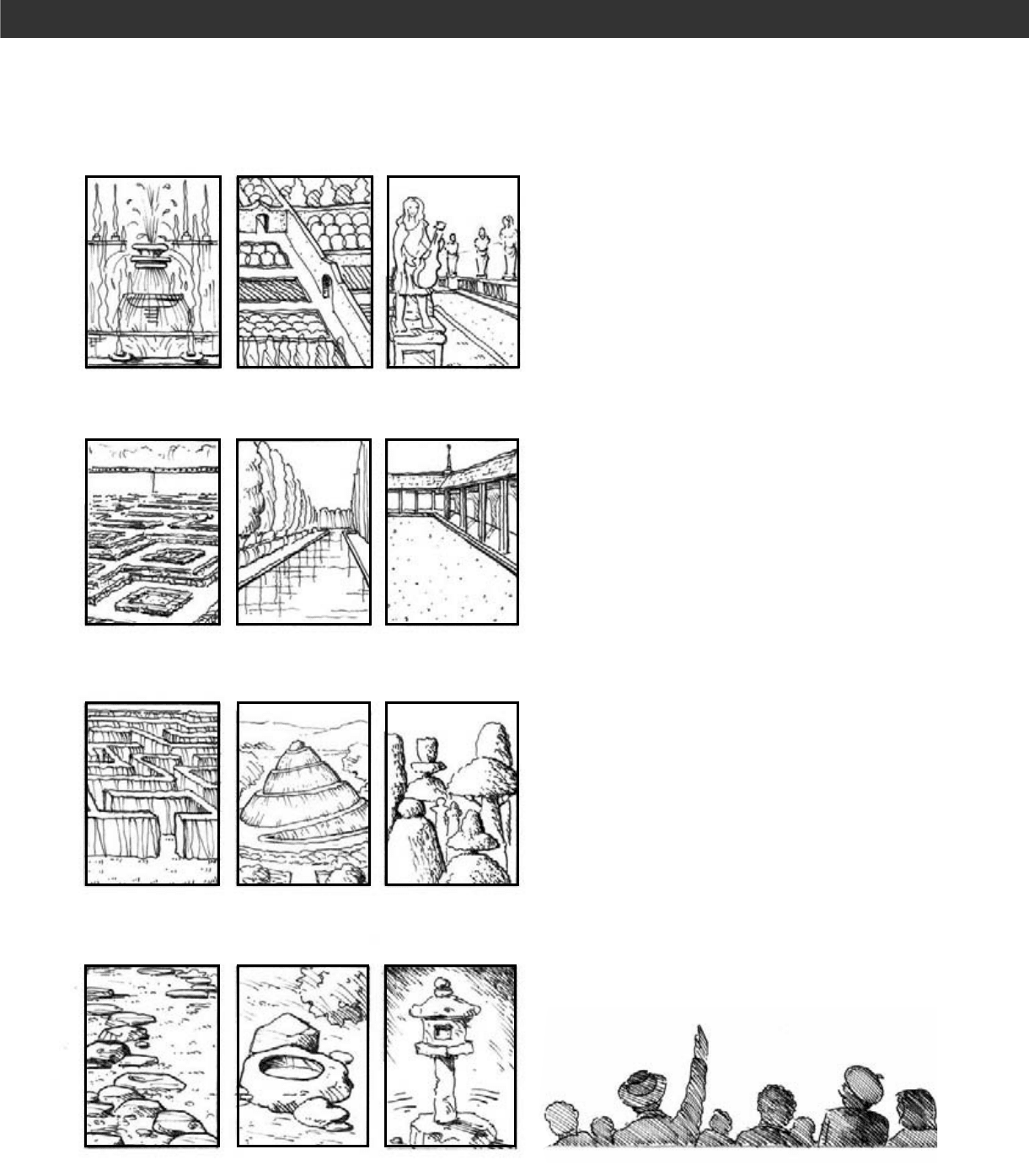
r further exploration
JAPAN
Stepping stones, Basins, and Lanterns
ITALY
Hydraulics, Compartments, and Sculptures
FRANCE
Parterres, Canals, and Galleries
ENGLAND
Mazes, Mounts, and Topiary