
Boults Е. Illustrated history of landscape design
Подождите немного. Документ загружается.

127
Porta was completed by Carlo Maderno
in 1603.
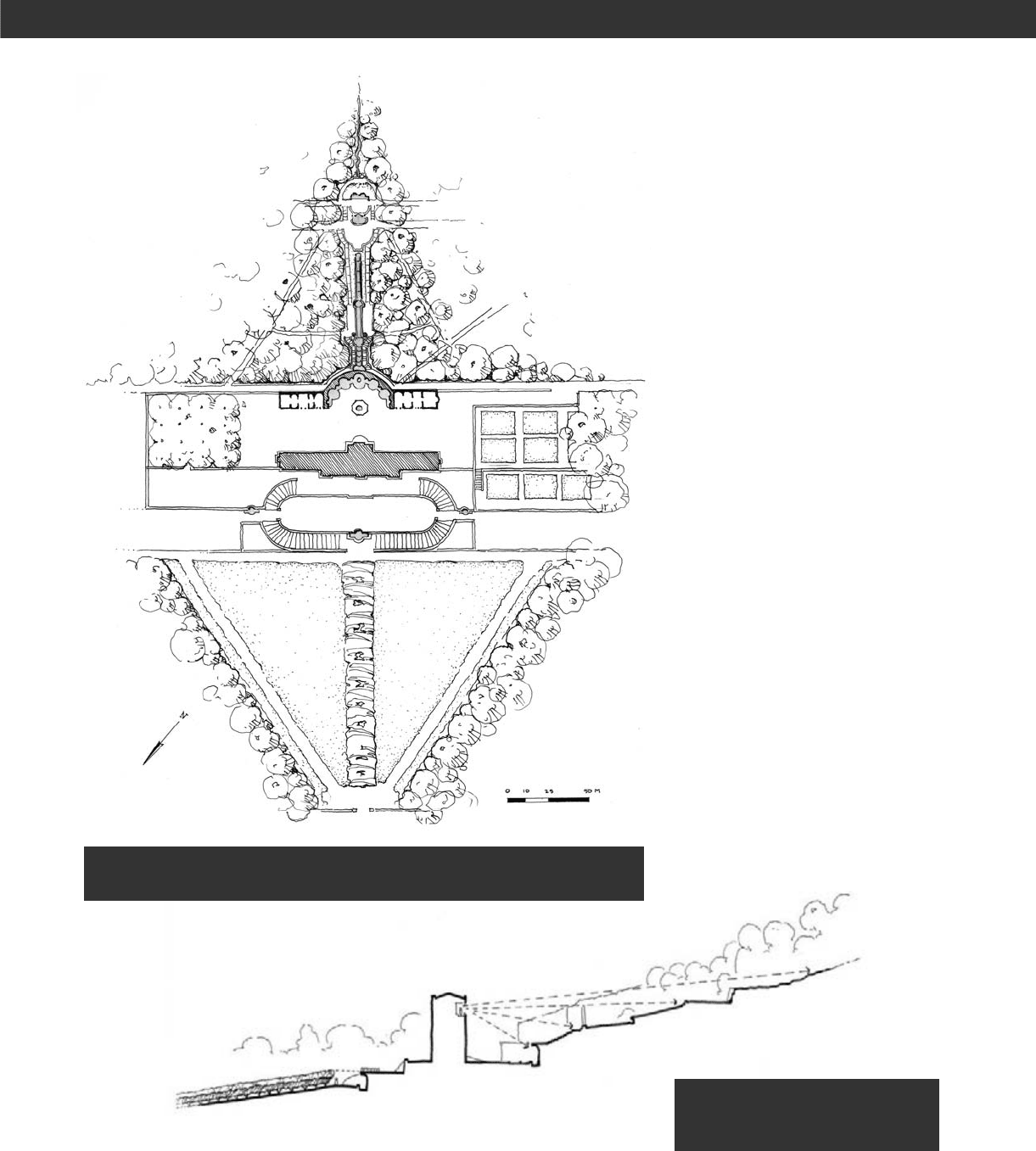
The orientation of the hillside villa is to
the northwest; views are across the
campagna toward Rome. The villa is set
on a large terrace, creating in the front
a platform to launch sight lines and
in the back a garden. The rear terrace
is carved out of the slope, forming an
exedra. The south facade of the villa,
the side toward the garden, is more
articulated and detailed than the north
facade.
The facade of the Villa Aldobrandini
has a distinctive “broken” pediment, a
Mannerist play on the classical orders.
The palazzo looks enormous, but is only
two rooms deep (a central foyer affords
views to both the garden and the city).
A long entrance allée helps merge the
huge mass of the structure into the
landscape. Movement is up along the
axis, but defl ected to the side as one
enters the villa. Originally, two small
allées bordered the path, disguising
utilitarian gardens and orchards; today,
a single massive pleached allée leads
from the town to the villa. A unique
illusion is created at the end of the al-
lée—the roof of the villa appears to sit
on top of a grotto. Curved double ramps
lead up to the forecourt and then to
the ground fl oor. Access to the piano
nobile can be made directly from the
garden level at back.
The highlight of the rear garden terrace
is the nymphaeum, or water theater.
The space is defi ned by a large semicir-
cular retaining wall, with arched niches
containing sculptures of mythological
fi gures. Atlas is at center holding up
the world, drenched by a cascade from
above. The exedra is terminated by two
pavilions, one a chapel to St. Sebastian,
the patron saint of the Aldobrandi-
nis, and the other a room of hydraulic
wonders.
17th CENTURY
/
ITALY
Toward the end of the 16th century in It-
aly, the order and clarity of Renaissance
styles gave way to a design impulse that
expressed the uncertainty and unease
felt by society. Space became ambigu-
ous, illusionistic, and distorted. Optical
tricks shook one’s belief in the order of
world. In the 17th century, Mannerist
tendencies were taken to an extreme.
Baroque styles were characterized by
a restlessness and exaggeration of
detail. The rational vocabulary of circles
and squares was supplemented by the
introduction of spiral, oval, and diagonal
geometries that kept the eye moving
through space.
DETAIL AND
DRAMA IN THE
GARDEN
Landscape space became more theatri-
cal. Italian gardens of the 17th century
were large-scale productions, no longer
limited by the conception of villa, garden,
and bosco as an ensemble complete
in itself.
21
Gardens now functioned as
places of spectacle and entertainment.
Plants and architecture became the set
decoration for fi gurative and literal gar-
den theaters. The use of sculpture and
water to animate a space was taken to
new levels.
The three gardens described next are
characteristic of the Italian Baroque
style.
VILLA ALDOBRANDINI,
FRASCATI
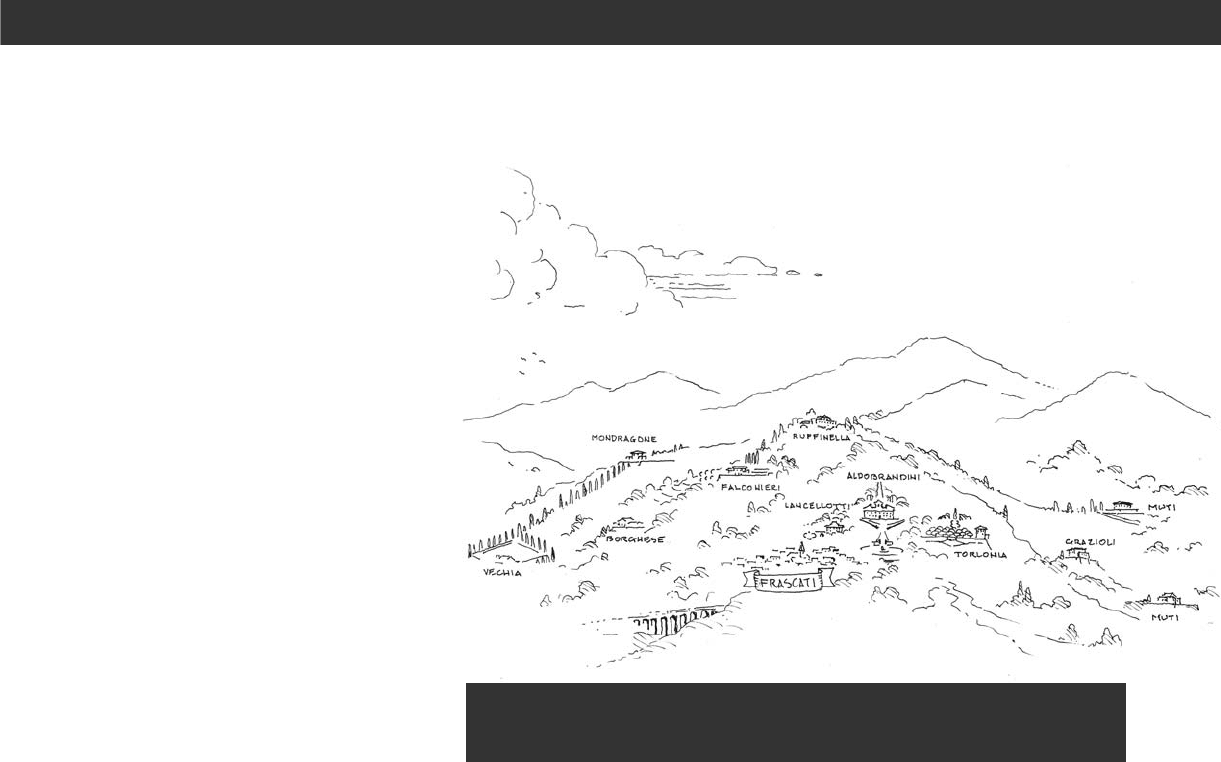
The town of Frascati, in the Alban hills
southeast of Rome, has been a popular
location for villeggiatura, or summertime
escape, since ancient times.
Cardinal Pi-
etro Aldobrandini began work on his villa,
a gift from his uncle Pope Clement VIII, in
1592. The initial work of Giacomo della
ITALIAN BAROQUE STYLES
FRASCATI VILLAS: In the 17th century, papal princes tried to outdo one another
with the lavish retreats they built in the hills of Frascati. The massive facades of
many of the villas were visible from Rome.
128
The water features at Villa Aldobrandini
were made possible by the construction
of several new aqueducts. Water was
brought to the villa from Mount Algido,
6 miles away. Giovanni Fontana and
Orazio Olivieri engineered the water-
works. The cascade begins in the woods
behind the villa, in a “natural” grotto
at the highest level, and travels down a
rough and rocky channel to the second
terrace. A “rustic” grotto on the second
terrace contains fi gures of peasants.
The water continues along a smooth
channel to the cascade, which is framed
by the twin Pillars of Hercules. Water
spirals down the columns in rills. Optical
illusions become evident: The garden
terrace disappears and the uppermost
loggias of the villa appear to hover over
the water staircase, framed by the
pillars. Conversely, from the villa, the
watercourse, hemmed in by the woods,
appears much closer.
The Pillars of Hercules represented the
edge of the known world in antiquity.
In that context, the design of the Villa
Aldobrandini could be understood as an
axis mundi, a metaphor for the rela-
tionship between heaven and earth.
23
The villa marks the threshold between
paradise (the river of life springing from
the grotto in the woods) and the world
(the city of Rome in the distance).
BAROQUE GEOMETRY: The design of Villa Aldobrandini incorporates site planning
principles and architectural features that are typical of Frascati villas.
22
OPTICAL TRICKERY: Terrain was
manipulated to create spatial illu-
sions at Villa Aldobrandini.
17th CENTURY
/
ITALY
129
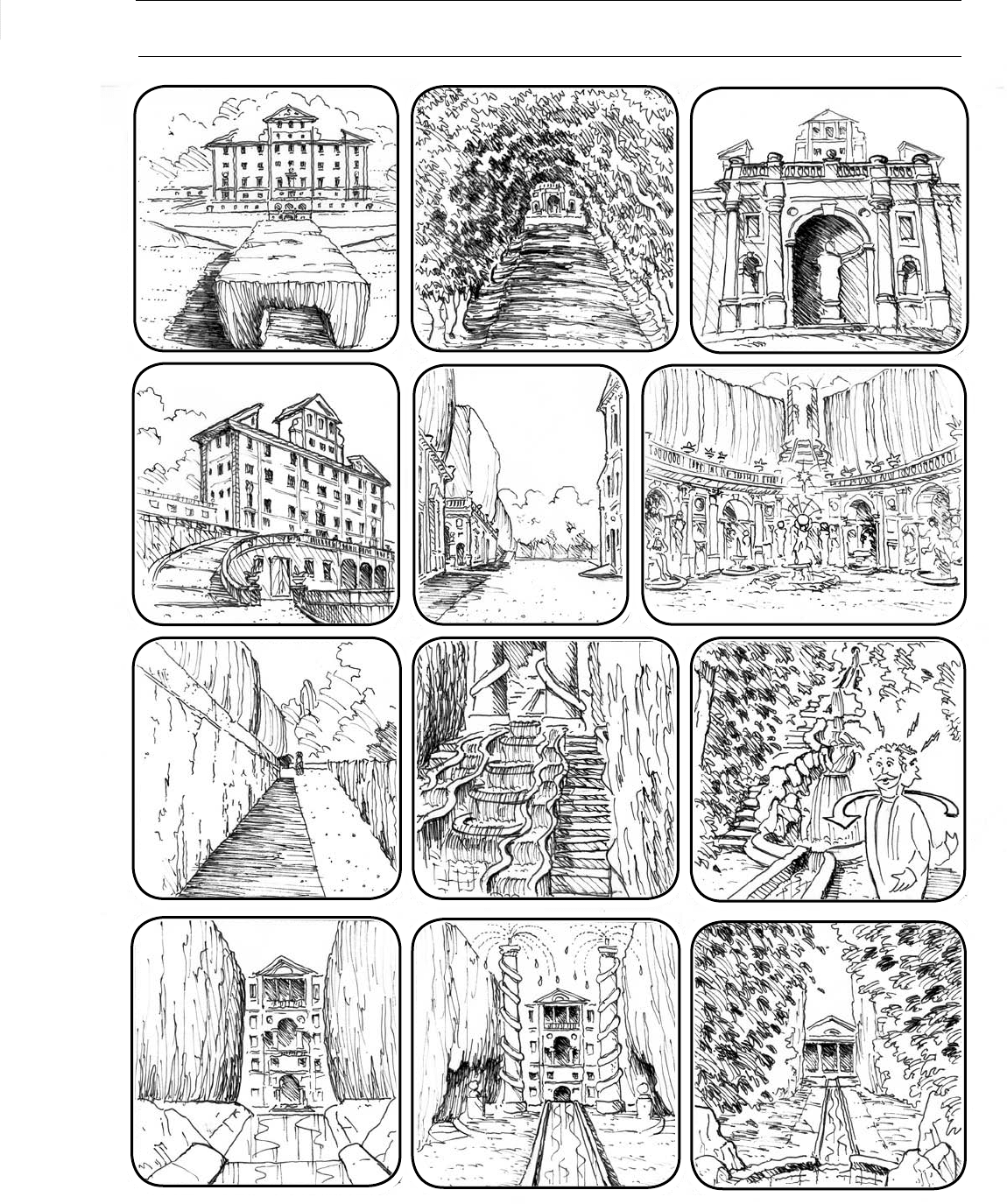
VISUAL NARRATIVE: Villa Aldobrandini
130
BOBOLI GARDENS, FLORENCE
Niccolo Tribolo began laying out the
gardens behind the Pitti Palace in
1549, shortly after the property
was acquired by Cosimo I de’ Medici
(1519-1574). As illustrated in a lunette
painted by Giusto Utens at the end
of the 16th century, the topography
behind the palazzo was manipulated
to form a “natural” amphitheater. A
large fountain of Oceanus can be seen
on the axis. The gardens celebrated
the water that Cosimo brought to
Florence through his construction of
aqueducts.
24
Additions to the gar-
dens continued throughout the 16th
century. Ammannati extended the
palace in 1558, adding a courtyard and
a grotto. To commemorate the wedding
of Cosimo’s son, Francesco, in 1565,
Giorgio Vasari built a corridor that
linked the palace with the Palazzo della
Signoria across the Arno.
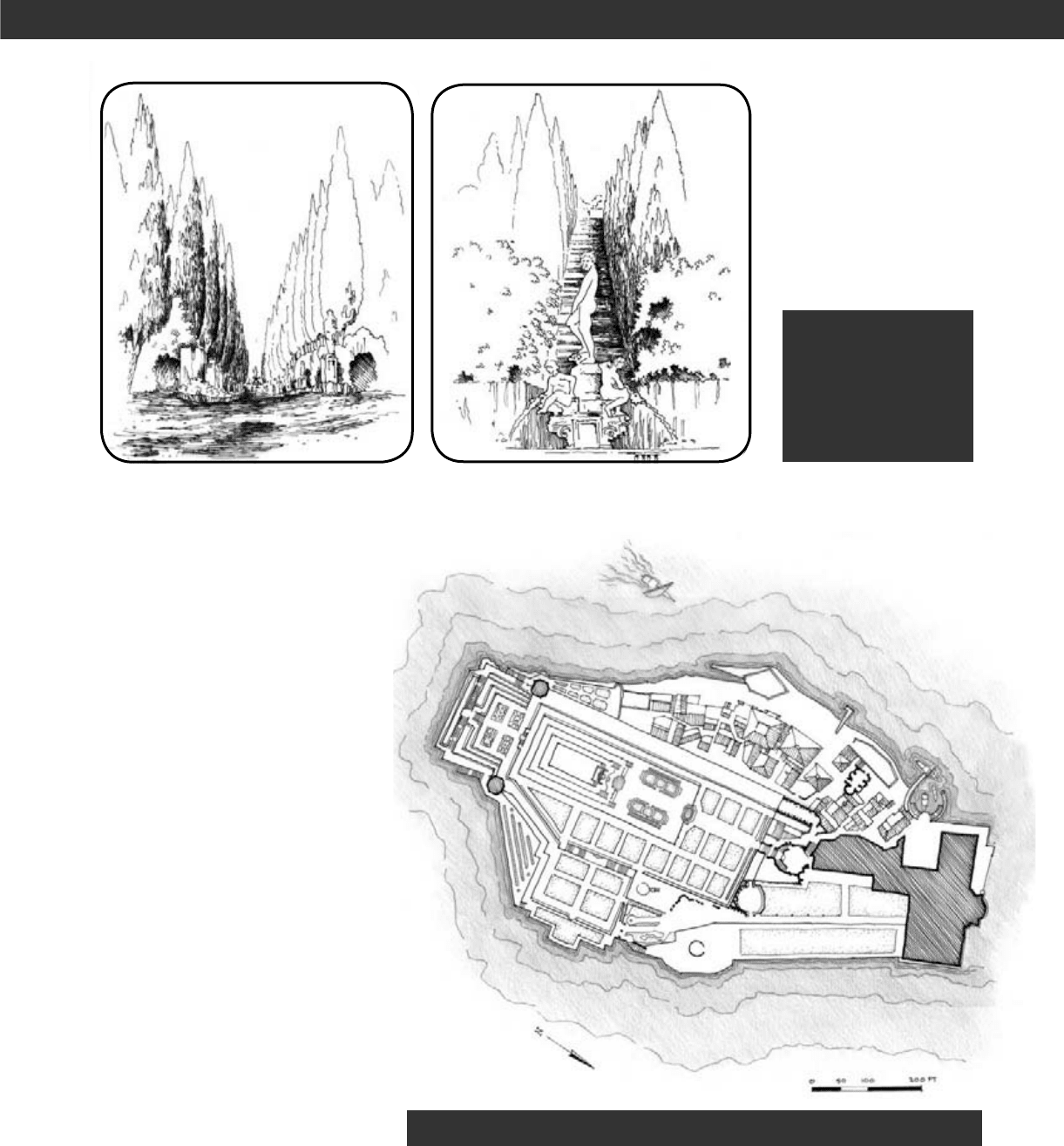
Beginning in 1618, Giulio Parigi and
his son Alfonso extended the garden
along a subsidiary axis on the western
portion of the site. Called the Viot-
tolone, the dramatic, cypress-lined
avenue leads down a slope to the
Isolotto. Here, an oval pond contains
an oval-shaped island and the colossal
Oceanus sculpture formerly located
within the grassy amphitheater. The
island, inspired perhaps by Hadrian’s
Maritime Theater, is surrounded by a
stone balustrade and evenly spaced,
potted citrus trees. Two bridges con-
nect to the isolotto along the path of
the axis. The space is surrounded by a
dark green clipped ilex hedge.
The Parigis added stone seats to Tribolo’s
arena, creating a proper amphitheater
and a more formal venue for the fetes,
masques, horse ballets, and wedding
celebrations staged by the Medicis. They
also continued work beyond the amphi-
theater, adding a horseshoe-shaped
terrace with a Fountain of Abundance at
the upper limits of the original axis.
From the piano nobile of the Pitti Palace,
views seem to extend indefi nitely along
the axis of the amphitheater. The wings
of the building appear continuous with
the landform. From the reverse view, the
distance seems compressed, the sunken
courtyard becomes invisible, and the
building becomes a ledge for views to the
Arno valley. These optical illusions are
typical Baroque tricks, refl ective of the
subversive attitude toward order that
characterized the era.
17th CENTURY
/
ITALY
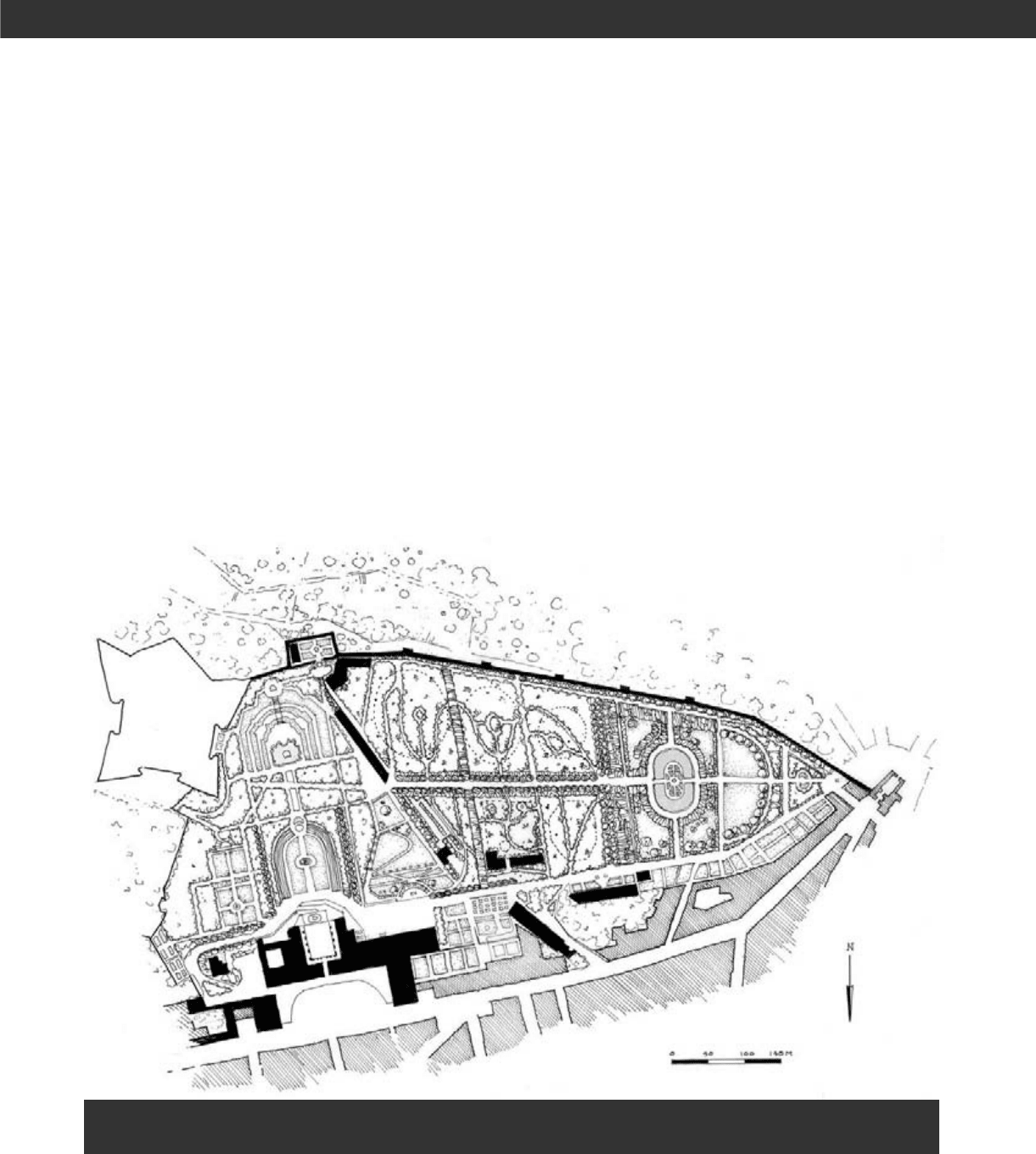
BOBOLI GARDENS, FLORENCE: The garden was enlarged in the 17th century, its redesign expressing a Baroque taste for the-
atrics and display.
131
ISOLA BELLA, LAGO
MAGGIORE
The palace and terraced gardens that
comprise Count Carlo Borromeo’s
confection on Lago Maggiore were begun
in 1630. The architectonic fantasy
took over 40 years to complete. Early
sketches show Isola Bella as a rigid
shiplike form, but some features, such
as the “prow” of cypresses, were never
constructed.
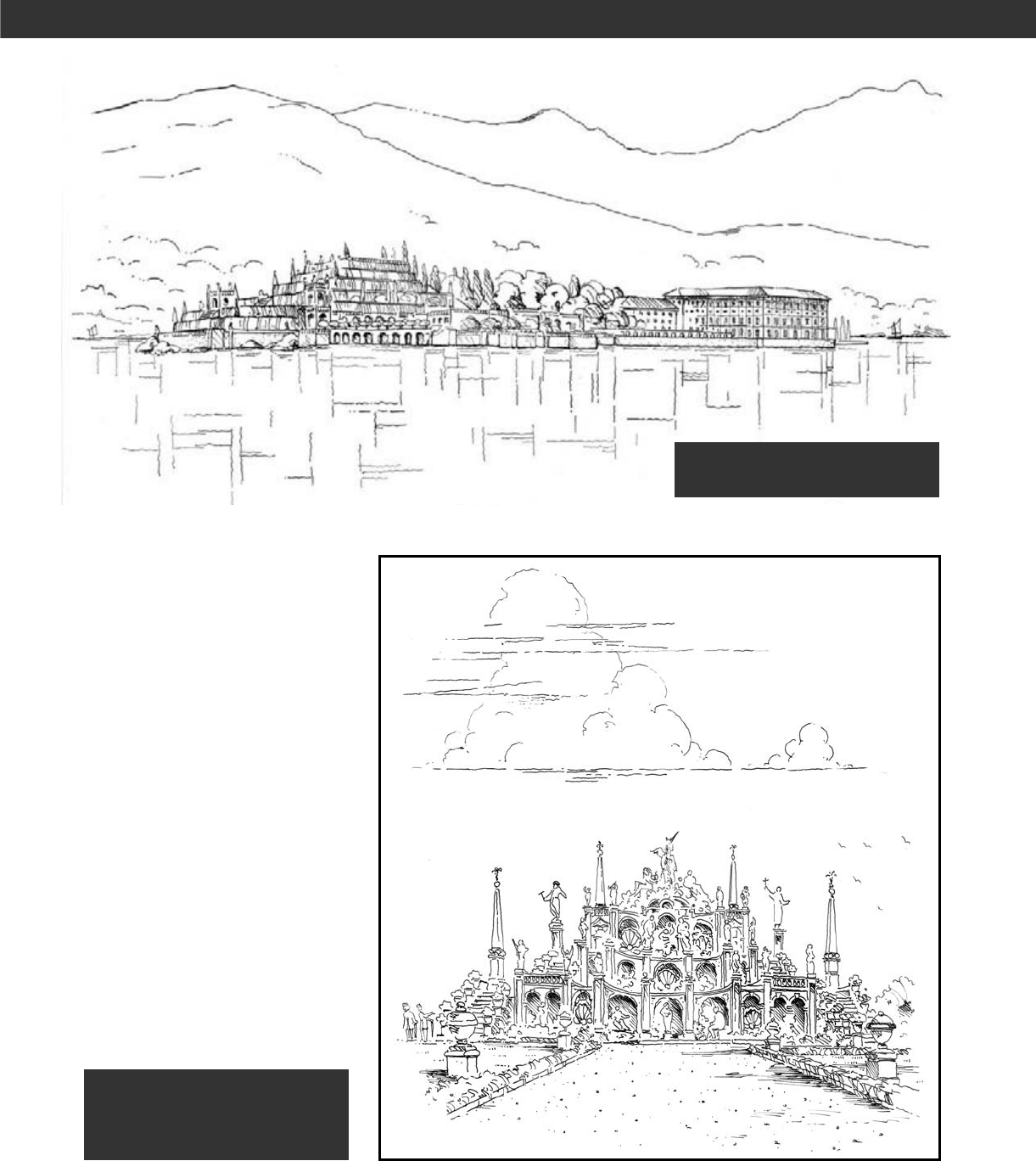
The palace complex occupies the north
end of the island. A fi shing village lies to
the west. The south end of the island
contains 10 rectangular garden terrac-
es. But the axial alignment between the
palace and garden could not be made
symmetrical. The offset is disguised by
curving stairs that accommodate the
displacement: The steps on the east
side have wider treads and meet the
steps on the west side at a point past
the centerline.
Entrance to the gardens is through a
courtyard at the back of the palace,
where a sculpture of Diana catches a
glimpse of herself in a basin. The curving
steps and staircases lead to the ter-
race of the camphor tree, on deck six. A
large concave/convex staircase is cen-
17th CENTURY
/
ITALY
VIOTTOLONE ILLUSIONS:
Looking down the Viotto-
lone toward the Isolotto
space seems to expand;
yet looking back up the
allée, the distance ap-
pears compressed.
ISOLA BELLA, LAGO MAGGIORE: The main organizing axis is tilted to the west.
132
17th CENTURY
/
ITALY
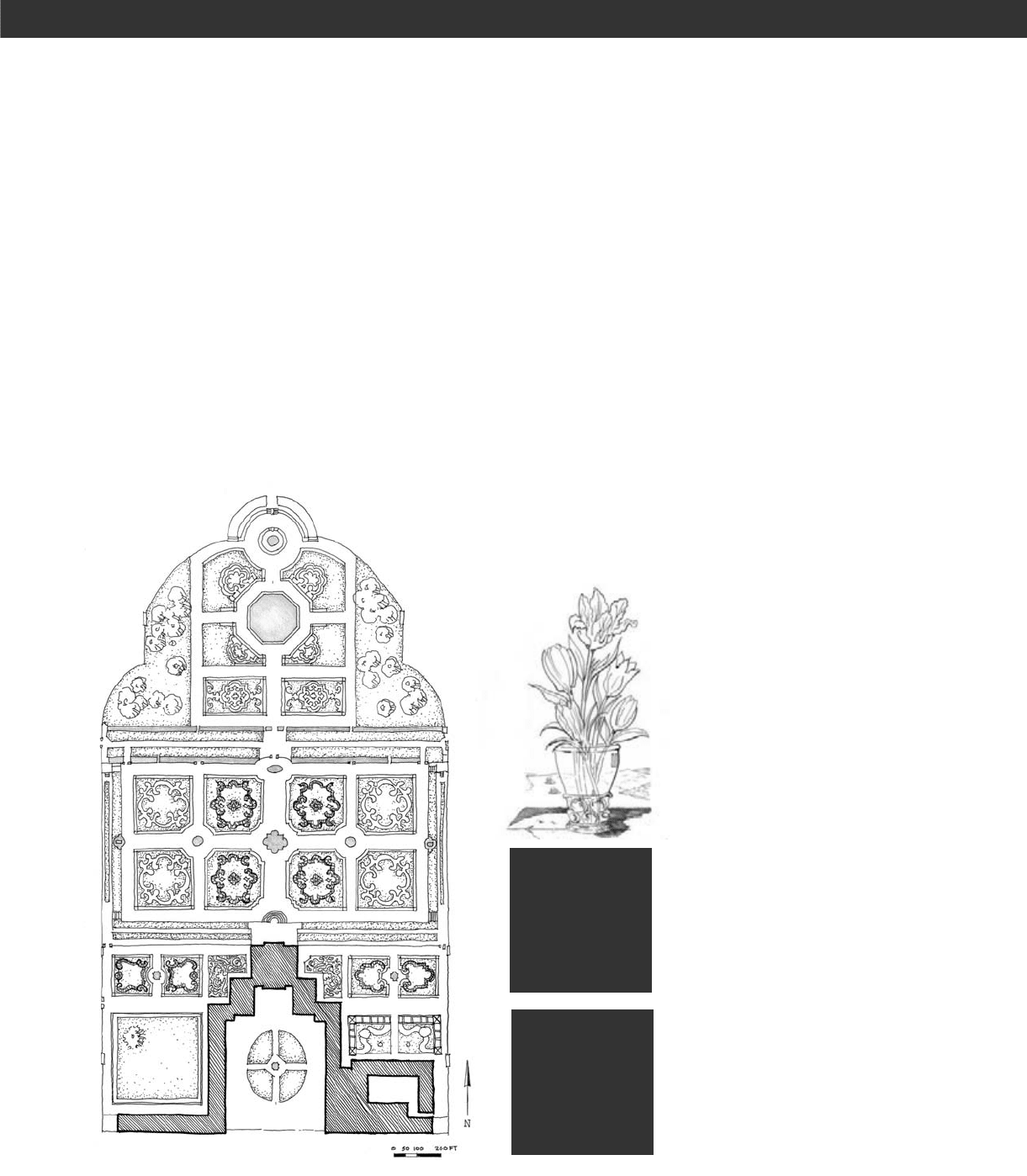
FANTASY ISLAND: Isola Bella was
always intended to look like a galleon.
WATER THEATER: A terraced exedra
of arched niches is decorated with
shells, pinnacles, nymphs, and cher-
ubs at Isola Bella.
tered on the amazing water theater and
crowned with a unicorn, the Borromeo
herald. The uppermost terrace behind
the water theater affords breathtaking
views of the lake and the Swiss Alps.
On the south end, octagonal pavilions
anchor the widened fi fth terrace. The
top fi ve levels are oriented with their
long sides perpendicular to the lower
terraces, elongating the garden toward
the palace. The terraces contain par-
terres of lawn and fl owers; peacocks
roam free. Every platform is a stage, but
the water theater is the star.
In typical Baroque fashion, proportions
are distorted. The verticality is over-
whelming, creating a sense of tension
with the horizontal planes. Typical
compositional principles of foreground-
midground-background are unsettled by
the villa’s position on the lake.
25
Water
is the intermediary zone. The island con-
fi nes the visitor, but not the view.
133
After the peace of Westphalia liberated
Holland from Spanish control, the country
emerged as an economic power in the 17th
century through the formation of interna-
tional trading companies and banks. For
the most part, Dutch gardens refl ected
the modest tastes of the middle-class
merchants who built them, and not the
affectations of an elite aristocracy.
26
By
the 17th century, an enthusiasm for horti-
cultural science developed in the Nether-
lands, building on the research conducted
in early botanic gardens. Bulbs, and tulips
in particular, were collected with passion.
The enduring love of fl owers is evident in
Dutch garden design.
17TH CENTURY
/
THE NETHERLANDS
THE FLOWERING OF THE DUTCH LANDSCAPE
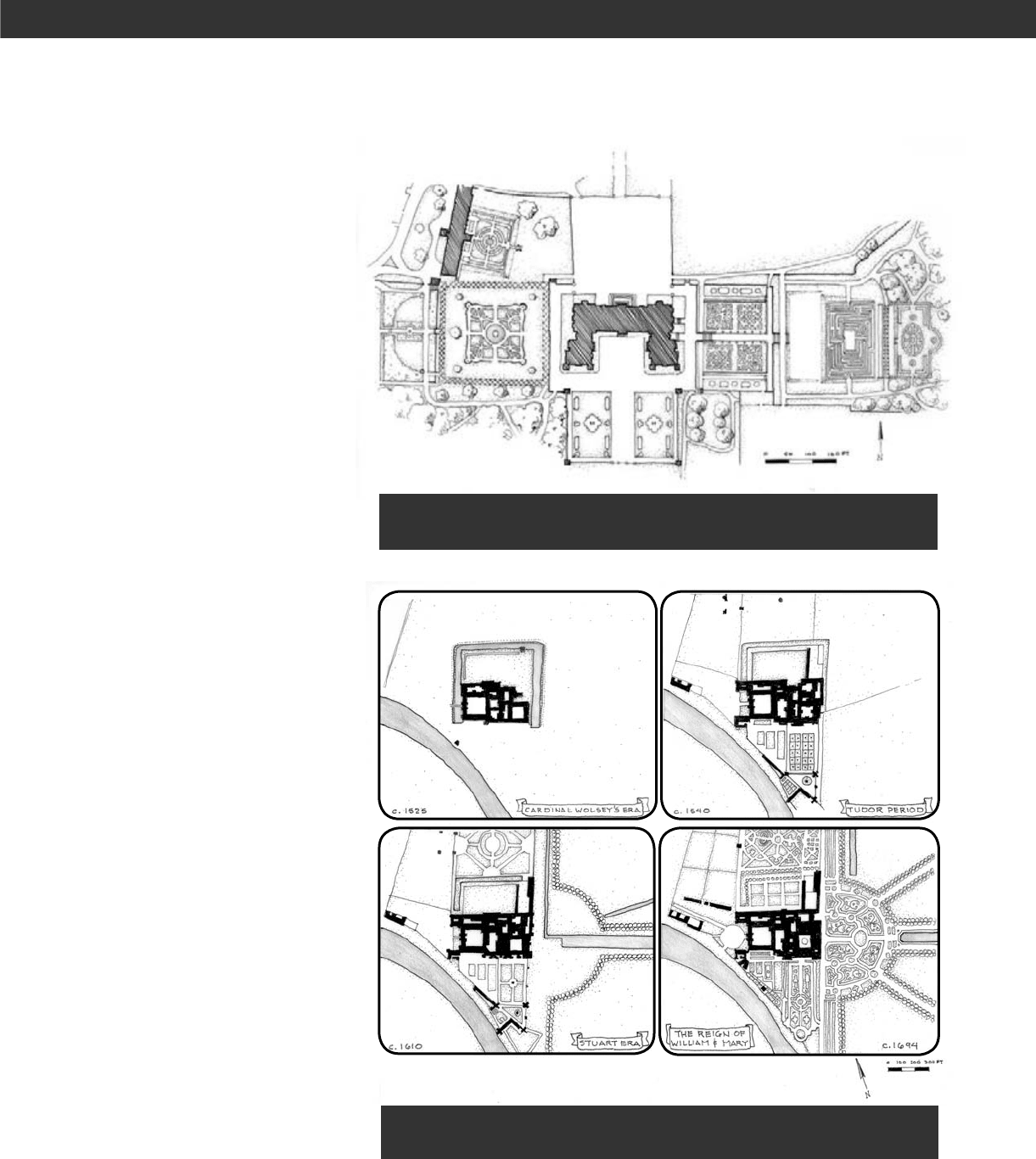
HET LOO: The
15-acre Great
Garden, directly
behind the palace,
is divided into
lower and upper
sections.
Dutch garden styles continued the
Italian Renaissance tradition of com-
partments and formal geometries, the
orthogonal division of space well suited
to the rectangular patterns of land
formed from dykes and canals. Vernacu-
lar elements included wooden gazebos
and berceaux (vault-shaped trellises),
parterres de pieces coupées (patterns
made primarily with fl owers), canals
(both functional and ornamental), and
large basins of still water (abundant,
of course, in the fl at Low Countries).
Stationary decorations (potted plants,
topiary, statuary) magnifi ed the static
quality of space. The protracted avenues
of the French Baroque were incompatible
with the Dutch landscape and mind-set.
But French infl uence can be seen in the
intricate ornamentation within the Ital-
ian Renaissance framework.
TRIM AND TIDY
LANDSCAPES
Het Loo, the royal palace of William and
Mary, exemplifi es 17th-century Dutch
garden style. Prince William was a provin-
cial governor from the House of Orange;
his wife, Mary, was the daughter of King
James II of England. Garden construc-
tion began in 1686 in conjunction with
the planning of William’s hunting lodge.
Dutch architect Jacob Roman and French
architect Daniel Marot collaborated on the
design. Marot was a Huguenot who fl ed to
the Netherlands after Louis XIV expelled
the Protestants from France. His infl uence
can be seen in the parterre design and the
expansiveness of the upper garden. Addi-
tional work was done on the gardens after
the coronation of William and Mary as king
and queen of England, in 1689. The garden
was completely destroyed during the 18th
century when Louis Napoleon covered it
over to build a picturesque, English-style
garden. Restoration of Het Loo to its
original form began in 1979.
The U-shaped lower garden is defi ned by
raised walkways on three sides, opening
to an oak-lined cross-avenue. The garden
contains intricate parterres de brode-
rie;
27
sculptures mark the intersections
of the pathways. The interior decora-
tion of the palace echoes the elaborate
arabesque patterns in the King’s and
Queen’s Gardens located on either side of
the palace, below the royal apartments.
Rectangular planting bands around the
parterre displayed new plant species
between clipped evergreens.
The large upper garden was built in 1689,
refl ecting the new trend toward spacious-
ness. Grass parterres continued the
strict geometry and formal symmetry
about the central axis. The enormous
King’s Fountain, fed by a natural spring,
marks the center. A semicircular colon-
nade terminates the axis; a previous
confi guration of the colonnade created
an axial vista to a distant obelisk. The
gardens at Het Loo contain numerous
fountains, canals, and cascades.
TULIPMANIA:
Speculation in tu-
lip markets drove
prices to exorbi-
tant levels; for-
tunes were made
and destroyed.
134
D
utch, French, and Italian infl uences
can be seen in 17th-century English
gardens. During the reign of William
and Mary, garden spaces displayed a
compactness characteristic of Dutch
gardens. Emphasis was on the planting
of fl owers, particularly tulips, as well
as the creation of topiary forms. At
the same time, a classical sensibility
informed the architecture of the period,
based on the work of Inigo Jones, who
had studied in Rome.
England saw an infl ux of French Hu-
guenot refugees, as did other northern
countries. These artists and craftsmen
transported continental design ideas,
as well as new plants, across the chan-
nel. New varieties of fruit trees were of
particular interest to the English. They
adapted the French idea of the vista,
too, but the terrain of England did not
permit infi nite views. Parterres were
also popular, particularly patterns cre-
ated solely with grass and gravel.
Representative examples include Hat-
fi eld House and Hampton Court.
HATFIELD HOUSE,
HERTFORDSHIRE
Robert Cecil was given Hatfi eld House
in exchange for a property he owned
that was coveted by King James I.
In 1611, Cecil began rebuilding Hat-
fi eld House. He laid out the gardens
around a north-south axis. The house
sits between a spacious balustraded
forecourt and rear terrace. Garden
courts and terraces to the east and
west form a cross-axis. A path from a
formal parterre on the east side leads
to a bowling green and maze. The gar-
den rooms illustrate the continuation
of Italian Renaissance styles. Water
features were designed by Salomon de
Caus. Exotic plants were provided by
John Tradescant, the elder.
28
Pleasure gardens such as Cecil’s were
popular until Cromwell turned the
country’s attention to more practical
forms of horticulture, enlarging farms
17th CENTURY
/
ENGLISH GARDENS
A RESTRAINED MIX OF EUROPEAN STYLES
HATFIELD HOUSE, HERTFORDSHIRE: The county manor is typical of early (Pre-
Restoration) 17th-century estates.
HAMPTON COURT: William and Mary’s addition to the palace refl ected compact,
colorful Dutch styles.
135
and improving agriculture. Many of the
manor houses were destroyed during the
Commonwealth of 1649–1660.
HAMPTON COURT, MIDDLESEX
(LONDON)
Charles II returned from exile in France
and was restored to the throne by a
reconvened parliament in 1660. He ap-
pointed two French designers, Gabriel
and Andre Mollet as royal gardeners,
hence French formalism and spatial
defi nition were imported to Britain.
29
William and Mary later enlarged Hamp-
ton Court, adding a new block designed
by Christopher Wren to the eastern part
of the castle. Henry VIII’s tudor gardens
were altered to refl ect Dutch styles.
Modifi cations made to Hampton
Court by Charles II include the Broad
Walk, Long Canal, and patte d’oie. The
tree-lined Broad Walk along the east
front of the palace projects out into a
semicircular allée that intercepts the
three arms of the patte d’oie—the
goosefoot pattern of radial avenues
designed by the Mollets. The Long Canal
is an extension of the central toe of the
patte d’oie. The Great Fountain Court,
designed by Daniel Marot, dates from
the reign of William and Mary. Contained
within the semicircular allée were par-
terres de broderie, topiary, fountains,
and many sculptures. Late in his life
William added the Chestnut Avenue to
the north side of the palace, adjacent
to the Wilderness. Queen Anne (ruled
1702–1714) obliterated any trace of
Dutch garden styles, grassing over the
parterres and removing fountains and
topiaried trees.
17TH CENTURY
/
ENGLISH GARDENS
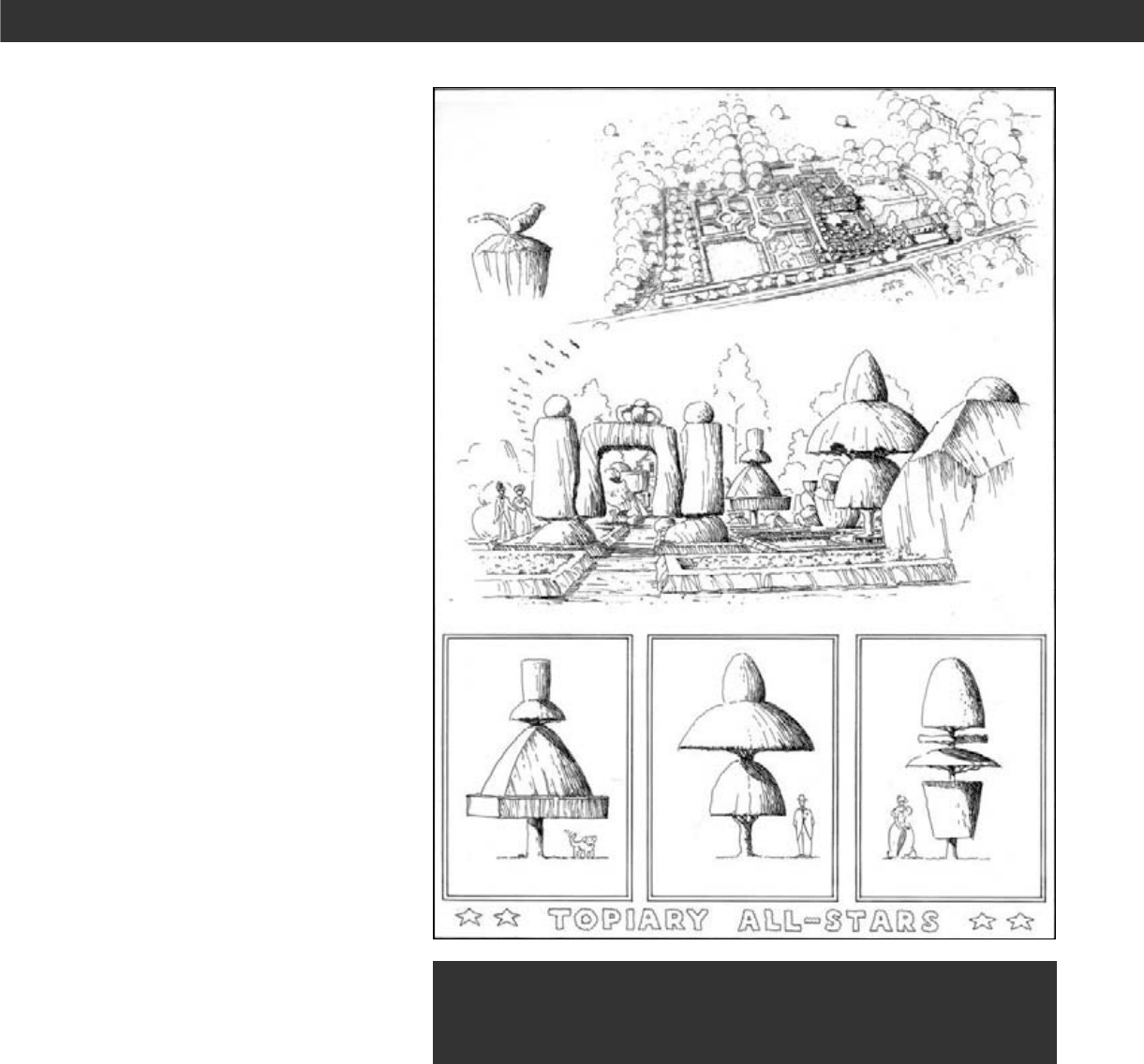
LEVENS HALL, CUMBRIA: The famous topiary garden was laid out in 1694 by Guil-
laume Beaumont, gardener to King James II. The plan also included a rose garden,
orchard, nuttery, herb and vegetable gardens, bowling green, and a massive beech
hedge.
136
In 17th-century France, people’s at-
titudes toward nature changed. Nature
was not considered beautiful until hu-
man order was imposed upon it: Shrubs
were clipped into hedges, trees trimmed
to form palissades, contours graded
with precision, rivers diverted, lands
inscribed with straight paths and allées,
and the ground decorated with par-
terres de broderie. Parterres were best
appreciated from a high vantage point,
hence the house gained new author-
ity as the symbol of visual control in a
garden.
ENDLESS
HORIZONS
Axial extensions out into the landscape
created a new relationship between
building, garden, and landscape. A
spatial dynamic developed based on
breakthroughs in physics and math-
ematics. The mathematics of infi nity
as developed by Rene Descartes implied
“limitless” space.
30
A horizon was rec-
ognized as being dependent upon one’s
point of view. Landscape designers
applied the science of optics (involving
refl ection, refraction, and geometry)
to the creation of perspectival space,
expressing the ultimate control and
power that humans had over nature.
The large-scale manipulation of the
landscape that characterizes French
classical gardens had much in common
with the theory and practice of 17th-
century military engineering. French
military engineers were the fi rst to deal
with massive earthworks. A fortress,
like a garden, is geometrically controlled
space. To ensure security, all parts
must harmonize; there can be no weak
spot in a defensive fortifi cation.
31
In ad-
dition, when distances become so great,
measurement becomes crucial. The
incredible precision with which landscape
designers created fl at terraces and ca-
nals was made possible by the advanced
instrumentation and mathematics of
military engineers.
The popularity of the Italian Baroque
style remained centered around Rome
during the Counter-Reformation. Other
European capitals also adopted Ba-
roque design vocabularies to express the
dynamism of a world in motion. The 17th-
century French garden, on the other
hand, was inspired by ideals of grandeur
and monumentality represented by
classical civilization. Louis XIV compared
himself to Augustus; he wanted to cre-
ate the new Rome.
17th CENTURY
/
FRENCH CLASSICAL GARDENS
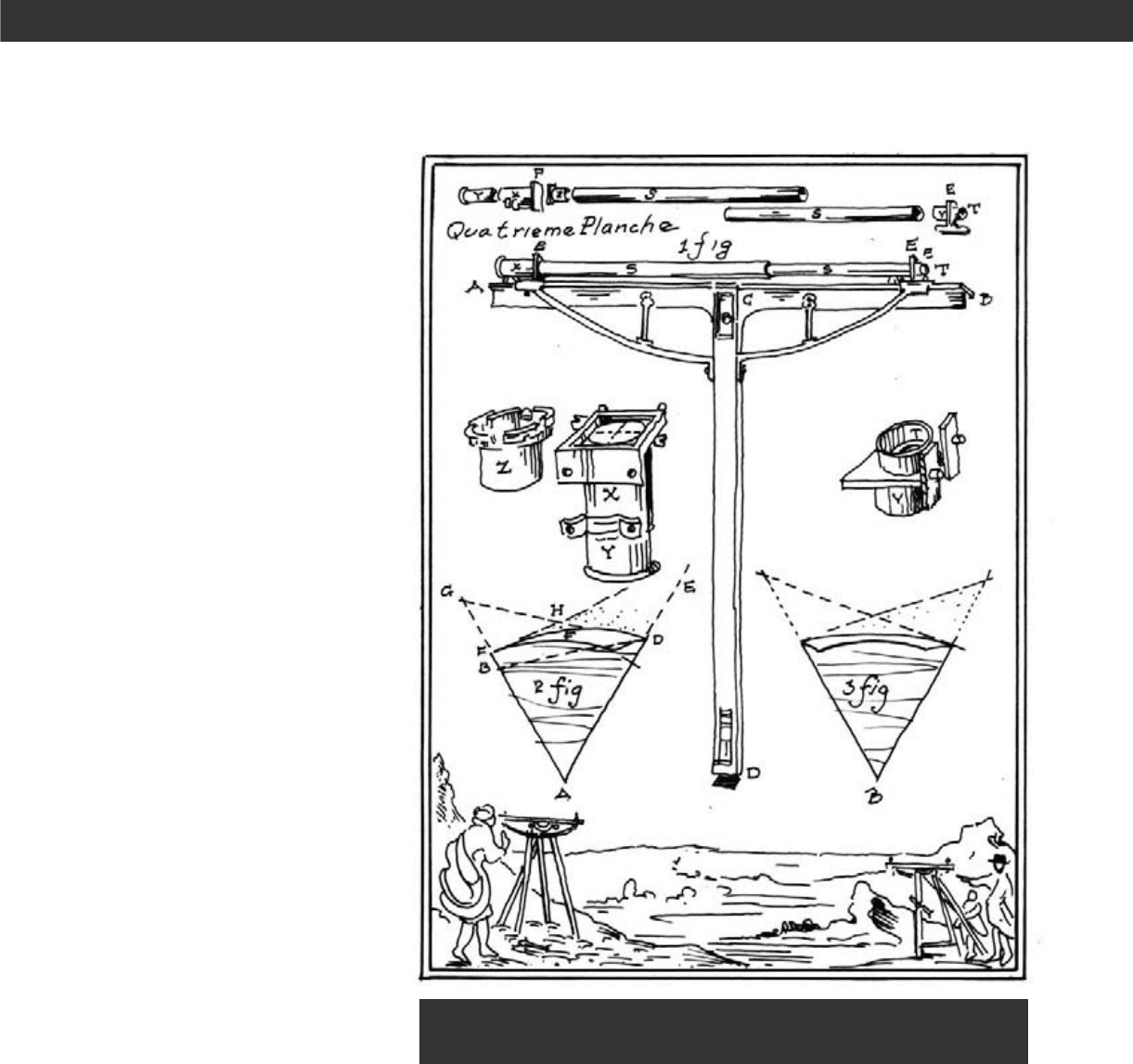
INSTRUMENTS FOR CALCULATING LEVELS, c. 1694: Large-scale earthworks were
made possible by advances in military engineering.
THE CONTROL OF NATURE