
Brown R. Society and Economy in Modern Britain 1700-1850
Подождите немного. Документ загружается.

The expansion of goods carriage after 1750 was not so spectacular as the growth of passenger traffic because a well
developed traffic already existed. However, there can be little doubt that the road system as a whole performed an indispensable
function, bearing the considerable traffic in all kinds of industrial material and products. The number of carrier firms
increased after 1750. In London in 1680 there were 322 distinct carrier services. This had only increased to 353 by 1790 but
had more than doubled to 735 by 1823. Exeter had three times as many firms in 1831 than in 1792. The most dramatic growth
was in the Birmingham area, where there was a fivefold increase between 1790 and 1830. The significance of this increase—
some 131 per cent in the ten largest cities—has to be placed against the 800 per cent increase in coaching traffic between 1790
and 1830 and the 120 per cent growth in population. The number of carriers barely kept up with the increase in population, a
situation exacerbated by the increase in canal and coastal traffic with which they were unable to compete. Unlike stage-
coaching, road goods haulage was dominated by small family businesses, particularly in the provincial centres, and it was
often unable to compete with coastal or canal transport. In 1822 the Leeds directory lists 163 haulage firms of which 131 were
small businesses operating between Leeds and the surrounding villages. Only 32 concerns, including Pickfords, provided a
long-distance service. Hull, by contrast, was completely dominated by small firms. JPs could, between 1692 and 1827, fix
haulage rates in their counties. In practice, however, the absence or presence of alternative carriers determined freight
charges.
The challenge of railways
Roads and road traffic were ill-equipped to meet the challenge of the railways. Turnpike trusts operated on a scale too small to
be run economically. Amalgamation, an effective remedy, came very slowly. From 1806 there were numerous parliamentary
inquiries into turnpikes and in 1844 Parliament endorsed the findings of a Royal Commission which recommended
consolidation under county authorities. By 1850, however, only the six counties of South Wales (1844) and the Metropolitan
Turnpike Trust (1826) had achieved this. The decline in long-distance stage-coaching, which contributed more than anything
else to the revenue of turnpike trusts, led to a fall in total revenue between 1837 and 1850 of a third. The 29 coaches that plied
between Liverpool and Manchester had been reduced to four within five months of the opening of the railway in September
1830. Within three months of the opening of the London to Birmingham railway the 22 coaches that operated this route had
been reduced to four. Coaching remained—long-distance in parts of Wales, Scotland and Ireland—but it was relegated to
filling the gaps where the railways did not run or providing haulage to the railway stations. The triumph of the railways took
longer in haulage than with passengers. The demand for sheer horsepower increased in the constructional stages of the
railways. Pickfords and Chaplin & Horne deliberately dovetailed their operations with railways—Chaplin so well that he
became chairman of the London & South Western Railway. By 1850 roads had generally given way to rail.
Well before 1700 a variety of efforts had been made to break through the constraints imposed by poor road
communications by turning to water transport particularly for the movement of heavy, bulky goods. Improving rivers to make
them more navigable and the use of coastal transport were two ways of achieving this as were canals from the second half of
the eighteenth century.
CANALS
Improvements to rivers
Improving Britain’s rivers was a continuous process dating back to the second half of the sixteenth century.
15
The state’s role
was limited to approving schemes and protecting the interests of the various parties affected. England’s rivers were chiefly
maintained by Commissioners of Sewers who could compel riparian owners to clear their stretches of a river or could levy a
rate to do this. The legal powers of the Commissioners did not stretch to improvements like locks, dredging, new cuts and the
regulation of weirs, and responsibility for this was given to separate bodies or individuals by letters patent or more usually by
Parliament. Change was promoted and finance provided by local efforts. There were spurts of state approval for river
improvements throughout the seventeenth and early eighteenth centuries—1634–8 (by letters patent for the Great Ouse, Lark,
Tone, Stour and Soar); 1662–5 (more than a dozen were authorized —most important on smaller rivers in the Severn basin
and for the Welland and Great Ouse into the Wash); 1670s (the Fal, Wey, Witham, Waveney and Bedfordshire Ouse); 1697–
1700 (schemes for rivers further north, the Aire and Calder, Trent and Dee and in the south the Yar, Tone, Lark and Bristol
Avon); 1719–21 (in the north, the Douglas, Derwent, Idle, Irwell, Mersey, Weaver, Dane and Eden). By 1720 over a thousand
miles of improvements had been sanctioned and even though some important work took place after 1720 the scope for further
advance was limited and providing more navigable water meant canals.
Improvements such as these were often piecemeal when seen from a national perspective. Sums invested were small and
the burst of legislation between 1697 and 1700 and 1719 and 1721 can partly be explained by low interest rates. Unlike
86 THE REVOLUTION IN COMMUNICATIONS—LAND AND WATER
turnpikes the money was on the whole well spent. Like turnpikes, promoters were often motivated by local considerations. The
main reason for the promotion of navigations, especially the later ones, was to secure or to distribute supplies of coal, wool,
lead, timber, iron and cloth. The Aire and Calder, the Don, Weaver and Mersey were made navigable primarily in the interests
of industries in which coal was a crucial factor. Dyos and Aldcroft recently commented that ‘It is generally true to say that
coal was the dominant influence on the development of the whole programme of inland waterways, of rivers as well as
canals.’
16
River improvements and later canals sought, however, indirectly, an outlet to the sea. Coastal shipping, working through
small ships in and out of dozens of ports and harbours that lined the coasts of Britain and Ireland, provided an outlet for local
products, together with the means by which foreign goods could be distributed from the larger ports. In 1768 Baldwin’s
London Directory named 580 places in England and Wales to which goods could be sent by water. The transport of coal
dominated coastal shipping. Between 1670 and 1750 40 million tons of coal was brought to London. Coal from South Wales
found a sale from Cardigan in the north to Plymouth and Exeter in the south, where it came into competition with Newcastle
coal. There was also a small market for Pembrokeshire anthracite coal in the larger London breweries and in the hopdrying
kilns of Kent and Herefordshire. Shipments of Welsh coal increased from about 300,000 tons in the 1790s to 1.29 million tons
by 1840. In the eighteenth century corn was the second most important commodity carried by coastal traffic. Most of this was
carried to the growing cities, especially London. The development of steam navigation on the Irish Sea made it possible for
Ireland to contribute food for these cities. The tonnage employed in the coastal trade between Britain and Ireland increased by
250 per cent between 1801 and 1849, with the bulk of that increase after 1827 when steam power took on its predominant
role. If tonnage of shipping entering British ports is taken as a measure of comparison then coastal shipping had a far higher
profile than shipping involved in trade with the colonies and foreign countries throughout the eighteenth and nineteenth
centuries. In 1841 coastal shipping entries were over 12.5 million tons excluding ballast while the tonnage from the foreign
and colonial trade was 4.65 million tons including ballast.
Coastal shipping
Coastal shipping provided an important means of transporting passengers, though storms restricted this to the period between
April and October. William Lovett came to London from Penzance in 1821, to seek employment as a rope-maker, by sea.
Passenger traffic achieved its greatest importance in the early 1840s when there were over 1400 miles of regular sailings
linking 90 ports and harbours. The gradual development of steam-powered ships aided this process. William Symington
successfully experimented with a steamship in 1788 but it was not until 1812 that Henry Bell’s Comet became the first
commercially successful steamboat. In 1821 the Post Office decided to maintain a continuous service on the Holyhead-Howth
route and between Liverpool and Dublin in 1826. This stimulated steamship companies and by 1830 there were continuous
steam-packet services all round the British coast and between Britain and Ireland. The popularity of passenger steamship
services in the 1830s and 1840s is explained by their greater speed and reliability compared to the sailing ship and by their
cheapness compared to coach travel.
Port improvements
Ports for much of the eighteenth century were ‘open’: open to the rise and fall of the tides which left ships beached on the
mud when the tide was out and open on the landward side to thieves. The increase in coastal and overseas trade, however, led
to continuous improvement in harbour facilities from the 1690s. The first wet dock was built at Rotherhithe on the Thames in
1700, a second at Liverpool between 1710 and 1715 and a third at Bristol after 1717. Harbour commissions built or improved
harbours at Bridlington in 1697, Whitby in 1701 for fishing, and Whitehaven 1708, Sunderland 1717 and Maryport
(Cumberland) 1747 for coal. New harbours were built on the south coast at Newhaven, Littlehampton, Shoreham and Ramsgate.
The most extensive and sustained programme of harbour and port improvements occurred in Scotland. Improvements were
made at Leith in the 1750s with a wet dock added in the 1790s, at Greenock, Ayr, Banff and Aberdeen and along the River
Clyde. Thomas Telford made a substantial contribution and at Ullapool and Tobermoray he planned and built entirely new
towns for the British Fisheries Society which had been founded in 1786 to encourage fishing from the coasts of Highland
Scotland as a possible answer to falling population and emigration.
The real spate of port improvements came from the 1790s and was closely linked to the growth in foreign trade, though the
requirements of the coastal trade were a significant and, sometimes decisive, influence on the side of modernization and
extension of berthing facilities. London acquired several new docks in the early nineteenth century—London Docks
completed in 1803, West and East India Docks in 1806, Surrey and East Country Docks in 1807 and Commercial Docks in
1815—largely because the Committee of West Indian Merchants threatened to transfer their trade elsewhere in 1793. The
expansion of the South Wales coal trade led to deepening river mouths and new wet docks at Llanelly in 1828, Cardiff in
1839, Newport in 1844 and Swansea in 1852.
SOCIETY AND ECONOMY IN MODERN BRITAIN 1700–1850 87
The emergence of canals
There were limitations to river improvements. Cuts had already been made to bypass some of the more tortuous bends and,
with the example of the Continent, it was not long before there was a move from natural to entirely artificial waterways.
18
Apart from the Exeter Canal, built between 1564 and 1566, the earliest canal in the British Isles was the 18-mile canal linking
Lough Neagh and Newry built in the 1730s so that coal could be more easily carried from the Tyrone coalfield to Dublin.
From 1736 to 1742 the work was directed by Thomas Steers, who had engineered the Liverpool dock in the 1710s. The cradle
of the canal age proper was in south-west Lancashire. Liverpool’s salt trade with Ireland and Europe depended on cheap
transport from the Cheshire salt-fields and coal from the Lancashire coalfields. The Mersey was improved as far as
Warrington after 1694 and the Weaver out of Cheshire by 1733. The transport of coal was still a problem and this stimulated
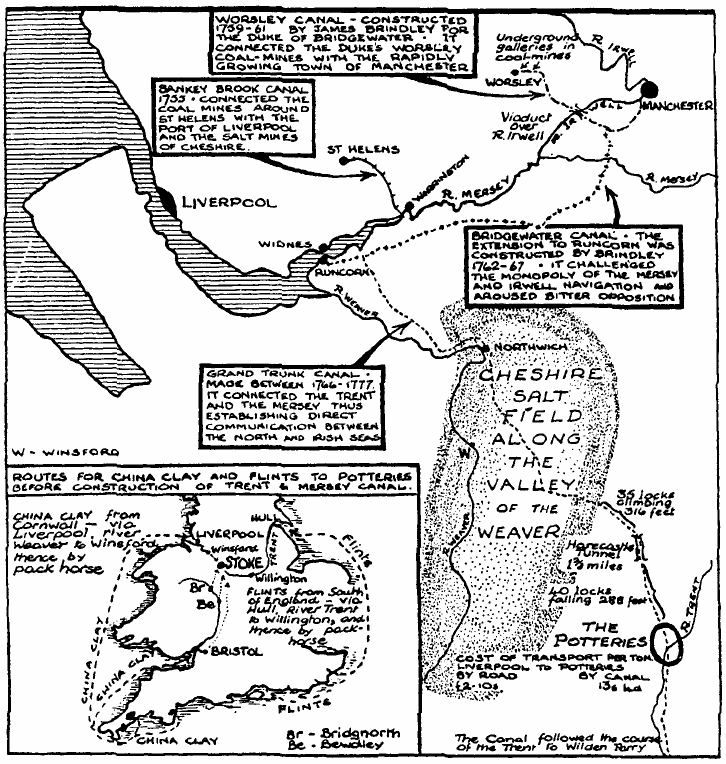
the Liverpool Corporation to commission the construction of the Sankey Brook Navigation. It was built between 1755 and
1757 under the supervision of Henry Berry. It was an outstanding success and provided the crucial stimulus to the industrial
development of the South Lancashire coalfield and the rise of St Helens. Its success has, however, been overshadowed in
popular imagination by James Brindley and the Duke of Bridgewater (Figure 7.7).
The cost of moving coal from the Bridgewater mines at Worsley was high and cutting this would, undoubtedly, lead to a
corresponding increase in sales for which demand was elastic. Using the engineering experience of his agent, John Gilbert,
and the energies of James Brindley, Bridgewater planned to link his mines to the rapidly growing markets of Manchester and
Liverpool. The first phase was completed between 1759 and 1761. Brindley used an aqueduct to carry the canal over the
River Irwell, drained the mine by taking the canal into the workings and used ‘puddled’ clay to prevent seepage. The
economic potential of canals was clearly demonstrated by the reduction of the price of coal in Manchester from 7d. to 3.5d.
per hundredweight. The construction of the main trunk routes followed in quick succession with a meteoric burst of
promotions between 1766 and the crisis of 1772. The Staffordshire and Worcestershire canal linked the Mersey and Severn at
Stourport in 1772 and the Grand Trunk canal linked the Mersey and Trent in 1777. The Birmingham canal linked that town to
the Staffordshire and Worcestershire canal via Wolverhampton. All three were engineered by Brindley. By 1776 Birmingham
had two further links, the Stourbridge and Dudley canals. Between them they brought cheap water carriage into the
Birmingham-south Staffordshire area. Midlands coalowners promoted the Coventry and Oxford canals in 1768 and 1769 but
financial problems led to delays and it was not until 1790 that there was a direct link between the Thames and the Grand
Trunk. Work started on the Leeds and Liverpool canal in 1770. Work was suspended in 1777 and did not resume until 1790
and it was not completed until 1815. In Scotland the Forth and Clyde canal was begun in 1768 but it too was delayed and not
finished until 1790. The Monkland canal, which brought coal from the Lanarkshire field to Glasgow, was started in 1770 and
also took some years to complete.
Later canal developments
The first phase of canal building ended with the act for the Chester canal in 1772. This was followed by a period of inactivity,
the result of the American War of Independence. The peace of 1783 led to an upsurge in economic activity, putting renewed
pressure on the communication network, and early in the 1790s a period of almost feverish enthusiasm for building canals
occurred which has rightly been called ‘canal mania’. Several important canals were completed but there were also a large
number of new schemes. Between 1791 and 1796 51 canal acts were passed with authorized capital of over £7.5 million. The
most important scheme was the Grand Junction Canal, authorized in 1793 and completed in 1805, linking the Midlands with
London. The Kennet and Avon canal, built by John Rennie between 1794 and 1810, linked London and the west. More
adequate trans-Pennine facilities were not available until the opening of the Rochdale (1804), Huddersfield (1811) and Leeds
and Liverpool (1816) canals. Most of the Welsh canals were built between 1794 and 1814. The Glamorgan, Neath,
Monmouthshire and Swansea canals provided 77 miles of canal at a capital outlay of £420,000. They carried iron to the
seaports and food and fodder in reverse. Existing canal interests prevented the creation of a viable network in north-east
Wales, and the branch of the Ellesmere canal built by Telford to the quarries beyond Llangollen left the ironworks at Bersham
and Brymbo and the collieries of Ruabon isolated. The Montgomery canal was started in 1797 to join the Ellesmere system
but it was not completed until 1816 and served mainly agricultural purposes. In the north of England and Scotland in the
period after 1790 canals were generally small. The exception was the Caledonian ship canal engineered by Telford between
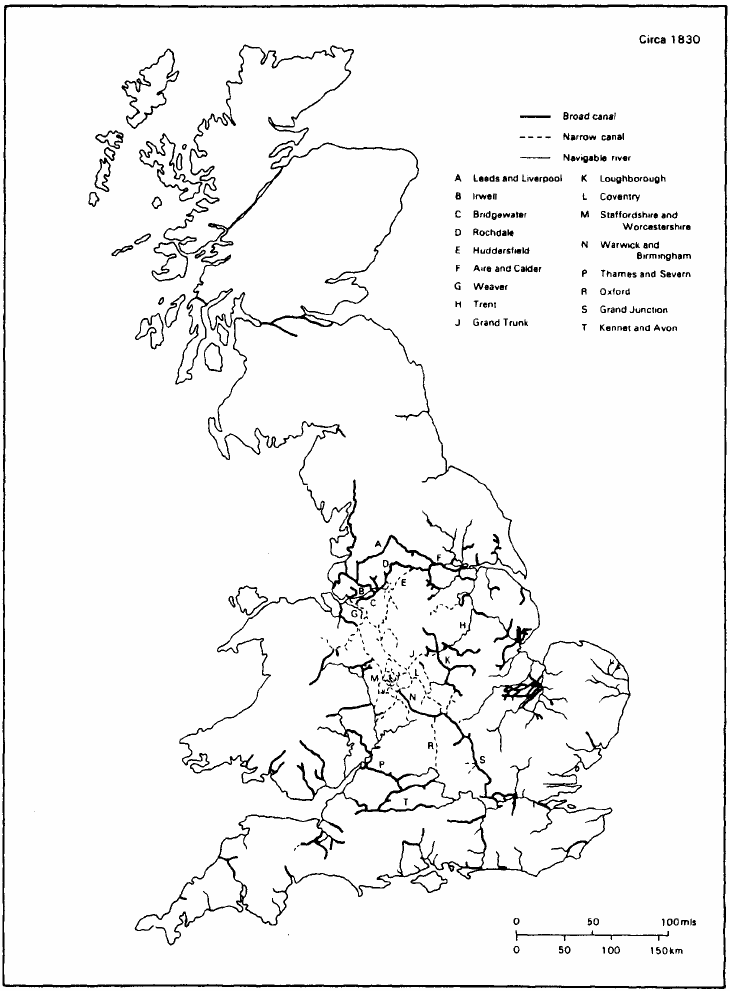
1803 and 1822. By 1830 the great building was over and there were over 4,000 miles of navigable waterways. There was no
central plan and this made the development of through, long-distance communications difficult, a situation exacerbated by
different canal sizes (Figure 7.8).
88 THE REVOLUTION IN COMMUNICATIONS—LAND AND WATER
Canals in Ireland and Scotland
With the notable exceptions of Ireland, the Caledonian and Crinan canals in Scotland and the Royal Military canal in Kent
and Sussex, all canals were funded from private sources.
19
Canal navigation had been in mind as early as 1715 in Ireland
when a statute envisaged the construction of a canal network. Since 1730 the income from certain duties had been earmarked
for this purpose but the only substantial work undertaken was the Newry canal. In 1751 these funds were entrusted to a
national body called The Corporation for Promoting and Carrying on an Inland Navigation in Ireland. It began constructing the
Grand Canal in 1756 and undertook navigation work on the Shannon, Boyne and Barrow. From 1772 it was allowed to make
grants to private companies which undertook the administration of existing schemes or new projects. From the 1770s an
increasing amount of private money supplemented state funds either in the form of private companies or by way of local
investment in the bodies of commissioners charged after 1787 with executing navigation work on individual rivers. The
incentive for several canals and navigations was the movement of coal on the mainland. The Newry canal was built to transport
coal from the Lough Neagh region to Dublin. The Barrow Navigation was influenced by the Leinster coalfield and in the early
nineteenth century the Grand Canal Company became owner of a mine on the Leinster field. Canal building continued into
the nineteenth century—the Grand Canal was completed to the Shannon, the Royal Canal was completed in 1817, the Ulster
canal from the Blackwater to the Erne was completed between 1825 and 1842 and the Ballinamore and Ballyconnell canal
from the Erne to the Shannon in 1860. From 1800 a Board of Directors of Inland Navigation was charged with promoting
work not transferred to separate bodies and after 1831 it was taken over by the Board of Works. The Irish canal network was
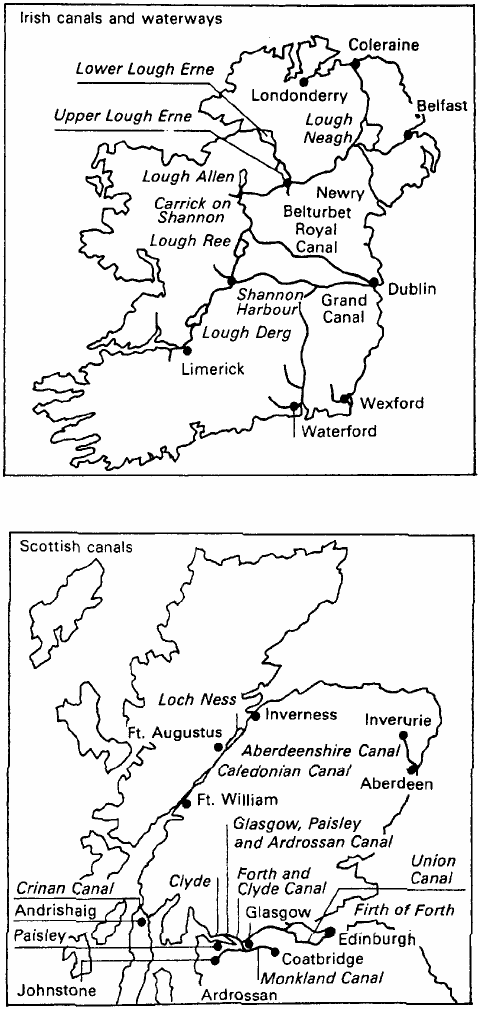
the result of work by both public and private bodies (Figure 7.9).
The Caledonian canal in Scotland was financed almost entirely by the state and cost over £1 million, three times Telford’s
original estimate. The Crinan canal, which provided an alternative to the journey round Pentland Firth, began as a private
Figure 7.7 Lancashire canals
Source: J.L.Gayler, I.Richards, J.A.Morris A Sketch-Map Economic History of Britain, George Harrap, 1966, p. 98.
SOCIETY AND ECONOMY IN MODERN BRITAIN 1700–1850 89
concern but was only completed with state aid and passed to the management of the Commissioners for the Caledonian
Canal. It is ironic that, as its cost of construction increased, so the contribution of the Caledonian canal to the economic life of
Scotland diminished and it never became a commercial success (Figure 7.10).
Building costs
The initiative for most private canal building came from local landowners and entrepreneurs, who had most to gain from local
internal improvements, who called the promotional meetings, employed surveyors and provided a large part of the necessary
capital. There were exceptions to this, like the Forth and Clyde canal which was financed largely in England. Canal shares
were generally of large denominations—units of £200 were very common and it was rare for units to be less than £50. Initial
Figure 7.8 The canal network c. 1830
Source: J.Langton and R.J.Morris Atlas of Industrializing Britain 1780–1914, Methuen, 1986, p. 85.
90 THE REVOLUTION IN COMMUNICATIONS—LAND AND WATER
capital tended to come from the locality concerned, but once the canal became a commercial success, ownership became more
diffused. By 1822 less than a third of shares in the Ellesmere canal were held in the counties through which it passed and the
rest were diffused throughout almost all England and North Wales. Many of the canals were extremely profitable before the
1830s, with many industrial canals paying dividends of 5–6 per cent within a few years of starting operations. Others were
complete failures either because the route was not economically viable or because of escalating construction costs. Most
canals cost more to build than had been expected, though the Caledonian canal was an extreme case.
The construction of canals was by navvies using a combination of simple manual techniques and horsepower. Aqueducts
became common—though few were as aesthetically pleasing as those of Telford at Chirk and Pontcysyllte on the Ellesmere
canal—tunnels a standard alternative to expensive and time-consuming flights of locks and a variety of technical devices like
inclined planes and lifts were developed to meet particular problems. It brought civil engineering into being and when the
Figure 7.9 Canals in Ireland
Figure 7.10 Canals in Scotland
Source: C.Cook and J.Stevenson Longman Atlas of Modern British History, 1978, p. 53.
SOCIETY AND ECONOMY IN MODERN BRITAIN 1700–1850 91
Institution of Civil Engineers was chartered in 1818 it was fitting that Telford should have been elected its president. Brindley
and Telford apart, the leading canal builders were John Smeaton (1724–92), his protégé William Jessop (1745–1814) who
worked with Telford on the Ellesmere canal, John Rennie (1761–1821) who built the Crinan and Kennet and Avon canals and
James Green (1781–1829), trained by Rennie, who built canals in the south-west. Brindley spawned disciples—Hugh
Henshall, his brother-in-law, and Robert Whitworth and Thomas Dadford, both of whom had been Brindley’s assistants and
whose sons learnt from them. Such personal connections were vital in transmitting skills from one generation to another. The
creation of the canal network was the first opportunity people had to grapple with large-scale engineering problems, an
experience that ‘stood them in excellent stead for the construction of the solid infrastructure of the Industrial revolution:
docks, harbours, railways, factories and warehouses’.
20
Economic benefits
It is difficult to exaggerate the contribution of canals to the economic development of Britain between 1760 and 1830. Their
effects touched almost every aspect of national life and very few parts of the British Isles could have escaped their influence
entirely. Dyos and Aldcroft
21
identified three major economic effects. First, canals dramatically enhanced the efficiency of the
whole economy by making a cheap system of transport available for both freight and passengers. The price of raw materials
like coal, timber, iron, wood and cotton tumbled dramatically. Building materials, whether bricks, sand or slate, became cheap
and accessible. It was the beginning of the end of the vernacular tradition in building. The needs of agriculture, whether for
manure or lime or for access to markets for grain, cheese and butter, were more easily satisfied wherever the canal penetrated.
By the early 1840s estimates for the total tonnage on British canals vary from 30 to 35 million tons: 75 per cent of this was
carried by canals in the area bounded by the Tweed, Thames, Severn and North Sea; 7 per cent was carried by both the Welsh
and Scottish canals. South and south-east England carried little more than 6 per cent and the south-west less than 5 per cent of
the national total. Secondly, canals were a means of overcoming a fuel crisis which threatened to limit industrial growth by
making cheap, abundant coal supplies available. Bridgewater was convinced that ‘a good canal should have coals at the heels
of it’. Thirdly, the building of canals created massive employment and spending power at a time of strategic importance for
the growth of industries looking for mass markets.
The advent of the railways soon put canals under pressure though their goods traffic reached its greatest volume after the
arrival of the railway in a district. Until 1845 canal companies were not legally entitled to act as carriers since Parliament
feared the creation of a transport monopoly. The work of transporting goods and passengers was undertaken by firms of
national reputation like Pickfords or Sutton. From 1845 Parliament allowed all canal companies to act as carriers in the belief
that they would then be better able to compete with railways. But almost none of the canals were suited to the successful
application of steam power. Boats could only go uphill by using the expensive and time-consuming poundlocks. England was
too hilly for canals to provide a long-term solution. Birmingham was the canal capital of England and the canal was at its best
in the flat lands bounded by Birmingham, Liverpool and Manchester. Topography was perhaps the main reason for the
essentially provincial character of the canals and hence their ultimate uncompetitiveness. The proliferation of companies
should have meant that there was healthy competition but in practice the canal user lost rather than gained. This can be seen in
the case of the Bridgewater Trustees who ran the canal after the Duke’s death. They followed a policy of maximizing income
regardless of long-term considerations and neglected maintenance work while increasing tolls. The attitude of Manchester
merchants changed from enthusiasm for the canal to anger. Warehouses were inadequate, pilfering common and
consignments often took months to get from Liverpool to Manchester and were ruined. In 1825 plans were drawn up for a
railway between Liverpool and Manchester:
it is not altogether on account of the exorbitant charges of the water-carriers that a railroad is desirable. The present
canal establishments are inadequate to…the regular and punctual conveyance of goods at all periods and seasons….
22
It is ironic that discontent with the first major canal should have produced the first major railway.
CONCLUSIONS
Through the period between 1700 and 1850 Britain remained a horse-drawn society. Stage-coaches, stage-waggons and canal
barges were hauled by horses. Freight was carried on packhorses. People, particularly the wealthy, rode horses. Power was
symbolized by the people on horseback. Steam alone was a threat—and even it was measured in terms of horsepower. In 1830
the threat of steam, on land if not at sea, seemed very remote. Short colliery railways were operated by horses and a few
unreliable and cumbersome engines were used in the north-east. Most people regarded railways as frightening and dangerous,
no more than a curious novelty. Few saw, as Bridgewater did, the potential of tramways plus steam locomotion. Thomas
Creevey wrote to his step-daughter on 14 November 1829:
92 THE REVOLUTION IN COMMUNICATIONS—LAND AND WATER
Today we have had a lark of a very high order. Lady Wilton sent over yesterday from Knowsley to say that the Loco
Motive machine was to be upon the railway at such a place at 12 o’clock for the Knowsley party to ride in if they liked.
I had the satisfaction, for I can’t call it pleasure of taking a trip of five miles on it, which we did in just a quarter of an
hour—that is 20 miles per hour. But the quickest motion is to me frightful: it is really flying, and it is impossible to divest
yourself of the notion of instant death to all upon the least accident happening. It gave me a headache which has not left
me yet. Sefton is convinced that some damnable thing must come of it.
23
NOTES
1 John Wesley Journal, 18 February 1747.
2 Laurence Sterne A Sentimental Journey, 1768, quoted in A.Briggs How People Lived, Vol. III, 1700–1815, Blackwell, 1969, p. 81.
3 Quoted in E.Pawson The Early Industrial Revolution, Batsford, 1979, p. 133.
4 A.O.Hirschman The Strategy of Economic Development, Oxford University Press, 1958, p. 133.
5 A.Young View of the Agriculture of Oxfordshire, London, 1809, p. 324.
6 A.Yarranton England’s Improvement by Sea and Land, London, 1698, Vol. II, p. 92.
7 A.Smith The Wealth of Nations, Dent, 1905 edn, Vol. I, p. 19.
8 On road developments in general see P.S.Bagwell The Transport Revolution from 1770, Batsford, 1974, chapter 2 and H.J.Dyos and
D.H.Aldcroft British Transport—an Economic Survey from the Seventeenth Century to the Twentieth, Leicester University Press,
1969, pp. 19–36, 62–80. W.Albert The Turnpike Road System of England 1663–1844, Cambridge University Press, 1972 is the
central work and E.Pawson Transport and Economy: The Turnpike Roads of Eighteenth Century Britain, 1977 is more analytical.
9 L.T.C.Rolt Thomas Telford, 1958 is the standard and very readable biography.
10 A brief discussion of turnpike disturbances can be found in J.Stevenson Popular Disturbances in England 1700–1870, Longman,
1979, pp. 43–5, 94–5. The disturbances in South Wales in the 1840s are best approached through D. Williams The Rebecca Riots,
Cardiff, 1955, P.Molloy And They Blessed Rebecca, Gomer, 1985, and D.J.P.Jones Rebecca’s Children, Oxford University Press,
1989.
11 D.Defoe A Tour Through the Whole Island of Great Britain, 1724–6, Penguin edn, pp. 429–432 lists the turnpikes built by the 1720s.
12 H.Homer Enquiry into the Means of Preserving and Improving the Publick Roads, 1767, quoted in Dyos and Aldcroft op. cit. p. 70.
13 P.S.Bagwell op. cit. p. 43.
14 ibid. p. 49.
15 T.S.Willan River Navigation in England 1600–1750, 1936 is still the best study though the 1970 reprint of J.Phillips General History
of Inland Navigation, 1792 is worth dipping into.
16 Dyos and Aldcroft op. cit. p. 41.
17 T.S.Willan The English Coasting Trade 1600–1750, 1938 gives the fullest treatment of the subject.
18 On canals see P.S.Bagwell op. cit. chapters 1 and 6 and Dyos and Aldcroft op. cit. chapter 3. More detailed studies can be found in
E.C.Hadfield British Canals, 1969 and his series of regional histories. J.Lindsay The Canals of Scotland, 1968 is essential.
L.T.C.Rolt’s biography of Telford op. cit. is a reliable account of his work.
19 The definitive study of this is J.R.Ward The Finance of Canal Building, Oxford University Press, 1974.
20 E.Pawson The Early Industrial Revolution, Batsford, 1979, p. 151.
21 Dyos and Aldcroft op. cit. pp. 102–3.
22 The prospectus of the Liverpool and Manchester Railroad Company is printed in T.Baines History of Liverpool, London, 1852, pp.
601–3.
23 Sir Herbert Maxwell (ed.) The Creevey Paper, 1903, Vol. II, p. 204.
SOCIETY AND ECONOMY IN MODERN BRITAIN 1700–1850 93
8
The revolution in overseas trade
All States and Kingdoms have flourished, and made a Figure in Proportion to the Extent of their Commerce….
1
Historians like being able to identify primary causes. Nowhere is this more evident than in explanations for the upturn in
Britain’s economic growth during the eighteenth century. Overseas trade has been highlighted by several historians for
different reasons. Many of the external features of economic growth, particularly the growth of export industries at a faster
rate than other industries, were associated closely with foreign trade. There are reasonably reliable annual statistics of foreign
trade—from 1696 for English trade, 1755 for Scotland and 1772 for Great Britain—the only annual series available for the
whole century. It is tempting to attribute a causal rather than a dependent role to so well-documented an area. H.J.Habakkuk
and P.Dean
2
, R.Davis
3
and W.W.Rostow
4
have adopted the notion of commercial pre-eminence whereas this has been
disputed by W.A.Cole,
5
R.Hartwell,
6
A.Thompson
7
and N.F.R. Crafts.
8
This chapter is concerned with examining the
changing character of trade between 1700 and 1850, the policy of government towards trade and the overall impact of trade
on the growth of the British economy.
SITUATION IN THE EARLY EIGHTEENTH CENTURY
The sixteenth century had seen a spirit of trading enterprise which led to the establishment of the Muscovy Company in 1555,
the Spanish Company in 1577, the Eastland Company in 1579 and the Senegal Adventurers in 1588. The East India Company
was founded in 1600 and set up its first trading base at Surat in 1609. The settlement of North America began at Jamestown in
1607 and a position was staked out in the West Indies in Barbados in 1605. Formally organized trade in Africa began in 1618
and from the 1670s the Hudson’s Bay Company contested the French position in Canada. But until 1660 both the scale and
character of English foreign trade was modest. Woollens acounted for between 80 and 90 per cent of exports and the major
dynamic element in the export trade was the development of lighter woollen cloths for sale in southern Europe. Imports and
re-exports of products from the growing American colonies and from the footholds in the West Indies and India expanded.
Tobacco was London’s major import by 1640. Sugar surged forward in the 1650s and accounted for 28 per cent of English
exports by 1660. Between 1600 and 1640 English exports grew at an annual average rate of 1.5 per cent and this accelerated
with an increase in re-exports after 1650. The merchant fleet probably doubled between 1610 and 1660 linking not just home,
colonial and foreign markets but carrying goods directly between foreign ports. The Navigation Acts of 1650 and 1651
consolidated this position by restricting the carrying trade, including the re-export of colonial products, to English merchants
and vessels.
Between 1660 and 1713 England was involved in conflicts, first with the Dutch (1665–7 and 1672–4) and then with France
(1689–98 and 1701–13), which were as much concerned with commercial and colonial considerations as with dynastic issues.
Britain came into direct competition with the Dutch in the early seventeenth century over their control of the Baltic trade,
their entrepôt trade and policies in the East and West Indies. The wars fought between England and Holland in the 1650s as well
as in the 1660s and early 1670s were far from conclusive. In France Colbert adopted a commercial policy in the 1660s with three
strands. First, he built up the mercantile marine and a navy to protect it. Secondly, he introduced tariffs to encourage French
exports and finally, he founded trading companies which pushed French interests in the Mediterranean as well as into the
Baltic, America, Africa and India. This proved a direct threat to England’s position and made France England’s greatest
adversary in the late seventeenth and eighteenth centuries. Between 1660 and 1700, though largely by 1689, there were major
changes in English overseas trade. By 1700 woollen cloth had fallen to less than half of the total exports despite its continued
growth. The reason for this change was the great expansion in the re-export trade to almost £2 million. Sugar and tobacco
made up about 40 per cent of the total in 1700. The re-export of goods brought in by the East India Company, particularly
Indian and Chinese textiles, accounted for a similar proportion. Calico imports were insignificant until the 1650s but increased
from 240,000 pieces in 1663–9 to 861,000 in 1699–1701. A third branch of the re-export trade was in European manufactures

sent to the expanding colonial market. Parallel to this was expansion in the slave trade with Africa to supply labour to West
Indian Plantations (Table 8.1).
The bulk of the export and re-export trade was with Europe, 82 per cent and 77.3 per cent of the respective totals; 61.3 per
cent of imports came from the same area. The impact of commercial expansion before 1700 on the overall growth in the
English economy was limited. Much of the growth was concerned with the import and re-export of goods which did not
directly stimulate English manufacturing growth. It did, however,
Table 8.1 English foreign trade in the late seventeenth century (£000)
1663–69 1699–1701 Percentage increase
Exports 3,239 4,433 37
Re-exports 900 1,986 121
Total exports 4,139 6,419 55
Total imports 4,400 5,849 33
Source: R.Davis ‘English Foreign Trade 1660–1700’ in W.E.Minchinton (ed.) The Growth of English Overseas Trade in the Seventeenth
and Eighteenth Centuries, Methuen, 1969, p. 92.
lead to increased capital investment in trade itself and in its ancillaries such as shipbuilding and repairing.
CHANGING FOCUSES FOR TRADE
Before 1750
In the 1680s the expansion of overseas trade slowed and the outbreak of the French wars in 1689 exacerbated this new
situation. Several causes for this stagnation can be identified. First, there were market changes. Woollen exports encountered
competition from East Indian cottons and silks which both extended the European market for textiles and shifted demand
away from English cloths and, contemporaries maintained, had an adverse effect on the English industry. The re-export trade
also encountered competition. After 1707 Glasgow came to dominate the tobacco trade, to the benefit of Scottish merchants
who had few links with England. The French encouraged sugar production in Hispaniola, acquired from Spain in 1697,
severely reducing sales of English sugar in Europe, especially after 1713. The growth of tariff systems by many European
countries
9
and the transformation of the English protective system after 1689
10
tended to hamper commerce. The monopolistic
commercial pretensions of the state partially explain why merchants sought greater freedom to carry on their business and
reduce the power of the trading companies. The monopoly of the Royal African Company was breached in 1698 and the
Newfoundland and Russian trades were thrown open the following year. Only the Hudson’s Bay, East India and Russia
companies were able to ward off these attacks. Finally, war disrupted trade, together with accompanying strain upon the
financial and banking systems. Between 1690 and the late 1740s England was involved in a series of costly wars.
11
The war
of the Spanish Succession (1702–13) caused trade to fall to a low level between 1704 and 1708. War could, however, have
trade bonuses. The Methuen treaty with Portugal in 1703 stimulated trade and helped to establish London as a major market in
bullion. England expanded her American possessions at the expense of France by the treaty of Utrecht. The growing
American population stimulated expanding trade after 1720. From Spain England took Gibraltar and the ‘Asiento’ which gave
English and colonial slave traders a thirty year legal monopoly of the supply of slaves to the Spanish American colonies
though this brought little gain to English trading companies. The South Sea Company made a loss on the only two significant
slave ships it sent to the Spanish colonies but the prospect of profit was one of the reasons which helped to build up the
‘stock’ of the Company in the ‘Bubble’ of 1720. Trade revived after 1713 but the dispute with the Baltic Powers in 1717–19,
the wars with Spain in 1718 and 1727–8 and the threat of war in 1734 all prevented consistent growth. The War of Jenkin’s
Ear, which began in 1739 and merged into the broader European conflict of 1740–8, made trade difficult, particularly between
1744 and 1748. Trade slowed down markedly because the dynamic factors in it—the woollen cloth trade and re-exports—lost
their vigour. Between 1690 and 1750 years of active trade were limited and short—1699–1701 aided by the removal of export
duties in woollens and grain, 1711 when woollen exports reached a new peak, 1714, the mid-1720s following Walpole’s
abolition of customs duties on English manufactures and some imports, 1735–8 when export of manufactured goods to the
colonies first began to expand, and in 1743. In general the English overseas trade grew at only about 1 per cent per annum
between 1690 and 1750 (Table 8.2).
SOCIETY AND ECONOMY IN MODERN BRITAIN 1700–1850 95