
Brown R. Society and Economy in Modern Britain 1700-1850
Подождите немного. Документ загружается.

5d. and 7d. But timber from the Forest of Dean, via Bristol to Chatham, cost as little as 1d. per ton per mile. The river basins
were extremely important arteries of trade in the early eighteenth century, particularly if they crossed major agricultural
76 THE REVOLUTION IN COMMUNICATIONS—LAND AND WATER
and industrial regions: the Severn, the Humber (fed by the Yorkshire Ouse, Aire, Calder and Trent), the Cambridgeshire Ouse
and the Thames. The Severn, for example, carried Shropshire coal, Droitwich salt, and corn, fruit and cheese downstream and
Dean iron for the Staffordshire metal-workers, timber, brass and groceries from Bristol upstream. The coastal trade was
similarly important and, as late as 1841, accounted for three times the tonnage of that of shipping from destinations overseas.
It was concentrated on the east coast. Of the 97,000 tons of coastal shipping in 1709, nearly 50,000 belonged to the ports of
Scarborough, Whitby, Newcastle, Yarmouth and King’s Lynn, variously engaged in the fishing, coal and corn trades. The coal
trade was of particular importance, with the major shipment of Newcastle coal down the east coast to London, though smaller
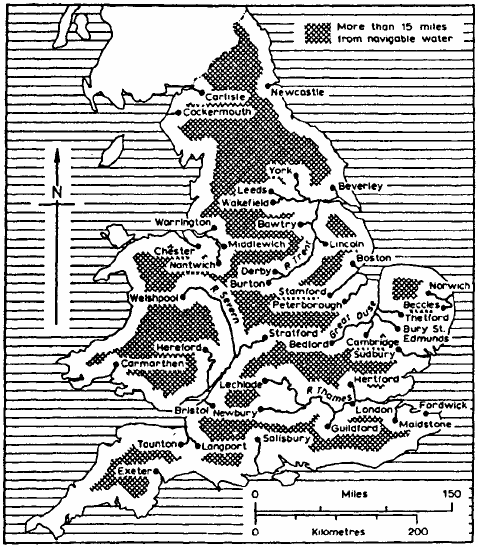
flows went to many other major or minor ports as far west as Exeter (Figure 7.2).
The water transport system did not overshadow land communications, even for bulk goods. The cost advantage of water
was often reduced by the longer distances taken by river or sea. Many areas were too far from navigable water to make full
use of it. Water transport had certain disadvantages. It was often slow and easily disrupted by war and weather. The
Newcastle colliers did not sail between December and February. Convoys could not always be organized and groceries had to
be diverted overland. Rivers froze, were subject to drought and flood and were obstructed by weirs, mills and dams. But the
two systems were interdependent. Water transport, where easily available, coped with the cheap, long-distance movement of
bulky and non-perishable goods. Road transport acted both as a feeder and distributor for this system and was important in its
own right for the transfer of small goods, perishables, passengers and information, but at a higher cost.
TURNPIKES
Expenditure on maintaining and improving roads was not a new activity in the eighteenth century. Just under £1 million was
spent on parish roads by mid-century. This was, however, insufficient to maintain the road system necessary to growing
commerce and manufactures.
8
The development of turnpike roads was one way out of this transport bottleneck. There had
been several schemes in the second half of the seventeenth century but these had been managed by local JPs. After 1706 it
was normal for Parliament, by special Act, to give authority to an independent and private body of trustees to raise the
necessary capital, improve the roads, place turnpikes or gates across the roads and charge users a toll within the limits
prescribed in the Act. Merchants and landowners were enthusiastic supporters of the new roads, which enabled them to get
their goods to market more quickly and so more cheaply and to cut the cost of highway repair for themselves. The West
Riding routes were turnpiked in the 1740s largely because of the actions of merchants in Leeds and Wakefield, who joined
with the tradesmen and merchants of the Lancashire towns to get the trans-Pennine roads improved. Wedgwood took an
Figure 7.2 Major river and coastal communication systems in 1700
Source: H.J.Dyos and D.H.Aldcroft British Transport, Leicester University Press, 1971, p. 84.
SOCIETY AND ECONOMY IN MODERN BRITAIN 1700–1850 77
active interest in turnpike schemes round the Potteries. Abraham Darby III and John Wilkinson were active trustees in
Shropshire. The number of trusts grew only slowly in the first half of the eighteenth century: on average eight acts were
passed each year. From 1750 to 1770 the annual average rose to about 40, a result of growing economic confidence and low
interest rates. Between 1770 and 1790 there was a slight fall in activity but from 1790 the annual average increased again to
about 55. Over 1,600 trusts were formed between 1750 and 1800. During the first 30 years of the nineteenth century 2,450
turnpike acts were passed, some creating new trusts, some re-establishing old ones (powers were generally granted for twenty-
one years only) and there was some consolidation of smaller trusts into larger units. By the mid-1830s there were 1,116
turnpike trusts in England and Wales managing some 22,000 miles of road—averaging just over 19.7 miles of road per trust.
At the same time there were 104,770 miles of parish highways so turnpikes accounted for slightly more than a sixth of all
roads.
In 1838 the trusts in England and Wales spent £1.75 million or £51 per mile of road, whereas only £11 3s. was spent on
each mile of parish road. Trusts had considerable flexibility over how much money they spent and it was not until the
Turnpike Act of 1822 that they had to keep proper audited accounts. Management was often notoriously inept and fraudulent.
For example the Kensington trust had an income of almost £10,000 for the three years between 1749 and 1751. Its 15 miles of
road were being maintained for no more than £100 per mile and yet the trust was in debt in 1752 by £3,300. However, in
Scotland and Wales trusts controlled networks covering a whole county, though they were usually split into ‘divisions’ to
facilitate management. The great drawback of the turnpike system was that it was not really a system at all but a response to
limited local and sometimes individual needs. With the exception of the London-Holyhead road, on which £750,000 was spent
by government between 1810 and 1835, and the establishment of the Commission for the Highland Roads in 1803, which
brought the military roads begun by General Wade up to coaching standards, there was no overall national scheme. The result
was a ‘patchwork’ of improved and unimproved roads. Road engineers like Macadam were fully aware of the disadvantages
of the piecemeal method of improvement and pointed out the advantage of trust consolidation. His views were partially
adopted by the turnpikes of north London in 1826 but an attempt to consolidate trusts on the Great North Road was frustrated
in 1830 by the marshalling of local vested interests against his plan. Turnpikes did improve transport despite their
maladministration and piecemeal development. There is little doubt that something more closely resembling a national system
of roads was emerging in Britain by the 1820s. But whether these roads served national rather than predominantly local
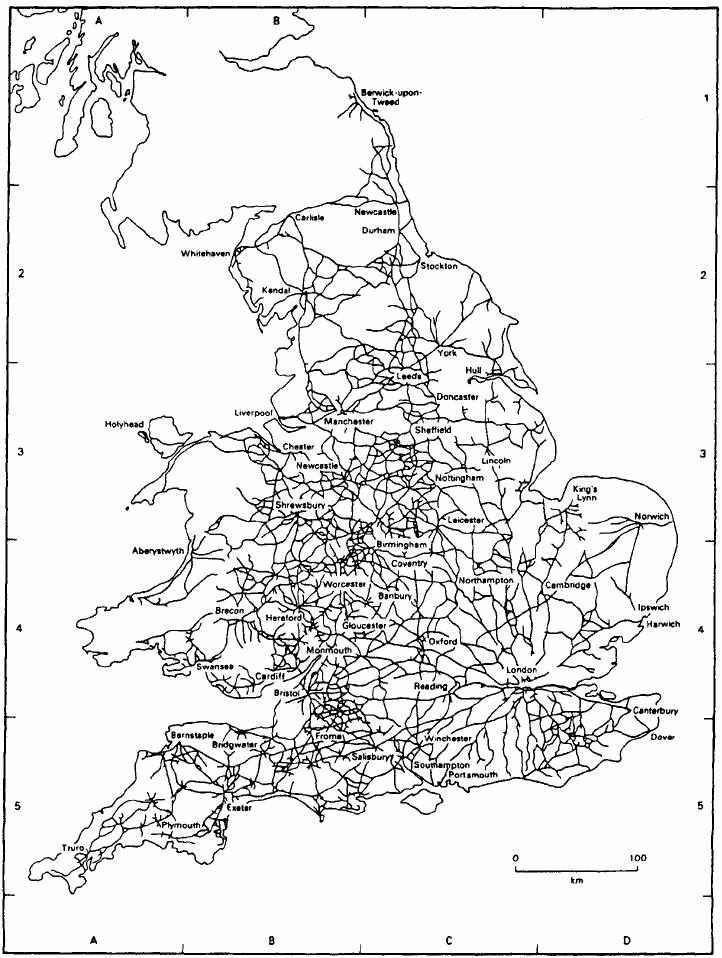
purposes is open to question. Turnpikes linked the major centres of population but they made up only a small proportion of all
roads (Figure 7.3).
The turnpike trusts allowed the road improvers the opportunity needed to test their theories. Road-making was in a poor
state in the mid-eighteenth century. Repairing, by filling in holes with rubble was considered more important. A critic, writing
in the Gentleman’s Magazine in 1751, rightly commented on the inability ‘to lay a foundation nor make the proper slopes and
drains…’.
The engineers: Metcalfe and Telford
John Metcalfe (1717–1810) dealt with each of these criticisms in the 180 miles of roads, mostly in Yorkshire and Lancashire,
which he supervised between 1765 and 1797. He used a firm foundation of large rocks, covered these with loose stone
chippings which were rammed down into the cracks and formed into a convex camber which drained water off into the
ditches dug below the level of the road. Thomas Telford (1727–1834) was the first roadbuilder to gain employment by
turnpike trusts and was a genius in construction. He built canals, bridges, aqueducts and docks as well as roads and bridges.
Robert Southey nicknamed him the ‘Colossus of Roads’.
9
His roads were expensive and of a very high standard. He laid a flat
foundation of larger stones which, in the middle 18 feet of the road, were covered with closely packed stones of no more than
2.5 inches. Once these stones has been compacted together by the weight of traffic passing over them a final 1.5 inches of
gravel was added. He applied these principles to the London-Holyhead road but, despite the criticisms of unnecessary expense
on the foundations and the disintegrating effects of frost and water on the gravel surface, his roads were an enormous
improvement on those of his predecessors. Like Brunel’s work later with railways, Telford’s approach to road and bridge-
building was aesthetic as well as functional.
Macadam
John Loudon Macadam (1756–1836) ultimately had more influence on road engineering than any of his predecessors. Like
Telford, he came from Scotland and he built on the work of Scottish engineers which he became familiar with as a road
commissioner from 1783. He took great pains to ensure good drainage and did not pay as much attention to the road
foundations themselves, arguing that foundations were less important than an impervious and indestructible surface. He raised
the level of the road above the level of the ground on which it was built and provided a camber of no more than three inches.
This significantly reduced the costs of building. The impervious surface was to be achieved by the compacting of stones of no
78 THE REVOLUTION IN COMMUNICATIONS—LAND AND WATER
more than 2 inches’ diameter. His technique was both simple and effective. Macadam repaired more roads than he built and it
was his administrative efficiency as much as his engineering skills which led to his appointment as surveyor to the Bristol Trust
in 1816. By February 1818 his methods had been adopted by eleven other trusts, managing over 700 miles of road in fifteen
counties. All three of his sons followed their father’s profession and by 1823 the Macadam family supervised over 2,000
miles of road for 107 trusts. His influence was felt throughout the 1820s in his evidence before parliamentary select
committees in 1819, 1820, 1823 and 1825 and in the advice he gave to other public bodies. Macadam’s vision of an efficient
road system capable of being developed on a national scale was thwarted by the intervention of the railways.
The geography of turnpikes
In England lines of turnpike roads radiated from London to the north and east and particularly into the Midlands. The line of
trusts on the Great North Road was almost unbroken to the Scottish Borders. The West Midlands and the area round Bristol
Figure 7.3 The turnpike road network in England and Wales in 1700
Source: R.Pope (ed.) Atlas of British Social and Economic History since c. 1700, Routledge 1989, p. 100.
SOCIETY AND ECONOMY IN MODERN BRITAIN 1700–1850 79
had a large number of turnpikes serving expanding industry and agriculture. Many roads in Wales were so bad that wheeled
carts could not move along them. In 1769 Arthur Young found the roads between Chepstow and Cardiff ‘mere rocky lanes, full
of hugeous stones as big as one’s horse, abominable holes….’ Indeed the poor state of roads here, as in Scotland, was partly
due to the lack of wheeled traffic. The steady growth of industry after 1770 was the greatest spur to road-building in Wales.
Industrialists joined with the gentry and innkeepers in this movement to improve the very poor state of Welsh roads. Much of
the activity was in the borderlands, along the main routes to Ireland through North and South Wales, to Holyhead and
Fishguard, and in the newly developing industrial areas. In the north quarry owners like Lord Penrhyn and Assheton Smith built
roads from Bethesda to Bangor and Llanberis to Port Dinorwic in 1782 and 1809 respectively. The needs of the woollen trade
led to turnpiking the roads between Welshpool and Shrewsbury and Oswestry after 1752. Similar activity followed in
Flintshire after 1756 and Caernarfonshire after 1759. By 1800 North Wales had about 1,000 miles of turnpike roads organized
on a county basis. In South Wales Anthony Bacon was the first industrialist to build a road between his ironworks at Merthyr
and Cardiff in 1767. In 1755 and 1758 two Acts were passed in Parliament permitting the construction of turnpikes in
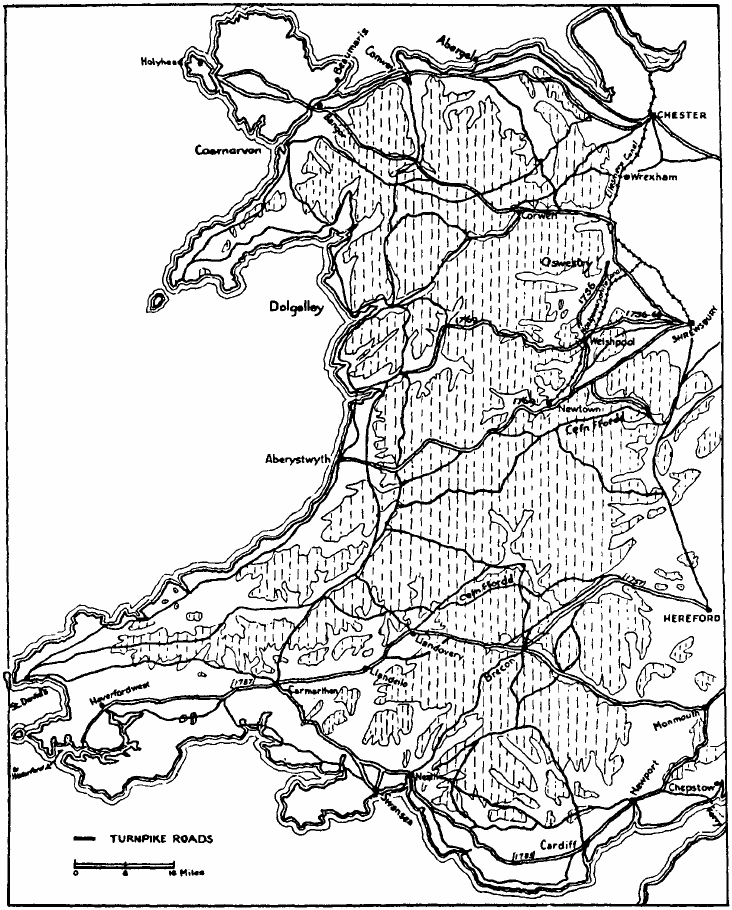
Monmouthshire, and these were soon extended throughout South Wales (Figure 7.4). The old landscape of road
communication was modified at the hands of twelve trusts in Carmarthenshire, four in Pembrokeshire, two in Cardiganshire,
two in Radnorshire, one in Breconshire and twelve in Glamorgan. It was in this area that opposition to the turnpikes was at its
most intense, leading to the Rebecca Riots in the early 1840s.
Scotland
The statutory basis for the upkeep of Scottish roads was laid down in a series of acts, chiefly in the seventeenth century. In
1719 Scotland was brought into line with England when JPs and Commissioners of Supply were authorized to appoint
overseers to ensure that roads were properly maintained with six days’ annual labour from tenants and others and money
provided by a tax on heritors not exceeding 10s. in the £100 Scots of value rent. As in England, the effectiveness of the provision
varied. Roads were not considered of major economic importance in eighteenth-century Scotland and improvements were
thus limited. The first turnpike trust act was passed in 1713, the next in 1751. The only co-ordinated group of road
improvements, some 1,050 miles and over 1,000 bridges carried out at public expense for military rather than economic
purposes, occurred in the Highlands under General Wade between 1725 and 1737 and after the ’45 by Major William
Caulfield. These roads were funded from annexed Jacobite estates and when, in 1784, these were restored the maintenance of
the roads was transferred to local funds. By 1800 they had fallen into disuse because of the insufficiency of local funding.
Telford was commissioned to survey these roads in 1801 and again in 1802. His reports were not just concerned with
Highland roads but with the changed conditions of Highland life. He believed that crofting and fishing should be encouraged
rather than sheep farming and that a network of good roads was essential for this purpose. The result was the setting up of the
Commissioners for Highland Roads and Bridges in 1803. The state paid half the cost of road maintenance and building and
landowners raised the remainder, either voluntarily or by assessment. Over 900 miles of new roads and 1,117 bridges were
built at a cost of over £500,000, £267,000 of which came from government. In 1813 the remaining military roads—only 300
miles by then—came under their control, with an annual grant of £5,000 for maintenance. Road improvements had greater
economic effect south of the Highland Line, especially as canals were never of much consequence in many parts of Scotland
and railways made their contribution only later in the nineteenth century. Turnpike construction and the industrial
development of central Scotland moved parallel especially after 1790. By the 1840s the major network of roads had been
built, often under the supervision of Telford, in many parts of Scotland. Statute labour was compulsorily commuted to money
payments in 1845 but was not finally abolished until an Act of 1878, which became effective no later than 1883.
Ireland
The 1730s and 1740s were a period of rapid road-building in Ireland coinciding with an upturn in inland traffic. Many of the
roads built between 1730 and 1760 were turnpiked. From Coleraine and Belfast roads were built south to Dublin to carry
linen. From Dublin itself roads were built to the west as far as Roscommon and to the south and south-east serving Cork and
Limerick. A fairly dense network of roads covered the region from Dublin to the Shannon and south to Limerick and Cork
where the most intensive agricultural exchanges in the country took place. Turnpike trusts had limitations and their utility as
financing agencies depended on projected income. They were not profitable in economically backward areas. From the 1760s,
however, most Irish road-building was financed by other means. The Grand Jury in each county had always had the power to
build roads. This was extended to levying a county rate to support road-building by statutes in 1759 and 1765. The great bulk
of road-building after the 1760s was financed in this way. This made possible the development of a road network without
relating it directly to the income that traffic might generate, itself a limiting constraint in much of rural Ireland. Further
advance came in the first half of the nineteenth century. First, there was an increase in coach routes which improved surfaces
and had an impact on commodity carriage as well. Secondly, roads were built in the more remote areas where they had been
80 THE REVOLUTION IN COMMUNICATIONS—LAND AND WATER
few or non-existent, as in Connemara and West Mayo. From 1822 parliamentary grants were available to help road-building
and in 1831 the Board of Works was established which took over from various bodies the management of canals, roads and
public works. In both Ireland and Wales the degree of centralized control over turnpikes was significantly greater than in
England, where private enterprise dominated.
Effects of turnpikes—opposition
Turnpikes were a mixed blessing. Toll charges could prove inconvenient and expensive. Some contemporaries argued that
turnpike development would lead to produce being sent to more distant markets, while others believed it would put up the
cost of bringing produce into an area. Arthur Young commented in 1769 in his Tour Through the North of England that
all the sensible people attributed the dearness of their country to the turnpike roads; and reason speaks the truth of their
opinion…make but a turnpike road through their country and all the cheapness vanishes at once.
Figure 7.4 Early roads, including drovers’ roads and early turnpike roads, in Wales
Source: W.Rees An Historical Atlas of Wales, Faber, 1951, plate 67.
SOCIETY AND ECONOMY IN MODERN BRITAIN 1700–1850 81
By 1800 opposition was spasmodic, and generally localized.
10
Protests occurred in five main areas. In 1727, 1731, 1735 and
1793 there were riots in and around Bristol with the destruction of toll-gates. Opposition seems to have been centred on the
Kingswood colliers, who were concerned that no toll should be imposed upon the provisions necessary to supply a growing
manufacturing area. Between 1735 and 1738 there were riots to the north of Bristol led by the ‘country people’, small
farmers. The area round Bristol, Gloucester and Ledbury had seen a multiplication of turnpikes in a small area in the 1720s.
Similar motives may have been present in attacks on turnpikes in the West Riding of Yorkshire in 1752 and 1753. The major
objection, however, was the high toll on the coal essential to cloth production. This explains the location of the protests and
the lead taken by small independent clothiers in the disturbances. The fourth area affected was the southern part of Scotland
between 1792 and 1815 with the consolidation of the turnpike system.
Why were turnpike riots relatively few in number? Turnpikes were generally promoted by the large landowner, the
capitalist farmer or industrialist who benefited from lower transport costs, fewer delays and access to newer markets.
Disturbances did not occur in areas of advanced industrial and agrarian capitalism but in communities of small farmers
and independent workers. To these people turnpikes were simply an unjustifiable tax on their already small incomes. This was
not, however, in itself sufficient to cause riots. The density of turnpikes has to be taken into account. In the areas examined
above and in South Wales there was a multiplication of trusts, which meant that even short journeys were liable to encounter a
significant number of toll-gates.
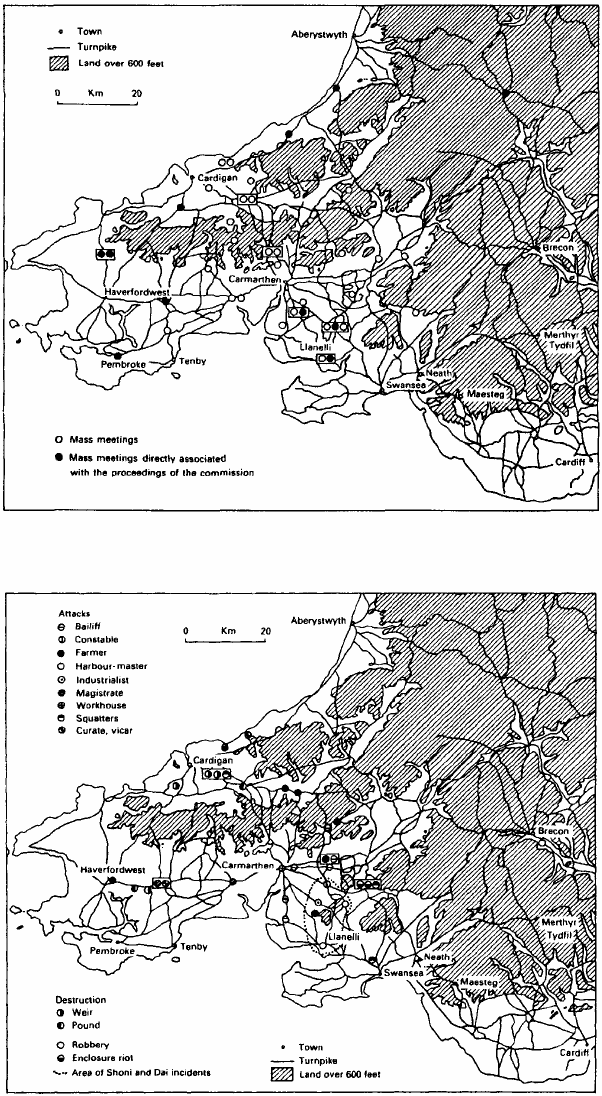
The Rebecca Riots between 1839 and 1844 grew out of a rural community undergoing rapid social change and growing
economic pressure. The name Rebecca was taken from the scriptural reference in Genesis 24:60: ‘And they blessed Rebecca
and said unto her, Thou art our sister, be thou the mother of thousands of millions, and let your seed possess the gate of those
which hate them.’ Men dressed in women’s clothing, often white gowns with their faces blackened or wearing masks—
though only some rioters would wear women’s clothing—attacking toll-gates at night to the accompaniment of much noise
and, in the early stages, a mock trial before the work of destruction began. Although the outward expression of unrest was the
destruction of the turnpike trusts, the grievances of the Rebeccaites were many: church-rates, tithes, high rents, the poor law,
clerical magistrates and the actions of insensitive agents. The extension of toll-gates on country roads, the poor harvests of
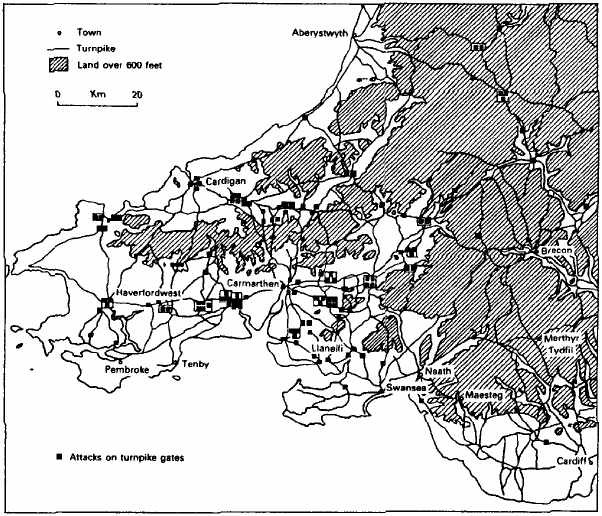
1839–41 and the collapse of prices in 1842–3 translated unrest into direct action. The main attacks were concentrated in
January 1839 along the Carmarthen-Pembrokeshire border and from the winter of 1842 to 1844 in Carmarthen,
Pembrokeshire and south Cardiganshire. Small farmers played a leading role in the earlier attacks though when unemployed
workers and iron-workers became active in west Wales farmers, fearful of attacks on their own property, co-operated with
government. The toll-gate problem evaporated after 1844 with the Turnpike Act of 1844 which consolidated the trusts.
County road boards took over all the trusts in each shire and tolls were simplified and made more uniform. David Williams
Figure 7.5 The Rebecca Riots
Figure 7.5a Turnpike gates 1838–44
82 THE REVOLUTION IN COMMUNICATIONS—LAND AND WATER
argues that this was the result of the removal of remaining tensions in the isolated communities occasioned by the coming of
the railways.
Effects of turnpikes—impact on communications
What contribution did the turnpike and parish roads make to improved communication in Britain in the eighteenth and first half
of the nineteenth century? Expenditure on parish roads was maintained rather than markedly increased after 1750. There was
Figure 7.5b Mass meetings 1943–4
Figure 7.5c Other collective protests 1842–4
Source: A.Charlesworth (ed.) An Atlas of Rural Protest in Britain 1548–1900, Croom Helm, 1983, pp. 166–7.
SOCIETY AND ECONOMY IN MODERN BRITAIN 1700–1850 83
a steady increase in turnpike spending rising from under £100,000 per annum in the 1750s to the peak of £1.5 million in the
1820s. All of this was achieved without significant state intervention in England and Wales. With the exception of the
London-Holyhead road the trusts were locally controlled, private enterprises. The major areas of public spending were in the
Scottish Highlands and Ireland. The local and private nature of many turnpikes determined their limitations and, despite
Defoe’s eulogy in the 1720s,
11
many roads were still in poor repair in 1800. Arthur Young found in 1769 that, of the 930
miles of turnpike he used in his 1,460-mile tour of the Midlands, Yorkshire, Northumberland and Cumberland, half were good
and the rest were equally divided between middling and bad. By 1813, however, he found that there had been substantial
improvements. Carl Moritz spoke of firm, smooth roads in his tour of England in 1782. The road system was, and remained
until after 1850, patchy, and arguably this was its greatest defect.
Not everyone saw these developments in a positive way. William Cobbett deplored the improvements which were, for him,
a wicked way of stealing the fruits of the earth from honest country-folk in order to sustain the ‘vermin’ living in the ‘Wens’
as he called the burgeoning towns and cities. Moralists deplored the vast amount of unnecessary travel. The restlessness of the
English was proverbial—contemporaries believed that this was to do with their propensity for melancholy and suicide. But
rhetoric aside, Henry Homer summed up the impact of improvements in 1767:
There never was a more astonishing revolution accomplished in the internal system of any country. The carriage of
grain, coals, merchandize, etc. is in general conducted with little more than half the horses which it formerly was….
Everything wears the face of dispatch and the hinge which has guided all these movements, and upon which they turn,
is the reformation which has been made in our public roads.
12
The coaching industry
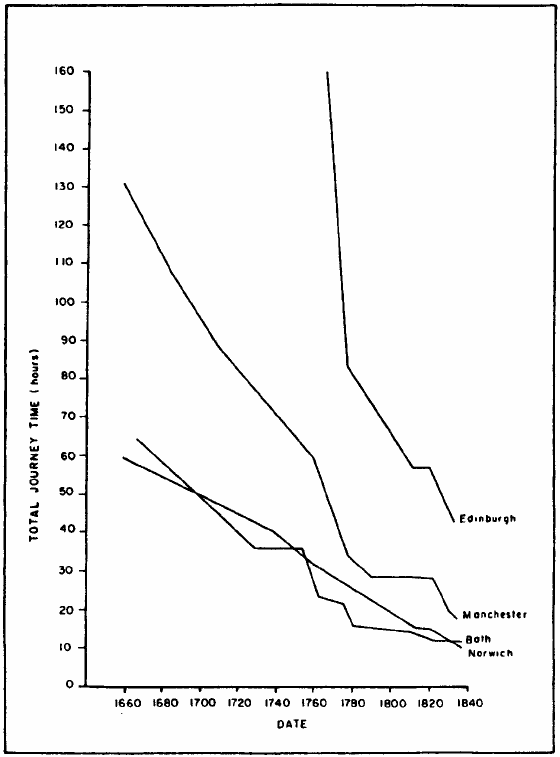
The reduction in journey times between main centres of population was one clear measure of the reality of the revolution on
the roads (see Figure 7.6). Times were reduced by up to 80 per cent between 1750 and 1830. In the mid-1750s it took between
10 and 12 days to travel from London to Edinburgh; by the 1830s it took 45.5 hours. In 1751 it took two days to reach Oxford,
in 1828 six hours. On average coaches maintained a speed of about 8 m.p.h. but faster performances were possible. It was not
just speed but the amount of travelling that increased dramatically, especially in the period after 1780. The number of stage-
coach services increased eightfold between 1790 and 1836. In 1740 there was one coach per week between London and
Birmingham, 30 in 1783 but 34 a day by 1829. P.S.Bagwell maintains that
It would not be wide of the mark to claim that 15 times as many people were travelling by stage coach in the mid-1830s
as were doing so 40 years earlier…. Assuming an average of eight passengers per trip (though many coaches could
carry up to 16 persons) and 2,500 trips per week, the number of individual coach journeys made in the course of that
year (1835) must have been over 10 million….
13
Public mail continued to be carried on horseback or by chaise between 1720 and 1762 when Ralph Allen had the monopoly.
His system was increasingly inadequate compared to the speed of ordinary stage-coaches. Newspapers were widely circulated
using coach, post or carrier from towns where they were printed to many others where agents distributed them to townsfolk
and through the countryside. After 1784 the Post Office was a powerful influence on the speed and reliability of road
transport, largely through the efforts of John Palmer. His scheme for carrying mail by stage-coach from Bristol to London via
Bath quickly spread to the rest of the country. One outcome of this was that the Postmaster-General had a keener interest in the
state of the roads. More travel meant better coaches and those made for the Royal Mail were of very high standards. John
Vidler of Millbank was awarded the contract for constructing these coaches according to the patent of John Bezant in 1787.
These coaches were heavy and cumbersome and passengers were subjected at times to severe pendulum-like jolting—in the
1790s being ‘coached’ meant getting used to the nausea which these vehicles induced. By the early nineteenth century the
Post Office was losing revenue from passengers partly because of competition and partly because of the public controversy
over its construction of coaches. The result was the development of lighter coaches and the use of the elliptical spring
(patented by Obadiah Elliot in 1805) which both reduced the cost of construction and led to greater comfort for passengers.
Bagwell argues:
Elliot’s elliptical spring and the redesigning of road vehicles which it made possible was as important in the history of
stage-coaching as the introduction of the multi-tubular boiler was in the history of the steam locomotive.
14
The combined effects of better road engineering and improved coach design made possible a dramatic growth in passenger
travel in the early nineteenth century. By 1820 it was quicker to travel by fast coach than on horseback.
84 THE REVOLUTION IN COMMUNICATIONS—LAND AND WATER
The growth of coaching generated a considerable industry. Most industry was organized on a small scale but there were a
significant number of large coaching firms. Almost 20 per cent of all the daily coaches leaving London were controlled by
William Chaplin, Benjamin Horne and Edward Sherman. This concentration in large firms was paralleled, though not in such
a large way, in provincial centres. A third of the coaches from Bristol were controlled by R.Coupland, J.Weeks and C.Bessell.
A similar situation existed in Birmingham, Derby and Leeds. Most coaching firms, which had the contract for certain routes,
were based on an inn from which they frequently gained their principal income. Chaplin’s headquarters was at the ‘Swan with
two Necks’ in Lad Lane but he also owned four other inns in London and two large stables. In 1838 his coaching business,
inns and hotels employed over 2,000 people and 1,800 horses and had an annual turnover of some £500,000. Most proprietors
hired their coaches and horses. In addition they had to pay for coachmen, guards and ostlers, turnpike tolls, the costs of
maintenance and advertising and a stage-coach levy charged by the Stamp Office (in 1776 it stood at £5 per coach and 0.5d. a
mile; by 1804 this was raised to 2d. a mile for a coach with four inside seats—these charges had to be paid whatever the actual
load and were not abated until 1838). Despite this, profits of 100 per cent on journeys were not uncommon and generally they
were over 30 per cent. These were shared between a number of contractors and subcontractors who were responsible for
maintaining the service on different stretches of the road, and could be maintained by adjusting fares because there was no
official ceiling on charges.
Coaching stimulated the breeding of horses, the provision of hay and fodder and led to the rapid expansion of inns and
hotels. But it was not without its problems. Travelling by stage-coach could be dangerous. Accidents were common, highway
robbery a continuous threat. Hotels and inns could be less than hygienic. In 1781 John Byng decided, after a tour of the West
Country, that innkeepers were insolent, ostlers sulky, chambermaids pert and waiters impertinent; the meat was tough, wine
foul, beer hard, the sheets wet, linen dirty and the knives never cleaned.
Figure 7.6 The decline in journey times using the fastest coaches 1660–1840
Source: E.Pawson The Early Industrial Revolution, Batsford, 1979, p. 144.
SOCIETY AND ECONOMY IN MODERN BRITAIN 1700–1850 85