
Brown R. Society and Economy in Modern Britain 1700-1850
Подождите немного. Документ загружается.

‘Modernization’
Where ‘modernization’ did occur in traditional outworking industries in the late eighteenth and nineteenth centuries it was
existing firms which played a leading role. In both Yorkshire and the West Country the majority of new factory entrepreneurs
had previous connections with the industry through its domestic organization. The marketing and management skills which
they had applied were important in enabling the new system to develop. A recent study of the 150 Arkwright-type cotton
mills operating in 1787 emphasizes the continuity of investment between the two systems.
11
For example, John Ashworth
(1696–1767) was by 1720 already employing spinners and fustian weavers in the area between Bolton and Blackburn. This
was continued by his son Henry (1728–90). He carried on an extensive business ‘in the manufacture of a coarse durable fabric
called Thick Sets Fustians and Jeans’, purchasing his raw materials in Manchester. The family business was continued by
John (1772–1855), who built the New Eagley mill in 1793 for power-spinning.
12
But the same study showed that a quarter of
mill-owners did not emerge from the textile industry.
Continuity of workers?
There is less agreement as to how far existing handworkers in any particular industry really did ‘shift over’ to the factory. The
theory of ‘proto-industry’ suggests that the domestic system created a landless proletariat in many ways at odds with the
traditional economic values and practice of the rural society around them. They only had a limited involvement in the rural
economy and their manual skills were largely irrelevant in farming. They had to be responsive to the opportunities and
pressures of a market economy, and were well equipped to form the first generation of the modern labour force.
Is the theory correct? There were distinct labour advantages, from the capitalists’ point of view, for locating industry in the
countryside. Population growth created labour surplus to the requirements of agriculture in some parts of Britain. In other
areas this growth resulted in surplus labour being absorbed by changing farming. Underemployment was endemic in
eighteenth-century Britain and there were large numbers of landless labourers for whom supplementing farming wages by
industrial work was a necessity. There were demographic effects which were both a consequence and cause of proto-
industries. David Levine draws the contrast between the villages of Shepshed and Bottesford in Leicestershire.
13
Shepshed
was a community of smallholdings and low incomes until, in the late seventeenth century, it became involved increasingly
with framework knitting organized by London capitalists. By 1800 it was highly industrialized. The mean age of marriage fell
by about five years—twice the national fall—and this had a direct impact on marital fertility, which rose significantly.
Bottesford remained a landlord-dominated community of tenant farmers which turned from arable to pastoral farming.
Employment opportunities contracted and, with no rural industry to provide alternative employment, the age of marriage rose
and fertility fell.
Hostility to ‘new’ technology
The traditional picture suggested that there was a stubborn hostility and refusal to accept new technology, albeit
unsuccessfully, and this view was reinforced in peoples’ minds by references to the Luddite movement of 1811–16 but some
people ‘stuck to their trade’. The nailers of Worcestershire and the Black Country continued to put their children into it when
only the hope and never the reality of a decent living remained. Andrew Ure believed that women were willing to sacrifice
their health in lace-embroidery at home rather than enter the higher-paid factory, since to do so implied a loss of caste or
gentility. But the continuities were many. Much factory industrialization took place in small village communities. Mill-
owners like the Ashworths used the skills of labourers who had previously been outworkers. Factories took men and women
out of the home, but few married women with small children were amongst them. Evidence from Lancashire suggests that
many urban textile workers seemed to have some experience in rural textile industries and that younger married men were
more willing to work in the new powerloom sheds than the elderly who remained on their handlooms. Trades disappeared
either when they were no longer necessary or when people were no longer willing to do the work for the wages provided.
Children did not follow in their parents’ footsteps but at least they probably sought a similar industry even if that meant
working in a factory.
‘Proto-industrialization’—some conclusions
The proto-industrial model highlights the division between capital and labour which characterized parts of the domestic no
less than the factory system, and it considers the continuity between the two systems. In doing so it has pinpointed certain
misconceptions about cottage industry. First the model makes quite clear what the domestic system entailed. It was one of several
methods of production that existed in the eighteenth and nineteenth centuries. In the urban context there were artisan
structures and small commodity production developed. Artisan manufacture, especially in London, made many of the
66 SOCIETY AND ECONOMY IN MODERN BRITAIN 1700–1850
consumer goods. Some industries were organized round a central plant but, particularly in iron production, this was combined
with putting out. In the villages there were self-employed craftsmen—the shoe-maker or tailor or blacksmith—who produced
and sold goods directly to the order of their local customers.
Secondly, proto-industries were mass producers and, in many ways, this did not require ‘skill’ or ‘craft’ in the same way as
artisan trades did. Cottage industry involved the making of plain, simple, inexpensive goods by hand or with simple tools.
This did not require much initial training and was largely done within the family unit. Some processes, like weaving heavy
woollens and hammering nails and chains, required considerable strength. But others, like sewing buttons on shirts, plaiting
straw, sticking matchboxes with glue, spinning yarn, called for neither brain nor brawn. Apprenticeship to learn ‘skills’ was
unnecessary because the work was simple, monotonous and undemanding—particularly suitable for women and children,
contemporaries believed. The domestic system involved as much drudgery as working in factories: the major difference was
that it was the wage-earner not the steam engine that determined the pace.
Thirdly, just as historians need to abandon the notion that the domestic system was all about skilled craftsmen, so the
notion that it was predominantly about ‘men’ needs to be abandoned as well.
14
Women and children became an attractive
pool of cheap labour for merchant manufacturers. Spinning was the archetype of the female domestic craft. In the 1790s the
majority of women in Essex were employed in spinning wool in town as well as countryside. The second most important
women’s industry was lace-making. Handknitting occupied women and children in many parts of the country. The significant
economic position of women and a sexual division of labour were demonstrated in linen manufacture. In pre-famine Ireland
the male weavers may have formed the linchpin of the manufacturing process but the viability of the industry depended on the
reliable source of yarn produced by women. Despite the constraints imposed on the expansion of textiles by the supply of yarn
and the almost entirely female nature of spinning, women were among the lowest paid workers. They were an unorganized
mass of sweated labour. Mechanization forced women’s wages down still further and their dominance over hand and jenny
spinning was eroded with the development of male control over mule-spinning. Men struggled to maintain their skilled
priority in the labour force against machinery and against the encroachment of unskilled women and this explains why gender
segregation occurred in the economy. Deliberately ignored by their better-organized menfolk and incapable of effective
collective self-defence, before the 1870s women were accustomed to regarding any earnings, however minute, as a
worthwhile contribution to the family income. Women’s work was often part-time or casual. This suited many employers and
husbands or fathers. Domestic service reinforced the low status and value of women’s work. It was in the ‘sweated trades’
like needlework that female outworking remained particularly important and gender exploitation occurred.
15
Finally, the contrast is often made between the corporate and highly organized culture of urban workers and the dispersed
and totally disorganized rural manufactures. Although resistance was easier in towns there is ample evidence of a high degree
of organization among rural workers. The decline of industry in southern England can be partly explained by the more forceful
workers’ resistance to machinery. Wiltshire and Somerset were extremely hostile to machinery. There were riots against the
flying shuttle in Trowbridge in 1785–7 and 1810–13 which postponed its introduction there and in west Wiltshire until after
1815. Weavers were still rioting against the shuttle in Frome in 1822. By contrast the clothworkers of Gloucestershire had
long adopted the gig mill. The degree of labour activity and resistance depended on local conditions and customs and the
relationship between employers and their workers. Strikes in centres of handloom weaving like Manchester, Coventry,
Barnsley and Norwich, in the major centres of framework knitting in Nottinghamshire and Leicester or among the nail-
makers of the Black Country were not just anti-technological in character but were motivated by what was perceived as an
attack on a ‘moral economy’ in which fair wages and prices were central.
It should now be easier to see the similarities and points of continuity between the domestic and factory systems. Both were
systems for mass production—though the domestic system was labour-intensive while factories were capital-intensive in terms
of plant—which overlapped in time and complemented rather than competed with each other. The emphasis placed on the
complete triumph of the factory system in cotton textiles with the consequent demise of handworkers has diverted attention
from the expansion of outwork methods in the ready-made clothing trade and in the boot and shoe industries. By the 1850s
outwork had more or less disappeared from the staple textile industries but it was more firmly entrenched than ever in and
around the industrial towns of the Midlands and south of England and above all in London, where there was a reservoir of
cheap, unskilled and underemployed labour.
TEXTILE PRODUCTION
The textile industries are frequently viewed as the epitome of the whole story from proto-industry to factory production. In
fact there was considerable variety of organization in textiles. In 1700 the wool and worsted industries of both the West
Country and Yorkshire were dominated by small clothiers. Their labour force was largely determined by the minimum number
of people it took to make a piece of cloth: in the case of kersey it took six—often the family—sorting, carding, spinning,
weaving and shearing for one week to produce one finished but undyed piece. During the eighteenth century a division arose
in Yorkshire between woollen and worsted branches. Woollen continued to be produced by the small clothiers who often
THE REVOLUTION IN INDUSTRIAL ORGANIZATION 67
combined manufacture with farming. By the 1720s Defoe found that the worsted industry, especially round Halifax, was
organized in a highly sophisticated combination of domestic and workshop manufacture. Worsteds had never been produced
by small independent clothiers and the Yorkshire worsted manufacturers ran extensive putting-out networks commonly
distributing wool within a radius of 20–30 miles. Capitalistic structures were not, by contrast, a feature of worsted
manufacture in Norfolk where the independent weaver, who brought yarn from independent spinners and who marketed his
own product, was the pivot of the industrial structure.
Framework knitting
In framework knitting capitalist relations were an eighteenth-century development. It started out as a skilled occupation
practised by people of some substance and master knitters operated an apprentice-journeyman system. The main centre of the
industry, originally in London and controlled by the London Chartered Framework Knitters’ Company, quickly spread to the
Midlands after 1680 and by 1750 was focused on Leicester and Nottingham. The Midland hosiers expanded quickly and
responded to changing market fashions. They ignored the old guild controls laid down by the London Company and
increasingly formed a capitalist elite. Population growth and agrarian change led to regional poverty and a cheap workforce
and reinforced the hold of the large hosiers.
Silk
Silk was a luxury industry in which capitalist and artisan confronted each other across the throwing and weaving branches of
the trade. After the introduction of Lombe’s silk-throwing machinery in 1719, mills sprang up in many areas and by 1800 the
industry was scattered over twenty counties and fifty towns employing proportionally far more children than other textile
mills. Tightly capitalist, from the outset it supplied the traditionally organized and skilled weaving branch. In Spitalfields,
London, the industry was artisan in structure and in the early eighteenth century manufactured elaborate brocades, velvets and
other rich fabrics. Weaving in other areas grew after the Spitalfields Act of 1773, which provided a procedure for fixing
weavers’ wages. It was extended to include silk mixtures in 1792 and in 1811 covered women as well as men. This tended to
depress the metropolitan industry and prompted many manufacturers to move their trade elsewhere. Silk weaving spread into
Essex, Suffolk and Norfolk. The silk-button trade moved to Macclesfield. Silk-ribbon weaving became important in Coventry
and a number of surrounding villages. A distinction between the town and villages soon arose. Urban weavers succeeded in
preventing an influx of cheap labour and kept wages low in the villages by banning rural workers from the more efficient
looms.
Linens
Linen production was a home occupation even after it was commercialized. Never defined as a skilled occupation, it was
largely assumed to be a woman’s preserve. Linen fostered the growth of the cotton industry through its close association with
fustian manufacture. Fustian producers were more caught up in capitalist relations than either linen workers or many wool
producers. By the mid-eighteenth century there was systematic intervention by middlemen and a developed putting-out
system.
‘Mixed’ firms
After 1770 technological change affected the organization of production.
16
Increasingly some processes took place in a
central mill or workshop around which the outworkers were ranged. At first, perhaps, only one process was mechanized while
others remained manual but as mechanization continued the industries were increasingly concentrated in factories until
eventually the whole industry was transformed. ‘Mixed’ industries or ‘mixed’ firms continued to exist until after 1850. In the
silk industry mixed production by a single large firm was common from the mid-eighteenth century. By 1818 Henry Critchley
had 50 of his 150 looms inside his Macclesfield factory and John Heathcote’s factory in Tiverton employed 850 ‘in’ and 1,
500 ‘out’. In cotton major inventions in spinning, carding and other subsidiary processes were followed only after a
generation by parallel changes in weaving. In 1788 there were 108,000 outworker hand weavers and this increased to 240,000
by 1820. In 1786 Samuel Oldknow employed some 800 outworker spinners and weavers in Stockport and Anderton. But he
concentrated the finishing in his own warehouse, where he had twenty warping mills and fifty girls hand-finishing the muslin,
and he controlled his own bleach and print works at Heaton. Among textiles, it was, however, the woollen industry which
kept its ‘mixed’ character longest. The spinning process remained manual for longer, owing to the greater difficulty of dealing
with the woollen than the cotton fibres. The real breakthrough came with the adaptation of machine spinning to worsted and
68 SOCIETY AND ECONOMY IN MODERN BRITAIN 1700–1850
woollen yarns from the early 1790s onwards. Until the 1830s the typical ‘mixed’ works was a central mill, steam- or water-
driven, containing preparatory, spinning and finishing processes together with domestic weavers.
Cotton mills—phases of factory development
Cotton mills were among the earliest and most numerous of industrial concerns. The pioneer firms were built along the swift
streams of Nottinghamshire, Derbyshire, North Wales and some of the less accessible parts of Scotland, but the industry
quickly became localized around Manchester and Glasgow. The minor centres, such as the West Riding, the Furness district,
North and South Wales, the Belfast and Dublin areas and the older centres of calico printing round London, declined after
1800. Although regional and local differences provided diversity in response to factory development and ‘staggered’ the
adoption of powered technology, it is possible to identify three main stages in the adoption of factory production in cotton.
Richard Arkwright and his partners pioneered the first stage of spinning mills in the 1770s and their number multiplied,
especially after Arkwright’s patent was declared void in 1785. By 1788 there were at least 142 water-driven mills in Great
Britain, including 49 in Lancashire and Cheshire, 39 in Derbyshire and Nottinghamshire and 19 in Scotland. By 1796
Glasgow had 39 water-mills and 30 large calicoprinting works. Even in this early water-powered spinning phase there were
some large concerns, particularly in Scotland. New Lanark had 1,300 indoor and 300 outdoor workers while other mills
including Catrine, Deanston, Stanley and Blantyre employed up to 1,000. In England mills at Mellor and Styal or the works
developed by the Peels in Bury reached a similar size.
The second phase of factory development was based on steam power for the spinning mule and eventually the powerloom.
After 1815 firms increasingly combined spinning and weaving in the factory. A Lancashire witness before a House of
Commons Select Committee in 1833 observed that at that date all new spinning mills had weaving sheds attached. New
Lanark was employing 1,600 inworkers and the 41 Glasgow mills averaged 244 workers each. The Strutts at Belper and
Milford employed 1,494 in 1815 and 1,613 three years later. The increase in the size of cotton mills during the first half of the
nineteenth century appeared to be a classic case of capitalist concentration, a point made by Engels in 1844. But this is too
simplified a picture. Up to 1850 capital and credit were available to small as well as large producers. In the 1840s the average
firm in Manchester employed 260 hands and a quarter employed fewer than 100. The impression that all cotton production
was factory-based is also too simplistic. The handloom survived as the dominant machine in parts of Lancashire for almost a
generation after it had given way to the powerloom in others: in large centres like Stockport, Blackburn and Oldham factory
production in spinning was widespread by the 1820s but it made little progress in the smaller villages of north-east
Lancashire, like Colne and Haggate, before the 1840s.
The geographical separation of cotton spinning and weaving in Lancashire, the third phase of factory development, began
in the 1840s. New weaving factories were set up in northern towns like Blackburn and Burnley. This was partly the result of
the economics of increased specialization in a growing industry, but also reflected the differences in commercial needs and
attitudes of each branch of the industry. Weaving was the more risky, and successful management seems primarily to have
been a matter of matching order book and output. This tended to keep firms small and combination with a spinning mill
ceased to be advantageous. What attracted weaving to the north from the 1840s was cheaper labour, coal and improved rail
access. Spinning was far more certain and straightforward, allowing for considerable economies in scale and the early
development of large joint-stock companies. There was no reason for such firms to leave established spinning districts with their
reservoir of skills and contacts. While combined firms remained common, certainly in 1859, by 1884 62 per cent of looms
were in the north and 78 per cent of spindles in the south.
Up to 1850 factory textile production, like its proto-industrial predecessor, operated not so much by directly subordinating
large bodies of workers to employers, but by subcontracting exploitation and management. This can be seen in mule-
spinning. Each pair of mules had a team of three workers. The ‘minder’ was in charge and was paid by the owner according to
the output of his mules. He had two assistants: a ‘big piecer’, who was usually a young adult, and a ‘little piecer’, usually a
youth or child. The piecers were essentially employees of the minder rather than the owner and the division of proceeds from
a given output was determined by the workers themselves. The minder was, in effect, a subcontractor. The burden of labour
management was passed on to the workforce and both recruitment and supervision were the responsibility of the minder. He
had a vested interest in increasing the output of his mules and a swifter pace of work could be enforced on the piecers by
payment on a time rate. The craft status of the minders rested less on their technical expertise than on their ability to keep the
piecers in a subordinate position. The minderpiecer system proved to be an effective method of labour management and
shows that skill and craft status could be socially constructed rather than technologically determined.
THE REVOLUTION IN INDUSTRIAL ORGANIZATION 69
METALLURGICAL AND ENGINEERING INDUSTRIES
Ironworking
The second major group of industries to develop large-scale enterprises in this period consisted of the metallurgical and
associated engineering concerns. A distinction may be drawn broadly between those industries which smelted and refined the
ore and those which made a product with the refined metal. Two main groups of ironworks can be distinguished in the
eighteenth century. The first consisted of survivals from the charcoal age which adapted themselves, and by the process of
vertical integration, acquired both the rolling mills, wiremills and other later stages of production, as well as, in some cases
their own ore-fields and coal-mines. The other works were, from the outset, based on coke-smelting and were greatly
furthered by Cort’s puddling process in the 1780s. The typical organization for charcoal smelting was a combine of works in
associated ownership which were often physically and geographically separate and separately managed. Despite this they
rarely employed more than a hundred workers, many of whom were scattered as charcoal burners or carters. The proximity of
iron and coal allowed concentration of production in one works complex though it was not until after 1750 that works were
consciously planned as a unit. The ‘typical’ labour force increased during the first half of the eighteenth century from below
100 to nearly 200. The real increase in size came in the 1790s with an average of 250 workers but some ironworks were much
larger. This was particularly the case in South Wales, developed by the commercial genius of Anthony Bacon and the
technical ability of Isaac Wilkinson in the 1760s which quickly exploited the puddling process to become the major centre of
wrought ironmaking. By 1830 the actual output of South Wales, 277,600 tons, represented 42 per cent of British output. In the
early eighteenth century labour was organized on a subcontracting method whereby a subcontractor undertook part or all of a
process, hired and paid his own men in return for an agreed sum for the tonnage produced. This was a transitional stage in
industrial management but it served the purpose of the ironmasters who were merchants rather than industrialists. The
ironworks of Merthyr Tydfil —the Cyfartha works of the Crawshays, Penydaren of the Homfrays, Dowlais of the Guests and
Plymouth of the Hills—exemplified large-scale organization. They employed labour on an extensive scale: the workforce of
Cyfartha reached 1,500 by 1810. Skilled labour—smelters, puddlers and forge-men—constituted between 30 and 40 per cent
of the workforce, had served a long apprenticeship and were often on long contracts. A piece-work or a time plus bonus
system generally operated for unskilled labour.
Mining and smelting
Lead-smelting also had some very large units, though these were either associated with mines, as in the case of the Quaker
Lead Company, or with lead warehouses, as with Walker, Parker & Co. It was in the copper-smelting industry and the related
brassworks that some of the largest firms and some of the most innovative managerial experiences were developed. There
were several reasons for the early development of large capitalist enterprises in the copper industry. Capital equipment was
expensive and there were sound economic reasons for combining copper-smelting, brass-making and some final goods
manufacture. At the same time, the geographical concentration of copper and zinc mining and the major markets in London
and Birmingham, allowed these firms to assume a mercantile role and carry heavy stock, to bring these two markets into
contact with each other. Growth began in the 1690s and was partly a result of the development of a new reverberatory
smelting furnace. For most of the eighteenth century large companies were concentrated in the two main existing regions: the
Bristol area and the North Wales-Cheshire and Lancashire belt. The Warmley Company of Gloucestershire, set up by William
Campion in 1746, employed 2,000 people, including outworkers, in 1767. In general, however, employment at a typical
smelting mill was not large, 100 in 1750 rising to 200 by 1830, but most companies had several plants. The largest combine was
headed by Thomas Williams who had smeltworks at the Mona and Parys mines at Amlwch, the Ravenhead works, the
Holywell works, Upper Banks works in Swansea and the Penclawdd works as well as the Mona Mine Company, the Stanley
works at St Helens, the Middle Bank works in Swansea and the Greenfield works. In the nineteenth century the weight of the
industry increasingly shifted to Swansea, to the coal, where 80 per cent of British smelting capacity was sited by 1830.
Control also increasingly came to be exercised by mercantile and coal-owning interests, particularly the Vivian family, who
took over Penclawdd in 1800 and the Hafod works in 1810, Grenfell and Williams, arising out of the Anglesey combine and
Nevill & Co at Swansea in 1794 and Llanelly ten years later.
In 1786 a foreign visitor, Sophie von la Roche, admired the English for ‘their skill in working metal—the great advantage
it gives them as regards the motion, lastingness and accuracy of machinery….’ Metal processing spawned a whole series of
relatively small-scale industries using iron, steel, brass, copper and various alloys. These relied on skilled workers, diversity
of output, innovative practices and handtools and were organized within the artisan and putting-out systems. Many of these
industries remained small-scale even if they adopted steam power and factory premises.
70 SOCIETY AND ECONOMY IN MODERN BRITAIN 1700–1850
Engineering
The development of the engineering industry was closely associated with iron processing. Coalbrookdale, Carron and
Bersham were also builders of machine tools. Millwrights and blacksmiths played a significant part in this development and
from being concerned with the mechanical and power needs of industry soon turned to the manufacture of machinery itself.
The creation of a skilled engineering labour force involved a division of labour and specialization of function. In 1824 Galloway,
a London engineer, had between 75 and 115 employees who were divided into a number of different trades—pattern makers,
iron and brass founders, hammermen, filers, wood turners etc. Firms tended to be small: in 1825 there were up to 500
engineering firms in the London area employing no more than 10,000 men. Henry Maudslay, who introduced the first mass-
production engineering in Britain, only employed about 80 men. It was not until the 1830s that there was a significant
increase in size among engineering firms and the industry was transformed from a labour- to a capital-intensive one. The
Forth Street works of Robert Stephenson & Co. at Newcastle employed 100 workers making steam locomotives in 1830 but
by 1838 this had increased to 400.
Skilled labour and regional differentiation in terms of levels of skills emerged in the late seventeenth century in the
hardware and cutlery trades of the Black Country, Birmingham and Sheffield. The unit of production was small and there was
an extensive division of labour. This division occurred both within specific industries and between products. By 1700 the
Sheffield industry had divided into three trades: culters, scissor-makers and those making scythes, and the skills of forging
and grinding. Largescale centralized enterprises like the Birmingham Soho works of Matthew Boulton were exceptional.
Boulton used the larger scale of production to divide and subdivide tasks which were then mechanized and he employed
skilled artists and designers to develop products which were uneconomic for smaller concerns. He was able to reduce labour
costs because skilled labour was no longer necessary, and in 1762 a large proportion of his workers were women and
children. It is likely that other large industrialists in Birmingham, like John Taylor, who employed 500 in 1755, and Henry
Clay with 300 workers, were controlling domestic workshops only and this was certainly so outside the Birmingham area.
William Whitehouse, a West Bromwich ironmonger employed his 1,200–1,500 nailers largely as outworkers as did the
Carron ironworks. The different forms of industrial organization that developed through the eighteenth and part of the
nineteenth centuries reflected the traditional artisan independence in the metal trades. The distinction between outworker,
manufacturer and artisan was ill-defined but friendly and trade societies attempted to enforce customary demarcation lines on
wages, prices and employment policy and exerted some degree of workplace control.
MINING
Mining became capitalized very early and, in some respects, was the model for other industries. Pits were large even by 1700
with sixty pits in nineteen collieries on the Tyne producing up to a million tons per year. The north-east monopolized large-
scale coal production because of its grip on the London and export trades. This made it a profitable, progressive and booming
industry which responded to growing demand by deepening its pits and increasing its labour force. The typical northern mine
was the property of either an active landowner or of a large capitalist partnership employing skilled managers or ‘viewers’.
There was a clear division of labour between the various types of coal miners throughout Britain. For example, in 1828 Lord
Wandesford’s Leinster collieries employed 1,870 workers to get the coal out (1,000 colliers, 200 hurriers, 300 thrusters, 300
pullers at pit top and 70 scavengers) plus 115 proprietors’ staff (18 agents and clerks, 2 weighman, 80 rangers and watchmen
and 15 roadmen and labourers). In smaller pits the ‘banksmen’ dominated production, employing up to twenty men with their
families but, although they were found in several other areas in 1800, they had disappeared in the north by 1720. Elsewhere large-
scale mining came later and largely depended on proximity to growing markets. The pits in the Yorks-Nottingham-Derby
coalfield expanded after 1780. The expansion of coal in South Wales paralleled the development of iron. Staffordshire
remained a county of small mines, though expansion in iron production led to large mining enterprises after 1770.
Large units also developed among metal mines also in this period. The tin mines of Cornwall were owned by groups of
‘adventurers’ on the ‘cost-book’ system (shares which meant that an investor could limit losses in risky businesses) who
contracted groups of workers to do the mining. There were two main types of workers, the ‘tributers’ who acted as
independent contractors at their own risk and paid the adventurers a percentage of the proceeds of ore sales; and the ‘tut-
workers’ who contracted to do certain tasks for specific sums. These contracts ran for a few months and could then be
renewed. This system was also adopted in copper mines which very quickly outdistanced the tin mines in size and economic
importance in the second half of the eighteenth century. This group contract system greatly reduced the load of management of
large numbers of workers in difficult conditions: in 1786 Dolcoath mines had 23 groups of tut-workers and Cook’s Kitchen
had 17 gangs of tut-workers and 11 sets of tributers. Lead-mining was not affected by sudden large increases in demand in the
eighteenth century and the Derbyshire workings were relatively small though the Leadhills deposits under the Earl of
Hopetoun’s land in Scotland employed up to a thousand workers in 1800. Mining as a whole showed certain common
THE REVOLUTION IN INDUSTRIAL ORGANIZATION 71
features. Rising demand during the eighteenth century gave ample opportunity for expansion. This was achieved by more
extensive and, above all, deeper working, made possible initially by the Newcomen steam engine. Production was largely
based on a system of group ‘bargains’ which relieved managers of some of their most difficult problems up to the 1820s.
Direct control of labour by managers developed after 1830.
CONCLUSIONS
Between 1700 and 1850 British industry was a complex web of improvement and decline, large- and small-scale production,
machine and hand processes. Some industries began to grow in size well before 1750. An important group of industries
passed through this threshold in the 1780s, including cotton spinning, bar-iron making and engineering. Others, like gas-
plants, did not develop until the early nineteenth century while others like linen and woollen weaving had not really
undergone substantial organizational change by 1850. The widespread use of internal contracts between employer and
workers and their use to ensure differentiation between the higher-paid skilled workers and the poorly-paid manual workers was
part of a social process rather than a technological imperative. In 1850 much industrial production was characterized by the
internal contract rather than hierarchical or bureaucratic control and differentiated production by hand technology rather than
standardized production by machines.
17
Consumer preference in Britain was for differentiated hand-produced goods and the
artisan trades suited this heterogeneity with its short production runs of unique items. The industrial revolution was marked by
considerable continuity in the organization of work, with the early factories tending to use the managerial practices of the
outworking and workshop modes of production which continued to exist. The extension of factories to the bulk of the economy,
the development of a domestic consumer market based on machine-produced standardized goods and the creation of new
managerial techniques was a product of the late not the early nineteenth century.
NOTES
1 D.C.Coleman The Economy of England 1450–1750, Oxford University Press, 1977, p. 8.
2 Charles Dickens Hard Times, 1854, edited by D.Craig, Penguin, 1971, pp. 24–5.
3 What follows uses M.Thomis The Town Labourer and the Industrial Revolution, Batsford, 1974 and Responses to Industrialisation,
David & Charles, 1976 and, more briefly, D.Bythell ‘Cottage Industry and the Factory System’, History Today, April 1983.
Documentary material can be found in M.Berg Technology and Toil in Nineteenth Century Britain, Cambridge University Press,
1979 and R.Brown Change and Continuity in British Society 1800–1850, Cambridge University Press, 1987.
4 W.Radcliffe Origins of Power-Loom Weaving, Stockport, 1828, pp. 59–61.
5 F.Engels The Condition of the Working Class in England, edited by W.O. Henderson and W.H.Chaloner, Blackwell, 1971 is the best
edition. The introduction, especially pp. xiii–xxiv, is valuable for its discussion of Engels’ sources and the unhistorical way in which
he used them.
6 M.I.Thomis op. cit., 1974, p. 92.
7 ibid. p. 89.
8 L.A.Clarkson Proto-Industrialization: The First Phase of Industrialization?, Macmillan, 1985 examines the literature but see also
M.Berg The Age of Manufactures 1700–1820, Fontana, 1985, pp. 69–91.
9 E.L.Jones ‘Environment, Agriculture and Industrialisation’, Agricultural History, 51 (1977).
10 J.Mokyr Why Ireland Starved, Allen & Unwin, 1985 especially chapters 6 and 7.
11 K.Honeyman Origins of Enterprise: Business Leadership in the Industrial Revolution, Cambridge University Press, 1982 and
F.Crouzet The First Industrialists, Cambridge University Press, 1985.
12 R.Boyson The Ashworth Cotton Enterprises, Oxford University Press, 1970 chapters 1 and 2 is seminal.
13 D.Levine Family Formation in an Age of Nascent Capitalism, Academic Press, New York, 1977 especially pp. 58–87 and
‘Industrialisation and the Proletarian Family in England’, Past and Present, 107 (May 1985).
14 On the role of women in the domestic system see M.Berg op. cit., 129–77, I. Pinchbeck Women Workers and the Industrial
Revolution, London, 1930 (Virago edn, 1981) is still of major value but can be supplemented by N. McKendrick ‘Home Demand and
Economic Growth: a New View of Women and Children in the Industrial Revolution’, in McKendrick (ed.) Historical Perspectives,
Studies in English Thought and Society, Cambridge University Press, 1974, E.Richards ‘Women in the British Economy’, History, 53
(1974) and B.Taylor Eve and the New Jerusalem, Virago, 1983. L.Davidoff and C. Hall Family Fortunes: Men and Women of the
English Middle Class, 1780–1850, Hutchinson, 1987, pp. 272–316 is essential.
15 D.Bythell The Sweated Trades, Batsford, 1978.
16 On the development of management and the factory S.Pollard The Genesis of Modern Management, Penguin, 1965 is a good starting
point.
17 M.Dauton ‘Toil and Technology in Britain & America’, History Today, April 1983 provides a valuable comparative perspective.
72 SOCIETY AND ECONOMY IN MODERN BRITAIN 1700–1850

7
The revolution in communications— land and water
Our servant came up and said, ‘Sir, there is no travelling today. Such a quantity of snow has fallen in the night that
the roads are quite filled up.’ I told him, ‘At least we can walk twenty miles a day, with our horses in our hands.’
So in the name of God we set out. We kept on, on foot or on horseback, till we came to the White Lion at
Grantham.
1
John Wesley was an inveterate traveller who, as this entry from his Journal shows, was not put off by the weather. Between
1739 and 1791 he rode a quarter of a million miles to found his 356 chapels and preach 40,000 sermons. But he was the exception.
For most people travel was an unfortunate necessity leading, as Laurence Sterne noted, to people simply staying at home
Nature has set up by her own unquestionable authority certain boundaries and fences to circumscribe the discontent of
man: she has effected her purpose in the quietest and easiest manner, by laying him under almost insuperable
obligations to work out his ease, and to sustain his suffering at home….
2
Growth and redistribution of population and developments in farming and industry led to the steady expansion of internal
trade. This was achieved by improvement and innovation in the transport system and in transport services. Turnpike roads
with their stage-coaches, canals and new harbours were symbols of progress as much as factories and enclosed fields.
Alexander Pope reflected contemporary attitudes when he wrote, in 1731:
Bid Harbours open, public ways extend,
Bid Temples, worthier of the God, ascend.
Bid the broad Arch the dang’rous Flood contain,
The Mole projected break the roaring Main;
Back to his bounds their subject sea command,
And roll obedient Rivers thro’ the Land;
These Honours, Peace to Happy Britain brings,
These are Imperial Works and worthy Kings.
3
IMPROVING COMMUNICATIONS
Widespread improvement in a communications system requires a larger and different capital outlay from that involved in
industrial or agricultural investment. The notion of ‘social overhead capital’ has been used to explain this difference. It must
be provided before an underdeveloped economy can expand its output of goods and services at a rate which will lead to
appreciable increases in per capita incomes. A.O.Hirschman
4
defined ‘social overhead capital’ as: firstly, capital formation in
an area that is ‘basic’ to a range of public activities, which provides the necessary infrastructure for growth elsewhere in the
economy; secondly, it is usually carried out by public authorities and is often regulated by governmental agencies; thirdly, it
is non-importable; and finally, there are high capital-output ratios. Hirschman suggests that a ‘wide’ notion of social overhead
capital is defined by the first three characteristics while the addition of the fourth ‘narrows’ the concept, focusing on transport
facilities and away from expenditure on social amenities like health, education and social security. It is capital used by society
as a whole rather than by particular enterprises and without which the economy will remain underdeveloped and natural
resources inaccessible. Social overhead capital investment has the following characteristics. Firstly, it requires much greater
outlays of capital than individual entrepreneurs can get access to. Secondly, the longer time necessary for construction means
that it takes an even longer time to yield substantial profits. Thirdly, the gross return on investment comes indirectly to the
community as a whole rather than directly to the initiating entrepreneurs though the initial willingness to invest is usually
occasioned, as in the case of the Duke of Bridgewater, by personal motives. This means that investment is often collective and
public rather than individual and private and is therefore better mobilized through foreign borrowing or taxation by
governmental or financial agencies. The first two characteristics were certainly applicable to the British experience between
1700 and 1850 but the third was not. The initiative and capital for laying down the British system of communication came
almost entirely from native private enterprise, though in the collective form of the trust or company.
ROADS AND WATERWAYS
Situation in the early eighteenth century
Roads had always been provided collectively, largely because they were associated with questions of military security.
Despite the volume of internal trade they were generally in a poor state in the first half of the eighteenth century. Roads were
at their best in and around London though in late 1736 the Court at Kensington Palace was cut off from the City by ‘a great
impassable gulf of mud’. Over the rest of the country the state of roads depended on the soil and the season. On the Wealden
clays of Sussex, Surrey and Kent travel was difficult even in the summer and wheeled transport came to a standstill in the winter.
Arthur Young commented that the Oxfordshire roads in the 1760s ‘were in a condition formidable to the bones of all who
travelled on wheels.’
5
In the Midlands roads were so bad that most of the trade of the Potteries went by packhorse in the 1750s. In the north-west
there were no roads for wheeled transport out of Liverpool until 1760. In Northumberland, according to a traveller in 1749,
there were no carts. In Scotland wheeled traffic was so unfamiliar that when a cartload of coal was brought from East Kilbride
to near Glasgow in 1723 crowds of people came out to see it. The first coach did not run from Edinburgh to Glasgow until
1749 and even in the 1780s the Chester Guide, though it advertised waggon and coach services to a number of English towns,
mentioned only packhorse services to North Wales. It was not until the late eighteenth century that this vicious circle was
broken. The necessity for passable roads reflected the distribution of population and the nature of economic activity. In both
Scotland and Wales the dominant economic activities were for markets in England. Meat walked itself to market along the
drovers’ ways from Wales, the Borders and the Scottish Highlands to the fattening pastures of the Midlands, East Anglia and
Essex. Some 40,000 Scots cattle were sold annually at St Faith’s cattle fair just north of Norwich in the early eighteenth
century. The state of land communication in Scotland and Wales was both a reflection and a cause of the undeveloped nature
of their economies. Had there been more goods to move, there would have been an incentive to improve the roads. By
contrast inter-regional and local communications enabled goods, often perishable, to be taken to the many markets of south-
east England and, in particular, to London. Defoe calculated that 150,000 Norfolk turkeys were driven in 300 droves down the
Ipswich road to London each year. Poultry was taken in special fourtiered waggons, pulled by teams of twelve horses, from
Peterborough to London twice a week. Live fish were carried in water butts on waggons from the Lincolnshire and
Cambridgeshire Fens to London. The quality and quantity of roads declined, the further they were from London.
Administration of roads: parishes and turnpikes
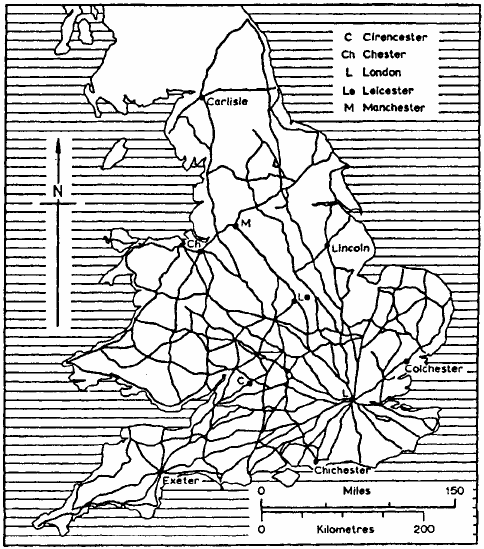
The poor quality of roads reflected the inadequacy of engineering skills and the localized nature of their administration
(Figure 7.1). The Highways Act of 1555 was the first legislation passed applying to roads in general in England and Wales.
The parish was made responsible for road repair and two people were appointed annually to act as surveyors with powers to
supervise four days’ work which parishioners were obliged to render annually on the parish roads. This ‘statute labour’ was
extended to six days in 1562 and was not abolished formally until 1835. The status of the Surveyor was raised in 1575 and in
1691 appointment was transferred to the quarter sessions. After 1662 parishes could levy a rate to cover the cost of repair and
employ hired labour to do the work. The interests of local communities seldom went beyond their parish boundaries and,
though this system may have been adequate for dealing with local roads, the trunk roads were usually repaired in a
perfunctory manner. Local inhabitants thought that the people who used these roads should pay for their upkeep. This was
recognized in 1663 with the passage of the first Turnpike Act, which gave authority to local Justices and allowed them to
charge tolls, though its ineffectiveness outside Hertfordshire resulted in no further legislation until 1695–6. The private
turnpike trust did not develop until after 1706. In so far as central government interfered at all, it was mainly to fit the traffic
to the roads rather than roads to the traffic. The inadequacies of the statute labour system was recognized by Parliament in a
long series of ad hoc measures. After 1691 JPs could levy road rates on parishes for a limited time. In Marylebone parish, then
on London’s outskirts, thirteen rates were levied between 1705 and 1723 to help repair the Edgeware and Great West Roads,
taxing local people more heavily as through traffic grew. Legislation to restrict the weight of waggons, the width of wheels
and the number of horses began in the 1620s. The amount of additional legislation—in 1629, 1662, 1670, 1696, 1718, 1741,
74 THE REVOLUTION IN COMMUNICATIONS—LAND AND WATER
1751, 1753 and 1773—demonstrated the inadequacy of this approach but until the late eighteenth century it was one of the
few known ways of saving the road system from complete collapse.
In these conditions travel was both slow and expensive. Most people, who had to travel to work or who wanted to travel
cheaply, simply walked. People who could afford to travelled by horse. The person on horseback was the symbol of travel in
eighteenth-century Britain and was more typical than the stage-coach or private carriage. Goods were carried slowly by
packhorse or mule or in big carriers’ waggons. The costs were high and it was impossible to carry cheap and bulky
commodities like grain or coal very far and still sell them at a profit.
Travel by water
Apart from the roads the water carriage system of navigable waterways and the sea played a vital role. Andrew Yarranton wrote
in 1698 that
Of necessity we must always be Sailing round about the Island, carrying and recarrying such heavy Commodities from
Port to Port, to be taken into the more Inward parts of the Kingdom, otherwise the charge of carrying such goods by
Land, would rise to a very vast charge, the High-ways of our Island being very uneven, and the ways therein in
Wintertime very bad.
6
Few areas in England were more than 15 miles from navigable water and those areas that were were, with the exception of the
area round Birmingham, were not economically important—the moors and mountains of the Pennines, Salisbury Plain,
Dartmoor and parts of the Downs. For the transport of bulk goods water transport was considerably cheaper than land
carriage. Adam Smith pointed out that:
Six or eight men…by the help of water-carriage, can carry and bring back in the same time the same quantity of goods
between London and Edinburgh, as fifty broad-wheeled waggons, attended by a hundred men, and drawn by four
hundred horses.
7
Cambridge undergraduates sent their trunks by sea and river from London rather than the 51 miles by road. Timber brought
out of the Weald to the coast cost about one shilling per ton per mile to transport by road in the 1670s while iron cost between
Figure 7.1 Major road networks in 1700
Source: H.J.Dyos and P.H.Aldcroft British Transport, Leicester University Press, 1971, p. 32.
SOCIETY AND ECONOMY IN MODERN BRITAIN 1700–1850 75