
Brown R. Society and Economy in Modern Britain 1700-1850
Подождите немного. Документ загружается.

2
Britain in the early eighteenth century
In 1749 the philosopher Montesquieu made the distinction in his The Spirit of the Laws between the internal (social and
psychological) and external (physical or environmental) aspects of human life suggesting that the link between them was to be
found in legal structures which institutionalized a society’s relationship with its environment.
1
He explained that different
physical environments gave rise to different needs which in turn produced different modes of life. This chapter is concerned with
outlining the contrasting experiences that existed in the early eighteenth century in the four parts which made up the British
Isles.
GEOGRAPHY—STRUCTURE AND CLIMATE
Although the geological structure of the British Isles is extremely complex when looked at in detail, in broad outline it is quite
simple.
2
The basic division is between the Highland zone of the west and north and the Lowland zone of the south and east
and Ireland. The Highland zone consists of very old rocks eroded and shaped by glaciation in some areas leaving nothing but
a thin covering of soil. But the glaciers also dumped heavy boulder clays and finely sifted sands and gravels. The human
response to these differences in soil type, drainage and structure in the early eighteenth century was diversity of meadow,
heath, pasture, arable field and bog. Oats were the main corn crop. Hunting and fishing took on a central importance in supplying
basic needs. Defoe wrote in the 1720s of north-west Scotland that
the people [live] dispersed among the hills without any settled towns. Their employment is chiefly hunting, which is, as
we may say, their food; though they do also breed large quantities of black cattle, with which they pay their lairds or
leaders for the rent of the lands… these cattle…are driven annually to England to be sold, and are even brought up to
London….
3
The prevailing western winds bring high rainfall. Annual rainfall is rarely below 40 inches and in some areas of Wales, the
Lake District, the Western Isles and north-west Scotland it exceeds 100 inches. This too has influenced what people could do.
Drainage is poor, the rain has washed out many of the nutrients leaving a soil capable of sustaining only poor vegetation.
Altitude has the greatest impact on human activity. In the 1760s the Duke of Hamilton determined rent for his farms by height
above sea-level—the higher the farm, the lower the rent. There was variation of human response to these different conditions.
In Scotland, for example, there were differences in farming techniques between the wetter West Highlands and the East
Highlands. In parts of Wales and Cornwall animals were driven up to the summer pastures and brought down to the shelter of
their byres at the beginning of winter. In or around the Highland zone lie most of Britain’s mineral resources: coal in Wales,
Lancashire, Yorkshire, Durham and Scotland; tin, copper and kaolin in Cornwall; lead in the Mendips and Derbyshire; iron in
the Forest of Dean, the Cleveland Hills and central Scotland.
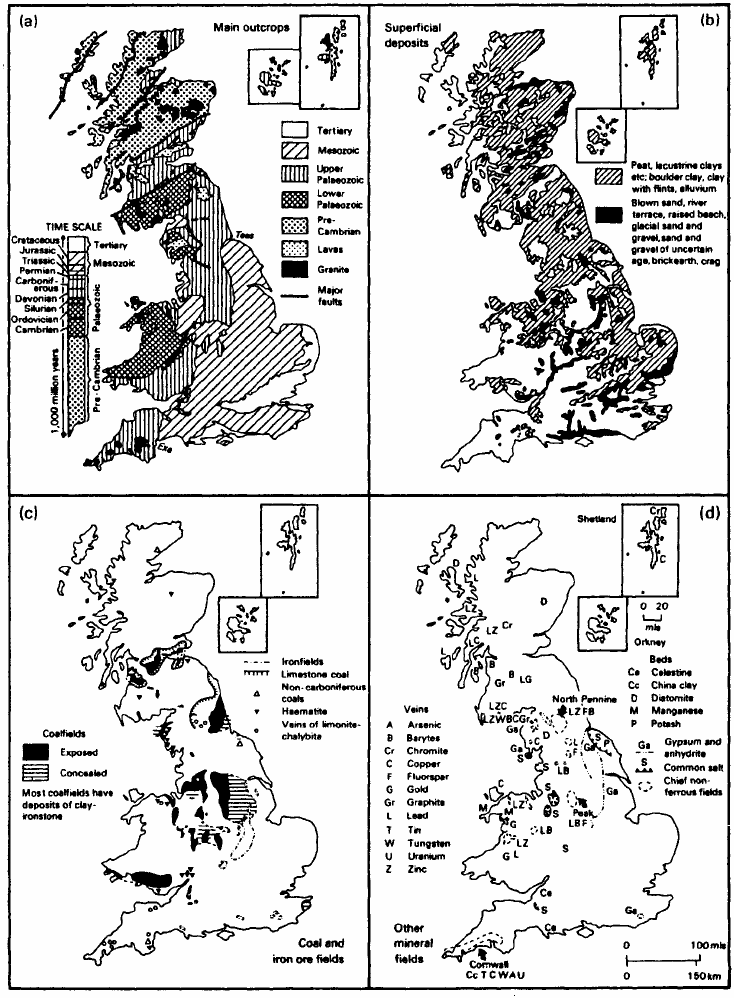
Lowland Britain and Ireland contains as much diversity as the Highland zone (see Figure 2.1). The underlying rocks are
softer and have weathered more quickly than those in the Highland zone to produce deeper and more fertile soils. There is less
rain and the climate is generally less harsh. In Lowland Britain the type of soil also determines what sort of farming is
possible. In the early eighteenth century the heavy clay soils were difficult to drain and plough. Lighter sandy soils were
easier to till. In Ireland, for example, woodland was strongest below 500 feet and had been largely cleared so that the rich
alluvial valleys could be used for pastoral or arable use. Flooding was a problem in the river valleys after heavy rain. The
coastal area between the Humber estuary and the mid-east coast was turned to swampy fens by the sluggish estuarine rivers.
Some advance had been made in the Fens proper in the seventeenth century as the result of the imported Dutch drainage
methods associated with Cornelius Vermuyden.
PEOPLE AND PLACES
In 1700 there were about 4.9 million people living in England, 406,000 in Wales, about a million in Scotland and about 2.5
million in Ireland. In Ireland there were concentrations of population on the coastal plain from Belfast to Dublin and around
Limerick and Cork in the west. In Scotland there were three sharp regional divisions: the greatest concentration was in the
Central Lowlands with Edinburgh containing about 40,000 people and Glasgow 12,000. The Southern Uplands, with their
better soils and climate, were more densely populated than the Highlands with its settled population concentrated on the
coasts and islands. The population of Wales was evenly distributed though some concentration had already begun in the Vale
of Glamorgan. Towns were small. Wrexham was the largest, with only about 3,000 people. In England there was a
marked contrast between the heavily populated areas of south and eastern England, the mining areas of Northumberland and
Figure 2.1 Physical divisions and resources in Britain
Source: J.Langton and R.J.Morris (eds) Atlas of Industrializing Britain 1780–1914, Methuen, 1986, p. 3
BRITAIN IN THE EARLY EIGHTEENTH CENTURY 7
Durham and the textile manufacturing West Riding of Yorkshire and the rest of the west and north, where people were thinly
scattered. London and its suburbs, containing about 600,000 people, was the densest concentration of people in Europe. Its
influence on almost every aspect of national life is difficult to exaggerate at this time. This dominance can be seen by
comparing it with the other major cities: Norwich, the second city, had just 30,000 people, as did Bristol, but Birmingham had
only 12,000, Newcastle 15,000 and Manchester and Leeds 10,000 each.
IRELAND
In 1700 Britain had a largely rural economy and society. Ireland was separate from mainland Britain physically and was not
constitutionally assimilated until the Act of Union in 1800. During the seventeenth century it emerged from a woodland
economy with hides as the only major export to a substantial agricultural country based on exporting cattle, beef, sheep and
dairy produce.
4
Much of this went either to the continually growing London or to the expanding textile areas of North Wales
and England. Growing trade led to concentration of traffic in Cork, Belfast and particularly Dublin, which had a population of
about 60,000 in 1700. This marked the beginning of the distinction between a ‘maritime’ economy based on a cash economy
which looked outwards and a ‘subsistence’ peasant economy.
In 1700 the Anglo-Irish Protestant landowners, who ruled through their control of 80 per cent of the land, were a
beleaguered minority. They accounted for about a quarter of the Irish population, were often absentees and were bitterly resented
by the Catholic tenant majority on religious and national grounds. This position was worsened by the nature of their settlement.
Theirs was a gentry plantation without the buffer of yeomanry and small freeholders which characterized England. Landlord
control was limited by the terms of the lease. Roman Catholics, who were excluded from public office, could not hold a lease
for longer than thirty-one years as a result of an act of 1704. But it was in the landlord’s interest to give Protestants life-leases.
This effectively made the tenant a freeholder with the right to vote in parliamentary elections and the landlords’ influence
depended on how many votes they could muster. Leaseholders were reasonably secure and many were well off by 1700. But
other sections of society were less comfortable. Some leaseholders sub-let all or part of their land at a substantially higher rent
than they themselves paid. Worse off still was the large body of labourers or ‘cottiers’ which made up about half of Ireland’s
population and lived on or below subsistence level. This was largely the result of underemployment since Irish farming did not
require high levels of labour. Wages were low, about 4d. per day, and were inadequate even though prices were lower than
those in England. An agrarian economy cannot easily absorb an expanding population and it was the cottiers who suffered most
and came to depend most heavily on the potato by 1800. By comparison with England they may have appeared backward but,
compared to much of the rest of Europe, their conditions were perhaps less wretched. Domestic production of woollen cloth
provided both additional employment and the basis for expanding woollen exports after 1660. Low land prices in Ulster led to
an influx of Scottish and English immigrants in the 1680s, whose Presbyterianism was as suspect to the Anglo-Irish as was
Catholicism. Ulster was transformed from being the most backward of Ireland’s four provinces to being the centre of linen
production, with Belfast as the fourth port in the country.
The relationship between the Anglo-Irish and England was based upon survival for the former and security for the latter.
The Anglo-Irish could not survive in Ireland’s hostile environment without England’s permanent military presence and they
provided a secure base through which the country was governed. In England the relationship between landlord and tenant was
based on a shared religious tradition. In Ireland the landlords were almost all Protestant while most of their tenants, with the
exception of those in Ulster, were Catholic. Little wonder that contemporaries and later historians have seen Ireland as a
‘colonial possession’. For the Catholic Irish majority the memory of war, conquest and dispossession survived and was
maintained through Gaelic, the everyday language of the peasantry, which kept alive a sense of cultural distinctiveness. This
‘colonial’ status was reflected in the constitutional machinery through which Ireland was ruled.
5
Power was exercised in
theory from Dublin Castle by the Lord Lieutenant or, in his absence, a commission of Lords Justices. The Lord Lieutenant was
appointed from England and was responsible to English ministers. The English Crown enjoyed substantial ‘hereditary
revenues’ and the Irish Parliament was only called to vote for additional supplies to top them up. Right to prepare legislation
lay with the Irish Privy Council, but approval had to be obtained from England. The Irish Parliament could either accept or
reject these bills but could not amend them and, if necessary, the Westminster Parliament had the power to legislate directly
for Ireland.
In practice the situation was somewhat different. The early eighteenth century saw the Irish Parliament develop a power of
the purse and its Commons began to question legislation presented to it. These constitutional debates coincided with the
increase in restrictive English economic legislation, especially the Woollen Act of 1699, and came to a head in the 1720s. The
1720 Declaratory Act reasserted Westminster’s authority ‘to make laws and statutes of sufficient force and validity to bind the
kingdom and people of Ireland’.
The prolonged struggle over ‘Wood’s Halfpence’, between 1723 and 1725 raised greater issues than that of copper coinage.
William Wood, a Wolverhampton ironmaster, obtained a patent in July 1722 to mint copper coins for Ireland. This project
was viewed in Ireland both as a symbol of English oppression and as a real threat to the Irish economy. It roused Irish
8 BRITAIN IN THE EARLY EIGHTEENTH CENTURY
patriotism against what was seen as a government-inspired financial scheme and Walpole proved incapable of dampening
opposition both in England and Ireland. In 1725 he recalled the patent. Walpole had yet to develop an effective system of
managing government. During the next decade he built up a more effective way of managing the Irish Commons through
several leading MPs known as the ‘undertakers’ who guaranteed to put through government business in return for a
considerable share of Crown patronage. This reinforced the strength of the Protestant minority.
Mainland Britain had been brought under the control of the Westminster Parliament by 1710. Wales was assimilated into
England by two acts of Parliament: the 1536 Act divided it up into counties on the English model and gave it representation in
the English Parliament and in 1543 an act provided for the appointment of justices of the peace and the replacement of Welsh
land law with English common law. Although the crowns of England and Scotland were united on the death of Elizabeth I in
1603 a more tangible union between the two countries was delayed until the Act of Union of 1707. In the early eighteenth century
the kingdom of Great Britain was of recent origin.
SCOTLAND
Scotland retained much of its own character after 1707 particularly in the legal system, in the kirk and in education.
6
The Act
of Union abolished the Scottish Parliament. It added 45 new members to the English Commons, made up of thirty county
representatives and fifteen from royal ‘burghs’ and added sixteen ‘representative peers’ to the House of Lords. The twenty-
seven largest counties received one member while the remaining six (Nairn and Cromerty, Clackmannanshire and Kinross,
Bute and Caithness) were paired with one seat each. The county electorate was confined to ‘freeholders of the old extent’ or to
owners of land rated at £400 Scots (£35 sterling), one that was much smaller than in England and open to fraud. The burghs
7
were arranged into fourteen groups each of which had one seat, with Edinburgh taking the fifteenth. Each burgh council
elected a representative which met with the other representatives in its group and these individuals then proceeded to choose
the MP.
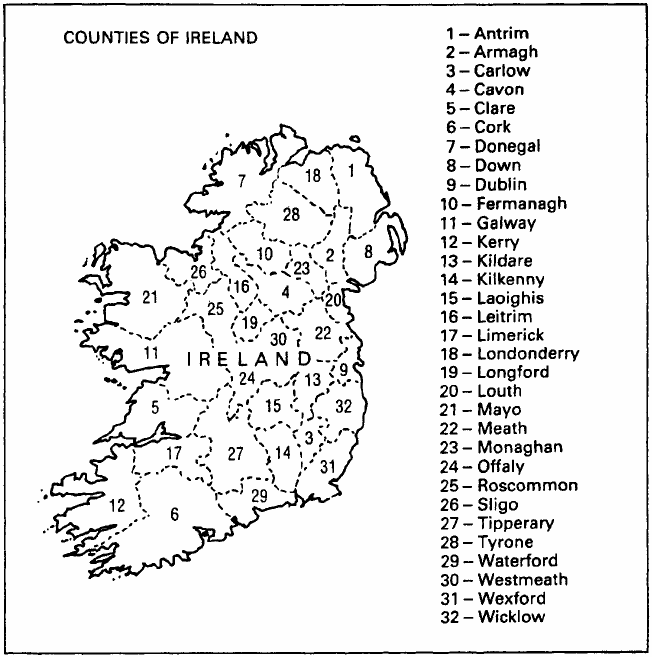
Figure 2.2 Counties of Ireland
Source: Based on R.K.Webb, Modern England, Allen and Unwin, 1969, pp. 4–5.
BRITAIN IN THE EARLY EIGHTEENTH CENTURY 9
The abolition of the Scottish Privy Council in 1708 effectively removed central government in Scotland. There was a
Secretary of State between 1708 and 1725 and again from 1742 to 1746 but Scotland was ‘managed’ by London-appointed
Scottish Whigs—Jacobites being excluded because they did not acknowledge the Hanoverian succession. Scotland was
largely governed from local level for much of the century and the Scottish aristocracy totally dominated political and social
life. Administration lay in the hands of the burghs and the parishes. The burghs fell into two types: royal burghs established
by the Crown and burghs of barony established by the aristocracy. In both cases they were completely dominated by the
landed interest. Theoretically the sixty-six royal burghs had a monopoly of trade, domestic or foreign, and their Convention,
an annual assembly of delegates, did attempt to maintain this monopoly. But burghs in general were essential to rural society
as markets or market-places and it was impossible to enforce this against growing burghs of barony like Kilmarnock,
Greenock and Hawick.
The parishes
The 938 Scottish parishes were governed by kirk sessions, the Scottish equivalent of the English vestry, which used money
raised by church-door collections and fines to finance poor relief. In Scotland levying a poor rate was discretionary rather than
mandatory, with the result that than one in parishes chose to do so. But since Acts of 1616 and 1633 each parish was required
to establish a school, provide a schoolhouse and pay for a schoolmaster. In the 1696 Act for Settling Schools landowners were
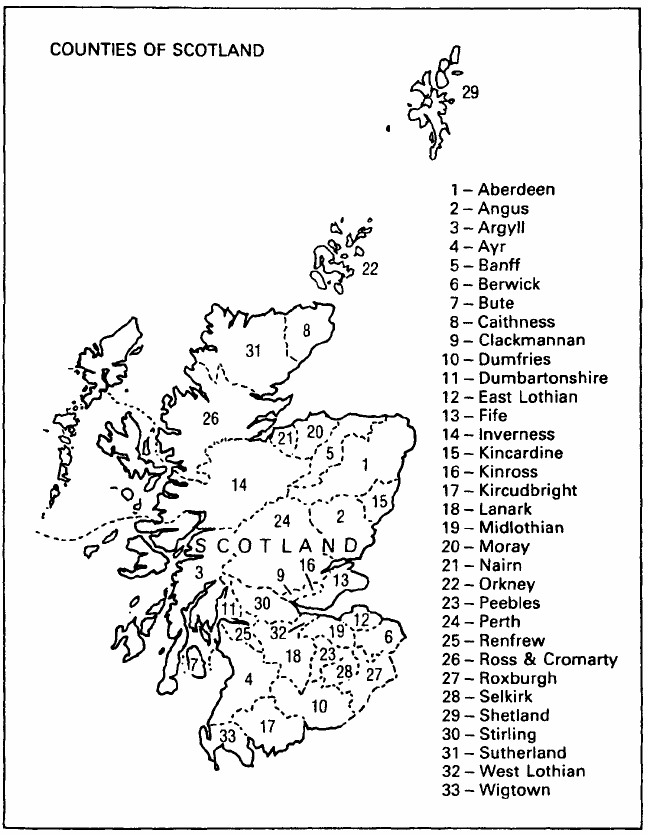
Figure 2.3 Counties of Scotland
Source: Based on R.K.Webb , Modern England, Allen and Unwin, 1969, pp. 4–5.
10 BRITAIN IN THE EARLY EIGHTEENTH CENTURY
rated for this system, though they could and did half of the burden on to their tenantry. By 1700 most Lowland parishes had a
school but in the Highlands their establishment came more slowly, particularly because of the difficulty in getting Gaelic-
speaking teachers.
The parish was also a system of ecclesiastical administration. In 1690 episcopal church government was replaced by
Presbyterianism ruled by a General Assembly. The parish minister had considerable power over his congregation on moral,
education, religious and other issues. Ministers received a regular stipend which in 1633 was laid down as a minimum 800
Scottish merks or just over £44 sterling. Tithes were less of an issue in Scotland than in England. In 1633 they became a fixed
charge or ‘teind’ paid in cash or meal by each estate in the parish. Provision was made for commutation of teinds at nine
years’ purchase. Glebe land was of little importance.
Legal systems
The most radical difference between Scotland and England lay in their respective legal systems. England had a unified and
centralized jurisdiction under the Crown but in Scotland heritable jurisdiction and offices, notably the sheriffs, were
widespread. The baron courts were the basic units of rural society dealing with petty crimes and community rules. The Act of
Union guaranteed the survival of the Courts of Session, Justiciary and Admiralty in their existing form and in article 20
That all heritable Offices, Superiorities, heritable Jurisdictions, Offices for life and Jurisdictions for life, be reserved to
the Owners thereof, as Rights of Property, in the same manner as they are now enjoyed by the Laws of Scotland,
notwithstanding of this Treaty and an independent legal profession was to become the ‘bearers and defenders of
nationality’.
Justices of the Peace had been introduced by legislation in 1587 and 1609 though they were never as important as in England.
Their role was complemented by the commissioners of supply who were responsible for collecting the land tax introduced in
1667. The difficulty in collecting this led to the commissioners becoming more involved in parish affairs and helping the
justices keep Scotland’s roads in working order. In the eighteenth century their work was made easier, for two reasons. First,
in 1748 heritable jurisdiction was abolished. Secondly, commissioner and justice were often the same person and also a local
landlord with much wider and more clearly defined powers over tenants than in England.
Scotland—an agrarian society
Scotland was a largely agrarian society. There were three main farming regions, with many smaller sub-regions further
complicating the picture. Good soils were largely concentrated in the Central Lowlands, the corridor sandwiched between the
poorer soils of the Highlands and the Southern Uplands. Both these areas were better suited to pastoral than arable farming.
By 1700 the Border region was geared to rearing sheep for marketing both wool and meat, usually in England. In Galloway,
in the south-west, the rise of large-scale cattle production for the English market produced large enclosed cattle parks of up to
2,000 acres. Arable farming was based on common grazing with an infield and outfield round the settlement. The settlement
was a cluster of houses known as a ‘ferm toun’ in the Lowlands and a ‘clachan’ in the Highlands. The infield, the land under
continuous cultivation, was divided into ‘breaks’. The land of individual farmers was distributed ‘runrig’ and lay dispersed
throughout the infield in strips (rigs). Each ‘break’ was sown with oats and barley and, sometimes in the Lothians, with
wheat. Sometimes a break was allowed to lie fallow for a year but generally the only time it was not under cultivation was in
the winter:
In place of a chequerboard of separate fields one must imagine the ground everywhere lying as open as moorland…
seldom divided in any way by hedge, wall or dyke…The pastoral land…was all more or less rough brown waste: there
was no question of grass being cultivated as a crop. The ploughed land within was in a series of undulating strips or rigs.
8
In 1700 there were about 10,000 landowners in Scotland. Eighty per cent of these were the ‘bonnet lairds’, who owned small
farms and were more akin to English yeoman than landowners living on rents. But there were still 1,500 more substantial
landowners. In the Highlands power and authority lay with the clan chiefs and society was organized for war. Extensive areas
were leased by the clan chief to ‘tacksmen’ who in turn sub-leased, generally on an annual verbal basis, to as many tenants as
possible. Payment was often in terms of goods and particularly military service. The nature of rural society in the Lowlands
and Southern Uplands, with some ‘middling groups’, in many areas holding direct from the Crown or by virtual ownership
known as ‘feuing’, was rather more complex. By 1700 most tenant farmers in the Lowlands had written leases for up to
twenty years’. The older system of joint leases, where tenants held a specific fraction of a farm, gave way to single tenancies
starting in the Lowlands. Tenants sub-let to people variously called acremen, crofters (who held infield but not outfield), cottars
BRITAIN IN THE EARLY EIGHTEENTH CENTURY 11
(who held small amounts of land to supplement their main works as hired labourers), grassmen (who had rights of pasture on
the outfields but no arable land), mailers and pendiclers.
Urban society
The small burghs were completely dominated by the landed interest and were not cut off from agriculture. They used their
common grazing, took peat from the hills and had arable lands to which their own labour force was restricted in harvest time.
Towns were important centres of specialist services, craft activity and mercantile capital. But they were generally small
because the centres of industrial activity—soap and salt production, the linen industry and the cattle trade—did not need
towns to process their products. The larger cities gained support from international trade —Glasgow, for example, was
growing as a centre of the tobacco trade— and also made specialized goods for the aristocracy.
9
The Scottish economy at the beginning of the eighteenth century had a dual nature. There was a basic agricultural sector
which was weak in its market aspects though capable of producing a surplus to sustain an aristocratic elite. There was also a
more sophisticated sector supplying that elite with imported luxury goods though increasing amounts were home-made. But
Scotland was an insecure society. It was split culturally between the Gaelic-speaking world and the Scots speech of the
Lowlanders. It was split politically between those who had Jacobite sympathies and those who looked to the Hanoverians.
The Highland society was based on clan kinship and personal loyalty whereas in the Lowlands a commercial relationship
between landlord and tenant was beginning to develop. The reality of 1707 was that England absorbed Scotland. The 45
Scottish MPs only just exceeded the 44 returned by the county of Cornwall.
WALES
10
Wales returned MPs from twenty-seven constituencies to the House of Commons. Wales only had half the representation
given to England—one county member (except for Monmouthsire) and one borough member. In 1700 between 1.8 and 4 per
cent of the county population could vote. The voting qualification for the twelve county MPs was the 40-shilling freehold, and
the size of the county electorate reflected the restricted number of freeholders, which was a result of the smallness of the
farming units. The term ‘freeholder’ was interpreted flexibly and, as in Ireland, often admitted people with long leases or
copyholds to the vote. Borough MPs were elected by a group of boroughs consisting of the county borough and a number of
‘out-boroughs’. In the case of Glamorgan seven out-boroughs shared with Cardiff, the county borough, the right of election.
In some boroughs, like Beaumaris, the franchise was vested in the corporation. In others, like Brecon, only resident freemen
could vote, while non-resident freemen could vote in Cardigan. More people voted in Welsh boroughs than in the counties. In
England there was a growing number of people who converted wealth into land but they were not sufficiently numerous in
Wales to affect the political monopoly of established landed interest.
Physically Wales can be divided into three regions: the highland areas; the coastal areas around these and the areas adjacent
to England. Pastoral farming was the dominant feature in the first two regions, with some elements of it apparent in the third.
In the highland areas farms consisted mainly of rough grazing with some meadowland around the farmhouse. In the second
area upland farms with little arable land were common in 1700 though in the lowlands arable land made up about a third of
the land used and mixed farming dominated. Cattle rearing, for consumption in the massive English market, was still more
important than sheep rearing and was dominated by the ‘porthmon’ or cattle dealer. By 1700 much of the lowland was already
gathered into compact farms but strip farming existed in the Vale of Glamorgan, Vale of Clwyd and Pembrokeshire. However,
the traditional Welsh pattern was more diffuse with dispersed small farming units together with an occasional hamlet. Even in
lowland Wales the response to farming was intensely local, reflecting differences in soil, slope, altitude and drainage.
Welsh society and economy
Welsh society was traditionally divided into bonedd a gwreng which broadly represented an upper and lower class. Bonedd
related to lineage which was accepted as the basis for authority and lay with the gentry. The aristocratic element was not
prominent though some Welsh land formed part of English aristocratic estates. Social and economic changes in the
seventeenth century depressed the conditions of the lesser gentry, who lost their traditional position in the Inns of Court and
the universities, in politics and Parliament, Just as in England it was those people with larger estates who capitalized on new
techniques and sources of income who prospered. There were between thirty and forty families in Wales with incomes in
excess of £3,000 a year: families like the Bulkeleys in Anglesey, the Mostyns in Flint, the Vaughans of Transcoed in
Cardiganshire, the Vaughans of Golden Grove in Carmarthanshire and the Morgans of Monmouthshire monopolized
Commons seats and the patronage which went with them. Each county contained between twenty-five and fifty families with
incomes between £500 and £1,000 a year, who served as JPs and ran their counties through the quarter sessions. Recent work
on Glamorgan
11
has spotlighted the diverse nature of this broad description. In 1700 there were ten families with incomes
12 BRITAIN IN THE EARLY EIGHTEENTH CENTURY
over £1,500 per year and forty-seven men owned 80 per cent of the county. But in the next fifty years many of the older
families died out and their heiresses were married off. Glamorgan’s ruling elite became Anglicized, creating a language barrier
with those they ruled. By the late eighteenth century such names as Corbet, Pennant, Assheton-Smith, Cawdor and Bute
testified to the extent of English and Scottish penetration. They were increasingly marked off from the community by a
growing gulf of language and religious and political affiliation. Smaller landowners switched their enterprise into fields which
brought them into contact with the growing ‘middling order’. This process of modernization can also be detected in
Denbighshire and Flintshire under the pervasive influence of Watkin William Wynn of Wynnstay in the north-east and in
Monmouthshire. These men rented their land out to tenant farmers who in turn employed farm labourers, hired for the year or
half year. Single labourers usually lived in as did women servants on the larger farms. Though workers were hired for a
specific job there was no strict division of labour and in the winter hired men often did the weaving.
The woollen industry was next in importance to the cattle trade in the Welsh rural economy. The cloth trade had been
moved to North and mid-Wales in the sixteenth century and was subjected to the Drapers’ Company of Shrewsbury. Its farm-
based production was concentrated in the area running from Machynlleth on the west coast through Merioneth, Montgomery
and Denbigh to the borderlands. Output was small in comparison with England: the four counties of Merioneth, Montgomery,
Monmouth and Pembroke in 1747 was estimated at £100,000 compared to Yorkshire’s £2,371,940. The whole of the south
and north had a scattering of industries. Copper, tinplate and related industries had existed in Swansea-Neath and Pontypool
since the sixteenth century. By 1700 most British production was concentrated there and was yoked to the mines of Anglesey.
By 1720 a sixth of British pig-iron production was from the scattered charcoal furnaces of South Wales. Slate production in
north-west Wales was already a major exporting industry to England and Ireland—a million slates were exported in 1688.
The economies of Wales and England were closely linked. The cattle industry was based on English needs. North Wales
was under the control of Shrewsbury and this was to pass to Liverpool after 1770. South Wales was enmeshed by Bristol. It
has been argued that
Generally, this core of the British imperial economy was itself colonial…. Many of the Welsh, on their upland farms
and at their treadmill of loom and spinning wheel and domestic drudgery, were trapped in a back-breaking poverty and
an unremitting colonial dependence which sent great droves of skinny cattle and skinny people seasonally tramping into
England to be fattened.
12
POLITICAL, SOCIAL AND ECONOMIC STRUCTURES
Who could vote
The economies, societies and politics of Ireland, Scotland and Wales were dominated by England. In Ireland, a dual system of
administration between Westminster and Dublin testified to the separate role of Ireland in public policy. In Wales, the Home
Office and Court of Chancery made no distinction between Welsh and English problems. No Welsh-speaking bishop was
consecrated in the eighteenth century after 1714. But in Scotland, the Presbyterian kirk remained a representative assembly of
a Scots community. Parliament at Westminster legislated for all four countries and after 1707 only Ireland had its own
legislative assembly. The House of Lords was composed of some 220 peers in the early eighteenth century, of whom 26 were
bishops and 16 ‘representative’ Scottish peers. These were the wealthy landowners whose vast territorial possessions gave
them social standing and political influence through their control of nomination to many seats in the House of Commons.
They were a relatively homogeneous group united by interest, blood and marriage. The House of Commons was made up of
489 English members: 80 county MPs, 405 borough members and 2 MPs each for the universities of Oxford and Cambridge.
The county MPs were elected by the 40-shilling freeholders. There were about 200,000 of these in 1700 but, if there was an
election, they could generally be influenced to vote, in accordance with the wishes of the dominant landowners. The cost of
county elections meant that it was usual practice to try to get agreement between the rival groupings without the need for an
electoral contest. Of the 203 English boroughs, 196 returned two members, the City of London and Weymouth returned four
members each, and five boroughs one member. Voting qualifications were far more varied. In 1700 the total electorate was
probably no more than 85,000. In the 12 ‘potwalloper’ boroughs all residents who had a house or hearth and did not receive
poor relief could vote—in Preston this meant a large electorate but in St Germans, Devon only twenty. The 37 ‘scot and lot’
boroughs saw the franchise given to those who paid this medieval poor rate—again the size varied, from 9,000 for
Westminster down to two for Gatton. There were 27 ‘corporation’ boroughs where the mayor and members of the corporation
had the right of election and 92 ‘freeman’ boroughs. In some boroughs the right to vote was attached to certain freeholds—in
29 ‘burgage’ boroughs it was vested in tenancy of land and in 6 ‘freehold’ boroughs in the ownership of land. The scale of the
borough electorate gave far greater scope for influence and intimidation. Well over a hundred constituencies belonged to the
BRITAIN IN THE EARLY EIGHTEENTH CENTURY 13
category of ‘close’, ‘rotten’ or pocket boroughs. This was aided by the public nature of voting on the ‘hustings’. The 1716
Septennial Act lengthened the life of a parliament from three to seven years, cutting down on the expense of electoral contests.
Parliament—functions
Parliament made laws, largely of a local nature, voted monies and discussed grievances. It was dominated by ministers who,
with the Crown, determined policy. Though the House of Commons was increasingly the focus for political power the House
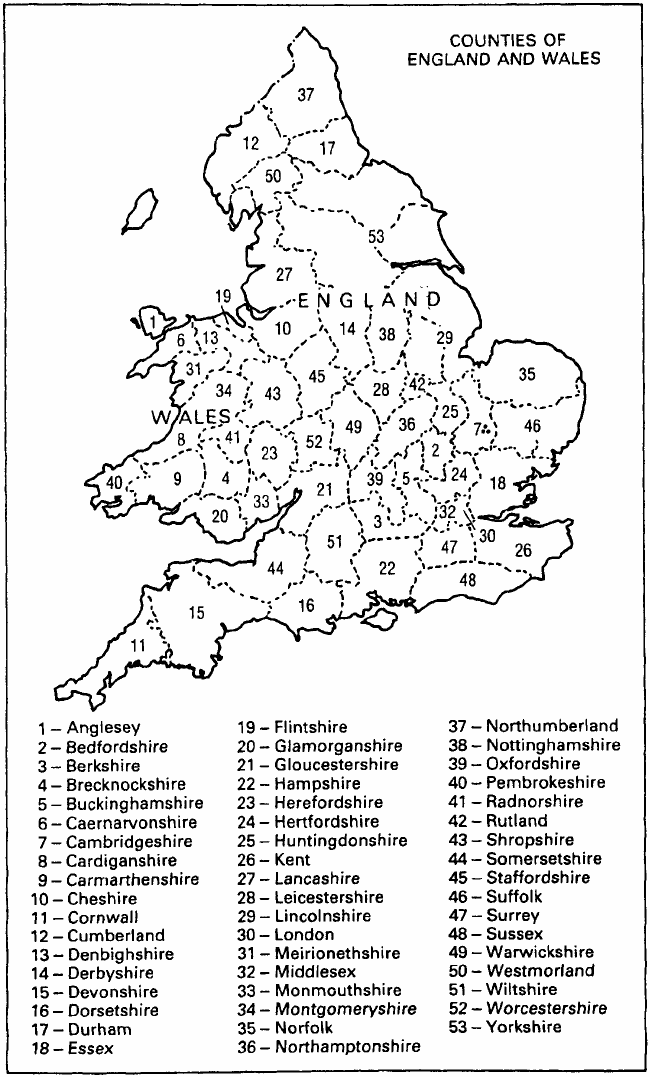
Figure 2.4 Counties of England and Wales
Source: Based on R.K.Webb, Modern England, Allen and Unwin, 1969, pp. 4–5
14 BRITAIN IN THE EARLY EIGHTEENTH CENTURY
of Lords retained its importance, if only because most ministers were peers. Successful ministers like Robert Walpole were able
to ‘manage’ both the Commons and the Crown, and political success depended on being acceptable to both. Government was
very much a co-operative venture between Commons, ministers and the Crown, and was concerned with external security,
promoting and protecting commercial interests, and maintaining law and order at home. Government gave ministers access to
Crown patronage and offices, many of which were sinecures carrying a good salary without involving duties, through which
they could ‘manage’ affairs.
13
This was an administrative conception of government, concerned with maintaining the existing
system rather than changing it.
Local administration—county and parish
At local level power was wielded by institutions working within the fixed and known boundaries of the county, parish and
borough. At the head of the county stood the Lord Lieutenant, a royal appointment. Below him were the JPs, usually from
among the gentry and were required by acts of 1732 and 1744 to possess land worth at least £100 per year, who exercised
their judicial and administrative powers through the quarter sessions but also had increasing powers of summary justice. The
only real check on their actions was that they had to act within the law though there was some supervision in Wales through
the Courts of Great Session, for which Wales was divided into four circuits, each of three counties.
There were some 9,000 parishes in England and Wales in 1700 which were governed by the vestry, composed of the most
important inhabitants often with an Anglican clergyman as chairman. It dealt with nearly all aspects of parish life: it appointed
churchwardens and received the accounts of the surveyors of highways and overseers of the poor though these were appointed
by the JPs. The vestry was the only institution in the country other than Parliament that could levy taxes or rates. Parishes
were also ecclesiastical units of the Established Church. Parishes were arranged into dioceses controlled by bishops and the
dioceses in turn were grouped into two provinces under the control of the archbishops of York and Canterbury. The close
proximity of manor house and church reflected the lay patronage in the church. The right of appointment or advowson to a
benefice generally lay with the landed gentry—this applied in Scotland as well. The parson drew his income from fees, from
his glebe land and from tithes. Tithes were paid by all, whether members of the Anglican Church or not and were bitterly
resented.
Local administration—town and city
Urban local government was less uniform. There were about 800 towns in England and Wales. About 200 were boroughs and
were governed by a corporation composed of mayor, aldermen and burgesses. Corporations had extensive powers—the right
to have civil courts of law and their own Sessions of the Peace, to have markets and make their own by-laws for the regulation
of trade and manufacture. The Corporation Act of 1661 and the Test Act of 1678 excluded Nonconformists and Catholics
from public office locally as well as nationally, though Nonconformists could get round this by annually attending the
Anglican church. The position of the non-corporate towns, including some of the most rapidly growing areas like Manchester
and Birmingham, was different: these relied on increasingly ineffective parish and manorial organizations for their
government.
A rural society
English economy and society too was largely rural. What marked England off from continental Europe, except for Holland, was
that during the eighteenth century it became increasingly less rural in outlook. The open field system of farming was
widespread in much of central, midland and southern England at the beginning of the eighteenth century. Although there had
already been substantial enclosure since the sixteenth century much of this had been piecemeal, affecting some parishes
completely, others partially whilst some were unaffected. In spite of the basic unity of practice the operation of the common
field system varied considerably. Farming on the heavy clay soil was different from that on chalklands and lighter soils. It is a
gross oversimplification to imply that northern and western England were given over entirely to animal farming. In these
areas there were small areas of intensely farmed arable land and large expanses of unenclosed pastures.
England was both diverse and remarkably united. It was a close-knit country partly because, despite regional differences,
its economy was interlocking. London lay at the centre of this economy and one in eight people in England lived there. Defoe
commented in the 1720s that The neighbourhood of London sucks the vitals of trade in this trade to itself.’
British farming fed London: cattle from Wales and from the Scottish Borders; vegetables from the market gardens that grew
up in Kent and Berkshire; fish from East Anglia, Sussex and Devon. Yet England had a market economy with each region
specializing in particular commodities. It is possible to identify certain regional differences which were profoundly important.
14
There was the divide between the south-east and the north-west, broadly the contrast between the richer and poorer counties,
and the greater and lesser urbanized parts of the country. The area south of the Bristol-Humber line was both heavily
BRITAIN IN THE EARLY EIGHTEENTH CENTURY 15