
Brown R. Society and Economy in Modern Britain 1700-1850
Подождите немного. Документ загружается.

thirds or more of the acceleration in population was due to a rise in fertility; and (2) one-third or less was due to improved
mortality.
For mortality alone to have accounted for population growth it would have had to improve far more dramatically. Growth
was therefore a combination of both fertility and mortality, but with an emphasis on the former.
MIGRATION
Emigration
The increase in fertility and the decline in mortality were certainly largely responsible for the rise in the total population of
Great Britain between 1700 and 1850. But from the late eighteenth century emigration had a marked, though secondary,
impact on national trends in population growth.
10
There were important regional differentials. Between 1780 and 1840 1.8
million left Ireland for either mainland Britain or North America and Australasia. The famine years between 1845 and 1851
exacerbated that trend. Outmigration, especially from the Highlands, had an important effect on Scotland’s demographic growth.
In England and Wales the effect of emigration on population increase was less dramatic. In fact there was widespread
opposition to emigration well into the late nineteenth century and until after 1815 the cause of emigration attracted little
sympathy. But in 1826 the Select Committee on Emigration advocated voluntary emigration as a solution to the problems of
excess labour at home and the needs of the colonies for labour and security from attack. Many contemporaries saw emigration
as the only real means of combating overpopulation. It was encouraged by a variety of public and private schemes. Large
Highland landowners provided assistance for their tenants to emigrate. Between 1815 and 1826 there were six ventures in
state-aided emigration and the Poor Law Amendment Act of 1834 assisted some 25,000 paupers, chiefly agricultural
labourers from the south-east of England, to emigrate by 1860. Emigration could be a way of escaping from poverty but the
poor could not leave without assistance. In Ireland low rates of emigration from County Cork before 1840 can be explained by
the large number of landless labourers unable to meet the costs of movement. Only after 1846, when conditions improved, did
emigration rates increase. Regional and socio-occupational patterns of emigration show that the worst extremes of poverty
prevented as often as they promoted movement abroad.
Internal migration
The most striking features of internal migration in the pre-industrial period were its frequency and its usually restricted
geographical range. In eighteenth-century England most people changed their permanent residence at least once in their lives
though few moved more than ten miles from their place of birth. Deane and Cole identified several features that characterized
internal migration during the eighteenth and early nineteenth centuries.
11
First, the level of migration between counties
increased twofold between 1700 and 1800. Secondly, the bulk of the migrant population went to the four counties in the
London area, Middlesex, Essex, Kent and Surrey. Thirdly, migration appears to have played a small role in the expansion of
newer industrial areas during the eighteenth century. Between 1700 and 1750 about 40 per cent of the migrants attracted to
areas outside London went, not to the North or the Midlands, but to Gloucestershire and Hampshire, Bedfordshire,
Buckinghamshire and Hertfordshire. Population growth in the industrial centres of Lancashire, Staffordshire, Warwickshire,
the West Riding, Cheshire and Monmouth in the eighteenth century was the result of natural increase and not until after 1800
did internal migration play a more important role.
Migratory patterns altered little during the eighteenth centuries for the following reasons. First, there were many traditional
barriers to mobility. Poor standards of education, low incomes, family loyalties, difficulties in transport were all factors that
limited movement. Secondly, employment opportunities increased in many rural areas, particularly where textile industries
continued to expand. As a result there was less need to look for employment elsewhere. Most of the early industrial centres
relied on nearby populations for their labour supply. Thirdly, the old poor laws restricted mobility in two important ways.
Many parishes dispensed relief liberally and this was a disincentive to movement. In 1836 a contemporary claimed that
the chief cause which has prevented English in distant counties from availing themselves of the vast demand for labour
in such thriving… towns as Birmingham, Liverpool…is the operation of the poor laws, by which the unemployed poor
has been chained to the soil…. Where the parish is bound to maintain a man at home it is natural that he should not go
abroad to seek for work…he will prefer the certainty of a scanty maintenance on idleness among his own friends.
12
The other poor law restraint was the settlement laws which forcibly removed paupers to their own parish if they needed
assistance. Though the impact of these laws upon mobility is debatable they certainly reinforced the identification of the
parish with security and may well have given potential migrants reasons to stay.
26 THE REVOLUTION IN NUMBERS—DEMOGRAPHIC CHANGE 1700–1850
Internal migration, however, did play an important part in determining regional differentials in the rate of population
growth within each of the countries of the United Kingdom. In mainland Britain the number of people who temporarily
deserted their homes and became seasonal migrants grew rapidly between 1750 and 1850. This was particularly the case for
the Irish
13
and, to a lesser extent, Scottish Highlanders who migrated because of overpopulation and poverty and lack of
employment opportunities outside farming in their own countries. The great increase in migration from the Highlands in the
half-century after 1810 owed much to the decline of kelp fishing and illicit whisky distilling industries and the disappearance
of military employment after 1815 as well as the ‘clearances’ of tenants by landlords converting arable land to pasture. Much
of the seasonal work done by the Irish on the mainland fell into the semi-skilled and unskilled categories. In farming they
provided the manual labour needed for harvesting—by 1794 open field farmers in Bedfordshire relied on the wandering Irish
for harvesting crops; in the building trade, for labourers; navvies for road building, canal digging and railway construction.
Those who turned seasonal migration into permanent settlement were largely involved in work English people found dirty,
disreputable or otherwise disagreeable—jobs like petty trading, keeping lodging-houses and beerhouses. In 1840 three-
quarters of the stall-holders in Manchester were Irish. Only in Scotland did the Irish get higher-paid jobs and this was due to
their willingness to use new machinery in place of the more conservative Scottish cotton spinners and weavers. The Famine
led to an enormous increase in the influx of Irish into Britain especially to Liverpool, Glasgow and the South Wales ports. In
1846 over 280,000 Irish immigrants arrived in Liverpool, of whom no more than 123,000 eventually went to other countries.
In fact the Famine marked the high point of Irish migration to Britain.
POPULATION GROWTH AND ECONOMIC CHANGE
Population growth had a positive influence on British economic growth in the eighteenth and early nineteenth centuries. It is
the precise nature of that relationship about which historians disagree. Economic expansion and population growth tend to be
closely associated. But the history of Ireland in this period demonstrates that rapid economic growth is far from being a
necessary or inevitable result of demographic growth.
If population growth did exert a decisive influence upon economic growth then it would have been evident chiefly through
a growth in demand. Deane and Cole
14
discuss its effects upon demand and the labour supply, upon transport improvements
and upon the search for inventions and their commercial application. They argue that movements in demand coincided with
population movements. The expansion of the economy in the first half of the century was limited by restricted demand and
this restriction was lifted by population growth after 1750. This argument holds good if economic and population growth did
coincide. But they did not. Accelerated economic growth was concentrated in the last quarter of the eighteenth century
whereas the maximum rate of population growth on mainland Britain was not achieved until after 1810. Population began to
expand after 1750, and some historians argue that this provided the final ingredient necessary to trigger off industrialization.
Deane and Cole have shown that the origins of higher growth rates in most eighteenth-century industries went back as far as
the 1740s but recent estimates have pushed growth back to the early decades of the century. A.H.John
15
argues that rising
demand for commercially produced products came from the bulk of the population as food costs fell in the early part of the
eighteenth century. This demand stimulated industrial expansion, which calls into question the existence of an economic
upturn in the 1740s and smoothes the upturn after 1780. The symbiotic relationship between population and economic growth
should not be overstated.
There are, however, many possible ways in which population growth may have had favourable effects on the rate of
economic development. In 1963 H.J.Habakkuk saw three possible consequences
an abundant supply of labour at the going wage was favourable to accumulation…and a high rate of natural increase
was a necessary condition of an abundant supply of labour. Population growth was therefore favourable to the widening
of capital….
16
a growing population might stimulate investment by its effects on the demand side…
a growing population is likely to spend a higher proportion of its income on housing and transport facilities.
This third tendency is encouraged, he argued, by urban concentration which made it profitable to create or improve services.
For example, the building of the canal from the Bridgewater coal-mines at Worsley to Manchester took advantage of the growing
demand for domestic coal.
The role of demographic change in the genesis of the British ‘industrial revolution’ was not a straightforward one. More
people in England, Scotland and Wales stimulated demands which the growing economy was largely able to satisfy. But in
Ireland population growth in the eighteenth century was followed by stagnation and immiseration in the first half of the
nineteenth century.
SOCIETY AND ECONOMY IN MODERN BRITAIN 1700–1850 27
NOTES
1 N.Tranter Population since the Industrial Revolution: the Case of England and Wales, Croom Helm, 1973, pp. 13–42 and his broader
Population and Society 1750–1940: Contrasts in Population Growth, Longman, 1985 provide the most straightforward discussion of
the problems. E.A.Wrigley and R.S.Schofield The Population of England 1541–1871, A Reconstruction, Cambridge University Press,
1989, first published 1981, is contentious, combative but ultimately convincing.
2 Useful analyses of Gregory King can be found in P.Mathias The First Industrial Nation, Methuen, 2nd edn, 1983 pp. 23–30 and
G.S.Holmes ‘Gregory King and the Social Structure of Pre-industrial England’, Transactions of the Royal Historical Society, 1977.
3 A convenient discussion of Massie which includes a comparison with King and Colquhoun can be found in P.Mathias The Social
Structure in the Eighteenth Century: a Calculation by Joseph Massie’, first published 1957 and reprinted in his The Transformation
of England, Methuen, 1977, pp. 171–89.
4 On the nature of nineteenth-century censuses and how to approach them see R.Lawton (ed.) The Census and Social Structure, Cass,
1978 especially pp. 1–27 and E.A.Wrigley (ed.) Nineteenth Century Society: Essays in the Use of Quantitative Methods for the Study
of Social Data, Cambridge University Press, 1972. W.A.Armstrong Stability and Change in an English County Town: A Social Study
of York 1801–1851, Cambridge University Press, 1974 shows what can be produced.
5 M.W.Flinn Origins of the Industrial Revolution, Longman, 1966, p. 22.
6 N.Tranter, op. cit. 1985, pp. 64–91, M.W.Flinn British Population Growth 1700–1850, Macmillan, 1970, pp. 37–50 and E.A.Wrigley
‘The Growth of Population in Eighteenth Century England: A Conundrum Resolved’ Past and Present, vol. 98, 1983. R.Porter
Disease, Medicine and Society in England 1550–1860, Macmillan, 1987, especially pp. 23–48, is a convenient summary of the
impact of disease and society’s response to it.
7 M.W.Flinn 1970, p. 45, N.Tranter 1985, pp. 87–8.
8 E.Shorter The Making of the Modern Family, Oxford University Press, Glasgow, 1977. J.R.Gillis For Better, for Worse: British
Marriages 1600 to the Present, Oxford University Press, 1985 is excellent and A.Macfarlane Marriage and Love in England 1300–
1840, Blackwell, 1986 is contentious.
9 P.Deane and W.A.Cole British Economic Growth, 2nd edn, Cambridge University Press, 1967, pp. 133–4.
10 A good analysis of nineteenth-century migration trends can be found in E.H. Hunt British Labour History 1815–1914, Weidenfield &
Nicolson 1981, pp. 144–87, especially pp. 158–76 on the Irish impact. See also A.Redford Labour Migration in England 1800–1850,
Manchester University Press, 1964.
11 P.Deane and W.A.Cole op. cit. pp. 111–14.
12 Quoted in E.H.Hunt op. cit. p. 149.
13 R.Swift and S.Gilley (eds) The Irish in Britain, 1815–1939, Pinter 1989 is a useful study on this subject and should be used in conjunction
with E.H.Hunt op. cit.
14 P.Deane and W.A.Cole op. cit. pp. 88–97.
15 A.H.John ‘Agricultural Productivity and Economic Growth in England 1700–1760’, in E.L.Jones (ed.) Agricultural and Economic
Growth in England 1650–1815, Methuen 1967.
16 H.J.Habakkuk ‘Population Problems and European Economic Development in the Late Eighteenth and Nineteenth Centuries’,
American Economic Review, vol. 53, 1963.
28 THE REVOLUTION IN NUMBERS—DEMOGRAPHIC CHANGE 1700–1850
4
Change on the land
In 1700 agriculture was the mainstay of both British economy and society. Little was to change until after 1800 and even by
1850 farming was the largest single employer of labour. ‘The most opulent nations, indeed, generally excel all their
neighbours in agriculture as well as in manufactures.’
1
Adam Smith believed that agriculture was the foundation of economic development, and historians have been eager to
point to the connections between industry and agriculture. But they have generally treated agriculture as the ‘sleeping partner’.
This anti-agrarian prejudice was conveyed clearly by John Stuart Mill:
The improvements which have been introduced into agriculture are so extremely limited, when compared with those of
which some branches of manufactures have been found susceptible, and they are, besides, so very slow in making their
way against those old habits and prejudices, which are perhaps more deeply rooted among farmers than among any other
class of producers….
2
Agriculture, in fact, played a dynamic role in the wider economy. Without a responsive farming sector the expanding
population could not have been properly fed and important areas of manufacture might have grown less rapidly. In 1700
Britain was more or less self-sufficient in food supplies and was a net exporter of wheat until the 1760s. Nearly 400,000
quarters of wheat went abroad each year between 1740 and 1750. Yet despite the increase in population British farmers still met
80 per cent of home needs in 1850. This revolution in output was the result of the widespread introduction of new methods of
farming—new crops, better rotation systems and, particularly in the nineteenth century, new machines—and new modes of
organization—enclosure of some open fields and waste, and better farm management.
AGRICULTURE—A DIVERSE REGIONAL FRAMEWORK
In 1700, with the exception of parts of upland Wales and Scotland, Britain was not characterized by self-supporting rural
communities.
3
Agriculture existed in a diverse market-oriented regional framework. Regions tended to specialize in the
production of those goods for which they were best suited. Highland Scotland and Wales raised cattle and sheep which were
driven to the fattening pastures of the Midlands and East Anglia before sale in the growing urban markets, especially London.
The southern English counties and much of Ireland were notable granaries. The western counties were mainly under grass.
Market towns were in a denser network in the wealthier southern part of England, except on the downland zones. In northern
England, Wales, Scotland and Ireland the market areas were more extensive. This reflected not only the different types of
farming but different market specializations. Cattle markets on the uplands and the sheep markets on the heathlands had much
wider limits than the corn, fruit and dairy markets of south-west, south and eastern England. There were, however, some
markets which had a significance outside their own area: large wheat markets at Ipswich, Farnham, Basingstoke, High
Wycombe and Bedford with Haddington and Dalkeith in Scotland; barley markets at Ware, Royston and Abingdon; Falkirk was
the main centre for Highland cattle sales, Shrewsbury, Wolverhampton and Birmingham had trade in Welsh cattle; the annual
sheep fairs at Weyhill, near Andover and Market Weighton in the north saw over 100,000 animals change hands; specialist
fairs were held at Norwich for fish, Banbury and Dunkeld for horses and Dorking for poultry.
BRITISH FARMING—MARKETS AND ‘MODERNITY’
British farming was modern in two important respects. It was both market-oriented and regionally specialized. But it would be
wrong to overestimate its sophistication. Eric Pawson
4
identified three features which put this ‘modernity’ in context: the
amount of land that lay waste, the organization of farming and the techniques used in cultivation.
‘Waste land’
‘Waste land’ consists of all land not used either for permanent farming or for extensive grazing. In 1696 Gregory King
estimated that about a quarter of the total area of England, Wales and Ireland was ‘waste’. The figure was considerably higher
in Scotland, perhaps as much as a half. Some waste was brought into use during the eighteenth century—some 2.8 million
acres—and even more in the nineteenth. In Wales, for example, between 1801 and 1815 there were seventy-six enclosure awards
involving some 200,000 acres, most of which was waste land lying between 700 and 1,000 feet on the upland fringes. Despite
Vermuyden’s drainage schemes of the mid-seventeenth century much of the Fens was still unusable because of flooding. The
relative distribution of waste lands in 1850 was very similar to that in 1700.
Organization of farming
Much of England’s arable area—perhaps as much as half—and most of Scotland’s was organized on the traditional common
or open field system. Lands were held by farmers throughout the large open fields in strips or, in Scotland, ‘rigs’. The
regional pattern of remaining open fields was very distinctive: outside Scotland, it was largely limited to the English clay
vales. By 1700 substantial areas of England and especially the lowlands of Wales had already been enclosed. Large parts of
the Weald, the Chilterns, East Anglia, the south-west and northern England had never been subject to communal organization,
the result either of the type of farming practised there or because they had gradually been reclaimed by individual farmers.
Both the English and Scottish open field systems
5
were based on the interdependence of arable and pasture, though the
English system was more developed. In Scotland the ‘infield’, the best cropped area, amounted to about a fifth of the arable
acreage and was kept in permanent tillage through applications of manure. The ‘outfield’ was cropped by shifting cultivation
with an area tilled until exhausted. In England, by contrast, the equivalent of the infield had evolved into common fields.
These were used in rotation, with one field left fallow or sown with a grass ley for common grazing. This supplemented the
common and waste and explained the grazing of animals on the stubble after the harvest. The remaining fields had spring and
winter sown grains. In Scotland climatic conditions led to all grains being spring sown. The systems did overlap. Parts of
lowland Scotland, especially in the Lothians, operated a common system similar to that of England. On the other hand, the use
of the infield-outfield system operated south of the Border, especially in the Yorkshire and Lincolnshire Wolds, in Derbyshire
and the Brecklands in Norfolk.
Contemporaries were quick to condemn the open field system, none more so than Arthur Young. He wrote in 1809:
When I passed from the conversation of the farmers I was recommended to call on, to that of men whom chance threw
in my way, I seemed to have lost a century in time, or to have moved a thousand miles in a day. Liberal
communication, the result of enlarged ideas, was contrasted with a dark ignorance under the cover of wise suspicion….
The old open-field school must die off before new ideas can become generally rooted.
6
Communal farming could be conservative and wasteful but the open field system was both adaptable and efficient,
7
and much
of the increase in output up to the 1780s in fact occurred through its use. But Eric Pawson is probably correct when he writes
that ‘Nevertheless, the open-field system of England and Wales was not the most suitable means of organizing eighteenth
century agricultural production.’
8
Farming techniques
Techniques used on both open and enclosed land were generally crude in 1700. Tools were very simple and mainly made of
wood. This remained the case throughout the eighteenth century. Iron ploughs were not widely used until the 1780s, later in
Wales and Scotland. Wooden ploughs pulled by oxen were still used in Sussex in the 1850s. In some upland areas farmers
moved their produce on wooden sledges while their more innovative neighbours were using steam engines and waggons on
railway tracks. Farming was labour-intensive. Harvesting was by scythe or sickle; threshing by flail and winnowing by the
wind.
The relatively primitive state of farming was reflected in the quality of output. Grain yields per acre, though they varied,
were low and increased by only 10 per cent during the next century. Increased output was to be achieved by bringing more
land under arable cultivation. Animal size was also low because of the quality and quantity of feed. Cattle and sheep
frequently died or lost weight in the winter months because of lack of fodder.
30 SOCIETY AND ECONOMY IN MODERN BRITAIN 1700–1850

‘Modernity’
British agriculture in 1700 possessed features which were strikingly modern —it was based on markets and was regionally
specialized—but was still backward in other areas—the existence of large areas of wasteland, communal organization and
primitive practice. The process of change in farming during the eighteenth century was slow and its origins lay in the
sixteenth and especially the seventeenth centuries. Eric Jones has recently commented that ‘The agricultural growth of the
eighteenth century was, as it were, a part of the history of an expanding universe not something that began with a “big
bang”.’
9
A REVOLUTION ‘IN SLOW MOTION’
Historians have reinterpreted their traditional view that the agricultural and industrial revolutions ran parallel from the mid-
eighteenth to mid-nineteenth centuries. Some have even questioned whether there was a unique growth in agriculture which
can be referred to as the ‘agricultural revolution’. The fundamental change in eighteenth-century agriculture was in its scale of
production. Overall output rose by almost a half, with all branches of farming participating to a lesser or greater extent. But
what form did these changes take and what was the chronology of growth? Chambers and Mingay
10
maintain that the
difference between the changes after 1750 and those of the preceding period was one of scale, adding that the advances after
1650 were ‘of supreme importance; but it was a condition rather than a fulfilment of the promise of agricultural revolution’. This
view of slow growth in the first half of the eighteenth century with more concentrated growth after 1750 is confirmed in
Table 4.1.
11
Table 4.1 Real output in agriculture (1700=100)
1700 100
1720 105
1740 104
1760 113
1780 126
1800 143
Source: M.Berg The Age of Manufacture 1700–1820, Fontana, 1984, p. 27
These figures are well below growth for industry and commerce and for total overall growth (see Table 4.2).
Table 4.2 Total real output and real output for industry and commerce (1700=100)
Industry and commerce Real output
1700 100 100
1720 105 108
1740 131 115
1760 179 147
1780 197 167
1800 387 251
Source: M.Berg op. cit., p. 27
Deane and Cole
12
suggest that wheat output per acre increased by about 10 per cent during the eighteenth century to about 22
bushels and that by 1850 output was about 25 bushels per acre. Between 1700 and 1850 yields of wheat increased by about a
quarter, and grain yields as a whole by rather less. But the most significant advance was not in yield per acre but in the
extension of land under grain by about half. Total corn output rose from about 13 million quarters in 1700 to 15 million in
1750, 19 million by 1800 and 25 million in 1820. Livestock estimates are even less certain than those for grain. The number of
sheep probably doubled in the eighteenth century to about 26 million but declined subsequently. Cattle numbers in Britain
were more constant at about 4 million but increased after 1800. There were, however, imports of cattle from Ireland and the
Continent and the total supply of meat was affected by the increase in the average size and weight of animals. The
achievement appears even more moderate when it is remembered that the major part of the increase in grain output was the
result of the expansion of cultivated land and that the average increase in the size of livestock accounted for perhaps only a
third of the total increase. G.E.Mingay sums up the difficulties in the following way
CHANGE ON THE LAND 31
The agricultural revolution of this period, then, consisted in the adoption over the larger part of the farmland, in the
course of a century and a half, of methods of production significantly more efficient than those which formerly
prevailed. This is an unsatisfactorily vague definition, but it is perhaps as good a one as can be formulated in the
existing state of knowledge.
13
New methods of farming were introduced gradually—advance in agriculture was not simply a post-1750 phenomenon. The
foundations for expansion, in the spread of new methods and the shift in emphasis away from the heavy to the lighter arable
soils, were laid then.
CHANGES IN FARMING
New crops
The most important change in agriculture lay in improved techniques of farming: the introduction of new crops, greater
attention to soil fertility, and improved livestock breeding. The impact of new fodder crops—leguminous grasses (clover, rye-
grass, lucerne and sainfoin) and roots, especially turnips, swedes and potatoes was widely felt. They were first introduced
from the Low Countries in the mid-seventeenth century, popularized by ‘Turnip’ Townshend and other improving landowners
and were widespread by the 1750s. Their impact was of major importance. First, they allowed large waste areas to be brought
into cultivation. These included extensive areas of light soil on scarpland England which had previously been used only as
sheep runs but also the areas which had previously been ‘bare’ fallow. New rotations were introduced. There was a Kentish
system and a Hertford system but the most famous was the four courses of wheat, turnips, barley and clover introduced in
Norfolk in the late seventeenth century. This ‘Norfolk rotation’ and other variants spread throughout the eighteenth century.
Roots and grasses were used in the Scottish counties of East Lothian and Berwick by the 1730s. Clover had spread as far as
the Hebrides by 1760. Turnips spread outside England more slowly, accounting for only 5 per cent of arable acreage in Wales
by 1800 and not reaching the Highlands until the early nineteenth century. Potatoes were the only root crop widespread
outside England during the eighteenth century and then primarily as a major item in people’s diet. A second consequence of
the new crops was that they underlay the increase in livestock production in the eighteenth and early nineteenth centuries by
providing winter feed. For this reason they were also introduced slowly on the heavier lands.
New crops cannot be examined entirely in terms of clover and turnips. By the 1770s difficulties arising from clover-sick
soils and diseased turnips were already matters of concern. The turnip crop could be unreliable and was restricted to areas of
free-draining soil. The result was a diversification of rotations using sainfoin, lucerne or other alternatives to clover and the
introduction of the hardier Swedish turnip and mangel-wurzel in place of turnips.
Improving soil fertility
In addition to the new crops a variety of methods were used to improve soil fertility. The supply of manure remained of
critical importance in maintaining the fertility of the soil. Until after 1850 the main source of manure was, and remained, the
dung of animals—hence the importance of new root crops and legumes which made it possible to keep more animals. Dung was
also brought in from outside and farmers within easy reach relied heavily on ‘town muck’. Farmers also made use of industrial
waste materials—coal ashes, soot, waste bark from tanneries, bones, pulverized slag from ironworks. Seaweed was widely
used in Scotland and coastal areas and pilchards in Cornwall. More widespread was the use of marl and lime. ‘Marl’ was a
term applied to calcareous clays that were quarried and then spread on sandy and clay soils to improve their structure and to
neutralize acidity. It was widely used, despite its high cost, throughout East Anglia, on the Chilterns and the Weald.
Eighteenth-century leases often laid down how many acres were to be marled each year. Increasingly marling gave way to liming,
which was used in many areas before 1700, and by 1800 most villages, even many farms, had their own lime-kiln. Liming
was an essential part of the reclamation process on the moorlands of Devon and Somerset, where turf was cut, burnt and the
ashes spread on the ground, before ploughing and liming. Guano, the dried droppings of seabirds, began to be imported in
1835 but quantities remained small till the 1840s. ‘Artificial’ fertilizers were introduced on a commercial scale in the 1840s
largely as a result of the work of Sir John Bennet Lawes.
Water meadows were widely used on areas adjacent to rivers to stimulate early pasture. This filled the ‘hungry gap’ in the
early spring and enabled more stock to be kept over winter. The practice spread from the West Country in the seventeenth century
into the West Midlands and the southern downland counties. In due course the adoption of roots in rotation provided a more
convenient and cheaper alternative, though water meadows were still in use in 1850.
Drainage was not a new problem in 1700. Although some surface drainage was achieved by the ridges and furrows created
during ploughing, the importance of effective under-drainage was not recognized until the mid-eighteenth century. Joseph
32 SOCIETY AND ECONOMY IN MODERN BRITAIN 1700–1850
Elkington had proposed the making of borings to enable water to pass through the impervious stratum to a porous one in 1764
and James Smith used shallow drains in the 1820s. But it was not until the appearance of a tile-making machine invented by
Thomas Scraggs and mole or drainage ploughs in the 1840s that the claylands were brought into more productive farming.
Improved livestock breeding
Livestock breeding improved considerably during the eighteenth and early nineteenth centuries. Before then the general
standard of animals, often grazed on the commons, where they bred indiscriminately, remained low. Each area had its own
local varieties of livestock, often well suited to the purposes required—wool, manure, meat or milk—and through natural
adaption acclimatized to the local environment. In order to improve livestock cattle were brought in from the Low Countries,
the Channel Islands and Denmark, and merino sheep from Spain. Robert Bakewell emerged as Britain’s foremost livestock
expert by the 1770s but his work was an extension of the work of earlier breeders and was complemented and improved by
contemporaries and successors like the Culleys, the Collings, Jonas Webb, Thomas Johnes who introduced the merino sheep
into Wales, Thomas Bates and Edward Corbet, the foremost cattle-breeder in North Wales. Bakewell’s pre-eminence rested with
his improved longhorn cattle and the ‘Dishley’ or ‘New Leicester’ sheep. Though both his sheep and cattle had defects—his
longhorns were deficient in milk and fecundity, and his sheep fattened quickly—he did succeed in his main object of
producing animals that were ready for the market quickly. Local breeds were improved by cross-breeding with Dishley sheep
or Colling’s shorthorns. This led to improvements in the Hereford beef breed, while experiments in Scotland by Barcley of
Urry, the Booths and Cruikshank of Sittyton improved on shorthorn cattle, Guernseys were brought into the south-west and
crossed with Devons, and the Aberdeen Angus became famous as a great beef animal.
Better machinery
Advances in stock, drainage, fertilizers and crops emphasized the need for improved farm tools and machinery. Before 1800
changes in implements, other than ploughs, proceeded slowly. The Rotherham plough, patented in 1730, only came into
favour at the end of the century and then only in the north and east. In the 1780s Robert Ransome of Ipswich introduced the
self-sharpening plough. This marked the beginning of mass-produced tools but in 1840 Ransomes too were producing as
many as eighty-six different designs of ploughs to suit local needs. Jethro Tull invented the seed drill in the 1720s but it was
not widely adopted until after 1800. From 1786 Andrew Meikle’s threshing machine began to be adopted and horse-drawn
reapers appeared in the early decades of the nineteenth century.
Mechanization in farming was primarily a mid-nineteenth-century development. The threshing machine was first adopted
in Scotland and by 1815 was common both there and in north-east England. But it was not general in the south or in Wales until
after 1850. Mention of drills rose rapidly after 1820 in Oxfordshire newspaper advertisements. Reapers and mowing machines
did not appear until the 1850s and became common only after 1870. In 1850 most of the British corn crop was still cut and
threshed by hand. The unreliability of some of the early machines partly accounted for this. But far more important was the
cost of labour. In the north, where labour costs were higher because of competition from non-agricultural employment, the
early adoption of powered threshing had economic justification. Adoption was more sluggish in the south where male labour
was cheap and plentiful. Some farmers kept the old methods to provide a major source of winter employment in order to
prevent throwing their regular men on to the parish.
The general effect of the spread of new farming techniques was to alter radically the pattern of eighteenth- and early
nineteenth-century agriculture. Until the 1820s arable prosperity shifted away from the heavy clay vales to the lighter
chalkland and heath soils. Many of these areas were close enough to the London market to profit from the overall rise in grain
prices after 1750. The expansion of farming on to the lighter soils increased the overall farmed acreage in Britain by about a
quarter. Some of this had been waste in 1700 but nevertheless the area of waste in England and Wales still exceeded one fifth
of the total in 1800. The key counties were Northumberland, Lincolnshire, Leicestershire, Northamptonshire, Suffolk, the east
counties of Scotland and above all Norfolk. Change occurred more quickly on the lighter soils, more slowly on the heavy clay
soils which suffered from a shorter growing season, least flexibility in cropping and a higher risk of harvest failure. But
important though these changes were their impact would have been lessened, especially after 1780, without the changes in the
organization of farming —the gradual evolution of estates and farms through enclosure.
LANDOWNERSHIP
Although contemporaries placed considerable emphasis on the consolidation of estates during the eighteenth and early
nineteenth centuries there was no rapid change in estate and farm size. Most farming was on a small scale. In 1851 62 per
cent of farm occupiers in Britain held land between five and a hundred acres. There were only 7,771 farms in England of over
1,000 acres while some 142,358 farms were under 100 acres. The experience of Buckinghamshire was representative of
CHANGE ON THE LAND 33
southern counties: in 1851 1,810 farms can be identified of which 872 were between 100 and 300 acres and only 229 over 300
acres; the average size was 179 acres. In Yorkshire, by contrast, 70 per cent of farms were under 100 acres and in Lancashire
and Cheshire the figure approached 90 per cent. Despite the relative importance of large estates, most farms of over 20 acres
were tenanted and of sufficient size to be economically viable. Only in Ireland and parts of Scotland was Britain a nation of
peasant occupiers where the cultivation of potatoes was intensive and allowed the increase in viable market units—by 1845
25 per cent of all holdings were between one and five acres and a further 40 per cent between five and fifteen acres.
There were three main categories of landownership in England.
14
The large landowners had estates of several thousand
acres and gradually increased their share of the total area from 15–20 per cent in 1700 to between 20 and 25 per cent by 1800.
The gentry,
15
with estates between 300 and 2,000 acres, remained relatively stable with about half of the total. But
freeholders, with less than 400 acres, saw their position decline particularly at the expense of the large landowners.
16
Landowners leased their land to tenants, allowing them to consolidate their farms and to remove the inefficient farmer more
easily. Below the tenantry were landless labourers who were employed either on a daily or annual basis. By the mid-
eighteenth century this three-tier structure was characteristic of England and eastern Scotland. In these areas universal access
to the land no longer existed because landowners did not subdivide their land to accommodate the rising population. The farm
workforce grew by only 8.5 per cent compared to a rise of 81 per cent in the population of England and Wales between 1700
and 1800. By contrast in many parts of Ireland, central Wales and the rest of Scotland rural society was composed of
landlords and rent-paying family cultivators whose potatoes allowed subdivision of holdings. Farming in England and eastern
Scotland had evolved into a capitalist mode with underemployed marginal labour being absorbed in the expanding industrial
sector. Elsewhere farming remained a subsistence pursuit without the profits which could be ploughed back into the land to
improve it.
Technological progress and organizational forms cannot really be separated, as the function of the landed estate in
promoting innovation showed. Organizational changes too had their origin in the seventeenth century. Farm book-keeping,
textbooks, land surveying methods, the specialist development of land law and estate management, the development of the
farm steward, societies with an interest in scientific agriculture, and the development of two legal devices, strict settlement
and new legal terms for raising a mortgage, were all in being before 1700. These developments aided the dissemination of
agricultural knowledge after 1700. It led to the formation of many local societies—the Dublin Society founded in 1731, the
Society of Improvers in the Knowledge of Agriculture in Scotland 1723, the Breconshire Society in Wales 1755, the
Smithfield Club 1798— which published journals, held annual shows where prizes were offered for improvements in crops,
livestock, implements and buildings, and some maintained fields for experiments. By 1810 there were seventy societies
throughout the country. In Scotland they were concentrated in the Lowlands and in England around the new industrial towns.
These evolved into national societies: the Highland and Agricultural Society of Scotland in 1785 and the Royal Agricultural
Society of England in 1838. Most of the early societies probably had very little direct impact on improvement. The Board of
Agriculture, formed in 1793, also proved ineffective as a means of accelerating agricultural progress. It lacked official status,
was inadequately financed and poorly managed by Arthur Young, its secretary. With few exceptions its county reports were
badly prepared and failed to attract a wide audience. The efforts of these societies became more effective after the 1810s
because of the necessity of efficient farming if profits were to be made and were supplemented in the 1840s by the work of
other private institutions like the Rothamsted farm of J.B.Lawes, the founding of the Royal College of Veterinary Surgeons in
1844 and the Royal Agricultural College at Cirencester the following year.
ENCLOSURE
Enclosure did more than any other development to alter the face of the countryside. But it is important to appreciate that in
1700 about half of the cultivated areas in Britain had already been enclosed or had never known open field cultivation.
Enclosure was therefore an irrelevant measure of improvement for much farming in what has been regarded as the vital
period. It is also true that British historians have tended to be far more interested in the controversial issue of the effects of
enclosure on rural society than in its economic advantages, though these were of more permanent consequence.
Through enclosure the dispersed and fragmented holdings in common fields were replaced by holdings that were
individually controlled, highly consolidated, much easier to work and more flexible in their use of soil. It was important in
improving the efficiency and flexibility of the open fields and in bringing into fuller use wastelands, marshes, heaths and hill
grazings. It also provided the opportunity to rationalize the earlier piecemeal enclosures. Tithes were often abolished as part
of the arrangements with the titheholder, who was compensated either with land or, less often, by a corn-rent. Enclosure allowed
villages to improve their road system, dig drainage channels, rebuild farmhouses, barns and byres, and plant new hedgerows
to provide windbreaks and shelter for stock.
17
34 SOCIETY AND ECONOMY IN MODERN BRITAIN 1700–1850
Chronology
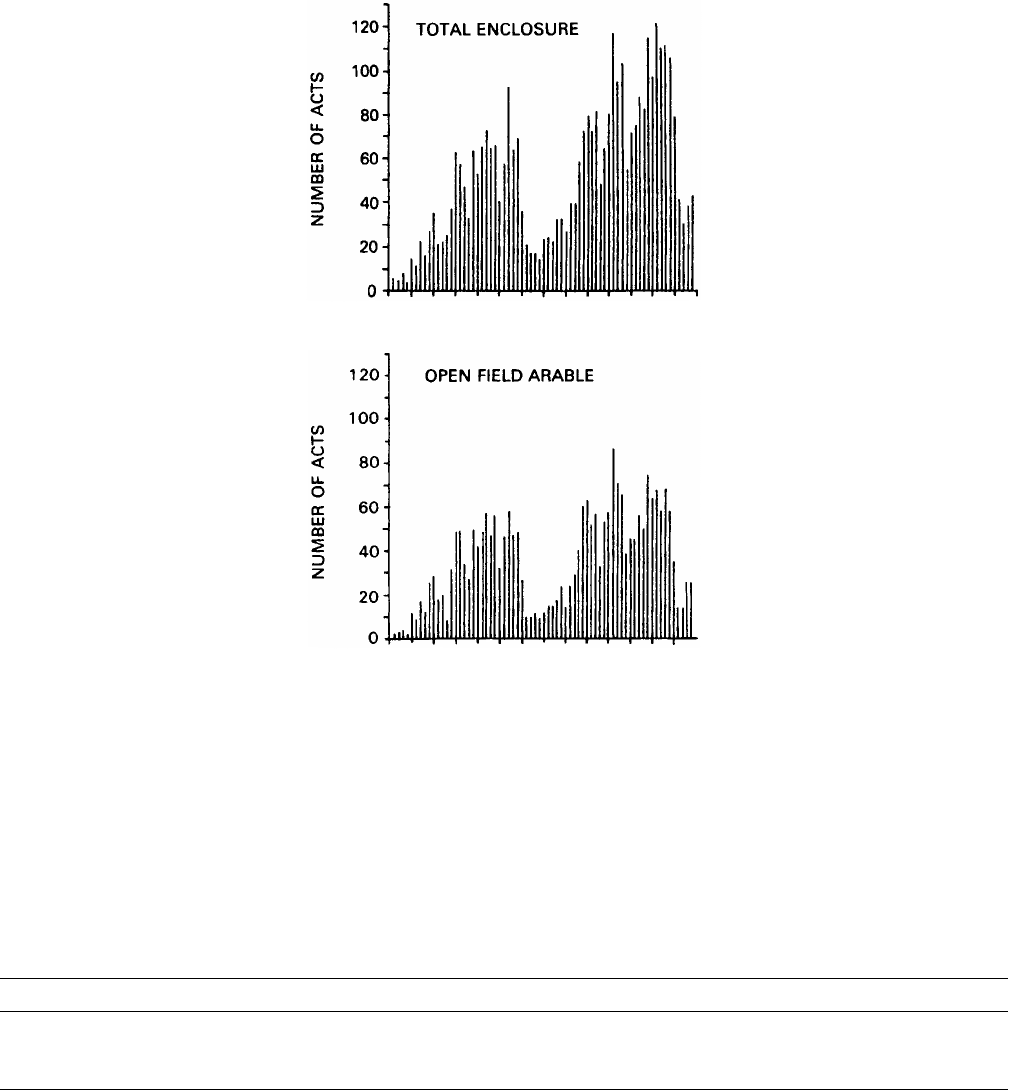
Enclosure between 1750 and 1850 was largely as the result of parliamentary acts and fell into two phases (see Figures 4.1–
4.3). Thirty-eight per cent of all acts were concentrated between 1750 and 1780, with 630 acts in the 1770s. The second phase
of activity occurred between 1790 and the mid-1830s, though 43 per cent of all acts were passed during the French
Revolutionary and Napoleonic wars.
The first phase was concentrated on the heavier-soiled counties of Midland clay belts, the lighter clays of much of
Lincolnshire and over 60 per cent of East Riding acts. The second phase completed this process but included the lighter soils
of East Anglia, Lincolnshire and the East Riding, marginal soils of the Pennine uplands and heaths of Surrey, Berkshire and
Middlesex.
Historians who have examined the amount of arable and the marginal land enclosed have probably overestimated the former
at the expense of the latter. M.E.Turner has provided the current summary of enclosure statistics shown in Table 4.3.
Table 4.3 Enclosure statistics
Open field Arable Common and waste Total
Acts 3,093 2,172 5,265
Acres (millions) 4.5 2.3 6.8
Percentage of England 13.8 7.1 20.9
Source: M.E.Turner op. cit., p. 62.
Regional variations
There were considerable county and regional variations. In the Fens drainage was the equivalent of enclosure elsewhere. In
the seventeenth century the draining of fens and marshes had been met with considerable opposition because each scheme
gave the monarch one-third of the recovered land, the drainers another third leaving only one-third for those with rights of
common. Eighteenth-century drainage using Dutch-type tower mills, beginning with that of Haddenham Level in 1727,
Figure 4.1 Annual total enclosure in England 1750–1819
Figure 4.2 Annual open field arable enclosure in England, 1750–1819
CHANGE ON THE LAND 35