
Brown R. Society and Economy in Modern Britain 1700-1850
Подождите немного. Документ загружается.

started a process of piecemeal action which lasted the rest of the century. The Crown did not take a third of the land and this
reduced much opposition. By 1820 over 200 windpumps kept the enclosed land drained and in 1821 steam engines were first
used.
18
An inscription on the existing engine house built for the Littleport and Downham Drainage Commissioners in 1830
records this in verse:
These fens have oft times been by Water drown’d.
Science a remedy in Water found.
The Powers of Steam she said shall be employ’d
And the Destroyer by Itself destroy’d.
Bedfordshire and Huntingdonshire were still predominantly open fields in 1750; only a few places had been voluntarily
enclosed. Bedfordshire had a high proportion of waste land—38.7 per cent of the total county area compared to 7.1 per cent in
Northampton, 1.3 per cent in Buckinghamshire and 9 per cent in Huntingdonshire, even with its fenland tracts. This waste
was mainly on the Lower Greensand and was still unenclosed when Thomas Bachelor produced his report in 1808. He found
that only 43 of the 124 parishes remained unenclosed. The proportion in Huntingdonshire was similar. By 1820 most of its
open-field parishes were enclosed and even some of the great areas of common grazing, whether heath or fen, had been
divided up among individual commoners. The disappearance of fields brought about an economic revolution that was as
important as the new hedged landscape. Tithe maps in the 1840s reveal the spread of pastoral farming across Huntingdonshire
and much of Bedfordshire north of the River Ouse. Only on the Lower Greensand of central Bedfordshire did arable farming
remain dominant, and in southern Bedfordshire dairy farming with an emphasis on butter and cheese for the London market.
19
In Staffordshire many commons and wastes were enclosed before 1850.
20
The largest operation was the destruction of the
Needwood Plateau, seen by improvers as ripe for development but which had previously had many agricultural uses and
provided the poor with much-needed fuel. William Pitt, author of the report on agriculture for the county in 1796, thought it
‘wild and Romantic’ but that ‘its continuance in its present state is certainly indefensible’. Half of its trees had been felled
between 1697 and 1701 and this process continued throughout the eighteenth century. In 1801 all common rights were
extinguished, the remaining 9,400 acres were enclosed between 1801 and 1811 and the trees finally cut down. This
disafforestation was scathingly attacked by a local magistrate, Francis Mundy, in his poem ‘the Fall of Needwood’ (1808).
Alas, no gentle sprite remains!
But foul fiends scour th’ affrighted plains,
Rob of their honour hills and lawn,
Trace the mean ditch that greedy yawns,
And teach the reptile hedge to crawl;
Twin pests, confederates, seizing all!
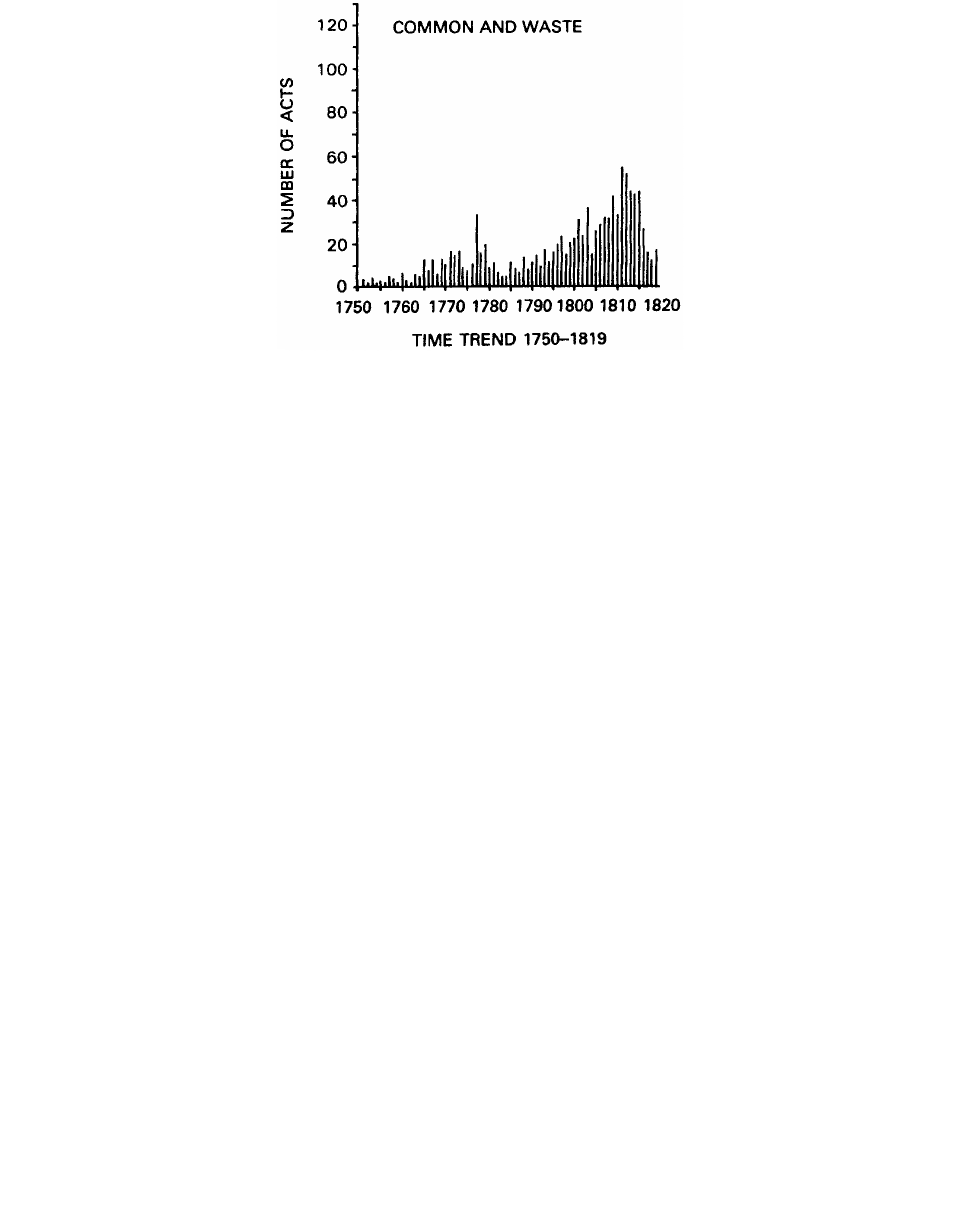
Figure 4.3 Annual common and waste enclosure in England, 1750–1819
Source: M.E.Turner English Parliamentary Enclosure, Dawson, 1980, p. 70.
36 SOCIETY AND ECONOMY IN MODERN BRITAIN 1700–1850
Wales
By 1700 much of lowland Wales had already been gathered into compact farms and enclosure reinforced this tendency.
21
But
only thirteen acts were passed before 1795 involving some 28,596 acres mostly in the border areas. The great enclosures in Wales
occurred between 1801 and 1815, when 76 acts were introduced affecting some 200,000 acres mainly on the highland
commons and wastes. These were due to the great rise in the price of corn which led to attempts at cultivation at a higher
altitude than ever before. The 1845 General Enclosure Act resulted in extensive enclosure in the 1850s and 1860s when 89
acts were passed. Enclosure and the spread of English land law had important social consequences leading to the virtual
extinction of leaseholders in favour of tenancies-at-will, often renewed annually. By the 1830s a network of small farms of
less than 100 acres had been created. Although the initial stimulus to enclosure in the wartime period may have been corn
prices, most acts were motivated by pastoral considerations providing the low-lying farms with much-needed pasture. The
enclosure of the hill slopes, coastal wastes and low-lying marshes led to improvements in cattle-breeding with the
Castlemartin blacks and Glamorgan reds dating from this time.
Scotland
Enclosure in Scotland took a different form, although the result in the Lowlands was very similar to England.
22
Despite the
passage of several acts by the Scottish Parliament after 1661 to facilitate enclosure, especially the acts of 1695, the major
transformation of the agricultural economy was apparently a very rapid one and also, by English standards, a late one. There
was some enclosure before 1750 but the peaks of activity were between 1750 and 1780, especially in the 1760s with lesser
peaks in the 1810s and 1830s. The Lothians and Berwickshire were largely enclosed by 1770 but in Ayrshire and Perthshire
the process was only just beginning. Nearly half a million acres were dealt with between 1720 and 1850.
Before 1750 the broad Highland straths were enclosed in the same way as the Lowland areas. But increasingly after the
1745 Rebellion, and particularly after 1780, large parts of the Highlands were cleared by the lairds and ordinary people swept
off their traditional lands and replaced by the new commercial sheep breeds developed in England.
23
Farms
were amalgamated and leased, at higher rents, to sheep graziers from the Lowlands. By 1800 large parts of the Central
Highlands, southern Inverness and Perthshire had been cleared and this process continued in the first half of the nineteenth
century throughout the north-west Highlands and Islands. Only in parts of the Western Highlands, the Outer Hebrides and
Shetland did the old crofting framework persist and then largely because of the interdependence of fishing and farming. The
social consequence of this was the progressive depopulation of the Highlands with the emigration of many people to North
America and Australasia or movement to join the growing factory workforce of southern Scotland or England.
Historians have often seen this process as an unmitigated disaster for the Highlands, in which evictions were perpetrated by
landowners who turned over their ancestral lands to capitalist sheep farmers who rejected the values of the old Highland clan
system. At a general level this may well be accurate but it neglects the fact that migration from the Highlands pre-and
postdated the clearances, that many people left the Highlands willingly, attracted by the better prospects of life in the southern
towns, and that many of the sheep farmers were Highlanders. The clearances are better understood as ‘the consequence of
seemingly inexorable demographic and economic forces, operating upon a dependent and insecure society, and beyond the
influence of local agency.’
24
The pressures upon Highland landlords to rationalize their land use was far more severe than in England. Agricultural
resources were narrow— the Highland economy was essentially a subsistence one—the levels of technology utilized were low
and there were severe limits on industrial production. The economy was unable to accommodate an expanding population in
contrast to the English or even southern Scottish experience. The Highlands could not follow the English example and expand
the area under arable production—these had already been set by geographical constraints—and ‘improvements’ would have
led to little increase in productivity. There was a reallocation of land within the pastoral sector of the Highland economy with
an expansion initially in cattle production and a later switch of emphasis towards sheep production after 1760. The landlord,
who controlled the resources of the Highlands, stood between the old society and the sheep farmers and was faced with a
difficult moral and economic dilemma. The clearances were far more ‘revolutionary’ than any other part of Britain’s agricultural
transformation.
Ireland
The trend towards larger farms on mainland Britain did not occur in Ireland. Only on prime grassland did large farms remain
intact as production units. In upland districts, on poorer soils and in areas away from centres of demand, small-scale farming
increased, subdivisions of land occurred and supplementary income was obtained from spinning and weaving. By 1800 the
most important change was the emergence of medium-sized, independent farming families. But generally in Ireland the
pattern of land ownership emerged in the 1690s and remained intact throughout this period. There were some 2,000 large
CHANGE ON THE LAND 37
private farms. A few were compact but most were broken up into non-contiguous parcels of land. Landowners rarely adopted
an active development of their estates as a whole and management of their properties was devolved to their tenants. Tenants
tended to be the ‘improvers’ of land while landlords were more heavily involved in infrastructure improvements to road
systems, canals and village planning. Improvement tended to be technical rather than structural: new crops rather than
enclosure.
Of the general extent of enclosure there is little doubt but the details of its chronology and regional nature changes as
research advances. It was a highly varied process whose role in change is questionable and the significance of which, relative
to earlier enclosures, is still not fully understood. Recent work has placed more emphasis on enclosure by agreement in the
seventeenth and early eighteenth centuries.
Why enclosure?
What motivated people to invest in enclosure after 1700? For investment to occur farmers must have believed or have
observed that enclosure would result in significant economic gains. Although some historians have noted the problematic
nature of efficiency gains many contemporaries were certain about the increased productivity achieved in terms of both
improved output and rent. Gains of about 10 per cent on the yield of grain have been identified in Oxfordshire, Warwickshire
and Northamptonshire when enclosed fields were compared with open ones. But improvements of 25 per cent may well have
been possible. Arthur Young wrote of enclosure in Buckinghamshire in his General Report on Enclosures, in 1808, that ‘the
rents before were fourteen shillings but now arable lands let to twenty eight shillings per acre; none under a guinea; and grass
from forty shillings to three pounds, all tithe free.’
For the landlord enclosure was an advantageous investment. Substantial rent increases meant that net profits of between 15
and 20 per cent could be made. Rental revaluation was thus both a cause and a consequence of enclosure. From the mid-
eighteenth century until the end of the Napoleonic Wars prices rose. This too stimulated landowners, who often relied on
fixed rents for income, to enclose and renegotiate leases with tenants who had previously gained from the rise in prices.
Interest rates?
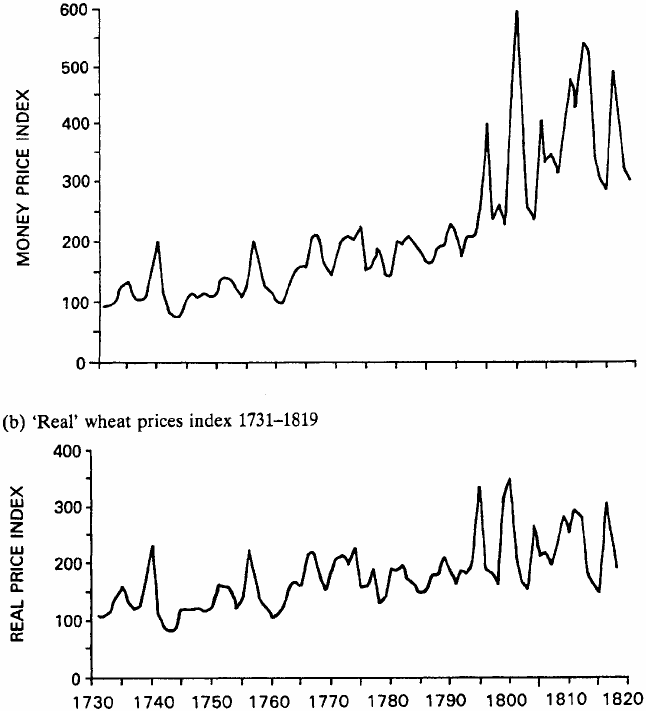
Were interest rates or prices the more important factor in the decision to enclose? Figures 4.4a and b show the wheat price
index from 1731 to 1819.
Between 1700 and the early 1790s growth was between 1 and 2 per cent per annum. Prices were relatively stable between
1730 and 1750 with the significant rise beginning from the 1750s culminating in the inflationary prices during the French
Wars. The coincidence of this with the growth of parliamentary enclosure is obvious. Rising wheat prices and the inevitable
effect of market forces are attractive in explaining motivation behind the additional enclosure of commons and waste after
1793 even though much of this was poor in quality and capable of only low yields.
Ashton emphasized the importance of money supply as a determinant of enclosure investment.
25
Relatively stable interest
rates in the 1760s and 1770s coincided with the growth of enclosure while the higher rates during the American War of the
late 1770s and early 1780s saw a significant decline. However, during the French Wars high interest rates and large numbers
of enclosures coexisted. But the level of inflation was higher than the interest rates and in real terms money was ‘cheaper’.
Population growth?
After 1740 population growth increased the demand for agricultural products. Price levels moved ahead more rapidly than those
in industry, turning the market in the farmer’s favour. Market orientation and regional specialization intensified as demand
grew and this was reflected in the nature of change. Although British farming was largely capitalized by 1800, high-intensity
farming was situated near the main centres of population in the band from Lancashire to London and in the Scottish Lowlands
and in Ireland while lower levels of intensity were to be found on the upland fringes where stock breeding dominated.
Rising population increased the supply of labour. In 1700 between 60 and 70 per cent of Britain’s population was occupied
wholly or partially in farming. The number of mixed occupations was, however, very large and farming was often a valuable
supplement to working in rural manufactures. By 1801 3.301 million people or 36 per cent of the population of England and
Wales were involved in agriculture, forestry and fishing. This was a per capita increase of about 8 per cent over the century
compared to a 81 per cent increase in total population. Although there were only slightly more people working in farming
they were feeding more people:
26
one person in 1700 fed 1.7 persons whereas in 1800 one person fed 2.5 people. Although
the percentage of the total population employed in farming continued to fall relative to other industries after 1800 in absolute
terms people employed continued to rise until 1850 and no English county declined in population between 1750 and 1850.
Farming remained a labour-intensive industry with no dramatic breakthrough in mechanization. Wages fell after 1800 only in
38 SOCIETY AND ECONOMY IN MODERN BRITAIN 1700–1850
those areas where there was little competition from alternative employers or where, as in the Highlands, change led to less
labour being needed. Here the social impact of change was at its most devastating.
27
Change in farming, particularly the willingness or ability of landowners to invest and labourers to introduce improved
techniques and enclosure, related closely to growing demand, high food prices and interest rates. Abundant harvests and low
prices were beneficial to everyone except farmers and landowners. This is reflected in the broad chronology of developments
in agriculture between 1700 and 1850. Although there were regional variations five main stages can be identified: 1700–50,
1750–90, 1790–1815, 1815–35 and 1835–50. The first half of the eighteenth century, when total grain output rose from 13 to
15 million quarters, saw a growing agricultural surplus—the result largely of better use of available resources occasioned by
the spread of new rotations and crops—when total population was not growing rapidly. From 1713 to the 1740s agricultural
prices were either stable or falling slightly and considerable wheat surpluses were exported. This was encouraged by bounties
imposed by statute in 1689 while import duties protected British farming when prices were low. Only between 1710 and 1719
and to a lesser extent between 1740 and 1749 did corn imports make any impact on the British market. G.E.Mingay
28
considers the period 1730 to 1750 one of ‘depression’. W.Allen wrote in 1736 that
the interest of our British landholders has been declining several Years last past. It has been a general Observation, that
Rents have been sinking and tenants as unable to make as good Payments as formerly…great Men’s Estates are
commonly cheaply rented…
and three years later S.Trowell stated that ‘farmers are at present as much depressed, though they labour a whole Year round;
and too many are reduced to the utmost Necessity…’
The extent and intensity of depression remains uncertain. Mingay bases his case on the estates of the Duke of Kingston
which spread over six counties. He shows that wheat prices fluctuated more than meat prices and that rents remained stable. The
Figure 4.4(a) Wheat prices index 1731–1819
Source: M.E.Turner English Parliamentary Enclosure, Dawson, 1980, p. 107.
CHANGE ON THE LAND 39

same general features were evident on other estates. The main reason for this ‘depression’ was a series of good harvests,
particularly in the 1740s, which forced prices down and benefited the consumer. There is the paradox of landowners
undertaking significant ‘improvements’ during a period of ‘depression’. Real output in agriculture rose by about 5 per cent
and this cannot be construed as revolutionary in quantitative terms. It is therefore in qualitative terms that historians must seek
the ‘agricultural revolution’ before 1750.
An end of famine? enclosure and food prices
Rising population, more favourable interest rates and a rise in food prices led to a quantitative revolution after 1750. Adam
Smith observed in The Wealth of Nations in 1776 that
not only grain but many other things from which the industrious poor derive an agreeable and wholesome variety of
food, have become a great deal cheaper. Potatoes…turnips, carrots, cabbages; things which were formerly never raised
but by the spade, but which are now commonly raised by the plough. All sorts of garden stuff, too, has become cheaper.
Between 1750 and 1790 there was a gradual but consistent increase in all food prices paralleled by gradual but accelerating
enclosure. Wheat increasingly became the staple grain food—89 per cent of Londoners were on a wheat diet by 1764—and
barley and rye continued to be important in northern Britain, Scotland, Wales and Ireland. Potatoes took on an increasing
importance and help to explain demographic growth in Ireland and parts of Scotland. A rough balance between population
and food supplies lasted until about 1780 but after that substantial and mounting imports were necessary. Corn prices began to
rise faster than other prices and faster than wages. This stimulated further agricultural change.
Years of shortage, amounting between 1795 and 1800 and 1808 and 1812 to ‘famine’, became more frequent and local
shortages and disturbances were often caused by the inability of the market structure to distribute supplies effectively.
Increased demand was met largely primarily by the increased output of domestic farmers. Domestic production of grain rose
at the same rate as total population—14 per cent between 1793 and 1815. This increase was achieved by a widespread
extension of the area under cultivation and the use of new crops and new breeds of livestock. The short-term response of
farmers may have taken the form of temporary alterations in their grain acreage but their long-term response was a sustained
effort to obtain a relative increase in their animal products. On the heavier clay soils, for example, unsuited for low-cost arable
production, land was enclosed for grazing and dairy production at the expense of grain. The surviving records for a Wiltshire
farm show that between 1793 and 1815 grain production fell by 20 per cent while that of livestock and dairy products rose
between 20 and 25 per cent. The major problem facing farmers in this period was labour costs. The extent to which enclosure
and new techniques required more labour has been challenged by Snell but in some areas labour shortages pushed up costs
further. Many areas were forced to rely heavily on temporary inflows of casual workers. Yet, with the exception of a few
areas, this did not result in the adoption of alternative hand tools or machines. In south Lincolnshire turnips and beans were
widely grown for fodder, but their potential benefit was lost since they were not hoed and the sheep not allowed to feed on
them, thus depriving the land of manure. Between 1790 and 1815 British agriculture increased its productivity by only 0.2 per
cent per annun. This compares unfavourably with the 0.3 per cent per annum between 1816 and 1846, a period generally
regarded as one of ‘depression’.
Prices fell dramatically after 1814 and thousands were demobilized or released from war industries. This caused problems
throughout agriculture
29
but the severity of distress was greatest on the clayland arable farms and least in dairy and stock-
rearing districts or in areas like Kent and Hereford where hops and fruit were important crops. Depression was therefore
closely related to the adaptability of the land under cultivation. Clayland farmers could not compete with the more advanced
farms of the light lands since they were unable to reduce their costs. Initially farmers sought legislative support in the form of
protection or reductions in taxes. The Corn Law of 1815 was the result. This delayed the necessary adjustment of British
farming since many clayland farmers clung on to their arable acreage in the persistent but vain hope that wartime prices would
eventually return. They provided vociferous testimony before various parliamentary inquiries which took place between 1813
and 1843 into the causes of ‘distress’. But by the 1830s many of them were making cost adjustments to lower prices or
moving across to mixed farming. The social cost of ‘depression’ were most severe in areas with falling agricultural wages.
30
Tarrifs did little to protect arable farmers and provoked a violent reaction which the Anti-Corn Law League built on the 1830s
and 1840s. Byron expressed the public wrath at the rapacity of the landlords in ‘The Age of Bronze’
Safe in their barns, these Sabine tillers sent
Their bretheren out to battle—why? for rent!…
The peace has made one general malcontent
Of these high market patriots; war was rent!
40 SOCIETY AND ECONOMY IN MODERN BRITAIN 1700–1850

Their love of country, millions all misspent,
How reconcile? by reconciling rent!
And will they now repay the treasures lent?
No! down with everything, and up with rent!
Their good, ill, health, wealth, joy or discontent,
Being, end, aim, religion—rent, rent rent!
TOWARDS A ‘GOLDEN AGE OF FARMING’
By the mid-1830s British farming had surmounted its ‘depression’. The introduction of inexpensive drainage techniques
liberated the claylands from high production costs. Farming generally became more ‘scientific’, producing higher output at
lower unit cost. From the mid-1840s till the 1870s agricultural production rose at 0.5 per cent per annum. There was a more
intensive application of the techniques of mixed farming on the light soils of southern and eastern England and on the Lothian
area of south-east Scotland. There was some shift on the clay soils, especially those in the north and west of England, to beef
and dairy production. Distance from alternative markets protected arable farming after 1846 far more effectively and much
less contentiously. Cheap food had become both an economic and a political necessity. R.S.Surtees caricatured this move to High
Farming in 1845
‘…you take your tenants in hand, Mr Jorrocks—make them drain.’ ‘Drainin’s a great diskivery, your Grace. It’s the
foundation of all agricultural improvement….’
‘Guano, nitrate o’ sober manure,’ continued Mr Jorrocks. ‘We’ll have such a Hagricultural ‘Sociation…. We’ll make
the grass grow, the grass grow….’
There is no doubt that British farming was more productive than it had been in 1700.
31
But this development was neither as
linear nor as progressive as the conventional view of agricultural change would have us believe. The point at which radical
change began has been pushed back into the sixteenth and particularly the seventeenth centuries. The role of Tull, Townshend,
Bakewell and their like has been reassessed. The chronology and regional experiences of farming changes were complex and
the notion of an ‘agrarian revolution’ unhelpful unless qualified by reference to particular aspects of those changes. As Mark
Overton commented:
If the meaning of a phrase is determined by its consistency of use, then the phrase ‘agricultural revolution’ has no
meaning…. During the last twenty years at least four claims have been made for the existence of an ‘agricultural
revolution’ at some time during the period 1560–1880, yet all differ in chronology and all emphasise different facets of
agricultural change.
32
NOTES
1 A.Smith The Wealth of Nations, ed. A.Skinner, Penguin, 1970, p. 111.
2 J.S.Mill ‘The Nature, Origins and Progress of Rents’ (1828) in Collected Works, Toronto, 1967, p. 177, quoted in M.Berg The Age of
Manufactures 1700–1820, Fontana, 1985, p. 93.
3 For the state of farming in 1700 and the role of topography reference should be made to chapter 2. J.Thirsk England’s Agricultural
Regions and Agrarian History 1500–1750, Macmillan, 1987 provides a brief statement. More detail can be found in J.Thirsk (ed.)
The Agrarian History of England and Wales, Vol. 5, Cambridge University Press, 1985. J.C.Beckett The Agricultural Revolution,
Basil Blackwell, 1990 is a short and concisely argued book which provides the best starting point for a discussion.
4 E.Pawson The Early Industrial Revolution Batsford, 1978, pp. 45–52.
5 On the Scottish system see chapter 2 pp. 16–18.
6 A.Young General View of the Agriculture of Oxfordshire, 1809, pp. 35–6.
7 A detailed discussion of this can be found in J.D.Chambers and G.E.Mingay The Agricultural Revolution 1750–1880, Batsford,
1966, pp. 50–3.
8 E.Pawson op. cit. p. 50.
9 E.L.Jones ‘Agriculture 1700–1780’ in R.Floud and D.McCloskey (eds) The Economic History of Britain since 1700, Vol. I
Cambridge University Press, 1981, p. 66.
10 J.D.Chambers and G.E.Mingay op. cit. pp. 12–13.
11 M.Berg op. cit. p. 27.
12 P.Deane and W.A.Cole British Economic Growth 1688–1959, Cambridge University Press, 1967, pp. 67–75.
13 G.E.Mingay The Agricultural Revolution, A & C Black, 1977, p. 6.
CHANGE ON THE LAND 41
14 The best discussion is to be found in G.E.Mingay English Landed Society in the 18th Century, Routledge & Kegan Paul, 1963.
15 Mingay again is useful here in The Gentry, Longman, 1976, especially pp. 80–164.
16 On this issue see G.E.Mingay Enclosure and the Small Farmer in the Age of the Industrial Revolution, Macmillan, 1968.
17 The literature on enclosure is extensive but the most recent brief study is M.E.Turner Enclosure in Britain 1750–1830, Macmillan
1984. More detailed studies are M.E.Turner English Parliamentary Enclosure, Dawson, 1980, J.A.Yelling Common Field and
Enclosure in England 1450–1850, Longman, 1977 and W.E.Tate The English Village Community and the Enclosure Movement,
Gollancz, 1967. K.D.M.Snell Annals of the Labouring Poor: Social Change and Agrarian England 1600–1900, Cambridge
University Press, 1985, pp. 138–227 is essential.
18 On the Fens see C.Taylor The Cambridge Landscape, Hodder & Stoughton 1972 and H.C.Darby The Draining of the Fens, Oxford
University Press, 1940.
19 See P.Bigmore The Bedfordshire and Huntingdonshire Landscape, Hodder & Stoughton, 1979 and J.Godber History of
Bedfordshire, Bedfordshire County Council, 1976.
20 See D.M.Palliser The Staffordshire Landscape, Hodder & Stoughton, 1976, pp. 119–32.
21 D.Williams A History of Modern Wales, John Murray, 1977, pp. 177–96 and E.D.Evans A History of Wales 1660–1815, University
of Wales Press, 1976, pp. 124–36 provide a general overview. D.Thomas Agriculture in Wales during the Napoleonic Wars,
University of Wales Press, 1963 is a more detailed study.
22 See J.E.Handley The Agricultural Revolution in Scotland 1963 and M.L. Parry and T.R.Slater (eds) The Making of the Scottish
Landscape, 1980.
23 E.Richards A History of the Highland Clearances, Croom Helm, 1982.
24 ibid. p. 7.
25 T.S.Ashton An Economic History of England: the Eighteenth Century,
26 Quoted in E.L.Jones ‘Agriculture 1700–1780’ op. cit. p. 71.
27 On the social impact of agricultural change, particularly the impact of enclosure, see chapter 17.
28 G.E.Mingay ‘The Agricultural Depression 1730–50’, Economic History Review, 2nd Series, 8 (3), 1956.
29 E.L.Jones The Development of English Agriculture 1815–1873, Macmillan, 1968 provides a brief analysis of the nature of ‘distress’
and ‘depression’.
30 For a detailed discussion of the fortunes of agricultural labourers see chapter 17.
31 G.E.Mingay (ed.) The Agrarian History of England and Wales, Vol. 6, Cambridge University Press, 1989 must now be regarded as
the major work on agricultural change.
32 Quoted in R.Butlin ‘Agrarian Changes in the 18th and 19th Centuries—the Experiences of the East Midlands’, The Historian, 6,
(1985). p. 11.
42 SOCIETY AND ECONOMY IN MODERN BRITAIN 1700–1850
5
The revolution in technologies— industrial change
Our engineers may be regarded as the makers of modern civilization…. Are not the men who have made the
motive power of the country, and immensely increased its productive strength, the men above all others who have
tended to make this country what it is.
1
To England alone the whole world is indebted to these inventions, and as her just reward, she has reaped,
beyond all comparison, the largest share of the golden results which have flowed from them.
2
The technological and scientific achievement of the period between 1700 and 1850 was substantial. The immense force of
that achievement in revolutionizing industrial production and organization, rapidly expanding trade and transport, stimulating
vast amounts of capital investment and altering the whole structure of the labour force in particular and society in general has
conventionally been examined in relation to the great inventions and inventors. This chapter will examine the relationship
between technology, science and industrial growth, particularly in textiles, iron, coal and the diffusion of steam power.
Industrial production throughout the eighteenth century was tailored largely towards satisfying the basic needs of the
population. It was not, by later standards, a sophisticated structure requiring widespread capital investment. There were
regional clusters of manufacturing activity, particularly around the ports, the provincial textile and metal-working centres and
in London. But these were loosely organized, dispersed and generally small-scale, often based round family groupings in a
rural setting. Throughout the eighteenth century and to a lesser extent in the first half of the nineteenth century, there was a
symbiotic relationship between the manufacturing and agricultural sectors. Employment was often ‘mixed’ and labour moved
freely from one sector to the other, often depending on the season.
ELEMENTS OF PRODUCTION
Raw materials
The four elements of production that combine in the manufacturing process are: raw materials, capital, labour and
entrepreneurship. Raw materials are important in two respects: as the source of production material and as a means of power.
In 1700 most industrial raw materials were of organic origin: farm products like wool, leather and flax; timber; water. Power
was either provided directly by labour or through machines powered by waterwheel, horse-gin or windmill. These sources of
materials and power were dispersed throughout the country and, as a result, so were many branches of industry. Coal, as a source
of raw material and power was, however, growing in importance. Brewing, glass and pottery manufacture had already
replaced wood with coal for fuel. Non-ferrous smelting and the iron industry were to make this transition during the
eighteenth century. By 1850 the raw material function in industry had changed. This was in response to the increased scale of
output and the widening range of products demanded by the growing market. The shift was from natural to steam power and
from timber and stone to iron and coal. But this was a process which occurred more gradually than has conventionally been
admitted.
Capital
Capital requirements also changed slowly.
3
Throughout the first half of the eighteenth century investment in capital stock was
low. Increased output was achieved not by increasing the scale or sophistication of production but by increasing the size of
the labour force. This was a capital-widening rather than a capital-deepening process. Advances in spinning technology could
only be fully utilized by increasing the number of handloom weavers until new technology became available in weaving.
Capital widening did not require intensive investment. However, the main thrust of investment after 1750 was capital
deepening especially where the adoption of improved or new technology involved intensive investment in fixed capital stock.
This was evident in cotton textile spinning with the costs induced by technological improvements and the application of steam
power after 1790. But this process must be kept in perspective as largescale factory mechanization was by no means typical
of the industry in 1800 or even 1850. Larger-scale investment was most notable in the iron industry, particularly with re-
organization into large-scale integrated concerns. Most eighteenth-century enterprises were either partnerships or family firms
—joint-stock companies had been virtually outlawed after the Bubble Act of 1720 following the collapse of the speculative
South Sea Company the previous year. Money could be borrowed by established firms but it was ploughed-back profits that
provided much of the money for fixed capital. However, the major part of capital was held not in fixed plant but in working
capital until after 1750. This was essential in outworking manufacture.
Labour
Labour requirements
4
were generally not large in 1700 though they too were to alter slowly in the next century. Rural
industry, usually controlled from the towns, was often used to supplement inadequate agricultural earnings. These cheap
supplies of labour enabled merchants to meet rising demands for goods. As manufacturing became more capitalized and as
new technology was developed, the nature of labour changed. Factories, mills and large mines required a more rigorous regime
than rural industries.
Entrepreneurship
The remaining factor of production was entrepreneurship.
5
The most successful regions, industries and firms were those in
which people saw the potential of new markets or of new products, then organized a means of exploiting them and raised the
capital necessary to finance both production and distribution. They were rarely inventors but seized the opportunities afforded
by the new technologies. They were the risk-takers of manufacturing industry and have been described as fulfilling ‘in one
person the functions of capitalist, financier, works manager, merchant and salesman’.
6
The eighteenth-century entrepreneur often made innovations in order to increase output and to earn windfall profits. A
critical part of the entrepreneurial function lay in seizing a market opportunity. But the nineteenth-century counterpart was
often forced to adopt new methods in order to maintain profits threatened by falling price levels and by increased
competition.
The British economy that developed during the eighteenth century at once looked backward and forward. It was an
economy in which artisan skills and traditions mingled with new products, demands, markets, labour forces and above all new
technologies. David Landes has produced a bold description of sweeping technological change centred on the cotton industry,
reinforced by the development of steam power and the expansion of the metal industries.
7
His apocalyptic vision needs to be
set against those historians like Sir John Clapham and more recently N.F.R.Crafts
8
who emphasize the continuities of the
period and see an industrial revolution ‘in slow motion’.
BRITAIN’S INDUSTRIAL EXPERIENCE IN 1700
England
The industrial experience of Britain in 1700 was complex. The weight of industry is partially discernible in the demographic
geography of the country. Certain areas were able to sustain a population in excess of local agricultural capacity through
employment in manufacturing or extractive industries. Central Devon supported woollen manufacture. The West Riding of
Yorkshire was not only sustained by textiles but also by coal mining and, in the Sheffield area, by metal-working. South
Lancashire leant heavily on linen, fustian and woollen products. The north-east lived off coal and associated industries,
especially glass and salt. Less obvious, because they were situated in good agricultural areas, were the woollen manufactures
of Wiltshire, Somerset, Gloucestershire, Norfolk, Suffolk and Essex. Silk was important in London. The hardware trade,
supplemented by coal mining, was the economic base of parts of Worcestershire, Staffordshire and Warwickshire centred on
Birmingham. Leicestershire, Derbyshire and Nottinghamshire maintained many thousands of people in framework knitting
for the hosiery industry. These main English regions apart there were numerous local industrial pockets, sometimes
dominating the locality, sometimes an adjunct to farming: iron, lead, tin and copper mining and processing; shipbuilding;
glass-making and salt production; paper-making; lace and rope-making. Brick-kilns were dotted throughout lowland England.
Industry was overwhelmingly rural in its location. With the exception of London only three large towns could be called
industrial centres in 1700: Norwich making worsteds; Birmingham, hardware and Manchester assorted textile goods, and even
44 SOCIETY AND ECONOMY IN MODERN BRITAIN 1700–1850
these were not just production centres but marketing and distribution points for rural manufactures. Gregory King’s estimate
of those employed in commerce and industry was 110,000 people in England at the close of the seventeenth century. This
survey has recently come under scrutiny, which has led to upward revision. P.H.Lindert has estimated a figure over 400,000
people excluding labourers.
9
England probably had a much more industrialized economy than historians previously assumed.
But it was not, in any useful sense of the term, an industrial country.
Wales, Scotland and Ireland
The situation in Wales, Scotland and Ireland was very different. In all three areas industry was an adjunct to the predominant
agrarian economy. The woollen industry figured next in importance to the cattle trade in the Welsh rural economy but its
output was, in comparison to England, small. In South Wales its early development had been in the boroughs—there are many
records of it in Cardiff and Caerffili—but by 1700 it was declining as a town-based industry. In North Wales it was a rural craft
from the beginning though firmly under the control of the Shrewsbury clothiers and dependent on the English market. Metal
industries, notably iron, lead, copper and tin, coal and slate expanded largely because landlords were quick to exploit the
resources of their estates. Welsh industry in 1700 was diffuse and expansion limited by the lack of substantial domestic
demand and poor communications, both of which adversely affected the market. In Scotland too industry was
overwhelmingly rural, though Elgin, Ayr, Dumfries, Falkirk, Paisley and especially Edinburgh catered for a fairly large
luxury market. Salt, soap, woollens and linen were the major manufacturing industries with significant coal mining in the
Ayrshire and Forth coalfields. Ireland lacked the same natural mineral resources as Wales and Scotland and had little heavy
industry. But it did possess a growing textile industry, particularly in Ulster, based on wool and linen.
Realigning industrial activity
The eighteenth century witnessed a realignment of industrial activity (Figure 5.1). In some cases, this meant the expansion of
industries that existed in 1700, such as woollen manufacture in the West Riding, iron in the Midlands, Lancashire cotton,
linen in eastern Scotland and northern Ireland. In others, it meant the rapid emergence of new activities like the South Wales
iron industry and the Glasgow and Irish cotton industries. Change also brought industrial decline as with the framework
knitters of London, the spinners and weavers of the West Country and East Anglia and the ironmasters of the Weald and
Forest of Dean. W.W.Rostow argues that ‘these rates tend to be related to the time of the last major technological
breakthrough which granted them a phase of increasing returns’.
10
M.Flinn echoed this view ten years earlier:
In the last resort, the decisive factor both in increasing the scale and in changing the methods and location of production
was technology… the industrial revolution stemmed from the adoption of new techniques of production.
11
Historians have emphasized inventors and their inventions without fully examining the rate of technological change or
diffusion.
12
The following questions need to be considered fully: what is technological change and what was its relationship to
science? What caused technological change? What was the rate of technological change and what were its effects?
CHANGING TECHNOLOGY
Technological change has been seen by Simon Kuznets as the process of transforming innovations into productive use in
relation to capital investment, entrepreneurial talents and market demand.
13
It is the practical application of a new machine or
technique—which may not have labour-saving effects—to the productive economy. Kuznets distinguished between (a) a
scientific discovery, an addition to knowledge; (b) an invention, the application of existing knowledge to a useful end; (c) an
innovation, the first industrial use of an invention; (d) an improvement, an adjustment to the existing innovation; and finally,
(e) diffusion, the spread of an innovation usually with additional improvements.
Relationship between science and technology
Just what was the relationship between science and technology in the economic changes that occurred between 1700 and
1850? W.W.Rostow is not alone in thinking that ‘The scientific revolution also related, somehow, to the coming of the first
industrial revolution at the end of the eighteenth century.’
14
There is little doubt of the importance of the tentative steps which
were taken in the seventeenth century. They put people in a position to understand, predict and consequently to manipulate
nature and the environment. Alexander Pope accurately satirized this reality when he wrote
THE REVOLUTION IN TECHNOLOGIES—INDUSTRIAL CHANGE 45