
Brown R. Society and Economy in Modern Britain 1700-1850
Подождите немного. Документ загружается.

Nature and Nature’s law lay hid in night;
God said, Let Newton be! and all was light.
The scientific revolution preceded the major industrial changes whether it is dated from the foundation of the Royal Society in
1662 or earlier in the century. But to what extent was there a direct link between advances in scientific understanding and
technological change? The traditional claim by historians of science that it was the ‘mother of invention’ and that there was
practically no interchange between scientists and industrialists has been vigorously denied, for example by T.S.Ashton:
The sciences were not…as yet so specialised as to be out of contact with the language, thought and practice of ordinary
men…. Physicists and chemists, such as Franklin, Black, Priestley, Dalton and Davy, were in intimate contact with the
leading figures in British industry: there was much coming and going between the laboratory and the workshop…
15
His view has been confirmed by more recent studies.
16
There were significant meeting places for scientists and industrialists
in the Royal Society and there was a similar community of interest in local societies like the Birmingham Lunar Society and
the Manchester Literary and Philosophical Society. Some leading industrialists, particularly Nonconformists, were educated
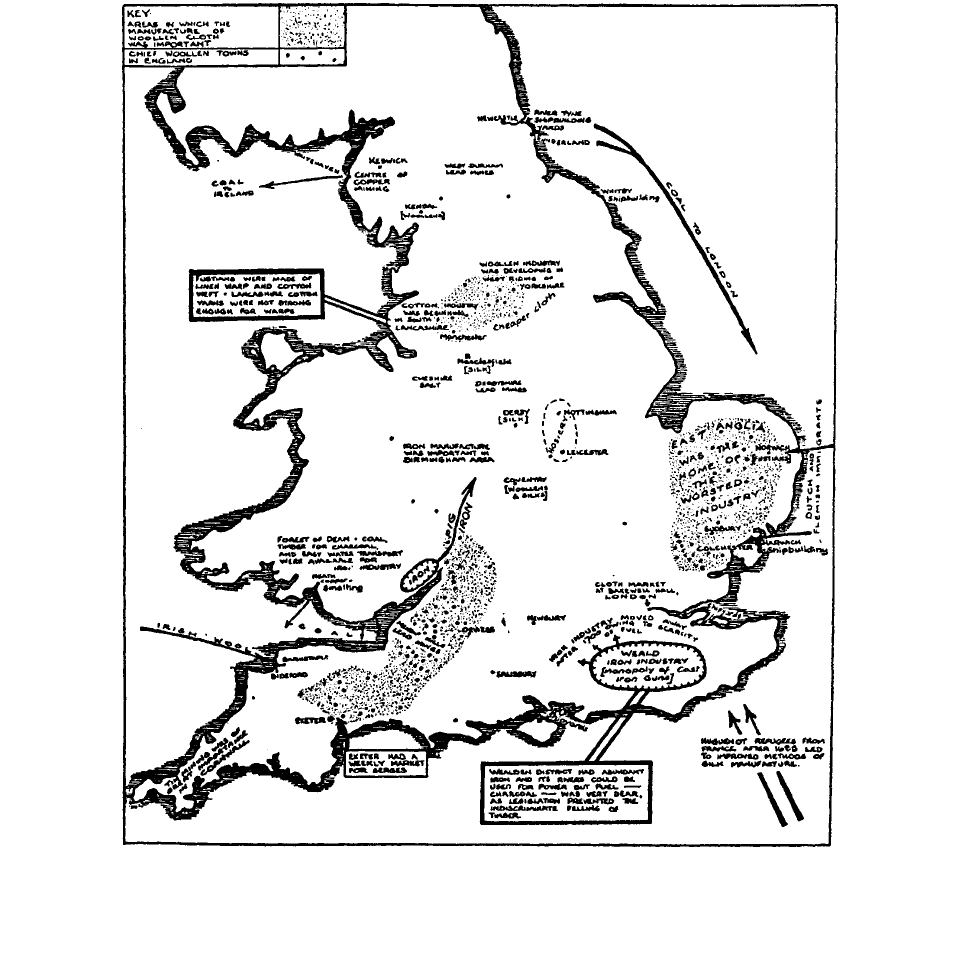
Figure 5.1 England before the Industrial Revolution
Source: J.L.Gayler, I.Richards, J.A.Morris A Sketch-Map Economic History of Britain, George Harrap, 1966, p. 72.
46 SOCIETY AND ECONOMY IN MODERN BRITAIN 1700–1850
in either Scottish universities or Dissenting Academies where the practical application of knowledge was given a high priority.
This has led some historians to see Nonconformity as an important training ground in ‘achievement motivation’ leading to
entrepreneurial enterprise and technological innovation. A.E.Musson argues: ‘There is now plentiful evidence of fruitful
collaboration between industrialists and scientists, and of applications of science in various fields.’
17
John Smeaton improved on waterwheels as a result of practical-scientific experiments and Richard Trevithick was aided in
the development of the high-pressure engine by Davies Gilbert. The list of people who made significant scientific
contributions or used experimental methods and were either educated in Scotland or who were born there is impressive—for
example, James Watt, Alexander Chisholm the chemist who assisted Josiah Wedgwood, Charles Macintosh, John Rennie and
David Mushet. The machinery which revolutionized textile production owed nothing to science. But textile production was
broader than spinning and weaving and in the finishing processes, particularly bleaching, advances in industrial chemistry did
play an important part. Natural bleaching meant exposing cloth that had been ‘soured’—soaked for about 48 hours in a weak
acid, usually buttermilk—to the sun for many days. Rising output increased the need for a faster technique. Although
sulphuric acid was used for ‘souring’ from the 1750s it did not remove the need for sun-bleaching. In 1774 a Swedish
chemist, Karl Scheele, discovered the gas we now call chlorine and C.L.Berthollet experimented with its use in bleaching
cloth in France between 1785 and 1786. By 1787–8 the process was being used by two firms in Scotland and one in
Nottingham and soon spread to Lancashire. Chlorine was both difficult and dangerous to use and in 1798–9 Charles Tennant
and Charles Macintosh invented bleaching powder (from the action of chlorine on slaked lime) which finally solved the
problem. This shattered the bleaching bottleneck and, it has been argued, was as much responsible for the expansion of
textiles in the nineteenth century as new machines. Science played an important role in the chemical industries and in other
industries like pottery, glass and paper-making, which relied heavily on chemical transformations.
There are, however, good reasons for retaining the conventional view. Although contemporary science could and did
introduce inventors to the properties of the physical world and to methods and perceptions they might otherwise not have
commanded, it could scarcely be described as a technological goldmine. In most areas science was disarticulated and its
insights had not been brought together into a coherent framework. Some theory was frankly wrong. Although this did not
prevent Jethro Tull, who believed mistakenly that air was the best manure, from developing the horse-drawn hoe and seed-
drill, it could retard developments. The caloric theory of heat which envisaged heat as a substance certainly obstructed study
of the theory of the steam engine. Up to 1800 most scientific achievements occurred in areas like astronomy, magnetism and
analytical mechanics which, although undoubtedly important when applied to technology, were well removed from the major
industrial advances. The oblique relationship between science and technology was summed up by James Watt:
Although Dr. Black’s theory of latent heat did not suggest my improvements on the steam-engine, yet the knowledge
upon various subjects which he was pleased to communicate to me, and the correct modes of reasoning and of making
experiments of which he set me the example, certainly conduced very much to facilitate the progress of my inventions…
18
David Landes concluded that before 1850 instances of connection between science and technology were ‘exceptional’ and that
‘such stimulus and inspiration as did cross the gap went from technology towards science rather than the other way’.
19
For example, in the nineteenth century Cornish pumping engines were performing more efficiently than contemporary
physics said was theoretically possible. Carnot’s work in the 1820s and 1830s on heat-engine theory was partly inspired by
reports of these high-pressure engines. Landes went on to argue that technical change was ‘anonymous’, ‘essentially
empirical and on the job training’ and that the innovators were ‘a line of tinkerers’.
The direct links between science and technology may have been greater than historians originally thought but questions
have been raised as to how representative they were and there is little evidence to suggest that these links played a major part
in inducing economic growth. Science did not initiate industrial trends, it merely solved some problems which the general
direction of industry had created. But the indirect influence of science upon technological change was crucial, creating a social
and cultural milieu in which scientific questioning and particularly method became widespread. During the course of the
nineteenth century, particularly after 1850, when technology took on more fully the mantle of initiator of economic change, it
was a technology that was based on science.
Why did innovation occur?
But why did innovation occur? Marxist historians link technological change with profit. E.J.Hobsbawm wrote that
It has often been assumed that an economy of private enterprise has an automatic bias towards innovation, but this is
not so. It has a bias only towards profit. It will revolutionize manufactures only if greater profits are to be made in this
way than otherwise.
20
THE REVOLUTION IN TECHNOLOGIES—INDUSTRIAL CHANGE 47

Demand
Greater profits will occur when they are a response to growing economic demands. Samuel Lilley maintained that this was the
primary reason for inventions: ‘Inventors did not act, nor did the social environment encourage them to act, unless the need
was already clear—indeed, pressing/
21
And Phyllis Deane said that innovation occurred ‘only when the potential market was
large enough and demand elastic enough to justify a substantial increase in output’.
22
Technological innovation, in these cases, was an effect not a cause of market demand. Growing population, rising standards
of living, at least until the 1790s, and growing commercialization combined to produce a steady expansion of the domestic
market. In fact there is no necessary conflict between profit and demand as explanations for technological change. New
products, as T.S.Ashton pointed out,
23
did not come into being by accident.
The argument that innovation was the result of increasing demand can be seen in the use of charcoal v. coke for smelting
iron. Pig-iron smelted from coke was inferior to charcoal-smelted iron in the first half of the eighteenth century. The shift to
the former from the latter was justifiable on cost grounds only after 1760. What caused the change in relative fuel prices? The
use of charcoal may have been almost sufficient to satisfy existing demand but new demands led to an increase in the scale of
operations and this raised charcoal prices. But it is equally possible to use a supply explanation to explain the move from
charcoal to coke.
24
Challenge and response
Technological innovation can also be seen in terms of challenge and response. Changes in one sector of an industry caused
demand pressures on another sector. There was, for example, interaction between the various branches of the iron industry.
Innovation in the furnace was matched by innovation at the forge. But the most famous example was in the textile industry,
where innovation in weaving led to a demand for improvements in spinning to keep up with handloom output. This situation
was then reversed. The output of powered spinning could only be used by increasing the number of handloom weavers until
efficient powered weaving was developed. This too is capable of alternative explanation. Rising demand for spinners quickly
exhausted the potential of a family-based labour force of a textile-producing community. Traditionally women did the
spinning but at lower wages than men and the speed-up of weaving quickly exhausted local supplies. Additional male labour
could have been drafted in but this would have pushed up labour costs and consequently the cost of yarn. The imbalance
caused by the diffusion of the flying shuttle and the need for spinning machines lay as much in inadequate labour supplies as
increasing demand. Patent records provide only a rough guide to the English inventiveness because being granted a patent did
not mean that it was of either industrial or productive value (Table 5.1). What is clear from the patents granted is that from the
1760s there was a sharply rising trend which after 1780 coincided with W.W.Rostow’s notion of ‘take-off’ in the British
economy.
Table 5.1 English patents granted 1700–1809
1700–09 22
1710–19 38
1720–29 89
1730–39 56
1740–49 82
1750–59 92
1760–69 205
1770–79 294
1780–89 477
1790–99 647
1800–09 924
Source: B.R.Mitchell with P.Deane Abstract of British Historical Statistics, Cambridge University Press, 1962, p. 268.
TEXTILES
In textiles, ironmaking, coal mining and the development of an efficient steam engine innovation has been seen as a response
to clear-cut economic incentives. Increased demands meant that reducing costs, particularly those associated with labour or
increasing productivity, could lead to financial gain. Attractive though the demand explanation for innovation is, as G.N.Von
Tunzelmann argues, ‘the a priori case that technical change stemmed from changes in demand is disquietingly slim…’.
25
48 SOCIETY AND ECONOMY IN MODERN BRITAIN 1700–1850
Technological change
The major developments in textile spinning and weaving
26
were: Kay’s flying shuttle, first introduced in the 1730s and widely
adopted by weavers in the 1740s and 1750s, which roughly doubled output and furthered the incentive to increase
productivity in spinning; Hargreaves’ spinning jenny, perfected in 1768, which increased the output to be spun by a single
operator; Arkwright’s water frame, patented in 1769, which permitted the production of a yarn strong enough for cotton warp
as well as weft; Crompton’s mule of 1779 which combined the principles of the jenny and water frame, and was made ‘self-
acting’ by Richard Roberts between 1820 and 1825; powered weaving, which was pioneered by Cartwright in the 1780s but
not perfected until the 1820s by William Horrocks and particularly Richard Roberts. Parallel to the developments after 1780
were changes in preparation and finishing, particularly Whitney’s cotton gin in the 1790s, rotary printing and chlorine
bleaching. This chronology of technological change opens up a range of issues—How was technology diffused? Is technology
itself sufficient to explain increasing productivity? What resistance was there to change?
Early inventions were technically so simple that they can be seen as responses to social and economic conditions that
offered widening opportunities for self-advancement through innovation. The achievement of Richard Arkwright illustrates this.
He used, some would say pirated, the work of others particularly the roller technique of Lewis Paul. Apart from the use of
power drive, Samuel Lilley states that ‘it was essentially the late medieval spinning wheel (with flyer this time)…’.
27
Arkwright’s genius lay in marketing the invention, over which he had patent control, until 1785. Adapting later machines to
productive use required engineering not ‘tinkering’ skills. From 1790 attempts were made to adapt the mule for power. By
1800 this had occurred though the services of a skilled operator were still needed to control it. But it was Richard Roberts, a
professional machine-builder, who developed a self-acting mule between 1820 and 1825 and a final version was perfected by
Henry Maudsley, rightly called the ‘king of mechanics’. Diffusion therefore had two stages. In the first ‘simple’ stage
inventions were developed which required no special qualifications or training, as Lilley says:
apart from the one really novel idea of drawing out by rollers, the cotton-spinning inventions up to about 1800 were
essentially a matter of connecting together in new combinations the parts of the spinning wheel which had been familiar
for centuries.
28
It was in the second stage, when the technical difficulties became more severe, that engineering skills were required. Not until
after the self-acting mule and the powerloom had been perfected can it really be said that the revolutions in textile production
take place. Arguably, the revolutionary developments occurred in preparation and finishing.
Cotton—chronology of growth
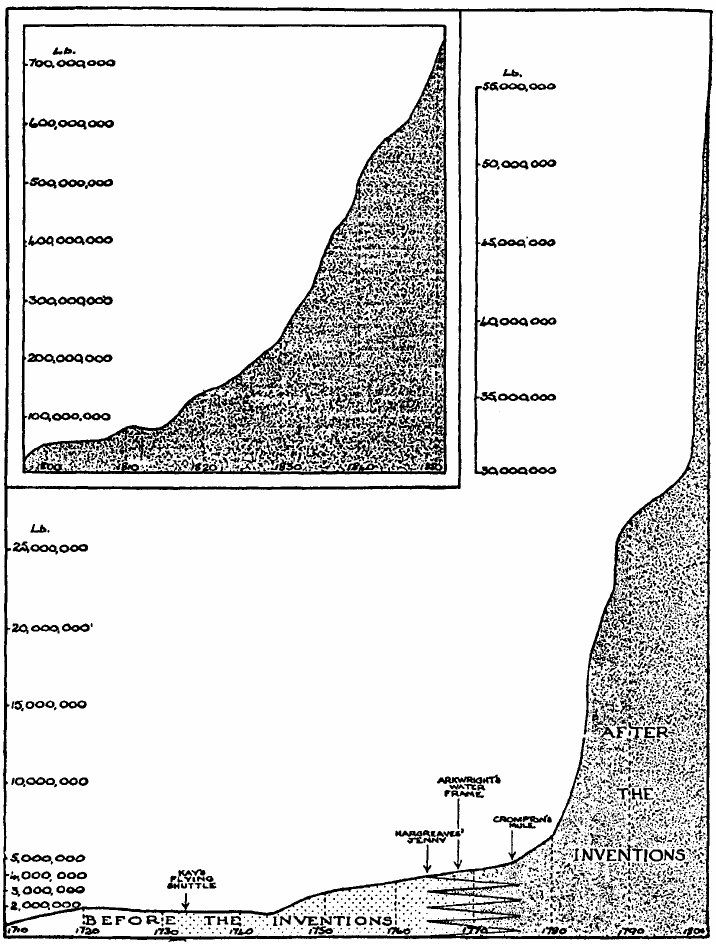
Cotton production fell into three stages during the eighteenth century, in each of which production increased at a remarkably
constant rate (Figure 5.2). From 1700 to the 1740s the rate of growth was about 1.4 per cent per annum. This was largely
because of legislation forbidding the import of brightly coloured Indian calicoes from 1700 which was reinforced in 1721 by
forbidding their wearing. Though this legislation was largely ineffective it enabled home producers to penetrate the domestic
market. The incentive for growth came from changing market potential not new technology. From the 1740s until the 1770s
the growth rate doubled. In the third period, after 1780, the annual rate leaped to 8.5 per cent per annum and this was
maintained into the nineteenth century.
Technological change allowed expansion to occur, particularly in the third period. But technology did not initiate cotton’s
explosive expansion. Mass home demand was the foundation of the industry’s success though by 1800 two-thirds of the
output went abroad. It was quantity rather than quality that was the basis of Britain’s cotton success.
Technological change laid the foundations of the nineteenth-century success of the cotton industry, seen in the adoption of
mechanical power and the consequent increase in productivity.
29
Until 1820 waterwheels provided most of the power for the
industry. Early textile production had modest power requirements which enabled mill-owners, particularly in the Pennines, to
keep costs low. Only in lowland areas and in urban centres was Watt’s rotary steam engine a necessity. By 1835, however,
steam was responsible for three-quarters of the power used. This was particularly evident in Lancashire, Cheshire, Derbyshire
and the West Riding. Only in Scotland and the Midlands was water power still widely used. This steam-power concentration
was paralleled by productivity concentration. In 1790 Lancashire and the surrounding counties accounted for 70 per cent of
output but by 1835 this had reached 90 per cent. Steam-powered spinning had two main advantages. It allowed finer-quality yarn
to be produced and it reduced labour costs by reducing the time taken to spin: in 1795 it took 300 spinner-hours to process
100 lb of cotton using power-assisted mules but by 1830 the self-acting mule had reduced this to about 135 hours. Mule-spinning
soon superseded the older ‘roller’ spinning techniques pioneered by Arkwright. It was not until the investment booms of
1823–5 and 1832–4 that powered weaving was widely adopted. Weaving and knitting were technically more difficult to
subject to either water or steam power. There were two major reasons for this. No commercial machine has been produced that
THE REVOLUTION IN TECHNOLOGIES—INDUSTRIAL CHANGE 49
was sufficiently reliable. The poor wages of the handloom weavers and framework knitters, which kept production costs
down, inhibited its adoption. From the 1820s powered spinning and weaving became increasingly widespread. In 1833 there
was estimated to be 100,000 power looms in Britain compared with 250,000 handloom weavers. This led to larger industrial
units and a process of integrating spinning and weaving under one roof. Machines and production had become standardized.
Locating the cotton industry
Important cotton-producing regions emerged after 1770. Lancashire was of primary importance, but some production
occurred in Derbyshire and Nottinghamshire, and Norwich retained a minor interest in cotton with fifteen cotton firms in
1810. There were a few scattered mills in North Wales and cotton replaced linen as Belfast’s major textile between 1780 and
1830. The Scottish industry round Glasgow also experienced a rapid rise to success but was a poor second to Lancashire.
Figure 5.2 The growth of the cotton industry 1710–1800
Source: J.L.Gayler, I.Richards and J.A.Morris A Sketch-Map Economic History of Britain, George Harrap, 1966, p. 94.
50 SOCIETY AND ECONOMY IN MODERN BRITAIN 1700–1850

Table 5.2 Cotton production and exports 1750–1849
Raw cotton (000 lbs) Exports of piece goods (million yards)
1750–9 2,820 –
1760–9 3,531 –
1770–9 4,797 –
1780–9 14,824 –
1790–9 28,645 –
1800–9 59,554 –
1810–9 96,339 227
1820–9 173,000 320
1830–9 302,000 553
1840–9 550,000 978
Source: B.R.Mitchell and P.Deane Abstract of British Historical Statistics, Cambridge University Press, pp. 177–81.
There is little doubt that the 1780s witnessed a spectacular growth in cotton output and that between 1790 and 1831 its
annual growth rate did not fall below 4 per cent (Tables 5.2 and 5.3).
Table 5.3 Real output in cotton—percentage per year
1700–60 1.37
1760–70 4.59
1770–80 6.20
1780–90 12.76
1790–1801 6.73
1801–11 4.49
1811–21 5.59
1821–31 6.82
Source: As Table 5.2.
This was well above any other industry and in that sense cotton development was atypical.
Wool
The woollen industry expanded by 0.8 per cent per annum between 1700 and 1740, and by 1.3 to 1.4 per cent for the next
thirty years, falling to 0.6 per cent for the years before the end of the century. From the 1780s the position of the industry
relative to cotton declined even though its output grew in absolute terms. By 1800 it accounted for about one-tenth of
industrial production, about the same as cotton, and its exports were valued at a quarter of the British total. There were also
major changes in its geographical distribution: the West Riding of Yorkshire grew in importance while the industry of Suffolk,
Essex and the West Country declined.
30
Table 5.4 Woollen output
Year UK wool clip (000 lb) Wool imports (000 lb) Exports Yarn (000 lb) By the yard (000 yd)
1775–9 80,000 1,566* – –
1780–9 90,000 2,535 – –
1790–9 90,000 3,747 – –
1800–9 100,000 7,451 – –
1810–19 100,000 13,181 14** 8,277†
1820–9 113,000 22,300 159 6,635
1830–9 120,000 42,800 2,270 6,953
1840–9 128,000 57,700 7,865 93,316††
* 1772–9; **1819 only; † 1815–19; †† including carpet.
Source: As Table 5.2 pp. 190–7.
THE REVOLUTION IN TECHNOLOGIES—INDUSTRIAL CHANGE 51
The woollen industry lagged behind cotton in applying new technologies. The conservatism of production with its ancient
regulated organization may have had some influence but other factors were probably more important. There were greater
technical problems in applying power-driven machinery to wool fibre. Markets did not expand as rapidly as in cotton and the
labour supply was more plentiful, preventing the same yarn bottleneck as in cotton.
Power-driven mechanization was initially confined to the preparatory stage. Spinning and weaving remained manual until
well into the nineteenth century. The jenny was introduced into Yorkshire in the 1770s but did not become widespread until
the later 1780s. Mules were introduced much more slowly and made little headway before 1830. Though initially used in a
domestic setting, by 1800 there were eighteen worsted spinning mills in Yorkshire and by 1830 little worsted yarn was hand-
spun any more. Powerloom weaving made very slow progress: by 1850 there were only 9,500 powerlooms in the whole
woollen industry compared to 100,000 in cotton. Handloom weaving was still dominant, though weavers were commonly
brought together in ‘loomshops’.
Reaction to new technologies was variable. In Essex weavers revolted against the factory system but accepted the flying
shuttle. In Yorkshire the jenny and carding machines were introduced by domestic spinners in times of expanding employment
but the hand-combers struck, unsuccessfully, in 1825 against mechanization which was finally achieved in the 1840s.
Spinning machines were widely but again unsuccessfully resisted in the West Country. Differences in the reception of new
technology have been attributed to regional social structures. In the south there was a sharper polarity between master and
man compared to the more uniform small weaver communities of the north. In reality explaining why an area took up, resisted
or ignored technical change necessitates examining power sources, product choice as well as employment structures and
community relations. Resistance to machinery was not always a consequence of the technology itself. The framework-knitters
were provoked to direct action, not by the machine as such, but by the malpractice of employers regarding apprenticeship and
quality.
Yorkshire never achieved as complete a dominance in wool as cotton did in Lancashire. Nevertheless, by 1850 the West
Riding contained 87 per cent of all worsted spindles and 95 per cent of the looms. Only in the Tweed valley was there a
dynamism and momentum in wool comparable to that of the West Riding. How did this happen? Proximity to Lancashire and
easy access to the whole series of innovations in technology played a major part. There is ample evidence of diffusion across
the Pennines. Worsted manufacture took to cotton-derived technology more easily and speedily than woollens and soon
became concentrated on the coalfields. Bradford ousted Halifax as the main worsted town because of its better supply of coal.
By 1850 it possessed half the county’s worsted spindles and more than half the power looms. Coal became important only at a
later stage in woollens. The Leeds-Huddersfield area concentrated on the cheaper and coarser end of the market and thus in
the nineteenth century had a larger and more readily expandable market. The shoddy trade was set up in 1813 and by 1858
Batley alone had at least fifty rag-shredding machines.
Tweedside, particularly Galashiels, also expanded. A remote low-quality industry whose production was valued at £26,000
in 1830, was transformed to a £200,000 a year industry by 1860. It moved into the ‘quality’ end of the market based on
discoveries in the design of woollen cloth, shrewd market sense and the exploitation of the nineteenth-century mania for things
Scottish. The Welsh industry failed to follow its northern rivals’ success, despite mechanization and concentration into
factories. The most successful Welsh mills were in the south-west, supplying blankets and flannels via the new railways to the
coalfield. But elsewhere the isolation of mills, their primitive technology and dependence on local raw materials meant that
their market applications were small.
Linen
Linen was the most important manufactured import in 1700. But in the early eighteenth century a domestic industry
developed making coarse-quality cloth used largely for sacking, canvas and sailcloth. Linen cloth worn in public still tended
to be imported from Holland, Germany and France. By the 1770s the English linen industry accounted for 6 per cent of the
total value of exports and ranked second only to woollens. Between 1740 and 1780 English linen production expanded
rapidly, based upon flax imports from Russia and Germany but with an increasing input from home-grown crops. This growth
occurred largely because, until Arkwright’s invention, it provided the warp thread that was mixed with cotton weft to make
fustian. During the technological revolution of the late eighteenth century the industry declined in relative importance. But
linen remained an important cloth for furnishing, sackcloth, thread and fine clothing with Knaresborough and Darlington as
important centres. An initial breakthrough in flax spinning was made in Darlington in 1787. But it was Leeds that became the
major centre of production largely because of the factory of John Marshall.
The English industry was also hit by growing competition from the Scottish and Irish industries. Although there had been a
long tradition of linen production in Ireland, especially in Ulster, during the late eighteenth century technological change led
to cotton production superseding linen. However, the Irish cotton industry was unable to compete with Lancashire and from
the 1820s the trend was reversed. Belfast became the centre of production which quickly mechanized after 1829 when John
Mulholland set up the first steam mill exploiting the ‘wet-spinning’ process. The Scottish industry was the major industry of
52 SOCIETY AND ECONOMY IN MODERN BRITAIN 1700–1850

the central lowlands in the first half of the eighteenth century. The application of scrutching and heckling machines to the
preparation stage led to a rapid increase in ‘lint’ mills— there were 4 in 1732 and 317 in 1782. Spinning machinery was
gradually introduced from the 1790s. There was some regional specialization with the eastern counties of Fife, Forfar and
Perth, centred on Dundee producing coarser, cheap cloth spun from flax, tow and hemp and after 1830 jute, while the western
counties of Renfrew and Lanark, centred on Glasgow, produced finer cambrics, gauzes and mixtures. Fine linen fabrics lost
out in competition to fine Glasgow cottons and the balance of production swung increasingly to the east.
New technology may have been applied to preparation and spinning but power-weaving had made little headway by 1850.
Throughout the United Kingdom in 1850 there were 965,000 spindles but only 1,200 powerlooms. Weaving remained the
province of the linen handloom workers.
Silk
In 1700 the focal point of silk production was at Spitalfields in London but during the following century production grew in
Norwich and especially in Cheshire and Derbyshire. Production was about 1.6 per cent of industrial production in 1812
compared to 4.2 per cent in linens, 11 per cent in wool and 12 per cent in cottons. Its technological revolution was earlier than
in other textile industries. Silk-throwing machines were introduced from Italy in the early eighteenth century. Weaving was
still largely manual by 1850 though machines like the Dutch ‘engine looms’ were introduced in the late eighteenth century for
weaving ribbons, especially, in Coventry, and the Jacquard looms for patterned weaving in the first half of the nineteenth
century. The comparative progress of mechanization in United Kingdom textiles can be seen in Table 5.5.
Table 5.5 The impact of mechanization in textiles
Textile Factories Spindles Powerlooms Horsepower steam water
Cotton 1,932 20,977,017 249,627 71,005 11,550
Wool 1,497 1,595,278 9,439 13,455 8,689
Worsted 501 875,830 32,617 9,890 1,625
Linen 393 965,031 1,141 10,905 3,387
Silk 277 1,225,560 6,092 2,858 853
Source: Factory Inspectors’ Returns, 1850, quoted in A.E.Musson The Growth of British Industry, Batsford, 1981, p. 93.
Knitwear and hosiery
New technologies were applied very slowly to some branches of textiles. The geographical localization of knitwear and
hosiery owed much to the invention, in 1589, of a stocking frame by William Lee, near Nottingham. By the 1840s 90 per cent
of the industry was in Leicestershire, Nottinghamshire or Derbyshire with a dispersed domestic structure within defined areas
around central warehouses. There were major technical problems in applying power to knitting machines and that plus the
superabundance of cheap labour meant that employers had little incentive to innovate. Steam was first used at Loughborough
in 1839 but did not spread to Nottingham until 1851 and it was not until the 1860s that high-quality factory goods could be
made. There were secondary centres of framework knitting at Tewkesbury, Hawick, Dumfries and in Devon. Framework
knitters were even more depressed than handloom weavers and in the 1851 Census 65,000 people were employed in the
industry: 35,000 men and 30,000 women.
Lace-making
Hand lace-making was a staple industry for women and children in Bedford, Buckingham, Northampton, Devon, Dorset,
Somerset, Wiltshire, Hampshire, Derby and Yorkshire. By the end of the century it was concentrated in the first three of these
counties and employed 140,000 people. The late eighteenth century saw the development of point-net and warplace using
modified framework knitting machines in Nottinghamshire. In 1808–9 John Heathcoat patented a bobbin-net machine but he
moved to Tiverton in Devon after his frames were smashed in 1816 and was employing 1,500 people by the mid-1820s. Hand-
made lace was faced with competition from two sources after 1815: the machine-produced lace of Devon and Nottingham,
and cheaper foreign imports. Demand for hand-made lace revived in the 1840s and the industry gained a new lease of life.
About half of the lace and a sixth of the hosiery was exported. This led to both industries experiencing sharp trade
fluctuations. Changing fashions could, as in the case of hand-made lace between 1815 and 1840, have an impact on growth.
This was also evident in glove-making which was centred in the late eighteenth century in London and Woodstock, Yeovil
and Worcester, where it was overwhelmingly domestic in organization. It too, was an industry of fashion and there was a great
decline after Huskisson removed the prohibition on French imports in 1830. The response of the clothing trade was also not
THE REVOLUTION IN TECHNOLOGIES—INDUSTRIAL CHANGE 53

technological. Increased demand was satisfied by a simple increase in the number of tailors, needlewomen, seamstresses and
dressmakers. The sewing-machine was not widely used before the mid-nineteenth century and even then it was hand or
treadle-operated at home.
Conclusions
In textiles from 1700 to 1850 the contrast was between those industries which used new technology in one or more stages of
production and those which retained the older methods of production. John Dyer wrote of an early spinning machine in 1757
in his poem ‘The Fleece’:
A circular machine of new design
In conic shape; it draws and spins a thread
Without the tedious task of needless hands.
Important though advances were to contemporaries in spinning and, ultimately, weaving the technologies of preparation and
finishing have recently received their just credit. Cotton-spinning machines could not have functioned as effectively as they
did without the cotton-gin of Eli Whitney or the new bleaching processes. Historians have emphasized the achievement of
cotton, its revolutionary growth and the impact of its technological innovations but they are also beginning to reappraise the
continuities of the textile industry as a whole and in that appraisal, technological change plays a far less important role.
IRON
Charcoal to coal
No other industry underwent the explosive development of cotton. But in two cases—iron and coal—a long, slow, even
hesitant, evolution throughout the years between 1700 and 1850 produced changes that were, in the long run, to be perhaps
more significant. For almost a century before 1720 the British iron industry had been in decline.
31
The reason was the rising
cost of timber and charcoal which were used as fuel for smelting. In principle the solution was easy: substitute coal for wood.
But there were major technical problems and it was not until 50 years after Abraham Darby developed his coking process at
Coalbrookdale in 1709 that coke-smelted pig-iron posed a major threat to charcoal-smelted iron. It was of lower quality and
although it was widely used for casting goods, it was considered inferior to charcoal-smelted pig for making wrought iron at
the forge, as well as being more expensive. C.K.Hyde has shown that capital and fuel costs remained higher than those of
charcoal furnaces and this, not Quaker secrecy, accounted for the slow spread of coke smelting beyond Shropshire. Not until
the demand for iron began to rise rapidly did charcoal pig lose its price advantage. The move from charcoal to coke led to a
change in the location of the industry.
The decline in the number of charcoal furnaces is shown in Table 5.6.
Table 5.6 Charcoal furnaces 1717 and 1790
1717 1790
Hampshire 1 0
Weald 14 3
S.W. England 16 11
S. Wales
Midlands
13 2
Cheshire, North Wales 5 1
Sheffield, North-East 9 2
North-West 3 5
Scotland 0 0
Source: H.R.Schubert History of the British Iron and Steel Industry from B.C. 450 to A.D. 1957, London 1957 p. 175.
The Weald dominated ironmaking in the sixteenth and early seventeenth centuries. It had the necessary resources—ironstone,
coppice woodland for charcoal, streams to drive waterwheels that powered the furnace bellows— and had, in the fifteenth
century, taken the continental idea of the blast furnace which it monopolized for the next hundred years. It was also close to
54 SOCIETY AND ECONOMY IN MODERN BRITAIN 1700–1850
the main markets: the naval dockyards and arsenals on the Thames and Medway and at Portsmouth which took the region’s major
output of guns and cannon balls. Its decline dated from about 1650 with the development of the Forest of Dean, which had as
many furnaces as the Weald by 1717. It was a major exporting region sending high-quality pig up the Severn to Birmingham
and the Midlands. In the eighteenth century both regions declined in relative importance to the growing coke-iron producers.
The coalfields were readily accessible to expanding industrial markets but could also provide an elastic supply of fuel and
coal measures ironstone. Demand for pig-iron grew at about 50 per cent per decade between 1750 and 1820 and the price
advantage of charcoal pig disappeared. In 1806 there were 162 coke furnaces but only 11 charcoal ones had survived. The
pattern of change was not quite as straightforward as a decline in charcoal furnaces and an increase in coke furnaces. Dean pig
was of a higher quality than that from the Weald and its value to the Birmingham trades helped to sustain an industry there.
For ordinary cast-iron goods the Weald was soon outclassed by Dean and Midland producers. It also lost its monopoly of gun-
making contracts from government after 1756 and in 1775 the Board of Ordnance made the final decision to transfer all its
contracts to lower-cost producers.
Scotland benefits
It was Scotland that benefited from this decline. In 1759 the Carron Company was established as a partnership at Falkirk.
Between half and two-thirds of its sales came from government contracts for cannon and shot which were made in an
integrated concern with four coke furnaces using a skilled workforce, many of whom came from the Weald. Until the 1780s it
remained the only sizeable Scottish works largely because the domestic market was too small to support much more capacity
and its pig was of too poor quality to sell outside Scotland. In 1806 its production of over 7,000 tons made up one-third of the
Scottish total. Not until the 1830s did the Scottish iron industry undergo a transformation with the application of James
Neilson’s ‘hot-blast’ process—whereby pre-heated air was blasted into the molten iron reducing fuel costs and permitting raw
coal to be used—combined with the use of the rich blackband ores that had been found in central Scotland in 1801. Hyde
argues however that this was not a major factor in Scotland’s success.
32
It was adopted less quickly in England and Wales
where qualities of coal were different. By the late 1840s Scotland was producing a quarter of total British pig-iron output.
Slowness of diffusion
The slowness of the diffusion of the coking process before 1760—there were only seventeen coke furnaces in that year in
Britain—was not just the result of difficulties in applying Darby’s original technique. The production of castings was much
less important than the conversion of pig into wrought iron whose malleability and tensile strength made it the leading useful
metal until the coming of cheap steel in the mid-nineteenth century. Darby II (1711–63) who, like his father was based at
Coalbrookdale, started producing a metal that was much better adapted for conversion. But forge-masters were reluctant to
use the new material despite the patents taken out in the 1760s for refining and reverberatory furnaces by the Woods brothers,
the Cranages and others. The breakthrough came in 1784, when Henry Cort perfected his puddling and rolling process. This
substituted coal for wood in a reverberatory furnace and this, coupled with some agreement to accept a rather lower quality in
return for a much reduced price, led to the rapid adoption of coke-smelted pig particularly in South Wales as the starting point
for conversion for wrought iron.
South Wales benefits
It was South Wales that benefited from the puddling and rolling or ‘Welsh’ process but there had been a long tradition of
ironmaking in this area. Charles Lloyd of Dolobran attempted, unsuccessfully, to improve on Darby’s coking process in the
1710s. English ironmasters took over some existing forges: Thomas Pratt acquired the works at Tredegar and Machan in 1732
and Thomas Maybery the Brecon furnace in 1753. From the late 1750s demand was stimulated by the Seven Years War,
which broadened the market perspectives of the industry. Entrepreneurs were attracted from the Midlands and large-scale
development occurred particularly on the north-eastern rim of the coalfield where iron ore was found along with coal and
limestone for lining the furnaces. The Hirwaun furnace was extended in 1757, Dowlais founded in 1759 and the Cyfarthfa and
Plymouth furnaces in 1765. Merthyr was the nucleus of this development and by 1765 was surrounded by new coke-fired
furnaces. By 1800 South Wales produced one-third of all British pig (Figure 5.3). South Wales ironmasters did improve on
the puddling process: Samuel Homfray of Penydarren inserted an iron floor to the furnace instead of sand and improved blast
potential and in the 1830s Joseph Hall used furnace cinders to assist oxidation, the ‘wet-puddling’ or ‘pig-boiling’ process.
James Nasmyth invented his ‘steam-hammer’ in 1839 which soon replaced the old steam or water-powered tilt-hammers
(Table 5.7).
THE REVOLUTION IN TECHNOLOGIES—INDUSTRIAL CHANGE 55