
Canete J.F. System Engineering and Automation: An Interactive Educational Approach
Подождите немного. Документ загружается.

78 3 System Description
1
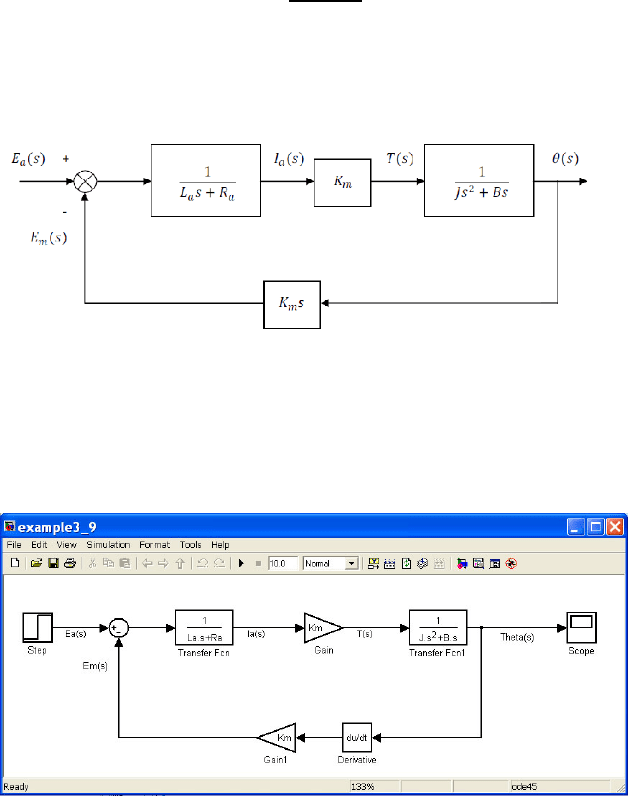
Based on the relationship between these equations, we can draw the block diagram
of the system with input
and output θs (fig. 3.24)
Fig. 3.24 Block diagram of the electromechanical system for Example 3.9.
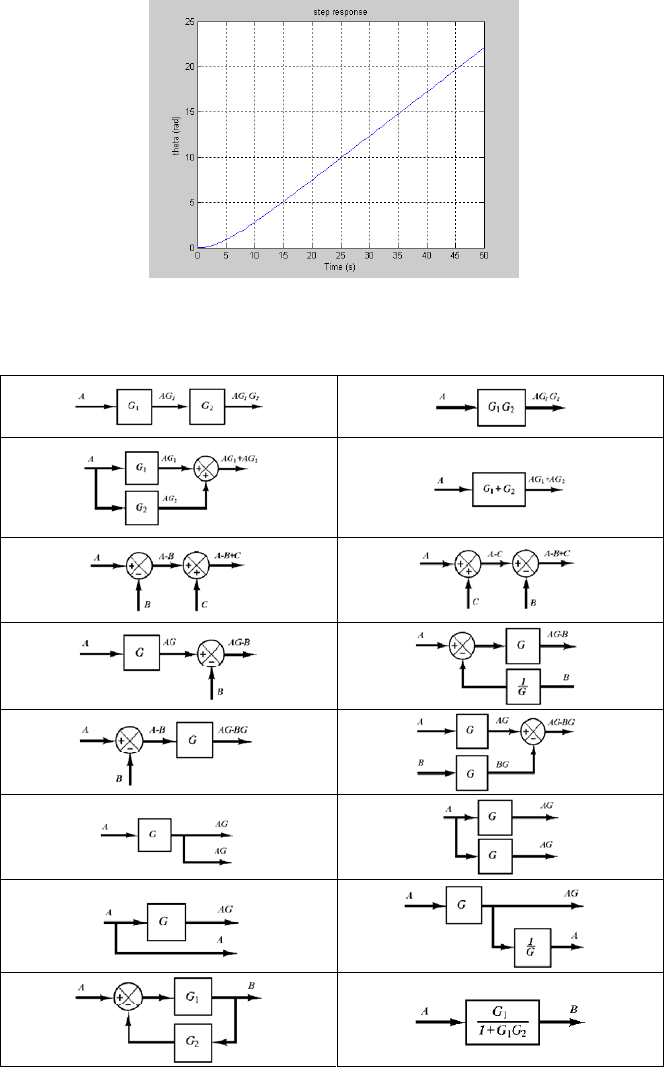
In fig. 3.25 and fig. 3.26 the corresponding block diagram developed by using
SIMULINK together and its step response respectively for the parameter values
indicated
1,
5,
0.8, 1.5 and 0.2 are shown.
Fig. 3.25 SIMULINK diagram corresponding to Example 3.9
From the block diagram of a system we can make changes to simplify or reduce
the original diagram to a single matrix transfer function, or a single transfer
function in case of a single-input single-output system, so that we can apply the
Laplace transform technique in order to find the system time response.
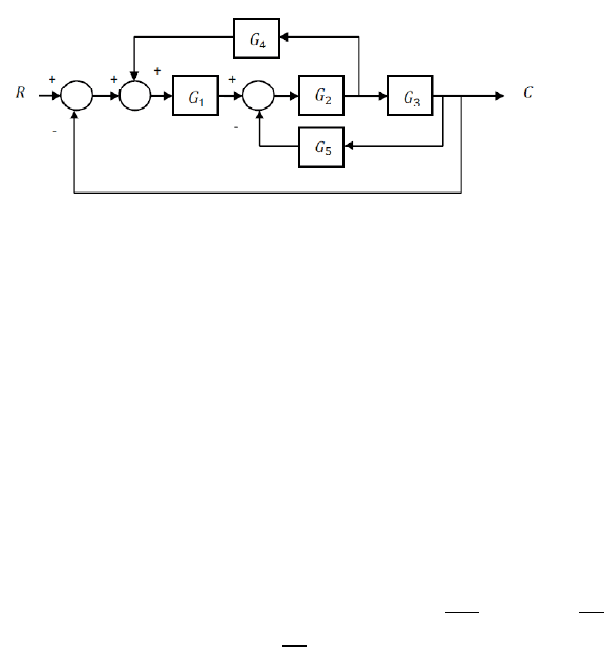
For this purpose we are going to apply some reduction rules, to transform a
more complicated system into a single equivalent system. In table 3.3 the rules
commonly used to simplify the block diagrams of dynamic systems are shown.
3.7 Block Diagrams 79
Fig. 3.26 Step response of the DC motor obtained by using SIMULINK
Table 3.3 List of rules commonly used to reduce a block diagram
80 3 System Description
By simplifying a block diagram, remember the following rules:
1. The product of transfer functions in the direction of the direct path must be the
same.
2. The product of transfer functions around the loop must be the same.
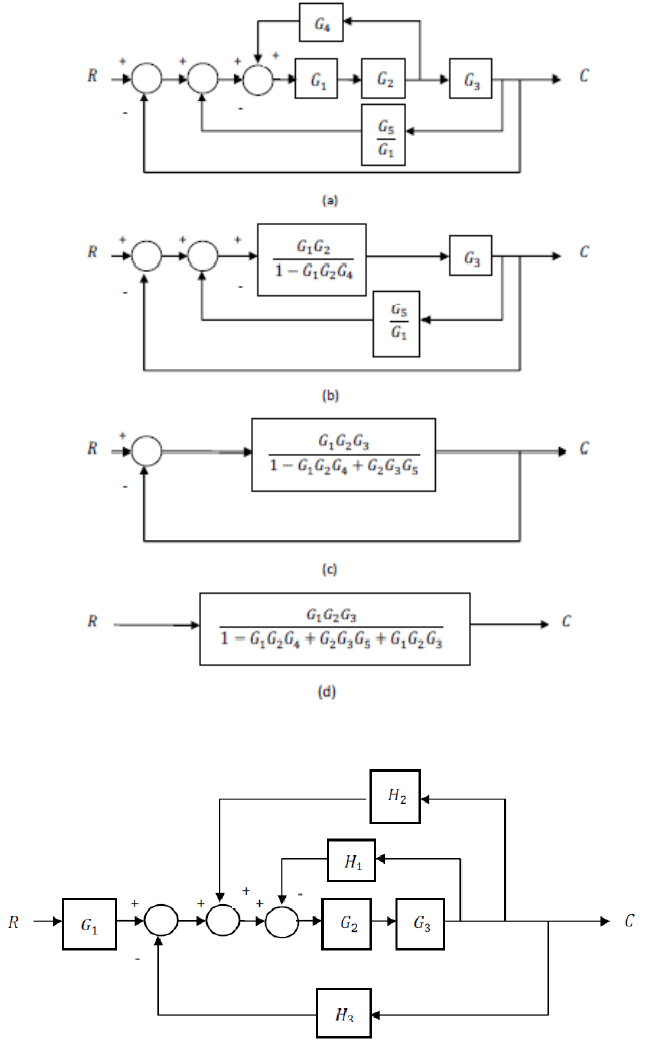
Example 3.10
Reduce the block diagram of fig. 3.27 to a single transfer function by applying the
adequate reduction rules.
Fig. 3.27 Block diagram for example 3.10
Solution
In first place we move the summing junction between
and
to the left, then
solve for the feedback involving
,
, and
. We follow by reducing the
feedback implying
⁄
and finally solve for the unity feedback to get the
single transfer function demanded
CsRs
⁄
(fig. 3.28).
MATLAB also includes commands that allow the reduction of block diagrams
automatically to get the single transfer function representative of the whole
system.
Example 3.11
Reduce the block diagram of fig. 3.29 to a single transfer function by applying the
necessary MATLAB commands for
10,
,
,
5 ,
2 and
. Draw also the impulse response for
the equivalent transfer function.
3.7 Block Diagrams 81
Fig. 3.28 Steps followed in reducing the block diagram for example 3.10 (from (a) to (d)).
Fig. 3.29 Block diagram for example 3.11
82 3 System Description
Solution
In first place we define each one of the individual transfer functions
>> s=tf('s')
>> G1=10;
>> G2=(s+2)/(s+10);
>> G3=1/(s+2);
>> H1=5;
>> H2=-2*s;
>> H3=3/(s+2);
Then, we calculate the series product of
and
>> G23=G2*G3
Transfer function:
s + 2
---------------
s^2 + 12 s + 20
We can group
,
, and
in a parallel way yielding
>> H123=H1-H2+H3
Transfer function:
2 s^2 + 9 s + 13
----------------
s + 2
Below we reduce the negative feedback configuration formed by G23 and H123
>> Gfeed_G23_H123=feedback(G23,H123,-1)
Transfer function:
s^2 + 4 s + 4
--------------------------
3 s^3 + 27 s^2 + 75 s + 66
Finally we compute the series product of the last transfer function with
,
yielding the reduced transfer function
>> G_reduced=G1*Gfeed_G23_H123
Transfer function:
10 s^2 + 40 s + 40
--------------------------
3 s^3 + 27 s^2 + 75 s + 66
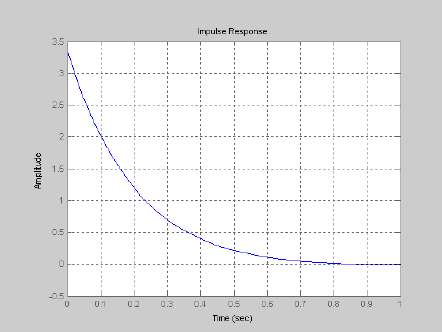
In fig. 3.30 the impulse response corresponding to the equivalent transfer function
derived by using MATLAB is shown.
3.7 Block Diagrams 83
Fig. 3.30 Impulse response of the equivalent transfer function for example 3.11.

Chapter 4
System Response Analysis
This chapter analyzes the output of systems, also known as response, given a
particular input. The utility of this study comes from the necessity of foreseeing
how a physical system, e.g. the electromechanical steering system of a vehicle,
reacts against an input stimulus, e.g. a sudden swerve. In this manner we can re-
design the system at hand, probably adding new components, to make it to behave
as desired.
The main characteristics of the response can be divided into two parts: the
transient response and the steady-state response. The former entails the first
reaction of the system, being the swiftness and smoothness of the response, the
key features, while the latter refers to the permanent value of the output, being the
error, i.e. the difference between the input and the response, the most important
parameter.
In this chapter we will study analytically the response of first and second order
systems and sketch the characteristic of the response of higher order systems
based on their components.
4.1 System Time Response
The way in which physical systems react against input stimuli depends, obviously,
on their own nature and the given input. When dealing with natural, non-
modifiable systems, for instance objects in a spatial orbit, we can only observe
and/or foresee the behavior of the system, for example the trajectory of a meteorite
entering the atmosphere. Regarding human-made systems, however, it becomes
essential to understand how systems react against different inputs in order to adapt
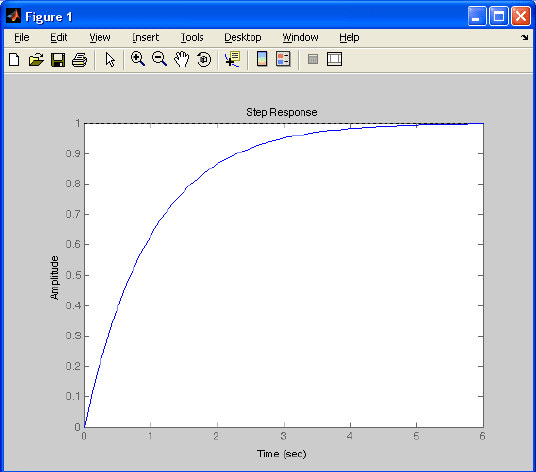
them to fulfill the needed requirements. For example, first-order systems, like a
thermometer, exhibit a characteristic curve response like the one shown in fig.
4.1
when they are exposed to a step input. According to the considered application we
could require to modify the thermometer to achieve particular features. For
instance, a medical thermometer should respond in few seconds with ±0.1º of
precision. However, the temperature sensor of the heating system for an apartment
can be designed to react more slowly, probably assuming a lower precision (which
would make it cheaper).
86 4 System Response Analysis
>>s=tf(‘s’);
>>G=1/(s+1);
>>step(G);
Fig. 4.1 Response of a first-order system against step input. In this example the system
follows the reference input pretty slowly, spending more than 4 seconds to achieve a final
and stable value, which could be assumable for certain applications. Right, Matlab
commands to obtain this response.
4.2 System Transient Response
Independent of the order of the system, we can distinguish between the natural
response and the forced response. The natural response of a system depends on the
system setup before the stimulus has been fired, that is, the response due to the
initial conditions of the system, while the forced response regards to the system
response due to the input stimulus considering the initial conditions as null. For
example, if we study the speed of a vehicle when stepping on the accelerator, the
forced response will account only for the speed increase, given the increment on
the fuel volume, while the natural response will be the speed due to the initial
velocity of the vehicle without considering the action on the accelerator.
Mathematically we can obtain the transfer function of both components of the
system response. Given a general differential equation that models a system:
(4.1)
The Laplace transformation considering initial conditions will be (recall chapter 3):
)1) ) 1)
110 110
''
nn mm
nn mm
ay a y ay ay bu b u bu bu
−−
−−
++++=++++KK

4.2 System Transient Response 87
(4.2)
Grouping terms, we will obtain that the system response is the result of the sum of
two components, lets say Y
1
, the forced response and Y
2
the natural response
which only contains the values of the initial conditions (noted here as P(s)).
(4.3)
Example 4.1
Consider the following differential equation. Compute the natural and forced
responses.
Solution
Applying the Laplace transformation we obtain
fig. 4.2 shows a plot of the different parts of the response.
First-Order System Response
First-order systems come from differential equations like:
(4.4)
For example, following the Fourier laws of thermal conduction, a normal
thermometer can be modeled through the equation:
(4.5)
()
()
()
()
11
10
11
10
() (0) ... (0) ... () (0) ()
( ) (0) ... (0) ... ( ) (0) ( )
nn n
n
mm m
m
asYss y y asYs y aYs
bsUssu u bsUsu bUs
−−
−−
−−−++ −+=
−−−++ −+
10
12
10
10
...
()
() () () ()
...
...
m
m
n
n
n
bs bs b
Ps
Ys Us Ys Y s
n
as as a
as as a
++ +
=+=+
++
++
923 (0)2,(0)4yyyu y y++= = =−
&& & &
2
() (0) (0) 9( () (0)) 2 () 3 ()
2
( )( 9 2) 3 ( ) (9 ) (0) (0)
3214
() ()
22
92 92
sYs sy y sYs y Ys Us
Ys s s Us sy y
s
Ys Us
ss ss
−−+ −+ =
++= ++ +
+
=+
++ ++
&
&
00
'yaybu+=
r
TT
dT
C
dt R
−
=