
Canete J.F. System Engineering and Automation: An Interactive Educational Approach
Подождите немного. Документ загружается.

108
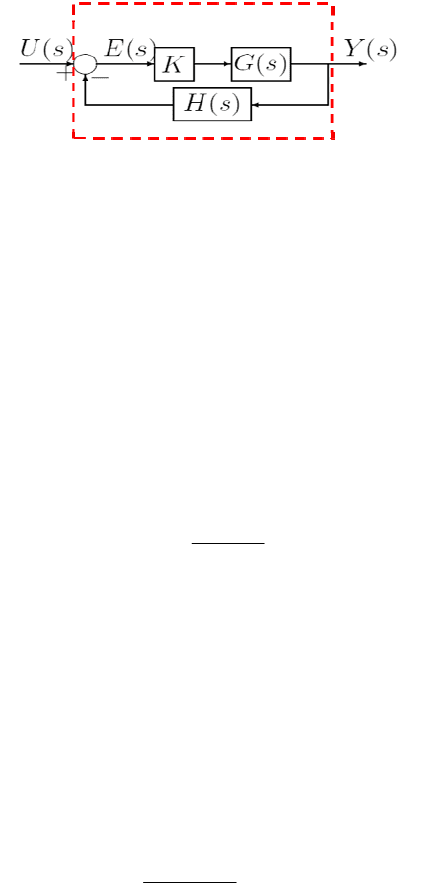
Fig. 4.17 Close-loop config
u
poles of the system can be c
a
This is actually a typ
i
controlled, H(s) represen
t
is a gain that amplifies th
e
happens, it means that
Y
therefore, no actuation is
c
Chapter 5 goes in det
a
are going to cope with
t
parameter K. This behav
i
of poles, and the root loc
u
Recalling Chapter 3
,
configuration of fig. 4.17
being the characteristic e
q
In this equation the para
m
roots, and therefore the p
o
Example 4.8
Considering
Obtain the close-loop tra
different values of K.
Solution
The close-loop transfer f
u
G
4 System Response Analy
s
u
ration. Through the root locus, all the possible locations of t
h
a
lculated in function of the parameter K.
i
cal proportional control where G(s) is the plant to
b
t
s a sensorial system that measures the plan outpu
t
, and
e
error signal given to G(s). When error is zero, in case
Y
(s)=U(s), and the input to the system G(s) is also zer
c
arried out.
a
il on proportional and other control systems, by now
w
t
he behavior of the close-loop system according to t
h
i
or, as commented before, will be defined by the positi
o
u
s technique comes to depict their possible locations.
,
the equivalent transfer function of the close-lo
o
is:
(4.3
7
q
uation
m
eter K, and thus, variations in its value will modify
i
o
sition of the poles.
nsfer function and the position of its poles according
t
u
nction is:
()
1
tot
KG
Gs
KGH
=
+
2
1
() () 1
710
G
sHs
ss
==
++
1()()0KG s H s+=
s
is
h
e
b
e
K
it
r
o,
w
e
h
e
o
n
o
p
7
)
i
ts
t
o
4.3 Root Locus 109
Giving values to the gain K and calculating the roots of the characteristic equation
for this second-order system, we obtain
K P1 P2
0 -5 -2
1 -4.62 -2.38
2 -4 -3
2.25 -3.5 -3.5
3 -3.5+0.872i -3.5-0.872i
6.5 -3.5+2.06i -3.5-2.06i
From this we can deduce that if 0
≤ K ≤ 2.25 the system is overdamped, that is it
has different and real poles, for K=2.25 the system is critically damped, i.e. it has
two real and equal poles, finally if K
≥ 2.25, the system is underdamped,
exhibiting a oscillating behavior due to the presence on complex conjugated poles.
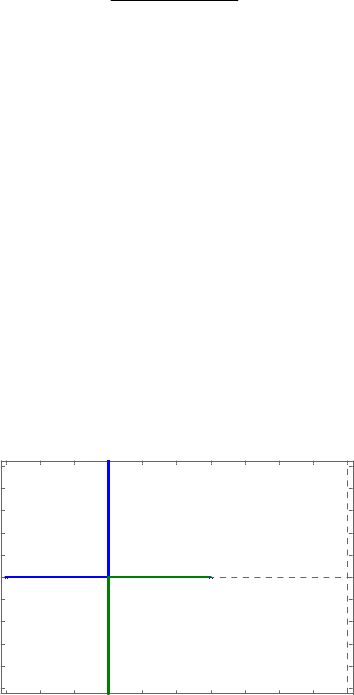
If we depict the position of the poles as long as the value of K is increasing we
obtain:
Fig. 4.18 Root Locus example. Illustration of how the poles move as long as the parameter
K increases.
That is, we can rapidly observe the position of each pole, and therefore
inference the behavior of the final system, in a plot like the one shown in
fig. 4.18. Obviously relying on a systematic calculation of the roots of the
characteristic equation to depict the possible position of the poles based on a given
parameter is not practical at all and a set of recipes are available for sketching it.
4.3.1 Root Locus Recipe
There exists a set of simple steps for sketching the root locus of a given system.
They are mathematically derived from the complex nature of the characteristic
2
()
710
K
Gs
ss K
=
+++
Root Locus
Real Axis
Imag Axis
-5 -4.5 -4 -3.5 -3 -2.5 -2 -1.5 -1 -0.5 0
-2.5
-2
-1.5
-1
-0.5
0
0.5
1
1.5
2
2.5
110 4 System Response Analysis
equation. That is, given expression (4.38), we can distinguish the real and complex
part of the equation and rewrite it as shown in (4.39).
(4.38)
(4.39)
That is,
(4.40)
(4.41)
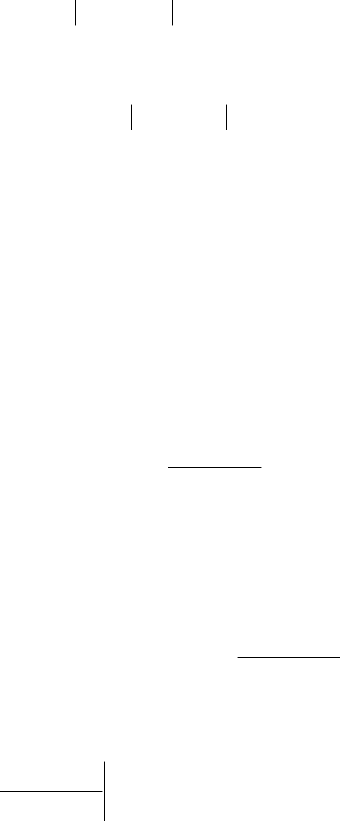
Equation (4.40) is known as the magnitude condition and can be used to calculate
the value of the parameter K for a particular position of the poles. Equation (4.41)
is called the angle condition and permits us to determine whether a particular point
of the s-plane belongs or not to the root locus, i.e. if there exist a value for K for
which one of the poles of the system are located at that particular point.
These two equations are the basis for the root locus method.
Example 4.9
Check the application of the magnitude and angle conditions to the system
At the test point s, .
Solution
G(s)H(s) can be rewritten as:
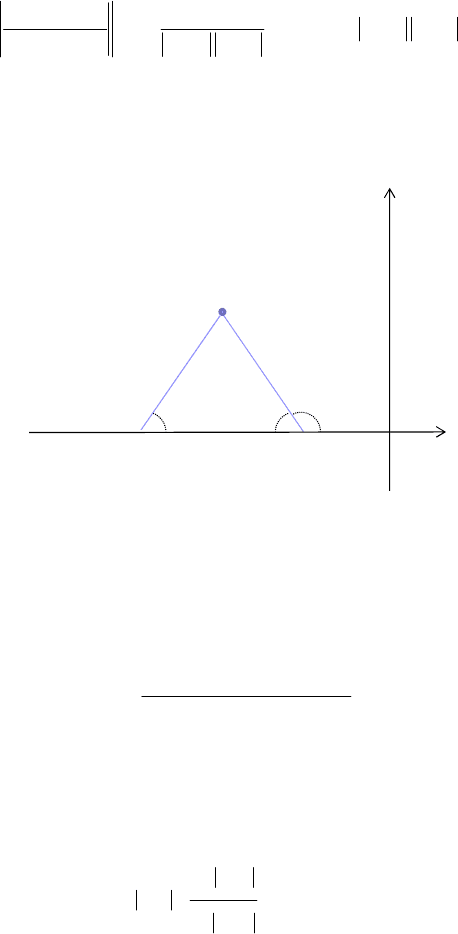
For the test point (see fig. 4.19), angle condition is computed as:
And therefore this condition holds for this test point. Actually it holds for
1()()0 ()()1KG s H s KG s H s+=⇒ =−
() () () () 1 0KG s H s KG s H s j∠=−+
() () 1KG s H s =
() () 1 (2 1), 0, 1, 2,...KG s H s k k
π
∠=∠−=+=±±
2
1
() () 1
710
Gs Hs
ss
==
++
1
3.5sj=− +
1
() ()
(2)(5)
GsHs
ss
=
++
[]
1
11
(2)(5) ( )
(2)(5)
ss
K
ss
ss
πθ θ π
=
∠ =−∠ + −∠ + =− − + =−
++
1
3.5 , [0, )sxjx=− ± ∈ ∞
4.3 Root Locus 111
Now we have confirmed that s
1
=-3.5+j belongs to the root locus we want to figure
out the value of K that moves one of the poles to this position. For that we rely on
the magnitude condition:
Yielding the value of K=3.6, which confirms what we figure out by sequentially
solving the characteristic function for different values of K.
Fig. 4.19 Root Locus example where the point s=s
1
is being checked whether it belongs or
not to the root locus (more description in the text).
In general, for an n-order system, the characteristic equation is given by
being
(4.42)
and the magnitude and angle condition computed as:
(4.43)
(4.44)
1
11
11
1253.6
(2)(5) 2 5
ss
KK
Ks s
ss ss
=
==⇒ =+ +=
++ ++
x
x
-5
s
1
θθ
jω
σ
-2
1
-2.25
|s
1
+5| |s
1
+2|
∠
s
1
+5
∠
s
1
+5
() 1Fs =−
12
12
( )( )...( )
()
( )( )...( )
m
n
Ks z s z s z
Fs
spsp sp
++ +
=
++ +
11
( ) ( ) ( ) (2 1), 0,1,2,...
mn
ii
Fs s z s p k k
π
∠=∠+−∠+= + =
∑∑
1
1
() 1
m
i
n
i
sz
Fs
sp
+
==
+
∏
∏

112 4 System Response Analysis
Next, a list of steps are given based on these conditions for sketching the root
locus.
Step 1. Placement of the poles and zeroes of G(s)H(s) on the s-plane
Firstly it is recommendable to rewrite the equation
(4.45)
Mark on the s-plane the poles p
i
with a cross ‘x’ and the zeroes z
i
with a small
circle ‘o’. Note that when K=0, equation (4.45) is reduced to
(4.46)
And thus, the poles of the closed-loop system are identical to the poles in the
open-loop configuration, that is G(s)H(s). Also notice that as long as K tends to ∞,
the roots of the equation (4.45) coincides with the zeroes of G(s)H(s):
(4.47)
Thus, at this first step we obtain significant information about the root locus
sketch: Root locus starts at the poles of the open-loop system, i.e. the root locus
will be made of n strokes, each one starting at a pole of G(s)H(s), when K=0, and
some of them, precisely m, ending at the zeroes of G(s)H(s), when K
→∞.
Step 2. Root locus on the real axis
In this step we focus on which part of the real axis will be part of the root locus,
that is we are going to apply the angle condition to points s∈ℜ, and s=(-∞,∞). A
practical rule to remember tells us that “a given point s* lying on the real axis
belongs to the root locus if and only if the sum of the real poles and real zeroes
place on its right is an odd number”. This fanciful rule is based on the angle
condition and the need of yielding an odd multiple of π.
Example 4.10
Sketch the root locus over the real axis for the open-loop system
1
11
1
()
10()()0
()
m
i
nm
ii
n
i
sz
KspKsz
sp
+
+=⇒ ++ +=
+
∏
∏∏
∏
1
()0
n
i
sp+=
∏
11
11 1
1
()()0
1
lim ( ) ( ) ( )
nm
ii
nm m
ii i
K
sp sz
K
sp sz sz
K
→∞
++ +=
⎛⎞
++ + = +
⎜⎟
⎝⎠
∏∏
∏∏ ∏
4.3 Root Locus 113
Solution
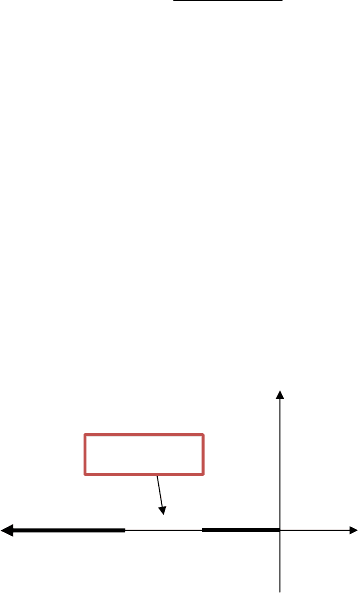
After step 1, we locate the three poles at s=0, s=-1, and s=-2 as shown in fig. 4.20,
and test a point s between p
1
and p
2
, that is s∈(-2,-1). In absence of zeroes, the
angle condition is computed, in this example, as
Note that the presence of two poles on the right of s contributes with 2*
π, while
the pole on the left does not contribute. Thus, it is obvious that s is not a part of
the root locus, as well as any point in the interval (-2,-1). Following the same
argument, ∀s∈(-∞,-2] and ∀s∈[1,0], s is part of the root locus.
Fig. 4.20 Testing points on the real axis. Based on the angle condition, a point on the real
axis will belong to the root locus if the number of poles (and zeros) placed on its right is
odd. In this case, the s point does not belong to the root locus.
In this example, we observe that a certain direction is given to one segment of
the root locus to indicate the path followed by the pole p2 as long as the parameter
K increases. Thus, p2 tends to -∞ and it can be said that the root locus entails a
segment that starts at p2 and ends at -∞.
Step 3. Assessing asymptotes
In step 1 we stated that the segments of the root locus begins at the poles of
G(s)H(s) when K=0 and ends at the zeroes when K=∞. Normally, in causal
systems, the number of zeroes, m, is less than the number of poles, n, and thus
only m segments will end at a zero. The rest of segments, concretely m-n will tend
asymptotically to infinity. In the example of fig. 4.20, m=0 and n=3, i.e. there are
no zeroes, and thus the three segments that start at each pole asymptotically go
1
() ()
(1)(2)
GsHs
ss s
=
++
3
1
0 ( ) 0 2 (2 1), 0,1, 2,...
i
sp k k
ππ ππ
−∠+ =++= ≠ + =
∑
x
x
x
+
Punto de Prueba
p0
p1
p2 s
Test Point

114 4 System Response Analysis
forward to infinity. The angle of the asymptotes with respect the real axis can be
determined by the equation (4.48).
(4.48)
This expression comes from the application of the angle condition to a distant
point (ideally at the infinity). At that distant point the angles from poles and zeroes
can be assumed as equal and thus, they are cancelled, turning the angle condition
into
The place where the asymptotes cross the real axis is determined by the mass
center of the poles and zeroes as:
(4.49)
In the example of fig. 4.20 there are two asymptotes, with σ= ±
π/2, located at
σ
a
=(-2-5)/2=-3.5.
Step 4. Identification of rupture points
In some occasions, two or more segments of the root locus collide at a particular
point of the s-plane, which is called a rupture point. That is, a rupture point occurs
when, given a certain value of K, the characteristic equation has roots with a
multiplicity greater than 1. Identifying these points will largely help to sketch the
root locus further away from the real axis.
Rupture points coincide with the maximum values of K so in practice, they are
computed by deriving K and solving the equation dK/ds=0. The solutions of this
equation, s*, fulfilling that K(s*)>0 are rupture points.
Example 4.11
Calculate the rupture points for the system
Solution
The characteristic function is:
(2 1)
0,1,2...
k
k
nm
π
φ
±+
==
−
nm
π
φ
=
−
11
() ()
nm
ii
ii
a
pz
s
nm
σ
==
−− −
==
−
∑∑
2
1
() () 1
710
Gs Hs
ss
==
++
4.3 Root Locus 115
from which
And solving
Checking that it is really a maximum of the curve K, we have that
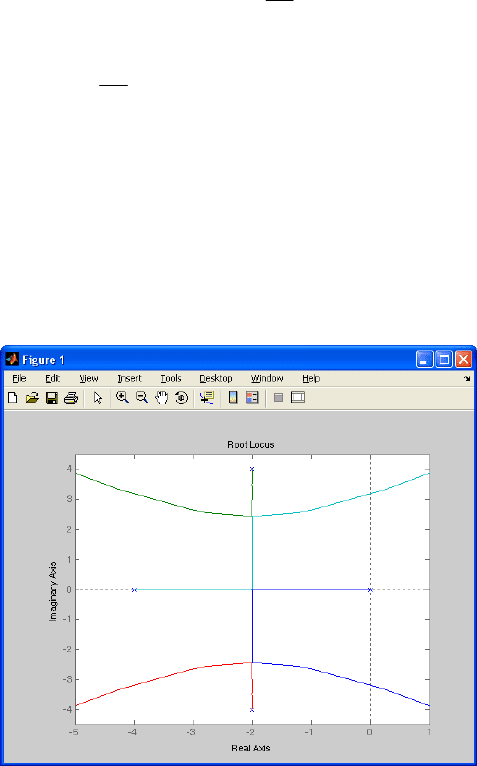
and thus s=-3.5 is a rupture point as revealed in the fig. 4.18.
Although it is common to find rupture points lying on the real axis, there
are some cases where the roots of dK/ds are complex conjugates as illustrated in
fig. 4.21.
Fig. 4.21 Root Locus example for a system with 4 poles. It is made of four segments that
collides at three rupture points: s=-2 and s=-2±2.45j
Step 5. Determination of starting/ending angles
This step is a straightforward application of the angle condition. It provides us
with valuable information about the direction of the segments when starting at the
poles or when ending at the zeroes.
2
710 0ss K+++=
2
710 27
dK
Ks s s
ds
=− − − ⇒ =− −
0270 3.5
dK
ss
ds
= ⇒ −−=⇒ =−
()
2
3.5 7( 3.5) 10 0K =− − − − − >
116 4 System Response Analysis
(4.50)
Step 6. Crossing points of the root locus with the complex axis
This is the last step for sketching a root locus and it is intimately related to
stability. In fact, in this step we calculate the value of the parameter K that made
unstable the close-loop system. At the moment, at least one pole of the close-loop
system will be located at the complex axis.
This step is not always applicable since there are cases where the system is
always stable regardless of the value of K
3
, as it is the example of fig. 4.18.
Example 4.12
Sketch the root locus for the system
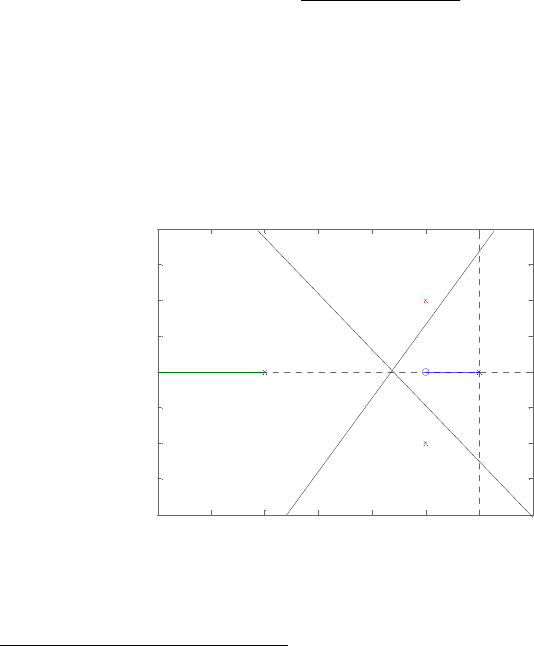
Solution
This system has one zero at s=-1 and four poles at s=0, s=-4 and s=-1±j.
The initial sketch is shown in fig. 4.22 where two segments lay on the real axis,
from s=-4 to infinity and from s=0 to s=-1and three asymptotes (n-m=3) with
Fig. 4.22 Root Locus example where two segments (those over the real axis) has been
traced. The asymptotes indicate the direction followed by the other two segments, starting
at the complex poles.
3
When K defined in the range [0,infinity).
pole poles zeroes
rest rest
zero zeroes poles
rest rest
ϕπϕ ϕ
ϕπϕ ϕ
=− +
=− +
∑
∑
∑∑
2
1
() ()
(4)( 22)
s
GsHs
ss s s
+
=
+++
-6 -5 -4 -3 -2 -1 0 1
-2
-1.5
-1
-0.5
0
0.5
1
1.5
2
Root Locus
Real Axis
Imaginary Axis
4.3 Root Locus 117
angles 60,180 and 300°, crossing the real axis at σ
a
=-5/3. At this moment we realize
that there should be two segments more, starting at s=-1±j and that they have to tend
to infinity following the asymptotes, but how? Calculating the starting angle from
these poles we obtain ±26.6°, giving us a cue about their orientation.
The sketch of the root locus is finished when the stability of the system and the
value of K and the location of the poles at the limit of the stability is computed. In
this example the Routh criteria yields that the system is unstable when K>24.78.
For this precise value, the characteristic equation has two roots at s=0±2.33j.
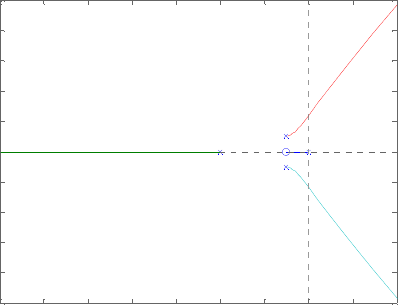
Therefore the root locus crosses the complex axis at ±2.33j. fig. 4.23 depicts the
root locus computed by the Matlab command
rlocus that confirms our initial
sketch was correct.
Fig. 4.23 Root Locus example depicted by rlocus. Note that there is a value of K that brings
the poles of the system to the right part of the s-plane, and thus, makes the system unstable.
In the following section the effect of adding/removing poles zeroes to the open-
loop system is commented.
4.3.2 Effects of Adding Poles/Zeros
Sometimes we are interested in modifying the behavior of a close-loop system to
obtain a particular response, e.g. reducing the overshoot, or to gain in stability.
One simple manner to do this is to add/remove poles/zeroes from the initial
configuration up to achieving our goal. In this section we analyze the effect of this
operation in the root locus.
Let’s begin with the simplest root locus, the root locus of a first-order system.
fig. 4.24 shows the root locus for a system with a pole at s=-5 and the close-loop
response for different values of K. Notice that as long as K increases, the pole
moves over the negative part of the real axis at the same time that the output
reduces the permanent error.
Root Locus
Real Axis
Imaginary Axis
-14 -12 -10 -8 -6 -4 -2 0 2 4
-10
-8
-6
-4
-2
0
2
4
6
8
10