
Canete J.F. System Engineering and Automation: An Interactive Educational Approach
Подождите немного. Документ загружается.

118 4 System Response Analysis
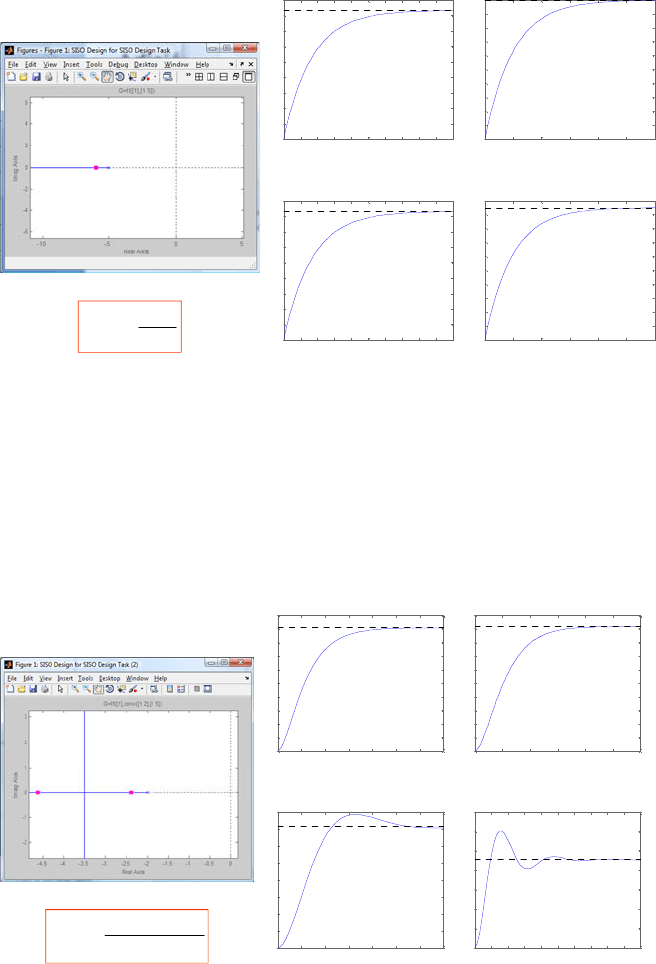
Fig. 4.24 Root Locus for a first order system. This is the simplest case where the root locus
covers the real axis in the range [-∞,p
1
].
If we now add a second pole, for instance at s=-2, the configuration of the root
locus will change, appearing as a rupture point from with the poles can move
upward and downward. Thus, according to the value of K, the system will be
overdamped, critically damped or underdamped, exhibiting their correspondent
behavior (see fig. 4.25)
Fig. 4.25 Effect of adding a new pole at s=-2. Note that the root locus turns into a cross
making the poles to move over the complex axis. As long as K increases the damping ratio
decreases, and thus, the system response oscillations increases.
5
1
)(
+
=
s
sG
Step Response
Time (s ec )
Amplitude
0 0.1 0.2 0.3 0.4 0.5 0.6 0.7 0.8 0.9 1
0
0.02
0.04
0.06
0.08
0.1
0.12
0.14
0.16
0.18
Step Response
Time (s ec )
Amplitude
0 0.1 0.2 0.3 0.4 0.5 0.6
0
0.05
0.1
0.15
0.2
0.25
0.3
0.35
0.4
0.45
0.5
Step Response
Time (s ec )
Amplitude
0 0.02 0.04 0.06 0.08 0.1 0.12 0.14 0.16 0.18 0.2
0
0.1
0.2
0.3
0.4
0.5
0.6
0.7
0.8
0.9
Step Response
Time (s ec )
Amplitude
0 0.01 0.02 0.03 0.04 0.05 0.06
0
0.1
0.2
0.3
0.4
0.5
0.6
0.7
0.8
0.9
1
K=1 K=5
K=25 K=100
)5)(2(
1
)(
++
=
ss
sG
Step Response
Time (se c)
Amp litu de
0 0.5 1 1.5 2 2.5 3 3.5
0
0.01
0.02
0.03
0.04
0.05
0.06
0.07
0.08
0.09
0.1
Step Response
Time (se c)
Amp litu de
0 0.5 1 1.5 2 2.5 3
0
0.02
0.04
0.06
0.08
0.1
0.12
0.14
0.16
0.18
0.2
K=1 K=2.25
Step Response
Time (se c)
Amplitude
0 0.2 0. 4 0.6 0.8 1 1.2 1.4
0
0.1
0.2
0.3
0.4
0.5
0.6
0.7
0.8
K=25
Step Response
Time (se c)
Amplitude
0 0.2 0.4 0.6 0. 8 1 1.2 1.4 1.6 1.8 2
0
0.2
0.4
0.6
0.8
1
1.2
1.4
K=100
4.3 Root Locus 119
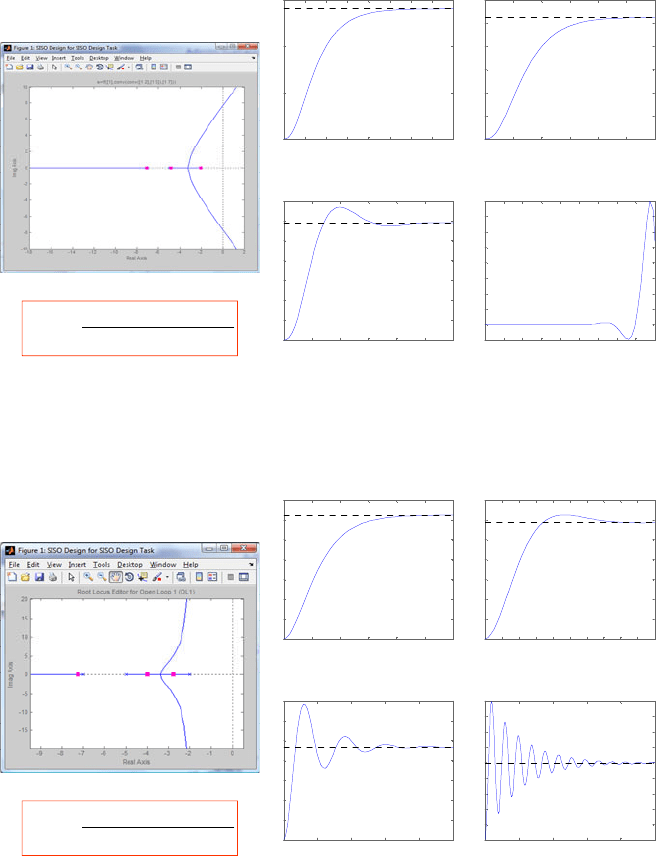
However, with only two poles the system is stable for any value of K. If we add
a third pole to the original system, for instance at s=-7, the root locus bends to the
right, existing a value of K that makes the system unstable (see fig. 4.26).
Concretely, when K=850, poles are located at s=0.177±8j.
Fig. 4.26 A three-pole root locus example. Adding a new pole bends the root locus to the
right. There is a critical value of K that moves the poles to the right part of the s-plane,
destabilizing the system.
Fig. 4.27 Effect of adding a zero. The addition of a zero at s=-10 corrects the deviation of
the root locus, avoiding the destabilization of the system.
)7)(5)(2(
1
)(
+++
=
sss
sG
K=1
K=8.2
K=100 K=850
Step Response
Time (s ec)
Amplitude
0 0.5 1 1.5 2 2.5 3 3.5 4
0
0.005
0.01
0.015
Step Response
Time (s ec)
Amplitude
0 0.5 1 1.5 2 2.5 3
0
0.02
0.04
0.06
0.08
0.1
0.12
Step Response
Time (s ec)
Amplitude
0 0.5 1 1.5 2 2.5 3
0
0.1
0.2
0.3
0.4
0.5
0.6
0.7
Step Response
Time (s ec)
Amplitude
0 10 20 30 40 50 60 70 80 90
-0.5
0
0.5
1
1.5
2
2.5
3
3.5
4
x 10
6
)7)(5)(2(
10
)(
+++
+
=
sss
s
sG
K=1 K=10
K=100 K=1000
Step Response
Time (s ec)
Amplitude
0 0.5 1 1.5 2 2.5 3
0
0.02
0.04
0.06
0.08
0.1
0.12
0.14
Step Response
Time (s ec)
Amplitude
0 0.2 0.4 0.6 0.8 1 1.2 1.4 1.6 1.8 2
0
0.1
0.2
0.3
0.4
0.5
0.6
0.7
Step Response
Time (s ec)
Amplitude
0 0.5 1 1.5 2 2.5
0
0.2
0.4
0.6
0.8
1
1.2
1.4
Step Response
Time (s ec)
Amplitude
0 0.5 1 1.5 2 2.5
0
0.2
0.4
0.6
0.8
1
1.2
1.4
1.6
1.8
120 4 System Response Analysis
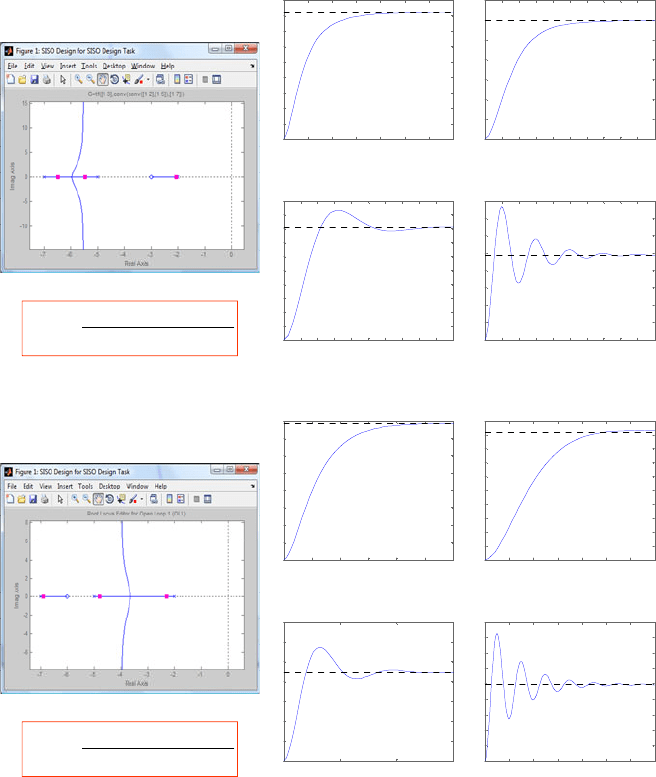
Fig. 4.28 Effect of adding a zero to the three-poles system at different locations. Notice that
in any case, the resulting system gains in stability.
Summing up we can realize that increasing the number of poles in the system
may lead to instability and undesired effects like overshooting. Contrarily, by
adding zeroes to the system we can obtain better results in the system response,
we can even stabilize a system. Let’s consider now the addition of a zero to the
previous example. When adding a zero, e.g. at s=-10, the root locus configuration
drastically changes, as shown in fig. 4.27. Now one of the segments ends at the
new zero, while the other two exhibit a behavior similar to the case where only
)7)(5)(2(
3
)(
+++
+
=
sss
s
sG
K=1 K=10
K=100 K=1000
Step Response
Time (s ec)
Amplitude
0 0.5 1 1.5 2 2.5 3 3.5
0
0.005
0.01
0.015
0.02
0.025
0.03
0.035
0.04
0.045
Step Response
Time (s ec)
Amplitude
0 0.2 0.4 0.6 0.8 1 1.2 1.4 1.6 1.8 2
0
0.05
0.1
0.15
0.2
0.25
0.3
0.35
Step Response
Time (s ec)
Amplitude
0 0.1 0.2 0.3 0.4 0.5 0.6 0.7 0.8 0.9 1
0
0.1
0.2
0.3
0.4
0.5
0.6
0.7
0.8
0.9
1
Step Response
Time (s ec)
Amplitude
0 0.1 0.2 0.3 0.4 0.5 0.6 0.7 0.8 0.9 1
0
0.2
0.4
0.6
0.8
1
1.2
1.4
1.6
)7)(5)(2(
6
)(
+++
+
=
sss
s
sG
K=1 K=10
K=100 K=1000
Step Response
Time (s ec )
Amplitude
0 0.5 1 1.5 2 2.5 3
0
0.01
0.02
0.03
0.04
0.05
0.06
0.07
0.08
Step Response
Time (s ec )
Amplitude
0 0.2 0.4 0.6 0.8 1 1.2 1.4
0
0.05
0.1
0.15
0.2
0.25
0.3
0.35
0.4
0.45
0.5
Step Response
Time (s ec )
Amplitude
0 0.5 1 1.5
0
0.2
0.4
0.6
0.8
1
1.2
1.4
Step Response
Time (s ec )
Amplitude
0 0.2 0.4 0.6 0.8 1 1.2 1.4
0
0.2
0.4
0.6
0.8
1
1.2
1.4
1.6
1.8
4.4 Identification 121
two poles are considered. Notice that the system is stable regardless of the value
of K, and thus we have introduced stability into the system.
Fig. 4.28 shows the effect of adding one zero at different real locations, proving
that in all cases the system keeps stable. The addition of poles and zeroes to a
given system is the basis for compensators, i.e. special systems added to the
original system to obtain the desired behavior far away from only considering the
K parameter. This is explained in detail in chapter 5, where the PID controller is
described, which, as an advance here, adds one zero and two poles to the original
system.
4.4 Identification
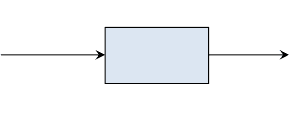
System identification refers to obtaining the transfer function of a system by only
considering its response to a given input (see fig. 4.29). This is useful when we
have not much information about a system at hand, i.e. it is a black box for us, and
we need to find out its transfer function for simulation purposes, for instance.
Although we assume that no information is provided by the system, some
hypothesis must to be considered, like for instance the order of the system. In this
book we will only focus on system identification of first and second-order systems
considering only unitary steps as system inputs.
Fig. 4.29 System identification. It consists on finding out the transfer function of the Plant,
G(s), by analyzing the system output for a particular input.
4.4.1 First-Order System Identification
As we commented in Section 4.2, a first order system can be represented by a
gain, K, and a time constant, τ. Thus, when we try to identify a system assuming it
is a first-order system, the goal is to find the values K, and τ.
Example 4.13
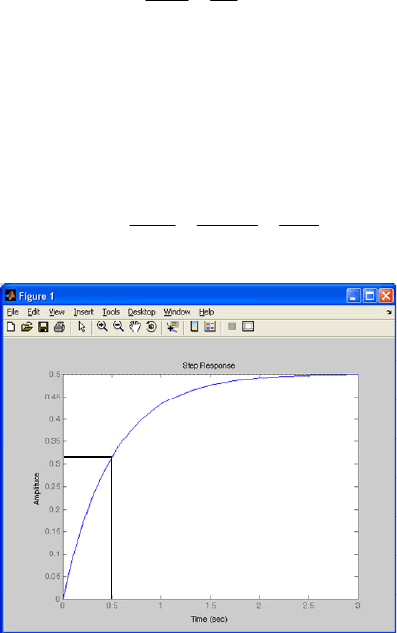
Considering a first-order system that when excited with a unitary step input
produces the output shown in fig.
4.30. Obtain its transfer function.
Solution
Recalling that parameter K is computed as the relation between the final value of
the output and the final value of the input. In the example of the fig.
4.30,
Plant
Input
U(t)
Output
C(t)
G(s)?
122 4 System Response Analysis
Remembering that the time constant is defined as the time when the output of the
system achieves 63.2% of the final value, by inspection we can conclude that
That is, the system whose output is the one shown in fig.
4.30 against a unitary step
input is:
Fig. 4.30 System identification for a first order system. The two parameters to be identified
are the system gain and the time constant. The former is calculated as the relation between
the final value of the response (in this case 0.5) and the final value of the input. The latter
can be obtained by visual inspection, fixing the moment when the response achieves 63.3%
of the final value (in this example at t=0.5 seconds).
4.4.2 Second-Order System Identification
The process of system identification becomes more complex when the initial
hypotheses indicate that the order of the system is two. Recalling previous
sections, a second-order system can be expressed in terms of
ξ, and ω
n
. According
to the damping ratio,
ξ, the poles of the characteristic equation can be real and
different, real and equal, or conjugate complex, in which case the value of
ω
n
affects the amplitude of the oscillations. Thus, the behavior of the response against
a step input varies in each case, and the aim of identification is to figure out the
values of the parameters
ξ, and ω
n
. To do this, a number of response features are
defined whose computation will help us to identify a second-order system.
() 0.5
0.5
() 1
y
K
u
∞
===
∞
( ) 0.632 0.5 0.315 0.5y
ττ
=⋅=⇒ =
0.5 1
()
10.5 1 2
K
Gs
sss
τ
== =
+++
4.4 Identification 123
Having the response of a second-order system when the input signal is a step, it
is defined the following (note that some of them have no sense when the system is
underdamped or critically damped. Expressions below are approximations and
come from analytical manipulations of the general second-order system response
function; its in-depth study is out of the scope of this book):
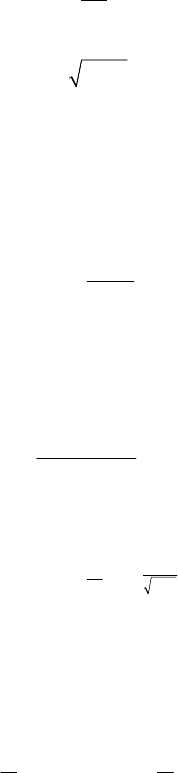
•
Peak Time. This is the moment when the maximum value of the output
is reached. This is an easily measurable parameter which can be
mathematically calculated as:
(4.51)
where
ω
d
, is
(4.52)
•
Rise Time. It refers to the needed time to reach the final value for the
first time, and thus, sometimes it is called rise time (0-100). Some
authors use the rise time (10-90) that refers to the time needed to pass
from the 10% of the final value to the first time that the response reaches
the 90%. The former can be calculated as:
(4.53)
where
β=acos(ξ).
•
System overshoot. The overshoot represents the percentage in which the
system output exceeds the final value. Mathematically, it can be
expressed as:
(4.54)
While the relation of this output characteristic and the parameters of the
system is:
(4.55)
• Settling Time. The settling time refers the first time that the system
output enters, and is maintained, in a band around the final value.
According to the width of such a band, the settling time can be
approximated to:
(4.56)
p
d
t
π
ω
=
2
1
dn
ωω
ξ
=−
r
d
t
πβ
ω
−
=
)
(()
100%
()
p
yt y
SO
y
−∞
=×
∞
2
1
d
SO e e
ξ
π
σπ
ξ
ω
−
−
−
==
43
(2%) (5%)
ss
tt
σσ
==
124 4 System Response Analysis
For a 2% and 5% band width of the final value, respectively.
•
Steady State value. The steady state value is the final value of the
system response, i.e. . This final value which can be obtained by
mere observation will serve to calculate the gain of the system, as
(4.57)
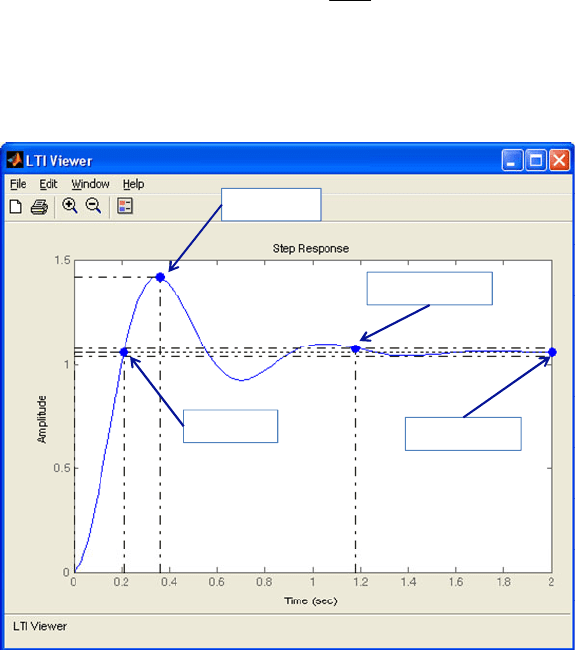
Fig.
4.31 depicts most of these characteristics over a underdamped second-order
system.
Fig. 4.31 Temporal characteristics of a second-order system visualized through the LTI viewer
application.
Let’s complete the identification process by calculating the transfer function of
the system that causes this output. There is not a unique way to proceed since we
have several equations to calculate only two parameters.
lim ( )
t
yt
→∞
()
()
y
K
u
∞
=
∞
Peak Time
Rise Time
Settling Time
Steady State
4.4 Identification 125
Example 4.13
For the system output given in fig. 4.31 and the following information
Peak time=0.364
Overshoot=34.7%
Steady State=1.06
Obtain the transfer function of the system
Solution
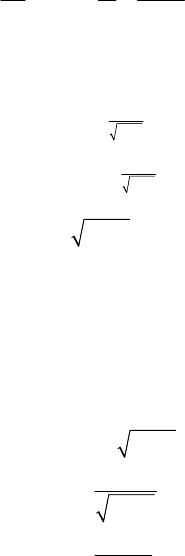
From equation (4.51)
(4.58)
From equation (4.55)
(4.59)
From equations (4.52), (4.58), and (4.59)
(4.60)
Finally the gain of this system is calculated from equation (4.57) and the
amplitude of the input as:
8.6307
0.364
pd
dp
t
t
πππ
ω
ω
= ⇒ == =
()
(
)
()
() ()
2
2
1
1
2
22
2
22
222
ln(34.7)
ln(34.7) 1
ln(34.7) ln(34.7) 0
0.3975
SO e
ξπ
ξ
ξπ
ξ
ξξπ
ξπξ
ξ
−
−
−
−
=
=
−=−
+− =
=
2
2
1
1
8.6307
0.9176
9.4056
dn
d
n
n
n
ωω
ξ
ω
ω
ξ
ω
ω
=−
=
−
=
=

126 4 System Response Analysis
(4.61)
With the values of K,
ξ, and ω
n
, we can now obtain the transfer function of the
system as:
4.5 System Stability
The stability concept refers to a desirable system characteristic for which if (and
only if) the input signal is bounded; the output of a stable system will also
be bounded. It is important to remark that in this concept the input signal has to be
bounded; otherwise, the system output can be unbounded even when it is
considered stable.
That is, we are interested in systems that responsed to a certain bounded
stimuli, e.g. a step signal with a bounded output. Far from mathematical
expressions, the stability concept is widely employed in an uninformed way. For
instance, if we try to put a pencil in a vertical position, we rapidly conclude that
this is an unstable configuration for this object. In contrast, if we think on a
Segway© we can notice that it is stable but only if the driver performs smooth
movements; and obviously it will be unstable, i.e. it will fall down, when an
abrupt change of the inclination is carried out (and of course, when the control
system is switched off).
From a mathematical point of view, we have already referred to system stability
when we analyzed the system responses. Remember that in the general case the
system response against a step input is:
(4.62)
Following the definition given at the beginning of this section, the output y(t) has
to be bounded and the unique way to assure this requirement is that, for every
term,
(4.63)
( ) 1.06
1.06
() 1
y
K
u
∞
===
∞
2
2
222 2
2
1.06*9.4056
()
2 (2*0.3975*9.4056) 9.4056
93.77
()
70.33 88.46
n
nn
K
Gs
sss s
Gs
ss
ω
ξω ω
== ⇒
++ + +
=
++
1
012
11 1
() cos ()
(1)!
j
i
q
nr
pt
j
pt n t t
ikke
ij k
K
yt K Ke t e K e t K e sen t u t
n
σσ
ωω
−
−−−−
== =
⎛⎞
=+ + + +
⎜⎟
−
⎝⎠
∑∑ ∑
lim 0
i
pt
t
e
−
→∞
=
4.5 System Stability 127
That is, in stable systems p
i
>0; what is the same, all the roots of the characteristic
equation have to lay on the left side of the s-plane. Thus, the most direct way to
check the stability of a system is to obtain the characteristic equation and calculate
its roots.
Example 4.14
Check whether the following system is stable or not.
Solution
Computing the roots of the characteristic function we rapidly notice that it is not
stable since
>> roots([1 4 1 -6])
ans =
-3.0000
-2.0000
1.0000
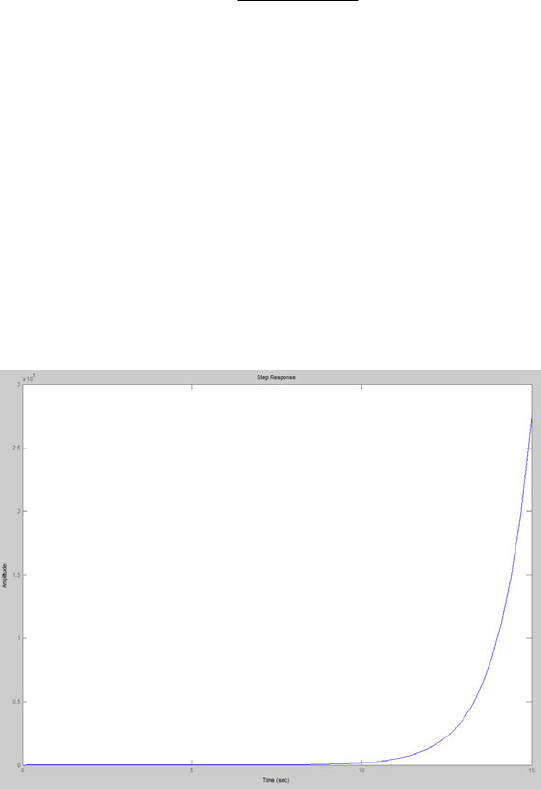
That is, one of the roots is placed on the right part of the s-plane, i.e. there is a
pole p1=-1, and therefore one of the exponential terms of the output will not tend
to zero. Actually, the step response of this system can be observed in fig. 4.32.
Fig. 4.32 Response of the system G(s) against a unitary step input. Clearly this system is
unstable, due to the presence of a pole at the right part of the s-plane.
32
1
()
46
Gs
sss
=
++−