
Canete J.F. System Engineering and Automation: An Interactive Educational Approach
Подождите немного. Документ загружается.


128 4 System Response Analysis
As you can observe, when studying system stability, sometimes it is not needed
to know where the poles are exactly placed, but to know whether all the poles are
on the left part of the s-plane. Moreover, if you do not have a computer program
(like Matlab) to solve high-order equations, it can be difficult to decide about the
stability of a given system. For that, there are some simple rules, given by the
Routh-Hürwitz theorem, which yields the number of poles that are placed in the
“wrong” place, that is, on the right part of the s-plane. The steps to easily check
the stability of a system are:
1.
Obtain the characteristic equation of the system.
(4.64)
2.
Assuming that a
0
≠0, if there is one (or more) term a
i
<0 when another
term a
j
>0 then one of the roots of the equation, at least, are positive (the
system is unstable) or complex conjugated in the form s=0±j
ω (critical
stability). This condition is necessary but not sufficient.
3.
If a characteristic equation passes step 2, there is a possibility of being
unstable yet. To completely check the stability of the system we proceed
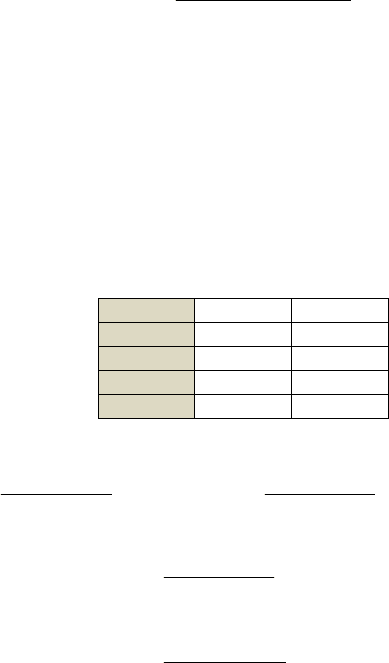
as follows. We construct a table like the one shown in fig. 4.33 where the
first two rows are filled up with the coefficients of the characteristic
equation: the first row lists the odd coefficients starting from a
n
while the
second row lists the even coefficients starting from a
n-1
. The rest of cells
of this table are calculated as:
(4.65)
…
…
t(3,1) t(3,2) t(3,3) t(3,4) …
… … … … …
t(n+1,1) t(n+1,2) t(n+1,3) t(n+1,4) …
Fig. 4.33 Routh-Hürwitz table. First two rows are filled up with the coefficients of the
characteristic equation, while the rest are computed through the expression (4.65).
The Routh-Hürwitz theorem assures that the number of poles located at the
right part of the s-plane coincides with the changes of signs of the elements of the
first column of the table. Thus, a system is stable if and only such elements are all
positive or all negative.
10
...
n
n
as as a++ +
()()
( 1,1) * ( 2, 1) ( 1, 1) * ( 2,1)
(, )
(1,1)
ti ti j ti j ti
ti j
ti
−−+−−+−
=
−
n
a
2n
a
− 4n
a
− 6n
a
−
1n
a
− 3n
a
− 5n
a
− 7n
a
−
4.5 System Stability 129
Example 4.15
Check the stability of a system given by:
(4.66)
Solution
The characteristic equation for the system (4.66) is
(4.67)
All the coefficients of (4.67) are positive so we cannot determine the stability of
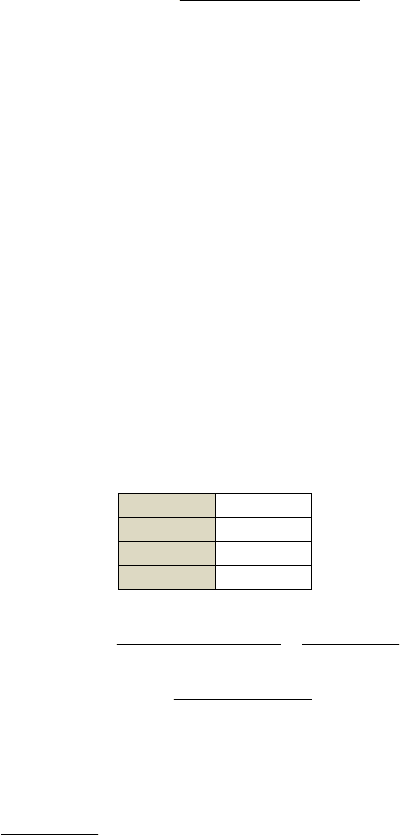
the system yet. We proceed to construct the table (note that empty cells are
considered as zero):
1 3 5
2 4
t(3,1) t(3,2)
t(4,1)
t(5,1)
being
(4.68)
In this example, notice that the first column of the table (in grey) is 1,2,1,-6, and 5.
So there are two changes of sign (from 1 to -6 and from -6 to 5), and therefore the
system at hand has 2 poles at the right part of the s-plane: it is unstable.
As expected, solving the characteristic equation we have that:
>> roots([1 2 3 4 5])
ans =
0.2878 + 1.4161i
0.2878 - 1.4161i
-1.2878 + 0.8579i
-1.2878 - 0.8579i
432
10 1
()
2345
s
Gs
ssss
+
=
++++
432
23450ssss++++=
(2*3) (1*4)
(3,1) 1
2
t
−
==
(2*5) (1*0)
(3,2) 10
2
t
−
==
(1* 4) (2 * 5)
(4,1) 6
1
t
−
==−
(6*5) (1*0)
(5,1) 5
6
t
−−
==
−
130 4 System Response Analysis
Example 4.16
Sometimes, system stability depends on a particular parameter which has to be
tuned up to make the system stable. For example given the system:
Check its stability in function of the parameter k.
Solution
We can proceed in a similar way to calculate the range of values that the
parameter can take to assure the system stability. The characteristic equation is
From the second rule of the method we can restrict the value of k that makes all
the coefficient of the equation to have the same sign as:
As commented this is only a necessity but not a sufficient condition for stability
and we have to complete the process:
1 k+2
3k 4
t(3,1)
t(4,1)
Now we have to calculate the range of the value of k such as:
Certainly, when k=0.5275 the roots of the characteristic equation are:
32
1
()
3(2)4
Gs
sksks
=
++++
32
3(2)40sksks++++=
30 0
0
20 2
kk
k
kk
>
⇒ >
⎫
⇒
>
⎬
+>⇒ >−
⎭
2
(3 *( 2)) (1*4) 3 6 4
(3,1)
33
kk k k
t
kk
+− +−
==
(3,1)* 4 (0 *3
(4,1) 4
(3,1)
tk
t
t
−
==
2
30 0
0.5275
364
0 2.5 0.5275
3
kk
k
kk
kk
k
>
⇒ >
⎫
⎪
⇒
>
⎬
+−
>
⇒ <− ∧ >
⎪
⎭
4.6
System Stationary R
e
>> roots([1 3*k k+2 +
4
ans =
-1.5825
0.0000 + 1.5898i
0.0000 - 1.5898i
and the system is at the li
m
>> roots([1 3*k k+2 +
4
ans =
-1.5510
0.0255 + 1.6057i
0.0255 - 1.6057i
the system becomes unst
a
>> roots([1 3*k k+2 +
4
ans =
-1.6741
-0.0629 + 1.5445i
-0.0629 - 1.5445i
the system is stable.
4.6 System Station
a
In previous sections we
w
of systems, paying atten
t
Although such features ar
e
temperature control syste
m
is still another relevant p
a
can be defined the stea
dy
reference signal and the
controlled systems that
e
The steady-state error of
s
to follow an input refere
n
paramount importance f
o
example, in the altitude
accurate and changing alt
i
error in the system on foll
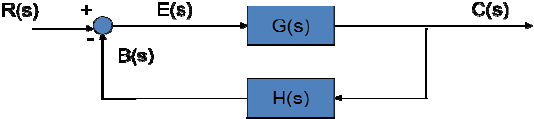
Fig. 4.34 Close-loop config
output. The error is defined
a
one.
e
sponse
1
3
4
])
m
it of the stability. For example for k=0.5
4
])
a
ble, while for greater values, for example k=0.6
4
])
a
ry Response
w
ere dealing with characteristics of the transient respon
s
t
ion to issues like maximum overshoot, peak times, e
t
e
highly relevant for real systems, e.g. it is desirable tha
t
m
responds quickly after a reference signal is given, the
r
a
rameter which has to do with the stationary response.
dy
-state error of a system as the difference between t
h
stationary system output. This parameter has sense f
o
e
xhibit a close-loop configuration as shown in fig. 4.3
s
ystems gives information about the ability of the syste
m
n
ce signal. The study and analysis of this parameter is
o
o
r designing reliable control systems. Let’s think, f
o
control system of an airplane, in charge of keeping
a
i
tude reference given by the pilot; obviously any inhere
owing the pilot instructions may lead to a crash.
uration considering a sensorial system that
m
easures the pl
a
a
s the difference between the reference signal and the measur
e
3
1
s
e
t
c.
t
a
r
e
It
h
e
o
r
4.
m
o
f
o
r
a
n
nt
a
nt
e
d

132 4 System Response Analysis
In the temporal domain, let r(t) be the reference signal and b(t) be system
output, probably measured by a sensorial system, the steady-state error can be
defined as:
(4.69)
Whereas in the complex domain, the error can be expanded and expressed as
shown in equation (4.70).
(4.70)
Using the equation (4.70) and the final value theorem, we can mathematically
define the steady-state error as:
(4.71)
Note that the error, obviously depends on the involved systems’ nature and also on
the characteristics of the system output. That is, regarding the stationary response,
a system will behave differently according to the given reference input.
In the following we will particularize the study of the steaty-state error for
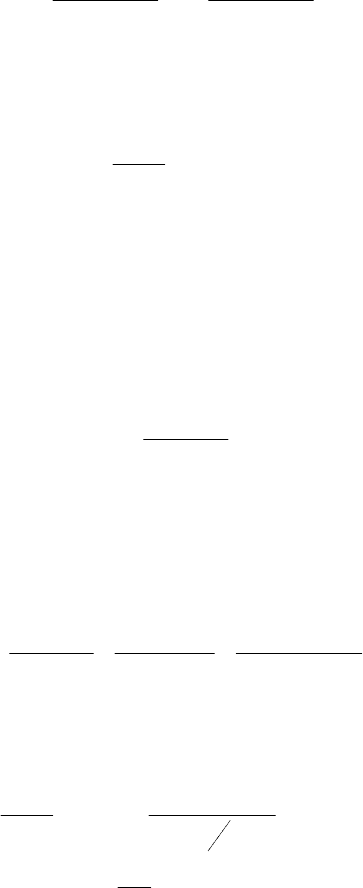
different input references and types of systems. For that the concept of type of a
system is considered and defined as the number of integrators of the open-loop
system G(s)H(s). That is, rewritting G(s)H(s) as:
(4.72)
It is said that G(s)H(s) is a N-type system. Next, let’s check the dependence of the
type of a system on the steady-state error when a particular input reference is
considered.
lim ( ) lim ( ) ( )
tt
eetrtbt
∞
→∞ →∞
==−
() () () () () ()
()
() () () ()
1()()
() ()
() ()1
1()()
1()() ()()
() ()
1()()
1
() ()
1()()
Es Rs Bs Rs HsCs
Gs
Es Rs Hs Rs
GsHs
HsGs
Es Rs
GsHs
GsHs HsGs
Es Rs
GsHs
Es Rs
GsHs
=−=−
=−
+
⎛⎞
=−
⎜⎟
+
⎝⎠
⎛⎞
+−
=
⎜⎟
+
⎝⎠
=
+
00
lim ( ) lim ( ) lim ( )
1()()
ts s
s
eetsEs Rs
GsHs
∞
→∞ → →
== =
+
1
1
(1)(1)
() ()
(1)(1)
n
N
n
Ks s
GsHs
ss s
λλ
ττ
+ ⋅⋅⋅ +
=
+ ⋅⋅⋅ +
4.6 System Stationary Response 133
4.6.1 Steady-State Error for Step Reference
Equation (4.71), considering R(s) as an input reference of amplitude A, is rewritten
as:
(4.73)
Considering , known as the position constant, the steady-state
error for step references is defined as:
(4.74)
Notice that as long as K
p
tends to infinite, the steady-state error tends to zero, and
this is only achieved when the system, G(s)H(s), is of type greater than one. That
is, from expression (4.72) it can be noted that for N
≥1, the limit will tend to
infinite.
Example 4.17
For the open-loop system
Indicate its type and its steady-state error for unitary step input.
Solution
The transfer function can be rewritten as:
It is a 0-type system and thus the error for a step input at the stationary will not be
equal to zero. That is, considering a unitary step input and equation (4.74), the
steady-state error is:
00 0
/
lim ( ) lim lim
1 () () 1 () ()
ss s
As A
esEss
GsHs GsHs
∞
→→ →
== =
++
0
lim ( ) ( )
p
s
KGsHs
→
=
1
p
A
e
K
∞
=
+
2
2
() ()
32
GsHs
ss
=
++
2
22 2/2
() ()
(1)(2)(1)(1/21)32
GsHs
ss s sss
== =
++ + +++
()
0
11
,lim 1
1
1
(1) 1
2
1
0.5
11
p
s
p
eK
K
ss
e
∞
→
∞
⎧
⎫
⎪
⎪
== =
⎨
⎬
+
++
⎪
⎪
⎩⎭
==
+

134 4 System Response Analysis
4.6.2 Steady-State Error for Ramp Reference
Similarly, when the reference signal R(s) is a ramp, equation (4.71) becomes
(4.75)
Considering , called velocity constant, the steady-state error
for ramp references is defined as:
(4.76)
Systems aimed to follow a ramp reference without error at the steady-state must
be, at least of type 2 (N
≥2), in order to make K
v
to tend to infinite, and therefore
make the error to tend to zero.
Example 4.18
Check the type of the following system and its steady-state error for step and ramp
inputs
Solution
Rewriting the transfer function we can check that it is of type 1, i.e. it has an
integrator, and thus, it will follow a step input without errors at the steady-state,
while it will not accurately respond to a ramp reference.
For a step input of amplitude A, the error will be:
2
000
/
lim ( ) lim lim
1 ()() ()() ()()
sss
As A A
esEss
GsHs s sGsHs sGsHs
∞
→→→
== = =
++
0
lim ( ) ( )
v
s
KsGsHs
→
=
v
A
e
K
∞
=
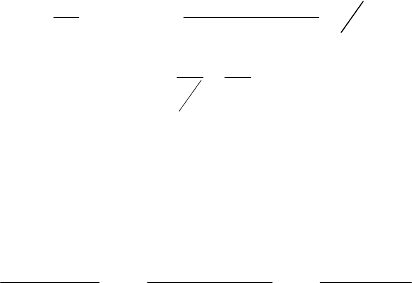
32
5
() ()
32
GsHs
sss
=
++
32
55 5/2
() ()
(1)(2) (1)(1/21)32
GsHs
ss s ss ssss
== =
++ + +++
()
0
()
5/2
,lim
1 ( 1)(1 / 2 1)
0
step p
s
p
step
A
eK
Ksss
e
∞
→
∞
⎧
⎫
== →∞
⎨
⎬
+++
⎩⎭
=
4.6
System Stationary R
e
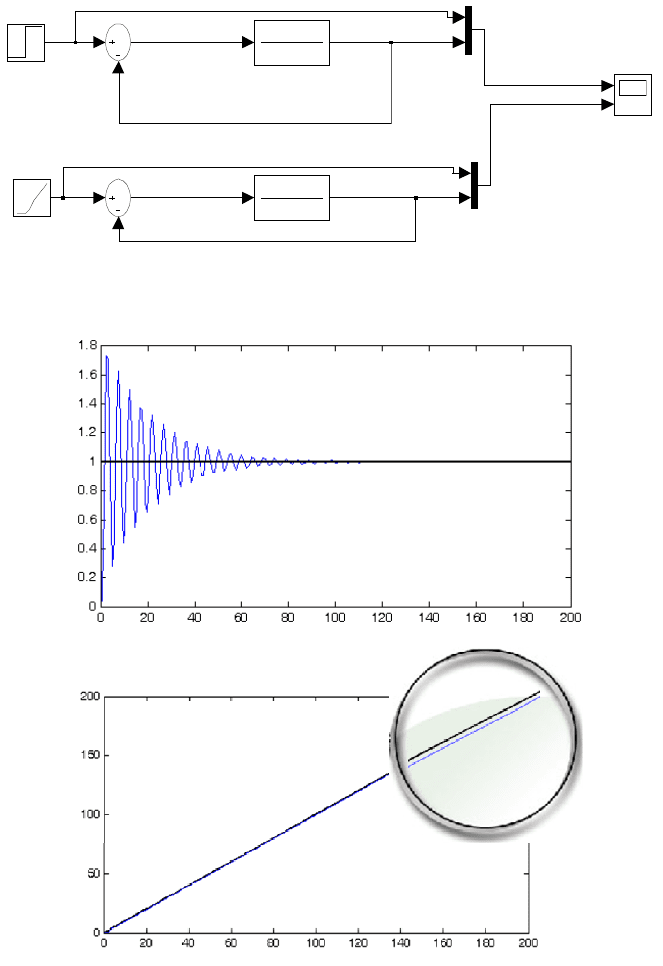
Fig. 4.35 Simulink diagram
f
Fig. 4.36 System response.
T
is of type 1, the steady-state
In this case the error at the
zoomed area.
Step
Ramp
e
sponse
1
3
f
or step and ramp inputs.
T
op) System response for unitary step signal. Given the syst
e
error is zero. Bottom) System response for unitary ramp sign
a
steady state is not zero (it is actually 0.2) as illustrated by t
h
Transfer Fcn 1
5
s +3s +2s
32
Transfer Fcn
5
s +3s +2s
32
Scop
e
3
5
e
m
a
l.
h
e
e
136 4 System Response Analysis
While for a ramp reference with slope R,
As expected the system has no errors at the steady-state for steps references but has
a certain error for ramps since it is a 1-type system (see fig. 4.36 and fig. 4.36).
The same reasoning can be done for other input references, for instance, for
parabolic references, R(s)=1/s
3
, the error will be calculated as:
(4.77)
And therefore the type of a system aimed to follow this input without error should
be of type 3 or higher.
()
0
()
5/2
5
,lim
2
(1)(1/21)
2
5
5
2
ramp v
s
v
ramp
R
eKs
Ksss
RR
e
∞
→
∞
⎧⎫
== =
⎨⎬
++
⎩⎭
==
3
22 2
000
/
lim ( ) lim lim
1()()
() () () ()
sss
As A A
esEss
GsHs
ssGsHs sGsHs
∞
→→→
== = =
+
+
Chapter 5
Introduction to Control Systems
Control systems are aimed to modify the behavior of an existing system to
perform in a desired way. Several examples can be found in the real life in which
certain control actions are needed to achieve the wanted results. For example the
temperature of a room may change due to external and unexpected perturbations,
e.g. somebody opens/closes a window, sunshine heats the walls, etc. An air-
conditioned system can be installed to help in keeping a given temperature in spite
of any external change in the system. The air-conditioned system includes
elements to modify the current temperature (also called actuators, since they act
on the system), sensors to measure the current temperature, and some control
logic to determine the actuation to be carried out in order to achieve the target
temperature. In this chapter we will introduce the basis of the control systems,
their influence on real life systems, and their design to modify the behavior of a
given plant to fulfill particular specifications.
5.1 Control Systems
Control systems have been present in the society from the ancient past in an
attempt to design and construct machinery with a particular purpose. For instance,
the first records of the oldest control system date from the III century BC, when
Ktesibios designed a water clock, knows as Clepsydra, based on a mechanism in
charge of maintaining constant the water inflow of a tank. By means of a floating
valve the water volume of an auxiliary tank is maintained invariable and thus the
inflow of water of the controlled tank constant. The water level of the latter
indicates how much time is passing.
However, the real expansion and formal study of the control systems came into
scene at the end of the XVIII century with the arrival of the Industrial Revolution.
Representative examples of this period are the self-regulating wind machine
devised by E. Lee in 1745 which was aimed to automatically control the
orientation and inclination of the windmill’s sails according to the wind direction
improving the mill performance. Another example is the steam engine centrifugal
governor envisaged by Watt in 1788 to regulate the speed of steam locomotives
(see fig. 5.1).
Nowadays, we can find control systems almost everywhere, from highly
sophisticated and complex systems to maintain the speed and course of planes, to