
Canete J.F. System Engineering and Automation: An Interactive Educational Approach
Подождите немного. Документ загружается.

158 5 Introduction to Control Systems
The value of K
cr
could have also been calculated by means of the Rooth
criterion, that tests the stability of a system according to the coefficients of the
characteristic equation.
Depicting the root locus of the system through the rltool (see fig. 5.20) we can
confirm the position of the poles when the proportional gain, called in this tool
compensator, C, is set to 10 as well as the value of
ω.
Finally, with these new values K
cr
=10 and P
cr
=0.9813, the gain values for a PID are:
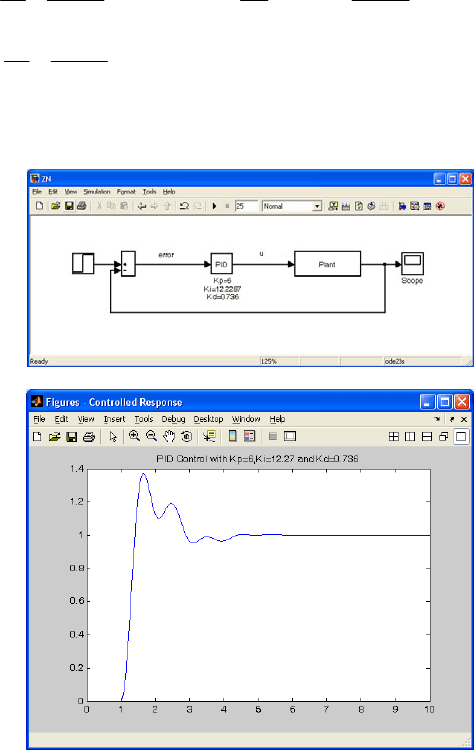
With these gains, the SIMULINK for the final controlled system is shown in
fig. 5.21 (up), and its response in fig. 5.21 (down).
Fig. 5.21 The tuned PID controller. Up) the SIMULINK diagram for the final system.
Down) the controlled system output. Note that swiftness is achieved at the expense of a
considerable overshoot.
{}
0.6 0.6 10
0.9813 6
0.4906,
2 2 0.4906
0.9813
0.1227, 6 0.1227
88
cr
p
cr
ii
i
cr
ddpd
K
K
P
TK
T
P
TKKT
==⋅=
⎧⎫
== = = ⇒ ==
⎨⎬
⎩⎭
== = = ⇒ =⋅ =
6
12.2287
0.736
p
i
d
K
K
K
5.4 Design of Controllers: Ziegler-Nichols Techniques 159
Notice that the controlled output exhibits a considerable overshoot, although its
second oscillation fulfills the 25% diminishing rule. Also note the reduced raising
time, mainly caused by the effect of the Kp and Ki gains, and also the work of the
integral component, eliminating the error at the steady state.
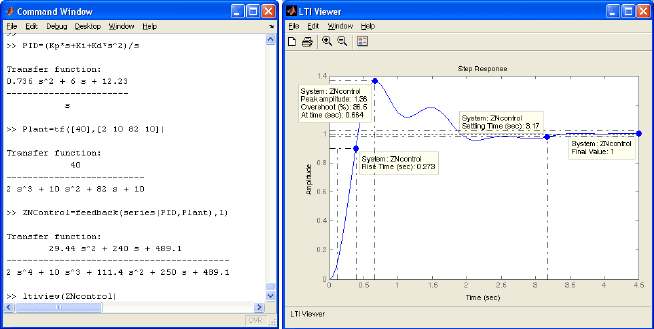
In order to evaluate the response characteristics of this output accurately, we
rely on the ltiview tool. Previously, we had to obtain the LTI object for the
controlled system since ltiview cannot deal directly with the SIMULINK diagram.
For that, we construct the transfer functions for the tuned PID and the plant, and
perform the series and feedback operations. The followed sequence of commands
and the result of the ltiview execution are shown in fig. 5.22.
From the results of the ltiview tool we derive that:
•
The system response is considerably fast with a rising time
.
•
It exhibits notable oscillations with a remarkable maximum overshoot
of .
•
The steady state is achieved shortly, with a settling time and a
null error because of the contribution of the integrative component.
Fig. 5.22 Response characteristics for the tuned PID control through ltiview. Left)
Computation of the LTI object through the transfer functions of the tuned PID, the plant,
and feedback and series operations. Right) Main window of the ltiview tool. Note how the
excessive overshoot (36.5%) is rapidly reduced giving a settling time of around 3.2
seconds.
Although this result may be valid for certain control systems, for example for
controlling a domestic water heater, it would result inadmissible for other more
critical situations requiring higher precision. Think for example that the plant
considered in this example represents the servomechanism of the steering system
of the vehicle. The reference input is given by the orientation of the steering wheel
0.273
r
t =
36.5%
3.17
s
t =
160 5 Introduction to Control Systems
and the output of the system is the orientation of the vehicle’s wheels. For instance
considering the current tuned PID for this example, when the driver turns the
steering wheel 20º, the vehicle’s wheel will achieve such a value after 0.5 seconds
approximately (the raising time from 0-100). After that the vehicle will be
oriented to ~27º and then will oscillate until the final value is the desired one. You
will agree, this situation is not funny when driving at 100 Km/h.
Being patent the weakness of the tuning provided by the Ziegler-Nichols
method, we rely now on a manual adjustment, taking into account the provided
values and the desired output. For example we will try to adjust such values to get
a quick response, minimizing oscillations.
Manual adjustment is complex since the effects of components are
interconnected and affect the output in opposite ways. We recall here the table of
the fig. 5.15 with the effects of each component of the PID over the characteristics
of the system response that reveals the cross effects of each component.
The key idea in this example is to reduce the overshoot by reducing the values
of K
p
and K
i
, which in turn will increase the rise time. One can think that
increasing K
d
sufficiently would fix the problem, but this is not the solution given
that in certain cases it produces more oscillations, although with lower amplitudes.
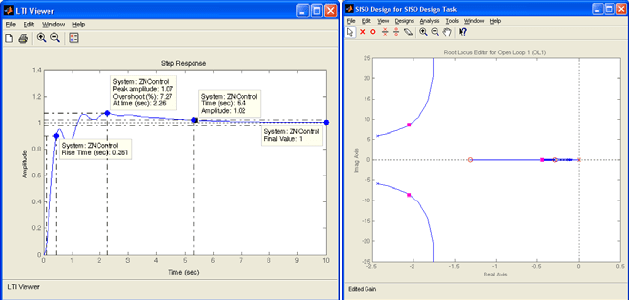
We have tried different options and one of the best is considering K
p
=5, K
i
=2 and
K
d
=1, assuring a relatively fast response with small oscillations and without error
at the steady state (see fig. 5.23).
Fig. 5.23 Results of the PID manual adjustment. Left) system response. Note that overshoot
has been considerably reduced. Right) Root locus of the controlled system. The presence of
complex poles in the close-loop contributes with oscillations in the output. The zeros added
by the PID and the proportional gain has been carefully selected to obtain a quick but not
too much oscillating response.
It is remarkable that the nature of the considered system does not allow us to
improve much more the response by only considering a PID. The plant exhibits
three poles (two of them are complex) and no zeros. The PID controller adds, as
previously commented, one integrator a two real zeros, resulting in a fourth order

5.5 Applications 161
system with two zeros. In this situation the controlled system will always exhibit
complex closed-loop poles (as shown in fig. 5.23, and thus, the output will
oscillate.
5.5 Applications
In this section we will deal with the use of rltool for adjusting a PID controller
through an illustrative example. Let’s consider a plant represented by the transfer
function:
(5.4)
For which, the following restrictions are established: a) Maximum overshoot <
5%, b) Settling time< 2 seconds, and c) null steady-state error for step inputs.
Factorizing the denominator of expression (5.2), it can be noticed that system is of
type 0, and thus, it presents a steady-error against step input. As commented, a
PID controller adds an integrator to the system, and thus, it increases the type of
the system, which would solve the requirement c).
(5.5)
A PID controller also adds two zeroes to the open-loop system whose location will
affect, primarily, the transient response of the controlled system. Thus, in order to
fulfill the proposed constrictions, we can proceed by placing two zeroes within the
root locus provided by rltool, adjusting their position until the constrictions are
met.
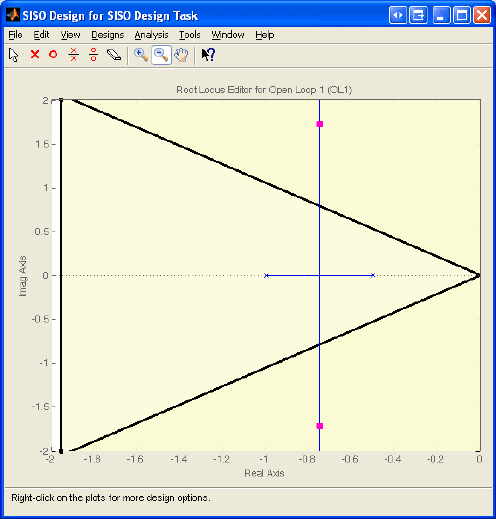
Fig. 5.24 shows the root locus of the original system, where the correspondent
constraints have been considered. The yellow area of the s-plane indicates the
incorrect position of the poles in close-loop for achieving the restrictions of
maximum overshoot and established settling time. To fulfill such restrictions we
should be able to move the poles of the system out of the yellow area, which is
impossible for the current system.
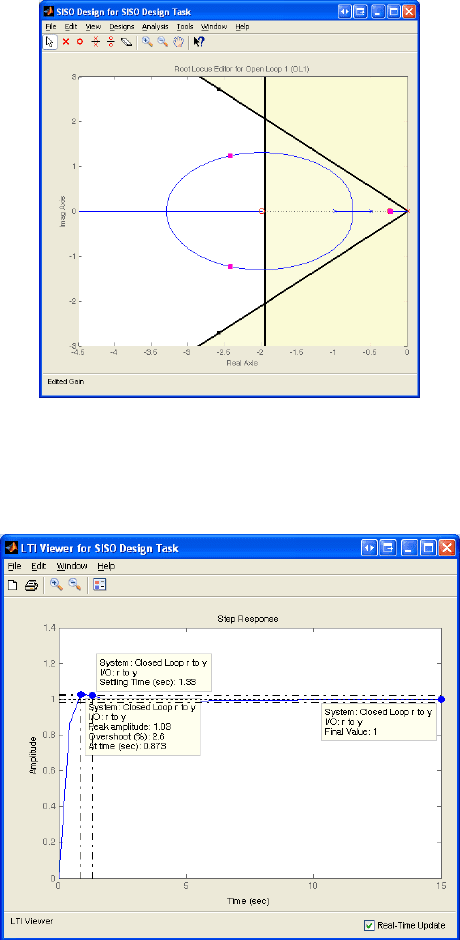
When adding an integrator, i.e. a pole at s=0, the root locus changes notably, as
shown in fig. 5.25. Now there is a segment that starts at the pole at s=-1 and runs
tending to -∞ over the real axis. Thus there will be a value for the compensator K
that moves out this pole from the yellow area, but not the others. Moreover, the
root locus is bended to the right, making the system unstable for certain values of
the compensator. Concretely this system is unstable for K ∈[0.25,∞).
2
6
()
231
Gs
ss
=
++
6
()
(2 1)( 1)
Gs
ss
=
++
162 5 Introduction to Control Systems
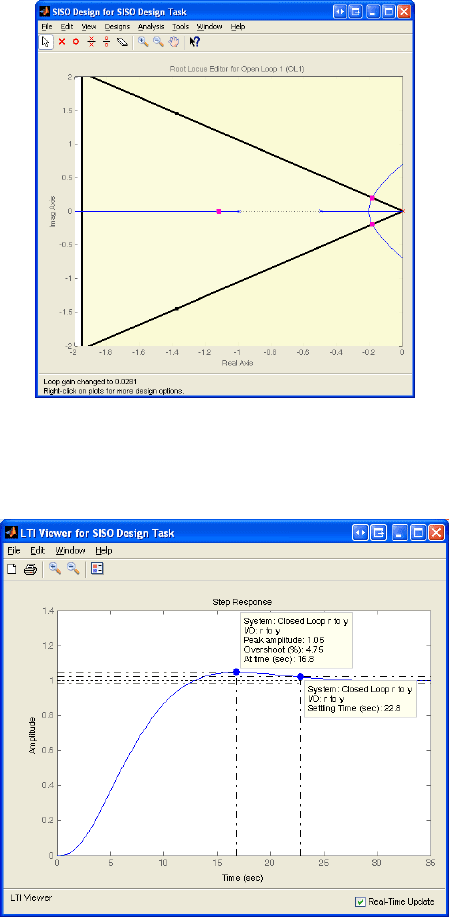
Fig. 5.26 depicts the step response for the system for the marked position of
poles in the close-loop. Note that the settling time restriction is far from being met
and that, it is not fulfilled regardless of the value of the compensator.
Fig. 5.24 Root locus for the second-order system considered in the example. Note that in
this configuration poles will be always located within the yellow area, and thus the two
restrictions cannot be simultaneously met (the restriction a), i.e maximum overshoot <5%,
is satisfied for K∈[0,0.227].
To fully design a PID controller, there remains the addition of two zeroes to the
system. There is no a unique solution and it depends on the ability and expertise of
the designer. In this case we have placed one zero at s=-0.2, relatively close to the
integrator. Thus the segment of that starts as the integrator goes over the real axis
until it reaches the added zero. The other zero has been placed at s=-2, modifying the
aspect of the root locus as shown in fig. 5.27. Notice that in this last configuration all
the root locus runs on the left part of the s-plane, and thus, the system will be stable
regardless of the value of the compensator K. Also note that two out of the three
poles can be moved out to the white area which represents the allowed zone where
the poles of the system must be able to fulfill the two imposed restrictions. It is
important to highlight that the zones displayed by rltool cannot be directly
applicable, since they are defined in terms of second-order systems. In our case as
5.5 Applications 163
Fig. 5.25 Root locus after adding an integrator. The addition of a pole makes the system
more unstable. In this configuration there are values of the compensator that moves some
poles to the right part of the s-plane.
Fig. 5.26 System response. Although the maximum overshoot restriction is achieved, the
settling time is far from the desired 2 seconds. In this configuration increasing the
compensator K will make the system unstable.
164 5 Introduction to Control Systems
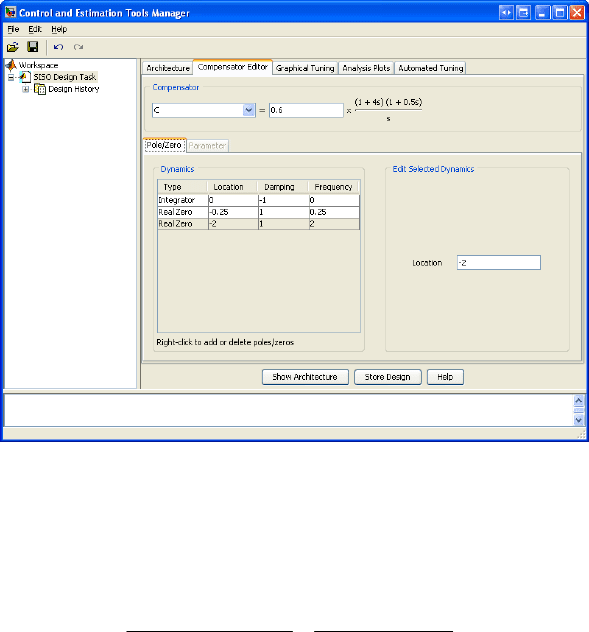
Fig. 5.27 Root locus after adding the integrator and two zeroes. Note that the addition of
zeroes makes the system to gain in stability. Close-loop poles are shown for K=0.6. Notice
that, for this value of the compensator, the integrator has been cancelled with the added
zero at s=-0.2.
Fig. 5.28 Controlled response. The three constraints have been achieved: overshoot < 5%
(2.6%), settling time < 2 seconds (1.33 seconds) and no steady-state error against unitary
step (final value is 1).
5.5 Applications 165
long as the compensator increases, the segment that started at the integrator
rapidly approach the added zero at s=-0.2. When this occurs, it is said that the pole
(integrator) and the zero are canceled, and the system can be approximated to a
second order system, being the constraint areas displayed in that case
representative of the constraints to be checked.
Fig. 5.28 illustrates the response of the controlled system for K=0.6. Settling
time has been reduced to 1.33 seconds and the maximum overshoot to 2.6%.
Once the requirements have been fulfilled, the transfer function of the designed
controller is shown by rltool (see fig. 5.29).
Fig. 5.29 Designed controller. Rltool constructs the transfer function of the additional poles
and zeroes included in the root locus.
For this example, the designed controller can be represented by a transfer
function with an integrator, two zeroes and a certain gain, i.e. it is a PID
controller, given by
(5.6)
Identifying expression (5.6) with respect to the transfer function of a PID
controller given in (5.3), we have to obtain the particular values for the parameters
Kp, Kd, and Ki of the obtained controller, being:
2
0.6(14)(10.5) 1.2 2.7 0.6
()
ssss
Gs
ss
⋅+ + + +
==
2.7
1.2
0.6
p
d
i
K
K
K
=
=
=

Chapter 6
System SimulationSystem
In the preceding chapters, we addressed the problem of solving the dynamical
equations in the form of differential equations that describe the linear system
behavior. However, most of the relationships that define a dynamic system are
nonlinear, and moreover, the most of the linear systems treated are a particular
case of non-linear systems in limited ranges of operation.
The solution of the nonlinear system cannot be generalized, that is, the
conclusions drawn are only valid for the initial conditions and parameters for
which they have been determined, and besides cannot in general, be solved
analytically, computer simulation usually being the technique employed to get the
solution numerically.
A number of useful numerical integration methods of ordinary differential
equations will be explained and applied to more realistic and complex nonlinear
processes with large numbers of dynamic equations. We will deal only with
lumped system, since the treatment of partial differential equations would require
more space than is available in this book.
Some examples have been included to help the reader to clarify the methodology
used to solve numerically the dynamical equations, which have been also simulated
by using both the SIMULINK and SIMSCAPE modeling environments, which
make it easier for the reader to understand the development and solution of these
examples.
6.1 Simulation Objectives
The simulation technique includes an extensive collection of methods and
applications aimed at reproducing the actual behavior of nonlinear systems on a
digital computer with appropriate simulation software.
The computer simulation is applied to a dynamic model previously obtained by
using the modeling techniques described previously. Starting from it, is derived a
computer model in order to run experiments to improve understanding of system
behavior under a set of changing conditions.