
Canete J.F. System Engineering and Automation: An Interactive Educational Approach
Подождите немного. Документ загружается.


178 6 System Simulation
Libraries which are accessed in the main SIMULINK window (fig. 6.5). Block
parameters can be defined from the MATLAB workspace.
The process of numerically integrating of the dynamics equations is essential
for the simulation task, and hence the integrator blocks form the core of the
simulation diagram.
The construction of the block diagram starts with the assembly of lines of
integrators for each of the state variables, gathering the adequate elements from
the Block Libraries to build its derivative functions associated. The initial
conditions for the state variables will be set within the integrators, and the outputs
of the integrators are the state variables themselves.
In this way, for a nonlinear dynamic system as defined by (6.1) in general, by
integrating both sides we obtain
,
(6.8)
expression which represents the lines of integrators for , whose particular
form depends on
,
specifically.
Once the simulation is performed, the output signals (states) can be displayed
graphically, and simulation run-time control window enables the selection of the
integration method along with the solver parameters (initial time, final time, step
size, error tolerance,...).
Example 6.2
Derive the block diagram for the dynamic system represented by
with initial conditions
0
and
0
. Run the simulation for
1.5, 2,
1 and
0, for 010 by using the ‘ode45‘ solver,
and display the output response to a square input ) with unitary amplitude
and frequency of 1 Hz.
Solution
Transforming this equation into state space, by defining
and
we
have
6.3 Systems Simulation in SIMULINK 179
These two equations define the line of integrators essential to build the
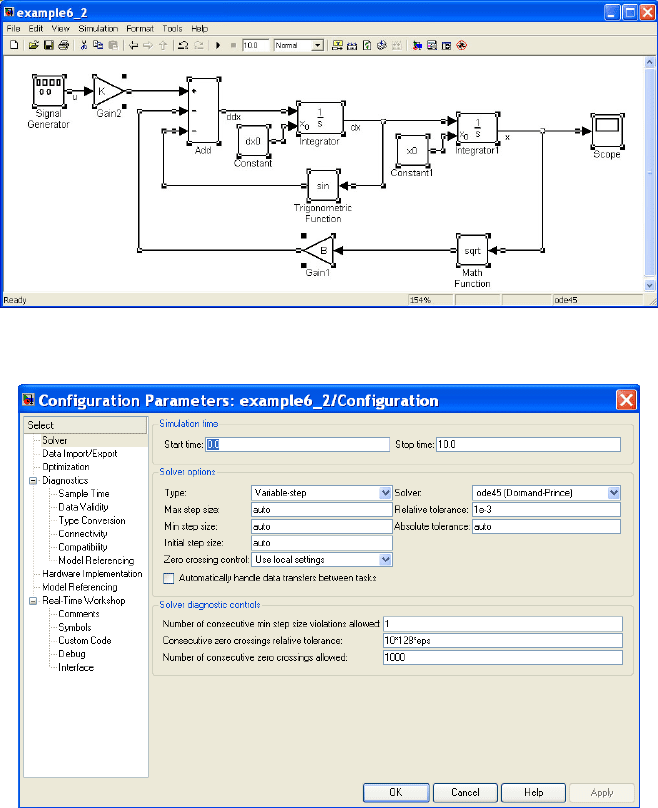
SIMULINK model, which form the core of the block diagram. We show in fig. 6.6
the complete simulation block diagram in SIMULINK for this system and fig. 6.7
displays the simulation run-time control window, showing information about
initial and final time, integration algorithm, minimum and maximum step size, and
error tolerance.
Fig. 6.6 SIMULINK diagram corresponding to example 6.2.
Fig. 6.7 Run-time control settings corresponding to example 6.2.
180 6 System Simulation
The parameters and together with the initial conditions have been set
within the MATLAB workspace
>> x0=1;dx0=0;
>> K=1.5;B=2;
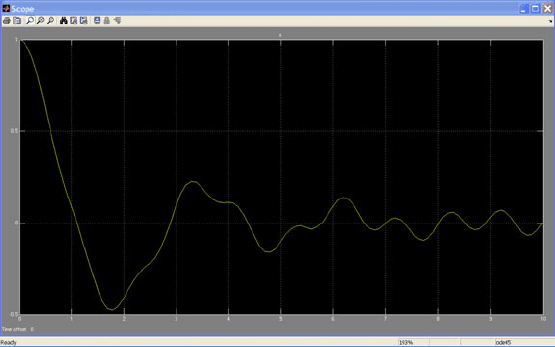
In fig. 6.8 it is depicted the system response to a square input signal.
Fig. 6.8 Output response in SIMULINK for example 6.2.
6.4 Systems Simulation in SIMSCAPE
SIMSCAPE is an acausal approach for modeling dynamic systems by using
connected physical components in which equations are defined, following a
specific connection diagram. This acausal methodology differs from the causal
one used in SIMULINK, where the interconnection of blocks reflects rather the
calculation procedure than the very structure of the modeled system.
These physical components can be connected through exactly defined
interfaces (connectors) in which variables used for connection are defined, so that
only connectors falling in the same connector classes can be connected.
SIMSCAPE is a multi-domain simulation environment that can also be linked
to specific domain libraries such as SIMPOWERSYSTEMS, SIMMECHANICS,
and SIMHYDRAULICS among others, all of them running under MATLAB.
6.4 Systems Simulation in SIMSCAPE 181
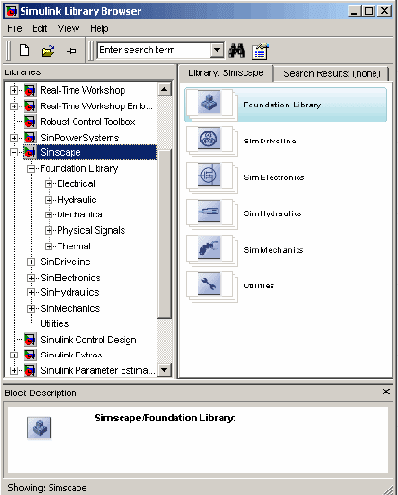
Fig. 6.9 The Physical Library browser of the SIMSCAPE program.
In SIMSCAPE, a model is a collection of physical blocks which must be
appropriately connected to define the dynamic system. Physical blocks can be of
very distinct nature, ranging from electric, mechanical, hydraulic and thermal, and
its constitutive parameters can be modified easily by double-clicking on them.
Lines are used to transfer physical signals from one block to another, in contrast
with SIMULINK. These physical blocks are arranged in Physical Libraries which
are accessed in the main SIMSCAPE window (fig. 6.9), and physical block
parameters can be defined from also the MATLAB workspace.
The construction of the physical block diagram starts with the assembly of each
one of the physical components which define the system model, gathering the
adequate components from the Physical Block Libraries.
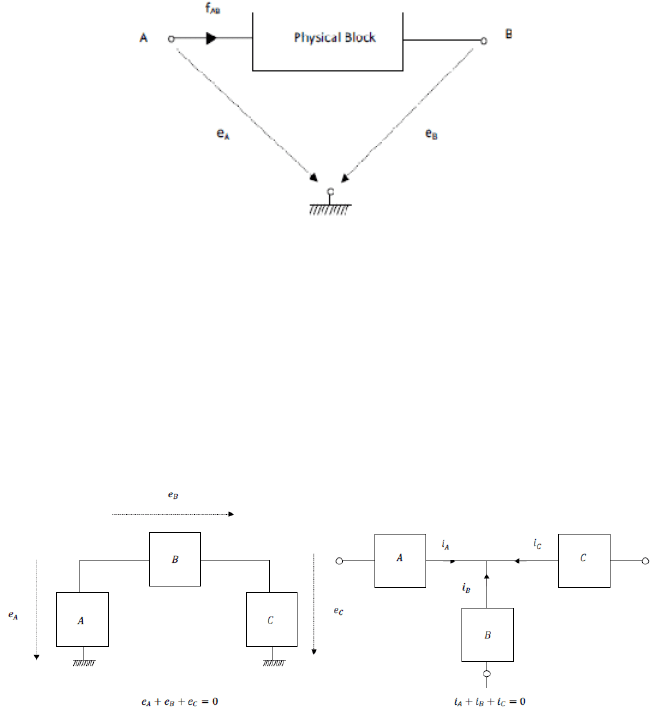
The Physical Network approach supports two types of variables (fig. 6.10),
effort variables (e
,e
) that are measured with a sensor connected in parallel to a
component with respect to a reference, and flow variables (
) that are measured
with a sensor connected in series to a component.
182 6 System Simulation
Fig. 6.10 The effort and flow variables for each SIMSCAPE component
There are different ports associated to the SIMSCAPE blocks, namely,
conserving ports ( and signal ports , different form the SIMULINK
standard ports (.
The conserving ports represent physical connections and relate physical variables
among physical blocks, and connection lines that connect these ports together are
bidirectional lines that carry effort, and flow variables rather than signals. The sum
of effort variables in a closed loop is null, while the sum of flow variables flowing
into a branch point, equals the sum of all its values flowing out (fig. 6.11).
Fig. 6.11 Conservation laws for physical block diagrams in SIMSCAPE
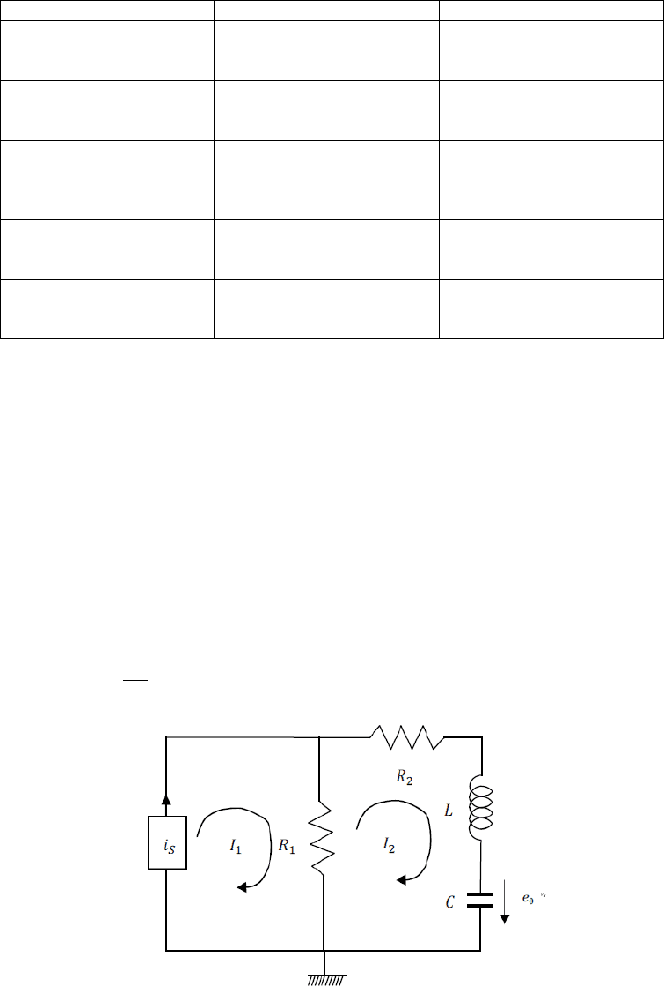
There are several types of conserving ports in SIMSCAPE each one with effort
and flow associated variables, which are listed in table 6.4.
The signal ports transmit signals between blocks with units associated with
them, usually specified along with the parameter values in the block, unlike
SIMULINK signals, which are dimensionless. Associated with these types of ports
are the sensor and actuator blocks. SIMSCAPE is equipped with a Physical Signal
Library which enables to implement linear and nonlinear operators, functions,
lookup tables, etc. In case a relationship is not available in SIMSCAPE to
implement a determined component.
In order to manage the signal inputs and outputs to and from the physical block
diagram, it is necessary to use converter blocks to connect SIMSCAPE diagrams
to SIMULINK sources and scopes. The SIMULINK-PS Converter block connect
6.4 Systems Simulation in SIMSCAPE 183
Table 6.4 List of physical conserving ports in SIMSCAPE
Physical Port Type Effort Variable Flow Variable
Electrical
Voltage
Current
Mechanical Translational
Velocity
Force
Mechanical
Rotational
Angular Velocity
Torque
Hydraulic
Pressure
Flow Rate
Thermal
Temperature
Heat Flow
SIMULINK sources or other blocks to the inputs of a SIMSCAPE diagram, and
conversely, the PS-SIMULINK Converter block connect outputs of a SIMSCAPE
diagram to SIMULINK scopes or other blocks.
Finally, it must be emphasized that ‘ode15s’ is one of the numerical integration
methods allowed by SIMSCAPE to run the model, so that a “Solver Configuration
block” must be connected to the diagram by creating a branching point at any
physical connection.
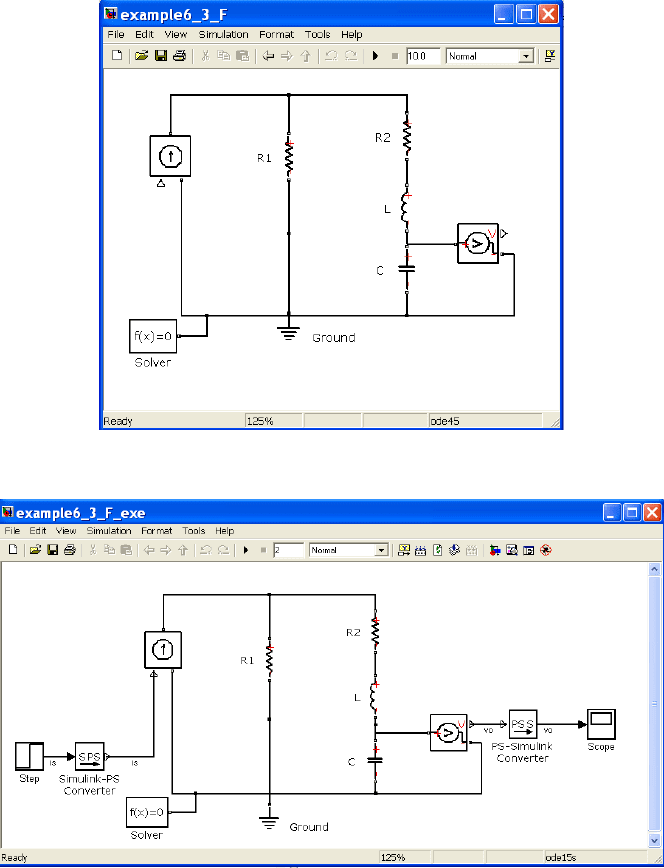
Example 6.3
Derive the SIMSCAPE physical diagram for the electric circuit shown in
(fig. 6.12), and plot the time response v
t
to input signal i
t
0.5u
t for
values of R1 = 0.2, R2 = 1, C = 0.01 and L = 0.1, starting from initial conditions
v
0
0 and
0
0.
Fig. 6.12 Diagram of components for the electric circuit of example 6.3.
184 6 System Simulation
Solution
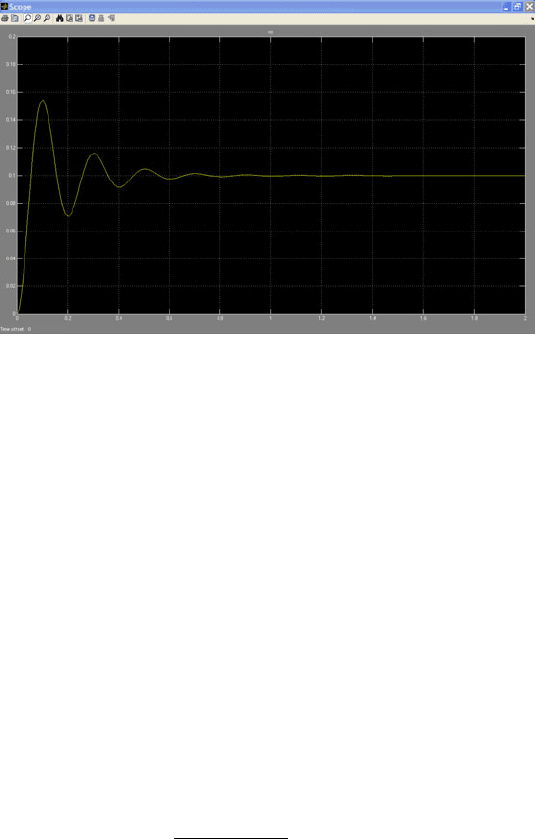
In first place we gather the electric components necessary to build the circuit,
including both the current source, voltage meter and the solver configuration block
(see fig. 6.13)
Fig. 6.13 SIMSCAPE diagram corresponding to example 6.3
Fig. 6.14 SIMSCAPE diagram corresponding to example 6.3 including input-output signals.
6.5 Applications 185
Adding the step input for the source current i
t
through the converter SPS
and measuring capacitor voltage v
t through a voltmeter to a scope by using the
PSS converter, is completed in the SIMSCAPE block diagram (fig. 6.14).
In fig. 6.15 the step response for the particular value of parameters
>> R1=0.2; R2=1; C=0.01; L=0.1 is shown;
Fig. 6.15 Output response for the SIMSCAPE model of example 6.3
6.5 Applications
In this section we are going to describe more comprehensive applications of
SIMULINK and SIMSCAPE simulation environments.
Example 6.4
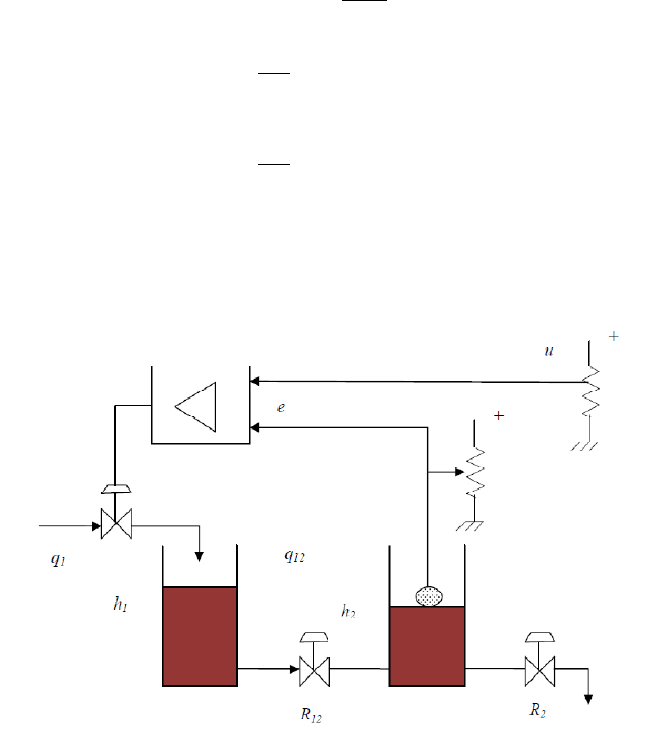
The system of fig. 6.16 represents a height controller system for two tanks. The
dynamic equations of the system include the nonlinear effects of the inlet flow
and the unidirectional flow between tanks
The system equations are given as follows:
,
0
0 0
0
186 6 System Simulation
·
·
being
,
,
,
,
the tank-1 height , tank-2 height, input flow to tank 1,
flow from tank-1 to tank-2, and output flow from tank-2, and
,
,
,
the
hydraulic resistances and capacitances, together
,
amplifier gains and
a
limiting value for
.
Fig. 6.16 Height control system for a two tank system.
Simulate the dynamic behavior in SIMULINK for a reference input pulse of
height 2 m and period 20 s (50% OFF 50% ON) for values of
1,
5,
4,
4,
0.8,
0.2,
5, plotting the evolution of
,
,
, by designing a block "subsystem" for each tank.
Solution
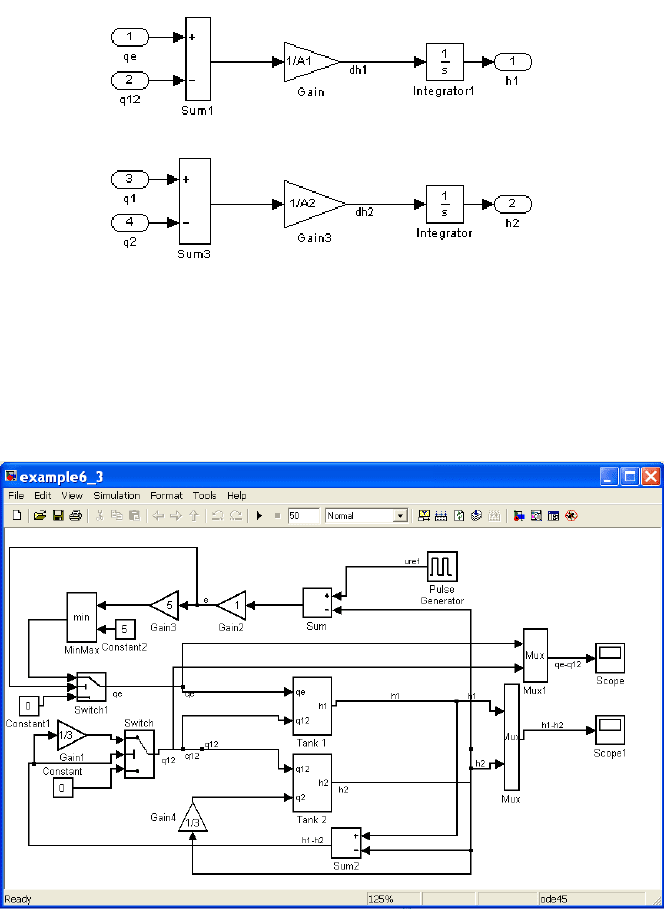
In first place we build the line of integrators for this system (fig. 6.17)
6.5 Applications 187
Fig. 6.17 Lines of integrators for the two tank system (encoded as ‘subsytems‘)
Then, we implement the state equations by using the appropriate blocks from
the Block Libraries, embedding the loading tank dynamics into ‘subsystems’ as
indicated above, resulting in the block diagram of (fig. 6.18).
Fig. 6.18 SIMULINK diagram corresponding to example 6.4.
The system achieves the control objective at tank-2 when a pulse height input is
applied (fig. 6.19), while maintaining the flowrate limitation conditions (fig. 6.20).