
Carson Ph., Mumford C. Hazardous Chemicals Handbook (Справочник по опасным химическим веществам)
Подождите немного. Документ загружается.


• Entry of dangerous substances into harbours.
• Marking and navigation.
• Handling of dangerous substances.
• Liquid dangerous substances.
• Packaging and labelling.
• Emergency arrangements and untoward incidents.
• Storage of dangerous substances.
• Explosives.
• Ship/shore checklist.
Information on dangerous chemicals entering harbour areas from sea should be provided to the
harbour master by the ship’s master. Notification should also include the ship’s name, call sign,
Table 15.13 Guidance relating to dangerous goods in cargo transport units (CTU) for transport by sea
Packer Driver
Do Check individual packages for damage, Check that goods and quantities are on
leaks, etc. dangerous goods declaration
Check packages show: Obtain from packer the container
• proper shipping name; packing certificate/vehicle declaration
• UN number; Obtain and carry transport documentation
• class label; including TREMCARD, etc.
• subsidiary risk label (where relevant); Check that any freight container has
• marine pollutant mark (where relevant); valid safety approval plate
• UN type approval mark Visually check the outside of the CTU for
Confirm nature of hazards from labels damage, etc.
Visual check on condition of CTU Ensure CTU doors are properly secured
before loading Learn emergency procedures
Check validity of safety approval plate of Ensure availability of appropriate personal
freight container protective equipment as advised in transport
Removal of irrelevant placards documentation, and suitable fire extinguisher
Follow loading plan when packing CTU Check sides and ends of CTU are placarded
Secure and brace packages inside CTU appropriately
Securely close and seal CTU when loading is Ensure irrelevant hazard data are removed
complete Ensure controls against fire and explosion
Ensure container packing certificate/vehicle are taken during the journey
declaration signed and forwarded to When parking vehicle avoid creating risk
ship operator or master to local people
Ensure placards are present on sides
and ends of CTU
Ensure written information on potential
hazards is passed from shipper to haulier
Do not Handle damaged, leaking or stained packages Accept load or start journey without
Load a freight container without valid safety relevant hazard information from shipper
approval plate Accept freight container without valid safety
Load packages of dangerous goods which approval plate
are improperly labelled and marked Allow CTU to travel with irrelevant hazard
Load packages into a dirty, wet or damaged CTU placards, marks or signs or if lacking in
Place packages in a CTU with incorrect placards information
still visible Allow placards to become obscured or damaged
Attempt to load packages without loading plan Have irrelevant hazard warning information
to ensure segregation of incompatibles in the cab
Leave cargo in an insecure CTU Start journey without checking availability of
Exceed the maximum gross mass of the CTU safety equipment in suitable condition for use
Smoke or use other means of ignition
Carry unauthorized passengers
SEA TRANSPORT 479

480 TRANSPORT OF CHEMICALS
nationality, overall length, draught and beam, intended destination within the harbour, and estimated
time of arrival. In addition, for marine tankers of 1600 tonnes gross, or carrying certain chemicals
and gases or oil in bulk, the following information should be provided:
• nature and quantity of chemicals, gas or oil carried by the vessel;
• whether tanker is fitted with operational inert gas system;
• whether atmosphere of cargo tanks has been rendered non-flammable;
• information about tanker certificates;
• defects to hull, machinery or equipment which may affect safe manoeuvrability of ship, affect
safety of other vessels, constitute a marine environment hazard;
• whether there is a hazard to property or people near to the harbour.
Controls for the safe transfer of chemicals between ship and shore will vary in detail. The escape
of dust and vapour should be minimized when loading and unloading of bulk liquids or solids and
persons should not be at risk. Precautions to avoid contact with water are needed when transferring
water-incompatible materials (page 229). Precautions for handling explosives include:
• packages should be kept from berth until vessel/vehicle is ready to receive them;
• where necessary restrict the handling to a no-smoking secure area;
• warning signs should be displayed during the handling process;
• vehicle interiors should be clean;
• metal-free shoes should be used;
• radio transmitters should be banned within 50 metres during the transfer, except for low-power
(25 watt) radios in mobile equipment such as cranes with aerials outside 2 metres of the
explosives.
Table 15.15 summarizes the precautions to be followed by the berth operator for the transfer of
dangerous bulk liquids.
Table 15.14 Checklist of responsibilities for sea transportation of chemicals
Action Person responsible
Dangerous chemical properly packaged and labelled Manufacturer/supplier/shipper
Training and supervision of those packing Packer
Health and safety of packers Packer
Construction, maintenance and plating of Owner or lessee of container or others who use
freight container or permit use, e.g. packer, haulier
Visual inspection of container and packages Packer
Container and vehicle loading – all packages securely stowed Packer
and braced
Provision of signed container/packing certificate – vehicle Packer
declaration
Placarding of cargo transport unit Packer or shipper
Placarding of vehicle Haulier
Provision of signed dangerous goods declaration Shipper
Information of hazards to haulier Shipper
Advanced notification to port Haulier
Safety during transfer of dangerous goods by road Haulier/driver

Modes of transport for liquids, gases and solids
Liquids
Liquids may be transported in numerous ways depending upon the quantity and distance involved.
The associated hazards are chemical-specific and also depend upon the physical condition, i.e.:
• liquid at atmospheric pressure and ambient temperature;
• liquefied gas under pressure and at ambient temperature; or
• liquefied gas at atmospheric pressure and at low temperature (i.e. fully-refrigerated transport).
Flammable liquid which spreads can result, on ignition, in a running liquid fire. If spilled onto
Table 15.15 General precautions to be followed for the transfer of dangerous liquids in bulk*
• Pipelines/hoses should be properly designed, of adequate strength and of good construction, from sound and suitable
material, properly maintained, appropriately protected against impact and used only for intended materials.
• Area in vicinity of pipeline berth should be adequately ventilated.
• Do not exceed safe working pressure; consider need for safety relief devices.
• Pipelines for flammable liquids/gases to be protected against arcing during connection and disconnection, e.g. hose
strings and metal arms fitted with insulating flange or a single length of non-conducting hose to ensure discontinuity
between vessel and shore. Seaward pipework should be electrically continuous to vessel, and landward piping electrically
continuous to the jetty earthing system.
• Insulating flanges or single length non-conducting hose should not be short circuited with external metal.
• Insulating flanges to be inspected and tested at intervals not exceeding one month to ensure the insulation is clean and
in good condition. Resistance should be measured between the metal pipe on shore side of flange and the end of the hose
or metal arm when freely suspended. The measured value should be at least 1000 ohms.
• Cargo hoses with internal bonding between end flanges to be checked for electrical continuity before introduction into
service and periodically thereafter.
• Berth operator should possess a supplier’s certificate for any hose forming part of the pipeline confirming that tests have
shown it is unlikely to burst in service.
• Hoses to be indelibly marked to indicate the substances for which it is intended, its safe working pressure, proof-test
pressure, date tested, and maximum or minimum service temperature.
• Before first use hoses to be inspected visually internally and externally and tested at proof pressure. Repeat at least
annually and include check on electrical resistance. The resistance of the complete assembly should be not more than
15 ohms, unless the hose is intended to be non-conducting when resistance should be at least 25 000 ohms. Inspect hose
daily when in use. Hoses used at monobuoys should also be hydraulically tested.
• When rigged for use hoses should be under supervision.
• After use drain before disconnection.
• Close each end of hose until reconnected unless made safe by draining and purging.
• Check any cargo handling controls, emergency shutdown and alarms are working before commencing transfer.
• Prior to the transfer the berth operator and master should agree maximum loading or unloading rate. Berth operator to
check periodically these are not exceeded.
• Communication should be established and maintained between people on the ship, the berth and at the storage installation
during loading/unloading.
• Berth operator to take reasonably practicable steps to control flammable or toxic gas escapes (e.g. hose support, flange
couplings liquid- or gas-tight, drip trays).
• Unloading or loading liquefied gas escapes should be limited to those vented via safety devices or authorized by the
harbour master. Rate of transfer should ensure pipelines cool gradually; lines should be vented safely at the end of the
transfer.
• Berth operator should ensure the unloading or loading of ship’s stores does not endanger the transfer of dangerous
chemicals or ballast water contaminated with dangerous substances, gas freeing, or tank cleaning.
• At the completion of the transfer of dangerous liquids the berth operator should render pipework, valves and associated
equipment safe; valves and tanks should be closed and shore pipeline blanked off.
* The full SI 1987 No. 37 and Approved Code of Practice should be consulted for complete details.
MODES OF TRANSPORT FOR LIQUIDS, GASES AND SOLIDS 481

482 TRANSPORT OF CHEMICALS
water spreading will be more extensive, and vaporization will be more rapid, because of the
increased rate of heat transfer. Unstable chemicals may pose an explosion risk. Toxic chemicals
may be released as a liquid which spreads or as a vapour cloud. The risk of environmental damage
is likely to be potentially serious in most cases.
The common means for transport are:
• In bottles, plastic drums, steel or resin-lined drums (e.g. of 210 litre capacity).
• Glass bottles which are used only for small quantities, e.g. 2.5 litres, but should be protected
in specially designed carriers.
• Plastic drums, which must not be subjected to excessive loading and, if returnable, require
checking for degradation, e.g. due to cracking, impact, distortion.
• By road or rail tanker.
• By ship, e.g. crude petroleum.
• By pipeline, e.g. LPG.
Accidents may be caused by impact, failure of container or pipeline, or during loading/unloading.
The hazards arise from:
• Fire and/or explosion.
• Toxic release:
– of a conventional type; or
– of an ultratoxic; either instantaneous or prolonged.
• Environmental pollution.
These mirror those at fixed installations, but loss of containment due to the triggering event can
occur anywhere en route. Thus accidents may occur in populated or environmentally sensitive
locations, or where domino effects are less easily controlled. Common risks are also associated
with all vehicular movements and mechanical/manual loading/unloading activities.
Problems may arise with switch-loading of road tankers, ships or pipelines and with the use of
returnable containers. The important considerations for safety are:
• Compatibility of the chemical with the materials of construction.
• Adequacy of cleaning out, and removal of residues from, the previous chemical carried to
avoid cross-contamination and potential reactive hazards on refilling.
• A sound information transfer system to avoid confusion of chemical identities and to ensure
the specific risks of each load are identified and made known to the carrier/transporter.
• Adequacy of decontamination of ‘empty’ containers, tankers, etc. before return.
Gases
Gases are transported:
• Under pressure in cylinders or pressurized tanks subject to the Pressure Systems Safety Regulations
2000.
• By pipeline.
In general, loss of containment is more serious than with the majority of liquids (unless they are
in a superheated state) since atmospheric dispersion will be immediate.
Release of a flammable gas or vapour may result in a jet or flash fire or any type of vapour

cloud explosion (p. 178). In fire conditions there can be a BLEVE hazard from containers of
liquefied gas. Release of a toxic gas or vapour always poses a potential risk of personal injury and
possibly of environmental damage.
Whilst they will differ depending upon gas properties, the procedures and precautions appropriate
for transport of cylinder gases are exemplified for LPG in Table 15.16.
Table 15.16 Procedures for safe transport of LPG cylinders by road
Transport
• Carry cylinders on open vehicles. Keep cylinders upright and adequately secured, e.g. with a rope.
• Keep a fire extinguisher, e.g. 1 kg dry power, in the cab to deal with any small fire, e.g. an engine fire.
• Do not leave cylinders on vehicles unsupervised.
• Ensure that the driver has received adequate training and instructions about the hazards of LPG, emergency procedures,
driver duties, etc.
• Ensure that relevant information is readily available on the vehicle, e.g. on a clipboard in the cab. This written information,
e.g. as a TREMCARD, should contain details of the nature of the load and the action to take in an emergency.
Duties of vehicle operator
• Check whether the Road Traffic (Carriage of Dangerous Packages, etc.) Regulations 1986 apply. Exceptions apply to
cylinders <5 litres; cylinders which are part of equipment carried on the vehicles, e.g. burning gear, bitumen boilers;
cylinders associated with vehicle operation, e.g. cooking, water heating.
• Ensure the vehicle is suitable, normally an open vehicle. Use of a closed vehicle should be restricted to a small number
of cylinders with a load compartment having adequate ventilation.
• Ensure the driver has adequate information in writing, e.g. a TREMCARD.
• Ensure the driver is provided with adequate instruction and training and keeps necessary records.
• Ensure loading, stowage, unloading are performed safely. All cylinders should be packed, strapped, supported in frames,
or loaded to avoid damage resulting from relative movement. Cylinders should be stowed with valves uppermost.
• Ensure all precautions are taken to prevent fire or explosion.
• Ensure suitable fire extinguishers are provided.
• Ensure the vehicle displays two orange plates if 500 kg of LPG is carried.
• Report any fire, uncontrolled release or escape of the LPG, to the appropriate authority.
Duties of the driver
• Ensure the relevant written information from the operator is always available during carriage. Destroy, remove or lock-
away information about previous loads.
• Ensure loading, stowage and unloading are performed safely.
• Ensure all precautions against fire or explosion are taken during carriage.
• Display orange plates (when required) and keep them clean and free from obstruction.
• If >3 tonnes of LPG is carried, when the vehicle is not being driven, ensure parking is in a safe place or that it is supervised
(by the driver or a competent person aged >18).
• On request provide appropriate information to persons authorized to inspect the vehicle and load.
• Report any fire, uncontrolled release or escape of LPG, to the operator.
The integrity of pipelines depends upon correct design, including materials selection, support
and protection from mechanical damage. Depending upon the gas, routine inspection and maintenance
may be supplemented by the provision of gas detection and alarm systems. Other considerations
are exemplified by the safety-related controls on the transportation of domestic gas via pipeline
systems summarized in Table 15.17.
Solids
A wide variety of containers of differing capacity and design are used for solids transport, i.e.
fibreboard, metal, resin-lined metal, plastic drums; plastic, paper or hessian sacks; tote bins; bulk
tanker; lorry-load. The material may then be stored in the containers as received, in hoppers or
silos, or simply in piles depending upon its properties and value.
MODES OF TRANSPORT FOR LIQUIDS, GASES AND SOLIDS 483

484 TRANSPORT OF CHEMICALS
Bulk transport is often favoured since it reduces the requirement for manual handling and
facilitates enclosed transfer into storage, thus reducing risks at the customer’s factory. Stock
inventories may, however, be increased.
Special considerations arise in the transport of:
• unstable chemicals (p. 235)
• chemicals prone to self-heating (p. 214). These may involve:
– breakdown of stock into numerous smaller units;
– blanketing of the material (e.g. to prevent ingress of air to oxidizable material or complete
quenching, e.g. with water);
– regular temperature measurements;
• reactive chemicals (p. 228). Segregation from incompatible chemicals is essential (p. 233)
• chemicals prone to generate combustible dust clouds (p. 220).
Loading and unloading
Tankers
Accidents during the loading/unloading of chemicals into/from road tankers, railway tankers,
ships and barges may involve discharge of the wrong chemical, vehicle movement during transfer,
failure of, or damage to, flexible transfer hoses, disconnection of transfer hoses whilst still under
pressure, and overfilling. Loading/unloading should be in designated areas positioned at an appropriate
distance from public roads, occupied buildings and – if relevant – possible ignition sources. A
good level of ventilation should be ensured together with spillage control facilities. These should
be backed up by standard operating procedures.
A basic safety audit covering design and system of work features to be covered for the loading/
unloading of non-pressurized hazardous liquids to/from tankers of tank containers is given in
Table 15.18.
Table 15.17 Measures for the control of management of domestic gas through pipeline systems (the Gas Safety
(Management) Regulations 1996)
Safety case – gas transporter
• Day-to-day management to ensure continuity of gas supply at the correct pressure and composition.
• Arrangement to deal with reports of gas leaks and suspected CO emissions.
• Arrangements for investigation of fire and explosion incidents.
Safety case – network emergency controller
• Arrangements to monitor the network – to identify any potential national gas supply emergency and to coordinate
preventive action.
• Arrangements to direct transporters to reduce consumption if it is impossible to prevent a gas emergency developing.
• Procedures for the safe restoration of gas supply following an emergency.
• Arrangements for emergency services.

Table 15.18 Basic safety audit checklist for loading/unloading non-pressurised hazardous liquids; tankers or tank
containers
Site
• Are there adequate signs available at the site entrance to
direct the traffic to the appropriate loading or off-loading
point?
• Is there adequate access to the loading area?
• Where, and to whom, does the driver report?
• Is there a dedicated waiting area for the tanker?
• Are there ‘no smoking’ notices where appropriate?
Tanker bay
• Can the vehicles drive in and out without reversing?
• Check separation distances from equipment, buildings,
other activities, etc.
• Does the ground slope? Check potential vehicle run-away.
• Check venting and ventilation facilities.
• Is vapour recovery provided?
• Are there notices for action in an emergency (e.g.
in the event of spillage, do not attempt to drive away)?
• Is the lighting adequate? Is there back-up?
• Will spillages be contained?
• Would fire water be contained?
• Earthing provisions.
Tanker or tank container
• Is it a dedicated tanker or tank container?
• Who provides the pump and hoses and are these checked
(integrity, compatibility)?
• How is the tanker filled – top or bottom?
• Are appropriate connections available (flanged, snap-on,
self-sealing)?
• Check lids, pressure and vacuum relief.
• Is switch loading in operation? If so, have the hazards
been recognized?
• Is tank dipping still necessary?
• Is the tanker labelled correctly?
• Check for cleanliness of tanker if loading.
Product
• Check hazards of substance (e.g. reactivity, flammability,
toxicity, corrosivity, etc.) versus precautions.
• Check need for purging and inerting.
• Check COSHH regulations compliance.
• Check for provision of safety data sheet with paperwork.
• Are quality control provisions adequate?
Activities
• Correct, identified tank.
• Are up-to-date operating instructions available?
• What are the tanker driver’s responsibilities?
• Check paperwork provided versus correct material and
quantities. Delay if unconfirmed.
• Is a tanker run-away or drive-away protective system used?
• Check p.p.e. needs.
• Who has ultimate responsibility for rail cars, site
management or the train driver?
Connection
• Earthing and bonding procedure.
• Approval to connect.
• Check provision of appropriate loading arms, connections,
couplings.
• Is access available to tanker top for connections or operation
of hatches?
• Are guard rails or safety harnesses provided for tanker top
operations?
Loading/unloading
• Area cordoned off; restricted access.
• Quantities and levels (adequacy of).
• No simultaneous transfers.
• Is overfilling alarm and protection provided?
• Metering; calibration and reliability.
• Velocity of liquid in pipes versus static electricity hazards.
• Vapour venting and gas balancing.
• If vapour return is used, what pressure is required and is
it below the tanker relief valve setting?
• Loading hot liquids; temperature checks, line heating and
insulation.
• Procedure for blockages (and disposal of residues).
Safety and general management
• Timing of loading/unloading.
• The management policy for inclusion of safety, health
and environment.
• A direct statement of the responsibility for the loading
and unloading operation.
• Driver training and licence check.
• Operator training check.
• Need for barriers, chocks or brake interlocks.
• Drains and handling spillages.
• Other safety equipment.
• Control of ignition sources.
• Smoking policy and notices.
• Means of escape.
• Reporting of faults and incidents.
Disconnection
• Ensure lines clear and depressurized.
• Approvals.
• Spillages, containment and treatment.
Checking
• Product specification and sampling.
• Hoses, pumps, connections, lids, locked or capped valves,
compartments.
• Contamination and cross-contamination.
• Quantities, weights or levels.
• Actions in the event of faults.
• Is the vehicle suitable for the material and in a roadworthy
condition before loading?
Vehicle departure
• Tanker exterior cleaning?
• Security of openings, connections and valves.
• Procedure on overfilling.
• Approvals and paperwork. Complete documentation.
LOADING AND UNLOADING 485
486 TRANSPORT OF CHEMICALS
Receipt
Document
Segregate,
e.g. by type
by usage
Reported ‘faulty’
document and identify
Vent
Purge
Washout
Washout
Vent
Inspect
test (or check dates)
OK Major
repairs
required
Refurbish,
e.g. valve caps
cages
supports
Fabrication
Retest
Document
Fill, label
document
Check weight
Test for leaks
Check integrity
Emergency/user
instructions
Despatch
Document
Recyle if
unsound/underweight
unsuitable in any way
• Tanker weighing.
• Exit route signs.
• Hazchem/Tremcards as necessary.
• Who checks the vehicle for integrity and cleanliness before
despatch?
Emergencies
• Check fire-fighting capability and access for fire appliances.
Foam make-up provisions.
Table 15.18 Cont’d
• Check provision of fire alarms, extinguishers, emergency
cut-offs.
• Provision of adsorbents.
• Water supplies.
• Emergency supplies.
• Emergency showers. Eyewash provisions. First aid.
• Communications.
• Liaison with emergency services.
• Procedures for dealing with the media.
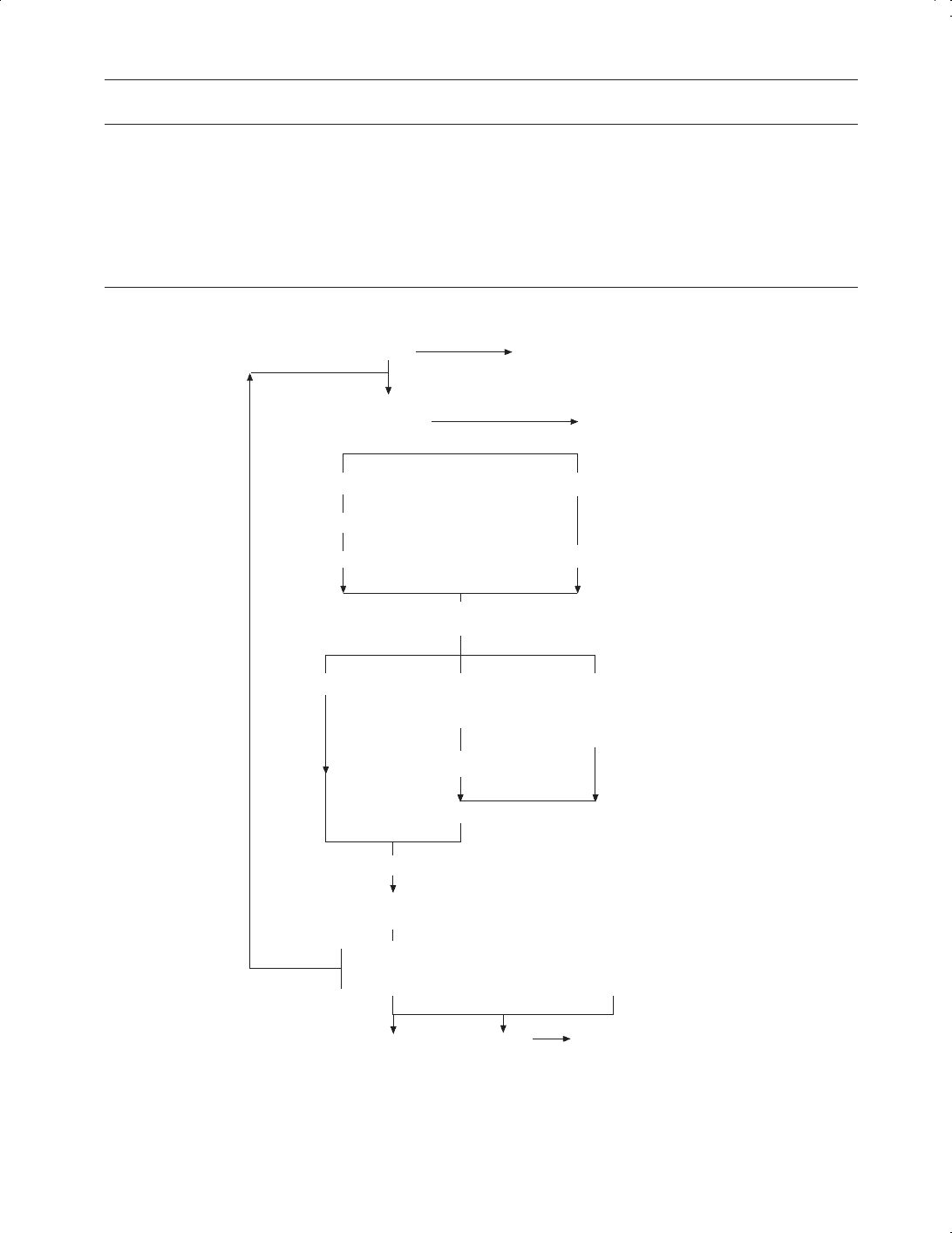
Figure 15.4
Procedure for refilling returnable chemical containers

Container filling/discharging
Considerations for the safe filling/discharging of containers will normally include:
• A segregated area adequately spaced from ignition sources, etc. with provision for spillage
control and with appropriate protection from vehicle impact.
• Avoidance of overhead piping, e.g. process lines, water, steam.
• Adequate weather protection, both for operators and to avoid ingress of rainwater or other
contaminants.
• Provision of information and instruction to personnel as to the hazards with the specific
chemical, including possible reactions.
• Thorough inspection of containers for integrity, correct labelling, sound valves or closures.
Figure 15.4 shows a procedure for the refilling of returnable containers with a chemical of assured
quality. (This will require some combination of documentation, sampling and analysis to ensure
that the chemical is of the correct type, and in the intended condition.) This is applicable to drums
and plastic containers, and bottles, but some modifications are necessary for pressure systems, i.e.
gas cylinders, covered by the Pressure Systems Safety Regulations 2000 including:
• A check from marks on the cylinder indicating that it has undergone proper examination at
appropriate intervals by a competent person.
• All appropriate safety checks including the provision of a correct valve, plug and protection
cap, if appropriate.
• A check that it is not overfilled and is within its safe operating limits.
CONTAINER FILLING/DISCHARGING 487

16
Chemicals and the environment:
sources and impact
Protection of the environment from pollution caused by ‘wastes’ is a matter of increasing concern.
It can be a technically-complex exercise because the variety of waste is extremely wide, the
volumes may be large, and the levels ‘permissible’ for release may be very low.
Examples of industrial chemical waste are given in Table 16.1. Common industrial sources of
pollution are given in Table 16.2. Since waste can result in pollution, the two terms are often used
synonymously.
Table 16.1 Types of waste and forms of pollutant
Source Type of waste Form of
pollutant
(1)
Agriculture, horticulture
BOD waste (high and low) L S A
Disinfectant A
Pesticides, herbicides (see below) PA
Fertilizers,
see
Inorganic chemicals A
Cement, bricks, lime
Chromium L
Dust S
Fluorides G
Sulphur dioxide G
Coal distillation, coal tar, coke ovens
Ammonia G A
Aromatic hydrocarbons G L
Combustion products G
Cyanate A
Cyanides G A
Dust S P
Fluorides G A
Hydrocarbons (general) G L A
Hydrogen sulphide G
Phenols L A
Polycyclic hydrocarbons G
Sulphur dioxide G
Tar G L S
Thiocyanates A
Construction, building, demolition
Combustion products G P
Dust S P