
Chen C.J. Physics of Solar Energy
Подождите немного. Документ загружается.


i
i
“ChenSolarEnergy” — 2011/5/17 — 17:56 — page 123 — #150
i
i
i
i
i
i
6.3 Second Law of Thermodynamics 123
heat can spontaneously transfer from a system at a higher temperature to a system at
a lower temperature. But heat can never spontaneously transfer from a system at a
lower temperature to a system at a higher temperature without expending mechanical
work. Such observations lead to the second law of thermodynamics.
6.3 Second Law of Thermodynamics
There are many ways to state the second law of thermodynamics. It can be shown that
all those incarnations are equivalent. A succinct formulation, similar to that of Kelvin
and Planck, is as follows:
It is impossible to build a machine that converts heat to mechanical work
from a single source of heat.
Because the heat in the ocean is unlimited, if perpetual motion of the second type
could be built, mankind would never have to worry having energy. Another formulation
of the second law of thermodynamics, due to Clausius, is as follows:
It is impossible to transfer heat from a reservoir at a lower temperature to
a reservoir at a higher temperature without spending mechanical work.
In fact, if a machine to transfer heat from a cold reservoir to a hot reservoir without
expending external mechanical energy could be built, everybody on Earth would be
able to enjoy free heating and free air conditioning.
6.3.1 Carnot Cycle
The spirit of the second law of thermodynamics can be best understood using the
Carnot cycle, proposed by Sadi Carnot in 1824 in the quest for the ultimate efficiency
of heat engines [1]. A schematic is shown in Fig. 6.2. The engine consists of two
heat reservoirs and a cylinder with a piston filled with a volume of working gas as the
thermodynamic system.
The Carnot cycle is an idealization of a heat engine that generates mechanical work
by transferring heat from a hot reservoir at temperature T
H
to a cold reservoir at tem-
perature T
L
. A complete cycle consists of four processes. First, the system is in contact
with the hot reservoir, undergoing an isothermal expansion process. The system, al-
ways at temperature T
H
, gains heat Q
H
from the hot reservoir. Second, the system
is isolated from the reservoir and is undergoing an adiabatic expansion process. With
no heat transfer, the temperature of the system is reduced to T
L
. Third, the system
is in contact with the cold reservoir, undergoing an isothermal compression process.
The system, always at temperature T
L
, releases heat Q
L
to the cold reservoir. Fourth,
the system is isolated from the reservoir and is undergoing an adiabatic compression
process. With no heat transfer, the temperature of the system is raised to T
H
.Anet
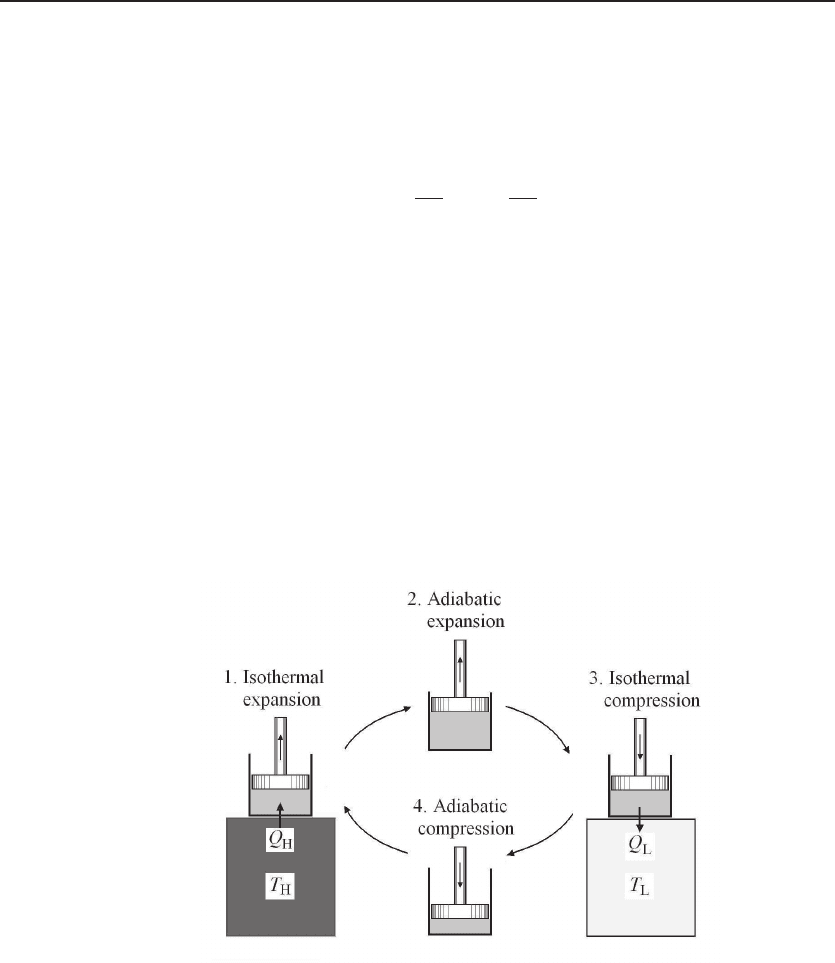
i
i
“ChenSolarEnergy” — 2011/5/17 — 17:56 — page 124 — #151
i
i
i
i
i
i
124 Thermodynamics of Solar Energy
work W is performed to the surroundings. The first law of thermodynamics requires
that
Q
H
= Q
L
+ W. (6.12)
The efficiency η of a heat engine is defined as the ratio of mechanical work W over
the heat energy from the hot reservoir, Q
H
:
η ≡
W
Q
H
=1−
Q
L
Q
H
. (6.13)
An essential assumption of the Carnot cycle is that the processes are reversible.
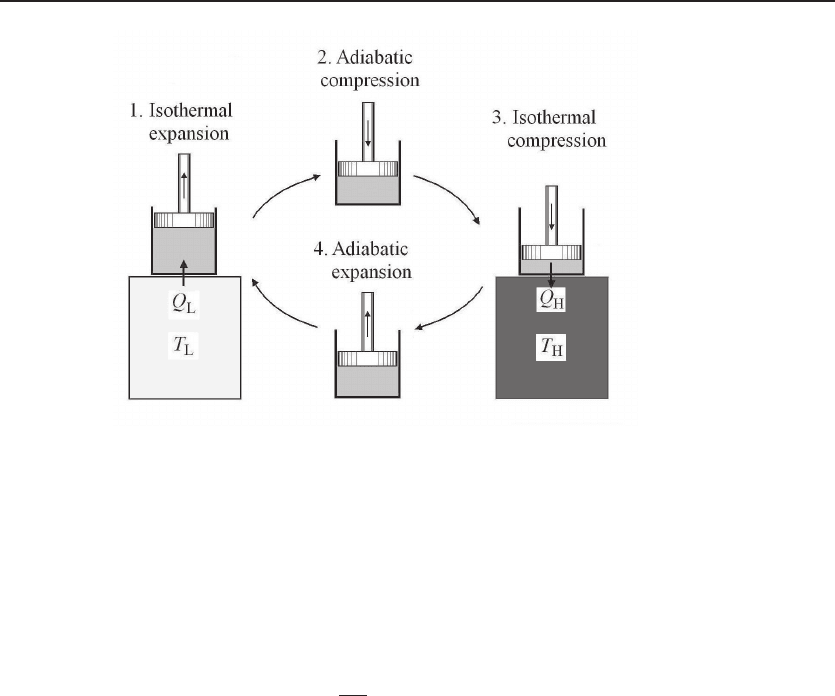
The Carnot cycle in Fig. 6.2 can be operated as a refrigerator or a heat pump; see Fig.
6.3. The thermodynamic system — a body of gas confined in a cylinder with a piston
— transfers heat from a cold reservoir to a hot reservoir with a cost of mechanical
work. The four processes are as follows: First, the system is in contact with the
cold reservoir, undergoing an isothermal expansion process. The system, always at
temperature T
L
, gains heat Q
L
from the cold reservoir. Second, the system is isolated
from the reservoir and is undergoing an adiabatic compression process. With no heat
transfer, the temperature of the system is raised to T
H
. Third, the system is in contact
with the hot reservoir, undergoing an isothermal compression process. The system,
always at temperature T
H
, releases heat Q
H
to the hot reservoir. Fourth, the system
is isolated from the reservoir and is undergoing an adiabatic expansion process. With
no heat transfer, the temperature of the system is reduced to T
L
.
Figure 6.2 Carnot cycle. The thermodynamic system is a quantity of gas confined in a cylinder with
a piston. It consists of four reversible processes: (1) an isothermal expansion process at temperature
T
H
, acquiring a heat Q
H
from the hot reservoir; (2) an adiabatic expansion process to reduce the
temperature to T
L
; (3) an isothermal compression process at temperature T
H
, releasing a heat Q
H
to the hot reservoir; (4) an adiabatic compression process to raise the temperature to T
H
.Anet
mechanical work W is done to the surroundings.
i
i
“ChenSolarEnergy” — 2011/5/17 — 17:56 — page 125 — #152
i
i
i
i
i
i
6.3 Second Law of Thermodynamics 125
Figure 6.3 Reverse Carnot cycle. An idealized representation of a refrigerator or a heat pump,
it consists of four processes: (1) an isothermal expansion process at temperature T
L
, acquiring a heat
Q
L
from the cold reservoir; (2) an adiabatic compression process to raise the temperature to T
H
;. (3)
an isothermal compression process at temperature T
H
, releasing a heat Q
H
to the hot reservoir; (4) an
adiabatic expansion process to reduce the temperature to T
L
. A net mechanical work W is required
to make the transfer.
Because the Carnot cycle is reversible, the same Carnot machine can function as a
heat engine or a heat pump (or equivalently, refrigerator). That fact has a far-reaching
consequence: The efficiency of all Carnot cycles depends only on the temperatures of
the two heat reservoirs,
η =1−
Q
L
Q
H
= f(T
H
,T
L
). (6.14)
The ingenious proof, given by Sadi Carnot in 1824, is based on a logical argument
as follows: If two Carnot machines have different efficiencies, one can use the Carnot
machine with a higher efficiency as the heat engine and the one with a lower efficiency
as the heat pump. The combined machine would contradict the second law of thermo-
dynamics. There are two alternative proofs with regard to the two formulations of the
second law of thermodynamics.
The first proof is as follows: With the same amount of heat from the hot reservoir,
that heat engine can generate more work than is required to pump heat from the cold
reservoir to recover the input heat back to the hot reservoir. Therefore, the combined
machine can convert heat into mechanical work from a single heat reservoir, which is
a perpetual motion of the second type. It contradicts the Kelvin–Planck formulation of
the second law of thermodynamics.
An alternative proof is as follows: By using all the mechanical work generated with
the heat Q
H
from the hot reservoir using the more efficient machine, a heat greater
than Q
H
can be generated to put back into the hot reservoir. The combined machine is

i
i
“ChenSolarEnergy” — 2011/5/17 — 17:56 — page 126 — #153
i
i
i
i
i
i
126 Thermodynamics of Solar Energy
capable of transferring heat from a cold reservoir to a hot reservoir without requiring
any external mechanical work. It contradicts the Clausius formulation of the second
law of thermodynamics. The conclusions of the analysis based on the Carnot cycle
is simple but far-reaching: The efficiency of a reversible Carnot cycle, regardless of
the nature of the process and the nature of the substance, is uniquely determined by
the two temperatures — the temperature of the hot reservoir and the temperature of
the cold reservoir. The universality of the Carnot cycle motivated William Thompson
(Lord Kelvin) to define the scale of thermodynamic temperature.
6.3.2 Thermodynamic Temperature
In Section 2.1, the condition of equality of temperature was defined. But the scale of
temperature is yet to be defined. Based on the theory of the Carnot cycle, William
Thomson (Lord Kelvin) defined the thermodynamic temperature, also known as the
absolute temperature or the Kelvin temperature scale [2], abbreviated K.
For reversible Carnot cycles, the efficiency is defined as
η ≡
W
Q
H
=1−
Q
L
Q
H
. (6.15)
Now look at the ratio of Q
L
and Q
H
. If the temperature of the hot reservoir equals
the temperature of the cold reservoir, then no mechanical work can be generated.
Therefore, Q
L
= Q
H
. In other words,
If
Q
L
Q
H
=1, then
T
L
T
H
=1. (6.16)
Obviously, the temperature scale should also satisfy the following:
If
Q
L
Q
H
< 1, then
T
L
T
H
< 1. (6.17)
The simplest temperature scale satisfying these criteria, proposed by Lord Kelvin
in 1848, is [2]
T
L
T
H
=
Q
L
Q
H
. (6.18)
Lord Kelvin showed that this absolute temperature scale is equivalent to the tem-
perature scale based on ideal gas properties [2]. The Kelvin temperature is also iden-
tical to the temperature in statistical physics created by Maxwell and Boltzmann; see
Appendix D.
In terms of the Kelvin temperature scale, the efficiency of a reversible Carnot cycle
(Eq. 6.15), is
η
c
=1−
T
L
T
H
, (6.19)
which is the maximum efficiency any heat engine can achieve, often referred to as
the Carnot efficiency. As shown, the lower the temperature T
L
, the greater the effi-
ciency. The efficiency can be artificially close to 1 if T
L
is sufficiently low. However,

i
i
“ChenSolarEnergy” — 2011/5/17 — 17:56 — page 127 — #154
i
i
i
i
i
i
6.4 Thermodynamic Functions 127
the efficiency of any heat engine cannot equal to 1; otherwise the second law of ther-
modynamics is violated. Although 0 K could never be reached, we can formally define
absolute zero temperature by
If Q
L
=0, or W = Q
H
, then T
L
=0. (6.20)
The Celsius temperature scale is defined as a shifted Kelvin scale, with the triple
point of water (the state in which the solid, liquid, and vapor phases exist together
in equilibrium) defined as 0.01
◦
C. On the Celsius scale, the boiling point of water is
found experimentally to be 100.00
◦
C. This definition also fixes the constant factor in
the Kelvin scale. The relation between the Kelvin scale and the Celsius scale is
K=
◦
C + 273.15. (6.21)
6.3.3 Entropy
Equation 6.18 can be rewritten as
Q
H
T
H
=
Q
L
T
L
, (6.22)
which has a significant consequence. Actually, Eq. 2.22 can be generalized to any
number of steps in a cycle, where in each step an infinitesimal heat δQ is transferred.
For a reversible cycle, the cyclic integral is zero,
δQ
T
=0. (6.23)
Therefore, a single-valued function of the state can be defined,
S
2
− S
1
≡
2
1
δQ
T
. (6.24)
This function, which plays a central role is thermodynamics, is called entropy.How-
ever, heat Q is not a function of the state, because the cyclic integral of δQ is, in general,
not zero. Each state of the system can have multiple values of the same quantity. How-
ever, an infinitesimal amount of heat can be expressed in terms of the state function
entropy as
δQ = TdS. (6.25)
6.4 Thermodynamic Functions
As discussed in Section 2.1, for the fixed state of a system, the state functions are fixed.
Examples of state functions include volume V , mass m, pressure P , temperature T ,

i
i
“ChenSolarEnergy” — 2011/5/17 — 17:56 — page 128 — #155
i
i
i
i
i
i
128 Thermodynamics of Solar Energy
etc. Heat and the mechanical work, on the other hand, are not state functions. We
denote the differentials of heat and mechanical work as δQ and δW.
According to the first law of thermodynamics, the total energy of a system is also
a function of the state. In fact, a mathematical representation of the first law of
thermodynamics is that the cyclic integral of the sum of mechanical work and heat is
zero,
(δQ + δW)=0. (6.26)
The difference of energy between state 1 and state 2 is defined as
U
2
− U
1
=
2
1
(δQ + δW). (6.27)
Because mechanical work is related to pressure P and volume V as δW = −PdV,
combining eq. 6.27 with Eq. 6.25, the differential of energy is
dU = TdS−PdV. (6.28)
6.4.1 Free Energy
The total energy of a system U can be defined as the capability of doing work to the
surroundings or the capability of transferring heat to the surroundings. In the analysis
of actual problems, sometimes it is necessary to emphasize the portion of energy related
to the capability of doing mechanical work. The definition of free energy satisfies this
purpose:
F = U − TS. (6.29)
Intuitively speaking, the definition of free energy seems to eliminate the heat component
of the total energy and retain the mechanical part. Similar to Eq. 6.25, the differential
of free energy is
dF = −SdT − PdV. (6.30)
Therefore, more precisely speaking, free energy is a measure of the capability of a state
of the system to do mechanical work at a constant temperature.
6.4.2 Enthalpy
Sometimes it is useful to know the portion of the energy of a system related to the
capability of delivering heat. The definition of enthalpy satisfies that purpose,
H = U + PV. (6.31)
Intuitively speaking, the definition of enthalpy seems to eliminate the mechanical
work component of the total energy and retain the heat content. Similar to Eq. 6.25,
the differential of enthalpy is
dH = TdS+ VdP. (6.32)

i
i
“ChenSolarEnergy” — 2011/5/17 — 17:56 — page 129 — #156
i
i
i
i
i
i
6.4 Thermodynamic Functions 129
More precisely speaking, enthalpy is a measure of the capability of a state of the
system to deliver heat at a constant pressure.
When a liquid evaporates under constant pressure, the volume of the gas increases.
The heat required for evaporation is the sum of the difference of internal energy U and
the work needed to expand the volume, PV. The heat transferred during the phase
change is the sum of U and PV,thatis,theenthalpy,
ΔH =Δ(U + PV) . (6.33)
6.4.3 Gibbs Free Energy
The fourth state function, introduced by Willard Gibbs, is
G = U + PV − TS. (6.34)
Similarly, the differential of the Gibbs free energy is
dG = −SdT + VdP. (6.35)
From Eq. 6.35, it is clear that if the temperature and pressure of a system are kept
constant and the quantity of the substance is constant, then the Gibbs free energy is
a constant. This property is important in the analysis of chemical reactions, because
most chemical reactions occurs under conditions of constant temperature and constant
pressure.
First, consider a single-component system in which the quantity of the substance is
a variable which by convention is expressed as the number of moles of the substance,
N. When the temperature and the pressure of the system are kept constant, the Gibbs
free energy can be expressed as
dG = −SdT + VdP+ μdN. (6.36)
The quantity μ is the Gibbs free energy per mole of the substance.
6.4.4 Chemical Potential
For a system with more than one component, the expression of the Gibbs free energy
(Eq. 6.36), can be generalized to
dG = −SdT + VdP+
i
μ
i
dN
i
, (6.37)
where i is the index for the ith component. If there is a chemical reaction in the
system, then the composition of the system, represented by the set of molar values
N
i
, will change. Under constant temperature and constant pressure, the equilibrium
condition of the system is
dG =
i
μ
i
dN
i
=0. (6.38)
The quantity μ
i
is known as the chemical potential of the ith component of the
system.

i
i
“ChenSolarEnergy” — 2011/5/17 — 17:56 — page 130 — #157
i
i
i
i
i
i
130 Thermodynamics of Solar Energy
6.5 Ideal Gas
Experimentally, it is found that within a large range of temperature and pressure many
commonly encountered gases satisfy a universal relation
PV = NRT, (6.39)
where P is the pressure in pascals, V is the volume in cubic meters, N is the number
of moles of the gas, T is absolute temperature in kelvins; and R is a universal gas
constant,
R =8.3144
J
mol · K
. (6.40)
In solar energy storage systems, for the gases commonly used, such as nitrogen, oxy-
gen, argon, and methane, at temperatures of interest the ideal gas relation is accurate
up to a pressure of 10 MPa, or 100 standard atmospheres pressure.
In the following, we will derive all the thermodynamic functions for the ideal gases.
First, we will show that the energy U of an ideal gas depends only on temperature
but not on volume. In fact, assuming that U = U (T,V ), using Eq. 6.25, the internal
energy varies with volume as
∂U
∂V
T
= T
∂S
∂V
T
− P. (6.41)
Using the equation of state 6.39, Eq. 6.41 becomes
∂U
∂V
T
= T
∂P
∂T
V
− P = T
P
T
− P =0. (6.42)
Defining the constant-volume specific heat per mole as
C
v
≡
1
N
∂U
∂V
T
, (6.43)
the internal energy as a function of temperature is
U
2
− U
1
=
2
1
NC
v
dT. (6.44)
If in the temperature interval of interest C
v
is a constant,
U
2
− U
1
= NC
v
(T
2
− T
1
). (6.45)
To obtain an explicit expression of entropy, we use Eqs. 6.25, 6.39, and 6.43,
dS =
dU
T
+
PdV
T
= NC
v
dT
T
+ NR
dV
V
. (6.46)

i
i
“ChenSolarEnergy” — 2011/5/17 — 17:56 — page 131 — #158
i
i
i
i
i
i
6.5 Ideal Gas 131
Again, assuming that the specific heat C
v
is a constant,
S
2
− S
1
= N
2
1
C
v
dT
T
+ R
dV
V
= N
C
v
log
T
2
T
1
+ R log
V
2
V
1
. (6.47)
Another important quantity is the constant-pressure specific heat C
p
. For ideal
gases, there is a simple relation between C
v
and C
p
.ToheatN moles of gas while
keeping the pressure constant, work P ΔV is done to the surroundings. According to
the first law of thermodynamics, an additional energy P ΔV must be supplied. Because
for an ideal gas P ΔV = NRΔT , the total energy required to raise the temperature is
ΔQ = NC
v
ΔT + NRΔT = N(C
v
+ R)ΔT. (6.48)
Therefore,
C
p
= C
v
+ R. (6.49)
The ratio of constant-pressure specific heat and constant-volume specific heat is an
important parameter in the study of the adiabatic process, often denoted as γ:
γ ≡
C
p
C
v
=1+
R
C
v
. (6.50)
During an adiabatic process, the heat transfer is zero. Therefore,
NC
v
dT = −PdV. (6.51)
On the other hand, from the equation of state for the ideal gas,
NRdT = VdP+ PdV. (6.52)
Combining Eqs 6.51 and 6.52, we obtain
1+
R
C
v
PdV + VdP=0. (6.53)
The solution of the above differential equation is
PV
γ
=const, (6.54)
which is the state equation of an adiabatic process.
In the following, we show that the efficiency of a reversible Carnot cycle of ideal
gas is η =1− (T
L
/T
H
), and thus the thermodynamic temperature scale is identical
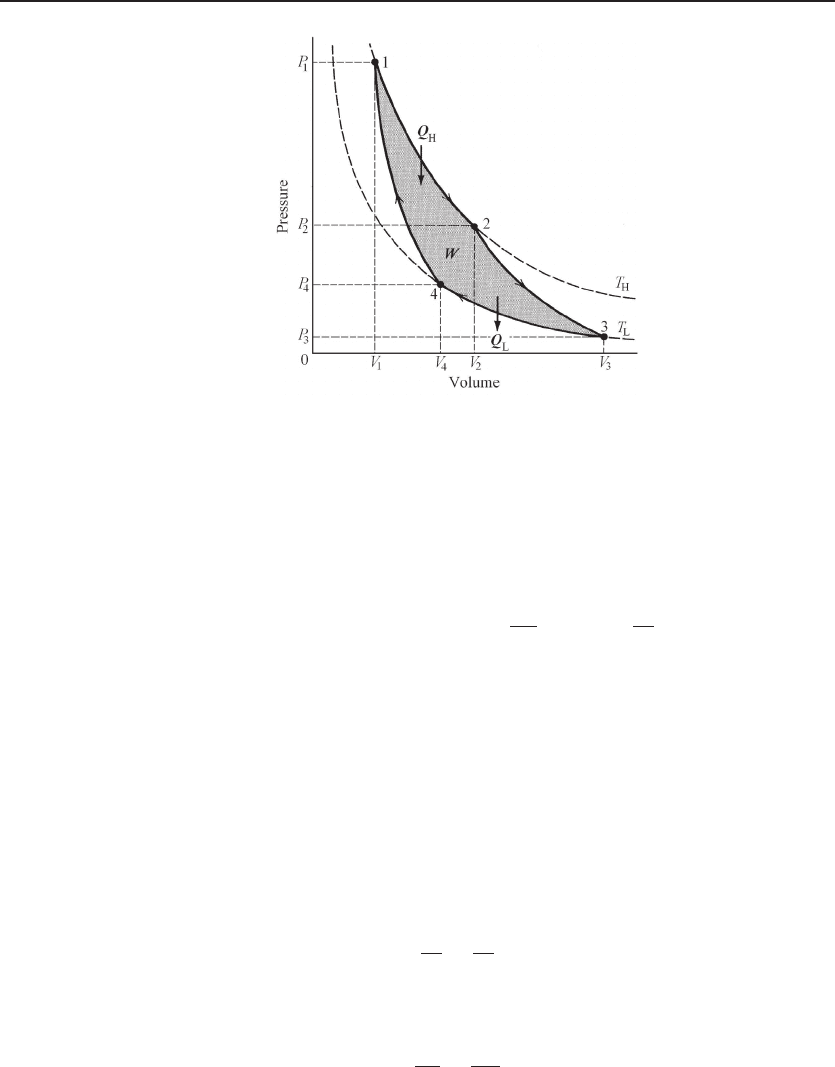
to the temperature scale based on the ideal gas; see Fig. 6.4. In the first process,
an isothermal expansion process at temperature T
H
from state 1 to state 2, the gas
medium receives heat from the hot reservoir,
Q
H
=
2
1
PdV = NRT
H
2
1
dV
V
NRT
H
log
V
2
V
1
, (6.55)
i
i
“ChenSolarEnergy” — 2011/5/17 — 17:56 — page 132 — #159
i
i
i
i
i
i
132 Thermodynamics of Solar Energy
Figure 6.4 Carnot cycle with ideal gas as the system. Curve 1–2 is an isothermal expansion
process at T
H
. Curve 2–3 is an adiabatic expansion process. Curve 3–4 is an isothermal contraction
process at T
L
. Curve 4–1 is an adiabatic contraction process. The gas does work W to the surroundings.
where V
1
and V
2
are the volume of states 1 and 2, respectively. In the third process,
an adiabatic contraction process from state 3 to state 4, the gas medium releases heat
to the cold reservoir,
Q
L
=
4
3
PdV = NRT
L
4
3
dV
V
NRT
L
log
V
3
V
4
, (6.56)
where V
3
and V
4
are the volumes of state 3 and 4, respectively.
Because processes 1–2 and 3–4 are isothermal, according to the equation of state,
P
1
V
1
= P
2
V
2
,
P
3
V
3
= P
4
V
4
.
(6.57)
On the other hand, processes 2–3 and 4–1 are adiabatic. According to Eq. 6.54,
P
2
V
γ
2
= P
3
V
γ
3
,
P
4
V
γ
4
= P
1
V
γ
1
.
(6.58)
Combining Eqs 6.57 and 6.58, we have
V
1
V
2
=
V
3
V
4
. (6.59)
Applying this relation to Eqs. 6.55 and 6.56, we conclude that the thermodynamic
temperature scale and the ideal gas temperature scale are identical,
T
L
T
H
=
Q
L
Q
H
. (6.60)