
Chen C.J. Physics of Solar Energy
Подождите немного. Документ загружается.

i
i
“ChenSolarEnergy” — 2011/5/17 — 17:56 — page 153 — #180
i
i
i
i
i
i
7.2 Many-Electron Systems 153
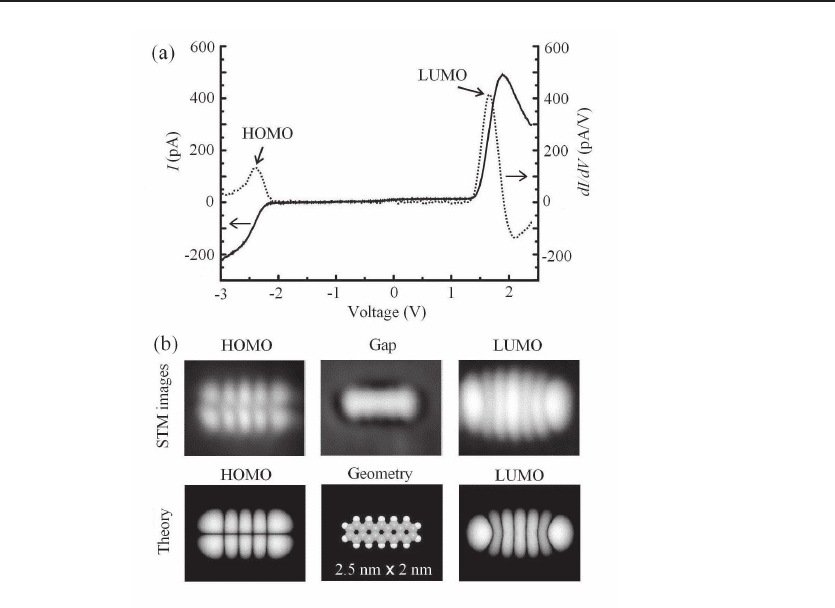
Figure 7.4 Experimental observation of HOMO and LUMO. Using a scanning tunneling
microscope, the energy levels and the probability density distributions of those states can be determined
by direct experimental measurements. (a) Tunneling current and tunneling conductivity curves. It
shows a peak at -2.4 eV below the vacuum level, corresponding to HOMO, and a peak at +1.5 eV
above the vacuum level, corresponding to LUMO. (b) Experimental observations of the charge density
contours of pentacene at -2.4 and +1.5 eV, corresponding to the HOMO and LUMO, respectively. The
theoretical results from numerical computations are also shown. Adapted from Ref. [18].
conductivity curves, where the peak at -2.4 eV below the Fermi level corresponding
to HOMO, and the peak at +1.5 eV above the Fermi level corresponding to LUMO.
Figure 7.4(b) shows experimental observations of the charge density contours of pen-
tacene at -2.4 and +1.5 eV, corresponding to the HOMO and LUMO, respectively. The
theoretical results from numerical computations are also shown.
7.2.4 Quantum States of a Nanocrystal
The scanning tunneling microscope is capable of not only mapping the electronic states,
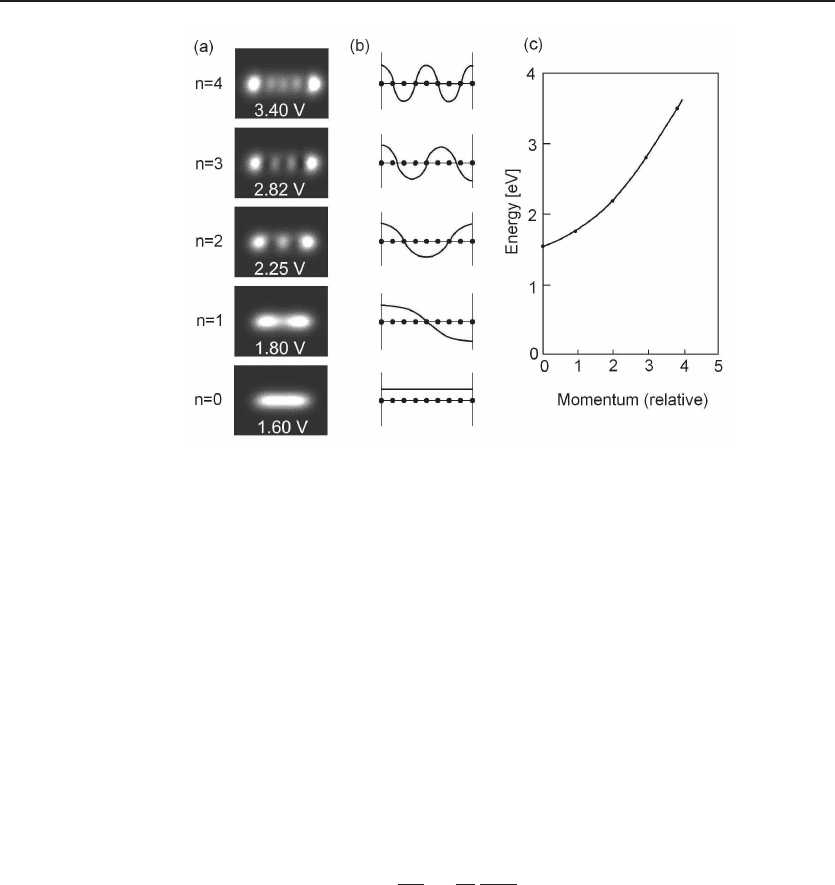
but also constructing artificial atomic structures not found in nature. Figure 7.5 shows
the electronic states observed on a nanocrystal made of a linear chain of 15 copper atoms
with spacing 225 pm assembled by STM. Electron density distributions at various bias
i
i
“ChenSolarEnergy” — 2011/5/17 — 17:56 — page 154 — #181
i
i
i
i
i
i
154 Quantum Transitions
Figure 7.5 Quantum states of a nanocrystal. (a) A nanocrystal made of 9 copper atoms
and the electron density distributions observed by STM at different bias voltages. Each bias voltage
corresponds to the energy level of an electronic state of the nanocrystal. (b) Wavefunctions of the
electronic states, which give rise to the observed electron density distributions. Each one has a different
wavevector. (c) Relation between the energy levels and the wavevectors of the electronic states, showing
a quadratic relation. Adapted from Ref. [18].
voltages are observed.
As shown, the wavefunction, exhibited as charge density distributions, as a function
of the energy level, controlled by the bias voltage, can be directly observed. As shown
in Section 7.1.3, the momemtum of the electron wavefunction is related to the number
of nodes in the charge density distribution. Experimentally, a quadratic dependence
on wavevector k is observed,
E = E
0
+const. ×k
2
. (7.43)
Similar to the theoretical argument in Eq. 7.27, an effective mass ca be obtained by
Eq. 7.28,
1
m
e
=
1
2
∂
2
E
∂k
2
. (7.44)
7.3 The Golden Rule
In previous sections, the stationary states of atoms, molecules, and solid systems were
described. For the utilization of solar energy, an understanding of the interaction of
radiation with the quantum systems that cause transitions among various quantum

i
i
“ChenSolarEnergy” — 2011/5/17 — 17:56 — page 155 — #182
i
i
i
i
i
i
7.3 The Golden Rule 155
states is of paramount importance. A quantum system can absorb a solar photon and
be excited from a state with a lower energy value to a state with a higher energy value
or decay from a state with a higher energy value to a state with a lower energy value
by emitting a photon or giving up the energy to the surrounding atoms.
A simple, sketchy theory was provided by Einstein in 1916, as shown in Section 2.5.
However, Einstein did not provide an explicit expression of those coefficients for a
concrete system. That problem was resolved by Dirac in 1927 in a beautiful and com-
prehensive treatment of time-dependent quantum mechanical perturbation theory [22].
In that paper, a first-order time-dependent perturbation theory provided an explicit
expression for the absorption and emission coefficients of radiation, thus also the rate of
transition among quantum states. The resulting formula is so important that in 1950,
Enrico Fermi coined a term Golden Rule for it in his book Nuclear Physics [29].
Dirac’s 1927 paper deals with a number of issues concerning the interaction of
radiation with atomic systems [22]. It is profound and difficult to read. Here, we
provide an easy-to-follow derivation of the Golden Rule. As we will see, the derivation
process provides a good understanding of the process of the interaction of radiation
with atomic systems.
The derivation process also provides the quantum-mechanical foundation of the
principle of detailed balance: a symmetry between absorption and emission.
7.3.1 Time-Dependent Perturbation by Periodic Disturbance
Consider a quantum system with a time-independent Hamiltonian
ˆ
H
0
.Itcouldbe
a molecule, or a piece of semiconductor. In the absence of external disturbance, the
equation of motion of a state |Ψ is
i
∂
∂t
|Ψ =
ˆ
H
0
|Ψ, (7.45)
where the state |Ψ is understood to be in general time dependent. Because the Hamil-
tonian
ˆ
H
0
is time independent, the system has a series of stationary states, labeled by
an integer n,
ˆ
H
0
|n = E
n
|n. (7.46)
A general solution of Eq. 7.45 can be written as
|Ψ =
∞
n=0
c
n
e
−iE
n
t/
|n, (7.47)
where c
n
are constant coefficients. That solution can be verified by direct substitution
into Eq. 7.45.
Assuming that for t ≤ 0 the system is in an initial state with index i,
|Ψ = e
−iE
i
t/
|i,t=0, (7.48)
where the normalization condition implies c
i
=1.

i
i
“ChenSolarEnergy” — 2011/5/17 — 17:56 — page 156 — #183
i
i
i
i
i
i
156 Quantum Transitions
The interaction of the system with radiation is described by a periodic disturbance
ˆ
V
rad
(t)=
ˆ
Ve
iωt
+
ˆ
V
†
e
−iωt
, (7.49)
which is turned on for t>0. It is easy show that the disturbance
ˆ
V
rad
(t) is Hermitian.
The first term represents an outgoing wave, and the second term represents an incoming
wave. Consider the incoming term first. The total Hamiltonian becomes
ˆ
H =
ˆ
H
0
+
ˆ
V
†
e
−iωt
. (7.50)
The equation of motion becomes
i
∂
∂t
|Ψ =
ˆ
H
0
+
ˆ
V
†
e
−iωt
|Ψ. (7.51)
We look for a trial solution of Eq. 7.51 of the form
|Ψ = e
−iE
i
t/
|i +
∞
n=i
c
n
(t)e
−iE
n
t/
|n, (7.52)
where the coefficients c
n
(t) are small but time dependent and are to be determined
by the equation of motion 7.51. At t = 0, the disturbance is not yet effective, and
therefore, c
n
(0) = 0. Substituting Eq. 7.52 into Eq. 7.51, we have three types of
terms. Because the disturbance
ˆ
V
†
is small, the first nonvanishing terms with
ˆ
V
†
are
∞
n=i
dc
n
(t)
dt
e
−iE
n
t/
|n =
ˆ
V
†
|ie
−iE
i
t/−iωt
. (7.53)
Now we look for the probability of transition to a final state, |f. Multiplying both
sides with a bra of that final state, f|, using the orthogonality condition f |n = δ
fn
,
one obtains
i
dc
f
(t)
dt
= f|
ˆ
V
†
|ie
−i(E
f
−E
i
)t/−iωt
. (7.54)
The coefficient c
f
(t) can be obtained by direct integration using the initial condition
c
f
(0) = 0,
c
f
(t)=f|
ˆ
V
†
|i
e
(E
f
−E
i
−ω)t/
− 1
E
f
− E
i
− ω
. (7.55)
The probability of finding a final state |f at time t is
p
fi
≡|c
f
(t)|
2
=
2π
t |f|
ˆ
V
†
|i|
2
sin
2
[(E
f
− E
i
− ω)(t/2)]
π [E
f
− E
i
− ω]
2
(t/2)
. (7.56)
Denote E
f
− E
i
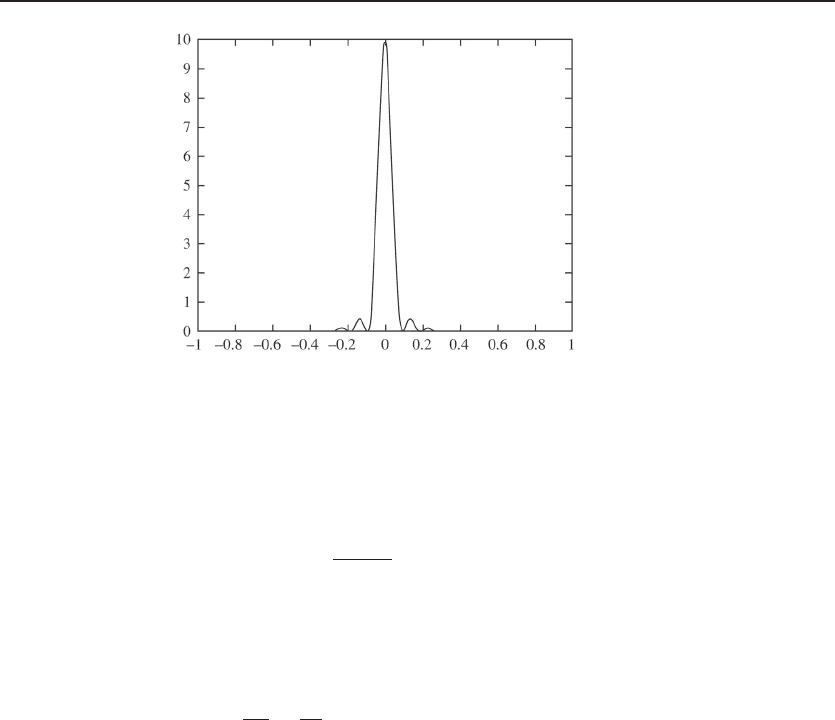
− ω = u and t/2 = a; the function in square brackets has a sharp
peak near u = 0, as shown in Fig. 7.6. The area under it is 1:
∞
−∞
sin
2
au
πau
2
du =1. (7.57)
i
i
“ChenSolarEnergy” — 2011/5/17 — 17:56 — page 157 — #184
i
i
i
i
i
i
7.3 The Golden Rule 157
Figure 7.6 Condition of energy conservation. The integrand in Eq. 7.58 approaches a delta
function when a approaches infinity. If the time of the experiment is not too short, the condition of
energy conservation is valid.
As a →∞, it approaches a delta function,
lim
a→∞
sin
2
au
πau
2
= δ(u). (7.58)
Therefore, when t →∞, the function in square brackets in Eq. 7.56 approaches a delta-
function δ(E
f
− E
i
− ω). Also, from Eq. 7.56, the probability of |f is proportional
to t, and therefore, the transition rate is
R
fi
≡
p
fi
t
=
2π
|f|
ˆ
V
†
|i|
2
δ(E
f
− E
i
− ω). (7.59)
Equation 7.59 is the Golden Rule for atomic systems with discrete energy levels. The
Bohr frequency condition,
ω = E
f
− E
i
, (7.60)
comes naturally. The radiation field can only transfer an energy quantum of ω to the
atomic system, which is the essence of Einstein’s theory of photons and provides an
explanation of the line spectra, especially the Ritz combination principle.
7.3.2 Golden Rule for Continuous Spectrum
For systems with a continuous energy spectrum, the parameter f becomes a continuous
variable. The number of states ΔN in an energy interval ΔE
f
is given by the density of
states of the final state, ΔN = ρ(E
f
)ΔE
f
. The transition rate R
fi
should be integrated

i
i
“ChenSolarEnergy” — 2011/5/17 — 17:56 — page 158 — #185
i
i
i
i
i
i
158 Quantum Transitions
over a range of states,
R
fi
=
2π
lim
t→∞
∞
−∞
|f|
ˆ
V
†
|i|
2
sin
2
[(E
f
− E
i
− ω)(t/2)]
π [E
f
− E
i
− ω]
2
(t/2)
ρ(E
f
) dE
f
=
2π
∞
−∞
|f|
ˆ
V
†
|i|
2
δ(E
f
− E
i
− ω) ρ(E
f
)dE
f
=
2π
|f|
ˆ
V
†
|i|
2
ρ(E
i
+ ω).
(7.61)
Similarly, the Bohr frequency condition E
f
= E
i
+ω comes naturally. Equation 7.61 is
the Golden Rule for the continuous energy spectrum for the case of electronic excitation
of an atomic system.
7.3.3 Principle of Detailed Balance
The above treatment is for the absorption of a photon from the radiation field. By
changing the sign of exponential in Eq. 7.50,
ˆ
H =
ˆ
H
0
+ λ
ˆ
Ve
iωt
, (7.62)
and repeating the treatment, Eq. 7.59 becomes
R
fi
=
2π
|f|
ˆ
V |i|
2
δ(E
f
− E
i
+ ω), (7.63)
where the Bohr frequency condition becomes
ω = E
i
− E
f
, (7.64)
which means that the atomic system decays from a state of higher energy to a state of
lower energy by emitting a photon to the radiation field. For a continuous spectrum,
the corresponding Golden Rule is
R
fi
=
2π
|f|
ˆ
V |i|
2
ρ(E
i
− ω). (7.65)
By exchanging the initial state and the final state, it is clear that the matrix element
is identical in both absorption and emission processes,
|i|
ˆ
V |f |
2
= |i|
ˆ
V
†
|f|
2
. (7.66)
The symmetry of absorption and emission is the foundation of the principle of detailed
balance, which plays a crucial role in the understanding of the efficiency limit of solar
cells.

i
i
“ChenSolarEnergy” — 2011/5/17 — 17:56 — page 159 — #186
i
i
i
i
i
i
7.4 Interactions with Photons 159
7.4 Interactions with Photons
The interaction of an atomic system with photons can be treated as a special case of
the Golden Rule by using an explicit form of the interaction term
ˆ
V . In Section 2.1.6,
the classical Hamiltonian of an electron in electric and magnetic fields is Eq. 2.32,
H =
1
2m
e
(p − qA)
2
+ qφ, (7.67)
where A is the vector potential of the electromagnetic field and φ is the electric (scalar)
potential. The Hamiltonian in quantum mechanics has exactly the same form, but the
dynamic variables become operators,
ˆ
H =
1
2m
e
(
ˆ
p − qA)
2
+ qφ. (7.68)
To treat the problems of the interaction between the solar radiation field and atomic
systems, two simplifications can be made: First, the spatial variation of the radiation
field, represented by the vector potential A, is usually over 1 μm, much slower than
the variation of the wavefunctions, which is less than 1 nm. Thus it can be treated as
a constant over coordinates and consequently commutes with p. Second, the square
of the vector potential, A
2
, is much smaller than the other terms and thus can be
neglected. Equation 7.68 becomes
ˆ
H = −
2
2m
e
∇
2
+ qφ −
q
m
e
(A • ˆp). (7.69)
Here the first two terms represent the Hamiltonian for the atomic system,
ˆ
H
0
,andthe
last term is the perturbation potential
ˆ
V .
A radiation field, a stream of sunlight, can be well represented by a plane wave.
Take z as the direction of travel. The disturbance term in the total Hamiltonian is
ˆ
V = −
q
m
e
A
0
•
˙
p e
i(k
z
z −ωt)
. (7.70)
Equation 7.70 can be written in a more convenience form. Using Eqs. 2.33 and 2.8
and recalling that the term eA is a small perturbation, the spatial variation (on the
order of 1 μm) is much slower than the variation of the atomic wavefunction, thus can
be considered as a constant, and the temporal variation of the disturbance potential
follows the e
−iωt
factor,
ˆ
V = −iωqA
0
•
˙
r e
−iωt
= E
0
• qr e
−iωt
,
(7.71)
which has an intuitive explanation. Because the spatial and temporal variations of
the electric field of the radiation are much slower than that of the atomic states, the
radiation field can be treated as uniform and static: The interaction of the radiation
field is the electric field intensity of the light, E, acting on the dipole moment of the
atomic system, qr. Hence, it is often called the dipole approximation.

i
i
“ChenSolarEnergy” — 2011/5/17 — 17:56 — page 160 — #187
i
i
i
i
i
i
160 Quantum Transitions
Problems
7.1. Using the definition of Hermitian operators (Eq. 7.8), show that for an arbitrary
matrix
ˆ
A, both
ˆ
A
†
+
ˆ
A and i(
ˆ
A
†
−
ˆ
A) are Hermitian.
7.2. A running wave in the x-direction with wavevector k
x
can be represented by a
function
ψ(x)=Ce
k
x
x−ωt
. (7.72)
Using de Broglie’s relation
p
x
= k
x
, (7.73)
prove that the momentum operator is
ˆp
x
ψ(x)=−i
∂
∂x
ψ(x). (7.74)
7.3. Using the coordinate representation of the state in one dimension, the wavefunc-
tion |ψ = ψ(x), and the definition of momentum
ˆp
x
|ψ = −i
∂
∂x
|ψ, (7.75)
prove the commutation relation, Eq. 7.9,
ˆxˆp
x
− ˆp
x
ˆx = i. (7.76)
7.4. The definition of angular momentum in quantum mechanics is
ˆ
m =
ˆ
r ×
ˆ
p. (7.77)
Prove that the angular momentum operator is Hermitian.
7.5. For the case of a string of atoms, the equation is the same as for an electron in a
one-dimensional box (Eq. 7.17). At the two ends of the atom chain, the wavefunction
should reach a maximum. The boundary conditions are
ψ
(0) = 0, (7.78)
ψ
(L)=0. (7.79)
Write the wavefunctions satisfying those boundary conditions.
7.6. Using the same conditions in Problem 7.5, obtain the energy levels of that system.
7.7. Using the same conditions in Problem 7.5, obtain the normalized wavefunctions
of that system.
7.8. Using the same conditions in Problem 7.5, obtain the wavefunctions with time
variation.
i
i
“ChenSolarEnergy” — 2011/5/17 — 17:56 — page 161 — #188
i
i
i
i
i
i
Chapter 8
pn-Junctions
To date, most solar cells are made of semiconductors. A semiconductor is character-
ized by a relatively narrow energy gap, typically a fraction of an electron volt to a
few electron volts. Electrons can be excited by a photon from the valence band to
the conduction band and form an electron–hole pair. The electron–hole pair stores a
substantial portion of the photon energy. After formation of the electron–hole pairs,
the pn-junction separates the electrons and holes to generate external electric current.
In this chapter, we will learn the basic physics of semiconductors and pn-junctions.
8.1 Semiconductors
8.1.1 Conductor, Semiconductor, and Insulator
When a large number of atoms come together to form a solid, the wavefunctions of
atoms interact to form extended states which are similar to the one-dimensional crystal
in Section 7.2.4. A number of energy bands are formed. In general, the number of states
is infinite. According to the Pauli exclusion principle, each state can only be occupied
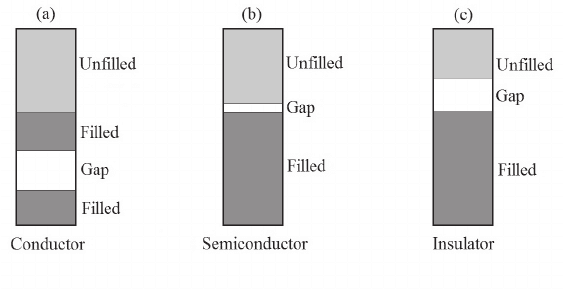
Figure 8.1 Conductor, semiconductor, and insulator. (a) For conductors, the highest occupied
energy level is in the middle of an energy band. (b) For semiconductors, the highest occupied energy
level matches the top of the valance band but the energy gap to the conduction band is small. (c) If
the energy gap is big, the solid is an insulator.
161
Physics of Solar Energy C. Julian Chen
Copyright © 2011 John Wiley & Sons, Inc.
i
i
“ChenSolarEnergy” — 2011/5/17 — 17:56 — page 162 — #189
i
i
i
i
i
i
162 pn-Junctions
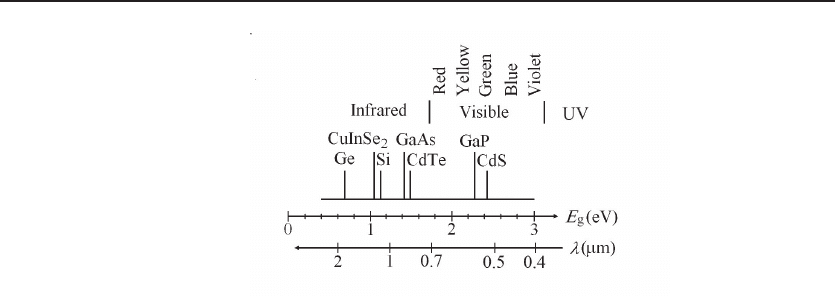
Figure 8.2 Band gaps of a number of semiconductors. The wavelength of light corresponding
to the energy gap is also shown. Most of the semiconductors used in solar cells have an energy gap
corresponding to the photons of near-infrared or visible light.
by one electron. Imagine electrons arte added to a system one by one, stating from the
state with lowest energy. At one point, the number of electrons equals the number of
protons in the system and the system becomes neutral.
According to the relative position of the energy bands and the highest occupied
energy level, there are three different cases, as shown in Fig. 8.1.
In Fig. 8.1(a), the highest occupied energy level is in the middle of an energy band.
The electrons can move to the unoccupied parts of the energy band. This type of
material is called a conductor or a metal.
If the highest occupied energy level matches the top of an energy band, which is
called the valence band, marked as E
v
, and the distance to the next energy band is
large, the electrons are not easily excited to the higher band. This type of materials is
called an insulator; see Fig. 8.1 (c).
An important case between those two is the semiconductor, where the gap between
the top of the valance band E
V
and the bottom of the next energy band E
c
is small
such that when the temperature is not too low electrons can be excited to the next
energy band, the conduction band. Typically the energy gap is less than a few electron
volts. Once the electrons are excited to the conduction band, some conduction can
take place. See Fig. 8.1(b).
Figure 8.2 shows the band gaps of a number of important semiconductors related
to solar cells.
8.1.2 Electrons and Holes
At low temperature, pure semiconductors have almost no mobile electrons, and the
conductivity is very low. By raising the temperature, electrons in the valance band
can be excited to the conduction band; see Fig. 8.3. Therefore, a semiconductor has
an important property: Conductivity depends critically on temperature — the higher
the temperature, the higher the conductivity.