
Chen C.J. Physics of Solar Energy
Подождите немного. Документ загружается.

i
i
“ChenSolarEnergy” — 2011/5/17 — 17:56 — page 143 — #170
i
i
i
i
i
i
Chapter 7
Quantum Transitions
As described in Chapter 2, sunlight embodies a wave–particle duality: it is both an elec-
tromagnetic wave and a stream of particles of indivisible energy packages, the photons.
The utilization of solar energy can be divided into two categories. The first category
is related to and can be explained by its wave nature, such as generating heat and the
antireflection coatings for solar cells. The second category is related to the quantum
nature of light. The light quanta, or photons, excite atoms, molecules, and solids from
the ground state to an excited state, then convert part of the energy into electric power
or chemical energy, such as various types of solar cells and photosynthesis.
In this chapter, we present the conceptual basis of the effect of sunlight as a stream
of photons, that is, quantum mechanics. It includes the quantum states of atomic
systems, its energy levels and wavefunctions, and transitions due to interactions with
radiation.
7.1 Basic Concepts of Quantum Mechanics
Quantum mechanics is a branch of physics which deals with the phenomena at the
atomic scale. It is a conceptual and mathematical description of how nuclei and elec-
trons come together to form condensed matter, how the system evolves over time, and
how the system interacts with radiation. The main difficulty of learning quantum me-
chanics is because the scale of atomic phenomena is below 1 nm, and quite different
from the phenomena at the macroscopic scale. For example, Newtonian mechanics is
a conceptual and mathematical description of macroscopic phenomena. Using a tele-
scope, the motion of celestial bodies can be observed and measured directly for the
verification of Newtonian mechanics. On the other hand, using optical microscopes,
micrometer-scale objects, such as cells in biology, can be observed, verified, and under-
stood directly. Only recently have the phenomena at the atomic scale, the entities of
quantum mechanics, become directly observable using scanning tunneling microscopy
(STM) and atomic force microscopy (AFM).
7.1.1 Quantum States: Energy Levels and Wavefunctions
In Newtonian mechanics, there are well-defined concepts thato describe the physical
phenomena: position, velocity, acceleration, momentum, angular momentum, mass,
143
Physics of Solar Energy C. Julian Chen
Copyright © 2011 John Wiley & Sons, Inc.

i
i
“ChenSolarEnergy” — 2011/5/17 — 17:56 — page 144 — #171
i
i
i
i
i
i
144 Quantum Transitions
and force. Newton’s laws are the natural laws behind these phenomena. The motion
of the planets in the solar system and the motion of the moons of the planets were the
first and still among the best demonstrations of Newtonian mechanics.
The structure of an atom is similar to a miniature solar system: a heavy, positively
charged proton surrounded by a number of light, negatively charged electrons. However,
classical mechanics is totally inadequate for describing the atomic systems. It fails
even to explain the fact that the atomic system can exist as a stable entity. Just
as Newtonian mechanics is used to describe experimental observations of the motions
of celestial bodies and macroscopic objects on Earth, quantum mechanics is used to
describe the motions of objects at the atomic scale. Instead of the concepts of position,
velocity, acceleration, momentum, angular momentum, mass, and force and so on, the
basic concept of quantum mechanics is the state. According to Dirac, a quantum state
is defined as one of the various possible motions of the particles or bodies consistent
with the laws of force and is represented by either a bra vector, |,oraket vector, |.
For confined systems, such as atoms and molecules, the states are discrete and can be
labeled by discrete quantum numbers, such as
n|, |n : n =0, 1, 2, ...; (7.1)
Quantum states in infinite space are labeled by continuous variables. For example, a
plane-wave state can be labeled by a wave vector k,
k|, |k : k =(k
x
,k
y
,k
z
). (7.2)
The states can be represented either by a vector with complex elements of infinite
rank or by a complex function of the space coordinates ψ(r), the wavefunction. For the
case of a vector, the elements or the values of a bra are the complex conjugates of the
elements or the values of a ket. For the case of a wavefunction, the bra is represented
by the complex conjugate of that of the ket wavefunction, ψ
∗
(r).
The terms bra and ket are taken from the word bracket. The expression of a complete
bracket represents the inner product of a vector,
a|b≡
∞
n=0
a
∗
n
b
n
, (7.3)
where a
∗
n
is the complex conjugate of a
n
, or the space integral of the wavefunctions,
ψ|χ≡
ψ
∗
(r)χ(r)d
3
(r). (7.4)
7.1.2 Dynamic Variables and Equation of Motion
The dynamic variables are expressed as operators to the states. If a state is represented
by a vector, then the operator is represented by a matrix. For clarity, we use the
convention that an operator is marked by a hat on a letter. For example,
|b =
ˆ
V |a (7.5)

i
i
“ChenSolarEnergy” — 2011/5/17 — 17:56 — page 145 — #172
i
i
i
i
i
i
7.1 Basic Concepts of Quantum Mechanics 145
means
b
m
=
X
n
V
mn
a
n
. (7.6)
In order for the values of a dynamic variable are real, the matrix must be Hermitian,
which means that the matrix must have the properties
V
mn
= V
∗
nm
. (7.7)
Consequently, the diagonal elements of the operator must be real. If an operator is not
Hermitian, one can define an adjoint operator
ˆ
A
†
such that
A
†
mn
= A
∗
nm
. (7.8)
It is easy to show that both
ˆ
A
†
+
ˆ
A and i(
ˆ
A
†
−
ˆ
A) are Hermitian.
According to the creators (Heisenberg, Schr¨odinger and Dirac), quantum mechan-
ics is formulated from the canonical form of classical mechanics with coordinate q, its
conjugate momentum p, and the Hamiltonian function of q and p, H(p, q). The quan-
tum mechanics of the system is constructed by considering the dynamic variables as
operators which satisfy the commutation relation
ˆq ˆp − ˆpˆq = i~, (7.9)
where ~ is Dirac’s constant, equal to the Planck constant h divided by 2π. For example,
in the wavefunction representation, the momentum ˆp
x
is
ˆp
x
|Ψi = −i~
∂
∂x
|Ψi. (7.10)
Then the commutation relation (Eq. 7.9), can be readily verified. A quantum state is
in general time dependent, the evolution of which follows the equation of motion
i~
∂
∂t
|Ψi =
ˆ
H|Ψi, (7.11)
where
ˆ
H is the Hamiltonian of the system as a function of the coordinate ˆq and mo-
mentum ˆp. For a closed system, the Hamiltonian cannot contain time explicitly. In
this case, Eq. 7.11 has a series of stationary state solutions,
|Ψi = e
−iE
n
t/~
|ψi. (7.12)
Here we use a capital letter to denote a state with time variation and a lowercase letter
to denote the time-independent part of the state. The stationary quantum state of a
system |ψi is the solution of the Schr¨odinger’s equation
ˆ
H|ψi = E|ψi. (7.13)

i
i
“ChenSolarEnergy” — 2011/5/17 — 17:56 — page 146 — #173
i
i
i
i
i
i
146 Quantum Transitions
7.1.3 One-Dimensional Potential Well
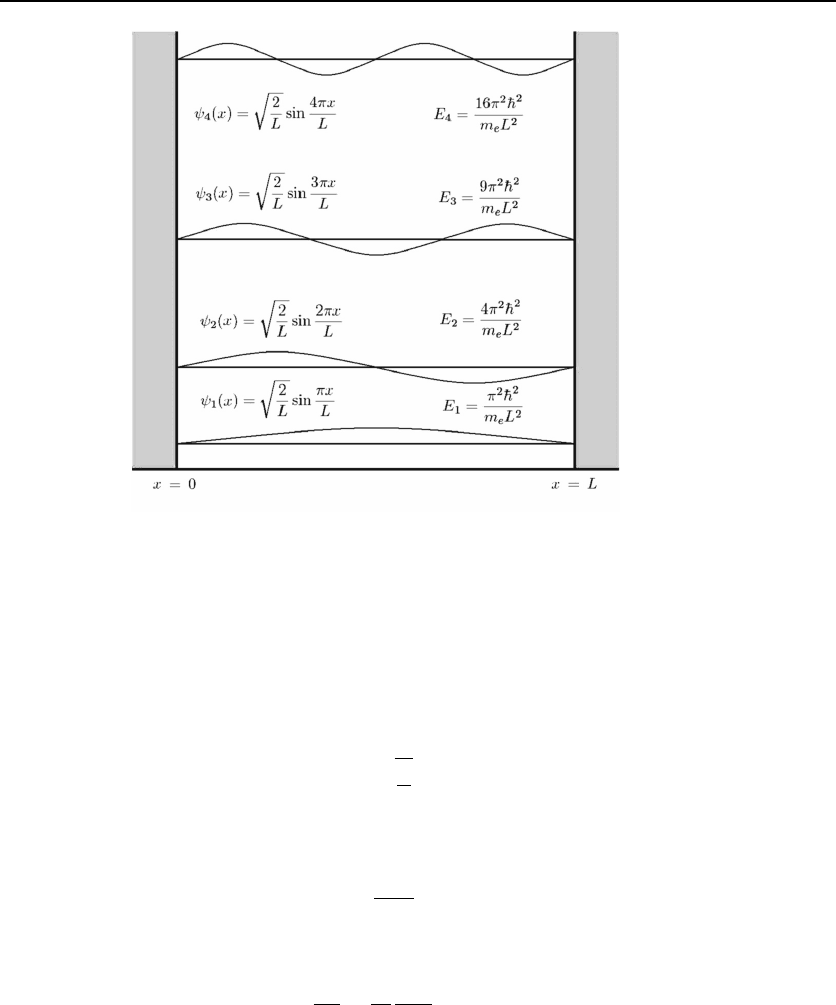
An instructive problem in quantum mechanics is an electron in a one-dimensional
potential well; see Fig. 7.1. The Hamiltonian is
ˆ
H =
ˆp
2
x
2m
e
+ V (x), (7.14)
where
V (x)=0, 0 <x<L,
V (x)=∞,x<0andx>L.
(7.15)
In terms of coordinate x,Schr¨odinger’s equation 7.13 becomes
−
2
2m
e
d
2
dx
2
+ V (x)
ψ(x)=Eψ(x). (7.16)
Inside the box, 0 <x<L, V (x) = 0. Equation 7.16 is reduced to
−
2
2m
e
d
2
ψ(x)
dx
2
= Eψ(x). (7.17)
At x = 0 and x = L, the wavefunction should vanish because the electron cannot
penetrate an infinitely high potential barrier, which implies two boundary conditions
ψ(0) = 0, (7.18)
ψ(L)=0. (7.19)
The solution satisfying the first boundary condition (Eq. 7.18) is
ψ(x)=C sin(kx), (7.20)
where C is a constant, and
k =
√
2m
e
E
. (7.21)
The second boundary condition (Eq. 7.19) requires
ψ(L)=C sin(kL)=0, (7.22)
which implies
k =
nπ
L
, (7.23)
where n is an integer. From Eq. 7.21, we obtain the energy levels
E =
n
2
π
2
2
m
e
L
2
. (7.24)
i
i
“ChenSolarEnergy” — 2011/5/17 — 17:56 — page 147 — #174
i
i
i
i
i
i
7.1 Basic Concepts of Quantum Mechanics 147
Figure 7.1 One-dimensional potential well. Energy levels and wavefunctions of an electron in a
one-dimensional potential well.
The constant C is determined by the normalization condition
Z
L
0
|ψ(x)|
2
dx =
Z
L
0
C
2
sin
2
(kx)dx = 1, (7.25)
because the average value of sin
2
(x) is 1/2, which implies
C =
r
2
L
. (7.26)
By rewriting Eq. 7.21, one finds that the energy level E is a quadratic function of
wavevector k,
E =
~
2
k
2
2m
e
. (7.27)
If mass is an unknown parameter, it can be obtained from the coefficient of that
quadratic function,
1
m
e
=
1
~
2
∂
2
E
∂k
2
, (7.28)
which is an essential relation in semiconductor physics to determine the effective mass
of an energy band.

i
i
“ChenSolarEnergy” — 2011/5/17 — 17:56 — page 148 — #175
i
i
i
i
i
i
148 Quantum Transitions
7.1.4 Hydrogen Atom
The hydrogen atom, a miniature solar system composed of a positively changed proton
and a negatively charged electron, is the first test case of quantum mechanics. To date,
it is still the best system in nature for the illustration and understanding of quantum
mechanics. By considering the proton immobile, the quantum state of a hydrogen atom
is the solution of the equation,
ˆ
p
2
2m
e
−
κ
r
|ψ = E|ψ, (7.29)
where κ = q
2
/4π
0
=2.30 × 10
−28
J · m (see Chapter 2) m
e
isthemassofelectron,
and r is the distance from the proton to the electron. The mathematical form of
the Hamiltonian in quantum mechanics is identical to the Hamiltonian in classical
mechanics.
It is interesting to note that, before Schr¨odinger invented wave mechanics in 1927,
the equation of motion of hydrogen in matrix form was resolved by Pauli in 1926, see
Appendix C. Schr¨odinger’s solution in terms of differential equations is more popular,
and can be found in elementary quantum mechanics textbooks. Pauli’s treatment is
more compact and conceptually transparent.
The quantum states of the hydrogen atom can be described by a set of quantum
numbers. The most widely used set of quantum numbers includes the principal quantum
number n, the angular quantum number l, and the magnetic quantum number m.The
energy value of the hydrogen atom depends on only the principal quantum number,
ˆ
H|n, l, m = E
n
|n, l, m, (7.30)
where
E
n
= −
κ
2
m
e
2n
2
2
. (7.31)
The energy of the ground state is E
1
= −2.17 × 10
−18
J=−13.53 eV. In a coordinate
representation, the quantum states are represented by wavefunctions. For example, the
wavefunction of the quantum state with the lowest energy level of a hydrogen atom is
r|1, 0, 0 = ψ
100
(r)=
1
πa
3
0
e
−r/a
0
, (7.32)
where a
0
is the Bohr radius,
a
0
=
2
m
e
κ
∼
=
0.0529 nm = 52.9pm. (7.33)
Although the wavefunction is often a complex function, and not directly observable,
the probability of the charge density proportional to
ρ(r)=|ψ
100
(r)|
2
=
1
πa
3
0
e
−2r/a
0
(7.34)
i
i
“ChenSolarEnergy” — 2011/5/17 — 17:56 — page 149 — #176
i
i
i
i
i
i
7.1 Basic Concepts of Quantum Mechanics 149
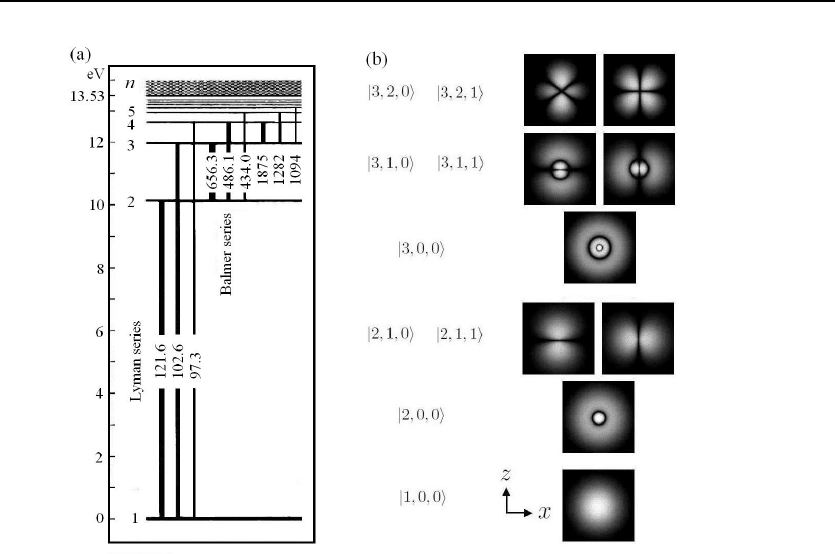
Figure 7.2 Quantum states of hydrogen atom. (a) The energy levels of the stationary states
of the hydrogen atom. The lowest energy level of the hydrogen atom, the ground level, is 13.53 eV
below the vacuum level. A series of energy levels lie between the vacuum level and the ground level.
(b) The probability distributions of the stationary states of the hydrogen atom, determined by the
wavefunctions. The numbers in the Dirac kets are, from left to right, the principal quantum number
n, the angular-momentum quantum number l, and the magnetic quantum number m.
is observable. In fact, both the energy level and the change density can be directly
observed using the scanning tunneling microscope. By definition, the probability is
normalized,
h1, 0, 0|1, 0, 0i =
Z
ρ(r) d
3
r = 4π
Z
∞
0
|ψ
100
(r)|
2
r
2
dr = 1. (7.35)
Figure 7.2 shows the stationary states of the hydrogen atom. Figure 7.2(a) shows
the energy levels. The lowest energy level of the hydrogen atom, the ground level, is
13.53 eV below the vacuum level. A series of energy levels lie between the vacuum
level and the ground level. Radiative transitions, that is, absorption or emission, can
occur between those levels. Figure 7.2(b) shows the charge density distributions of the
stationary states of the hydrogen atom.
The quantum state of hydrogen can be excited to a state with a higher energy level
by absorbing a photon, or de-excited to a state with a lower energy value by emitting
a photon.

i
i
“ChenSolarEnergy” — 2011/5/17 — 17:56 — page 150 — #177
i
i
i
i
i
i
150 Quantum Transitions
7.2 Many-Electron Systems
For atomic systems in nature, in terms of quantum mechanics, only a handful have
analytic solutions: the hydrogen atom in both nonrelativistic and relativistic forms,
and the hydrogen molecular ion, which also has only one electron. For systems with
many electrons, an approximation is necessary. Because the nuclei are much heavier
than electrons, in searching for the solutions of the Schr¨odinger equation for a system
with N electrons, the coordinates of the nuclei r
I
are taken as predetermined fixed
values. The kinetic energy terms of the Hamiltonian T only contains the coordinates
of the electrons,
T = −
2
2m
e
j=N
j=1
∇
2
j
. (7.36)
The potential energy includes the following three terms: the attractive potential be-
tween the electrons and the nuclei,
V
1
= −
I=N
I=1
i=N
i=1
Z
I
κ
|r
I
− r
i
|
; (7.37)
the repulsive potential among the electrons,
V
2
=
j=N
j=1
i=N
i=1
κ
|r
j
− r
i
|
; (7.38)
and the repulsive potential among the nuclei,
V
3
=
I=N
I=1
J=N
J=1
Z
I
Z
J
κ
|r
I
− r
J
|
. (7.39)
The Schr¨odinger equation is
[T + V
1
+ V
2
+ V
3
] |ψ = E|ψ, (7.40)
where |ψ depends on the coordinates of the electrons.
7.2.1 Single-Electron Approximation
Despite the complexity of the problem, a simple and very successful concept, single-
electron approximation, has been applied extensively in condensed-matter physics for
many decades. An earlier version of this approach is the Hartree–Fock method or the
self-consistent field (SCF) method. A later version, density-functional theory (DFT),
makes the numerical computation more efficient and in general more accurate. For
both methods, the problem of the many-electron system can be reduced to a number of
single-electron problems, each electron moving in the mean potential φ formed by the

i
i
“ChenSolarEnergy” — 2011/5/17 — 17:56 — page 151 — #178
i
i
i
i
i
i
7.2 Many-Electron Systems 151
nuclei and the rest of the electrons. Due to advances in computers and computational
algorithms, quantum chemistry has reached a status where the predictions are reliable
and useful.
In the case of a molecule, the solution of the SCF problem generates a series of
stationary states, each with its own wavefunction and energy eigenvalue, which can be
labeled by a positive integer n,
−
2
2m
e
∇ + qφ
|n = E
n
|n. (7.41)
Suppose the molecule is made of nuclei with order number Z
I
. The total positive
charge is
N =
nuclei
I=1
Z
I
. (7.42)
Charge neutrality requires that for the normal state of the molecule there must be N
electrons. following the Pauli exclusion principle, the electrons fill up the states one by
one, starting with the state with the lowest energy value. Once the N-th state is filled,
the molecule becomes neutral.
For solid states, the number of nuclei is effectively infinite, and the labeling of the
single-electron states needs a continuous variable, or a combination of an integer and
a continuous variable. Because the lattice has translational symmetry, a wavevector k
is a good quantum number.
The solutions to the resulting nonlinear equations behave as if each electron is
subjected to the mean field generated by all other particles. Those equations can only
be resolved numerically.
7.2.2 Direct Observation of Quantum States
Until the 1980s, the quantum states of atomic systems were considered merely as math-
ematical conveniences to explain macroscopic physical quantities. After the invention
of the scanning tunneling microscope by Binnig and Rohrer in 1981, the quantum states
of atomic systems, including the molecular orbitals, became directly observable [18].
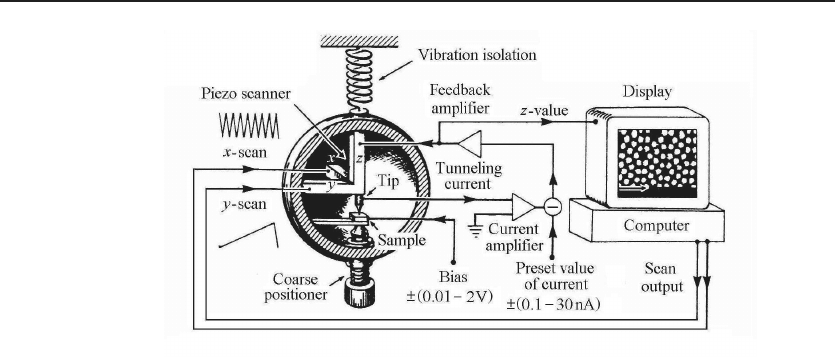
Figure 7.3 shows a schematic of a scanning tunneling microscope. A probe tip,
usually made of W or Pt–Ir alloy, is attached to a piezodrive, which consists of three
mutually perpendicular piezoelectric transducers: x− piezo, y− piezo, and z-piezo.
Upon applying a voltage, a piezoelectric transducer expands or contracts. By applying
a sawtooth voltage on the x-piezo and a voltage ramp on the y-piezo, the tip scans on
the xy-plane. Using the coarse positioner and the z-piezo, the tip and the sample are
brought to within a fraction of a nanometer from each other. The electron wavefunc-
tions in the tip overlap electron wavefunctions in the sample surface. A finite tunneling
conductance is generated. By applying a bias voltage between the tip and the sample,
a tunneling current is generated.
The tunneling current is converted to a voltage by the current amplifier, which is
then compared with a reference value. The difference is amplified to drive the z-piezo.
i
i
“ChenSolarEnergy” — 2011/5/17 — 17:56 — page 152 — #179
i
i
i
i
i
i
152 Quantum Transitions
Figure 7.3 Scanning tunneling microscope. The scanning waveforms, on the x- and y-piezos,
make the tip raster scan on the sample surface. A bias voltage is applied between the sample and
the tip to induce a tunneling current. The z-piezo is controlled by a feedback system to maintain the
tunneling current constant. The voltage on the z-piezo represents the local height of the topography.
To ensure stable operation, vibration isolation is essential [18].
The phase of the amplifier is chosen to provide a negative feedback: if the absolute
value of the tunneling current is larger than the reference value, then the voltage
applied to the z-piezo tends to withdraw the tip from the sample surface, and vice
versa. Therefore, an equilibrium z-position is established. As the tip scans over the
xy-plane, a two-dimensional array of equilibrium z-positions, representing a contour
plot of the equal tunneling-current surface, is obtained, displayed, and stored in the
computer memory.
Therefore, the STM image can display simultaneously the energy level (by varying
the bias voltage) and the wavefunction (by displaying the electron charge density).
7.2.3 Quantum States of Molecules: HOMO and LUMO
Consider a molecule with N positive charges; see Eq. 7.42. The Pauli exclusion princi-
ple requires that each state (with different spin as different states) can only be occupied
by one electron. By adding electrons one after another starting from the lowest state,
with N electrons, the molecule becomes neutral. The state or molecular orbital with
highest energy level of a neutral molecule is the highest occupied molecular orbital
(HOMO). The state with energy level above that HOMO is unoccupied for a neutral
molecule, and is called the lowest unoccupied molecular orbital (LUMO). For organic
molecules having a connection to a piece of conductor, HOMO is below the Fermi level.
Otherwise the electron in that state can escape to form a positive molecular ion. On
the other hand, the LUMO is above the Fermi level. Otherwise an electron from the
connected conductor can occupy it to form a negative molecular ion.
Using STM, the electron charge density and the energy level of the HOMO or LUMO
can be directly observed. Figure 7.4 illustrates the tunneling current and tunneling