
Chen C.J. Physics of Solar Energy
Подождите немного. Документ загружается.

i
i
“ChenSolarEnergy” — 2011/5/17 — 17:56 — page 92 — #119
i
i
i
i
i
i
92 Tracking Sunlight
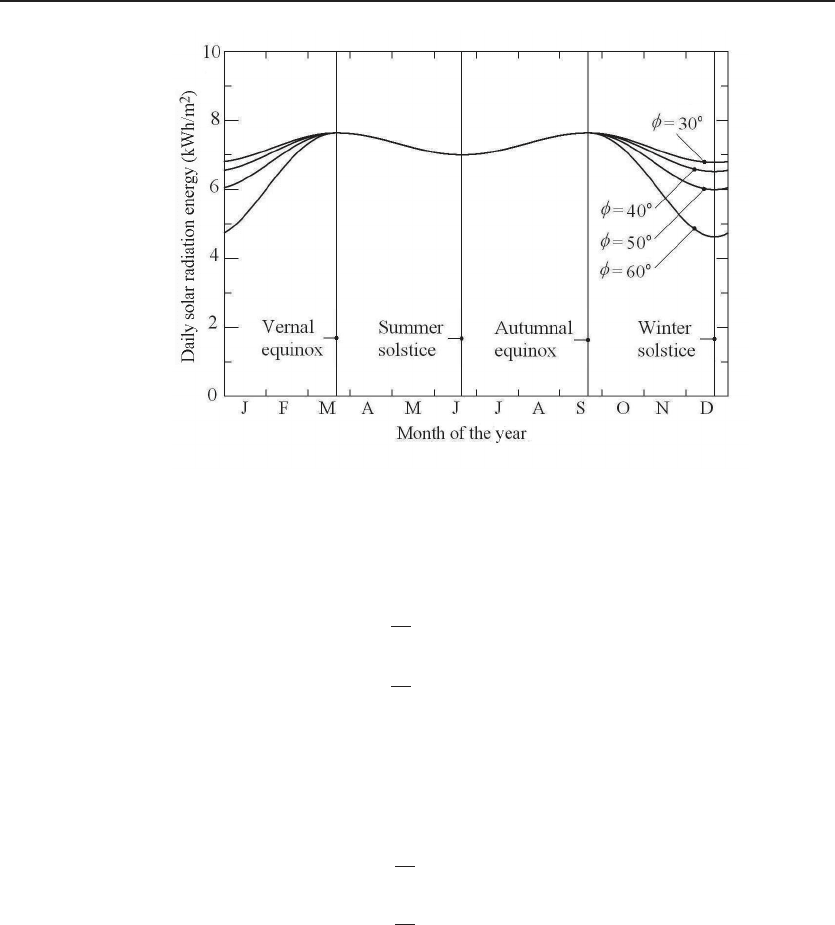
Figure 4.10 Daily solar radiation energy on a latitude-tilt surface. Solar panels placed on
a latitude-tilt surface enjoy almost the maximum solar radiation over the entire year.
only limited by the angle of incidence,
H
D
=
12
π
cos δ
π/2
−π/2
cos ωdω
=
24
π
cos δ.
(4.53)
As shown in Fig. 4.10, in this period of the year, the daily radiation energy is inde-
pendent of latitude. However, between the autumnal equinox and the vernal equinox
of the next year, sunrise is later than 6:00 am and sunset is earlier than 6:00 pm. The
daily radiation energy is
H
D
=
12
π
cos δ
ω
s
−ω
s
cos ωdω
=
24
π
cos δ sin ω
s
.
(4.54)
Also shown in Fig 4.10, the radiation energy is reduced and depends on the latitude of
the location, but not by much. Over the entire year, maximum solar radiation energy
is obtained.
If the surface is allowed to follow the apparent motion of the Sun, the daily radiation
energy can be further enhanced. Consider a solar panel mounted on an axis parallel to
i
i
“ChenSolarEnergy” — 2011/5/17 — 17:56 — page 93 — #120
i
i
i
i
i
i
4.3 Treatment in Solar Time 93
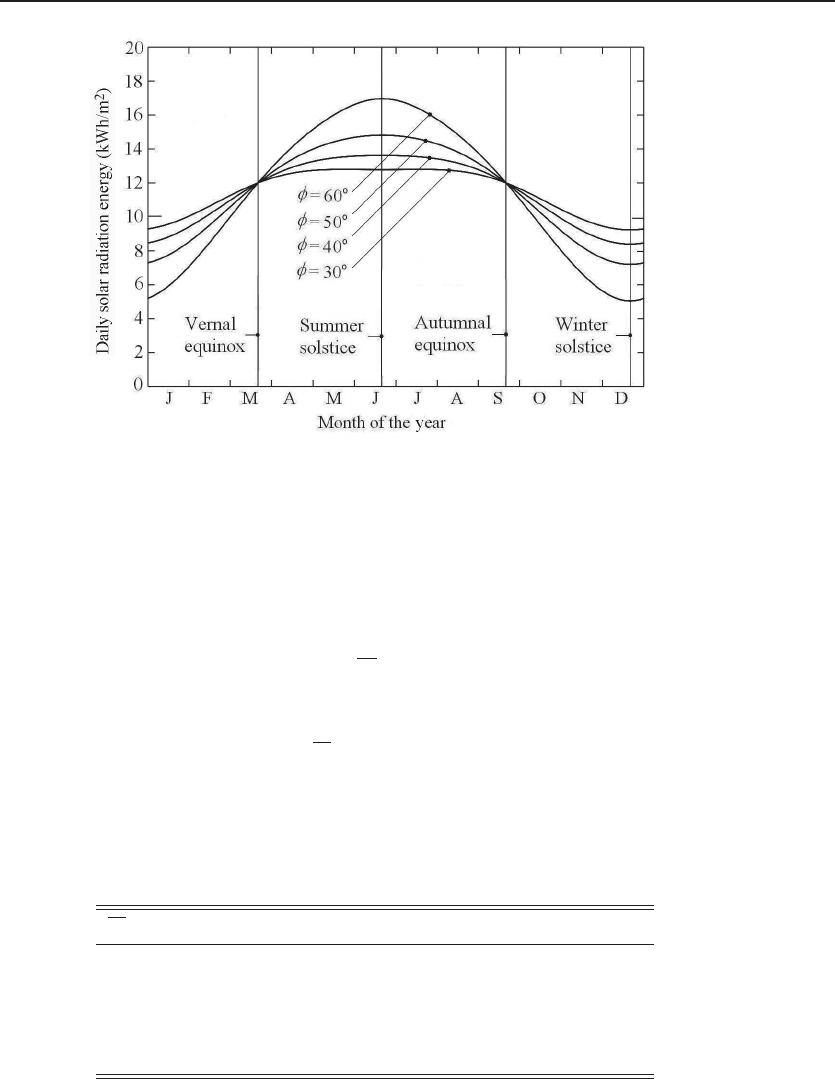
Figure 4.11 Daily solar radiation energy on a surface with tracking. Daily radiation received
by a solar panel mounted on an axis parallel to the axis of Earth and the rotates uniformly one turn per
day, similar to that on Plate 7. The average daily solar radiation over the entire year is independent
of latitude, see Table 4.2.
the axis of Earth and that rotates uniformly one turn per day. The daily solar radiation
energy is
H
D
=
24
π
cos δω
s
. (4.55)
As shown in Fig. 4.11, the daily solar radiation on a surface with single-axis tracking
is substantially higher than for fixed surfaces. The advantage is more apparent in the
average direct daily solar radiation
H
D
over a year, as shown in Table 4.2. The solar
radiation on a surface with tracking is more than 50% higher than all fixed surfaces.
Nevertheless, because of the effect of shadows, it does not save horizontal area.
Table 4.2: Average Daily Solar Radiation on Various Surfaces
H
D
in kWh/day at Latitude 30
◦
40
◦
50
◦
60
◦
Vertical, facing south 3.72 4.57 5.25 5.60
Vertical, facing west or east 3.31 2.93 2.46 1.91
Horizontal 6.25 5.43 4.39 3.11
Latitude tilt facing south 7.27 7.21 7.08 6.77
Optimum single-axis tracking 11.50 11.50 11.50 11.50

i
i
“ChenSolarEnergy” — 2011/5/17 — 17:56 — page 94 — #121
i
i
i
i
i
i
94 Tracking Sunlight
4.3.5 The 24 Solar Terms
As shown in previous sections, the motion of the Sun in a calendar year is determined
by the Sun’s ecliptic longitude l. The vernal equinox at l =0
◦
or 360
◦
, the summer
solstice at l =90
◦
, the autumnal equinox at l = 180
◦
, and the winter solstice at
l = 270
◦
are the four cardinal points. To study the position of the Sun over a year,
more points are needed. In traditional Western calendars, including the Julian calendar
and the Gregorian calendar, the definitions of the 12 months are not based on natural
phenomena. The calendars are not accurately synchronized with the motion of the
Sun. Therefore, it is inaccurate and inconvenient to use calendar dates to specify the
motion of the Sun.
In East Asia, however, for over two thousand years, a purely solar-based calendar
system has been used: the 24 solar terms. It is defined solely on the basis of the orbital
motion of Earth around the Sun. Similar to dividing a mean solar day into 24 h,
Table 4.3: The 24 Solar Terms
No. Name In Pinyin l (deg) Approx. date
0 Winter solstice D¯ongzh`ı 270
◦
December 22
1 Minor cold Xi˘aoh´an 285
◦
January 6
2Majorcold D`ah´an 300
◦
January 20
3 Spring commences L`ıch¯un 315
◦
February 4
4 Rain water Y˘ush˘ui 330
◦
February 19
5 Insect awakes J¯ıngzh´e 345
◦
March 6
6 Vernal equinox Ch¯unf¯en 0
◦
March 21
7 Pure brightness Q¯ıngm´ıng 15
◦
April 5
8 Grain rain G˘uy˘u30
◦
April 20
9 Summer commences L`ıxi`a45
◦
May 6
10 Grain forms Xi˘aom˘an 60
◦
May 21
11 Grain in ear M´angzh`ong 75
◦
June 6
12 Summer solstice Xi`azh`ı90
◦
June 21
13 Minor heat Xi˘aosh˘u 105
◦
July 7
14 Major heat D`ash˘u 120
◦
July 23
15 Autumn commences L`ıqi¯u 135
◦
August 8
16 Heat recedes Ch˘ush˘u 150
◦
August 23
17 White dew B´ail˘u 165
◦
September 8
18 Autumnal equinox Qi¯uf¯en 180
◦
September 23
19 Cold dew H´anl˘u 195
◦
October 8
20 Frost descents Shu¯angji`ang 210
◦
October 23
21 Winter commences L`ıd¯ong 225
◦
November 7
22 Minor snow Xi˘aoxu˘e 240
◦
November 22
23 Major snow D`axu˘e 255
◦
December 7

i
i
“ChenSolarEnergy” — 2011/5/17 — 17:56 — page 95 — #122
i
i
i
i
i
i
the solar term system divides a solar year (the time between two consecutive vernal
equinoxes) into 24 equal parts; see Table 4.3. Each year, the exact date and time of
day of each of the 24 solar terms is published in the Almanac. The date and time for
the four cardinal points in years 2011 through 2020 is shown in Table 4.4. Because
the rough coordination of the date in the Gregorian calendar with vernal equinox, the
dates differ for only one or two days from year to year. Since the ecliptic longitude l of
the Sun at each solar term is well defined, by using the formula of the Sun’s declination
(Eq. 4.27), the declination of the Sun at the 24 solar terms can be calculated,
δ ≈ ε sin l = ε sin
(S − 6) π
12
, (4.56)
where S is the order of the solar term, shown in Table 4.3. The number 6 is taken
because in Table 4.3, vernal equinox is number 6.
Traditionally, in the Asian calendar, the first solar term is defined as spring com-
mences. It is equivalent to defining 3 am early morning as the starting time of a day.
This tradition was established probably because spring commences means the starting
of agricultural activities of a year. The logical starting solar term is the winter solstice,
which is equivalent to defining midnight as the starting time of a day.
4.4 Treatment in Standard Time
For several millennia, all over the world, humans have been using the motion of the Sun
for time keeping, the solar time. However, because the motion of the Sun is not uniform,
solar time shows significant deviation from the time defined by uniform motion, for
example, the rotation of Earth, the pendulum, or an atomic clock, represented by the
motion of the fictitious mean sun. The difference could be as much as 16 min or more.
In order to make a sunlight tracking system based on standard time, the difference
must be taken into account to reasonable accuracy. In this section, we will present
a treatment which is simple to understand and program and yet accurate enough for
solar energy utilization.
4.4.1 Sidereal Time and Solar Time
To very high accuracy, the angular velocity of Earth’s rotation is a constant. Therefore,
the time interval between two consecutive passages of a given fixed star over an ob-
server’s meridian is a constant, which is an accurate measure of time, the sidereal day.
The word sidereal was derived from the Latin sideus, which means “star”. However,
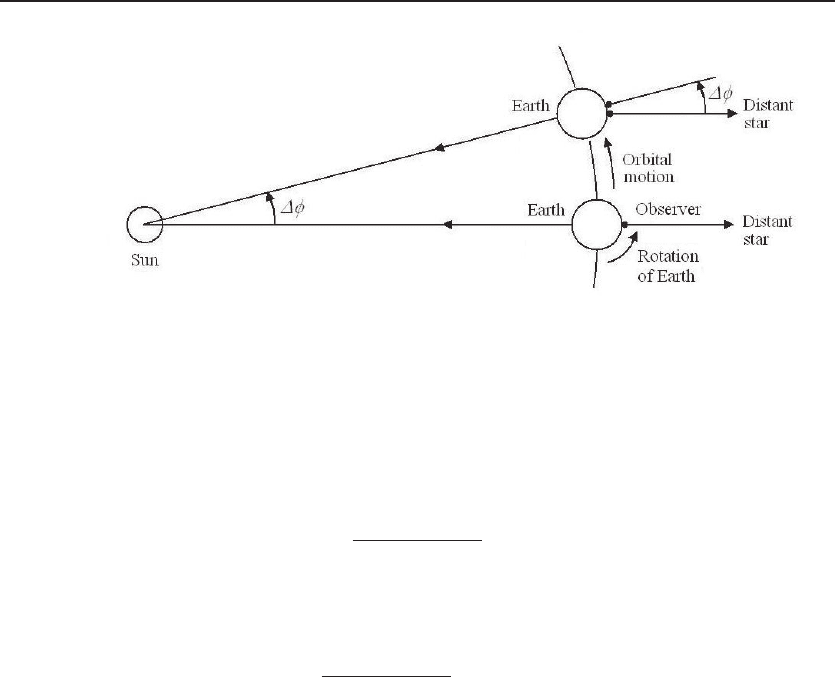
because Earth also has an orbital motion around the Sun, the duration of the solar day
is different from the sidereal day; see Fig. 4.12. For example, at midnight, an observer
sees a distant fixed star at its meridian. At the time the same star passes the meridian
again, Earth has rotated about the Sun by an angle
Δφ =
360
◦
365.2422
=59
08
. (4.57)
4.4 Treatment in Standard Time 95
i
i
“ChenSolarEnergy” — 2011/5/17 — 17:56 — page 96 — #123
i
i
i
i
i
i
96 Tracking Sunlight
Figure 4.12 Sidereal time and solar time. Because Earth has a rotation on its axis and an
orbital motion around the Sun, the duration of the solar day is different from the sidereal day. A solar
day is 0.273% longer than the sidereal day.
Therefore, a solar day is 0.273% longer than the sidereal day. Because solar time is
takenastimeasweknow,andrememberthata360
◦
angle of rotation corresponds to
24 h, it equals
24
h
mean solar time =
24
h
× 366.2422
365.2422
=24
h
3
m
56
s
sidereal time. (4.58)
the length of one sidereal day is
24
h
sidereal time =
24
h
× 365.2422
366.2422
=23
h
56
m
04
s
mean solar time. (4.59)
In the above equations, we introduced the term mean solar time. Hereweareusing
a simplified model for the orbital motion of Earth around the Sun, namely, a perfect
circle on the sidereal equator with a uniform angular speed. From the point of view
of an observer on Earth, such a fictitious Sun of uniform motion along the celestial
equator is called the mean sun.
From Fig. 4.12, the actual value of time depends on the location of the observer.
Specifically, it depends on the longitude of the observer. To make a universal time, a
standard longitude must be selected. Similar to the case of the origin of longitude, the
standard longitude for the universal time is selected as the prime longitude located at
Greenwich. The time starting at midnight at Greenwich is called Greenwich mean time
(GMT), or more often, universal time (UT).
The world is divided into time zones. Each zone has a definition of time which
differs mostly an integer number of hours from the GMT or UT. For example, Eastern
standard time (EST) is defined as UT−5h. In the summer, Eastern daylight saving
time (EDT) is defined as UT−4h.
i
i
“ChenSolarEnergy” — 2011/5/17 — 17:56 — page 97 — #124
i
i
i
i
i
i
4.4.2 Right Ascension of the Sun
As discussed in section 4.2, in the equatorial coordinate system, the position of a star
can be characterized by the declination and the hour angle. The declination of a star
does not vary over time. However, because of the rotation of Earth, the hour angle of
a star varies over time. Uusing the right ascension α instead of the hour angle, the
coordinates of each fixed star are, to a high degree of accuracy, fixed.
Similar to the case of longitude on Earth, a fixed point on the celestial sphere should
be chosen as the reference point. The point universally chosen is the vernal equinox Υ,
the point where the Sun passes the celestial equator while heading north; see Fig. 4.13.
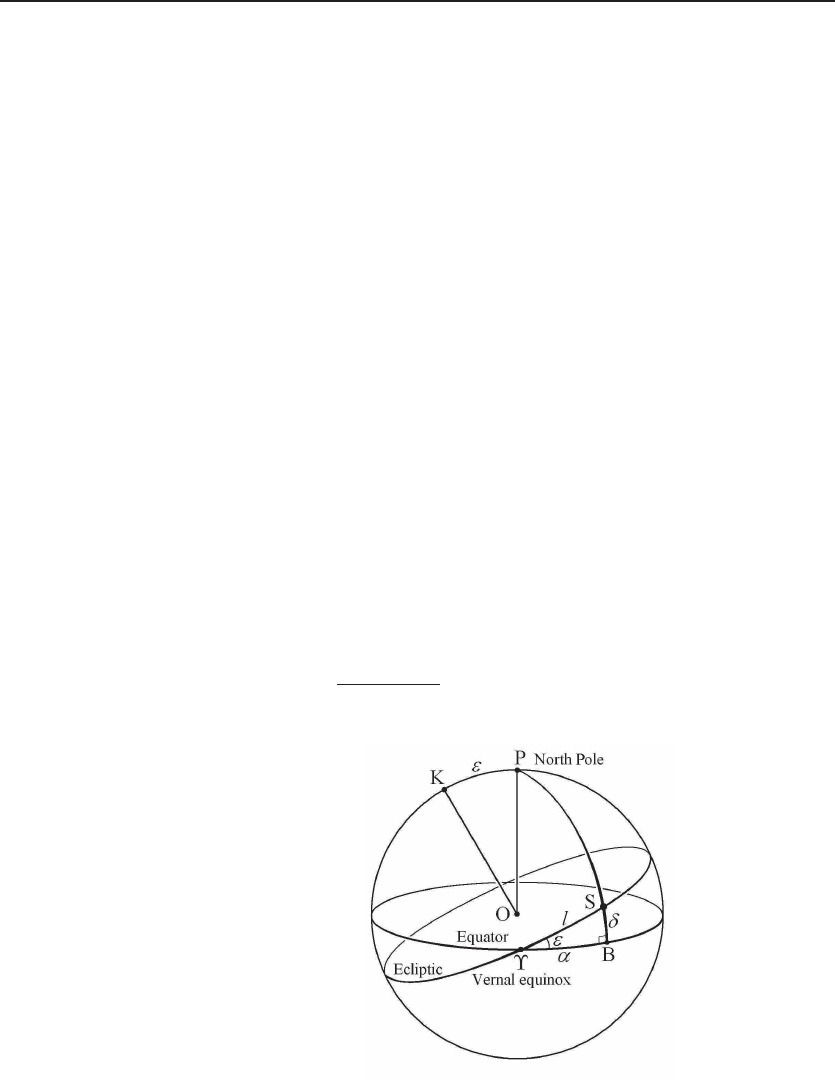
The angle between the intersection of the meridian passing through the star S with
the equator B and the vernal equinox Υ is called the right ascension of the star. The
sign convention is opposite to that of the hour angle: It is measured eastward. For
the treatment of the motion of the Sun, this convention is natural, because it increases
with the number of the day in the year;
4.4.3 Time Difference Originated from Obliquity
As mentioned previously, there are two origins of the difference between the motion of
the true sun and the mean sun. The first is the obliquity ε. Time is measured by the
angle of the mean sun on the equator, but the true sun is moving on the ecliptic plane.
Assuming that the Sun is moving uniformly on the ecliptic circle, its mean longitude l
is a linear function of time. The mean longitude of the Sun increases by 2π during a
calendar year; see Fig. 4.13. Taking the number of the day N as the unit of time and
the vernal equinox Υ as the origin, which is March 20 or 21, approximately the 80st
day of the year, the mean longitude in radians is
l =
2π (N − 80)
365.2422
. (4.60)
Figure 4.13 Obliquity and
equation of time. Because of
obliquity, even if Earth is orbit-
ing the Sun with a uniform an-
gular speed, the projection of the
speed of the apparent motion of
Sun on the equator is not uni-
form. It gives rise to a term of
the difference between mean so-
lar time and true solar time with
a periodicity of half a year.
4.4 Treatment in Standard Time 97

i
i
“ChenSolarEnergy” — 2011/5/17 — 17:56 — page 98 — #125
i
i
i
i
i
i
98 Tracking Sunlight
The number of the day N can be computed using Eq. 4.28. The accurate date and
time for vernal equinox is shown in Table 4.4.
Because of obliquity, the projection of the longitude l on the celestial equator, the
right ascension α, is not linear over time. Using the formula for a rectangular spherical
triangle, we find the relation
tan α =cosε tan l. (4.61)
Currently, ε ≈ 23.44
◦
, and cos ε ≈ 0.917, very close to 1. Using a trigonometry identity
cos ε =
1 − tan
2
ε
2
1 + tan
2
ε
2
, (4.62)
Eq. 4.61 can be written as
tan l − tan α
tan l +tanα
=tan
2
ε
2
. (4.63)
Using the obvious relation
tan l − tan α
tan l +tanα
=
sin l cos α −cos l sin α
sin l cos α +cosl sin α
=
sin(l −α)
sin(l + α)
, (4.64)
we find
sin(l −α)
sin(l + α)
=tan
2
ε
2
. (4.65)
Because l −α is a small quantity, and hence sin(l −α) ≈ l −α and sin(l + α) ≈ sin(2l),
we obtain a formula up to the first order of ε
2
,
l −α ≈ tan
2
ε
2
sin(2l) ≈ 0.043 sin(2l). (4.66)
4.4.4 Aphelion and Perihelion
The second difference between the fictitious mean sun and the true sun is that the orbit
of Earth is elliptical rather than circular. The distance between Earth and the Sun is
farthest at aphelion and closest at perihelion. Aphelion is derived from the Greek words
apo (“away from”) and helios (“sun”), while perihelion includes the Greek word peri
(“near”). The date and the hour in the day of each aphelion and perihelion for 2011
to 2020 are shown in Table 4.4. (The accuracy of the time for aphelion and perihelion
is only up to the hour, whileas the accuracy of equinoxes and solstices is up to the
minute). The distance of the Earth and the Sun is about 3% further at aphelion than
it is at perihelion. Because radiation intensity is inversely proportional to the square of
distance, the solar radiation power in early January is 6% stronger than that in early
July.

i
i
“ChenSolarEnergy” — 2011/5/17 — 17:56 — page 99 — #126
i
i
i
i
i
i
Table 4.4: Cardinal Points in Years 2011 through 2020
Year Perihelion Aphelion Equinoxes Solstices
2011 Jan 3, 19h Jul 4, 15h Mar 20, 23:21 Jun 21, 17:16
Sep 23, 09:05 Dec 22, 05:30
2012 Jan 5, 01h Jul 5, 04h Mar 20, 05:14 Jun 20, 23:09
Sep 22, 14:49 Dec 21, 11:12
2013 Jan 2, 05h Jul 5, 15h Mar 20, 11:02 Jun 21, 17:16
Sep 22, 20:44 Dec 22, 05:30
2014 Jan 4, 12h Jul 4, 00h Mar 20, 16:57 Jun 21, 16:38
Sep 23, 02:29 Dec 22, 04:48
2015 Jan 4, 07h Jul 4, 15h Mar 20, 22:45 Jun 21, 17:16
Sep 23, 08:21 Dec 22, 05:30
2016 Jan 2, 23h Jul 4, 16h Mar 20, 04:30 Jun 20, 22:34
Sep 22, 14:21 Dec 21, 10:44
2017 Jan 4, 14h Jul 3, 20h Mar 20, 10:29 Jun 21, 04:24
Sep 22, 20:02 Dec 21, 16:28
2018 Jan 3, 06h Jul 6, 17h Mar 20, 16:15 Jun 21, 10:07
Sep 23, 01:54 Dec 21, 22:23
2019 Jan 3, 05h Jul 4, 22h Mar 20, 21:58 Jun 21, 15:54
Sep 23, 07:50 Dec 22, 04:19
2020 Jan 5, 08h Jul 4, 12h Mar 20, 03:50 Jun 20, 21:44
Sep 22, 13:31 Dec 21, 10:02
4.4.5 Time Difference Originated from Eccentricity
The eccentricity of the orbit of Earth around the Sun gives rise to a second term in the
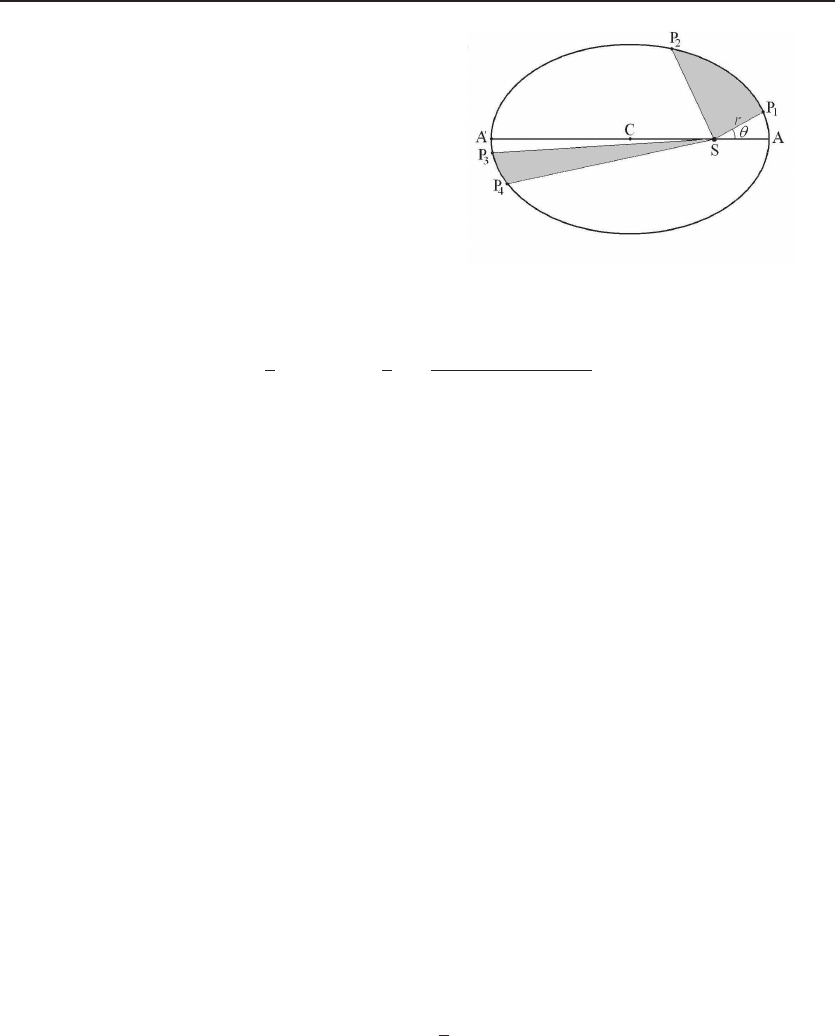
equation of time. According to Kepler’s first law, the orbit of Earth around the Sun is
an ellipse, and the position of the Sun is at a focus of the ellipse. From the point of
view of Earth, the Sun is orbiting Earth along an ellipse,
r =
p
1+e cos(θ − θ
0
)
, (4.67)
where r is the instantaneous distance between the Sun and Earth; e is the eccentricity
of the ellipse, currently e =0.0167; θ is the true longitude of the Sun along the ecliptic;
θ
0
is the true longitude of the perihelion; and p is a constant.
According to Kepler’s second law, the radius vector of the ellipse sweeps out equal
4.4 Treatment in Standard Time 99
i
i
“ChenSolarEnergy” — 2011/5/17 — 17:56 — page 100 — #127
i
i
i
i
i
i
100 Tracking Sunlight
Figure 4.14 Eccentricity of Earth’s
orbit: Kepler’s laws. According to
Kepler’s laws, Earth is moving around
the Sun on an elliptical orbit. It gives
rise to a term of the difference between
mean solar time and true solar time with
periodicity of a year.
areas in equal times:
1
2
t
0
r
2
dθ =
1
2
t
0
p
2
[1 + e cos(θ − θ
0
)]
2
dθ ∝ t. (4.68)
Because the eccentricity e is small, the integrand of Eq. 4.68 can be expanded into a
power series,
t ∝
t
0
[1 − 2e cos(θ − θ
0
)] dθ = θ − 2e sin(θ − θ
0
). (4.69)
For an entire year, the longitude increases by 2π, and the sine function returns to its
original value.
Now, we relate the true longitude of the Sun, θ, with the mean longitude l discussed
in the last section, which is proportional to time. For a calendar year, both quantities
increase by 2π. Therefore,
l = θ − 2e sin(θ − θ
0
). (4.70)
If the eccentricity e is negligibly small, we have
θ = l. (4.71)
For a first-order approximation, we substitute θ in the second term of Eq. 4.70 with l,
which yields
θ = l +2e sin(l − l
0
), (4.72)
where l
0
is the longitude of perihelion. The second term in Eq. 4.72 arises from the
eccentricity of the orbit.
4.4.6 Equation of Time
By combining Eq. 4.72 with Eq. 4.66, we obtain a complete expression of the equation
of time (ET) up to the first order of obliquity and the first order of eccentricity, e =
0.0167,
ET = l − α =tan
2
ε
2
sin(2l) −2e sin(l − l
0
)
≈ 0.043 sin(2l) − 0.0334 sin(l − l
0
).
(4.73)
i
i
“ChenSolarEnergy” — 2011/5/17 — 17:56 — page 101 — #128
i
i
i
i
i
i
The unit of angles, l and α, is in radians. A complete circle is 2π. To convert the
unit to time as we know, we notice that the mean Sun revolves around Earth every
24 hours. The time it takes for the mean Sun to catch up the true Sun, or vice versa,
following Eq. 4.73, is
ET(min) =
24 × 60
2 π
[0.043 sin(2l) − 0.0334 sin(l − l
0
)]
=9.85 sin(2l) − 7.65 sin(l − l
0
).
(4.74)
In Eq. 4.74, as usual, the time difference is expressed in minutes. Using the approximate
formula for the mean longitude l, Eq. 4.27, an explicit expression of the equation of
time can be obtained,
ET =
9.85 sin
4π (N − 80)
365.2422
− 7.65 sin
2π (N − 3)
365.2422
(min). (4.75)
Here the date of perihelion is assumed to be January 3. The number of the day in a
year N can be computed using Eq. 4.28. Equation 4.75 is sufficiently accurate to deal
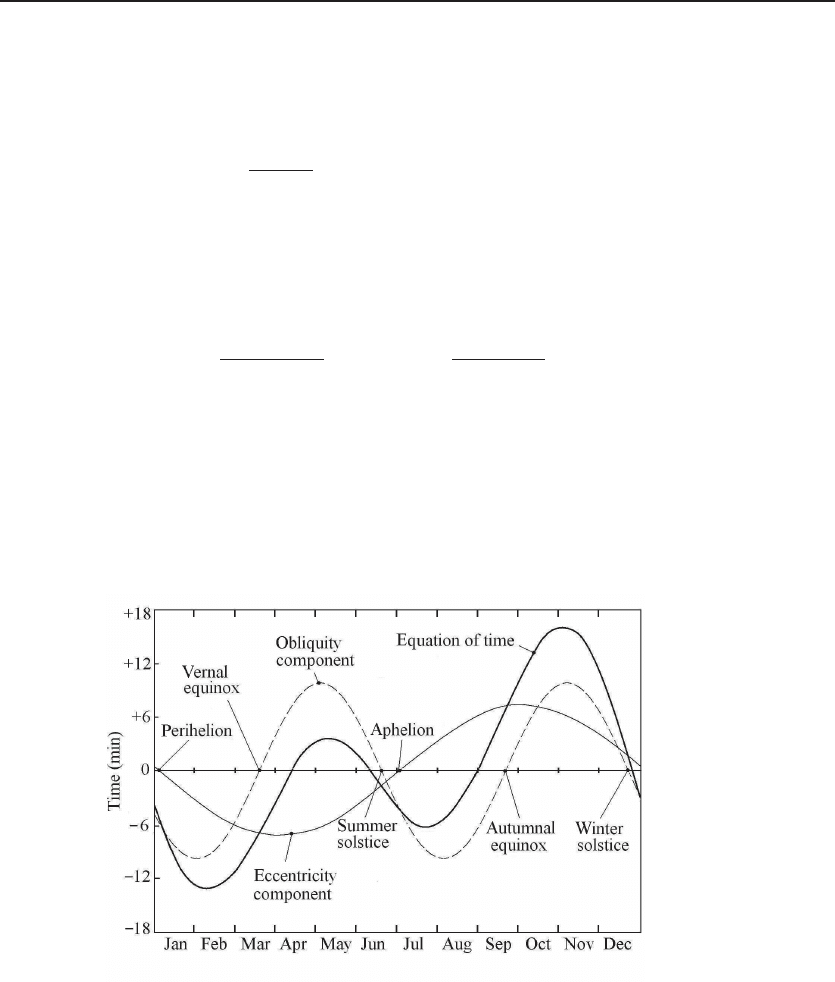
with problems in sunlight tracking. A chart is shown in Fig. 4.15. Remember that
hour angle ω is to the negative of right ascension α, the equation of time ET should be
added to the hour angle of the Sun, which means that if ET is positive, the real Sun is
faster than the mean Sun.
Figure 4.15 Equation of time. Thick solid curve, the difference between mean solar time and
true solar time, the so-called equation of time has two terms. The first term, the thin solid curve, has
a periodicity of a year, originated from the eccentricity of the orbit, which starts at aphelion. The
second term, the dashed curve, originated from the obliquity of the ecliptic, has a periodicity of half
a year, and starts at the vernal equinox.
4.4 Treatment in Standard Time 101