
Chen C.J. Physics of Solar Energy
Подождите немного. Документ загружается.


i
i
“ChenSolarEnergy” — 2011/5/17 — 17:56 — page 173 — #200
i
i
i
i
i
i
8.3 Analysis of pn-Junctions 173
It is equivalent to two first-order differential equations in the same sense that x
2
=4
is equivalent to x = 2 and x = −2,
dδn
p
(x)
dx
=
1
√
τ
n
D
n
δn
p
(x) (8.40)
dδn
p
(x)
dx
= −
1
√
τ
n
D
n
δn
p
(x), (8.41)
which represent decays to the +x and −x directions, respectively. To account for
junction current, for each side of the junction, only one of the two is needed. The
diffusion current of electrons is
I
n
= qD
n
dδn
p
(x)
dx
= q
D
n
τ
n
δn
p
(x). (8.42)
At x = 0, using Eq. 8.35, the junction current of electrons is
I
n
(x
p
=0)=−q
D
n
τ
n
n
p
exp
qV
k
B
T
− 1
. (8.43)
Similarly, for holes,
I
p
(x
n
=0)=q
D
p
τ
p
p
n
exp
qV
k
B
T
− 1
. (8.44)
The total junction current is
I = q
D
n
τ
n
n
p
+
D
p
τ
p
p
n
exp
qV
k
B
T
− 1
. (8.45)
Furthermore, using the approximate relations
p
n
=
n
2
i
N
D
,n
p
=
n
2
i
N
A
, (8.46)
Eq. 8.45 can be reduced to
I = qn
2
i
1
N
A
D
n
τ
n
+
1
N
D
D
p
τ
p
exp
qV
k
B
T
− 1
. (8.47)
8.3.4 Shockley Equation
Denoting a constant
I
0
≡ qn
2
i
1
N
A
D
n
τ
n
+
1
N
D
D
p
τ
p
, (8.48)
i
i
“ChenSolarEnergy” — 2011/5/17 — 17:56 — page 174 — #201
i
i
i
i
i
i
174 pn-Junctions
Eq. 8.47 is simplified to the well-known form of the diode equation, also known as the
Shockley equation,
I = I
0
e
qV/k
B
T
− 1
. (8.49)
By applying a large reversed bias voltage on the diode, the exponential term van-
ishes. The current I = −I
0
. Therefore, the constant I
0
is the reverse saturation current
density. A question that remains to be answered is whether in the above derivation
of the diode equation only the current at the border of the space-charge region (the
transition region) and the neutral region is counted. What about the current deep in
the neutral regions? The simple answer is, the electric current must be continuous. As
the minority carriers are recombined with the majority carriers, there is a continuous
current of majority carriers to replenish the lost ones. Because the concentration of
majority carriers is orders of magnitude greater than that of the minority carriers, the
disturbance caused by such a current is very minor.
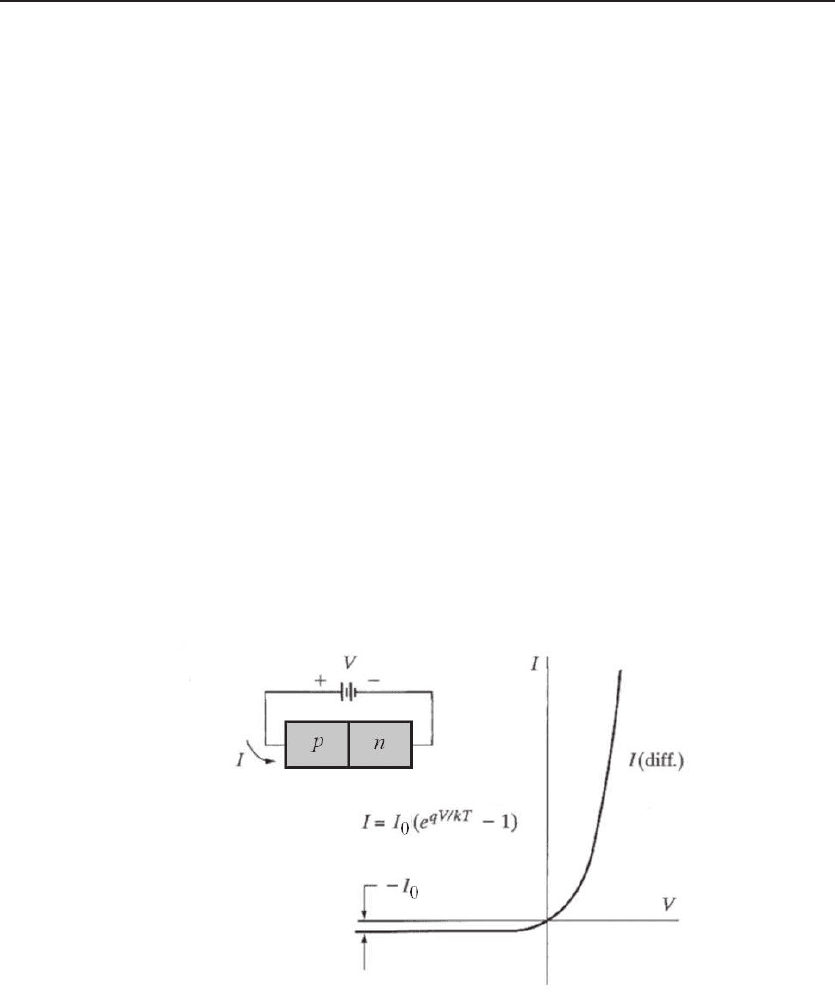
Figure 8.9 shows the current–voltage behavior of a pn-junction. According to the
diode equation 8.49, in the first quadrant with a forward bias at room temperature,
the current is growing exponentially, about one order of magnitude per 60 mV. In the
third quadrant, as the applied voltage exceeds 100 mV the current reaches a saturated
value, which is dominated by the drift current. The two sides are highly asymmetric,
which makes the pn-junction the most widely used rectifier.
The quality of a rectifier critically depends on the magnitude of the reverse satura-
tion current density I
0
. As shown in Eq. 8.48, the decisive factor is the minority-carrier
lifetimes τ
n
and τ
p
. The longer the lifetime, the smaller the reverse saturation current
density, and more improved the quality of the rectifier. This fact is equally important
Figure 8.9 Current-voltage behavior of a pn-junction. With a forward bias, at room tem-
perature, the current is growing exponentially, about one order of magnitude per 60 millivolts. In the
third quadrant, as the applied reverse voltage exceeds 100 millivolts, the current reaches a saturate
value, which is dominated by the drift current.

i
i
“ChenSolarEnergy” — 2011/5/17 — 17:56 — page 175 — #202
i
i
i
i
i
i
8.3 Analysis of pn-Junctions 175
for solar cells. As we will show in Chapter 9, the most significant limiting factor of
solar cell efficiency is minority-carrier lifetime. Therefore, in the design and manufac-
ture of solar cells, efforts should be devoted to reducing the rate for minority-carrier
recombination and thus prolong the minority-carrier lifetime.

i
i
“ChenSolarEnergy” — 2011/5/17 — 17:56 — page 176 — #203
i
i
i
i
i
i
176 pn-Junctions
Problems
8.1. A typical silicon solar cell has the following parameters: The p-type material has
acceptor concentration N
A
=1× 10
16
cm
−3
, hole diffusion coefficient D
p
=40cm
2
/s,
and lifetime τ
p
=5μs. The n-type material has donor concentration N
D
=10
19
cm
−3
,
electron diffusion coefficient D
n
=40cm
2
/s, and lifetime τ
n
=1μs. The permittivity of
free space is
0
=8.85×10
−14
F/cm, and the relative permittivity of silicon is
r
=11.8.
The intrinsic carrier concentration in silicon is n
i
=1.5 × 10
10
cm
−3
. Assuming the
built-in potential is qV
0
=0.75 V, calculate the following:
1. Width of transition layer, W
Hint: The donor concentration is too high, thus the n-layer is very thin. The width
of transition layer is effectively that of the p-layer. The dielectric constant (permittivity)
of silicon is the product of the permittivity of free space and the relative permittivity
of silicon.
2. Diffusion lengths for holes and electrons
3. Saturation current density I
0
4. The pn-junction capacitance of the 10-cm × 10-cm solar cell.
8.2. Show that excess minority carriers decay with x by
δp
n
(x)=δp
n
(0)e
−x/L
p
(8.50)
and
δn
p
(x)=δn
p
(0)e
−x/L
n
, (8.51)
where the diffusion lengths are defined as
L
p
=
D
p
τ
p
(8.52)
L
n
=
D
n
τ
n
. (8.53)
8.3. Using diffusion length as a parameter, show that the junction current is
I = q
D
n
p
n
L
n
+
D
p
n
p
L
p
e
qV/k
B
T
− 1
. (8.54)
8.4. The mobility of holes in silicon is μ
p
=480 cm
2
/V·s at room temperature. What
is its diffusion coefficient D
p
?
Hint: use Einstein’s relation.
i
i
“ChenSolarEnergy” — 2011/5/17 — 17:56 — page 177 — #204
i
i
i
i
i
i
Chapter 9
Semiconductor Solar Cells
The photovoltaic effect, the direct generation of electric power by light in a solid mate-
rial, was discovered by British scientists William Grylls Adams and his student Richard
Evens Day in the 1870s using selenium. A few years later, Charles Fritt of New York
constructed the first photovoltaic module for generating power from sunlight. However,
the efficiency of the selenium solar cells was less than 0.5%, which meant it would not
generate sufficient energy economically.
An important breakthrough was made in the 1950s by Gerald Pearson, Darryl
Chapin, and Calvin Fuller at Bell Labs. Using silicon, they demonstrated a solar cell of
efficiency 5.7%, ten times greater than that of the selenium solar cell; see Section 1.4.
Solar cells first found applications in space. The efficiency of silicon cells has been
improved to about 24% in the early 2000s, very close to the theoretical limit of 28%.
To date, semiconductor solar cells account for roughly 90% of the market share.
Especially, silicon solar cells account for more than 80% of the solar cell market. Thin-
film solar cells, especially those based on CIGS (copper–indium–gallium–selenide) and
CdTe-CdS, are second to silicon solar cells in market share. Organic solar cells, which
will be presented in Chapter 10, is a promising emerging technology.
9.1 Basic Concepts
The solar cell is a solid-state device which converts sunlight, as a stream of photons,
into electrical power. Figure 1.22(b) shows the structure of a typical silicon solar cell.
Thebaseisapieceofp–type silicon, lightly doped with boron, a fraction of a millimeter
thick. A highly doped n–type silicon, with a thickness of a fraction of one micrometer
was generated by doping with phosphorus of much higher concentration. Because of
the built-in potential of the pn-junction, electrons migrate to the n–type region, and
generate electric power similar to an electrochemical battery.
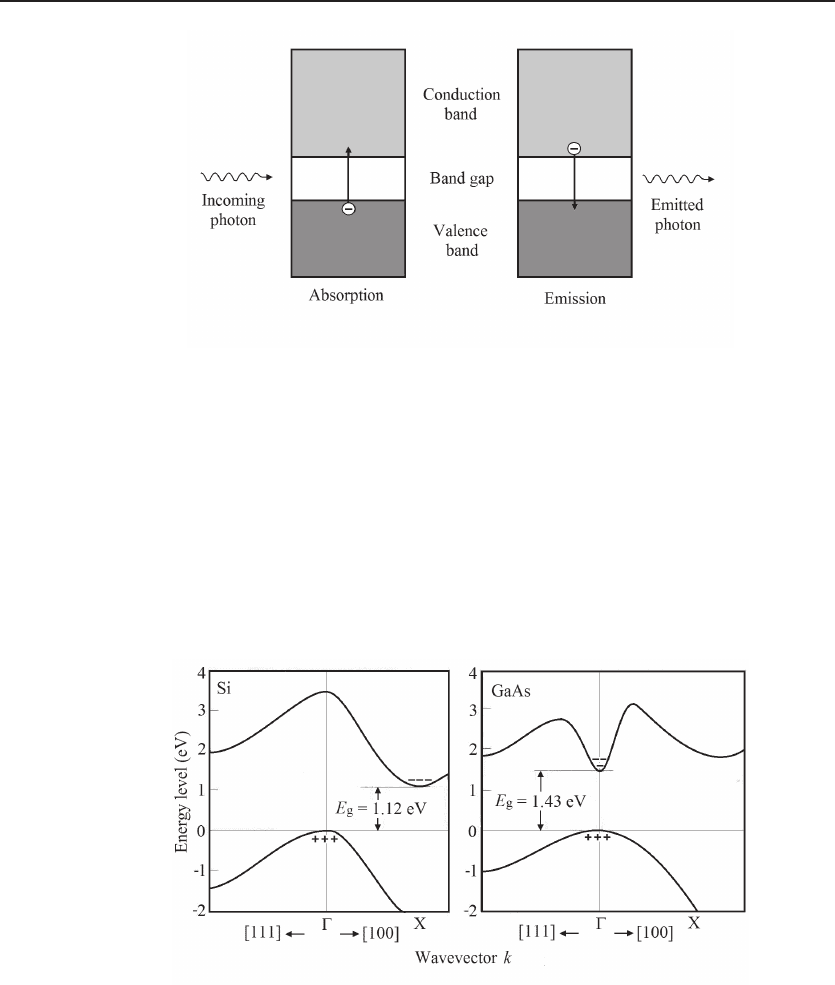
According to the theory of quantum transitions presented in Chapter 7, radiation,
as a stream of photons, interacts with a semiconductor in two ways; see Fig. 9.1. A
photon with energy greater than the gap energy of the semiconductor material can
be absorbed and create an electron–hole pair. An electron–hole pair can recombine
and emit a photon of energy roughly equal to the energy gap of the semiconductor.
According to the principle of detailed balance (see section 7.3.3), the probabilities of
177
Physics of Solar Energy C. Julian Chen
Copyright © 2011 John Wiley & Sons, Inc.
i
i
“ChenSolarEnergy” — 2011/5/17 — 17:56 — page 178 — #205
i
i
i
i
i
i
178 Semiconductor Solar Cells
Figure 9.1 Interaction of radiation with semiconductors. According to the theory of quantum
transitions, a photon with energy greater than the gap energy of the semiconductor material can be
absorbed and create an electron–hole pair. An electron–hole pair can recombine and emit a photon of
energy roughly equal to the energy gap of the semiconductor.
the two processes should equal. This fact has a significant consequence to the efficiency
of solar cells; see Section 9.2.3.
Because the potential energy of the electron–hole pair equals the value of the en-
ergy band, the best material should have a band gap close to the center of the solar
spectrum. Another factor that affects the efficiency of solar cells is the type of the
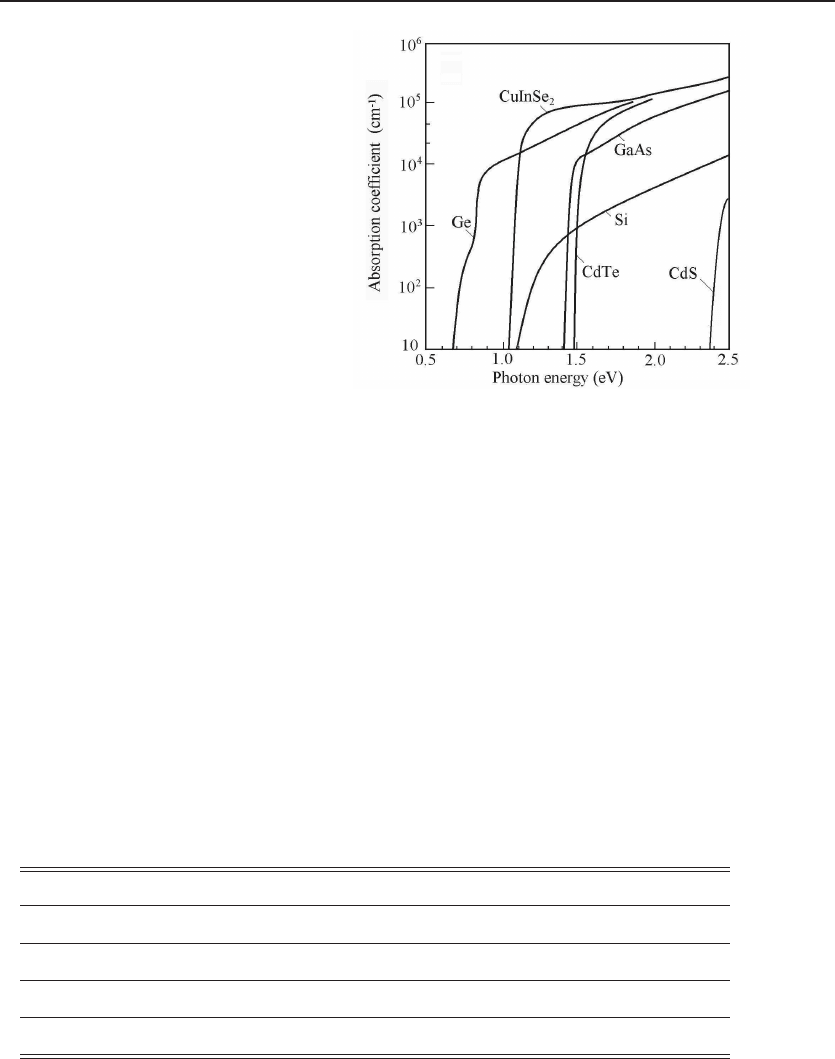
energy gap. Depending on the relative positions of the top of the valence band and
Figure 9.2 Direct and indirect semiconductors. Depending on the relative positions of the top
of the valence band and the bottom of the conduction band in the wavevector space, the energy gap
of a semiconductor can be direct or indirect. Direct semiconductors have a much higher absorption
coefficient than that of indirect semiconductors. As shown, Si is an indirect semiconductor and GaAs
is a direct semiconductor.
i
i
“ChenSolarEnergy” — 2011/5/17 — 17:56 — page 179 — #206
i
i
i
i
i
i
9.1 Basic Concepts 179
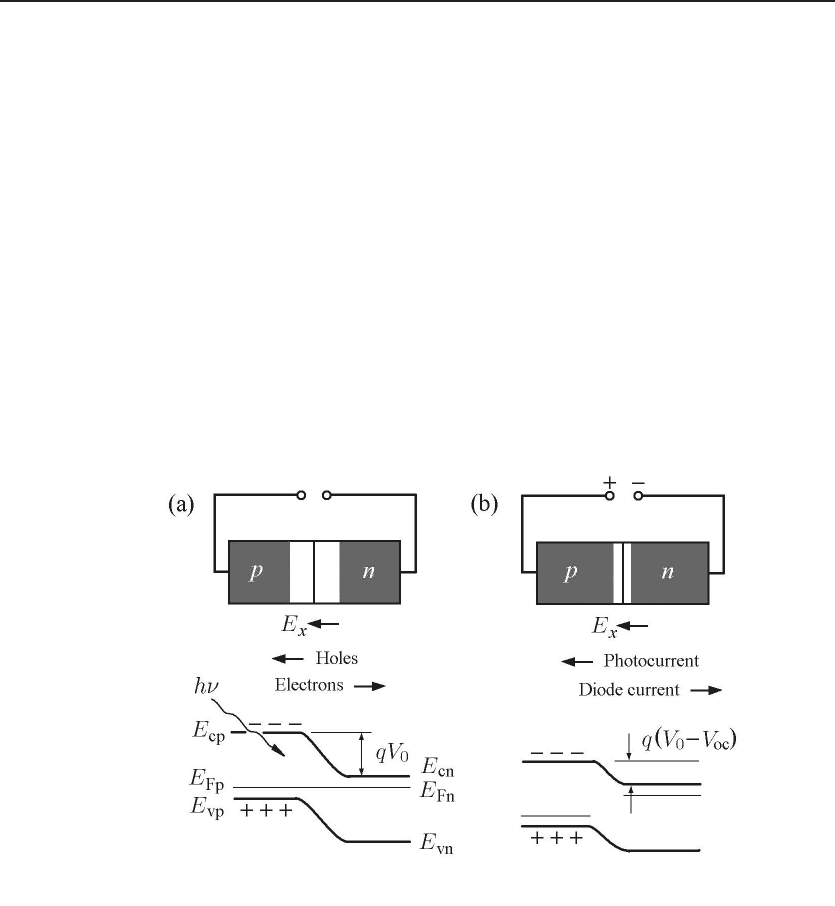
Figure 9.3 Absorption spectra of
semiconductors commonly used
for solar cells. The most commonly
used material for solar cells, silicon,
is an indirect semiconductor, and has
a relatively low absorption coefficient,
typically 10
3
cm
−1
. A thickness of
0.01 cm is required for efficient absorp-
tion. Direct semiconductors, such as
GaAs, CuInSe
2
and CdTe, have ab-
sorption coefficients ranging from 10
4
to 10
5
cm
−1
. A thickness of a few mi-
crometers is sufficient for an almost
complete absorption.
the bottom of the conduction band in the wavevector space, the energy gap of a semi-
conductor can be direct or indirect; see Fig. 9.2. For semiconductors with a direct
gap, such as GaAs, CuInSe
2
, and CdTe, a photon can directly excite an electron from
the valence band to the conduction band; the absorption coefficient is high, typically
greater than 1 ×10
4
cm
−1
. For semiconductors with an indirect gap, such as Ge and Si,
the top of valence band and the bottom of the conduction band are not aligned in the
wavevector space, and the excitation must be mediated by a phonon, in other words,
by lattice vibration. Therefore, the absorption coefficient is low, typically smaller than
1 × 10
3
cm
−1
. A thicker substrate is required. Figure 9.3 shows the absorption spectra
of commonly used semiconductor materials for solar cells. Table 9.1 gives the properties
of frequently used solar cell materials.
Table 9.1: Properties of Common Solar-Cell Materials.
Material Ge CuInSe
2
Si GaAs CdTe
Type Indirect Direct Indirect Direct Direct
Band gap (eV) 0.67 1.04 1.11 1.43 1.49
Absorption edge (μm) 1.85 1.19 1.12 0.87 0.83
Absorption coef. (cm
−1
)5.0×10
4
1.0×10
5
1.0×10
3
1.5×10
4
3.0×10
4
i
i
“ChenSolarEnergy” — 2011/5/17 — 17:56 — page 180 — #207
i
i
i
i
i
i
180 Semiconductor Solar Cells
9.1.1 Generation of Electric Power
Figure 9.4 shows a quantitative explanation of how the electric power is generated by
a solar cell. As shown in Fig. 9.4(a), a photon generates a electron–hole pair in the
p–type region. Because of the built-in electric field, which points towards the p–type
region, the electrons drift into the n–type region, whereas the holes stay in the p–type
region. By connecting the two terminals in Fig. 9.4 together, almost all the electrons
generated by the photons can migrate to the n–type region, and complete the circuit.
The short-circuit current is the current of the electrons generated by sunlight. As shown
in Fig. 9.4(b), if the two regions are not connected externally, the charges accumulated
in the two regions generate a potential across the junction capacitance. The potential
becomes a forward voltage for the diode. The thickness of the transition region is
reduced, and a forward diode current is created. When the forward diode current
equals the drift current of the electrons generated by the photons, an equilibrium is
established. The voltage on the two terminals is the open-circuit voltage of the solar
cell under illumination.
Figure 9.4 Separation of holes and electrons in a solar cell. (a) The incident photons
generate electron–hole pairs. The built-in electrical field in the transition region is pointing toward
the p–type region. The electrons, negatively charged, is dragged by the field into the n–type region.
By connecting the two terminals, an electrical current is generated. The short-circuit current is
determined by the rate of electron–hole pair generation from the radiation. (b) If the terminals are
not connected, the electrons migrate to the n–type region are accumulated and builds a voltage across
the junction capacitance. The direction of the voltage is the same as the forward bias voltage of the
diode, which generates a current to compensate the electron current. At equilibrium, an open-circuit
voltage is established.
i
i
“ChenSolarEnergy” — 2011/5/17 — 17:56 — page 181 — #208
i
i
i
i
i
i
9.1 Basic Concepts 181
9.1.2 Solar Cell Equation
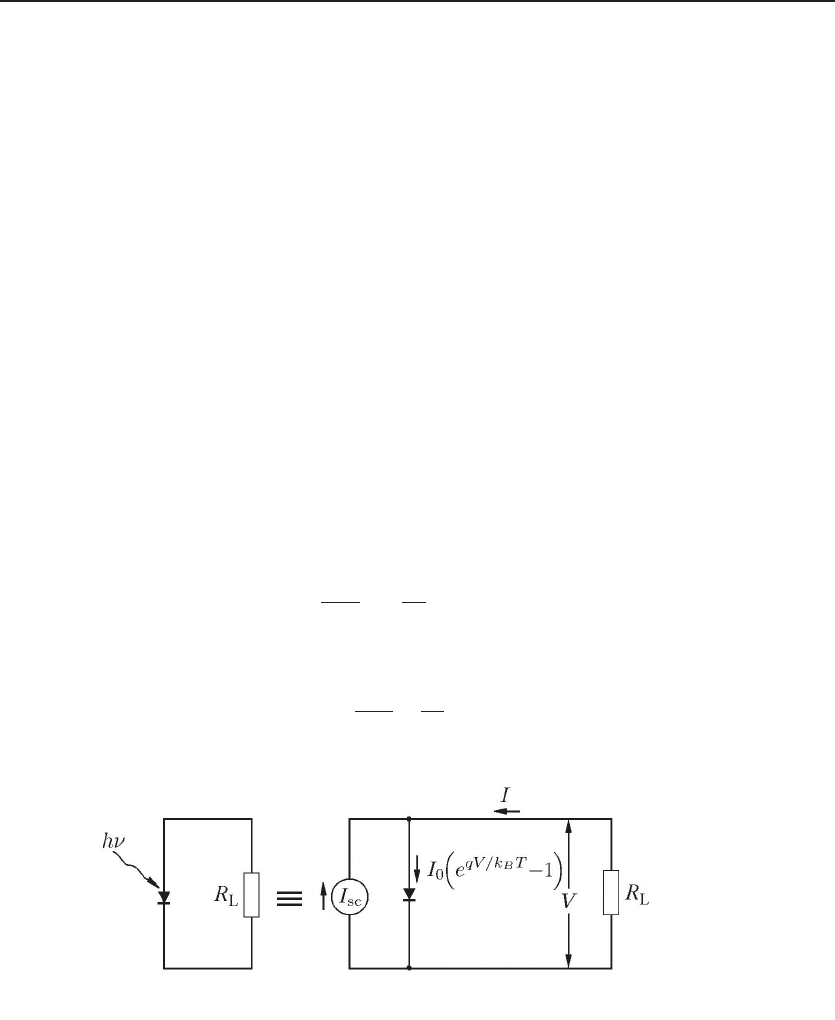
A solar cell can be represented by a current source connected in parallel with a pn-
junction diode; see Fig. 9.5. The current source is the photocurrent generated by
incoming sunlight, defined by Eq. 9.27. the diode equation is changed to
I = I
0
e
qV/k
B
T
− 1
− I
sc
. (9.1)
which is the fundamental equation of solar cells, in a format consistent with the diode
equation. However, in Eq. 9.1, while the voltage is always positive, the current is
always negative. This is understandable because the diode is a passive device which
consumes energy. By considering the solar cell as a battery, the direction of current
should be reversed. Therefore, a better form of the solar cell equation is
I = I
sc
− I
0
e
qV/k
B
T
− 1
, (9.2)
where both voltage and current are always positive; see Fig. 9.5.
The open-circuit voltage is the voltage when the current is zero, defined by the
condition
I
0
e
qV
oc
/k
B
T
− 1
= I
sc
. (9.3)
Consequently,
V
oc
=
k
B
T
q
ln
I
sc
I
0
− 1
. (9.4)
Because I
sc
is always much bigger than I
0
, Eq. 9.3 can be simplified to
V
oc
=
k
B
T
q
ln
I
sc
I
0
. (9.5)
Figure 9.5 Equivalent circuit of solar cell. A solar cell can be represented by a current source
connected in parallel with a pn-junction diode. The current source is the photocurrent generated by
incoming sunlight.

i
i
“ChenSolarEnergy” — 2011/5/17 — 17:56 — page 182 — #209
i
i
i
i
i
i
182 Semiconductor Solar Cells
9.1.3 Maximum Power and Fill Factor
The output power of a solar cell is determined by the product of voltage and current,
P = IV . As discussed in Section 1.4.2, it is always smaller than the product of the
short-circuit current I
sc
and the open-circuit voltage V
oc
, see Fig. 1.25. The rated power
of a solar cell is the maximum power output with an influx of photons of one sun, or 1
kW/m
2
, under favorable impedance-matching conditions. In general, the condition of
maximum power is
dP = IdV + VdI =0, (9.6)
in other words,
dI
dV
= −
I
V
. (9.7)
According to the solar cell equation 9.2, the output power as a function of the output
voltage V is
P = IV =
I
sc
− I
0
e
qV/k
B
T
− 1
V. (9.8)
From Fig. 1.25, we observe that the voltage of maximum power is only slightly
smaller than the open-circuit voltage. Introduce a voltage offset v,wewrite
V = V
oc
− v. (9.9)
Using Eq. 9.5, Eq. 9.8 can be simplified to
P ≈ I
sc
(V
oc
− v)
1 − e
−qv/k
B
T
. (9.10)
Taking the derivative of P with respect to v, the condition of maximum power is
e
qv/k
B
T
=1+
qV
oc
k
B
T
. (9.11)
Again, using Eq. 9.5, Eq. 9.10 becomes
e
qv/k
B
T
=1+ln
I
sc
I
0
. (9.12)
Because I
sc
I
0
, we find
v =
k
B
T
q
ln ln
I
sc
I
0
. (9.13)
Therefore, the voltage at maximum power is
V
mp
= V
oc
− v = V
oc
1 −
ln ln(I
sc
/I
0
)
ln(I
sc
/I
0
)
, (9.14)
andthecurrentatmaximumpoweris
I
mp
= I
sc
1 − e
−qv/k
B
T
= I
sc
1 −
1
ln(I
sc
/I
0
)
. (9.15)