
Chen C.J. Physics of Solar Energy
Подождите немного. Документ загружается.

i
i
“ChenSolarEnergy” — 2011/5/17 — 17:56 — page 163 — #190
i
i
i
i
i
i
8.1 Semiconductors 163
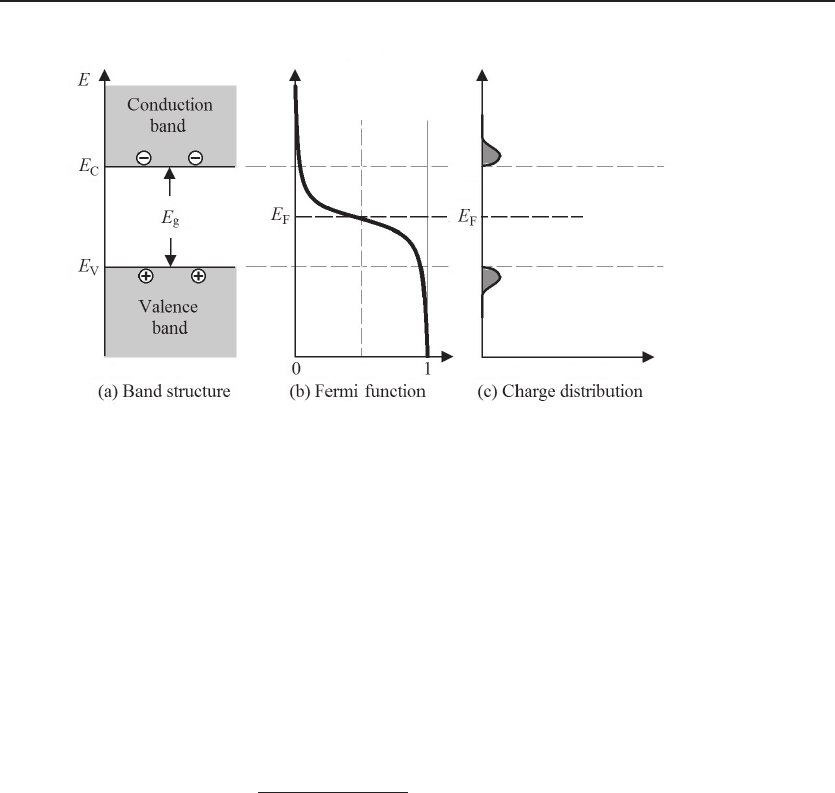
Figure 8.3 Intrinsic semiconductors: Free electrons and holes. Thermal excitation could
raise electrons from the valence band to the conduction band, to make electron–hole pairs. Charge
neutrality requires that the concentration of electrons equals the concentration of holes.
According to Fermi–Dirac statistics (see Appendix D), at temperature T, the con-
centration of electrons n
0
at the bottom of the conduction band is
n
0
= N
c
f(E
c
), (8.1)
where N
c
is the effective density of states of the conduction band, a quantity determined
by the property of the semiconductor, and f(E
c
) is the Fermi function (Eq. D.22 in
Appendix D), the distribution function of electrons at absolute temperature T .At
room temperature, k
B
T ≈ 0.026eV,thevalueofE
c
−E
F
is about 1 eV, and the factor
1 in the Fermi function can be neglected. To high accuracy, we have
f(E
c
)=
1
e
(E
c
−E
F
)/k
B
T
+1
≈ e
−(E
c
−E
F
)/k
B
T
. (8.2)
Therefore, the concentration of electrons in the conduction band is
n
0
= N
c
e
−(E
c
−E
F
)/k
B
T
. (8.3)
In the valance band, there is a deficiency of electrons from the saturated situation.
The deficiency of electrons in the valence band forms the mobile carriers, the holes.
Similarly, the concentration of holes, p
0
,isgivenas
p
0
= N
v
[1 − f(E
v
)] ≈ N
v
e
−(E
F
−E
v
)/k
B
T
, (8.4)
where N
v
is the effective density of states in the valence band and E
v
is the energy
level of the top of the valence band.
i
i
“ChenSolarEnergy” — 2011/5/17 — 17:56 — page 164 — #191
i
i
i
i
i
i
164 pn-Junctions
It is an interesting and important fact that the product n
0
p
0
is independent of the
Fermi level. Actually, by combining Eqs. 8.3 and refeq08110, we obtain
n
0
p
0
=
N
c
e
−(E
c
−E
F
)/k
B
T
N
v
e
−(E
F
−E
v
)/k
B
T
= N
c
N
v
e
−(E
c
−E
v
)/k
B
T
= N
c
N
v
e
−E
g
/k
B
T
.
(8.5)
For intrinsic semiconductors, or semiconductors without impurities, charge neutrality
requires that n
0
= p
0
. Therefore, an intrinsic carrier concentration n
i
can be defined,
n
i
=
N
c
N
v
e
−E
g
/2k
B
T
, (8.6)
with the general property
n
0
p
0
= n
2
i
, (8.7)
which is valid even for semiconductors with impurities.
8.1.3 p-Type and n-Type Semiconductors
Semiconductors have an even more important property: their conductivity critically
depends on the type and concentration of impurities. According to the position of the
energy level of the atoms in the band gap of a semiconductor, there are two major
types of impurities.
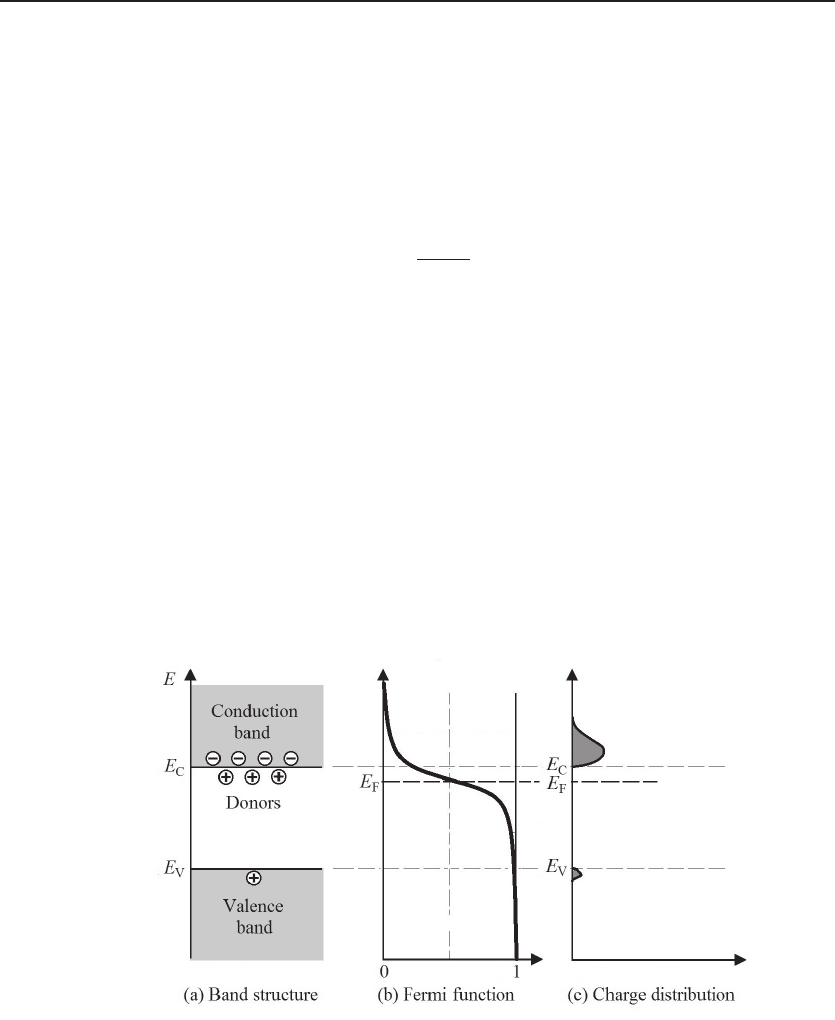
The energy level of donor atoms is just below the bottom of the conduction band.
The impurity atom can easily be ionized to contribute an electron to the conduction
Figure 8.4 n-type semiconductor. The donor atoms release electrons into the conduction band.
The Fermi level shifts toward the conduction band. The concentration of free electrons approximately
equals the concentration of donor atoms.
i
i
“ChenSolarEnergy” — 2011/5/17 — 17:56 — page 165 — #192
i
i
i
i
i
i
8.1 Semiconductors 165
band. For silicon and germanium, atoms from group V of the periodic table (N, P, As
and Sb) are effective donors. The Fermi distribution is still valid, but the Fermi level
has shifted toward the conduction band, as shown in Fig. 8.4. Assume the concentra-
tion of donor atoms is N
D
. If the temperature is moderately high, all donor atoms
could be ionized. The concentration of free electrons in an n-type semiconductor, n
n
,
approximately equals the concentration of donor atoms,
n
n
= N
D
. (8.8)
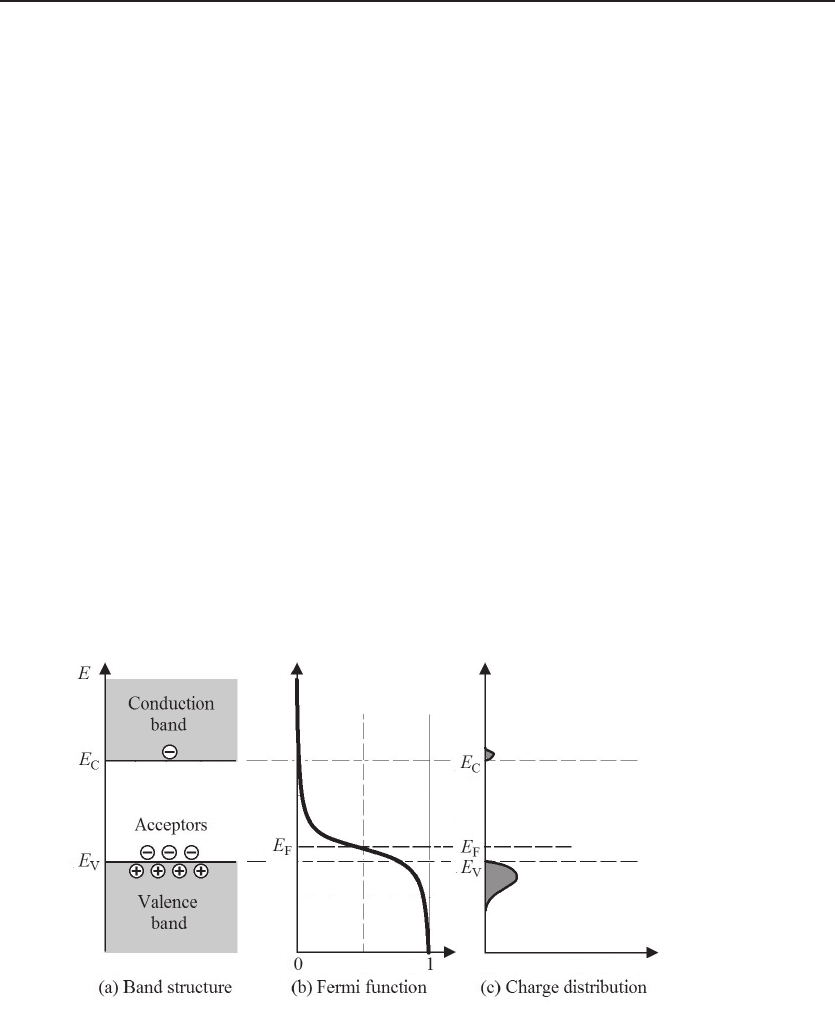
On the other hand, the energy level of acceptor atoms is just above the top of the
valence band. An electron in the valence band can easily be trapped by the acceptor
atoms and leave a hole in the valence band. For silicon and germanium, atoms from
Group IIIA (B, Al, Ga, and In) are effective acceptors. The Fermi distribution is still
valid, but the Fermi level has shifted toward the valence band, as shown in Fig. 8.5.
Assuming the concentration of acceptor atoms is N
A
. If the temperature is moderately
high, all acceptor atoms become negative ions. The concentration of holes in a p-type
semiconductor, p
p
, approximately equals the acceptor concentration,
p
p
= N
A
. (8.9)
In both cases, the product of the concentrations of free electrons and holes equals the
square of the intrinsic carrier concentration,
n
n
p
n
= p
p
n
p
= n
2
i
, (8.10)
Figure 8.5 The p-type semiconductor. The acceptor atoms grab electrons from the valence
band to create holes. The Fermi level shifts toward the valence band. The concentration of holes
approximately equals the concentration of acceptor atoms.

i
i
“ChenSolarEnergy” — 2011/5/17 — 17:56 — page 166 — #193
i
i
i
i
i
i
166 pn-Junctions
where p
n
is the hole concentration in an n-type semiconductor and n
p
is the free-electron
concentration in a p-type semiconductor. Each is a minority-carrier concentration.
8.2 Formation of a pn-Junction
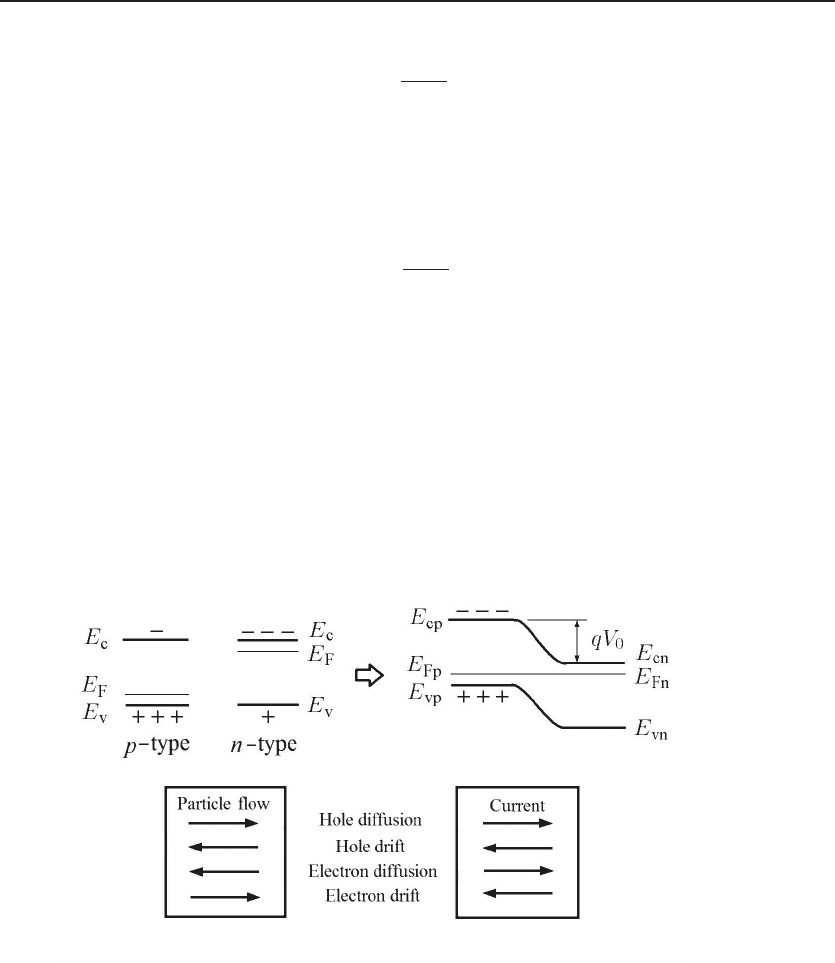
When a p-type semiconductor and an n-type semiconductor are brought together, a
built-in potential is established. Because the Fermi level of a p-type semiconductor is
close to the top of the valence band and the Fermi-level of an n-type semiconductor
is close to the bottom of the conduction band, there is a difference between the Fermi
levels of the two sides. When the two pieces are combined to form a single system,
the Fermi levels must be aligned. As a result, the energy levels of the two sides must
undergo a shift with a potential V
0
. Letting E
cp
be the energy level of the bottom of
the conduction band for the p-type semiconductor versus the Fermi level and E
cn
that
for the n-type semiconductor, the built-in potential is
qV
0
= E
cp
− E
cn
; (8.11)
see Fig. 8.6. The establishment of a built-in potential near the boundary of a pn-
junction can be understood from another point of view, the flow of carriers. Because
in the n-region the hole concentration is very low, the holes diffuse from the p-region
to the n-region. After a number of holes move to the n-region, an electrical field is
formed to drive the holes back to the p-region. At equilibrium, the net current J
p
(x)
must be zero,
J
p
(x)=q
μ
p
p(x)E
x
(x) − D
p
dp(x)
dx
=0, (8.12)
where μ
p
is the mobility of the holes, p(x) is the concentration of holes as a function
of x, E
x
(x)isthex-component of electric field intensity as a function of x,andD
p
is
the diffusion coefficient of the holes. Using Einstein’s relation,
D
p
μ
p
=
k
B
T
q
, (8.13)
and the relation between the potential V (x) and electric field intensity, E
x
(x)=
−dV (x)/dx, Eq. 8.12 becomes
−
q
k
B
T
dV(x)
dx
=
1
p(x)
dp(x)
dx
. (8.14)
Integrating Eq. 8.14 over the entire transition region yields
−
q
k
B
T
(V
n
− V
p
)=ln
p
n
p
p
. (8.15)
Because V
n
− V
p
= V
0
, Eq. 8.15 can be rewritten as
i
i
“ChenSolarEnergy” — 2011/5/17 — 17:56 — page 167 — #194
i
i
i
i
i
i
8.2 Formation of a pn-Junction 167
p
n
= p
p
exp
−qV
0
k
B
T
. (8.16)
Similarly, because in the p-region the free-electron concentration is very low, the
free electrons diffuse from the n-region to the p-region. After a number of free electrons
move to the p-region, an electrical field is formed to drive the free electrons back to
the n-region. At equilibrium, the net current of free electrons must be zero. A similar
equation is found,
n
p
= n
n
exp
−qV
0
k
B
T
. (8.17)
The meaning of Eqs. 8.16 and 8.17 is as follows: p
n
is the concentration of holes
in the n-regionofthepn-junction and p
p
is the concentration of holes in the p-region
of the pn-junction. Because of the potential established by the space charge, V
0
,the
former is reduced by a factor of exp(−qV
0
/k
B
T ) from the latter. The situation for the
concentration of free electrons is similar.
To make a mental picture, we will make an order-of-magnitude estimate of the
two equations. A typical value of the built-in potential is V
0
≈ 0.75 eV. At room
temperature, k
B
T ≈ 0.026 eV. The factor exp(−0.75/0.026) ≈ 10
−12.5
. Therefore, the
absolute values are very small. For obvious reasons, both p
n
and n
p
are called minority
carriers.
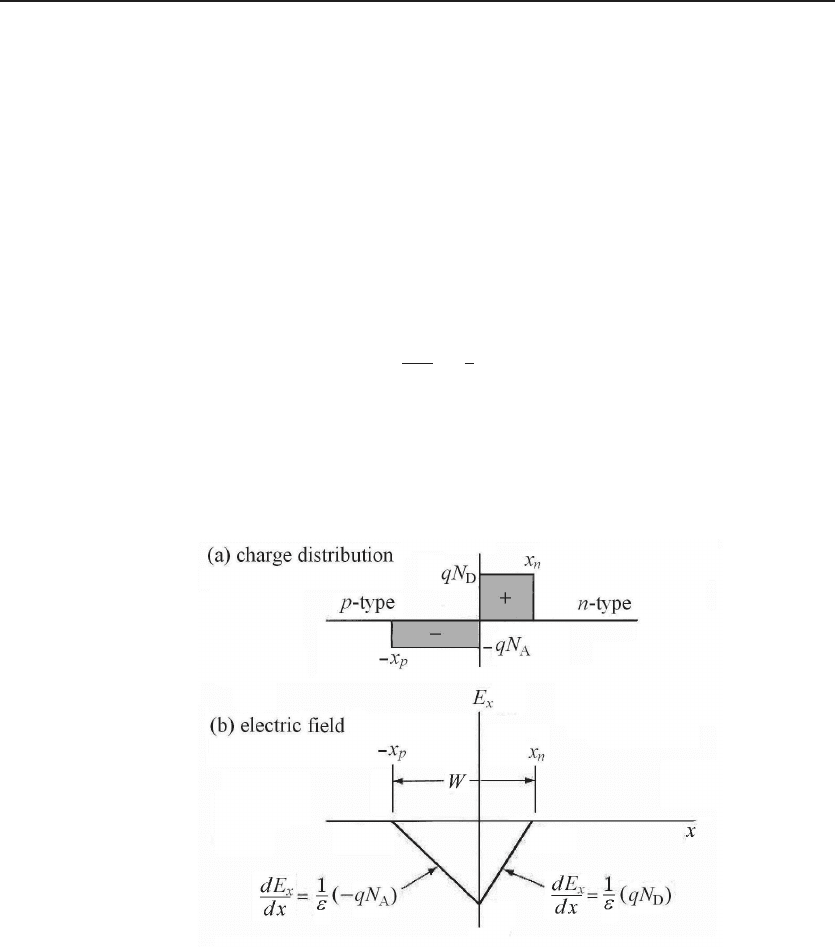
Figure 8.6 Formation of a pn-junction. By bringing a piece of p-type semiconductor and a piece
of n-type semiconductor together to form a junction, the Fermi levels must be aligned. This would
happen naturally as follows: The holes in the p-side moves to the n-side, and the free electrons in the
n-side moves to the p-side, to form a double charged layer, until an equilibrium is established. The
dynamic equilibrium is established by a balance of drift current driven by the electrical field, and a
diffusion current driven by the gradient of carrier density.
i
i
“ChenSolarEnergy” — 2011/5/17 — 17:56 — page 168 — #195
i
i
i
i
i
i
168 pn-Junctions
Equations 8.16 and 8.17 are essential in being able to understand the current-voltage
behavior of the pn-junction and the derivation of the diode equation.
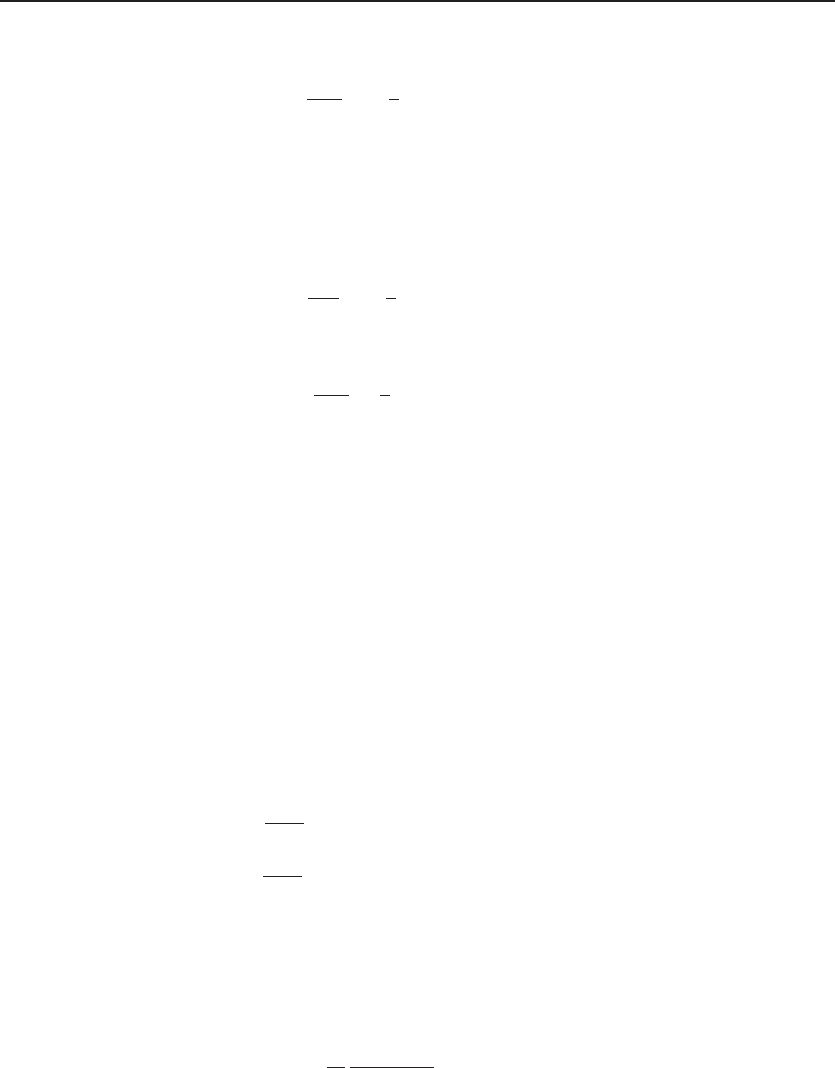
To better understand the pn-junction, we need to establish a mathematical model
for the space charge and the potential curve. A very effective and fairly accurate model
is based on the depletion approximation; see Fig. 8.7. Under such an approximation,
in the p-region near the junction boundary there is a layer of thickness x
p
where all
the holes are removed and the charge density ρ
p
is determined by the density of the
acceptors N
A
, which are negatively charged,
ρ
p
= −qN
A
. (8.18)
The electrostatic potential φ in this region is given by Poisson’s equation,
d
2
φ
dx
2
=
1
qN
A
, (8.19)
where is the dielectric constant or permittivity of the semiconductor and is the prod-
uct of the permittivity of a vacuum,
0
, and the relative dielectric constant
r
of the
semiconductor. The permittivity of a vacuum is given as
0
=8.85 × 10
−14
F/cm. For
example, for silicon,
r
= 11.8, ≈ 1.04 × 10
−12
F/cm. Alternatively, Eq. 8.19 can be
Figure 8.7 Charge and field distributions. The standard model of the pn-junction is based
on the depletion approximation.Inthep-region near the junction boundary, all holes are depleted,
leaving the negatively charged acceptor ions to make the space charge. In the n-region near the junction
boundary, all free electrons are depleted, leaving the positively charged donor ions to make the space
charge. The electrostatic problem can be solved analytically to provide an easy-to-handle mathematical
model which is sufficiently accurate for most problems in semiconductor devices, especially solar cells.
i
i
“ChenSolarEnergy” — 2011/5/17 — 17:56 — page 169 — #196
i
i
i
i
i
i
8.2 Formation of a pn-Junction 169
expressed in terms of electric field intensity,
dE
x
dx
= −
1
qN
A
. (8.20)
Similarly, there is a slab of thickness x
n
where all the free electrons are removed,
and the charge density ρ
n
is determined by the density of the donors, N
D
, which are
positively charged,
ρ
n
= qN
D
. (8.21)
Poisson’s equation gives
d
2
φ
dz
2
= −
1
qN
D
. (8.22)
and the corresponding equation for electric field intensity is
dE
x
dx
=
1
qN
D
. (8.23)
The boundary conditions for Eqs. 8.19, 8.20, and 8.22 are as follows. First, the
charge neutrality of the entire transition region requires that
N
A
x
p
= N
D
x
n
. (8.24)
Second, outside the transition region, the electric field should be zero:
E
x
=0 for x ≤−x
p
and x ≥ x
n
. (8.25)
Third, the electrostatic potential should match the values at the boundaries of the
transition region:
φ =0, at x = −x
p
,
φ = V
0
, at x = x
n
.
(8.26)
The solutions of Eqs 8.20 and 8.23 with boundary condition Eq. 8.25 are
E
x
= −
qN
A
(x + x
p
), for −x
p
≤ x<0;
E
x
=
qN
A
(x − x
n
), for 0 <x≤ x
n
.
(8.27)
Using boundary conditions 8.26 and the definition of the width of the transition
region W ,
W = x
p
+ x
n
, (8.28)
the following relation is obtained:
V
0
=
q
2
N
A
N
D
N
A
+ N
D
W
2
. (8.29)
i
i
“ChenSolarEnergy” — 2011/5/17 — 17:56 — page 170 — #197
i
i
i
i
i
i
170 pn-Junctions
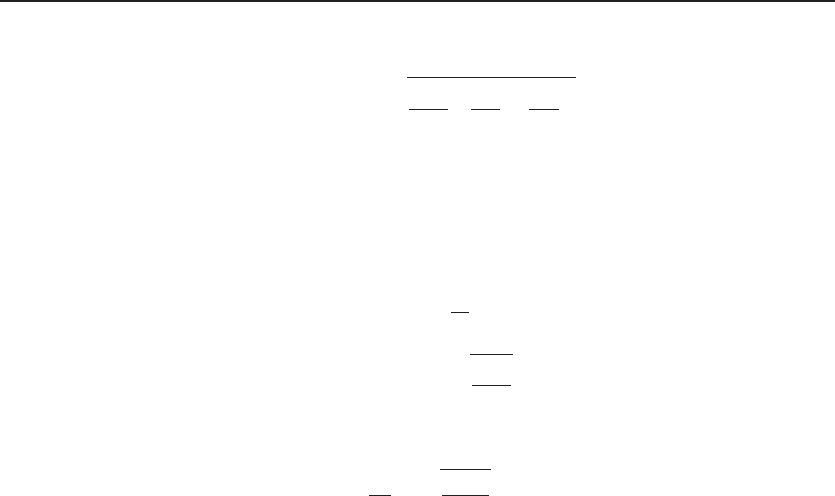
The width of the transition region as a function of V
0
is
W =
2V
0
q
1
N
A
+
1
N
D
. (8.30)
Most solar cells are manufactured from a lightly doped p-type silicon wafer as the
base, typically 100 – 300 μm thick, doped with boron of density N
A
≈ 1 × 10
16
cm
−3
having resistivity ρ ≈ 1Ω· cm. The n-type emitter is created by doping heavily on
one side with phosphorus, with density N
D
≈ 1 × 10
19
cm
−3
, having resistivity ρ ≈
10
−3
Ω · cm. For the case of N
D
N
A
, Eqs 8.29 and 8.30 are simplified to
V
0
=
q
2
N
A
W
2
(8.31)
W =
2V
0
qN
A
. (8.32)
From Eq. 8.32, we obtain the capacitance of the pn-junction,
C ≡
W
=
qN
A
2V
0
F/cm
2
. (8.33)
8.3 Analysis of pn-Junctions
As we saw in Section 8.2, especially Fig. 8.6, in the absence of external applied voltage,
there is no current running through a pn-junction, because the diffusion current and
the drift current cancel each other for both holes and free electrons. By applying
an external voltage on a pn-junction, the equilibrium is broken and a net current is
generated.
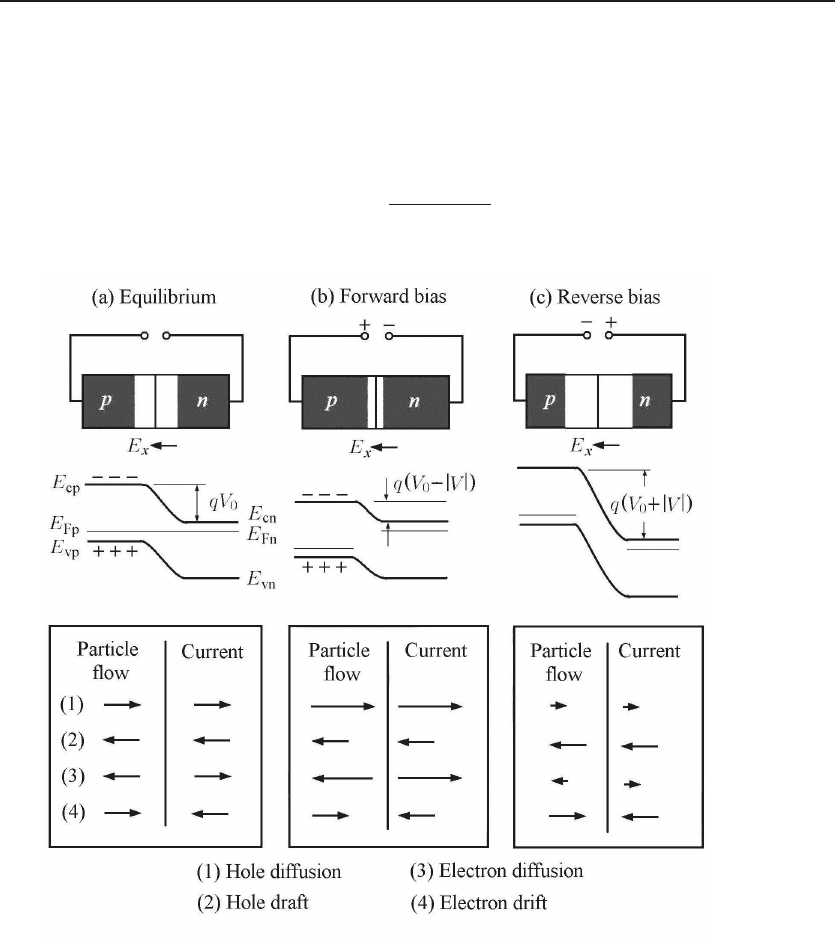
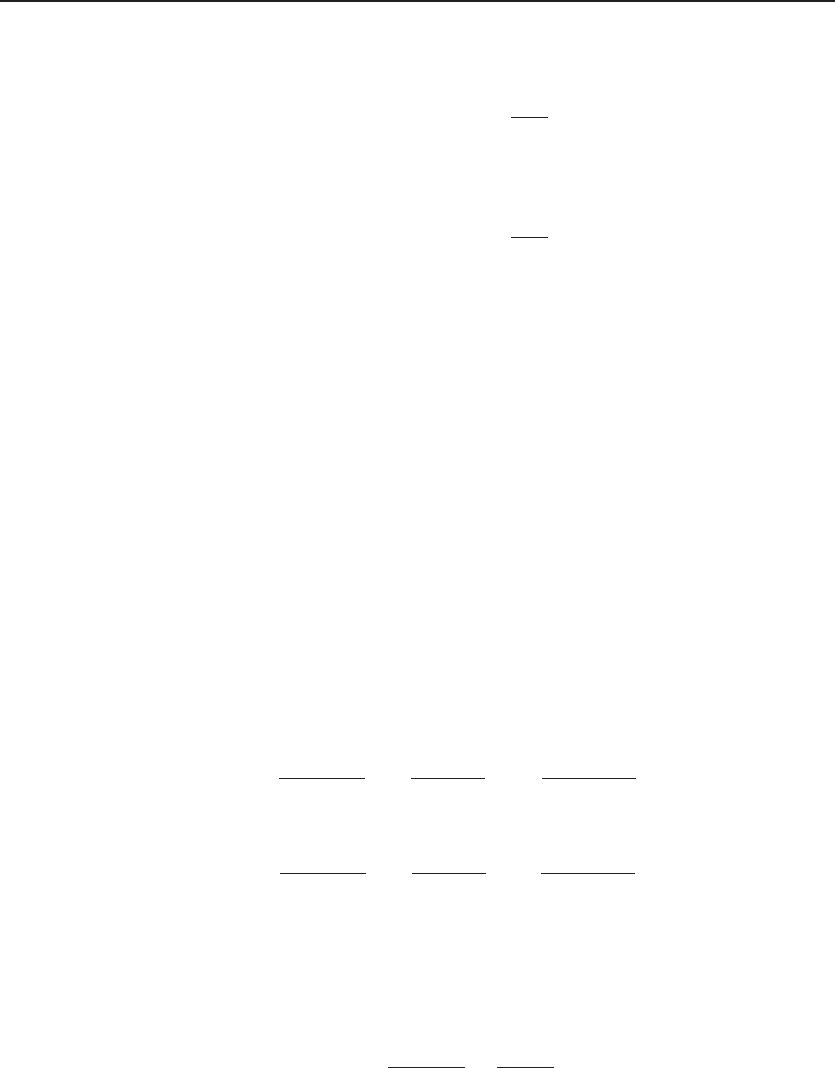
Qualitatively, the mechanism can be explained as follows; see Fig. 8.8. At equilib-
rium, as shown in Fig. 8.8(a), for both electrons and holes, there is a concentration
gradient which gives rise to diffusion and an electrical field pointing to −x-direction
which drives the carriers in an opposite direction. The net current is zero. By applying
a positive bias voltage, namely, connecting the positive terminal of a battery to the
p-sideandthenegativeterminaltothen-side, as shown in Fig. 8.8(b), the external
potential pushes the holes to the n-sideandthefreeelectronstothep-side. The poten-
tial barrier is reduced. Diffusion currents of both holes and free electrons are increased.
The drift current, depending on the available carriers, are unchanged. The net current
is nonzero. On the other hand, by applying a reversed bias, as shown in Fig. 8.8(c),
the holes are pushed further back into the p-region and the free electrons are pushed
further back into the n-region. The diffusion current is further reduced. The drift cur-
rents are unchanged and become the dominant factor. Eventually the current reaches
a saturated value determined by the drift currents.
i
i
“ChenSolarEnergy” — 2011/5/17 — 17:56 — page 171 — #198
i
i
i
i
i
i
8.3 Analysis of pn-Junctions 171
8.3.1 Effect of Bias Voltage
To account for the current quantitatively, we should further develop the concepts in
Section 8.2. By applying a forward bias, as shown in Fig. 8.8(b), the potential difference
across a pn-junction becomes V
0
− V . The electron concentration in the p-region, n
p
,
changes:
n
p
−→ n
n
exp
−q(V
0
− V )
k
B
T
. (8.34)
Figure 8.8 Effect of bias in a pn-junction. (a) At equilibrium, without external bias, the diffusion
current and the drift current cancel each other. (b) A positive bias voltage pushes the holes to the
n-side and the free electrons to the p-side. The potential barrier is reduced. Both diffusion currents
of holes and free electrons are increased. The drift currents, depending on the available carriers, are
unchanged. The net current is nonzero. (c) By applying a reversed bias, the holes are pushed further
back into the p-region and the free electrons are pushed further back into the n-region. The diffusion
current is reduced. Only the drift current persists.
i
i
“ChenSolarEnergy” — 2011/5/17 — 17:56 — page 172 — #199
i
i
i
i
i
i
172 pn-Junctions
Comparing with Eq. 8.16, one finds an excess free-electron concentration at the border
of the neutral p-region,
δn
p
(x =0)=n
p
exp
qV
k
B
T
− 1
. (8.35)
Similarly, the external forward bias voltage V generates an excess hole concentration
at the border of the neutral n-region,
δp
n
(x =0)=p
n
exp
qV
k
B
T
− 1
. (8.36)
The excess carrier concentrations generate an excess diffusion current, which is the
main part of the forward-bias current of a diode.
To obtain an explicit expression of the current as a function of the bias voltage,
we notice first that even with a substantial forward bias, for example, 0.5 V, the
excess minority carriers δp
n
and δn
p
are still much smaller than the majority carrier
concentrations p
p
and n
n
. For example, using V =0.5 V, from Eq. 8.34, δp
n
≈
exp(−250/26) ×p
p
≈ 10
−5.8
×p
p
. Therefore, the concentration of majority carriers can
be treated as a constant even with a substantial bias voltage.
8.3.2 Lifetime of Excess Minority Carriers
Diffusion of excess minority carriers is the origin of junction current. However, there
is a competing process which limits the junction current. The excess minority carriers
are surrounded by a sea of majority carriers which are constantly courting for recom-
bination. Because the concentration of majority carriers, p
p
or n
n
, is several orders
of magnitude greater than the concentration of excess minority carriers, even with re-
combination, p
p
or n
n
is virtually a constant. The rate of decay of excess minority
carriers is thus proportional to its concentration, which can be characterized by a life-
time. The combined effect of diffusion and lifetime of the excess minority carriers can
be summarized in the following equations. For free electrons,
∂δn
p
(x, t)
∂t
= −
δn
p
(x, t)
τ
n
+ D
n
∂
2
δn
p
(x, t)
∂x
2
, (8.37)
where D
n
is the diffusion coefficient, and τ
n
is the lifetime of free electrons. For holes,
∂δp
n
(x, t)
∂t
= −
δp
n
(x, t)
τ
p
+ D
p
∂
2
δp
n
(x, t)
∂x
2
, (8.38)
where D
p
is the diffusion coefficient and τ
p
is the lifetime of holes.
8.3.3 Junction Current
At equilibrium, the concentration of carriers is independent of time. For example,
Eq. 8.37 becomes
D
n
d
2
δn
p
(x)
dx
2
=
δn
p
(x)
τ
n
. (8.39)