
Chen C.J. Physics of Solar Energy
Подождите немного. Документ загружается.


i
i
“ChenSolarEnergy” — 2011/5/17 — 17:56 — page 183 — #210
i
i
i
i
i
i
9.2 The Shockley–Queisser Limit 183
After some simplification, maximum power is
P
mp
= I
mp
V
mp
= V
oc
I
sc
1 −
1 + ln ln(I
sc
/I
0
)
ln(I
sc
/I
0
)
. (9.16)
The fill factor η
f
,
1
defined as
η
f
≡
I
mp
V
mp
V
oc
I
sc
, (9.17)
is
η
f
=1−
1 + ln ln(I
sc
/I
0
)
ln(I
sc
/I
0
)
. (9.18)
Typically, η
f
=0.8 − 0.85.
9.2 The Shockley–Queisser Limit
In 1961, William Shockley and Hans Queisser made a thorough analysis of pn-junction
solar cell, and established an upper limit for the efficiency of single-junction photovoltaic
cells as a consequence of the principle of detailed balance[77]. The efficiency is defined
as the ratio of power delivered to a matching load versus the incident radiation power
to the solar cell. Three parameters are involved: The temperature of the Sun, T
;the
temperature of the cell, T
c
; and the energy gap of the semiconductor, E
g
. Actually,
efficiency only depends on two dimensionless ratios:
x
s
=
E
g
k
B
T
, (9.19)
x
c
=
E
g
k
B
T
c
. (9.20)
Typically, k
B
T
=0.5eV,k
B
T
c
− 0.025 eV, and E
g
is on the order of 1–2 eV. Therefore,
the typical order of magnitude is x
s
≈ 2 −−4, and x
c
≈ 40 −−80.
The analysis of Shockley and Queisser was based on the following assumptions:
1. A single p–n-junction
2. One electron–hole pair excited per incoming photon
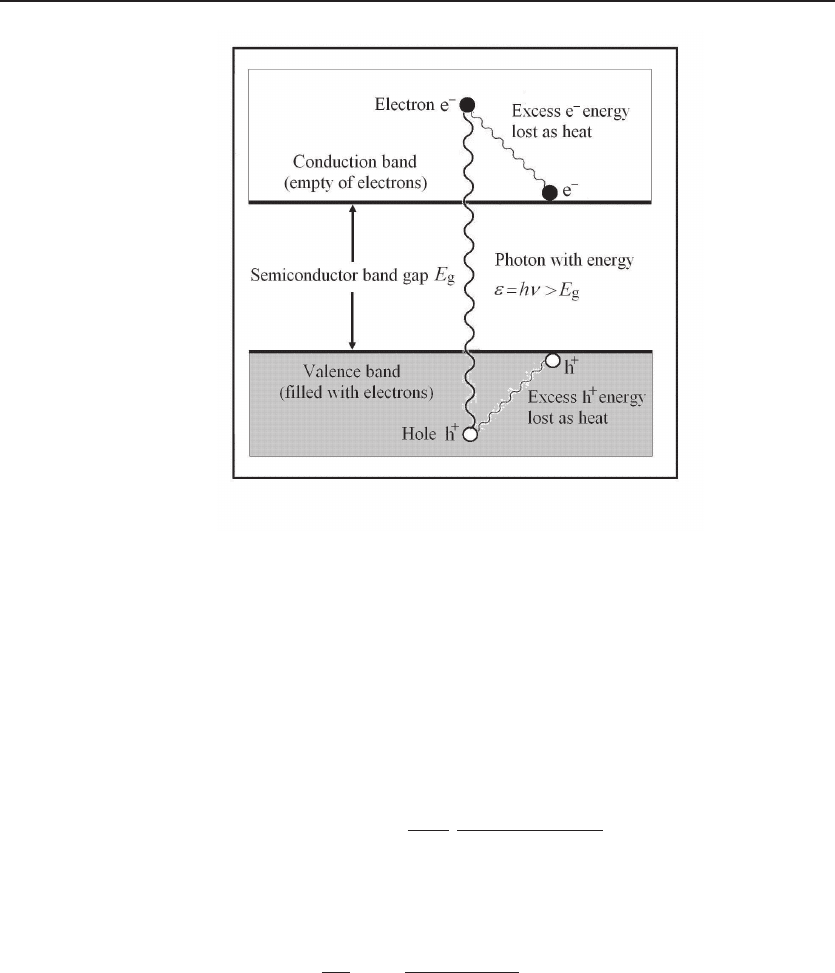
3. Thermal relaxation of the electron–hole pair energy in excess of the band gap
4. Illumination with unconcentrated sunlight
The above assumptions are well satisfied by the great majority of conventional solar
cells, and the limit is well verified by experiments, unless one or more assumptions
are explicitly removed, for example, using concentrated sunlight or using tandem solar
cells. In these cases, the arguments of the Shockley–Queisser theory are still valid.
1
In the literature, the notation FF is often used to represent the fill factor, a factor of efficiency in
the treatment of solar cells by Shockley and Queisser. To maintain consistency of notations, we use
η
f
instead.
i
i
“ChenSolarEnergy” — 2011/5/17 — 17:56 — page 184 — #211
i
i
i
i
i
i
184 Semiconductor Solar Cells
Figure 9.6 Generation of an electron–hole pair. A photon of energy greater than the band
gap of the semiconductor can excite an electron from the valence band to the conduction band. The
electron–hole pair energy in excess of the band gap dissipated into thermal energy of the electrons
quickly (with a time scale of 10
−11
s). The useful part of the photon energy for converting to electrical
energy equals the band gap.
9.2.1 Ultimate Efficiency
Shockley and Queisser first considered the effect of band gap [77]. Assuming that
solar radiation is proportional to blackbody radiation of temperature T
,thepower
spectrum is (see Eq. 2.96),
u(, T
) d =
2πq
4
c
2
h
3
3
exp(/k
B
T
) − 1
d. (9.21)
Equation 9.21 represents the radiation power density at the surface of the Sun. At
the location of Earth, the spectral power density is diluted by a factor f defined by
Eq. 2.103,
f =
r
A
2
=
6.96 × 10
8
2
[1.5 × 10
11
]
2
=2.15 × 10
−5
. (9.22)
Shockley and Queisser evaluated the ratio of the power of electron–hole pairs and
the incident radiation power by assuming that the absorptivity of the semiconductor
for photons with energy less than E
g
is zero and those greater than E
g
is unity. This
i
i
“ChenSolarEnergy” — 2011/5/17 — 17:56 — page 185 — #212
i
i
i
i
i
i
9.2 The Shockley–Queisser Limit 185
simplification is also used to evaluate the rate of radiative combination of the electron–
hole pair thus generated; see section 9.2.3. For photons with >E
g
, the electron-pair
energy is quickly thermalized to E
g
; see Fig. 9.6. By replacing one of variables in Eq.
9.21 is by E
g
, the power of thus generated electron–hole pairs is
P
ep
=
2πq
4
E
g
f
c
2
h
3
∞
E
g
2
d
exp(/k
B
T
) − 1
=
2πq
4
f(k
B
T
)
4
c
2
h
3
x
s
∞
x
s
x
2
dx
e
x
− 1
. (9.23)
On the other hand, the incident radiation power is
P
s
=
2πq
4
f
c
2
h
3
∞
0
3
exp(/k
B
T
) − 1
d =
2πq
4
(k
B
T
)
4
f
c
2
h
3
π
4
15
. (9.24)
The efficiency as a function of the dimensionless variable x
s
is
η
u
(x
s
)=
P
ep
P
s
=
15
π
4
x
s
∞
x
s
x
2
dx
e
x
− 1
. (9.25)
The integral in Eq. 9.25 can be evaluated using a simple numerical integration program
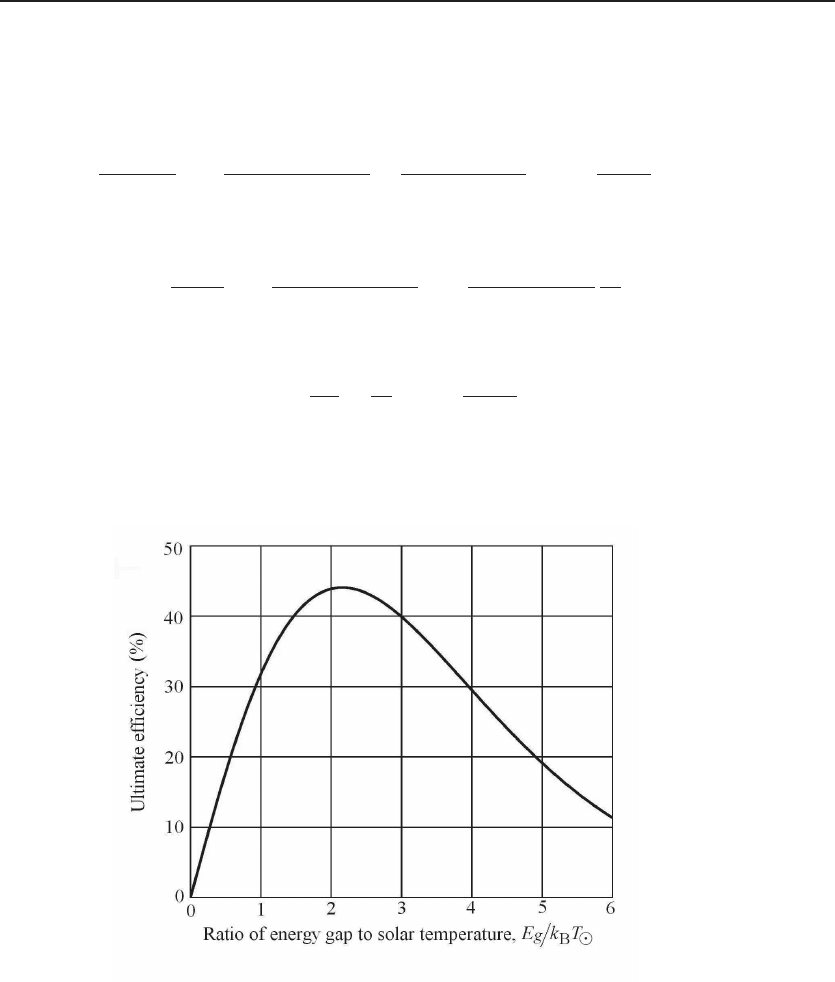
or the quickly converging expansion in Problem 9.1. The result is shown in Fig. 9.7. A
Figure 9.7 Ultimate efficiency of solar cells. Only photons with energy greater than the band
gap can be absorbed, and the electron–hole pair energy in excess of the band gap is dissipated into
thermal energy of the electrons, which make an ultimate limit to the efficiency of solar cells. The
maximum efficiency is 0.44, at E
g
=2.2 k
B
T
.ForT
= 5800 K, k
B
T
≈ 0.5 eV, the optimum band
gap is 1.1 eV.

i
i
“ChenSolarEnergy” — 2011/5/17 — 17:56 — page 186 — #213
i
i
i
i
i
i
186 Semiconductor Solar Cells
qualitative explanation of the result is as follows. If the band gap is small, the range
of photon absorption is large. However, most of the photon energy is dissipated as
heat; see Fig. 9.6. For a large band gap, the range of spectral absorption is reduced.
Therefore, it should have a maximum somewhere. The position and the value of the
maximum efficiency can be obtained using a numerical program, and the results are
E
g max
=2.2 k
B
T
; η
u max
=0.44. (9.26)
Taking T
= 5800 K, k
B
T
≈ 0.5 eV. The optimum band gap is 1.1 eV. Shockley and
Queisser called it the ultimate efficiency.
9.2.2 Role of Recombination Time
The ultimate efficiency determines the maximum open-circuit current of a solar cell.
If the solar radiation power received by a solar cell is P
S
, the power of the electron–
hole pairs generated by the solar radiation is η
u
P
S
. It corresponds to the maximum
short-circuit current of the solar cell,
I
sc
=
q
E
g
η
u
P
S
. (9.27)
The open-circuit voltage at the terminals of the solar cell is determined by the diode
equation 9.4. Combining Eq. 9.4 with Eq. 9.27, we have the nominal power, defined as
the product of the short-circuit current and the open-circuit voltage,
P
no
= I
sc
V
oc
=
η
u
(x
s
)
x
c
ln
I
sc
I
0
− 1
P
S
. (9.28)
Clearly, the reverse saturation current of a pn-junction, I
0
, is the limiting factor, de-
termined by Eq 8.48,
I
0
= qn
2
i
1
N
A
D
n
τ
n
+
1
N
D
D
p
τ
p
. (9.29)
The reverse saturation current, Eq. 9.29, can be estimated using actual data from
semiconductors. A general observation is as follows. The higher the reverse saturation
current, the smaller the open-circuit voltage. By looking at Eq. 9.29, it is clear that
the determining factor is the recombination time, τ
n
and τ
p
. Once an electron–hole
pair is generated by absorbing a photon, the pair has a tendency to recombine by
generating radiation or giving up the energy to the lattice. Shockley and Queisser
found a fundamental limit due to radiative recombination of electron–hole pairs based
on a detailed-balance argument.
9.2.3 Detailed-Balance Treatment
In the steady state, the electron–hole pairs in a solar cell are undergoing two major
processes: the generation of the pairs by solar radiation with a rate F
s
and various
i
i
“ChenSolarEnergy” — 2011/5/17 — 17:56 — page 187 — #214
i
i
i
i
i
i
9.2 The Shockley–Queisser Limit 187
recombination processes. The generation rate F
s
is calculated by assuming that the
spectral density of sunlight is a blackbody radiation with temperature T
but diluted
because of the distance between the Sun and Earth by a factor f =2.15×10
−5
,defined
by Eq. 9.22. The number of electron–hole pairs generated per unit area per unit time
on a surface perpendicular to the sunlight is expressed by the power of the electron–hole
pair (Eq. 9.23),
F
s
=
P
ep
E
g
=
2πq
4
f
c
2
h
3
∞
E
g
2
exp(/k
B
T
) − 1
d. (9.30)
Many factors that contribute to recombination, such as those related to defects or
surfaces, can be reduced or avoided. The radiative recombination F
c
, however, is a
process which sets a fundamental limit on the efficiency of solar cells. To evaluate
the rate of radiative recombination of the electron–hole pairs, Shockley and Queisser
considered the equilibrium of the solar cell with the environment at the cell temperature
T
c
, typically 300 K, without sunlight. The principle of detailed balance requires that
the generation rate must equal the recombination rate. This principle, manifested as
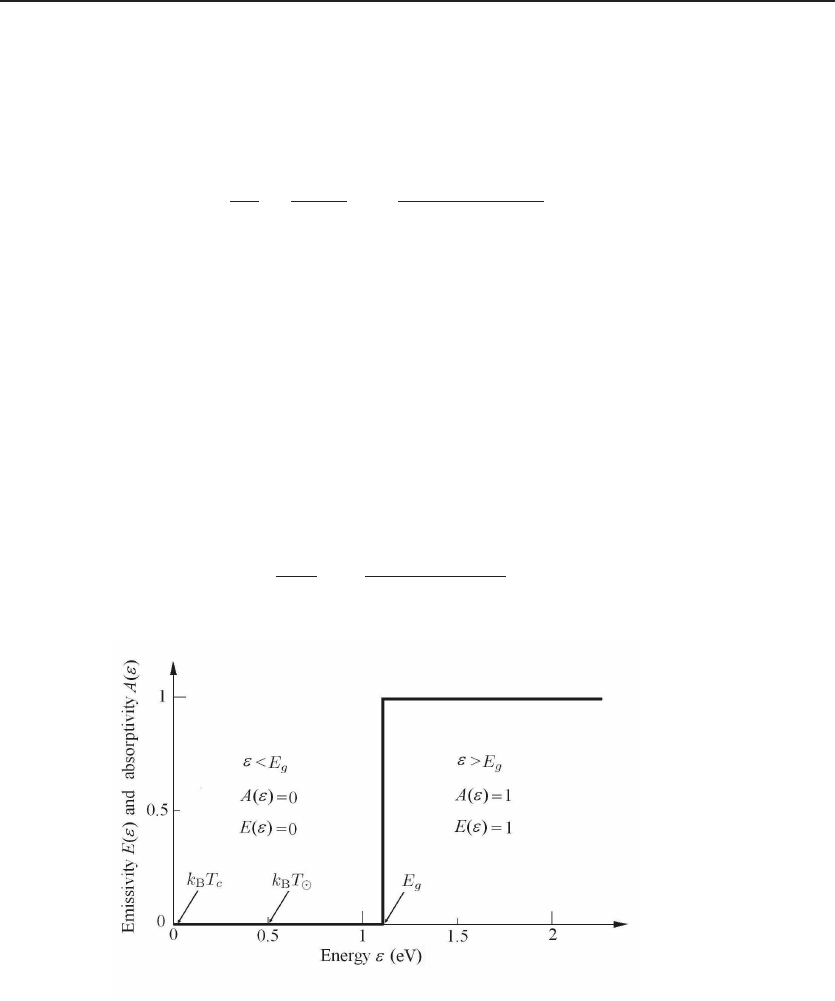
Kirchhoff’s law, states that emissivity equals absorptivity at any given wavelength.
With respect to the simplified model of Shockley and Queisser [77], for photons with
energy greater than the energy gap of the semiconductor, the emissivity is 1; otherwise
it is 0 (see Fig. 9.8). The rate of radiative electron–hole recombination can be calculated
using an integral similar to Eq. 9.30 but at the environment temperature T
c
,
F
c0
=
2πq
4
c
2
h
3
∞
E
g
2
exp(/k
B
T
c
) − 1
d. (9.31)
Figure 9.8 A simplified optical model of semiconductors. To evaluate the effect of radiative
recombination, Shockley and Queisser used a simplified optical model of semiconductors. For photons
with energy greater than the band gap of the semiconductor, the absorptivity is 1, and hence the
emissivity is also 1. Otherwise the emissivity is 0.

i
i
“ChenSolarEnergy” — 2011/5/17 — 17:56 — page 188 — #215
i
i
i
i
i
i
188 Semiconductor Solar Cells
Typically, the parameter x
c
in Eq. 9.20 equals E
g
/k
B
T
c
≈ 40 – 80, and thus the term
1 in the denominator of the integrand of Eq. 9.31 can be neglected. To high accuracy,
the result is
F
c0
=
2πq
4
(k
B
T
c
)
3
c
2
h
3
∞
x
c
x
2
e
−x
dx =
2πq
4
(k
B
T
c
)
3
c
2
h
3
e
−x
c
x
2
c
+2x
c
+2
. (9.32)
The above result is valid when the semiconductor is at equilibrium. With sunlight,
excess minority carriers are generated. For example, if the bulk of a solar cell is made
of p–type semiconductor, according to Eq. 8.34, with an external voltage V , the electron
concentration changes from its equilibrium value n
p0
to
n
p
= n
p0
exp
qV
k
B
T
c
. (9.33)
Thus, the radiative recombination rate is increased to
F
c
(V )=F
c0
exp
qV
k
B
T
c
. (9.34)
At a steady state, the rate of electron–hole pair generation must equal the rate of
radiative recombination plus the rate of electron consumption due to the current I
drawn by the external circuit,
F
s
= F
c
(V )+
I
q
. (9.35)
By shorting the terminals together, the voltage V is zero, and the short-circuit current
is
I
sc
= q (F
s
− F
c0
) . (9.36)
Using Eq. 9.34, the current on the external load, I,isgivenas
I = I
sc
+ qF
c0
1 − e
qV/k
B
T
c
. (9.37)
Defining the reverse saturation current I
0
as
I
0
= qF
c0
, (9.38)
Eq. 9.37 becomes
I = I
sc
+ I
0
1 − e
qV/k
B
T
c
. (9.39)
The open-circuit voltage can be obtained by setting I =0,
V
oc
=
k
B
T
c
q
ln
I
sc
I
0
− 1
. (9.40)
Because F
s
F
c0
, Eq. 9.40 can be simplified to
V
oc
=
k
B
T
c
q
ln
F
s
F
c0
− 1
. (9.41)

i
i
“ChenSolarEnergy” — 2011/5/17 — 17:56 — page 189 — #216
i
i
i
i
i
i
9.2 The Shockley–Queisser Limit 189
9.2.4 Nominal Efficiency
Shockley and Queisser defined the nominal efficiency as
η
n
=
V
oc
I
sc
Ps
. (9.42)
Using Eqs. 9.41, 9.27, and 9.20, after some reduction, we find the expression
η
n
= η
u
η
d
, (9.43)
where the ultimate efficiency η
u
is defined by Eq. 9.25, and the detailed balance
efficiency η
d
is defined as
η
d
=
qV
oc
E
g
=
1
x
c
ln
F
s
F
c0
− 1
, (9.44)
Using Eqs. 9.30 and 9.31, we obtain
F
s
F
c0
=
f
x
c
x
s
3
∞
x
s
x
2
dx
e
x
− 1
e
−x
c
x
2
c
+2x
c
+2
. (9.45)
As shown in Eq. 9.44, the detailed-balance efficiency η
d
is the fundamental upper
limit of the ratio of the open-circuit voltage and the band gap of the semiconductor in
volts. It depends on the temperature of the cell. If the temperature of the solar cell is
very low, x
c
→∞, the detailed-balance efficiency becomes
η
d
→
1
x
c
ln (Ce
x
c
) →
x
c
+lnC
x
c
→ 1, (9.46)
because the expression C varies much less than the exponential. Therefore, at very low
cell temperatures, if there is no other recombination mechanism other than radiative
recombination, the open-circuit voltage approaches the band gap energy in volts and
the nominal efficiency approaches the ultimate efficiency.
The reverse saturation current in Eq. 9.38 is the absolute limit of the observed
reverse saturation current (Eq. 9.29). In addition to radiative recombination, there are
other types of recombination processes that increase the reverse saturation current and
then reduce the efficiency of solar cells; see Section 9.3.
9.2.5 Shockley–Queisser Efficiency Limit
With a load of matched impedance, the output power of a solar cell can be maximized.
As shown in Section 9.1.3, the maximum power is related to the nominal power by a
form factor η
f
approximately
η
SQ
= η
u
η
d
η
f
≈ η
u
η
d
1 −
1 + ln ln(I
sc
/I
0
)
ln(I
sc
/I
0
)
. (9.47)
i
i
“ChenSolarEnergy” — 2011/5/17 — 17:56 — page 190 — #217
i
i
i
i
i
i
190 Semiconductor Solar Cells
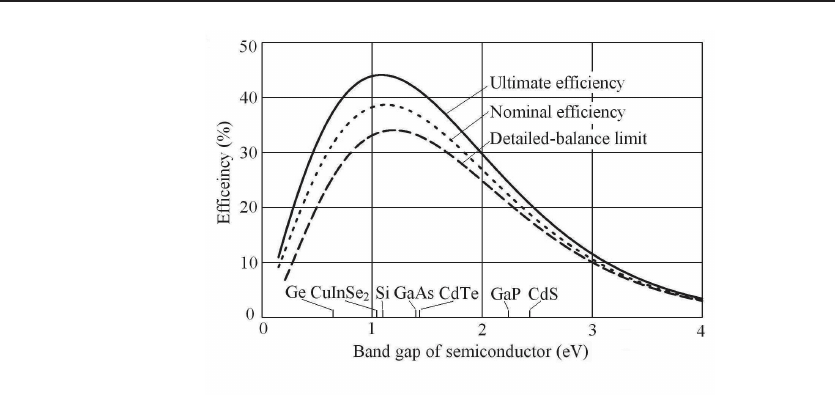
Figure 9.9 Efficiency limit of solar cells. Efficiency limit as determined by detailed balance.
The solar radiation is approximated by blackbody radiation at 5800 K. The temperature of the solar
cell and its surroundings is assumed as 300 K. The abscissa is the band gap of the semiconductor
in electron volts. The values of several important solar cell materials are marked. The ultimate
efficiency is determined by the absorption edge and thermalization of excited electrons. The nominal
efficiency, which is always lower than the ultimate efficiency, is a result of radiative recombination of
electrons and holes. While driving an external load at maximum power, the radiative recombination
is further increased, and the efficiency is further reduced. The detailed-balance limit of efficiency is a
fundamental limit for the conditions listed by Shockley and Queisser. After Ref. [77].
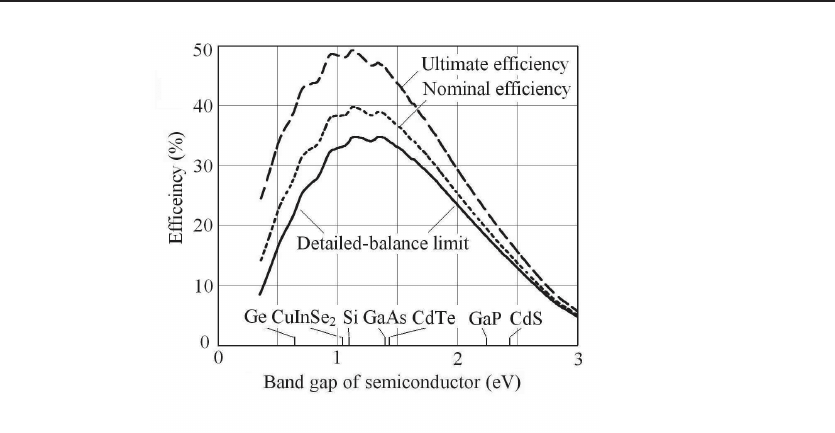
The detailed-balance efficiency limit, together with the ultimate efficiency and the
nominal efficiency, for T
= 5800 K and T
c
= 300 K, is shown in Fig. 9.9. The abscissa
is the band gap of the semiconductor in electron volts. Values of several important solar
cell materials are indicated. The ultimate efficiency is determined by the absorption
edge and thermalization of excited electrons. The nominal efficiency, which is always
lower than the ultimate efficiency, is a result of radiative recombination of electrons and
holes. While driving an external load at maximum power, the radiative recombination
is further increased, and the efficiency is further reduced.
In the original paper [77], Shockley and Queisser also discussed several factors that
affect the efficiency limit, such as both sides of a solar cell can radiate which only one
side receives sunlight, the non-blackbody behavior of the cell, nonradiative electron–
hole pair recombination processes, and the difference between the solar constant and
the AM-1.5 solar radiation. The efficiency is further reduced by a few percentage points.
9.2.6 Efficiency Limit for AM1.5 Radiation
Shockley and Queisser assumed that solar radiation is a blackbody radiation [77]. The
actually solar radiation spectrum received on Earth is influenced by scattering and the
absorption of water vapor, carbon dioxide, and so on; thus the spectrum is different
from blackbody radiation; see Section 5.2. How is the efficiency limit for actual solar
i
i
“ChenSolarEnergy” — 2011/5/17 — 17:56 — page 191 — #218
i
i
i
i
i
i
9.3 Nonradiative Recombination Processes 191
Figure 9.10 Efficiency limit of solar cells for AM1.5 solar radiation. Efficiency limit as
determined by detailed balance for the AM1.5 solar radiation. The abscissa is the band gap of the
semiconductor in electron volts. The values of several important solar cell materials are marked.
Similar to Fig. 9.9, the ultimate efficiency, the nominal efficiency, and the detailed-balance limit of
efficiency, the fundamental limit for the conditions listed by Shockley and Queisser, are shown.
radiation spectrum changed from that of blackbody radiation?
The problem can be resolved using the same method of Shockley and Queisser.
Instead of using the blackbody radiation spectrum, the measured solar radiation, the
standard AM1.5 spectrum (see Plate 1) is used to compute the integrals in Eqs. 9.25 and
9.45. Because the strongest absorption and scattering are in the mid- to far-infrared and
ultraviolet regions, visible light is basically unchanged. Because the infrared radiation
with photon energy lower than the energy gap of the semiconductor does not participate
in the generation of the electron–hole pair, and ultraviolet photons would lose more
energy in the thermalization process, efficiency with regard to total radiation power
is slightly higher. The strong absorption peaks and valleys are smoothed out by the
integration process. Therefore, the final result is qualitatively identical to that from a
blackbody radiation approximation. Thus, the blackbody approximation is appropriate
and useful.
9.3 Nonradiative Recombination Processes
The Shockley–Queisser limit is solely based on the thermodynamics of radiative recom-
bination of electron–hole pairs. There are several other recombination mechanisms and
factors that could limit the solar-cell efficiency. Some of the factors are intrinsic and
others can be mitigated or avoided by better cell design and manufacturing.
i
i
“ChenSolarEnergy” — 2011/5/17 — 17:56 — page 192 — #219
i
i
i
i
i
i
192 Semiconductor Solar Cells
As shown in Section 9.2.2, the most serious limiting factor to solar cell efficiency is
the recombination rate of electrons and holes. According to the basic equation of solar
cells (Eq. 9.5), the open-circuit voltage is determined as
V
oc
=
k
B
T
q
ln
I
sc
I
0
. (9.48)
The dark current I
0
is determined by Eq. 8.48. The solar cells are always made of a
thicker, lightly doped substrate and a thinner, highly doped film. For example, the
typical silicon solar cell is made of a p–n
+
junction. Therefore, only one of the two
terms dominate. Thus, Eq. 8.48 can be simplified to
I
0
=
qn
2
i
N
D
τ
. (9.49)
The open-circuit voltage is
V
oc
= const +
k
B
T
2q
ln τ. (9.50)
Obviously, the greater the recombination time τ, the greater the open-circuit voltage
V
oc
, and the efficiency will be greater.
If there are several recombination processes, the rate is additive, and thus the inverse
of the recombination time is additive,
1
τ
=
1
τ
1
+
1
τ
2
+ ... +
1
τ
n
. (9.51)
Each additional recombination process causes a reduction of the total recombination
time, and thus a reduction of efficiency.
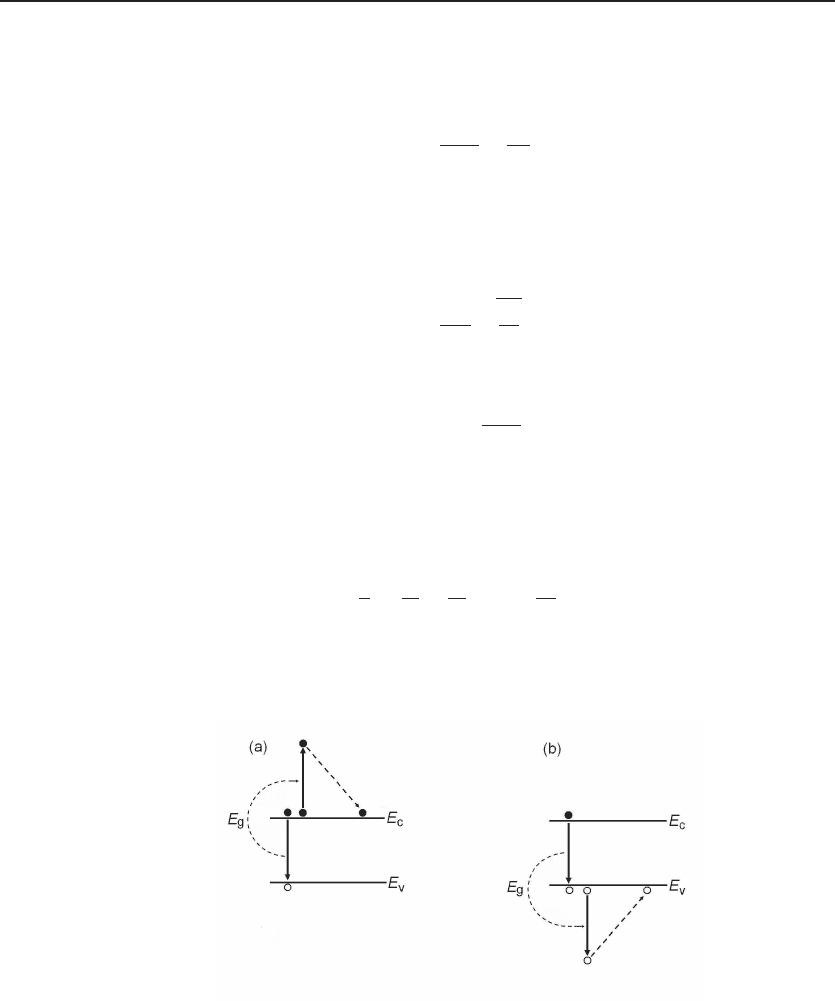
Figure 9.11 The Auger recombination process. The electron–hole pair can recombine and
transfer the energy E
g
into either a free electron near the conduction band edge E
c
, (a), or free hole
near the valance band edge, E
v
, (b). Then the excited electron quickly loses its excess energy to the
lattice as phonons.