
Chen C.J. Physics of Solar Energy
Подождите немного. Документ загружается.

i
i
“ChenSolarEnergy” — 2011/5/17 — 17:56 — page 193 — #220
i
i
i
i
i
i
9.3 Nonradiative Recombination Processes 193
Various types of nonradiative recombination processes are discussed in details in
Chapter 7 of Jacques I. Pankove’s book [65]. Their effect on the efficiency of solar
cells is discussed in Chapter 3 of Martin A. Green’s book [34] and subsequent papers
[35, 83].
9.3.1 Auger Recombination
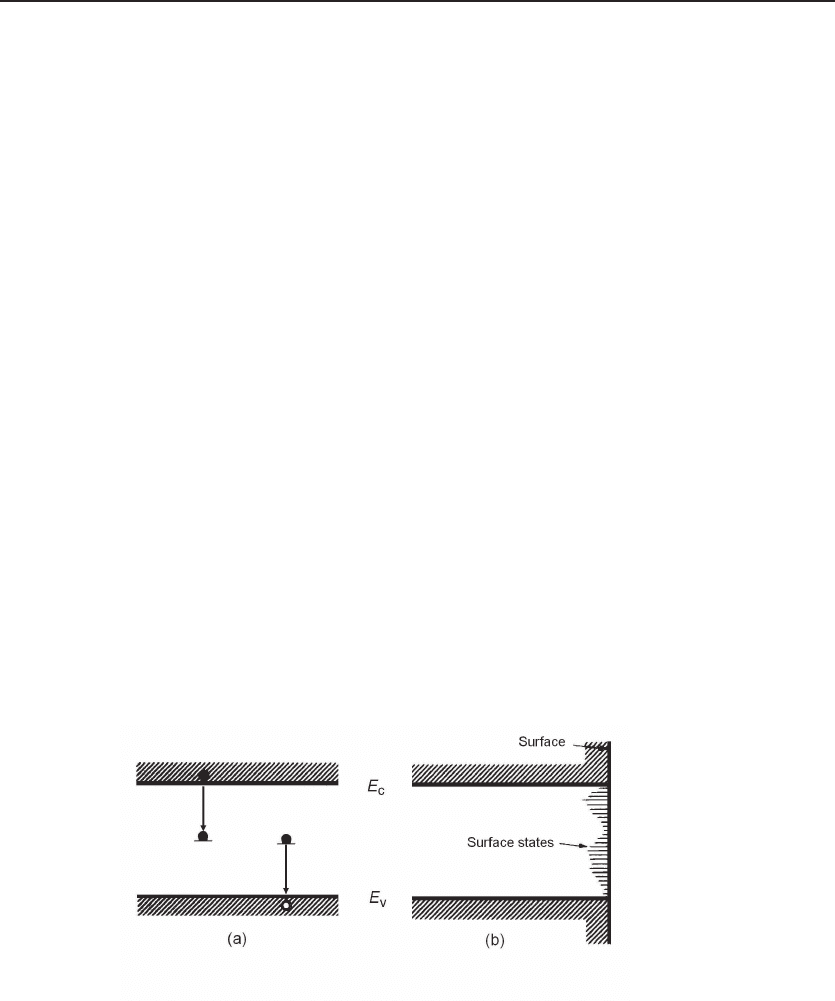
As shown in Section 9.2.3, after an electron–hole pair is created, both the free electron
and free hole quickly transfer excess energy to the lattice as phonons and stay near
the band edge. The electron–hole pair can recombine and emit a photon, as shown in
Section 9.2.3. An alternative process, the Auger process, is to transfer the energy E
g
into either a free electron near the conduction band edge, E
c
, as shown in Fig. 9.11(a),
orafreeholenearthevalancebandedge,E
v
, as shown in Fig. 9.11(b). Then the
excited electron quickly loses its excess energy to the lattice as phonons.
Clearly, Auger recombination is an intrinsic process which cannot be eliminated
by smart design. Detailed calculations and experiments have shown that, for good-
quality crystalline silicon, it is the dominant recombination process besides radiative
recombination, which would further reduce the theoretical efficiency from the Shockley–
Queisser limit of about 32% to about 28% [35, 83].
9.3.2 Trap-State Recombination
As shown in Section 8.1.3, the impurities in a semiconductor create states in the energy
gap. The gap states are effective intermediate media for a two-step recombination
process; see Fig. 9.12(a). Clearly, the higher the concentration of impurities, the more
the gap states, and thus the shorter the electron–hole pair lifetime. As a general
guideline, high-purity semiconductor materials are preferred.
Figure 9.12 Two-step recombination processes. The electron–hole pair can recombine and
transfer the energy E
g
into either a free electron near the conduction band edge, E
c
(a), or free hole
near the valance band edge, E
v
(b). Then the excited electron or hole quickly loses its excess energy
to the lattice as phonons.
i
i
“ChenSolarEnergy” — 2011/5/17 — 17:56 — page 194 — #221
i
i
i
i
i
i
194 Semiconductor Solar Cells
9.3.3 Surface-State Recombination
Surfaces of the semiconductor materials can represent a high concentration of defects, or
surface states. Each surface state can become a mediator for two-step recombination;
see Fig. 9.12(b). An experimentally verified effective method to reduce or eliminate
surface states is passivation. For silicon, typical methods are either to create a Si–SiO
2
interface by oxidation, or to create a Si-Al
2
iO
3
interface by depositing a thin layer of
alumina. Both SiO
2
and Al
2
iO
3
are insulators, and thus prevent the formation of direct
metallic conductor on the surface. At both the top and back sides, only a small area
is allowed to make ohmic contact. We will discuss this issue in section 9.5.2.
9.4 Antireflection Coatings
As discussed in Section 2.2.3, because all semiconductors have high refractive indices,
according to the Fresnel formulas, reflection loss at the semiconductor–air interface is
significant.
The solution, that is, antireflection coatings, were invented in early twenteenth
century and has been applied to reduce the reflection of lenses in eyeglasses, cam-
eras, telescopes, and microscopes. The concept of antireflection coatings is shown in
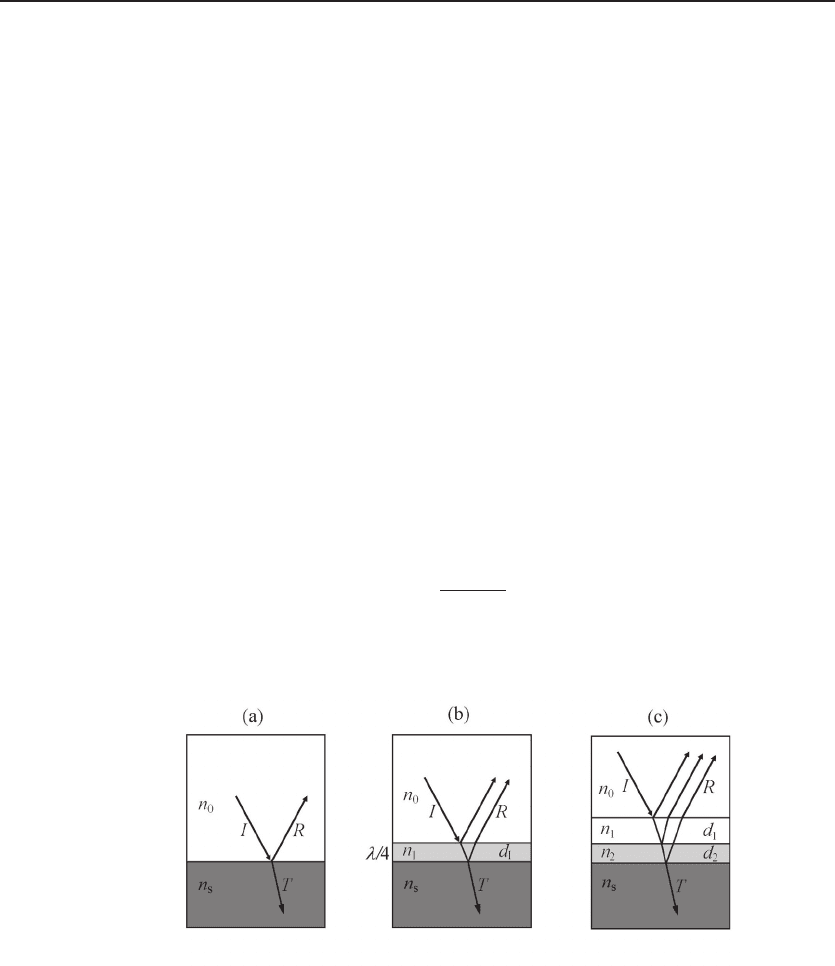
Fig. 9.13. Without antireflection coatings, the reflection coefficient at the interface of
two media with refractive indices n
1
and n
2
is determined by the Fresnel formula 2.78,
R =
n
1
− n
2
n
1
+ n
2
2
. (9.52)
For example, for silicon, where n =3.8,R =0.34, which is very high. By coating the
Figure 9.13 Antireflection coatings (a) At the interface of two dielectric media, the reflection
coefficient is determined by the Fresnel formula. (b) By coating the interface with a film of dielectric
material with an refractive index equal to the geometric mean of the indices of air and the bulk and
a thickness equal to a quarter of the wavelength in that medium, the reflection can be eliminated.
However, it only works for one wavelength. (c) Using multiple coatings, the wavelength range for
almost zero reflection can be extended.

i
i
“ChenSolarEnergy” — 2011/5/17 — 17:56 — page 195 — #222
i
i
i
i
i
i
9.4 Antireflection Coatings 195
surface with a film of thickness equal to a quarter wavelength in that medium, the two
reflected light waves should have a phase difference of 180
◦
. If the intensities of the two
reflected light waves are equal, complete cancellation can take place. The condition of
cancellation is then
n
1
− n
2
n
1
+ n
2
2
=
n
2
− n
3
n
2
+ n
3
2
. (9.53)
Itcanhappenonlywhenn
1
/n
2
= n
2
/n
3
,or
n
2
=
√
n
1
n
3
. (9.54)
In other words, the reflection can be completely eliminated when the refractive index of
the thin film is the geometric mean of the refractive indices of air and the bulk medium.
Obviously, it only works for a single wavelength. As shown in Fig. 9.13(c), by using
multiple coatings, two or more reflection minima can be created, and the wavelength
range for almost zero reflection can be extended.
The above argument based on interference is intuitive but not accurate. Multiple
reflections take place in the film. The simple interference argument does not work for
multiple antireflection coatings. The standard treatment is based on a matrix method,
as presented in the next section.
9.4.1 Matrix Method
A general treatment of the optics of stratified media can be found in Born and Wolf [13]
and Macleod [57]. In both books, very general cases are discussed, and the mathemat-
ics is quite complicated. Here we present a simple treatment for the case of normal
incidence. For antireflection coatings on solar cells, it represents most of the essential
physics and is mathematically transparent. For advanced readers, it can serve as a
bridge to understand more sophisticated treatments.
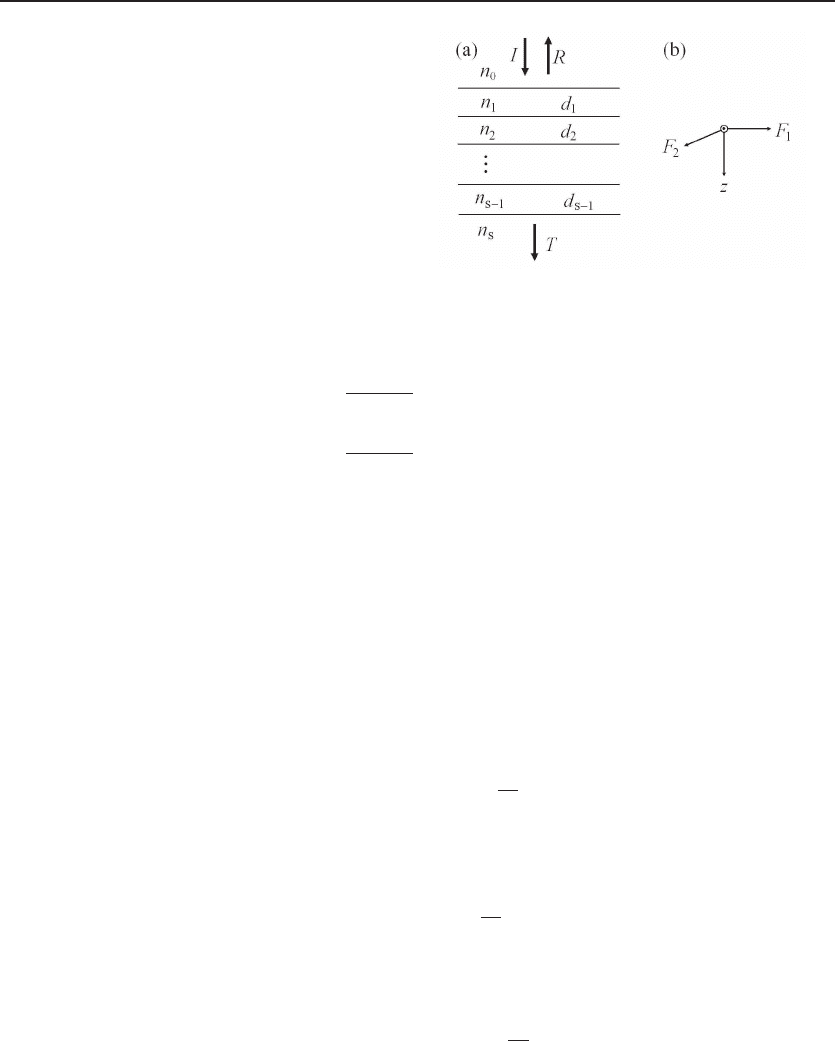
Consider an antireflection coating with s films each with refractive index n
j
and
thickness d
j
; see Fig. 9.14. Consider the electromagnetic wave of one polarization with
circular frequency ω; see Fig. 2.3. Because, for a vacuum, E
x
= cB
y
(see Eq. 2.26), we
combine them as a two-dimensional vector,
F(z)=
F
1
(z)
F
2
(z)
=
E
x
(z)
cB
y
(z)
. (9.55)
Because both E
x
and B
y
are continuous at a boundary of two layers of dielectrics,
F
1
and F
2
are also continuous at a boundary of two dielectrics. Within the jth film,
following Eqs. 2.41 – 2.44, Maxwell’s equations for F
1
(z)andF
2
(z)are
dF
1
(z)
dz
= ik
0
F
2
(z), (9.56)
dF
2
(z)
dz
= in
2
j
k
0
F
1
(z), (9.57)
i
i
“ChenSolarEnergy” — 2011/5/17 — 17:56 — page 196 — #223
i
i
i
i
i
i
196 Semiconductor Solar Cells
Figure 9.14 Matrix method
for antireflection coatings. For
each layer of antireflection coating,
Maxwell’s equations for a continuous
medium is valid. Its effect can be
represented by a 2 × 2 matrix. (a)
The incident, reflected, and transmit-
ted light can be represented by a two-
dimensional vector for each. (b) The
field vectors and the z-direction.
where k
0
= ω/c as the wavevector of the electromagnetic wave in a vacuum. Both F
1
and F
2
satisfy the following second-order differential equations:
d
2
F
1
(z)
dz
2
+ n
2
j
k
2
0
F
1
(z)=0, (9.58)
d
2
F
2
(z)
dz
2
+ n
2
j
k
2
0
F
2
(z)=0, (9.59)
There are two easily verifiable solutions: the forward-running wave,
F(z)=
1
n
j
F
0
e
in
j
k
0
z
(9.60)
and the backward-running wave,
F(z)=
1
−n
j
F
0
e
−in
j
k
0
z
. (9.61)
In general, the field is a linear combination of both waves. To obtain the general
solution in a multilayer film system, we write down the solutions of Eqs. 9.56 and 9.57
with boundary conditions F
1
(0) and F
2
(0) at z = 0. The solutions can be easily verified
as
F
1
(z)=F
1
(0) cos k
0
n
j
z +
i
n
j
F
2
(0) sin k
0
n
j
z, (9.62)
F
2
(z)=in
j
F
1
(0) sin k
0
n
j
z + F
2
(0) cos k
0
n
j
z. (9.63)
Equations 9.62 and 9.63 can be written conveniently in matrix form:
F
1
(z)
F
2
(z)
=
⎛
⎝
cos k
0
n
j
z
i
n
j
sin k
0
n
j
z
in
j
sin k
0
n
j
z cos k
0
n
j
z
⎞
⎠
F
1
(0)
F
2
(0)
. (9.64)
Introducing the two-by-two matrix
M
j
(z)=
⎛
⎝
cos k
0
n
j
z
i
n
j
sin k
0
n
j
z
in
j
sin k
0
n
j
z cos k
0
n
j
z
⎞
⎠
, (9.65)

i
i
“ChenSolarEnergy” — 2011/5/17 — 17:56 — page 197 — #224
i
i
i
i
i
i
9.4 Antireflection Coatings 197
Eq. 9.64 can be written in concise form
F(z)=M
j
(z) F(0). (9.66)
The matrix format has some interesting properties. By direct arithmetic, it is easy
to prove that
M
j
(z
1
+ z
2
)=M
j
(z
1
) M
j
(z
2
), (9.67)
and then
F(z
1
+ z
2
)=M
j
(z
1
+ z
2
) F(0). (9.68)
Using the inverse matrix
M
−1
j
(z)=
⎛
⎝
cos k
0
n
j
z −
i
n
j
sin k
0
n
j
z
−in
j
sin k
0
n
j
z cos k
0
n
j
z
⎞
⎠
, (9.69)
where it can be verified directly that M
j
(z) M
−1
j
(z)=M
−1
j
(z) M
j
(z)=1, a reverse
equation can be established,
F(0) = M
−1
j
(z) F(z). (9.70)
Because at the boundaries the x-andy-components of E and B are continuous, for
a series of films with thicknesses d
j
,
F(d)=M
s−1
(d
s−1
) M
s−2
(d
s−2
) ... M
2
(d
2
) M
1
(d
1
) F(0), (9.71)
where d is the total thickness of the antireflection films. The inverse expression is used
more often,
F(0) = M
−1
1
(d
1
) M
−1
2
(d
2
) ... M
−1
s−2
(d
s−2
) M
−1
s−1
(d
s−1
) F(d). (9.72)
In the following, we will treat the problems of single-layer antireflection (SLAR)
coatings and double-layer antireflection (DLAR) coatings.
9.4.2 Single-Layer Antireflection Coating
The reflectance of the SLAR coating can be easily calculated using the matrix method.
Because on the semiconductor side there is only transmitted light, the calculation starts
with the field vector of transmitted light,
F(0) = M
−1
1
(d
1
) F(d). (9.73)
Since we are only interested in the ratio of the intensities of the incident light and the
reflected light, the absolute magnitude and phase of the light waves are not important.
Following Eq. 9.60, the transmitted light can be represented by
F(d)=
1
n
s
, (9.74)
i
i
“ChenSolarEnergy” — 2011/5/17 — 17:56 — page 198 — #225
i
i
i
i
i
i
198 Semiconductor Solar Cells
where n
s
is the refractive index of the substrate. The field vector F(0)isamixtureof
incident and reflected light waves. It can be separated by a projection matrix
P =
n
0
−1
n
0
1
. (9.75)
In fact, from Eqs. 9.60 and 9.61, at z =0,
P F(0) = P
1
n
0
I +
1
−n
0
R
=2n
0
R
I
. (9.76)
SinceweareinterestedintheratioofR and I, the factor 2n
0
has no effect. Combining
Eqs. 9.69 and 9.73 – 9.75, we find
R =(n
0
− n
s
)cosδ
1
− i
n
1
−
n
0
n
s
n
1
sin δ
1
, (9.77)
I =(n
0
+ n
s
)cosδ
1
− i
n
1
+
n
0
n
s
n
1
sin δ
1
, (9.78)
where δ
1
is the phase shift of the film,
δ
1
= n
1
k
0
d
1
. (9.79)
The reflectivity is
R =
R
I
2
=
n
2
1
(n
0
− n
s
)
2
cos
2
δ
1
+(n
2
1
− n
0
n
s
)
2
sin
2
δ
1
n
2
1
(n
0
+ n
s
)
2
cos
2
δ
1
+(n
2
1
+ n
0
n
s
)
2
sin
2
δ
1
. (9.80)
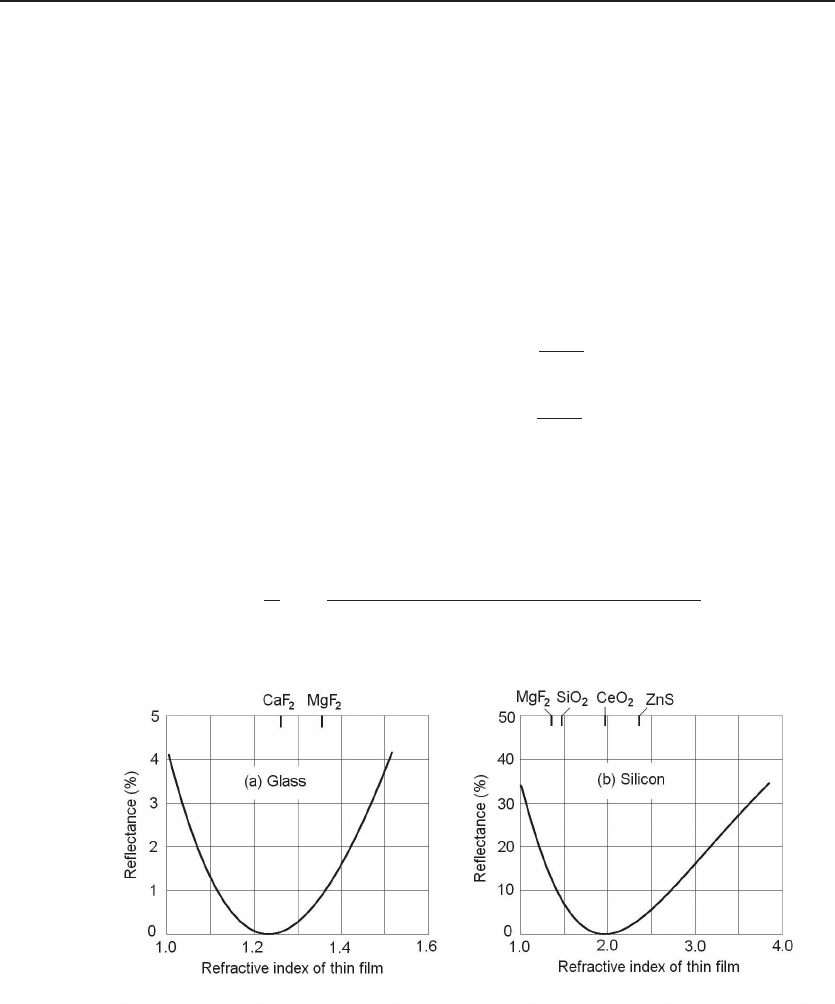
Figure 9.15 Choice of materials for SLAR coatings. The minimum reflectance for an SLAR
coating is determined by the refractive index of the material; see Eq. 9.81. Two cases are shown. For
glass, calcium fluoride and magnesium fluoride are the best choices. For silicon, cerium (ceric) oxide
is the best choice.

i
i
“ChenSolarEnergy” — 2011/5/17 — 17:56 — page 199 — #226
i
i
i
i
i
i
9.4 Antireflection Coatings 199
Two special cases are worth noting. If the thickness of the coating is one quarter of
the wavelength in that medium, that is, δ
1
= π/2, then
R =
n
2
1
− n
0
n
s
n
2
1
+ n
0
n
s
2
. (9.81)
When n
2
1
= n
0
n
s
, the reflectivity is zero. This verifies the result based on the na¨ıve
interference argument resulting in Eq. 9.54.
If the thickness of the coating is one-half of the wavelength in that medium, that
is, δ
1
= π,then
R =
n
0
− n
s
n
0
+ n
s
2
, (9.82)
which coincides with the Fresnel formula 2.80, as if the antireflection coating does not
exist.
9.4.3 Double-Layer Antireflection Coatings
The above treatment can be extended to double-layer antireflection (DLAR) coatings
readily. The mathematical details are left as an exercise. The general result for the
reflectance is
R =
R
2
1
+ R
2
2
I
2
1
+ I
2
2
, (9.83)
where
R
1
=(n
0
− n
s
)cosδ
1
cos δ
2
−
n
0
n
2
n
1
−
n
s
n
1
n
2
sin δ
1
sin δ
2
,
R
2
=
n
0
n
s
n
2
− n
2
cos δ
1
sin δ
2
+
n
0
n
s
n
1
− n
1
sin δ
1
cos δ
2
,
I
1
=(n
0
+ n
s
)cosδ
1
cos δ
2
−
n
0
n
2
n
1
+
n
s
n
1
n
2
sin δ
1
sin δ
2
,
I
2
=
n
0
n
s
n
2
+ n
2
cos δ
1
sin δ
2
+
n
0
n
s
n
1
+ n
1
sin δ
1
cos δ
2
,
(9.84)
and the phase shift of the jth film is given as
δ
j
= n
j
k
0
d
j
. (9.85)
As a special case, if the thicknesses of both films are a quarter-wavelength, where
δ
1
= δ
2
= π/2, all cosines are zero and all sines are unity. We have
R =
R
I
2
=
n
0
n
2
2
− n
s
n
2
1
n
0
n
2
2
+ n
s
n
2
1
2
. (9.86)
i
i
“ChenSolarEnergy” — 2011/5/17 — 17:56 — page 200 — #227
i
i
i
i
i
i
200 Semiconductor Solar Cells
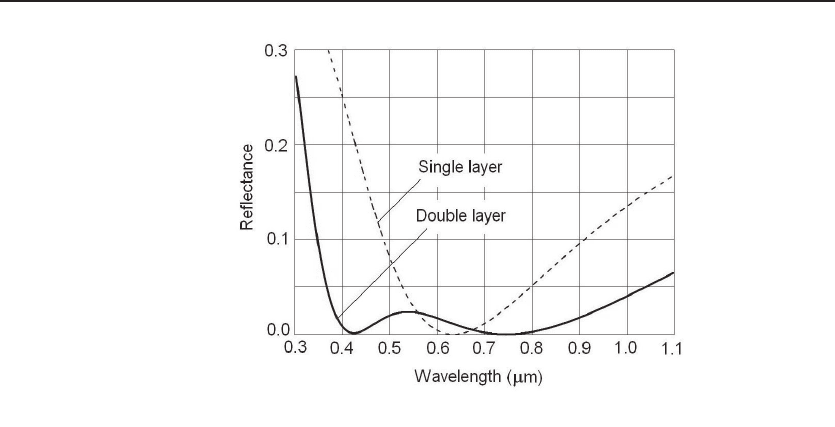
Figure 9.16 Wavelength range of antireflection coatings. Single-layer antireflection coating
has one minimum-reflectance wavelength. Shown here is the reflectance for a 80-nm-thick CeO
2
SLAR
film on silicon substrate. DLAR coatings can have two minimum-reflectance wavelengths. Shown here
is the reflectance of a 101-nm ZnS film and a 56-nm MgF
2
film on a silicon substrate. The wavelength
range of low reflectance is greatly increased. See Ref. [91].
The condition for zero reflectance is
n
0
n
2
2
= n
s
n
2
1
. (9.87)
Therefore, the choice of materials can be broadened.
The major advantage of multilayer antireflection coatings is the wavelength range.
As discussed in the previous section, even if the best material is chosen, for an SLAR
coating, complete reflection cancellation can only happen for a single wavelength. For
DLAR coatings, this can happen for two different wavelengths. This can be seen
from the expression of reflectance R. If the condition in Eq. 9.87 is satisfied, when
cos δ
1
and cos δ
2
vanishes at two different wavelengths, reflection is eliminated at both
wavelengths. Figure 9.16 shows two cases used in manufacturing. The dashed curve
is the reflectance for an 80-nm-thick CeO
2
SLAR film on silicon. The solid curve
is the reflectance of a DLAR cotings with a 101-nm-ZnS film and a 56-nm MgF
2
film on a silicon substrate, which provides two minimum-reflectance wavelengths. The
wavelength range of low reflectance is greatly increased. See Ref. [91].
9.5 Crystalline Silicon Solar Cells
The first practical solar cell, invented in 1954, used crystalline silicon. To date, crys-
talline silicon solar cells still have 80 – 90% of market share. The material has many

i
i
“ChenSolarEnergy” — 2011/5/17 — 17:56 — page 201 — #228
i
i
i
i
i
i
9.5 Crystalline Silicon Solar Cells 201
advantages:
1. Silicon, comprising 27% of Earth’s crest, is the second most abundant element
after oxygen.
2. Its band gap is almost optimum regarding the solar spectrum.
3. Chemically, silicon is very stable.
4. Silicon is nontoxic.
5. Because of the microelectronics industry, the production and processing of ultra-
pure silicon are well developed.
6. After more than 50 years of research and development, the efficiency of sili-
con solar cells, 24.7% for research prototypes, is already close to its theoretical
limit. The mass-produced modules, limited for cost reduction considerations,
have reached 20% efficiency.
9.5.1 Production of Pure Silicon
The raw material for silicon, silica, is the most abundant mineral on Earth, including
quartz, chalcedony, white sand, and numerous noncrystalline forms. The first step in
silicon production is to reduce silica with coke to generate metallurgical-grade silicon,
SiO
2
+C−→ Si+CO
2
. (9.88)
The silicon thus produced is typically 98% pure. For applications in solar cells, at least
99.9999% purity is required, so-called solar-grade silicon. However, many processes can
generate silicon with impurity levels less than 10
−9
, which is needed for high-efficiency
solar cells.
Two processes are commonly used. In the Siemens process, high-purity silicon
rods are exposed to trichlorosilane at 1150
◦
C. The trichlorosilane gas decomposes and
deposits additional silicon onto the rods, enlarging them:
2HSiCl
3
−→ Si + 2HCl + SiCl
4
. (9.89)
Silicon produced from this and similar processes is called polycrystalline silicon. The
byproduct, silicon tetrachloride, cannot be reused and becomes waste. The energy
consumption in this process is also significant.
In 2006 Renewable Energy Corporation in Norway (REC) announced the construc-
tion of a plant based on fluidized-bed technology using silane, taking silicon tetrachlo-
ride as the starting point:
3SiCl
4
+Si+2H
2
−→ 4HSiCl
3
,
4HSiCl
3
−→ 3SiCl
4
+SiH
4
,
SiH
4
−→ Si+2H
2
.
(9.90)
i
i
“ChenSolarEnergy” — 2011/5/17 — 17:56 — page 202 — #229
i
i
i
i
i
i
202 Semiconductor Solar Cells
The purification process takes place at the silane (SiH
4
)stage. AccordingtoREC,
the energy consumption of this new process is significantly reduced from the Siemens
process. Also, using the almost free hydroelectric power in Norway, REC is expecting
to reduce the cost of solar-grade pure silicon to less than $20 per kilogram.
To prepare for solar cell production, pure silicon can go through two alternative
processes. For single-crystal silicon solar cells, the Czochraski process or the float-
zone process is applied to generate single-crystal silicon ingots. Alternatively, the pure
silicon can be melted in an oven to produce polycrystalline ingots.
9.5.2 Solar Cell Design and Processing
The efficiency of solar cells has gradually improved since the invention of the silicon solar
cell in 1954. Recently, the 25% efficiency of laboratory prototypes of monocrystalline
silicon solar cells has approached its theoretical limit; see Plate 5.
There are several silicon solar cell designs. Here we present one by the University
of New South Wales in Australia, the passivated emitter, rear locally diffused (PERL)
cells (Fig. 9.17), which has achieved up to 24.7% efficiency under standard global solar
spectra; see Refs. [91] and [36].
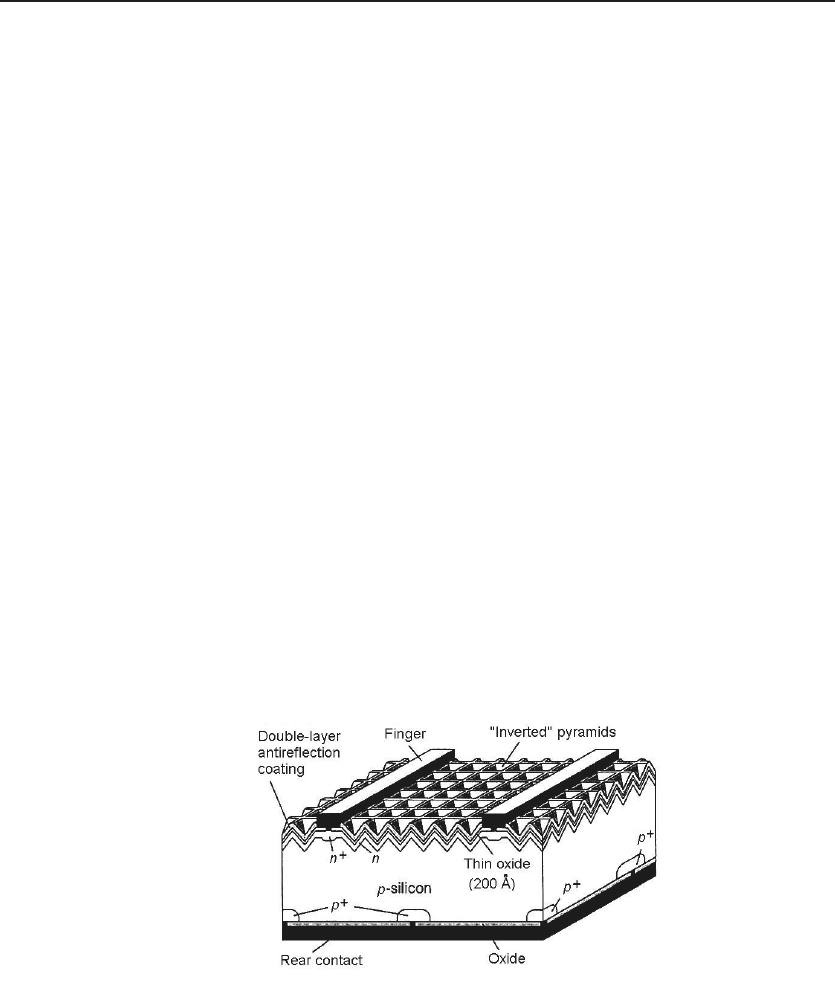
The design of the PERL solar cell is shown in Fig. 9.17. In addition to using a
rather thick wafer (370- or 400-μm) high-quality monocrystalline silicon, it has several
features that enhance efficiency.
Passivation and Metal Contacts
To reduce surface recombination, both sides of the wafer are passivated with a layer of
silicon dioxide. Because SiO
2
is an insulator, metal contacts must be made with small
holes in the SiO
2
film. By locally diffusing boron to the rear contact areas, the effective
Figure 9.17 Typical high-efficiency silicon solar cell. The front side of the relatively thick
silicon wafer is textured to capture light. A double-layer antireflection film is applied. The back side is
passivated with silicon dioxide to reduce surface recombination. The rear contacts are enabled through
highly doped p+ regions. After Ref. [91].