
Chen C.J. Physics of Solar Energy
Подождите немного. Документ загружается.

i
i
“ChenSolarEnergy” — 2011/5/17 — 17:56 — page 223 — #250
i
i
i
i
i
i
10.5 Bilayer Organic Solar Cells 223
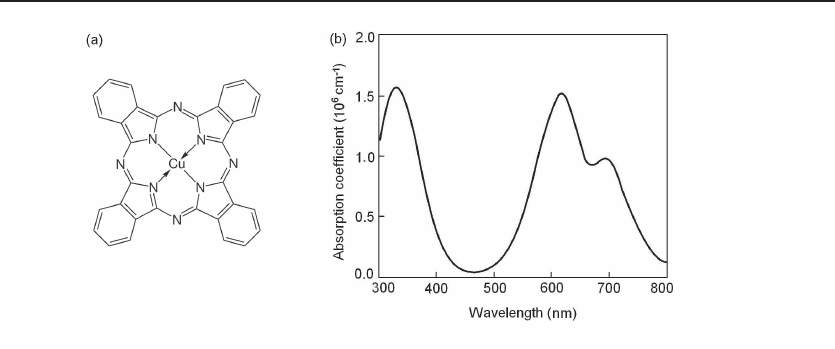
Figure 10.11 CuPc and its absorption spectrum. (a) Chemical structure of CuPc. (b) Ab-
sorption spectra of a solid thin film of CuPc. The red, yellow, green, and violet radiations are heavily
absorbed. The material shows a dark blue color. Adapted from Ref. [38].
short diffusion length; see below.
The second process, exciton diffusion, deserves much attention. In contrast to
semiconductor solar cells, the diffusion lengths of excitons in organic polymers are very
short, typically 5 – 10 nm. Therefore, the lifetime of the excitons are very short. If the
polymer is too thick, the excitons generated by photoexcitation might not reach the
donor–acceptor interface and then disappear. In order to increase the probability for
excitons to reach the acceptor, a nonplanar interface is often used; see Fig. 10.10(a).
In the third process, the exciton dissociates into a free electron and a free hole.
The material for the acceptor should facilitate the dissociation and the final transfer of
the carrier to the back contact, the cathode. In the first successful demonstration of a
bilayer organic solar cell, a perylene tetracarboxylic derivative is used [80]. Later, C
60
(buckminsterfullerene) and its derivatives are often used [15, 38].
Similar to dye-sensitized solar cells, the bilayer organic solar cells have disadvan-
tages. Its efficiency is less than one-half that of the crystalline silicon solar cells. The
long-term stability of the organic materials still needs to be improved.

i
i
“ChenSolarEnergy” — 2011/5/17 — 17:56 — page 224 — #251
i
i
i
i
i
i
224 Solar Electrochemistry
Problems
10.1. Assume that (1) 50% of the leaf surface is stuffed with chlorophyll, (2) 30%
of the solar photon hitting the chlorophyll generates one ATP, and (3) it takes 10
ATP to generate one sixth of glucose, a unit of CH
2
O. What is the efficiency of that
photosynthesis process?
Hint: Use the blackbody radiation formula to estimate the average photon energy of
sunlight. Note that
∞
0
x
2
dx
e
x
− 1
=2ζ(3) = 2.404. (10.5)
10.2. The crown of a typical sugar maple tree is roughly a sphere of 5 m radius. If the
photosynthesis process of the leaves is devoted to making syrup, on a sunny summer
day, how many kilograms of condensed maple syrup (60% sugar in weight) can this tree
produce?
Hint: 1 eV equals 96.5 kJ/mol. Use the experimental value of photosynthesis efficiency
(5%) to estimate the solar radiation required to produce 1 kg of syrup.
i
i
“ChenSolarEnergy” — 2011/5/17 — 17:56 — page 225 — #252
i
i
i
i
i
i
225
Chapter 11
Solar Thermal Energy
11.1 Early Solar Thermal Applications
One of the earliest documentations of solar thermal energy applications is in Code of
Zh¯ou Regulations (Zh¯ou L˘ı), a government document on the organization and laws of
the West Zh¯ou dynasty (eleventh century B.C. – 771 B.C.). An entry in that book says,
“The fire-maker uses a solar igniter (y´angsu`ı) to start a fire using sunlight.” M`oz˘ı, a
philosopher and physicist living in the Zh¯ou dynasty (468 B.C. – 376 B.C.), expounded
the imaging properties of concave mirrors. A good quantitative understanding had been
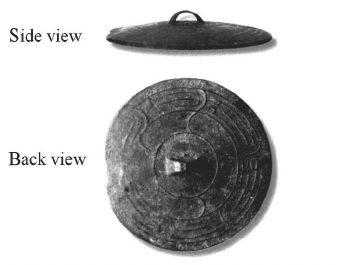
achieved at that time. To date, six such solar igniters have been found from various
West Zh¯ou dynasty tombs. Sixteen from the East Zh¯ou dynasty (770 B.C. to 221 B.C.)
were also unearthed. Figure 11.1 shows an example, dated about 1000 B.C., discovered
in 1995 in F´uf¯ong county of Sh˘anx¯ı province. Its diameter is 90.5 mm. Its radius of
curvature is 207.5 mm, and the focal length is 103.75 mm. The original mirror was
rusty. By making a mold from the original and cast in bronze, after polishing, the
replica can ignite a straw using sunlight in a few seconds. Similar solar igniters have
been found in other Bronze Age cultures over the world.
According to a Greek legend, in 212 B.C., Archimedes used mirrors to focus sunlight
on ships of an invading Roman fleet at Syracuse and destroyed the fleet. The use of
burning mirrors for military purposes was a favorite theme of Middle Age and Renais-
sance scholars. However, later experiments in the seventeenth through the nineteenth
Figure 11.1 A 3000-years-old
solar igniter. A bronze solar ig-
niter (y´angsu`ı) of the early Zh¯ou
dynasty, dated 1000 B.C., discov-
ered in 1995 from a Zh¯ou dynasty
tomb in F´uf¯ong county of Sh˘anx¯ı
province. With a radius of curva-
ture 207.5 mm, its focal length is
103.75 mm. A replica of the origi-
nal can ignite a piece of straw using
sunlight in a few seconds.
Physics of Solar Energy C. Julian Chen
Copyright © 2011 John Wiley & Sons, Inc.
i
i
“ChenSolarEnergy” — 2011/5/17 — 17:56 — page 226 — #253
i
i
i
i
i
i
226 Solar Thermal Energy
centuries showed that even with modern technology and large mirrors the focused sun-
light is not intense enough to burn ships at a reasonable distance. The story is probably
amyth.
In 1767, French-Swiss scientist Horace Benedict de Saussure designed and built the
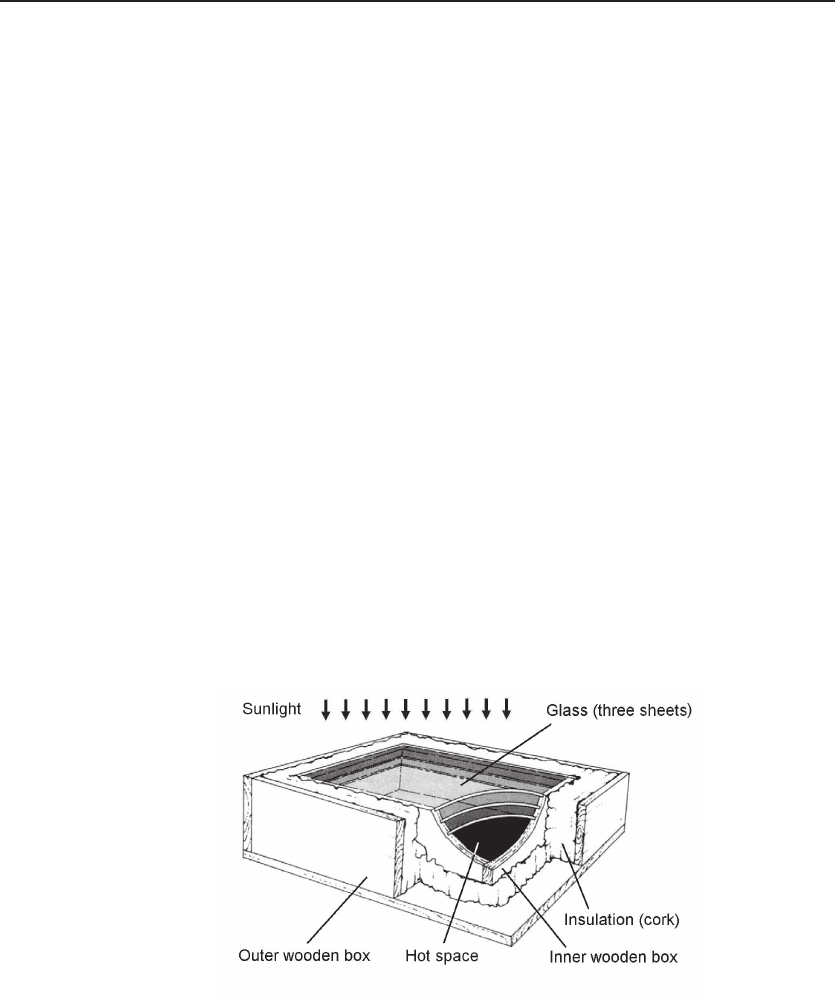
first solar heat trapper that could be used for cooking [17]. Figure 11.2 shows the
device. It is made of two wooden boxes, a small one inside a large one, with insulation
(cork) in between. The inside of the small box is painted black. The top of the small
box is covered by three separate sheets of glass, with air between adjacent glass sheets.
By facing the top of the box toward the Sun, and moving the box to keep the glass
perpendicular to sunlight, in a few hours, the temperature inside the small box reaches
above 100
◦
C. Therefore, it is a hot box heated by the Sun. To identify the source of the
heat, de Saussure carried a hot box to the top of Mt. Cramont. He found that although
the air temperature there is about 5 – 10
◦
C lower than on the plain, the interior of
the box could reach the boiling point of water as well. He attributed this effect to the
clearness of the air on top of the mountain, where solar radiation is stronger.
Horace de Saussure’s experiment is a demonstration of the greenhouse effect.It
motivated Joseph Fourier to explain the equilibrium temperature of Earth by infrared
absorption of Earth’s atmosphere. Fourier explained his theory of the greenhouse effect
by making an analogy to de Saussure’s hot box where the glass sheets keep heat inside.
However, de Saussure’s hot box was too slow to heat up, and the temperature
could not become high enough for cooking, for example, 150
◦
. This was probably the
reason it did not become a popular product. The first mass-produced solar thermal
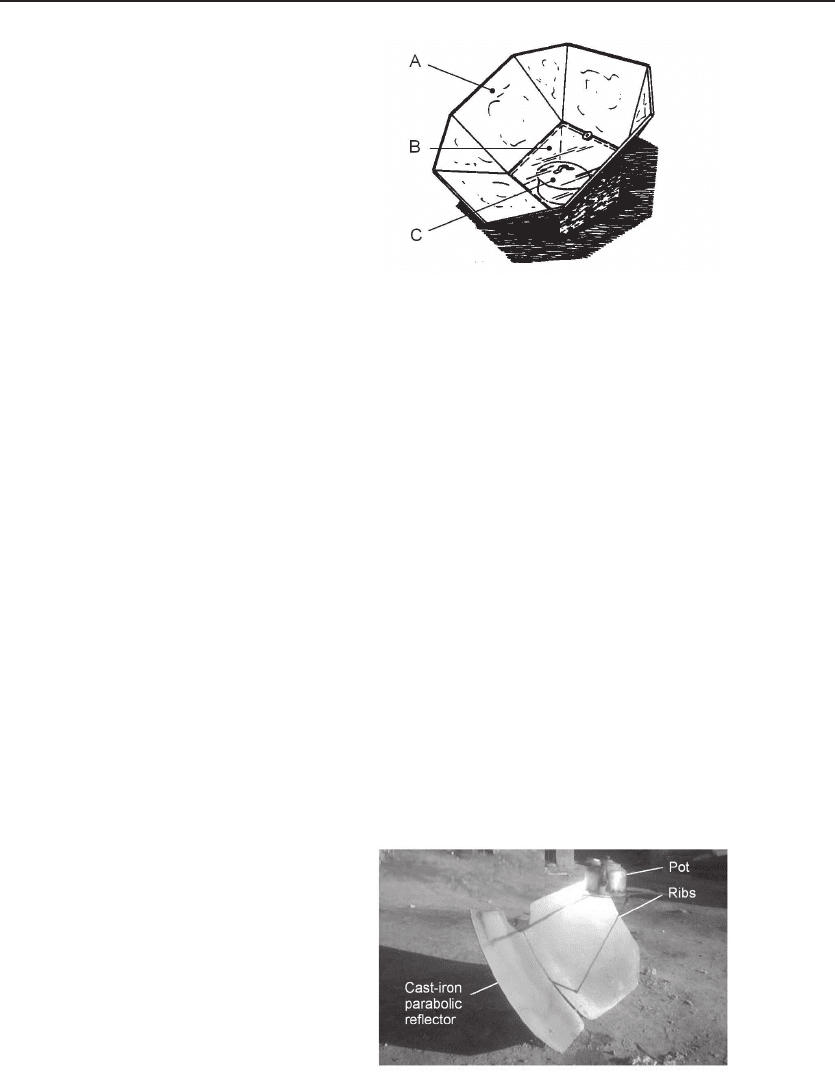
device is the solar oven invented by W. Adams in the 1870s in Bombay, India [3]. He
added a modest solar energy concentration device to de Saussure’s hot box, as shown in
Fig. 11.3. Eight glass mirrors (A) form an octagonlike reflector. Concentrated sunlight
Figure 11.2 The hot box of Horace de Saussure. In 1767, Horace de Saussure designed and
built the first solar cooking device, the hot box. Using three sheets of glass, the sunlight could come
in but heat could not escape, making the temperature inside the box rise to the boiling point of water.
Adapter from Butti and Perlin [17], courtesy of John Perlin.
i
i
“ChenSolarEnergy” — 2011/5/17 — 17:56 — page 227 — #254
i
i
i
i
i
i
Figure 11.3 Adams solar oven.
In 1878, W. Adams invented a so-
lar oven in Bombay, India. Eight
mirrors made of silvered glass (A)
form an octagonal reflector. Sun-
light is concentrated and floods into
a wooden box covered with glass
(B), which contains a pot (C). The
box can be rotated by hand to align
with sunlight. The temperature in
the box could exceed 200
◦
C [3].
floods into the wooden box covered with glass (B), which contains a pot (C). The
mirrors and the glass are inclined so that the rays of the Sun fall perpendicular to the
box. When the Sun moves, the box can be rotated by hand to align with sunlight. In
a paper published in 1878 in Scientific American [3], Adams reported, “The rations of
seven soldiers, consisting of meat and vegetables, are thoroughly cooked by it in two
hours, in January, the coldest month of the year in Bombay, and the men declare the
food to be cooked much better than in the ordinary manner.” His solar oven was then
mass produced in India and became quite popular. In the United States, the Adams
solar oven has become a popular product for camping and an educational device for
teenage students.
A solar oven currently in widespread use in third world countries is shown in
Fig. 11.4. It is a parabolic reflector made of cast iron and plated with chromium.
Two steel ribs support a steel holder for a pot. The pot is always positioned near the
focal point of the parabolic dish. By manually aligning the axis of the parabolic dish
with the sunlight, the pot can receive a maximum amount of solar heat. This type of
solar oven is mass produced in Eastern China and more than 10 thousand units are
sold annually in Tibet.
In the twentieth century, the solar water heater was invented and improved, and
became increasingly popular [?]. A brief history of the solar water heater is presented
in Chapter 1. On the other hand, concentrated solar thermal electricity is a bright
Figure 11.4 Cast-iron solar
oven. Cast-iron parabolic reflec-
tor supported by a tripod with a
joint which can be turned in two
axes. Two steel ribs support a
steel holder for a pot. By manually
aligning the axis of the parabolic
dish with the sunlight, the pot can
always receive the maximum solar
heat.
11.1 Early Solar Thermal Applications 227

i
i
“ChenSolarEnergy” — 2011/5/17 — 17:56 — page 228 — #255
i
i
i
i
i
i
228 Solar Thermal Energy
spot in solar power generation. In the following sections, we present the physics of
solar thermal energy applications.
11.2 Solar Heat Collectors
For all solar thermal applications, the first step is to convert solar radiation energy into
heat. From both materials and mechanical structure points of view, the key requirement
is to absorb as much sunlight as possible and to lose as little heat energy as possible.
Three methods are used: selective absorption surface, vacuum to block heat conduction
and convection, and focused sunlight to change the ratio of the absorbing surface area
and the emitting surface area.
11.2.1 Selective Absorption Surface
In early solar thermal applications, such as water heaters in the early twentieth century,
the absorbing surface was painted a dull black. As a blackbody, it could absorb the
maximum amount of solar radiation. When the body became hot, it lost energy by
radiation.
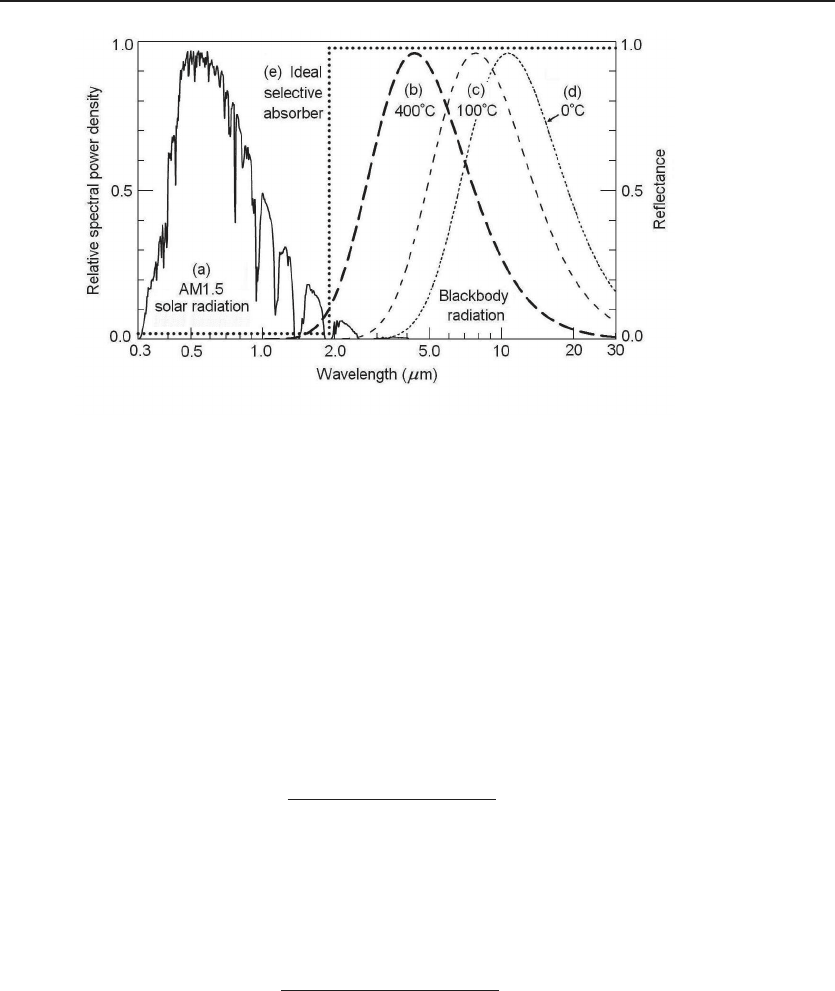
The blackbody radiation spectra of the Sun and a hot body, for example, a pot of
boiling water or a solar thermal absorber at 400
◦
, could be separable on the energy
scale; see Table 2.3 and Fig. 2.4. It becomes more intuitive to make a plot of the
relative spectral power density on a logarithmic scale of wavelength (see Problem 2.3),
u(λ, T )=
2πhc
2
λ
5
e
hc/λk
B
T
− 1
=
3.75 × 10
8
λ
5
e
λ
T
/λ
− 1
W
m
2
1
μm
,
(11.1)
where the power density is expressed in watts per square meter and the spectrum
is expressed in terms of wavelength in micrometers. Figure 11.5 shows the relative
spectral power density of AM1.5 solar radiation and from hot bodies. As shown, the
peak of solar radiation is around 0.5 μm. On the other hand, the radiation from a hot
body at 400
◦
Cis4μm and that of boiling water is 8 μm. The blackbody radiation
spectrum from the hot liquid is well separated from that of solar radiation. Therefore,
by designing a material having a high absorptivity for wavelength shorter than 2 μm
and a low emissivity for longer wavelength, the absorption of solar radiation can be
maximized and radiation loss can be minimized.
In the solar energy literature, the property of the surface is usually denoted by its
reflectance at different wavelengths, R(λ). The absorption surface for solar thermal
applications is opaque. Energy conservation requires that the sum of reflectivity and
absorptivity be
R(λ)+A(λ) = 1; (11.2)
i
i
“ChenSolarEnergy” — 2011/5/17 — 17:56 — page 229 — #256
i
i
i
i
i
i
11.2 Solar Heat Collectors 229
Figure 11.5 Spectral power density of solar radiation and hot bodies. (a) The spectral
density of solar radiation concentrates to wavelengths shorter than 2 μm. (b) – (d) The spectral
density of bodies on Earth. Even at 400
◦
, it is concentrated in wavelengths greater than 2 μm. (e)
The ideal selective absorber is a perfect blackbody for λ<2 μm and a perfect miror for λ>2 μm.
see Eq. 5.2. According to Kirchhoff’s law, the emissivity of a surface equals its absorp-
tivity (Eq. 5.3),
E(λ)=A(λ). (11.3)
Therefore, the requirement of an ideal selective absorbing surface is low reflectivity for
wavelengths shorter than 2 μm and a high reflectivity for longer wavelengths.
Two dimensionless quantities are defined to characterize the global performance of
theselective absorption surface as follows. The solar absorptivity α is defined as
α =
∞
0
u
(λ)[1− R(λ)] dλ
∞
0
u
(λ) dλ
, (11.4)
where the solar radiation power density u
(λ) is the AM1.5 direct normal spectral
power density. The thermal emissivity ε is defined as
ε =
∞
0
u(λ, T )[1− R(λ)] dλ
∞
0
u(λ, T )dλ
, (11.5)
where u(λ, T ) is the blackbody radiation of the solar device at temperature T defined in
i
i
“ChenSolarEnergy” — 2011/5/17 — 17:56 — page 230 — #257
i
i
i
i
i
i
230 Solar Thermal Energy
Eq. 11.1. The photothermal conversion efficiency can be calculated using the formula,
η = α −ε
σT
4
CI
, (11.6)
where σ is the Stefan–Boltzmann constant, T is the temperature of the solar heat
collector, C is the concentration factor, and I
is the solar radiation power density,
with a typical value of 1 kW/m
2
on a sunny day under normal incidence conditions.
Since the concept of selective absorption surface was proposed in the 1950s, it
became an intensive international research project, especially in the United States,
Israel, and Australia. For a review with an extensive list of references, see Ref. [41].
For a systematic treatment of theory and processes, see Ref. [47]. The ideal selective
absorption curve is the dotted line in Fig. 11.5, with α = 1 and ε = 0. Nevertheless,
very good approximations have been achieved. There is still much research interest in
this, especially for solar thermal electricity applications, where the temperature of the
fluid should be as high as possible. According to basic thermodynamics, the maximum
efficiency is the Carnot efficiency (Eq. 6.19),
η
c
=1−
T
L
T
H
. (11.7)
For example, if the fluid heated by solar radiation is 40
◦
C higher than ambiant tem-
perature at 20
◦
C (293 K), the maximum efficiency of a heat engine is 12%. The tem-
perature of the fluid should be 400 – 500
◦
C in the solar thermal collector. However,
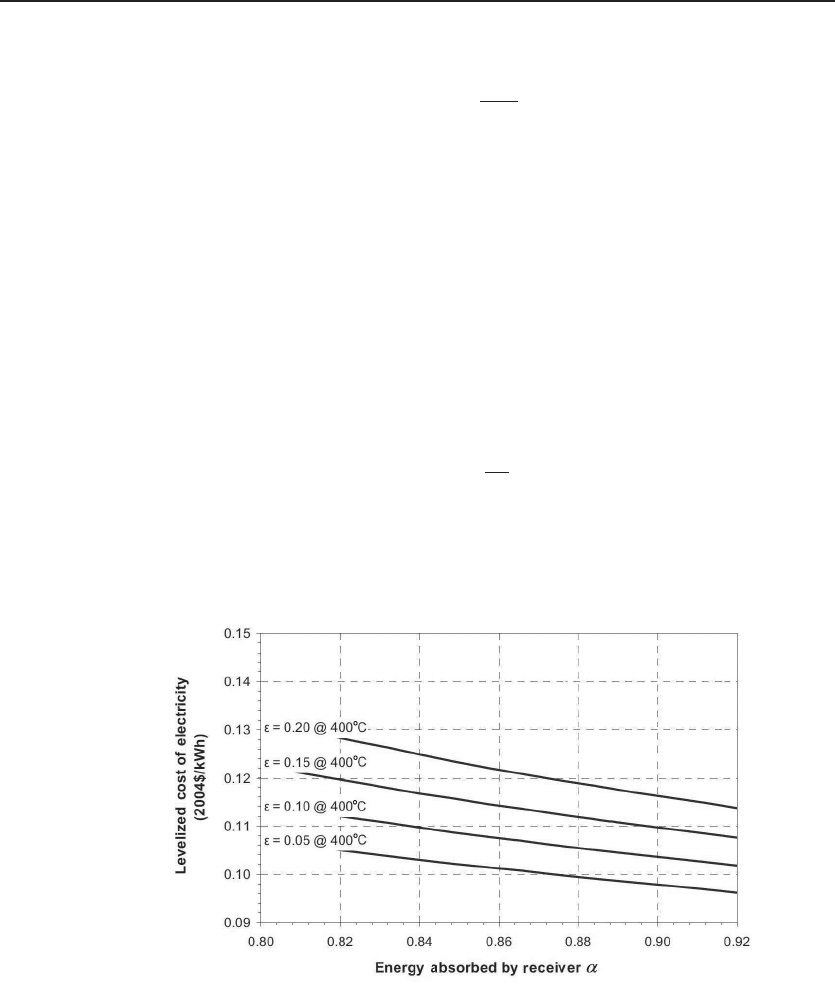
Figure 11.6 Effect of selective absorption on solar thermal devices. Estimated effect of solar
absorptivity α and thermal emissivity ε on the levelized cost of electricity generated by a solar thermal
system. As shown, improvement of the selective absorption coating is a critical factor in achieving
grid parity. After Ref. [41].

i
i
“ChenSolarEnergy” — 2011/5/17 — 17:56 — page 231 — #258
i
i
i
i
i
i
11.2 Solar Heat Collectors 231
at that temperature, the radiation loss is substantially higher. Figure 11.6 shows an
estimate of the effect of solar absorptivity α and thermal emissivity ε on the levelized
cost of electricity generated by a solar thermal system. As shown, the improvement of
the selective absorption coating is a critical factor in achieving grid parity.
The requirements for a selective absorption coating are as follows:
1. High solar absorptivity, ideally α = 90% to 97%
2. Low thermal emissivity, ideally ε = 3% to 10%
3. Durable at working temperature, for example, 30 years at 400
◦
4. Stable in air
5. Low-cost large-scale manufacturing
There are several types of selective absorption surfaces:
1. Intrinsic selective absorbers, such as semiconductors
2. Metal mirror coated with a thin absorption layer
3. Thin film with a window of transmittivity on a transparent cover.
4. Multilayer interference film
Because of the high stability, high contrast, and relative ease of mass production, a
metal mirror coated with a thin absorption layer is the most popular type. The mirror
can be made of any metal of high reflectivity for infrared radiation, such as copper,
aluminum, nickel, and stainless steel. The absorption film is made of metal oxides, and
named “dark mirrors.”
Table 11.1 lists several well-studied and commercialized dark mirrors. the first three
cases, black nickel, black chrome, and black copper, are produced with a liquid-phase
process and are stable in air up to a few hundred degrees Celsius. The Al–AlN
x
system
must be processed in a vacuum chamber, and is stable in a vacuum up to 500
◦
C.
It is particularly convenient for vacuum tube thermal absorbing systems because the
Table 11.1: Selective Absorbing Surfaces
System Mirror Absorbant α
Black nickel Ni or steel NiS–ZnS 0.88 – 0.96 0.03 – 0.10
Black chrome Cr Cr
2
O
3
0.97 0.09
Black copper Cu Cu
2
O–CuO 0.97 – 0.98 0.02
Aluminum nitride Al Al
3
N
4
0.97 0.10
Source: Ref. [41].
i
i
“ChenSolarEnergy” — 2011/5/17 — 17:56 — page 232 — #259
i
i
i
i
i
i
232 Solar Thermal Energy
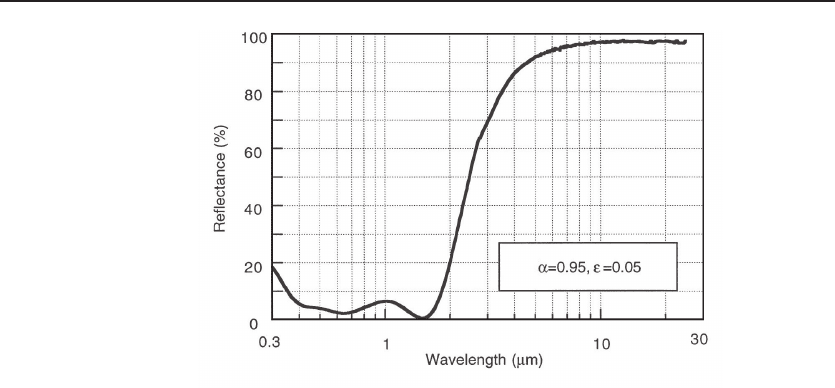
Figure 11.7 Reflectance curve for cermet selective-absorbing surface. The measured re-
flectance spectrum of a surface with AlN cermet composite on stainless steel base [89, 90]. It approaches
the ideal behavior shown in Fig. 11.5.
deposition of aluminum and AlN can be made in the same processing chamber. The first
step, aluminum deposition, is performed in a vacuum. Then, by controlled bleeding
of nitrogen, good-quality AlN
x
film can be formed. Because the selective coating is
working under a vacuum, it does not deteriorate.
For high-temperature systems, for example, solar thermal electricity system working
at 400 – 500
◦
C, especially with a requirement of stability in air, a cermet coating is pre-
ferred. A cermet is a composite material composed of ceramic (cer) and metallic (met)
materials which could have the properties of both a ceramic, such as high-temperature
resistance and hardness, and a metal, such as the ability to undergo plastic deformation.
Therefore, properly designed cermet coatings can withstand high temperature and are
stable in air [42, 89, 90]. Figure 11.7 shows the reflectivity spectrum of a surface with
an AlN cermet composite on a stainless steel base. As shown, it approaches the ideal
behavior illustrated in Fig. 11.5.
11.2.2 Flat-Plate Collectors
As discussed in Section 1.5.1, the first successful solar water heater, the Day-and-Night,
uses flat-panel solar heat collectors. It is relatively easy to build and rugged enough to
withstand the elements. In fact, thousands of such flat-panel solar heat collectors built
in 1920s, are still working properly in Florida after more than 80 years of exposure to
the harsh weather. In the whole solar hot water system, only the water tank needs
to be updated using foam polyurethane as insulating material. Figure 11.8 shows a
schematic. It is essentially a de Saussure hot box ( Fig. 11.2), hosting a copper plate
with copper pipes soldered on, painted black. Usually one or two sheets of glass are
installed for top-side heat insulation. Water can be heated up to 60
◦
or 80
◦
.Itisa