
Claverie J-M., Notredame C. Bioinformatics for Dummies
Подождите немного. Документ загружается.

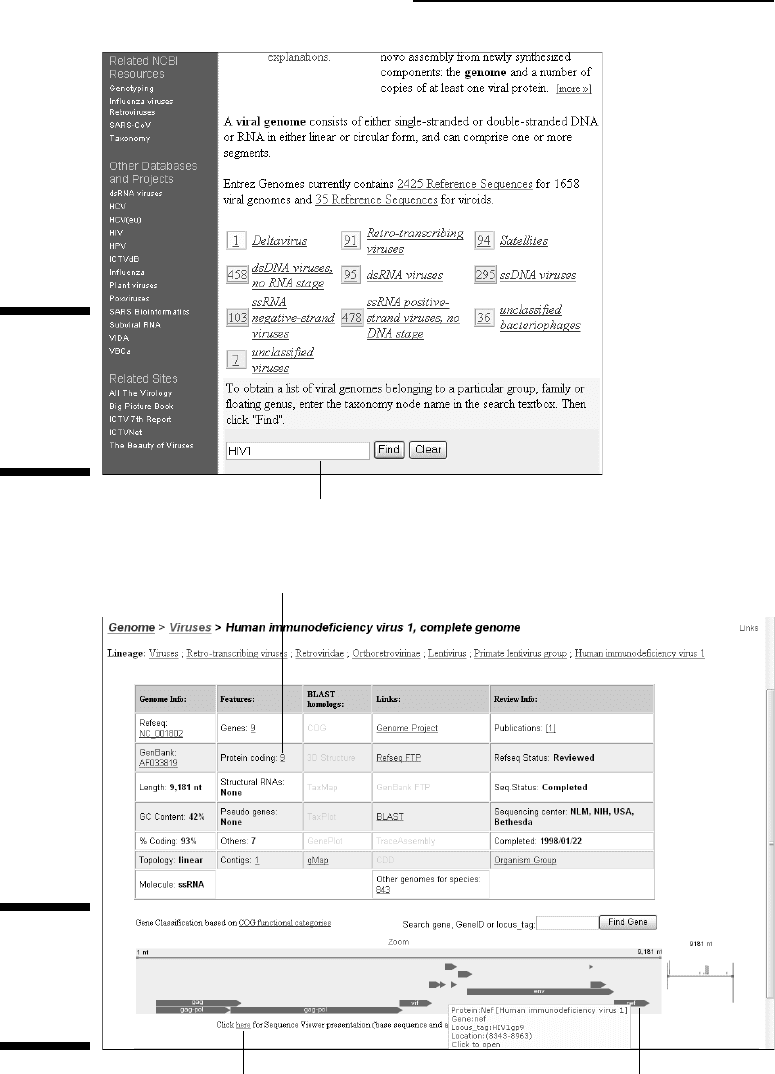
Click here for all proteins.
Click here for a live map. Click here to get gene details.
Figure 3-14:
General
structure of
the HIV-1
genome.
Enter the name of your virus of interest.
Figure 3-13:
The table of
all available
viral
genome
sequences.
90
Part II: A Survival Guide to Bioinformatics
08_089857 ch03.qxp 11/6/06 3:54 PM Page 90
Similar pages are available for all viruses, regardless of their sizes.
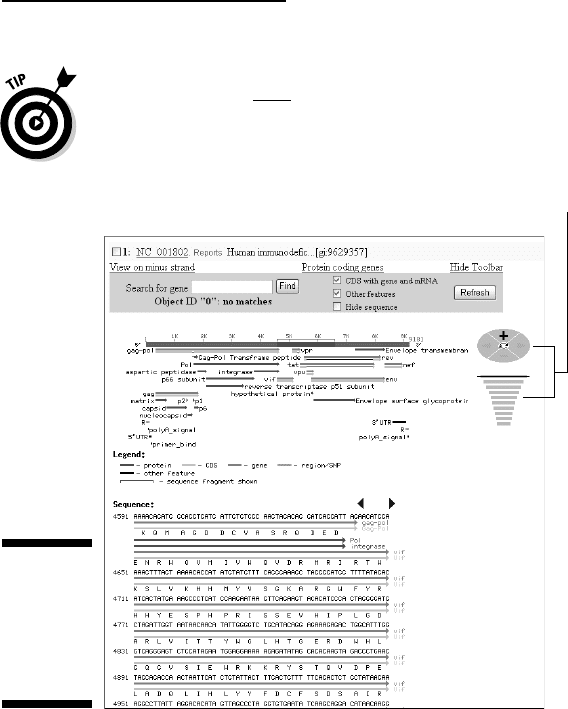
Clicking the her
e link (bottom of Figure 3-14) gets you a live map,
allowing you to zoom in on any genome region, down to the nucleotide
sequence level, as shown in Figure 3-15.
Figure 3-15 shows a position in the genome where the end of the Pol
gene slightly overlaps with the beginning of the Vif gene. Viruses com-
monly have the same nucleotide sequence involved in the making of
two different amino-acid sequences.
6. Click your browser’s Back button.
This takes you back to the HIV-1 Genome entry page. (Refer to
Figure 3-14.)
7. Click the number (9) following Protein coding (second column and
row of the table).
The Protein List page appears, as shown in Figure 3-16. Here, you can
retrieve the DNA and protein sequences in different formats — GenBank
format, or FASTA format — by clicking one of the three lozenges in the
rightmost column.
Navigate/zoom in on the viral genome using these buttons.
Figure 3-15:
Zooming in
on the HIV-1
genome: the
Pol/Vif
overlap.
91
Chapter 3: Using Nucleotide Sequence Databases
08_089857 ch03.qxp 11/6/06 3:54 PM Page 91
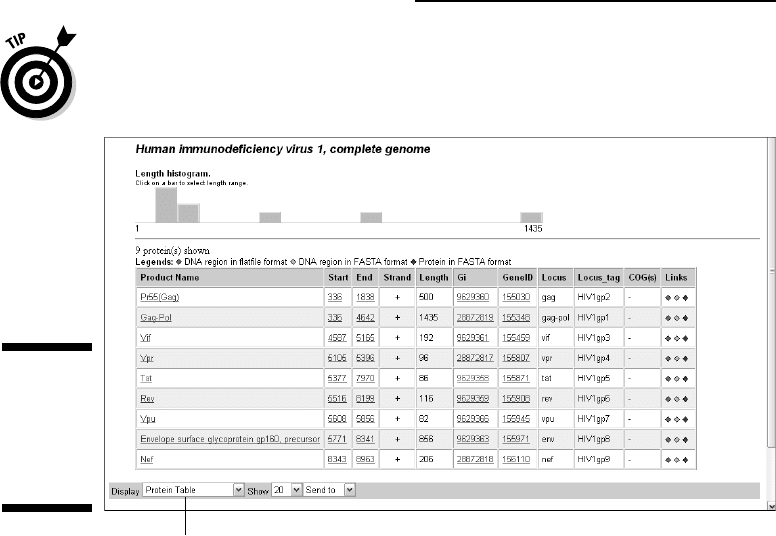
If you want, you can download the complete set of protein sequences by
selecting Protein FASTA in the Display pull-down menu.
Working with complete bacterial genomes
NCBI Entrez offers a nice interface to all publicly available complete bacterial
genome sequences. For a quick tour, do the following:
1. Point your browser to www.ncbi.nlm.nih.gov/entrez/.
The NCBI PubMed home page dutifully appears.
2. Click Genome on the black menu bar near the top of the form.
This takes you to the Entrez Genome page.
3. In the left dark-blue margin, click the Chromosome link located under
the Bacteria heading.
This step returns a listing of all bacteria whose chromosomes have been
fully sequenced. (Directly clicking Bacteria would have given you a
longer list, including parasitic DNA segment called plasmids.) Figure 3-17
shows the top of the list.
Select Protein FASTA here to download all sequences.
Figure 3-16:
Download-
ing HIV-1
gene and
protein
sequences.
92
Part II: A Survival Guide to Bioinformatics
08_089857 ch03.qxp 11/6/06 3:54 PM Page 92
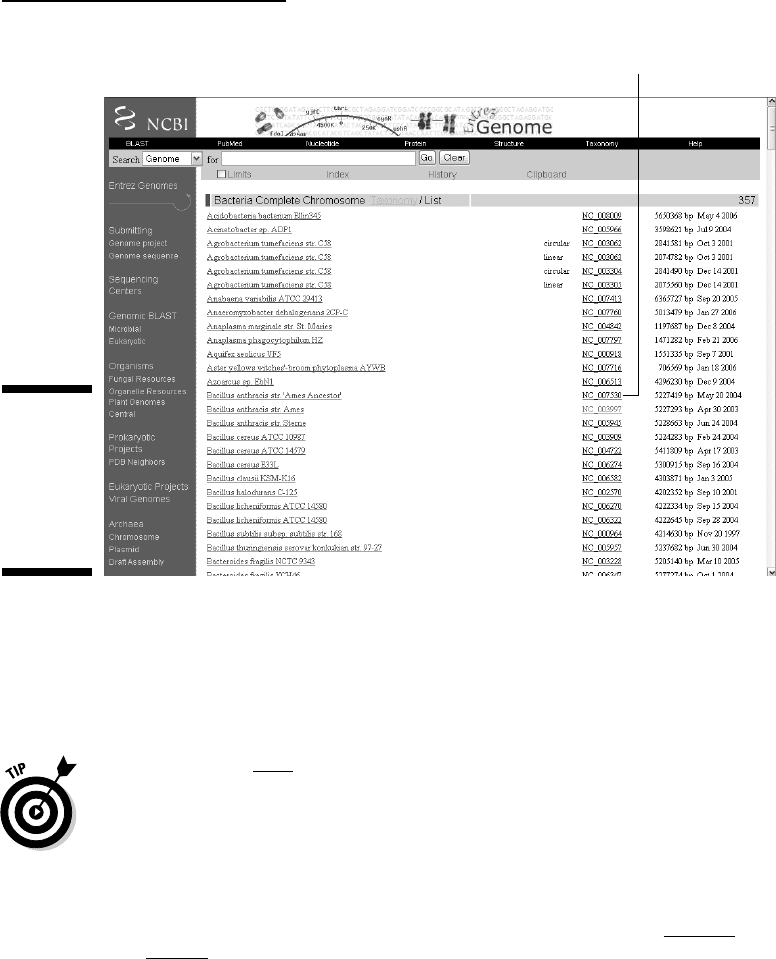
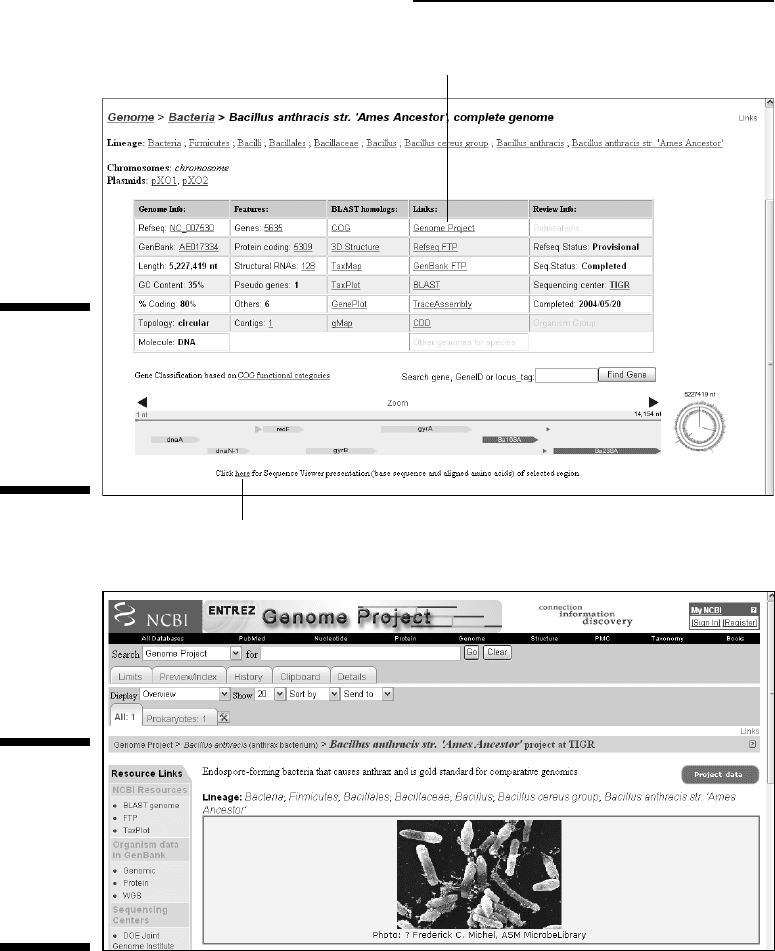
4. Click the NC_007530 link corresponding to the dangerous bioterror-
ism agent
Bacillus anthracis.
Your browser displays a table that summarizes the content and features
of the bacterial genome. It’s similar to what we already got for viruses
(see Figure 3-18).
Clicking the Her
e link near the bottom gets you the same type of live
map we saw with the HIV-1 virus (see the previous section), although
the genome is now much larger. On this map, you can click to zoom into
a particular region of the genome. The genome summary table contains
numerous links to analyses pre-computed for all the genes (function,
similarity, evolutionary relationships) that we leave you to try out for
yourself.
5. Back in the Summary table (refer to Figure 3-18) click the Genome
Project link.
Doing so gets you a quick description of the bacterium, along with a pic-
ture, details about its habitat, the disease it causes, and so on — as well
as the reasons why it was important to decipher its genome sequence in
the first place. (See Figure 3-19.)
Click here.
Figure 3-17:
The list of all
available
bacterial
genome
sequences
(top part).
93
Chapter 3: Using Nucleotide Sequence Databases
08_089857 ch03.qxp 11/6/06 3:54 PM Page 93
More bacterial genomics at TIGR
The Institute for Genome Research (better known by its acronym TIGR) is
home to a team of scientists who pioneered the field of bacterial genomics. In
1995, these scientists produced the two first complete bacterial genomes:
Figure 3-19:
Genome
Project
page for
Bacillus
anthracis
(strain Ames
ancestor).
Click here to learn about the bacteria.
Click here for a live map.
Figure 3-18:
Bacillus
anthracis
(strain Ames
ancestor)
genome
summary.
94
Part II: A Survival Guide to Bioinformatics
08_089857 ch03.qxp 11/6/06 3:54 PM Page 94
Hemophilus influenzae and Mycoplasma genitalium. Since then, they have con-
tributed to more than 70 complete bacterial genomes, with more on the way.
TIGR offers a site that is quite complementary to the NCBI resource because
it keeps track of all ongoing bacterial genome sequencing projects (not only
of the completed ones), propose its own variety of well-integrated analysis
tools for use, and offers the possibility to run similarity searches on its
genome sequence data well before the actual completion of the projects
themselves. In addition, TIGR’s scientists offer a specific perspective on the
genomes they have sequenced through their own genome viewing software.
To pay them a quick visit, do the following:
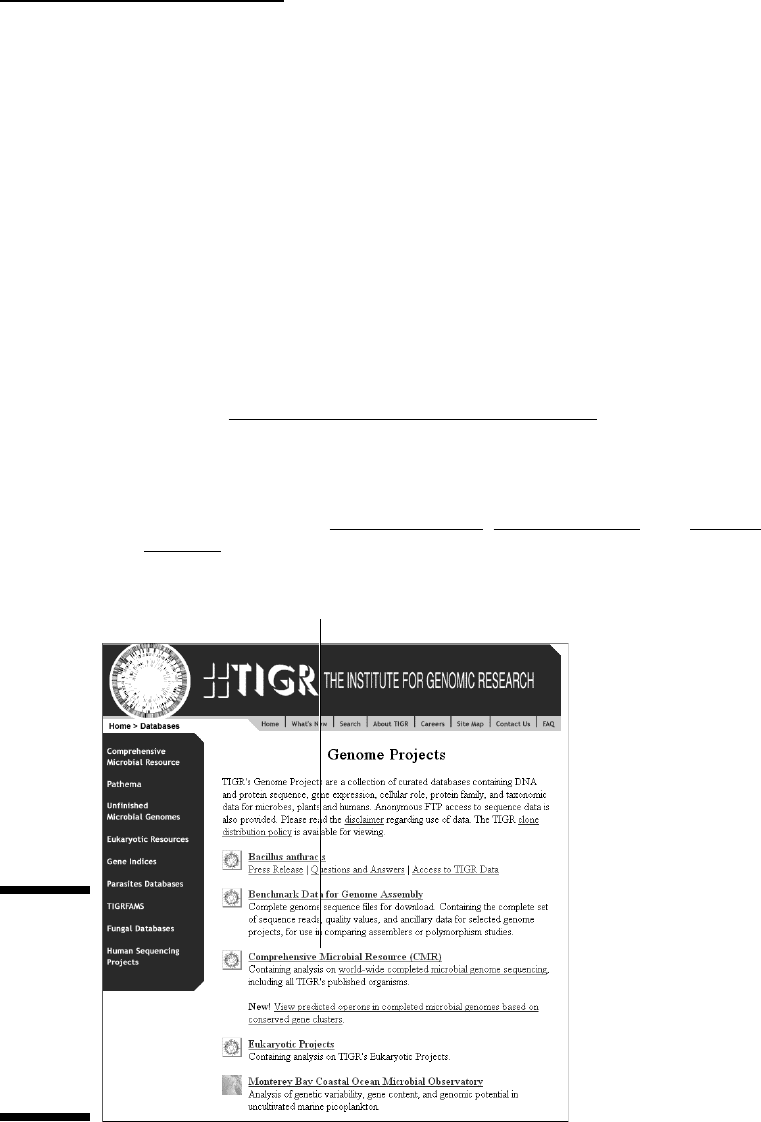
1. Point your browser to www.tigr.org/tdb/.
The TIGR home page appears, as shown in Figure 3-20.
2. Click the Comprehensive Microbial Resource (CMR) link.
A long list of micro-organisms appears, from which you get to select the
one you are interested in.
3. Select one microbe in the list, and then explore the various analyses
tools by clicking the
Genome Searches, Genome Toolbox, and Genome
Analyses links at the top of each microbe-specific page.
Click here.
Figure 3-20:
The
Genome
Projects site
at The
Institute for
Genome
Research
(TIGR).
95
Chapter 3: Using Nucleotide Sequence Databases
08_089857 ch03.qxp 11/6/06 3:54 PM Page 95
Microbes from the environment at DoE
The U.S. Department of Energy (DoE) is also a main player in microbial
genomics. Its Joint Genome Institute specializes in the study of organisms
that are either (a) important for preserving (or de-polluting) our environ-
ment, or (b) offering some new perspective in solving the incoming world-
wide energy crisis (such as cheap ways of producing hydrogen).
To take a look at its data, follow these steps:
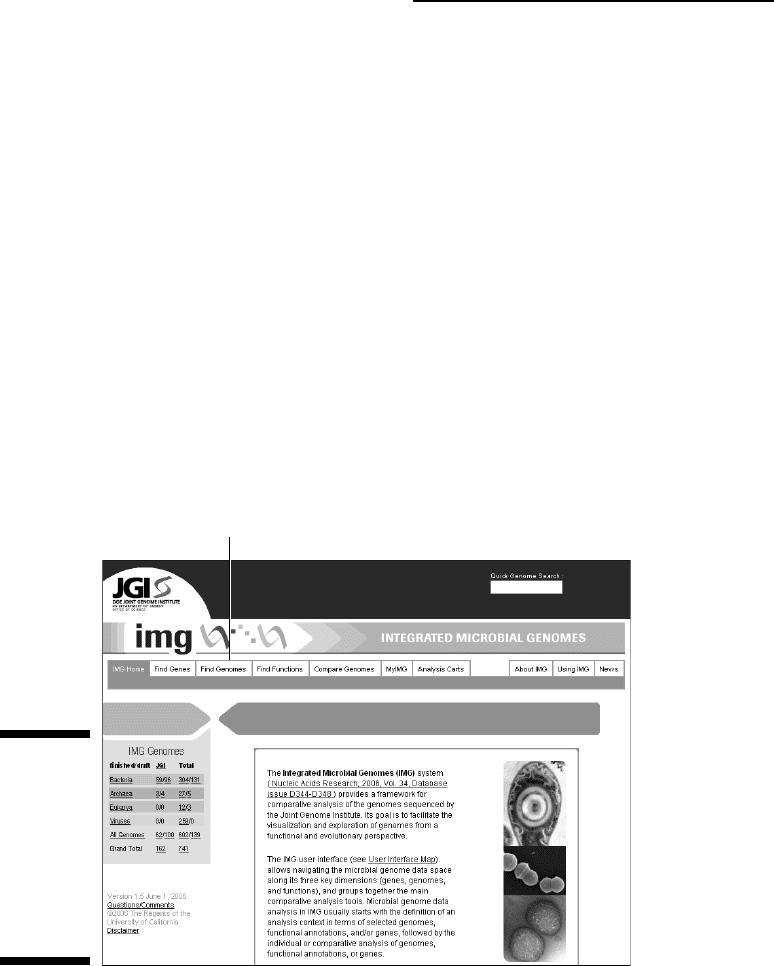
1. Point your browser to img.jgi.doe.gov/.
The Integrated Microbial Genomes resources home page appears, as
shown in Figure 3-21. As was the case with the NCBI and TIGR sites, spe-
cific sets of tools are proposed. The next step looks at the IMG genome
display — one of the more useful IMG resources.
2. To access the IMG Genome display, first click the Find Genomes link.
A table of the available organisms appears.
3. Select an available organism by checking the corresponding box, then
clicking Save Selections.
The first organism, Aeropyrum pernix, would be a good choice for now.
Click here to start.
Figure 3-21:
The
Integrated
Microbial
Genomes
site at the
DoE Joint
Genome
Institute.
96
Part II: A Survival Guide to Bioinformatics
08_089857 ch03.qxp 11/6/06 3:54 PM Page 96
4. In the new page that appears, confirm your selection by clicking
Compare Genomes.
A Genome Statistics page appears.
5. In the Genome Statistics page, click the number one in the DNA
scaffolds row.
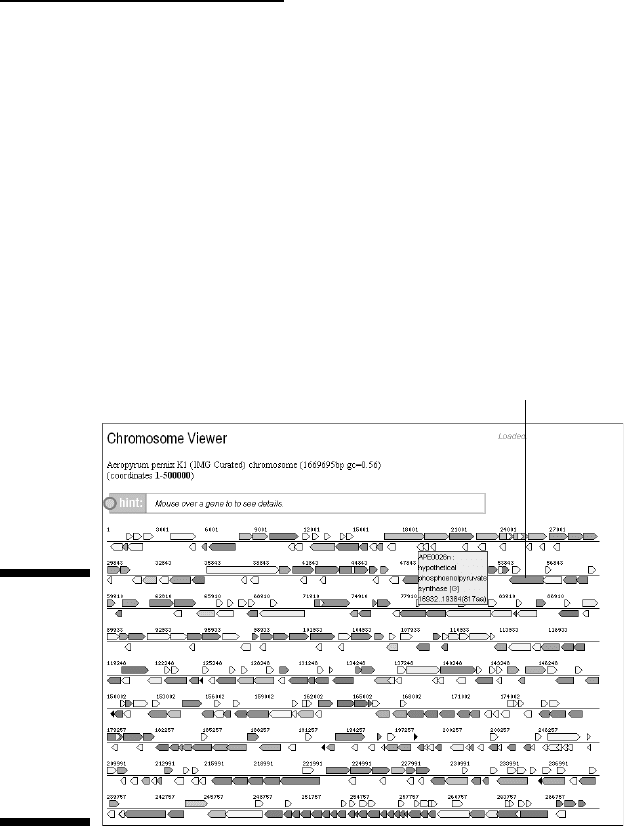
6. In the new page that appears, select a coordinate range (for instance
1 . . . 500000).
This results in a live display of the microbe gene content in that range,
as shown in Figure 3-22. Putting the mouse pointer over the gene symbol
gets you its name — and clicking the symbol provides you with a wealth
of information on the corresponding protein.
Exploring the Human Genome
The sequencing of the human genome is probably one of the greatest scien-
tific accomplishments of modern times. With 3000 million (and then some)
nucleotides spread over 23 chromosomes, this genome is definitely a com-
plex object to deal with. The major task ahead for bioinformatics is to inte-
grate all the past, present, and future information that human genes contain
in a maintainable, user-friendly resource.
Click on a gene symbol to find out more about its function.
Figure 3-22:
The
chromosome
viewer at
the
Integrated
Microbial
Genomes
DoE
resource.
97
Chapter 3: Using Nucleotide Sequence Databases
08_089857 ch03.qxp 11/6/06 3:54 PM Page 97

If you want to make sense of human data, you must have clear ideas on the
current state of the data:
The complete nucleotide sequence of the human genome is now at
hand — except for a few thousand holes that are still being filled up.
This is a reason why new versions (also called “assemblies”) of the —
almost-finished — human genome are periodically released. This state
of flux is true for all large animal genomes.
This sequence was obtained in raw format; the next challenge is the
annotation of the raw data — creating a detailed and accurate FEATURES
table of the human genome.
Throughout the world, new information is generated daily on human
gene properties and functions, using a wide array of techniques. Ideally,
someone has to gather it all, package it nicely, and offer it to the whole
research community for free!
Having doubts that the last goal will ever be attainable in this less-than-perfect
world? Well, think again, because this is where we’re taking you right now.
Finding out about the Ensembl project
The Internet home page of Ensembl (www.ensembl.org) says it all: Ensembl
is a joint project between the European Bioinformatics Institute (EBI) and the
Sanger Institute, both located near Cambridge (U.K.). Together they’ve devel-
oped an integrated database and software system to produce and maintain
automatic annotations for the genomes of animals, with a special attention to
our closest relatives: the vertebrates. This project — like the others we
describe in this chapter — relies heavily on the collaboration of a large
number of individual laboratories. It all started as part of the International
Human Genome Project, continued for the Mouse Genome project, and is
now being pursued for other animals. Data and software are also freely flow-
ing among numerous national database and bioinformatics centers from all
over the world, allowing a complex cross-linking to take place.
Getting started on the Ensembl site
Considering how complex the human genome is, you may not be surprised to
find that you can attack the Ensembl resources from many different angles.
To quickly find out about your options, the best thing to do is to jump on the
guided tour that Ensembl proposes on its home page. Here’s how it’s done:
1. Point your browser to www.ensembl.org/.
The impressive Ensembl home page appears, as shown in Figure 3-23.
98
Part II: A Survival Guide to Bioinformatics
08_089857 ch03.qxp 11/6/06 3:54 PM Page 98
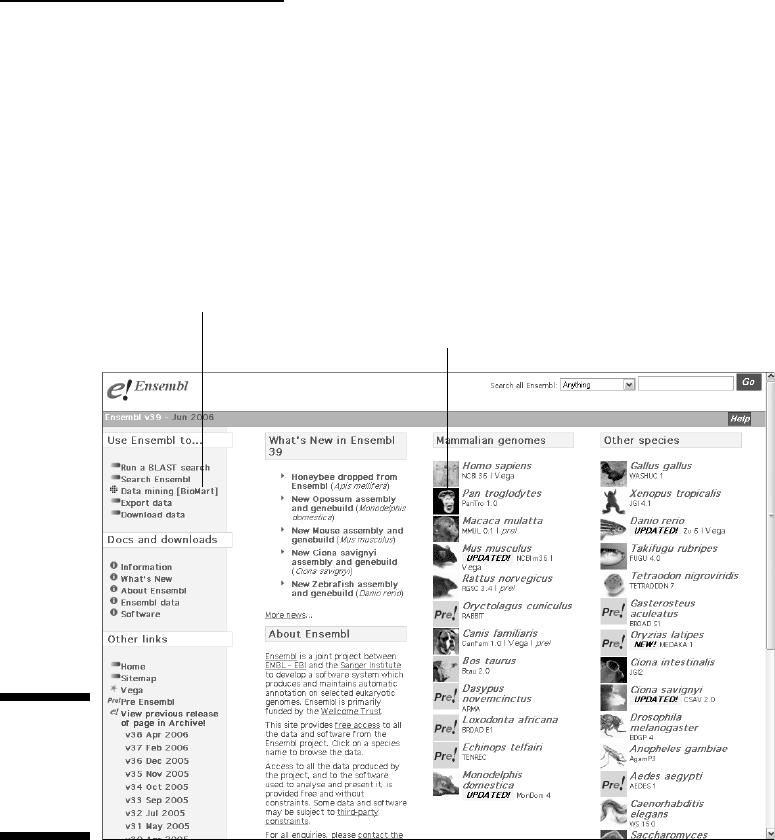
The page densely filled up with links, much too numerous to be explored
in detail in this chapter. You can literally spend weeks navigating all the
possibilities. For now, let’s focus on the right half of the page, where
links to specific animal genome areas are indicated by small pictures.
Thanks to them, you already learned the Latin species name for chim-
panzee (
Pan troglodytes!), rabbit (Oryctolagus cunicumus!), or armadillo
(
Dasypus novemcinctus!). However, the main reason we’re here is to take
a look at the human genome, so let’s click the DaVinci-inspired
Homo
sapiens
icon.
2. Click the Homo sapiens icon.
The page that appears (see Figure 3-24) presents a schematic image of
the various human chromosomes (numbered according to their size),
including the sex chromosomes X and Y, as well as the DNA molecule of
the human mitochondria (a small energy-producing organelle present in
all human cells). This schematic image is “hot,” meaning that clicking a
certain area brings up a new window associated with that area.
Use BioMart for serious data mining.
Click here to start navigating the human genome.
Figure 3-23:
The
Ensembl
project
home page.
99
Chapter 3: Using Nucleotide Sequence Databases
08_089857 ch03.qxp 11/6/06 3:54 PM Page 99