
Claverie J-M., Notredame C. Bioinformatics for Dummies
Подождите немного. Документ загружается.

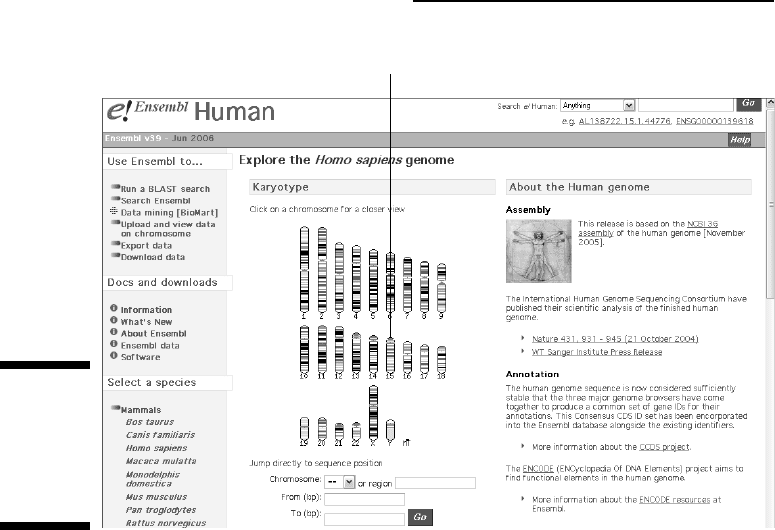
3. Click anywhere on the chromosome 15 picture.
This lands you in the Chromosome 15 data subset (Figure 3-25), within
which we can now ask specific questions, such as: Where is the dUTPase
gene? We can do this the hard way by clicking in the region of the q21.1
band and then manually scanning the region. (We see this information
earlier in this chapter — remember Figure 3-8?) An easier way is to use
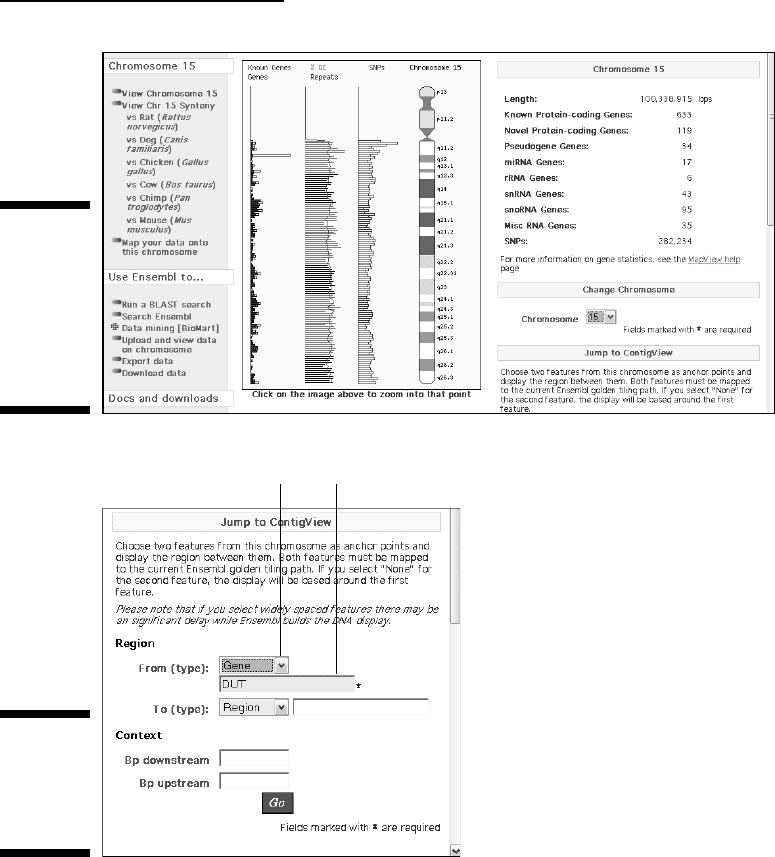
the Feature Locator at the bottom right corner of the page, below the
Jump to ContigView yellow banner, as shown in Figure 3-26. To do so,
follow these steps:
a. Select Gene in the From pull-down menu.
b. Enter DUT in the search window, then click the red Go button.
You are now looking at a complex output, giving you the structure
and the genomic context of the DUT gene at increasing resolution
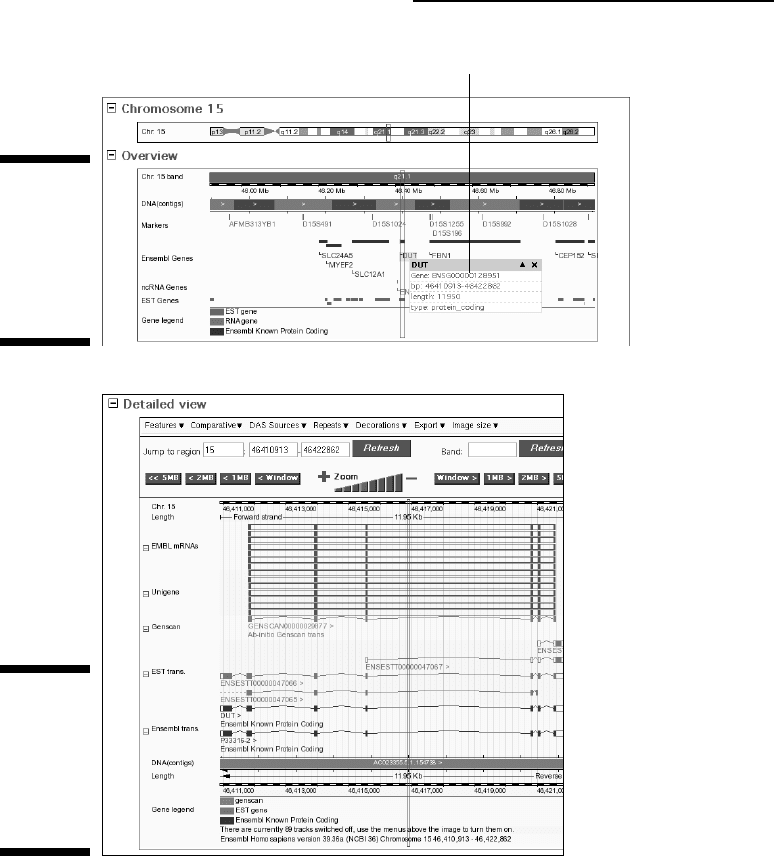
from top to bottom: a schematic overview (1 Mbp range) (see
Figure 3-27), a detailed view (10-kbp range) (see Figure 3-28), and
even a base-pair view (100-bp range).
Mousing over the display at various levels lets you examine any
chromosome location (down to the level of a gene and its neigh-
bors), study the internal structure and the alternative forms of
expression of this specific gene, and assess the eventual conse-
quences of single-nucleotide polymorphisms within that gene (SNP).
Click on chromosome 15.
Figure 3-24:
Starting
your journey
in the
human
genome.
100
Part II: A Survival Guide to Bioinformatics
08_089857 ch03.qxp 11/6/06 3:54 PM Page 100
Getting a complete ID card on the Human DUT gene
Notice that in the overview display (refer to Figure 3-27), the DUT gene name
is highlighted. Clicking the gene name here reveals a label with its Ensembl
gene number, its location, length, and type (protein coding). In turn, clicking
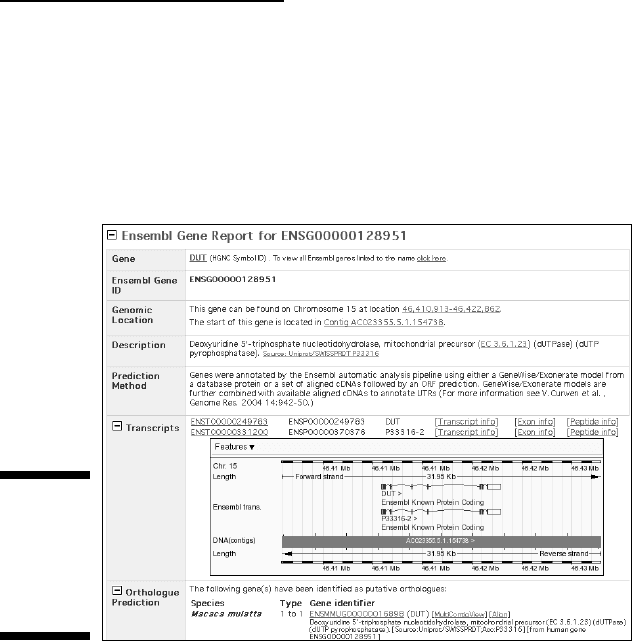
the gene number returns an exhaustive ID card where everything you ever
wanted to know about this gene can be found, either explicitly, or as one of
the zillions of links to relevant entries in other databases. Check out Figure
3-29 to see how the Human DUT ID card looks like.
Select gene. Input gene name.
Figure 3-26:
Looking for
the Human
dUTPAse
gene: DUT.
Figure 3-25:
Focusing on
a given
genome
data subset:
Human
Chromosome
15.
101
Chapter 3: Using Nucleotide Sequence Databases
08_089857 ch03.qxp 11/6/06 3:54 PM Page 101
Finding disease genes with coding SNPs using BioMart
There’s more to Ensembl fun than just random browsing. If you’re a serious sci-
entist, it can answer meaningful questions very easily, very precisely, and very
quickly, even if the output isn’t always as pretty as what we showed you in the
preceding section. The data-mining system that the Ensembl people designed
for this purpose is called BioMart. (Refer to Figure 3-23, upper-left corner.)
Figure 3-28:
The Human
DUT gene
location:
10-kb range
detailed
view.
Click here to get the gene ID card.
Figure 3-27:
The Human
DUT gene
location:
1-Mbp
range
overview.
102
Part II: A Survival Guide to Bioinformatics
08_089857 ch03.qxp 11/6/06 3:54 PM Page 102
Imagine that, as a competent human geneticist, you ask yourself the following
questions:
Which genes on Chromosome 15 have been linked to a disease?
Which SNPs (Single-Nucleotide Polymorphisms) have been identified?
If you’re just dying to find a candidate gene for a disease you’ve just geneti-
cally mapped on chromosome 15, the first question makes a lot of sense.
To make things even more interesting, we can look for
coding SNPs — the
impetus for our second question. (SNPS involve nucleotide changes that may
alter the sequence and possibly the shape and/or function of the correspond-
ing protein product.)
Now, both of these questions are real doozies. Believe it or not, you can answer
them in less than a minute with Ensembl! Follow these steps to see how:
1. Point your browser to www.ensembl.org/.
The Project Ensembl home page appears.
2. Click the Data Mining link in the upper-left corner of the page.
(Refer to Figure 3-23.)
Your browser displays the starting page MartView page, which is already
set up for working with the last version of the Human genome data (oth-
erwise select the dataset).
Figure 3-29:
Top part of
the Ensembl
ID card for
the Human
DUT gene.
103
Chapter 3: Using Nucleotide Sequence Databases
08_089857 ch03.qxp 11/6/06 3:54 PM Page 103
3. Simply proceed by clicking the Next button.
The new page looks formidable, with a zillion selectable search options.
Don’t panic; we’ll get you through it in no time!
4. At the top of the form (Region set up), check the Chromosome box,
and select 15 from the pull-down menu.
5. In the following section (Gene set up), check the top box, and select
With Disease Association from the accompanying pull-down menu.
Then check the Gene Type box, and select protein_coding from the
associated pull-down menu.
6. Scroll down the form until you reach the SNP set up area; check the
Coding box and then click the Next button at the bottom of the page.
7. In the Output form that appears, check the Chromosome Name and
Band boxes, and then check the Ensembl Gene ID, Description and
MIM Disease ID boxes in the next section.
MIM stands for Mendelian Inheritance in Man, and is the leading human-
genetic-disease database.
10. Proceed to the bottom of the form and click the Export button.
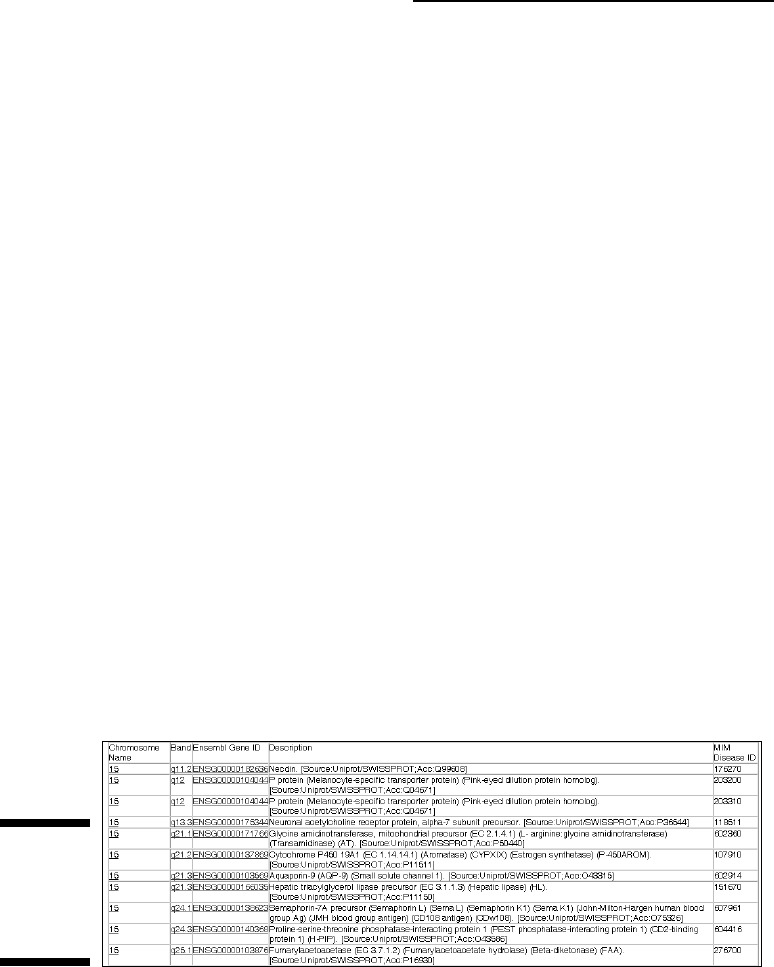
In no time at all, Ensembl returns a table that looks like Figure 3-30. Our
BioMart search identified many different genes known to be associated
with various diseases, and for which sequence polymorphisms inducing
protein changes have been documented. These will be our prime candi-
dates for further research. As before (refer to Figure 3-29), clicking the
Ensembl Gene ID will produce a comprehensive information card for
these genes, allowing you to quickly figure out whether their functions
are related to the disease symptoms.
The range and complexity of the questions you can address through the
Ensembl BioMart resource is truly impressive. We really encourage you to
spend some time playing with it, even though it isn’t as visual as the zooming
tools we showed you in previous sections.
Figure 3-30:
Output of
your first
BioMart
query.
104
Part II: A Survival Guide to Bioinformatics
08_089857 ch03.qxp 11/6/06 3:54 PM Page 104

Chapter 4
Using Protein and Specialized
Sequence Databases
In This Chapter
Exploring protein maturation
Understanding a UniProtKB/Swiss-Prot entry from the top down
Finding out about detailed protein biochemistry
Discovering the function of your protein
Hunting up useful protein-related information resources
Mankind is a catalyzing enzyme for the transition from a carbon-based to a
silicon-based intelligence.
— Gerard Bricogne
W
e’ve focused this chapter to finding information on protein sequences.
The databases on proteins don’t limit themselves to providing
sequences. In this chapter, we show you that by mastering the — sometimes
tangled — network of Web links available to you on the Internet, you can
relate proteins to their gene sequences, to their functions, and even to their
3-D structures.
Don’t let that abundance and diversity of information fool you. As it is for the
nucleotide sequence world, where everything revolves around one central
resource (that is, GenBank), most of the links between genes, proteins, and
functions rely on UniProtKB/Swiss-Prot, the central resource on annotated
protein sequences co-funded by the Swiss Institute of Bioinformatics (SIB)
and the European Bioinformatics Institute (EBI). In this chapter, we show you
how to extract every bit of information you need from this database.
09_089857 ch04.qxp 11/6/06 3:55 PM Page 105

You have many ways of landing on the Swiss-Prot database (or the UniProt
knowledge base, as they also call it now!). Most genomic databases, genome
browsers, or sites running a sequence retrieval system (SRS) link you directly
to the relevant Swiss-Prot entry. If you want to know how to query Swiss-Prot
to find an entry by keyword, go to Chapter 2, where we explain how to do this
in some detail.
106
Part II: A Survival Guide to Informatics
Swiss-Prot: A personal vision of the protein world
Although GenBank and Swiss-Prot occupy sim-
ilarly central roles for the international commu-
nity of biologists, their overall philosophies
aren’t quite the same. GenBank, as a primary
sequence repository, obeys a relatively strict
historical point of view. In GenBank, the authors
have full authority over the content of the
entries they submit. GenBank annotators are
only responsible for the recently introduced
RefSeq entries — the ones they derive from
their own expert analysis of the community-sub-
mitted entries. However, the RefSeq entries
never replace the original GenBank entries, and
all these layers of information are maintained
side by side.
In contrast, Swiss-Prot is not a repository data-
base but a derived information resource, con-
veying the vision of its head and founder, Amos
Bairoch (helped out by a group of experts). As a
consequence, the only truly current Swiss-Prot
version is the one on Amos’ portable computer.
This idea of “personal vision” also means that
Amos Bairoch doesn’t need anybody’s permis-
sion to correct or change a Swiss-Prot entry on
the spot. To do this, Amos simply needs to be
convinced by an expert, or by his own evalua-
tion of the literature, that a change is necessary.
Believe us, we have seen this happening on our
own kitchen table!
The benefit of such a philosophy is obviously
great when it comes to flexibility; blatant errors
can be removed very quickly while hot discover-
ies are incorporated immediately. This is the
reason why Swiss-Prot is considered the best-
annotated protein database, and why it occupies
such a pivotal role in molecular biology and
genomics. The downside involves the (inevitable)
upper limit of what the best researcher in the
world can do (or supervise), even when helped
by a large team of annotators — at the European
Bioinformatics Institute (EBI) in Hinxton as well
as the Swiss Institute of Bioinformatics (SIB) in
Geneva — and a circle of experts. These days,
Swiss-Prot has troubles coping with the present
rate of new (nucleotide) sequence determination
and is falling behind in terms of completeness.
To alleviate this problem, a Swiss-Prot buffer
has been created that is called TrEMBL (for
automatic
TR
anslation of
E
uropean
M
olecular
B
iology
L
aboratory nucleotide sequences).
TrEMBL entries are generated at the EBI from
GenBank submissions and annotated mostly
automatically, using sequence similarity as a
main criterion. Upon visual inspection, manual
correction, and final approval by Amos Bairoch,
TrEMBL entries are then converted into
bona
fide
Swiss-Prot entries.
The idea that such a key worldwide information
resource rests on a single’s man shoulders may
come as a shock to you. However, this sort of
thing has been quite common since the early days
of bioinformatics. Among other famous examples
of one-man shows, we can cite Elvin Kabat ‘s
Immunoglobulin sequence database, Richard J.
Roberts’ Restriction Enzyme Database, or Victor
McKusick’s database of human genetic dis-
eases (Online Mendelian Inheritance in Man,
OMIM). To paraphrase Sir Winston Churchill: “In
the field of bioinformatics, rarely have so many
owed so much to so few!”
09_089857 ch04.qxp 11/6/06 3:55 PM Page 106

The focus of this chapter is on giving you a good understanding of the con-
tent of a Swiss-Prot entry so that you know exactly what is what in the very
exhaustive annotation of this database. We then show you how you can use
this annotation as a starting point to visit more specialized databases. You
can use these databases to further your investigations of the function or
structure of your protein.
We start this chapter by giving you some general ideas on how the cell turns
a native protein sequence into a mature protein. These post-translational
modifications are very important for the protein function. Finding out about
them is one of the main reasons you want to use a protein database. (See
Chapter 6 if you want to find out how to predict these modifications.)
From Translated ORFs to Mature Proteins
Because sequencing DNA molecules is so much easier and cheaper than
sequencing proteins, most of the amino-acid sequences we know do in fact
correspond to computer translations of open reading frames (ORFs) detected
through the analysis of genomic data. Most of the corresponding proteins
have never actually been isolated by anybody. This is why protein specialists
hate us molecular biologists and bioinformaticists when we keep talking
about translated ORFs as if they were genuine proteins. For a while, at the
beginning of the genomic era, the easy thing to do was to consider these
protein specialists a bunch of grumpy old men and simply ignore them.
However, after genomes were sequenced, people’s interest in proteins came
back in a large-scale format known as proteomics.
Proteomics is the scientific
field dealing with the visualization and quantification of the set of protein
molecules present in a given tissue or organism. Proteomics analysis brought
a rapid accumulation of data — and quickly demonstrated that protein spe-
cialists had very good reasons to be angry with us.
ORFs: What you see is NOT what you get
When biologists perform a 2-D gel electrophoresis (a tricky experiment sepa-
rating protein molecules according to their mass in one direction and their
charge in the other), real proteins almost never behave as you’d expect given
the computer translation. In the world of ORFs and proteins,
what you see is
NOT what you get.
The reason is that, when translated from RNA, the nascent amino-acid chain
can be heavily modified on its way to becoming a mature protein. Even simple
physico-chemical properties of a mature protein — such as size, molecular
weight, or isoelectric point — are hard to predict if you know only the
computer-generated amino-acid sequence. This complex process of protein
107
Chapter 4: Using Protein and Specialized Sequence Databases
09_089857 ch04.qxp 11/6/06 3:55 PM Page 107
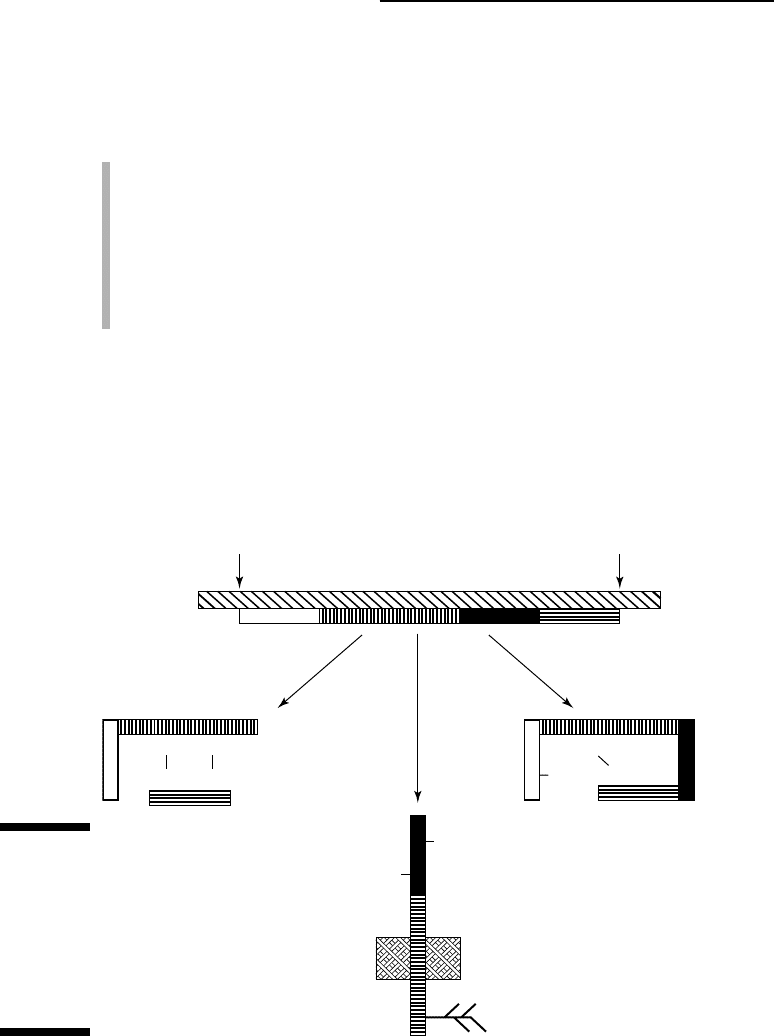
maturation is referred to as post-translational modification. Figure 4-1
summarizes it.
Protein maturation may include any combination of the following stages:
Cuts within the amino-acid chain
Removal of fragments of the amino-acid chain (this is the case for
insulin)
Chemical modifications of specific amino acids (methylation, for example)
Addition of lipid molecules (myristoylation, for example)
Addition of glycosidic (sugar) molecules (glycosylation, for example)
A major role for a protein database (in contrast with an ORF sequence collec-
tion) is to display this type of information, when it is available from experi-
mental data or is predicted using various computational techniques. (For
more on such techniques, see Chapter 6). Hence post-translational modifica-
tions make up a sizeable portion of the protein features recorded in Swiss-
Prot entries.
ATG
Proteolysis
Phosphorylation
Modification
Glycosylation
Membrane
S
S
Disulphide bonds
STOP
ORF
S
S
S
S
Ac
P
P
Figure 4-1:
Possible
modifi-
cations
encountered
during
protein
maturation.
108
Part II: A Survival Guide to Informatics
09_089857 ch04.qxp 11/6/06 3:55 PM Page 108

A personal final destination
for each protein
In order to correctly accomplish their functions, proteins have to reach the
right destination in the organism or within the cell. As it is translated, the
peptide chain may expose a variety of highly specific sequence signals — “ZIP
codes,” if you will — which the cell then uses to direct the protein to the appro-
priate compartment (in or out of the cell). This sorting always involves the
transport of the protein across one or several membranes and is also referred
to as
translocation. The final activities and destinations of a protein include
Getting attached to the cell membrane
Being secreted outside the cell
Being transported into the periplasm (for bacteria)
Being transported to the mitochondria or any other organelle
Being transported into the cell nucleus
Because knowing the final compartment where a protein ends up is impor-
tant in understanding its function, this information (proven or predicted) is
one of the important features recorded in protein databases like Swiss-Prot.
A combinatorial diversity
of folds and functions
The most important step in turning a newly synthesized peptide chain into a
functional protein is the folding of this chain into a compact and stable 3-D
structure. Except for small proteins (fewer than 100 amino acids), the final
protein structure generally consists of several relatively independent
domains. You can imagine these domains as a basic set of fairly rigid LEGO
bricks. Nature can assemble these bricks to produce the immense variety of
existing proteins. For instance, given a basic set of three domains (A, B, C),
you can end up with Protein AAA or AB or BCC or BAC, and so on.
Most natural proteins are made of combinations of one to ten domains
picked from a set of a few thousands. Despite significant sequence variations,
the domains are identifiable by their
scaffold sequence signatures — the
motifs in the protein amino-acid texts that remain recognizable despite a zil-
lion years of divergent evolution. The recognition and the definition of pro-
tein domains is a major research topic of bioinformatics. (See Chapters 6, 7, 9
and 11.) The domain architecture underlying a particular protein sequence is
important to know because it gives hints about the protein’s possible 3-D
structure — and suggests its potential biochemical or cellular function.
109
Chapter 4: Using Protein and Specialized Sequence Databases
09_089857 ch04.qxp 11/6/06 3:55 PM Page 109