
Claverie J-M., Notredame C. Bioinformatics for Dummies
Подождите немного. Документ загружается.

For this reason, a significant part of each Swiss-Prot entry is devoted to the
description of the domain organization of proteins, as identified or predicted
by all available methods.
Reading a Swiss-Prot Entry
Despite the complicated concepts that their descriptions rely on, proteins
are much simpler objects than genes:
Proteins correspond to relatively small sequences (350 amino acids
long, on the average).
Unlike genes, proteins have clear beginnings and clear ends.
Proteins are defined on a single strand.
Whatever modifications occur between the ORF sequence and the
mature protein, the amino acids they contain remain in the same order.
Given all these reasons, you’d probably expect Swiss-Prot entries to be easier
to read and understand than GenBank’s — and you’d be right!
Like a GenBank entry — which we cover with great flair in Chapter 3 —
a Swiss-Prot entry is divided into several main sections:
The general information part
The bibliographic information part
The functional information part
The feature table
The sequence part
Using the human
epidermal growth factor receptor (EGFR) as an example, the
following sections show you how to decipher a Swiss-Prot entry from top to
bottom, step by step (or line by line).
Deciphering the EGFR Swiss-Prot entry
The EGF receptor is a rather complex molecule. We use it here because it
illustrates remarkably well the wealth of information you can glean from a
Swiss-Prot entry.
110
Part II: A Survival Guide to Informatics
09_089857 ch04.qxp 11/6/06 3:55 PM Page 110

Chapter 2 shows you more sophisticated ways of querying Swiss-Prot, but for
our purposes here, we can use the following basic search:
1. Point your browser to www.expasy.ch/sprot/.
The UniProtKB/Swiss-Prot page of the ExPASy server appears (refer to
Figure 2-10, Chapter 2, to remember what it looks like).
2. Type the Swiss-Prot ID P00533 in the Search window (top of the page).
This is the entry corresponding to the human receptor of the epidermal
growth factor. We chose it because this protein is hot! It is an oncogene
(a trigger for cancer), and it exhibits a fairly detailed annotation. Because
more people work on hot proteins, they’re usually better annotated than
the more mundane ones.
3. Click the Go button.
The UniProtKB/Swiss-Prot P00533 entry page appears. If you want to
print this page, click the Printer-Friendly View button at the top right.
Because of the large amount of information available that deals with this
particular protein, this entry is probably among the most complicated
you’ll ever come across when interacting with Swiss-Prot. Most other
entries don’t exhibit a third of the keywords and fields you can find here.
General information about the entry
You’re now ready to go through this fairly complex entry step by step. Blue
banners separate the main sections across the screen. The first one is titled
Entry Information and contains the following six fields:
Entry Name: EGFR_HUMAN. This Swiss-Prot identifier gives a quick
idea of what the entry is all about. Here, the name is quite explicit, but
don’t count on that — such clarity isn’t always the case! For instance,
the fly lysozyme entry name is
LYSA_DROME, certainly more ambiguous
and more difficult to remember (DROME stands for
DROsophila
MElanogaster).
As a general rule, the entry name is not supposed to be meaningful, nor
stable. As a consequence, you’re strongly advised
not to use it for cross-
reference purposes, or as a sequence identifier in an article. Instead, you
should use the primary accession number that appears on the next line.
Primary Accession Number: P00533: This is the truly unique and stable
identifier of this sequence. You must use this number when referencing
the entry in your work.
111
Chapter 4: Using Protein and Specialized Sequence Databases
09_089857 ch04.qxp 11/6/06 3:55 PM Page 111

Accession numbers are great because they allow you to retrace the
database history of a given protein. For instance, you can imagine that
the EGF-receptor protein, being an unusually long protein, was first
described as a partial sequence. Then people worked further to deter-
mine longer fragments of this protein, and so on. At each step, they pub-
lished a paper and submitted a new version of the EGF-receptor protein
(perhaps in the process correcting earlier mistakes). Unlike GenBank,
Swiss-Prot keeps only one version of the EGF receptor and summarizes
our knowledge up to this day.
Ancient accession numbers never die; they just get stored in the
secondary accession number field.
Secondary Accession Numbers: O00688, P06268, Q14225, et al:
Secondary accession numbers make sure that when you read an old
paper mentioning Q12225 or P06268 as accession numbers for EGFR, you
can still use the old reference to find the most recent one. See for your-
self and try to use one of these older numbers in the Search window.
Whatever secondary accession number you type in, you always fall back
on the current one: P00533. This is a clean and simple way to remove old
entries while keeping them unambiguously linked to the state-of-the-art
version.
The next lines in the General information are self-explanatory.
Integrated into Swiss-Prot on: July 21, 1986.
Sequence was last modified on: November 1, 1997.
This suggests that it took ten years to get the whole sequence right!
Annotations were last modified on: July 25, 2006.
Clearly, a lot of work is still going on about this important protein.
Notice that, for the whole entry, the field definition (the left part of each line)
is an active link that directs you to the relevant part of the Swiss-Prot manual.
Reading a few of those might earn you some respect from the local bioinfor-
matics gurus!
Name and origin of the protein
At this point, we encounter a new section (introduced by the blue banner):
Name and Origin of the Protein. It contains the following five fields:
112
Part II: A Survival Guide to Informatics
09_089857 ch04.qxp 11/6/06 3:55 PM Page 112
Protein name: Epidermal growth factor receptor [Precursor]: This
field contains general descriptive information about the sequence. It is
generally sufficient to identify the protein precisely. If the sequence is a
fragment, this field indicates it.
Here, the
[Precursor] attribute indicates that the sequence must be
cleaved to form the mature form of the protein.
Synonyms: Receptor tyrosine-protein kinase ErbB-1, EC 2.7.10.1: The
E.C. number (2.7.10.1) encodes the biochemical reaction (tyrosine-
protein kinase) that this protein performs. E.C. stands for Enzyme
Nomenclature Committee, and we give you a bit more information about
it in Table 4-1.
This little line doesn’t look very impressive, but it can be the starting
point of a fascinating journey toward a complete understanding of this
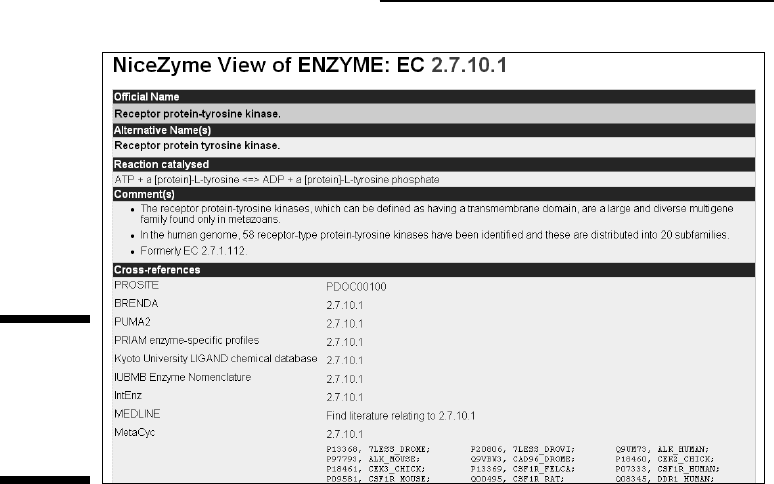
protein enzymatic function. For example, click the 2.7.10.1
link to see the
NiceZyme view of the enzyme, as shown in Figure 4-2. The links on this
page lead to various types of information; you can
• Locate your protein within a chart of all cellular metabolic
pathways
• Get a description and sequence profile of the family it belongs to
• Get the chemical formulas of the biochemical compounds it can
interact with
Gene name: EGFR: This field is useful when you need to interact with
nucleotide sequence and genome databases. It can help keep queries
clear and unambiguous. (For more on gene names, see Chapter 3.)
From: Homo sapiens (Human)
[TaxID:9606
]:
The From field defines
precisely the origin of the protein. The species designation consists, in
most cases, of the Latin genus and species designation followed by the
English name (in parentheses). For viruses, only the common English
name is given. Clicking the Taxonomic ID 9606
link gets you to the H.sapi-
ens
page of the NEWT taxonomy database maintained by the UniProtKB
group (
www.ebi.ac.uk/newt/index.html).
Taxonomy: Eukaryota; Metazoa; Chordata; Craniata; Vertebrata; ...,
etc: This field lists the taxonomic classification of the source organism.
The taxonomic classification used is that maintained at the National
Center for Biotechnology Information (NCBI). Each group name is a link
to a list of all the Swiss-Prot entries from that group.
This field is handy if you want to quickly gather all the protein
sequences of a given species for your research projects.
113
Chapter 4: Using Protein and Specialized Sequence Databases
09_089857 ch04.qxp 11/6/06 3:55 PM Page 113
The References
The next section of the P00533 entry is the References section — and it
really is as simple as it looks: a list of the bibliographical references used to
build the current entry. In this example, it includes the various studies that
have contributed to the sequencing, to the definition of several isoforms of
the protein as expressed in different tissues or tumors, and to the mapping
of various post-translational modifications, disulphide bonds, or ligand-
binding sites. This protein’s importance can be measured by the number of
references here — 34 is pretty impressive.
For each of the published citations, Swiss-Prot provides the relevant
NCBI/PubMed identifier and for most of them a direct link to the article
abstract.
The Comments
The Comments section holds any useful information that just doesn’t fit
anywhere else. The comments are free texts grouped together in comment
blocks; a block contains one or more comment lines and is introduced by a
topic keyword. The topic keywords themselves are pretty wide ranging, as
the listing in Figure 4-3 makes clear. (You can get to this listing — part of the
Swiss-Prot manual — by clicking the Comments heading.)
Figure 4-2:
NiceZyme
view of
Swiss-Prot
entry
P00533.
114
Part II: A Survival Guide to Informatics
09_089857 ch04.qxp 11/6/06 3:55 PM Page 114
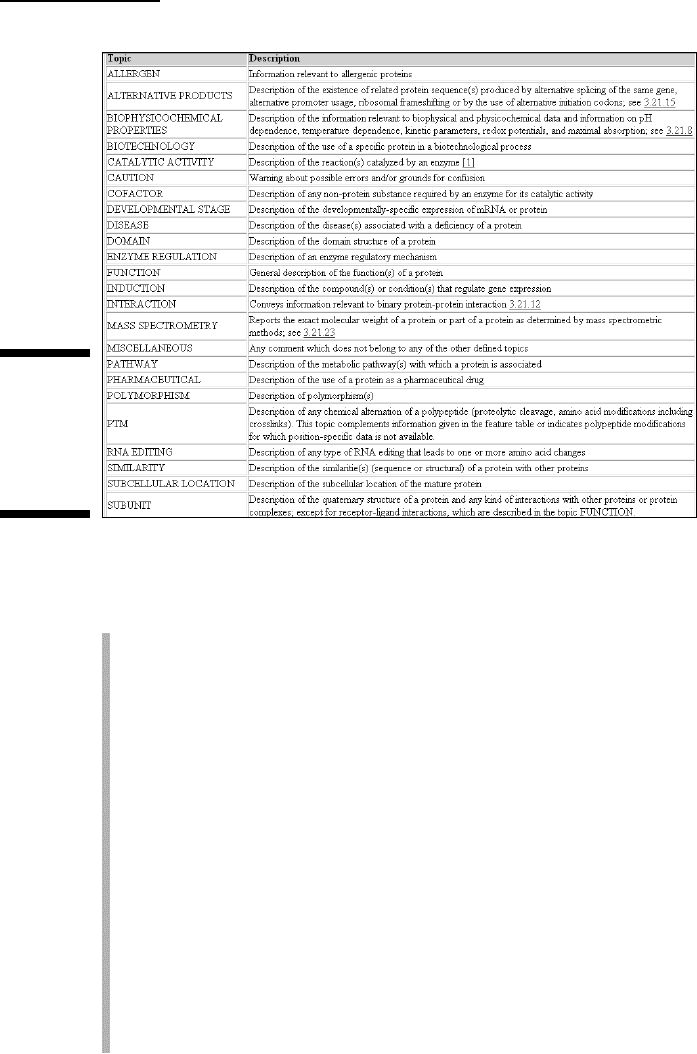
The Comments section of entry P00533 is particularly rich, as it includes
information about the following topics:
FUNCTION: Receptor for EGF, involved in the control of cell growth
CATALYTIC ACTIVITY: Tyrosine-protein kinase
SUBUNIT: Other proteins it forms stable complexes with
INTERACTION: Other proteins it interacts with
SUBCELLULAR LOCATION: Cellular-membrane protein
ALTERNATIVE PRODUCTS: The isoforms from splice variants
TISSUE SPECIFICITY: Placenta, ovarian cancer
PTM: List some of the Post Translational Modifications
DISEASE: Defects in EGFR are associated with lung cancer
MISCELLANEOUS: Used here to describe the molecular mechanism
(dimerization) underlying the function of the protein
SIMILARITY: With other sequences of the EGF receptor subfamily
WEB RESOURCE: A link to GeneTests, an NIH-funded database on
clinically available genetic tests
Figure 4-3:
Key topics
in the
Comments
section of
Swiss-Prot.
115
Chapter 4: Using Protein and Specialized Sequence Databases
09_089857 ch04.qxp 11/6/06 3:55 PM Page 115
The content of the Comments section is often sufficient to decide whether a
match (with BLAST or otherwise) of your query with a particular Swiss-Prot
entry makes sense or not.
Let’s skip the Copyright notice — the stuff for the lawyers out there — and
jump into the big Cross-References section that comes next.
The Cross-References
The Cross-References section contains links to entries in other databases
that contain some information about our protein.
Most of the links in this section take you to new databases. With all this Web
jumping about from database to database, it can be easy to get lost and lose
your original Swiss-Prot entry. To avoid this confusion, when you browse the
Cross-References section, open the links in a new window: Click the link with
the
right button of your mouse (not the left, as you usually do) and choose
Open in a New Window from the context menu that appears.
There are bunches of fields in the Cross-References section. The following list
will help you keep at least the major ones straight:
EMBL: This field contains all necessary links with the nucleotide
sequences world. As we point out in Chapter 3, numerous GenBank,
EMBL, and DDBJ entries can be related to a single protein sequence.
Click the CoDingSequence
link to send a query to the EBI SRS server for
finding the CDS (
CoDing Segment, the part of the nucleotide sequence
that precisely encodes the protein from start to stop) of these entries.
PIR: This historical field contains the accession numbers of the corre-
sponding entries in the late Protein Information Resource (PIR), now dis-
continued, but incorporated in the UniProtKB consortium.
UniGene: A link to NCBI’s gene expression database (see also the
CleanEx field for linking to DNA chip experimental data).
PDB: This field contains a link to a sequence homologue of the current
query, for which 3-D structural information (X-ray crystal structures) is
available. Here, this is Swiss-Prot entry P11362, the basic fibroblast
growth factor 1, for which several crystal structures exist in the protein
Databank (PDB). Click the PDB
link to see the relevant page. (The PDB ID
here is 1FGK.)
ModBase: This field links you to ModBase, a database of theoretically
calculated models, not experimentally determined structures. The
models may contain significant errors, as pointed out by the authors
themselves.
116
Part II: A Survival Guide to Informatics
09_089857 ch04.qxp 11/6/06 3:55 PM Page 116
In Chapter 11, we explain all the great things you can do when homolo-
gous structural information is available for your protein.
There is no PDB field when no direct or indirect structural information
exists. This is the case for a sizeable portion of the entries in Swiss-Prot.
DIP and IntAct: Links to protein-protein interaction databases. DIP
stands for
Database of Interacting Proteins, a database maintained by
UCLA. This is an interesting resource in that it lists all the proteins that
have been experimentally shown to interact with our EGF-receptor pro-
tein. IntAct (a project from EBI) is built from the information found in the
literature.
GlycoSuiteDb: This field is only there when your protein has a known
glycosylation pattern. It provides a link to the relevant chemical compo-
sition of the sugar moiety. This is a nice site, but the free service is pro-
vided only to academics and requires a personal registration, a
significant drawback to other researchers.
SWISS-2DPAGE: This field contains a link to the proteomics world.
Clicking SWISS-2DP
AGE brings you to a collection of 2-D gel elec-
trophoreses for different human tissues or tumors. If your protein has
been identified on a gel, the spots are highlighted. This is the case for
P00533. Otherwise, all that appears on-screen is a box of its expected
location (drawn after its theoretical isoelectric point pI and predicted
molecular weight). This is great if you’re ready for real experimental
work!
HGNC: This field (for human proteins only) provides a link to the official
human gene names provided by the HUGO (
HUman Genome
Organization) Gene Nomenclature Committee.
GeneCards: This field provides a link to the relevant entry in the
GeneCards database maintained by the Weizmann Institute of Science,
based in Israel.
GeneLynx: This field provides a link to the relevant entry of GeneLynx, a
collection of hyperlinks to the publicly available resources associated
with each human gene.
MIM: This field (mostly for human/mouse proteins) provides a link to
the relevant entry in OMIM, the human genetic disease database Online
Mendelian Inheritance in Man.
Ontologies: This subsection attempts to list, in a hierarchical manner
(called an
ontology) all the functions the EGFR gene product is known to
be associated with. Clicking on the QuickGo view link (at the send of this
subsection) gets you a nice summary of all that information.
117
Chapter 4: Using Protein and Specialized Sequence Databases
09_089857 ch04.qxp 11/6/06 3:55 PM Page 117

Profiles/domains: The Cross-References section contains a series of
fields that deal with the classification of the protein in families of related
sequences based on their sharing of basic domains.
Many different concurrent classification systems exist. They all use
different methods (algorithms) for the definition and detection of the
recurrent structural/sequence domains, as well as for the clustering of
the proteins in families. The principle behind these classifications and
the use you can make of them are well described in Chapters 7, 9, and
11. The relevant keywords are
• InterPro (summarizing most of the following ones)
• Pfam
• Prodom
• PRINTS
• SMART
• PROSITE
• BLOCKs
If you have time for only one click, use the InterPr
o
link; it is a summary
of all the others (except for BLOCKs). Clicking the Graphical view of
domain structure link in the InterPro row shows you at once that many
different recurrent domains have been identified in the EGF receptor
protein P00533.
Ensembl: This field is only here for human and mouse proteins. It pro-
vides a link to the relevant gene report in the Ensembl database, a major
human genome resource. (For more on Ensembl, see Chapter 3.)
With the NCBI/PubMed and the PDB links, we believe this is one of
the most useful hyperlinks provided in the Swiss-Prot entries for mam-
malian genes.
RZPD-ProtExp and SOURCE: These useful fields (for the experimental-
ists) let you identify sources of publicly available starting material (like
cDNA clones) in case you decide to work on the EGFR gene, or on its
protein product.
This ends the very long Cross-References section for entry P00533. If
you’ve been clicking many of these links, you’ve pretty much found out
everything there is to know about your protein.
The Keywords
The following section of the entry is the Keywords field (on the top of
Figure 4-4). It is a simple list of terms relevant to your current protein, such
as transmembrane, receptor, glycoprotein, and so on. Clicking any one of
118
Part II: A Survival Guide to Informatics
09_089857 ch04.qxp 11/6/06 3:55 PM Page 118
these keywords brings out a list of all Swiss-Prot entries that contain the
same term. With the increasing size of the database, we’re not sure that this
type of query is truly useful anymore. The keyword
receptor, for example,
retrieved more than 1,570 entries!
Using the Advanced search and Full text-search features of the ExPASy
server’s SRS search (see Chapter 2) allows you to query Swiss-Prot by using
keywords in combination. This technique gives you more specific searches.
The Features
Farther down the P00533 entry, we enter the Features section, where infor-
mation on the protein is precisely mapped onto the sequence. This concept
will be familiar if you’ve worked with GenBank (as described in Chapter 3) —
fortunately, it’s much simpler for proteins.
The main part of Figure 4-4 shows the beginning of the Features section for
P00533.
The whole section is organized in a table with the following self-explanatory
headings:
Key From To Length Description
The Key field indicates the kind of feature you’re looking at. The numbers in
the
From and To fields correspond to the N-terminus-through-C-terminus
numbering of the sequence, whereas the
Length field does the math for you
and gives the length of the sequence. The
Description field gives you a
brief written summary of the feature.
Going down the
Key field column for the P00533 entry (refer to Figure 4-4),
we can see numbers associated with the following key terms:
SIGNAL: The numbers associated with this Key term indicate that
residues 1 to 24 are a signal peptide, as expected for a transmembrane
receptor protein.
Notice that clicking the SIGNAL
link (like any other keyword link in this
field) brings out the relevant part of the Swiss-Prot user manual (refer to
Figure 4-4) where you can read about the precise meaning of this term.
Clicking the underlined sequence range (for example, 1 24
) highlights
this segment in the display of the sequence.
119
Chapter 4: Using Protein and Specialized Sequence Databases
09_089857 ch04.qxp 11/6/06 3:55 PM Page 119