
Claverie J-M., Notredame C. Bioinformatics for Dummies
Подождите немного. Документ загружается.

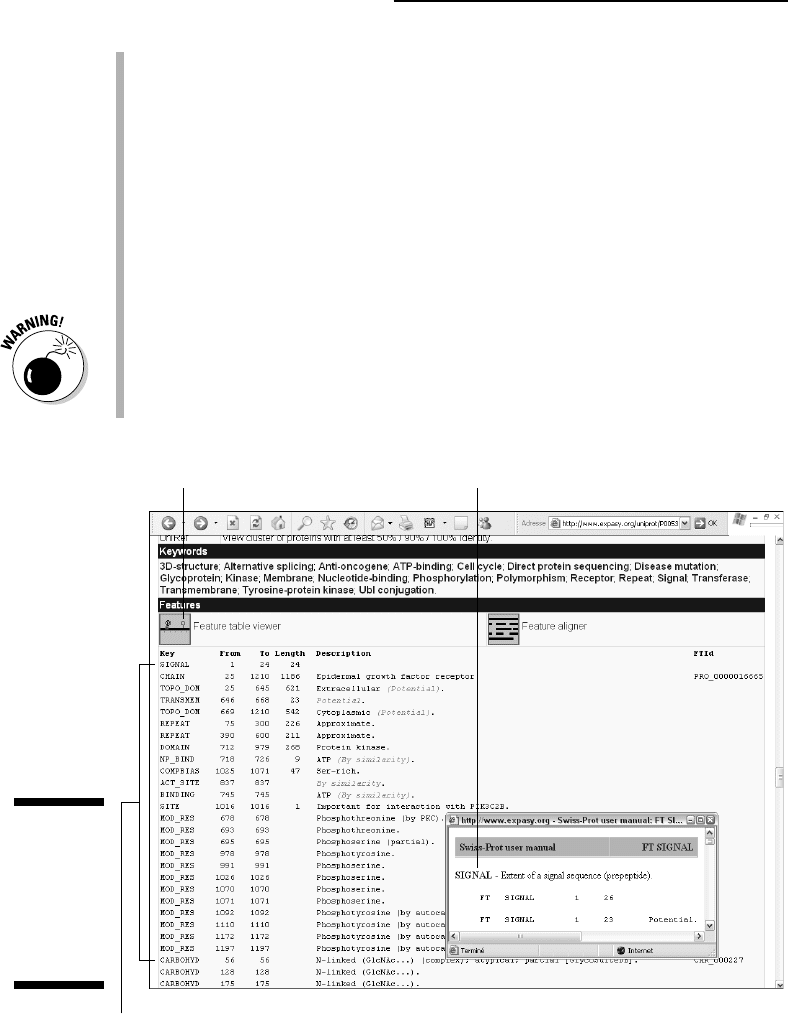
CHAIN: Here we see that the mature peptidic chain goes from residue 25
to 1210 (the C-terminus), meaning that the signal peptide is indeed
excised from the final protein.
TOPO_DOM: Topological domain. Indicates which parts of the sequence
correspond to what is exposed outside of the cell (the extracellular
domain) or remains inside (the intracellular domain).
TRANSMEM: Here we see that the following 23 residues (646–668) are
the transmembrane segment of the protein.
DOMAIN: These numbers indicate another domain. Residues 669 to 1210
are all inside the cell, forming the intracellular domain of the protein.
Notice that what Swiss-Prot calls DOMAIN here, corresponds to a
broader topological definition than what specialists usually mean with
this word in databases like InterPro or Pfam. For instance, the extracellu-
lar domain of our EGFR protein contains several InterPro domains. (Click
the links to see for yourself.)
Graphic display
On line manual
Key fields
Figure 4-4:
Top of the
Features
section for
Swiss-Prot
Entry
P00533.
120
Part II: A Survival Guide to Informatics
09_089857 ch04.qxp 11/6/06 3:55 PM Page 120

We find the DOMAIN keyword used again to indicate a serine-rich segment,
and the region of the sequence responsible for the protein kinase activity.
This confirms what we’ve just said about the loose usage of this term in
Swiss-Prot. Let’s keep moving, however, in search of newer terms:
NP-BIND: The numbers here indicate the extent of the nucleotide phos-
phate binding region — from residue 718 to 726 — for binding ATP.
BINDING: Here we can see the precise binding site for ATP — on lysine
at position 745.
ACT_SITE: The numbers here indicate amino acids involved in the activity
of an enzyme.
To the nonspecialist, the three Key field terms listed above address
fairly overlapping concepts.
COMPBIAS: Extent of a compositionally biased (in this case, a serine
rich) region of the protein sequence.
Next comes some information about residues that are chemically modified
after translation (as shown in Figure 4-5). The corresponding keywords are:
MOD_RES: The numbers here indicate residues undergoing phosphory-
lation. Click MOD_RES
to find out the list of chemical modifications
associated with that keyword.
CARBOHYD: Here we can see the numerous residues on which carbohy-
drate molecules have been attached as well as the type of link (C–, N–,
or O–). Note that they’re all in the extracellular domain, as one would
expect. Clicking the CARBOHYD
keyword can tell you much more about
the intricacies of glycosylation.
DISULPHID: The numbers here indicate cysteine pairs forming a bond in
the mature protein; there are plenty such pairs here.
Finally, the Features section ends up with a series of specialized features:
VAR_SEQ: This field is used to indicate amino-acid changes from the trans-
lation of different mRNAs (isoforms) generated by alternative splicing.
VARIANT: This field identifies natural variation of the EGFR protein
sequence, most of which have been associated with lung cancer.
MUTAGEN: In contrast with the previous field, this field is used to
record sequence changes that have been experimentally (voluntarily)
introduced in the protein.
CONFLICT: This feature is used to indicate discrepancies between differ-
ent sources of the same protein sequence — basically errors or unrecog-
nized polymorphisms.
121
Chapter 4: Using Protein and Specialized Sequence Databases
09_089857 ch04.qxp 11/6/06 3:55 PM Page 121
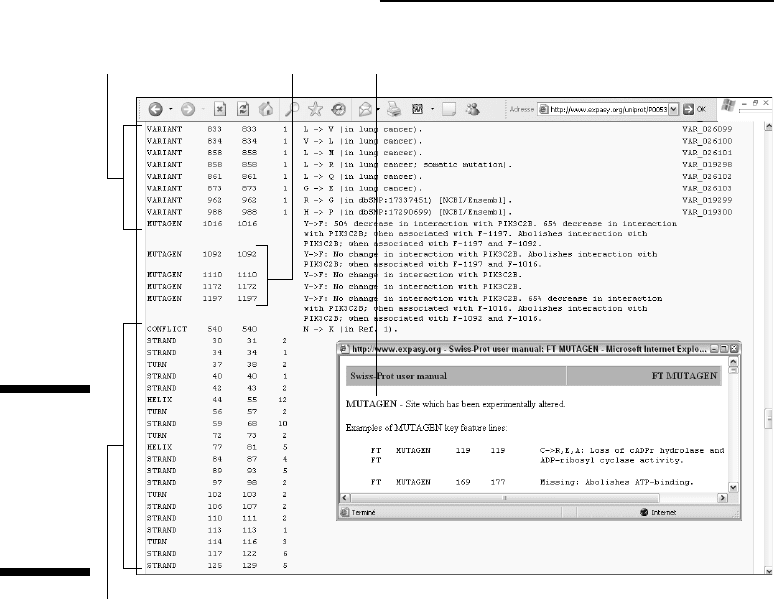
Following these features lines, we enter into a detailed linear description of
the local shapes (called the
secondary structure) of the backbone of the pro-
tein. Secondary structures come in three flavors: STRAND (an extended,
stringy shape), TURN (as it says!), and HELIX (a twisted, springlike shape).
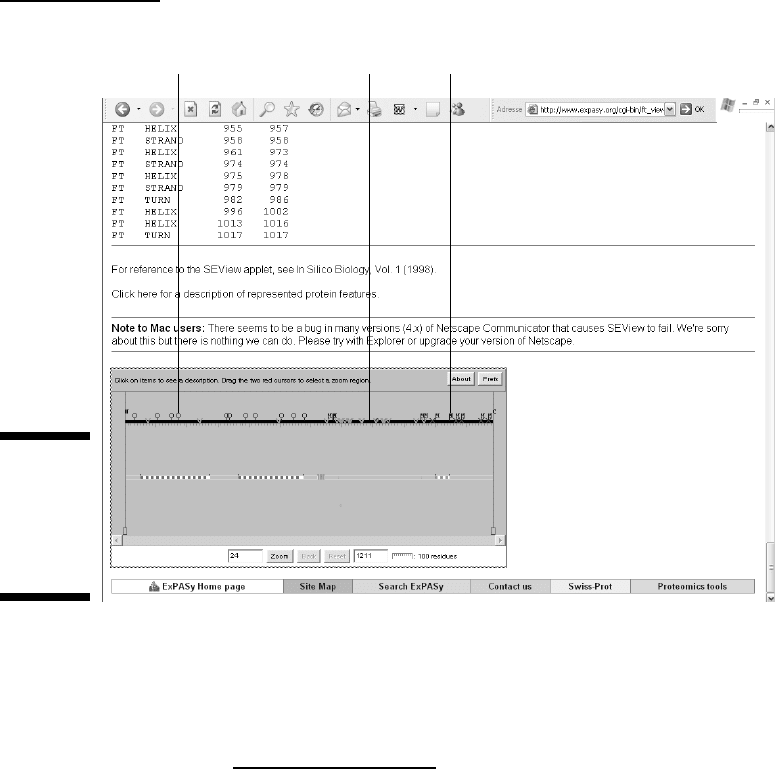
Before leaving this long Features section, look along the left side for the
Feature Table Viewer icon (refer to Figure 4-4, top left). Click the icon and
scroll down the new page that appears to see a little graphic display, as
shown in Figure 4-6. It gives you a global picture of the EGFR protein primary
structure. Mousing over this picture tells you what feature corresponds to
each symbol. With P00533, this shows you at a glance that all the phosphory-
lation events take place in the intracellular domain — while all the other
modifications (disulphide bridges and glycosylations) occur in the extracellu-
lar domain. If you’ve done a bit of biochemistry, you know that this makes
sense and is as it should be!
Natural variation Experimentally altered
3-D structural information
Figure 4-5:
The bottom
of the
Features
section for
entry
P00533.
122
Part II: A Survival Guide to Informatics
09_089857 ch04.qxp 11/6/06 3:55 PM Page 122
Finally, the sequence itself
There’s nothing special to say about this straightforward section. Remember
that you can get the sequence in the more convenient FASTA format version
by clicking the P00533 in F
ASTA format link, located at the bottom right of the
entry. Use the File
➪Save As option of your browser to save it, or cut and
paste it into a word processor.
Finding Out More about Your Protein
After carefully reading the Swiss-Prot entry on your protein of interest (or its
homologue) and using all the hyperlinks it provides, you probably know 90
percent of what the whole world knows about this protein.
Glycosylation Variation Phosphorylation
Figure 4-6:
The Feature
table viewer
for Swiss-
Prot entry
P00533.
123
Chapter 4: Using Protein and Specialized Sequence Databases
09_089857 ch04.qxp 11/6/06 3:55 PM Page 123

Your next problem is to make sense of, integrate, or eventually under-
stand what you have read, in Swiss-Prot or through its numerous
hyperlinks. For instance, perhaps you’re not quite sure what myristi-
lation is? Or you don’t necessarily understand the biochemical reaction
catalyzed by a protein? Or you’d like to know in which pathway this
enzyme is involved?
In brief, there may come a time when you need additional information to
better understand what you’ve read in Swiss-Prot. In the following sections,
we point out some extremely valuable resources for our knowledge-craving
readers!
Finding out more about
modified amino acids
If you want to find out everything you always wanted to know about the mod-
ification of amino acids during protein maturation, have a look at RESID
(r)
, the
post-translational modification database maintained by John Garavelli at the
European Bioinformatics Institute. For instance, you can use this resource to
quickly find out what myristylation is exactly. Here’s how:
1. Point your browser to www.ebi.ac.uk/RESID/.
The RESID Database of Protein Modifications page appears.
2. Click the Search RESID link.
A search form appears.
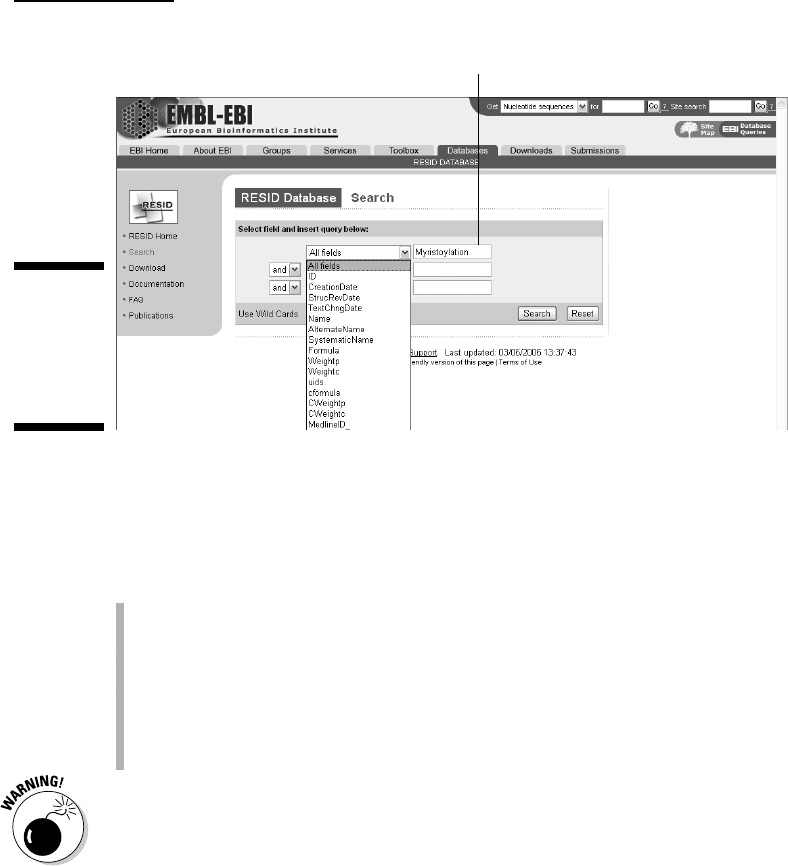
3. Enter myristoylation in the search window (refer to Figure 4-7).
4. Click the Search button.
The query returns a table with 3 entries: AA0059 ( N-myristoyl-glycine),
AA0078 (N6-myristoyl-L-lysine), and AA0307 (S-myristoyl-L-cysteine)
5. Click the AA0078 link in the RESID ID leftmost column.
You obtain a complete report on this modified amino acid, ending with
its detailed chemical formula.
Not impressed with this one? Why not have a go at the modified cysteine —
L-cysteinyl molybdopterin guanine dinucleotide (AA0281)? Now,
there’s a
compound name to conjure with; reading it aloud several times can only help
the processing of your query!
124
Part II: A Survival Guide to Informatics
09_089857 ch04.qxp 11/6/06 3:55 PM Page 124
Some advanced biochemistry sites
If you want to brush up your biochemistry and chemistry skills, visiting the
following sites could help:
The Glycan Structure Database at www.glycosuite.com/
This one is free for academics only — and registration is required.
The Lipid Bank at lipidbank.jp
ChemIDplus at chem.sis.nlm.nih.gov/chemidplus/
This one is fun; you can query the databank by drawing the molecule of
your dreams!
Be aware that using these databases is tricky for nonspecialists. We only
introduce them here so you know they exist. There is some brushing up on
biochemical paths to do before you can search them in a sensible way.
Finding out more about
biochemical pathways
Reading that your protein is involved in the biosynthesis of di-amino-pymelate
probably rings no bell at all! To find out which biochemical pathway (a succes-
sion of elementary reactions leading to a compound central to the cell’s well
being) your protein belongs to, pay a visit to the Boehringer site.
Enter search term.
Figure 4-7:
Querying
the RESID
database for
myristoy-
lation.
125
Chapter 4: Using Protein and Specialized Sequence Databases
09_089857 ch04.qxp 11/6/06 3:55 PM Page 125

If you’ve ever done any formal biochemical studies, we’re pretty sure you’ve
seen this huge chart hanging on a wall in your biochemistry department. Did
you know that you can search it automatically these days? Yep, this is the
kind of era we’re living in!
1. Point your browser to www.expasy.ch/cgi-bin/search-
biochem-index
.
2. Type
pimelate in the Keyword Search window and then click the
Submit Query button.
Your browser displays the Pimelate page. Pimelate — a central molecule
for the creation of bacterial cell walls — is just an example here. If you
like, you can substitute the name of the compound you’re working on at
the moment.
3. Click J3 below 6-DIAMINOPIMELATE, the first entry in the list.
This brings up a local chart where you can see that this compound is
central to the biosynthesis of bacterial cell walls.
Table 4-1 lists more great biochemical-pathway resources.
Table 4-1 Biochemical Pathways Resources Available Online
Address Description
www.genome. The famous Kyoto Encyclopedia of Genes and Genomes
ad.jp/kegg/ (KEGG). E.C. numbers or gene names are the best starting
points for this resource.
brenda.bc. The Comprehensive Enzyme Information System BRENDA is
uni-koeln.de a must if you plan to get into real experiments!
www.chem. The official site for Enzyme Nomenclature of the
qmul.ac.uk/ International Union of Biochemistry and Molecular Biology
iubmb/ (IUBMB)
.
www.ecocyc. The Encyclopedia of E. coli Genes and Metabolism. Now
org extending progressively to other bacteria.
Finding out more about protein structures
If you have analyzed your protein at the sequence level by all available means
(motif search in Chapter 6, database search in Chapter 7, multiple alignment
126
Part II: A Survival Guide to Informatics
09_089857 ch04.qxp 11/6/06 3:55 PM Page 126

in Chapter 9), your next question probably relates to the position of certain
amino-acid residues in your protein 3-D structure. Is this amino acid buried
or at the surface? Is it close or far from another residue? Is it in the active
site? The list of questions goes on. All these questions require structural
information. In Chapter 11, we show you how to relate sequences and struc-
tural information. For now, Table 4-2 gives you a list of the major resources
dedicated to this topic.
Table 4-2 Databases Dedicated to Structural Information
Address Description
www.rcsb. PDB, the official repository database for protein 3-D
org/pdb/ structures.
www.ncbi.nlm. with tools for their visualization and comparative analysis.
nih.gov/
Structure/
scop.mrc-lmb.
SCOP, a Structural Classification Of Proteins, aims to
cam.ac.uk/ provide descriptions of the structural and evolutionary
scop/ relationships among all proteins whose structure is known.
www.cathdb.info CATH (
C
lass,
A
rchitecture,
T
opology,
H
omologous
superfamily) also provides a hierarchical classification
of protein-domain structures.
swissmodel. Swiss-Model is a fully automated server that models
expasy.org protein-structure homology, accessible via the ExPASy
server.
Finding out more about major
protein families
Some protein families are so hot they’ve become whole worlds of their
own. There is always a time when general protein databases just can’t
manage the sheer amount of detailed information required by the special-
ized research community. Highly specialized information resources exist
to fulfill that niche. If your favorite protein belongs to one of the following
categories, you may want to try some of the resources that we list in
Table 4-3.
127
Chapter 4: Using Protein and Specialized Sequence Databases
09_089857 ch04.qxp 11/6/06 3:55 PM Page 127
Table 4-3 Some Specialized Protein Databases
Address Description
imgt.cines.fr IMGT, the International Immunogenetics database, spe-
cializes in Immunoglobulins, t cell receptors, and major
histocompatibility complex molecules of all vertebrate
species.
rebase.neb.com REBASE is a restriction/modification enzyme database.
www.cazy.org/ CAZy is an information resource on enzymes that
CAZY/ degrade, modify, or create glycosidic bonds.
merops.sanger. MEROPS is a database providing a wealth of
ac.uk information on proteases.
www.kinasenet. PKR, the Protein Kinase Resource, is a Web-accessible
org/pkr/ compendium of information on the protein kinase family
of enzymes.
www.nursa.org Nursa, the Nuclear Receptor Signaling Atlas, is a great
information resource on nuclear (for example, steroid)
receptors together with their coactivators, corepres-
sors, and ligands.
senselab.med. The Human Brain Database provides information on the
yale.edu/senselab proteins involved in neural processes, such as ion
channels, membrane receptors of neurotransmitters
and neuromodulators, and olfactory receptors.
www.ncbi.nlm. The COG (Clusters of Orthologous Groups) database
nih.gov/COG regroups proteins shared by at least three major
phylogenetic lineages, thus corresponding to
ancient conserved domains.
128
Part II: A Survival Guide to Informatics
09_089857 ch04.qxp 11/6/06 3:55 PM Page 128

Chapter 5
Working with a Single
DNA Sequence
In This Chapter
Identifying problems with your sequence
Computing and displaying a restriction map
Profiling your sequence for a variety of properties
Finding ORFs, exons, and genes
Assembling sequence fragments
Not everything that can be counted counts, and not everything that counts
can be counted.
— Albert Einstein (1879–1955)
P
roteins perform most biological functions, so biologists tend to consider
DNA sequences kind of dull. They’re mostly right. The truth of the
matter is, 90 percent of the DNA you may use in your work is nothing more
than an information-storing device, sort of the organic equivalent of a floppy
disk or a DVD. Still, we probably shouldn’t turn up our noses at information-
storing devices. DNA contains information that the cell knows how to put to
effective use, as quickly as your computer can turn a dull-looking DVD into
the latest destroy-all-at-any-cost network game.
If you’re interested in a protein, directly working out its amino-acid sequence
is hell. Sequencing its gene and then deducing the protein sequence from the
genetic code is much easier. This is why DNA sequences are so important.
These days, working with DNA sequences is an obligatory intermediate step;
you simply must know how to handle a nucleotide sequence in order to work
with protein or RNA sequences. DNA sequences are the mothers of all
sequences!
10_089857 ch05.qxp 11/6/06 3:56 PM Page 129