
Claverie J-M., Notredame C. Bioinformatics for Dummies
Подождите немного. Документ загружается.


If you’re reading this book, it’s probably fair for us to assume that you’re not
a highly trained scientist working in one of those mega-super-duper genome-
sequencing centers churning out nucleotides by the millions every day. This
chapter is thus focused on the analysis of relatively small sequences — 100,000
nucleotides long at most. The skills necessary for dealing with genomic frag-
ments of a reasonable size or with complementary DNA — cDNA, the DNA
copy of a messenger RNA — is the name of the game in this chapter. This is
the kind of sequence you can routinely determine in a well-equipped molecu-
lar biology lab or get done for a reasonable price by a sequencing company.
When you get an experimental sequence back, your first task is to make sure
it’s okay so you don’t waste a month trying to make sense of something com-
pletely botched and end up nowhere. This chapter begins with a section
showing you how to check for the most common problems encountered in
sequences fresh from the bench. But remember Murphy’s Law: If something
can go wrong,
and has not been discussed in this section, it will happen to you!
Catching Errors Before It’s Too Late
Sequencing a DNA fragment involves purifying it, cloning it into a vector
(such as a plasmid), amplifying it into a biological host (most often a bac-
terium like E. coli), and finally submitting it to one of the various sequencing
protocols, such as primer extension or dye-termination. During this process,
accessory DNA segments are deliberately linked to your target DNA. In addi-
tion, many unintended events can occur, resulting in a sequence that doesn’t
faithfully correspond to the genetic information you intended to study.
The most common problem is that the sequence you get back has been cont-
aminated with some of the sequence of the vector you used (or that some-
body else used in the laboratory). Recognizing this problem — and knowing
how to deal with it — is so important that we devote the next section to pre-
cisely this topic.
Removing vector sequences
The DNA (or cDNA) you send out for sequencing is inserted into a cloning
vector — plasmid, phage, cosmid, BAC, PAC, or YAC — so that it can be
manipulated. The sequences you get from such constructs inevitably include
segments derived from these vectors, at least at one extremity or the other.
You can detect and remove them from your sequence by simply running a
search for similarity against the sequence of the vector you have been using.
(As a responsible scientist, you’re expected to have this information!)
130
Part II: A Survival Guide to Bioinformatics
10_089857 ch05.qxp 11/6/06 3:56 PM Page 130
However, your sequence might also be cross-contaminated by somebody
else’s vector — maybe from the bench next to yours. It’s thus wiser to search
your sequence not only for the vector you expect, but also for other possible
vector contaminations, just in case. Here’s how to do it using a nice interac-
tive tool available at the NCBI (the
National Center of Biotechnology
Information):
1. Point your browser to www.ncbi.nlm.nih.gov/VecScreen/
VecScreen_docs.html
.
The entry page for VecScreen appears. It contains both a nice tutorial
on sequence contamination (click the Contamination
link to read it) as
well as an explanation of how VecScreen works. Basically, it performs a
blastn search (see Chapter 7) of your sequence against a special data-
base of all vectors and cloning adapter sequences known to man. This
database is known as UniVec, and a simple click the UniV
ec link on this
page provides you with more details about this unique database.
When you believe you’re ready for the real thing, rather than just reading
about the real thing, go grab your new sequence and proceed to Step 2.
2. Point your browser to www.ncbi.nlm.nih.gov/VecScreen/.
A typical sequence-input window appears, ready for your input.
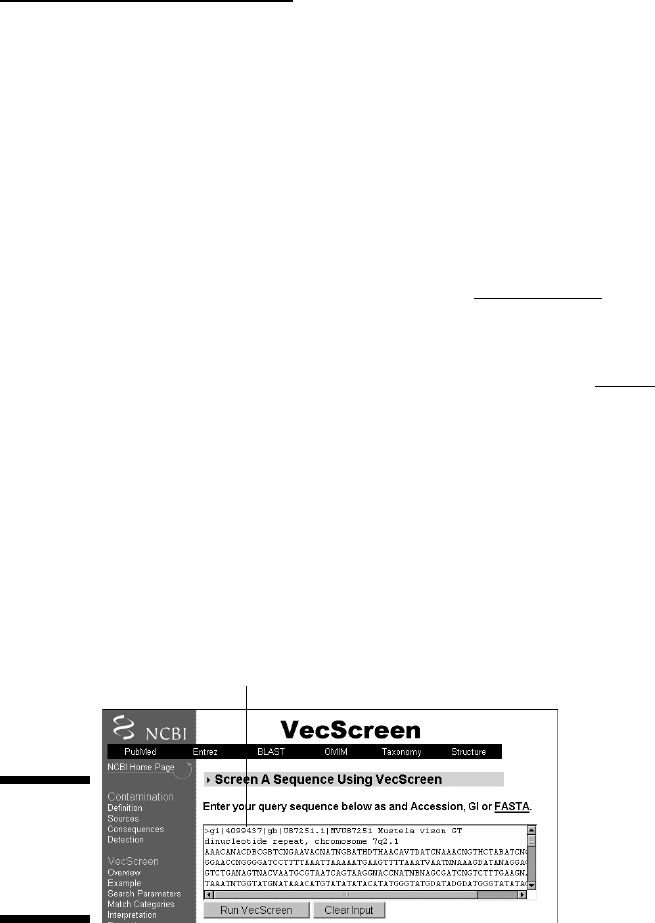
3. Paste in your newly determined sequence in the input window, as
shown in Figure 5-1.
You can use FASTA or raw format.
4. Click the Run VecScreen button below the input window.
You immediately get back the BLAST formatting page, showing you that
your VecScreen request was in fact a BLAST search in disguise. (For
more on BLAST, see Chapter 7.)
Paste in your new sequence.
Figure 5-1:
The
VecScreen
input
window.
131
Chapter 5: Working with a Single DNA Sequence
10_089857 ch05.qxp 11/6/06 3:56 PM Page 131

It’s better to use VecScreen from the start rather than trying to use blastn
because the VecScreen server chooses parameter values that are best
for vector detection.
5. Click the Format! button and wait.
Don’t change any of the default parameters.
At this point — and depending on the workload of the BLAST server —
you’ll either get the standard waiting page (
This page will be
automatically updated in
xx seconds), or the results of your
search pop up immediately.
6. The two possible outcomes are
• Non-significant similarity found.
This is good news! This message indicates that the sequence you
submitted does not resemble any known vector/adapter. You can
proceed to the next stage of its analysis, following the rest of this
chapter.
•
An output listing matches of some kind.
This is bad news! Your query does contain some vector/query
sequence.
A VecScreen contamination report output contains two parts. The top part
displays the distribution of the contaminating sequences along the length of
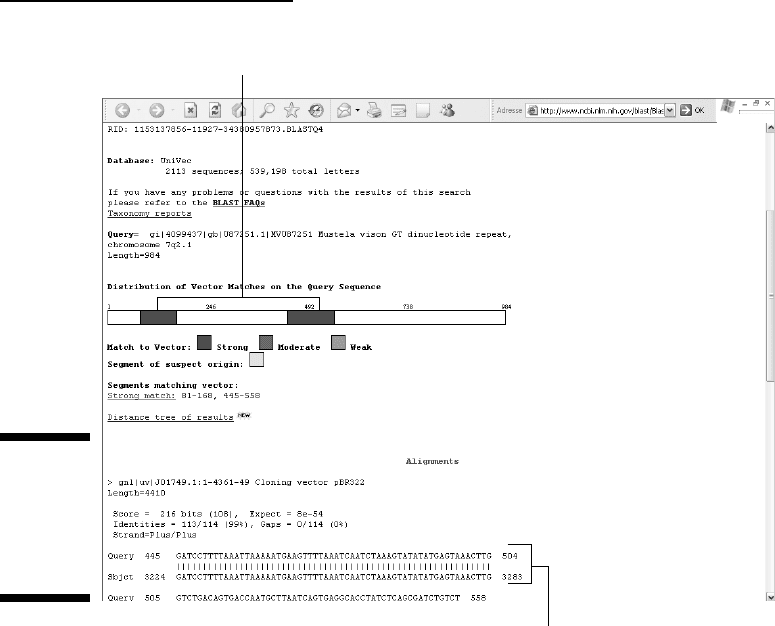
your query sequence, using a color-coded graph (Figure 5-2 — you’ll have to
go there online to see it in color). The second part is a standard blastn output,
providing you with the identity of the matched vector/adaptor as well as the
detailed alignment.
The different colors on the graph correspond to the strong (red), moderate
(purple), or weak (green) matches in the UniVec database. A yellow code is
used to delineate segments of suspect origin such as short segments in between
two vector matches. The U87251 exhibits two regions of 100 percent identity
with the popular PBR322 cloning vector. Most likely, it is a contaminated
sequence that was submitted to GenBank before vector-sequence filtering
was systematically included in the submission process.
What to do next with contaminated sequences is fully explained in a com-
plete tutorial that you can follow by clicking the Interpr
etation of VecScreen
Results link provided at the top of any VecScreen positive output.
In general, you have two options when finding contaminations. If the contami-
nated parts are at the extremity of your sequence and correspond to the
vector you used, all is fine. Just remove these parts and proceed. If, on the
other hand, contaminated parts are found elsewhere (as in Figure 5-2), or if
the contaminating vector is not yours, you’d better consider this sequence to
be the result of a chimeric clone or a DNA cross-contamination. In that case,
throwing it away is the safest thing to do!
132
Part II: A Survival Guide to Bioinformatics
10_089857 ch05.qxp 11/6/06 3:56 PM Page 132
Cases when you shouldn’t
discard your sequence
In case of a VecScreen match, do not merely rely on the name of the UniVec
database entry to decide that your experiment was contaminated by some-
body else’s vector. You may have used pUC19 as a cloning vector and see that
VecScreen is reporting a strong match with pUR222 or lactose operon genes
from
E. coli. This is okay. Most commercial vectors are derived from the same
initial natural plasmid and
E. coli constructs. Their sequences must thus be
100 percent identical. The UniVec matches are simply reported in the order
that they occur in the database. If your vector is not first, another entry (cor-
responding to a locally 100-percent-identical sequence) will be reported
instead.
Also, if you’re working on genes that resemble the kinds of genes used to
build vectors (such as antibiotic resistance genes, repressor/activator genes,
or some biosynthetic genes), you should actually
expect matches in the
UniVec database.
Your sequence displays two strong vector contaminants.
Blast N sequence alignment
Figure 5-2:
VecScreen
output
display of a
contaminated
sequence.
133
Chapter 5: Working with a Single DNA Sequence
10_089857 ch05.qxp 11/6/06 3:56 PM Page 133

Don’t throw away these sequences before you interpret the detailed alignment.
In any case, beware of near 100-percent matches with any piece of the
E. coli
or yeast genome, even if these parts don’t correspond to vectors. These are
sure signs of cross-contamination. Modern molecular biology techniques are
very good at amplifying pieces of DNA from the bench next to yours!
Computing/Verifying a Restriction Map
Here’s another way of checking whether the sequence you get back from the
sequencing lab or company actually corresponds to the piece of DNA you
sent out: Compare the pattern of restriction enzyme digestion (also called a
restriction map) that you experimentally observe with the pattern (theoretical
restriction map) that you can compute from the sequence.
Computing a theoretical restriction map is easy. All you do is look for exact
matches of a given restriction-enzyme site within your sequence. All the known
enzymes and sites are described in the REBASE database (
rebase.neb.com).
After locating the matches in the sequence, it’s simply a matter of counting
the number of resulting fragments (DNA segments between two successive
sites) and computing their sizes. You can then compare the computer predic-
tion with your lab experiment. The more restriction enzymes you test, the
more certain you’ll be that your sequence is correct.
You can use this approach to verify long sequences — such as bacterial
genome sequences — that were assembled from many shorter ones, as hap-
pens with the Shotgun DNA sequencing protocol. If the sequence and its
assembly are correct, the number and size of the predicted fragments should
perfectly correspond to the experimental restriction map.
A couple of good Internet sites spare you all the work of having to collect
the information about restriction-enzyme sites and doing the matching your-
self. These sites maintain their own current versions of the authoritative
Restriction Enzyme Database, REBASE, so you don’t have to worry about it.
They scan your sequence for all the specific sites corresponding to an
enzyme list that you can select according to various criteria.
One such Internet site we find especially useful offers a nice little interactive
tool called Webcutter, developed by Max Heiman. Here’s how to put it to
work for you:
1. Point your browser to www.firstmarket.com/cutter/cut2.html.
This gives you access to the most current version of Webcutter.
134
Part II: A Survival Guide to Bioinformatics
10_089857 ch05.qxp 11/6/06 3:56 PM Page 134

2. Enter the sequence you’d like to check.
At the time of this writing, Webcutter offers you three ways to input your
sequence:
• Copy and paste it into the Sequence window displayed on the
www.firstmarket.com/cutter/cut2.html page.
• Upload the sequence from your computer (Netscape users only).
The sequence has to be in a text format, without its name or any
FASTA-style header.
• Directly fetch a GenBank entry by using its accession number or
other identification methods. (The latter case applies if you’re
designing a cloning experiment for a gene already known.)
3. Select the options that correspond to your problem.
Options include
• Choosing whether to treat the input sequence as linear or circular
• Selecting various output formats for the results (maps, table of
enzymes)
• Filtering the results based on whether enzymes cut or don’t cut
your sequence — or cut your sequence a given number of times
• Specifying a subset of enzymes — based on various criteria — to
be included in the analysis
4. Click the Analyze Sequence button at the bottom of the form.
The result usually arrives very quickly and is — thankfully —
self-explanatory.
The University of Massachusetts Medical School offers a similar service with
a different interface at
biotools.umassmed.edu/tacg/WWWtacg.php.
For a list of other restriction mapping servers, check out the REBASE Related
Sites link on the REBASE home page (rebase.neb.com). All these servers
are equivalent in terms of accuracy. Shop around until you find the one
whose input/output format you like best.
Designing PCR Primers
The polymerase chain reaction (PCR) is a very common experimental labora-
tory technique people use to amplify segments of DNA they find interesting.
To make a PCR, you must
135
Chapter 5: Working with a Single DNA Sequence
10_089857 ch05.qxp 11/6/06 3:56 PM Page 135

1. Identify the DNA sequence you want to amplify.
2. Order primers from a DNA synthesis company.
Primers are small pieces of DNA (20–30 bases) that match the extremi-
ties of the complete sequence you’re interested in. Designing good
primers is the most delicate step in a PCR.
3. Run your PCR experiment.
These days, people use PCR for almost anything that has to do with wet-lab
sequence analysis — subcloning a gene in an expression vector, verifying its
assembly and sequence, inducing or detecting mutations, or detecting its rel-
atives in other organisms.
The trickiest step when you do a PCR is the design of the
primers — the two
small DNA fragments capable of firmly hybridizing on each side of your gene
in a highly specific manner. Primer design programs are here to help you
decide which portion of your large sequence makes the best primers, thus
avoiding a series of potential problems too numerous to be listed here.
The Internet site of the University of Massachusetts Medical School
(
biotools.umassmed.edu/) provides a link to a very complete and easy-
to-use tool for primer design. It is a Web implementation of Primer3, the well-
known program developed by Steve Rosen and Helen Skaletsky. To put it to
(hopefully good) use, do the following:
1. Point your browser to biotools.umassmed.edu/.
The Bioinformatics Resources page of the University of Massachusetts
Medical School appears, offering access to several sequence-analysis
programs that you may want to try by yourself later.
136
Part II: A Survival Guide to Bioinformatics
What is PCR?
Running a polymerase chain reaction (PCR)
involves mixing a DNA template (containing the
sequence that you mean to amplify), the
primers, a cocktail of nucleotides and other bio-
chemical compounds, and a heat resistant
enzyme called DNA polymerase — all in a
single little plastic tube. You then put that tube
in a benchtop expensive machine called a
ther-
mal cycler.
According to a preset program, this
machine will make the tube go up and down in
temperature. For each temperature cycle, the
amount of copies of the DNA segment that you
want to amplify is doubled. For instance, after
30 cycles, you have 2
30
(1 billion) more of it. This
is why PCR is such a great technique in forensic
science: Lick a stamp, and scientists will be
able to sequence your DNA!
If you want to know more about PCR, visit
nature.umesci.maine.edu/forensics/
p_intro.htm
for a great animated introduc-
tory course.
10_089857 ch05.qxp 11/6/06 3:56 PM Page 136
2. Click the Primer Selection Tool link in the DNA Sequence Analysis
section.
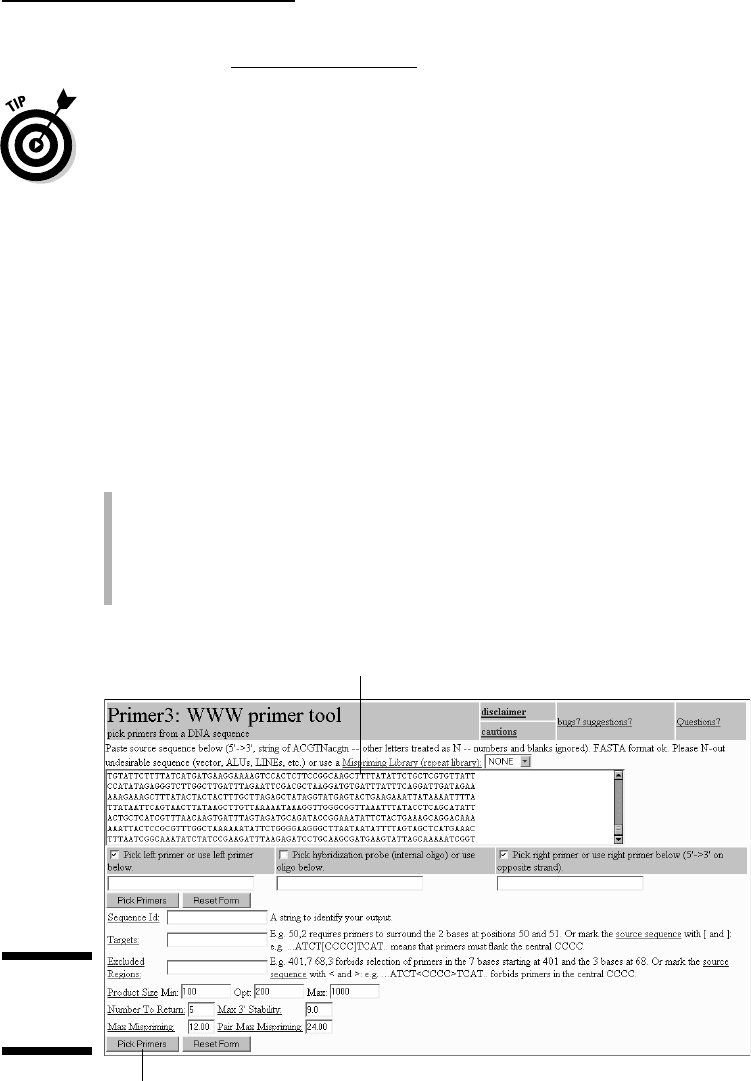
The Primer3 page dutifully appears. The form can look rather intimidat-
ing, as Figure 5-3 more than clearly shows. Don’t let it scare you! In most
cases, you can get by with the default settings.
3. Paste your sequence in the Sequence window.
4. Click the Pick Primers button.
The results return very quickly. They include a map of the best oligonu-
cleotide pair (left and right primers) according to the constraints listed
in the form. In addition, four alternative solutions (by default) are pro-
posed. The position, length, predicted melting temperature, and G+C
percentage (the fraction of guanine and cytosine nucleotides) are given
for each listed oligonucleotide.
If you’re ready to modify the default setting, the form allows all reasonable
experimental situations and constraints to be imposed upon the primer-
selection process, including
Searching for only a left or right primer, or a single hybridization probe
Proposing your own left or right primer
Selecting sequence positions to be flanked or excluded
Selecting a range of product sizes
Paste your sequence here.
Click here to get your primers.
Figure 5-3:
Primer3
input form.
137
Chapter 5: Working with a Single DNA Sequence
10_089857 ch05.qxp 11/6/06 3:56 PM Page 137

Imposing a range of oligonucleotide sizes, G+C percentages, or melting
points
And many more highly sophisticated options
After you’ve gotten your primers, your final responsibility is to verify that
they will not hybridize anywhere — except where you
intend them to
hybridize. For instance, you want to make sure that the selected oligonu-
cleotide sequences aren’t found outside the gene you’re interested in — or
(worse) resemble a frequent repeat in the DNA you’re going to amplify.
The techniques for avoiding these problems involve BLAST searches against
the vector sequences, the relevant genomes as well as their most common
repeats. You can use the NCBI BLAST server for this purpose. (For more on
BLAST searches, see Chapter 7.)
Analyzing DNA Composition
After these analyses — with all the going back and forth from computer to
bench they entail — you’re now convinced that the sequence in your test
tube is indeed the right stuff. The time has now come to analyze it! Whenever
you have a new piece of a new genome, the first question people will ask you
is:
What is the percentage of G+C? Because the pairing between the guanosine
(G) and cytosine (C) nucleotides is more stable than the pairing between
adenosine (A) and thymidine (T) in the DNA ladder, this percentage deter-
mines how the DNA will behave in your experiments. The first level of analy-
sis you can perform is, thus, simply to count the number of A (adenosine),
G (guanosine), C (cytosine), and T (thymidine) in your sequence.
Establishing the G+C content
of your sequence
Most often, people establish G+C content by using a program installed on
their own computers. Many programs that to do this are commercial packages,
available from an open source consortium (such as EMBOSS), or are written
up by the computer science student you keep handy and pay with pizza. If
you want to save the cost of the pizza, you can even do the coding yourself if
you’ve learned the basics of one of the basic computer-programming languages
out there.
However, if you want to use an online service to establish the G+C content of
your sequence for you, check out the Pasteur Institute’s EMBOSS server (at
138
Part II: A Survival Guide to Bioinformatics
10_089857 ch05.qxp 11/6/06 3:56 PM Page 138

bioweb.Pasteur.fr/seqanal/EMBOSS/) and click geecee in the table of
available EMBOSS programs (
bioweb.pasteur.fr/seqanal/interfaces/
geecee.html)
.
Counting words in DNA sequences
After establishing the G+C content, the next step in complexity is to consider
your DNA text as made up of overlapping “words.” For instance, consider the
following DNA sequence:
ATGGCTGACTGACTGACTGACTGAC......
You can read it as
A, T, G, G, C, T, G, A, C, T, G, A, C, T, G, A, ......
where counting the various components A, C, G, and T leads to the simple
nucleotide statistics. But you can also read the sequence as
AT, TG, GG, GC, CT, TG, GA, AC, CT, TG, ....
and compute the frequency of the 16 different dinucleotides (2-letter words).
Then again, you can read the same sequence as made of triplets — like this —
ATG, TGG, GGC, GCT, CTG, TGA, GAC, ACT, CTG, ...
and compute the frequency of the 64 different trinucleotides (3-letter words),
and so on.
The German-based company Genomatix offers a nice free Web site where you
can compute the nucleotide, dinucleotide, and trinucleotide frequencies of
your DNA sequence. Here’s how it’s done:
1. Prepare your DNA sequence in a file, using a text format.
2. Point your browser to
www.genomatix.de/cgi-bin/tools/
tools.pl
.
3. Select the Create Sequence Statistics button.
4. Click the Start Selected Task button at the bottom left of the page.
A Sequence Input window appears.
5. Cut and paste your sequence into the Sequence Input window.
Use the format of your choice. (Here we use the plain — that is, raw —
format.)
139
Chapter 5: Working with a Single DNA Sequence
10_089857 ch05.qxp 11/6/06 3:56 PM Page 139