
Claverie J-M., Notredame C. Bioinformatics for Dummies
Подождите немного. Документ загружается.


Making multiple alignments with
ClustalW around the clock
ClustalW is the most common online program. Table 9-8 gives you a list of
available servers, starting with the site where you can download ClustalW
to install it on your own machine.
Note: The last link in Table 9-8 is the location where you can download the
executable to install it on your own machine. It is
not a Web server.
Table 9-8 A List of ClustalW Servers
Name Location Address
EBI Europe www.ebi.ac.uk/clustalw
EMBnet Europe www.ch.embnet.org/software/
ClustalW.html
PIR USA pir.georgetown.edu/pirwww/
search/multialn.shtml
BCM USA searchlauncher.bcm.tmc.edu/
multi-align/multi-align.html
GenomeNet Japan align.genome.jp/
DDBJ Japan www.ddbj.nig.ac.jp/search/
clustalw-e.html
Strasbourg Europe ftp://ftp-igbmc.u-strasbg.fr/
pub/ClustalW/
Finding your favorite alignment method
If ClustalW isn’t suited for the sequences you want to align, Table 9-9 saves
the day by giving you the addresses of a few other servers.
300
Part III: Becoming a Pro in Sequence Analysis
15_089857 ch09.qxp 11/6/06 4:00 PM Page 300

Table 9-9 Multiple Sequence Alignment Resources
over the Internet
Method Description Address
Tcoffee Accurate combination www.tcoffee.org
of sequences and www.ch.embnet.org/
structures software/TCoffee.html
www.ebi.ac.uk/t-coffee/
Probcons A Bayesian version of probcons.stanford.edu/
Tcoffee
MUSCLE A fast and accurate
www.drive5.com/muscle/
sequence cruncher
Kalign A fast sequence
msa.cgb.ki.se
aligner
MAFFT A fast and accurate
timpani.genome.ad.jp/~
sequence cruncher mafft/server/
using Fast Fourier
Transforms
Dialign Ideal for Sequences
bibiserv.techfak.
With Local Homology uni-bielefeld.de/dialign/
Searching for motifs or patterns
If your sequences are too distantly related for making a multiple sequence
alignment, your last chance is trying to find a conserved pattern across them.
Table 9-10 lists some of the online methods you can use for this purpose.
Table 9-10 Motif-finding Methods Available Online
Method Address
Gibbs Sampler bioweb.pasteur.fr/seqanal/interfaces/
gibbs-simple.html
, bayesweb.wadsworth.
org/gibbs/gibbs.html
Pratt http://www.ebi.ac.uk/pratt/
eMotif dna.stanford.edu/emotif/
(continued)
301
Chapter 9: Building a Multiple Sequence Alignment
15_089857 ch09.qxp 11/6/06 4:00 PM Page 301

Table 9-10
(continued)
Method Address
MEME http://meme.sdsc.edu/meme/
TEIRESIAS http://cbcsrv.watson.ibm.com/Tspd.html
Bioprospector http://ai.stanford.edu/~xsliu/
BioProspector/
Improbizer www.soe.ucsc.edu/~kent/improbizer/
improbizer.html
BLOCK-Maker blocks.fhcrc.org/blocks/blockmkr/
make_blocks.html
302
Part III: Becoming a Pro in Sequence Analysis
15_089857 ch09.qxp 11/6/06 4:00 PM Page 302

Chapter 10
Editing and Publishing Alignments
In This Chapter
Reformatting your multiple sequence alignment
Manually editing a multiple sequence alignment with Jalview
Turning your Alignment into a logo
Shading a multiple sequence alignment with Boxshade
It looked so good that I thought it just had to be genuine.
— Everyone’s favorite secret thought
T
his chapter is all about using and modifying an existing multiple
sequence alignment. If you don’t have one ready yet, don’t worry; we
start by showing you how to generate a dummy multiple sequence alignment
that you can use throughout the entire chapter.
The first real section in this chapter — as opposed to the kind-of-real section
about making a dummy multiple sequence alignment — tells you what gurus
assume we all know about alignment formats. We also show you how to
decide which format you want to use (or avoid!) and — generally speaking —
how to find your way across the format jungle.
If you have generated your multiple sequence alignment with any kind of
automatic method, you probably need to arrange (edit) it manually before
you can really use it. When you stop to think about it, editing a multiple
sequence alignment isn’t trivial: It requires inserting gaps in an entire sub-
group of sequences or shifting several sequences all at once, and so on.
When you do this with a standard word processor, pretty soon you’re going
to feel as if you’re playing with a Rubik’s Cube. No matter how slowly and
carefully you start, after three minutes of moving things about, everything is
out of control! In order to avoid this kind of confusion, we show you some
powerful editing tools in this chapter that you can use over the Internet.
16_089857 ch10.qxp 11/6/06 4:01 PM Page 303
After you have the alignment of your dreams, there’s a good chance that you
may want to prepare it for publication. Nothing looks nicer than a beautiful
multiple alignment with a well-chosen color scheme and a few pieces of anno-
tation where it matters. In fact, good-looking alignments are so convincing
that you should convince yourself of the quality of your alignment
before
beautifying it! Several online tools are available to do this, and we introduce
them in this chapter.
Finally, we show you a couple of tools that can help you extract information
from your multiple sequence alignment. These include using protein logos to
identify the most conserved positions.
All in all, this is a small chapter — but if you decide to go through it, you’ll
have no more excuses for attaching simple, raw-text alignments to your
reports, publications, or lab books!
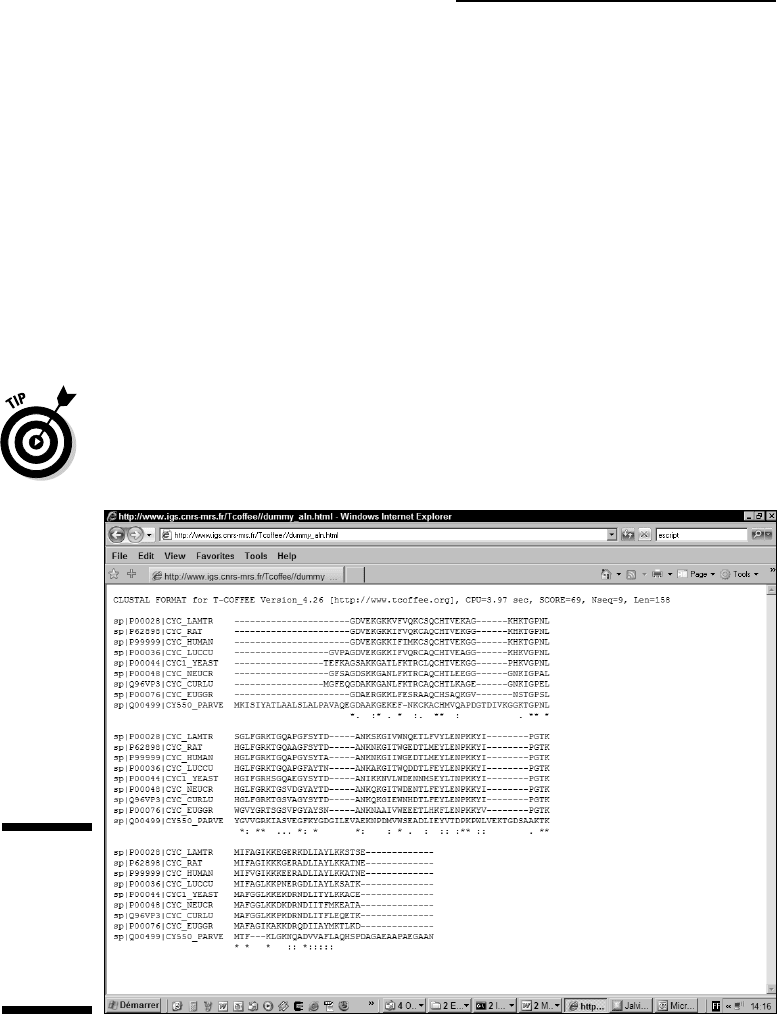
If you do not have an alignment ready, you can download one for your crash
tests from
www.tcoffee.org/dummy_aln.html. It is an alignment in ALN
format (see Figure 10-1).
Figure 10-1:
A multiple
sequence
alignment in
ALN or
ClustalW
format.
304
Part III: Becoming a Pro in Sequence Analysis
16_089857 ch10.qxp 11/6/06 4:01 PM Page 304

Getting Your Multiple Alignment
in the Right Format
When using online servers — or even local programs — you do not always
have full control of what goes in and what comes out of the program you use.
For instance, many multiple-sequence-alignment programs commonly output
only one format: MSF (Multiple Sequence Format). What can you do if you
want to analyze this multiple sequence alignment with a program that only
reads FASTA-formatted alignments? The answer is simple: Use a reformatting
program just like the ones we introduce in this chapter.
When it comes to multiple sequence alignments, there is no such thing as a
perfect format. Anyone used to dealing with the many services available
online knows that each service tends to have its favorite format. (See the “A
format for everyone: Democracy or anarchy?” sidebar if you want proof of
this fact.) Understanding everything there is to know about formats is an abil-
ity you only acquire with some practice — but this chapter gives you some
ideas, and we prepare you to be on the lookout for potential problems.
305
Chapter 10: Editing and Publishing Alignments
A format for everyone: Democracy or anarchy?
The variety of formats is a major curse in bioin-
formatics. For a long time, the tradition was that
anyone developing a new program would design
his or her own house format. Each new format
was slightly different from the others — and
especially appealing to only a particular cate-
gory of biologists. For instance, people doing
phylogeny became very attached to the Phylip
format; users of GCG (a popular bioinformatics
package) preferred MSF, and so on. Whether we
like it or not, the weight of history has made each
of these formats totally acceptable — and today
they all live in perfect harmony, side by side on
our computer keyboards — or do they?
Another source of confusion in the field was the
communication wars between biologists and
computer scientists. For many years, biologists
have complained about the computer scientists’
formats, basically saying, “We cannot make
sense of this gibberish.” In retaliation (and
because they needed to), biologists also cre-
ated formats they could use — to the contempt
of computer scientists, who dubbed these for-
mats “amateurish and ambiguous.” Both the
biologists and the computer scientists were
probably right in their respective evaluations.
But that didn’t help.
Things may be about to change with the XML
language coming to the fore. XML (e
X
tensible
M
arkup
L
anguage) is a close relative of HTML —
the language of the Web. XML makes it possible
to simply describe your data with keywords
everyone can agree on. Today, biologists and
computer scientists consent — albeit weakly —
that XML could be the solution and the main
bioinformatics programs are now able to pro-
duce output in XML.
16_089857 ch10.qxp 11/6/06 4:01 PM Page 305

Unfortunately, nothing is standardized yet, and the number of programs able
to use XML is still limited. To be honest, you can expect the ancient formats
we describe in this section to still be around when your grandchildren retire
in their early 90s.
When you choose to store your data in a specific format, you must ask
yourself four questions:
Do most programs support this format?
Will my collaborators be able to use it?
Can I store all the information I need with this format?
Is it easy to manipulate?
Today no format is so perfect that you would answer yes to each of these
questions; any choice relies on the right trade-off between what you really
need and what’s available. If you can, avoid using a mixture of formats when
running a project.
The taxonomy of multiple-sequence-alignment formats is rather complex.
Table 10-1 lists the most common formats you may come across when
manipulating multiple sequence alignments.
Table 10-1 A Classification of Multiple Sequence
Alignment Formats
Name Type Usage
post-script, Graphic Terminal formats suitable for printing only
PDF, HTML
FASTA Text Easy to manipulate
(Figure 10-2) Noninterleaved (not readable by humans)
Easy for renaming sequences
Supported by most programs
Cannot incorporate extra annotation
PIR Text Similar to FASTA but with an extra line
Can incorporate limited extra annotation
MSF Text Most standard multiple-alignment format
(Figure 10-3) Difficult to modify manually
Interleaved (easy to read for humans)
Can include extra annotation, such as weights
Supported by most programs (but some programs
only support it partially!)
306
Part III: Becoming a Pro in Sequence Analysis
16_089857 ch10.qxp 11/6/06 4:01 PM Page 306
Name Type Usage
Selex Text Extended version of MSF
Can include extra annotation
Supported by few programs
ALN Text Simplified version of MSF
(Figure 10-1) Default output of ClustalW
Interleaved (easy to read for humans)
Supported by many programs
Phylip Text Variant of ALN
Useful for doing phylogenetic analysis
Supported by most phylogenetic packages
Recognizing the main formats
The alignments you see in publications are usually in a graphic format that
isn’t very useful for doing analyses. The last section of this chapter shows
you resources that you can use for generating these alignments. You’ve
already seen the ALN format in this chapter (refer to Figure 10-1), and FASTA
is another format (see Figure 10-2) that has cropped up a number of times in
previous chapters. In the lab, MSF, as shown in Figure 10-3, is probably the
most common format. Note that MSF and ALN are
interleaved (meaning easier
for humans to read but not for machines), whereas FASTA is not.
To make an interleaved format, the idea is to take the complete multiple
sequence alignment — and then chop it into blocks of 60 residues. The file
displays the blocks one after the other.
If you want to further investigate the intricacies of the world of formatting,
here are two extensive resources for keeping your formats straight:
emboss.
sourceforge.net/docs/themes/SequenceFormats.html
and www.
ebi.ac.uk/help/formats_frame.html
.
Working with the right format
Sometimes when a program offers several outputs, keeping only the graphic
output is tempting because it seems — with its flashy colored annotation —
to be the most complete. This graphic output usually comes in post-script,
.pdf, .html, .gif, or .jpeg format. If you keep only this graphic output,
though, you can be badly stuck.
307
Chapter 10: Editing and Publishing Alignments
16_089857 ch10.qxp 11/6/06 4:01 PM Page 307
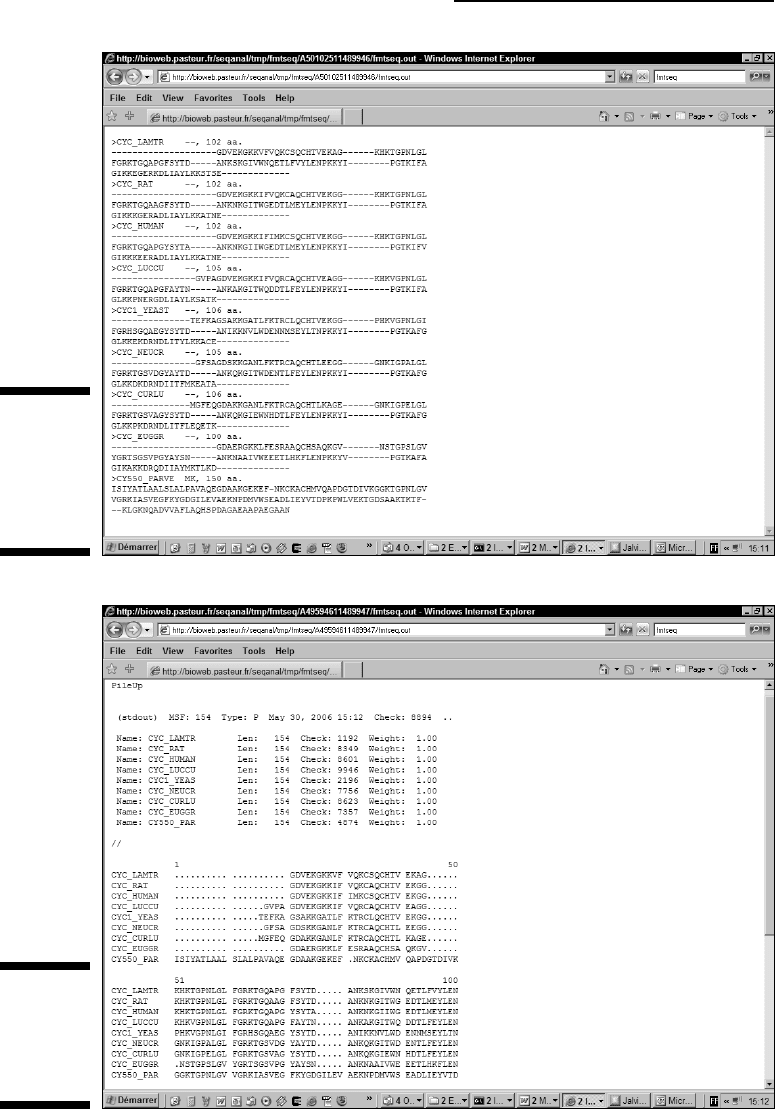
Figure 10-3:
A multiple
sequence
alignment in
MSF format.
Figure 10-2:
Multiple
sequence
alignment in
FASTA
format.
308
Part III: Becoming a Pro in Sequence Analysis
16_089857 ch10.qxp 11/6/06 4:01 PM Page 308

Graphic outputs are useful for displaying your information. Using graphic
output with any sequence-analysis program, however, is virtually impossible.
You can request a graphic output if you want the pretty picture, but you must
also keep the text version. Remember that turning a text into a graphic is
always easier than the other way round!
Text representations are much more civilized; they are the default output of
most multiple-sequence-alignment programs and servers. Their main pur-
pose is to be easy to display, easy to manipulate, and easy to transfer from
one program to the next. Of course, they’re much less flashy than their
graphic counterparts!
MSF is the most standard format for multiple sequence alignments. This is the
most common format if you download an alignment from the Web, for example.
FASTA or PIR are a bit less common but are on the rise. If you’re using phyloge-
netic programs, Phylip is fairly common. ALN is also fairly common because it
is the default output of ClustalW, the most widely used multiple-sequence-
alignment program. ALN offers a good trade-off between most formats.
Converting formats
If the program you’re using doesn’t produce alignments in the format you
need, it is possible to use a third-party conversion tool to get to the format
you want. In the following step list, we show you how to convert an alignment
in ALN format (refer to Figure 10-1) into a FASTA-format multiple alignment.
1. Point your browser to bioweb.pasteur.fr/seqanal/inter-
faces/fmtseq.html
.
The Pasteur Institute’s fmtseq Sequence Conversion page appears, as
shown in Figure 10-4.
2. Enter your e-mail address in the field provided.
3. Paste your alignment in the Sequence window.
fmtseq automatically recognizes most formats. If you don’t have any
spare sequences lying around, use the dummy multiple sequence align-
ment we created at the beginning of the chapter.
If your sequence names are longer than 15 characters, the rest of the name
gets incorporated IN the sequence. This is a major source of confusion.
4. Specify a format for your output by making a selection from the
Output Sequence Format drop-down menu.
For our example, we chose FASTA.
5. Scroll Down The Page to reach the “Input Parameters” section (you
can also click on the Input Parameters link) and select the format you
want to input from the Input Sequence Format drop-down menu.
309
Chapter 10: Editing and Publishing Alignments
16_089857 ch10.qxp 11/6/06 4:01 PM Page 309