
Claverie J-M., Notredame C. Bioinformatics for Dummies
Подождите немного. Документ загружается.


If you leave this selector blank, as shown in Figure 10-5, fmtseq tries to
guess your format automatically. If it fails to do so, you can select your
input format here (assuming you know it!).
6. In the Output Parameters section, make sure that the Convert to
Lowercase and the Convert to Uppercase options are deselected.
When you deselect these two options, fmtseq retains the original case of
each symbol in your alignment. Some programs, such as Dialign, use
case to indicate the local reliability of the alignment.
The Pretty-Print option gives you access to a menu that makes it possi-
ble to control every detail in your output format, such as the number of
characters per line, the indentation, and other minute details.
7. Click the Run ftmseq button at the top or the bottom of the page.
Wait until your browser displays the result page. In most cases, the
results come back interactively in a few seconds, but if the server is very
busy, it may send the output using the e-mail you provided in Step 2.
8. Click the fmtseq.out link to see your alignment reformatted.
9. Save the reformatted file with the File
➪Save As option of your browser.
You can save this file as a .txt or .html file.
Sequence reformatting is one of the most common facilities on the Web.
Table 10-2 lists some of these sequence reformatting servers and what you
can do using them.
Table 10-2 Sequence Text Conversion on the Web
Name Address Description
fmtseq bioweb.pasteur.fr/seqanal/ Converts
interfaces/fmtseq-simple.html, most formats
www.bimcore.emory.edu/Pise/
READSEQ bimas.dcrt.nih.gov/molbio/ A very popular tool
readseq/, for reformatting; does
dot.imgen.bcm.tmc.edu/ not recognize ALN
seq-util/readseq.html,
iubio.bio.indiana.edu/
cgi-bin/readseq.cgi
,
bimas.dcrt.nih.gov/
molbio/readseq/
,
www.ebi.ac.uk/readseq/
SeqCheck darwin.nmsu.edu/bioinfo/ Cleans your FASTA
seqcheck/seqcheck.php sequences
310
Part III: Becoming a Pro in Sequence Analysis
16_089857 ch10.qxp 11/6/06 4:01 PM Page 310
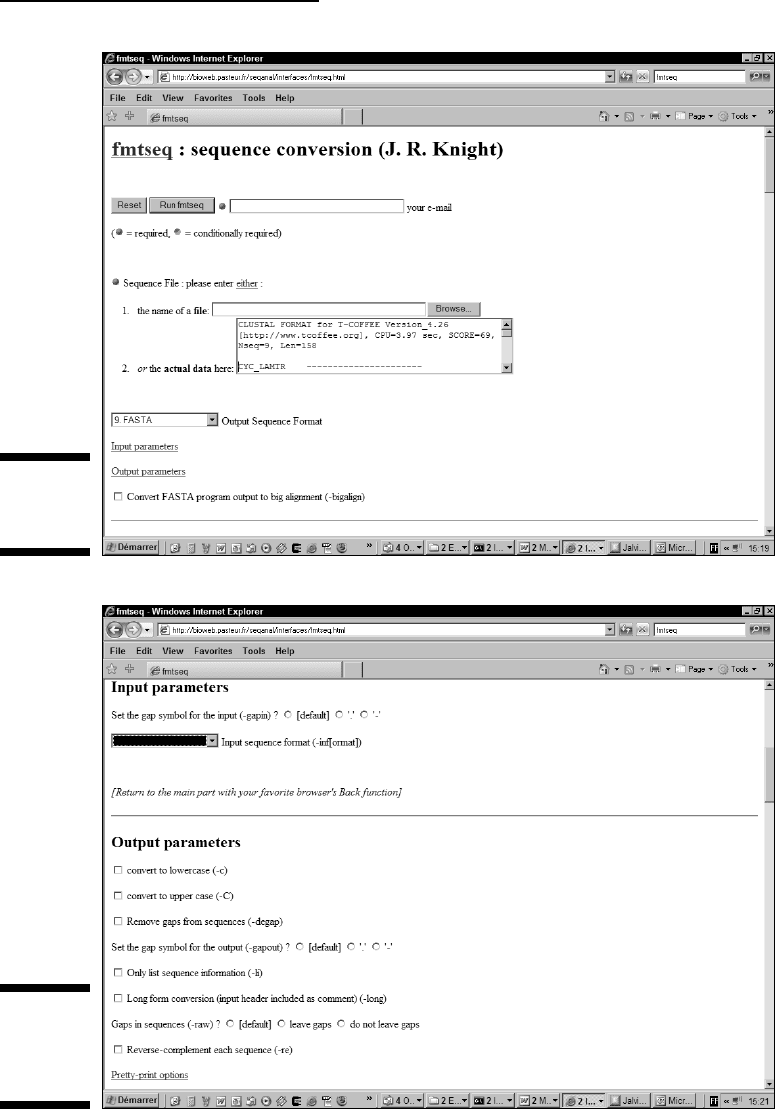
Figure 10-5:
Output
parameters
of fmtseq.
Figure 10-4:
The fmtseq
server.
311
Chapter 10: Editing and Publishing Alignments
16_089857 ch10.qxp 11/6/06 4:01 PM Page 311

Watching out for lost data
No matter what they tell you, there’s always the danger that you can lose
information when changing the format of your sequences. Each type of
format supports different types of information. The problem is that, in
most cases, you only realize this when it’s too late. Table 10-3 lists the
kinds of features that formatting can destroy.
Along the same lines, do not take for granted that similar online servers do
the same thing (even if they have the same name and the same interface).
Two servers running READSEQ may run different versions of this program,
or the same version with different default parameters. As a consequence, a
problem that doesn’t occur with one server may occur with the next server.
It really pays to keep your eyes peeled and to keep backup copies of your
original files.
Table 10-3 Information You Can Lose When Reformatting
Information Type Nature of the Loss
Sequence name Long names can be truncated when switching formats.
Special characters may also be modified. This happens
when converting from FASTA to ALN. The effect of the trun-
cation is unpredictable. Sometimes a portion of the name is
added to the sequence!
Upper/lowercase Case sometimes contains useful information. Strictly speak-
ing, FASTA only supports uppercase. Some programs hate to
receive an input with a mixture of cases.
Gap type Some formats, such as MSF, use different symbols for differ-
ent types of gaps (
., -, ~). These are often turned into (-)
symbols after reformatting.
Annotation MSF can support weight values for the sequences. This
information is lost in most conversions. The extra line of
annotation in PIR often disappears when changing the
format of these alignments. Any annotation that comes after
the sequence name in FASTA is bound to disappear after a
conversion.
Special amino Some reformatting programs support the code for
acid or ambiguities such as X (for undetermined amino acids) or N
nucleotides (for nucleotides). If your sequences travel across many pro-
grams, these symbols may disappear. This can be a problem
if you rely on the offset of some residues within the
sequences. If you can, stick to the standard 4-nucleotide
alphabet and the 20-amino-acid alphabet.
312
Part III: Becoming a Pro in Sequence Analysis
16_089857 ch10.qxp 11/6/06 4:01 PM Page 312
Using Jalview to Edit Your Multiple
Alignment Online
Multiple-sequence-alignment methods aren’t perfect. The people who make
them know this, and the people who use them must also consider this fact.
To produce an alignment that you know is right, you can torture a program
(and yourself) until it spits out exactly what you want. This may take time
and may never lead to the desired result. You can also bite the bullet and
edit this alignment yourself. The best recipe for instant insanity is trying to
modify your multiple sequence alignment with a standard word processor
(such as Microsoft Word or any similar product). It is an experience that has
shattered some of the smartest people. The chances of never recovering are
high, so don’t do it!
Because editing a multiple sequence alignment is so complicated, biolo-
gists have developed text editors that are specific for multiple sequence
alignment. They make it easy for you to see exactly what’s going on. They
also make it possible to group sequences so you can realign two subgroups
without having to modify the entire alignment. Most of these editors require
that you install something on your computer. This should not deter you;
some of these programs — Seaview, for instance — are really easy to install
on a PC.
However, if you want to stick to your browser, you can use Jalview, a Java
applet that you need only load into your Web browser for instant action.
Jalview is a Java applet and uses the same language as Dotlet (see Chapter 8)
and has the same general properties:
It runs on your own computer.
When you load a sequence in Jalview, your sequence does not travel
over the Internet; it stays in your computer.
If you want to ensure that none of your data travels across the Internet,
choose the File
➪Work Offline option on your browser as soon as Jalview
is loaded.
Do not load confidential sequences in Jalview BEFORE doing this. The
Web interface is NOT secure.
313
Chapter 10: Editing and Publishing Alignments
16_089857 ch10.qxp 11/6/06 4:01 PM Page 313
Starting Jalview
We only show you the basics about Jalview here. If you want to go further
into discovering all the possibilities of this extremely powerful tool, we
recommend you check out the extensive online documentation at
www.jalview.org/help.html.
1. Point your browser to www.jalview.org/download.html.
2. Click the Install button.
3. Accept every proposition prompted to you by the system.
If this is the first time you are using Jalview, it will need to upload the
java applet. This will take a few minutes. It will then ask you to accept a
few permissions having to do with network access — permissions you
should graciously grant. If you have already used Jalview before, your
computer will only check that you are using the latest version.
4. Close ALL the windows that appear within the Jalview Window, as
they only contain sample data.
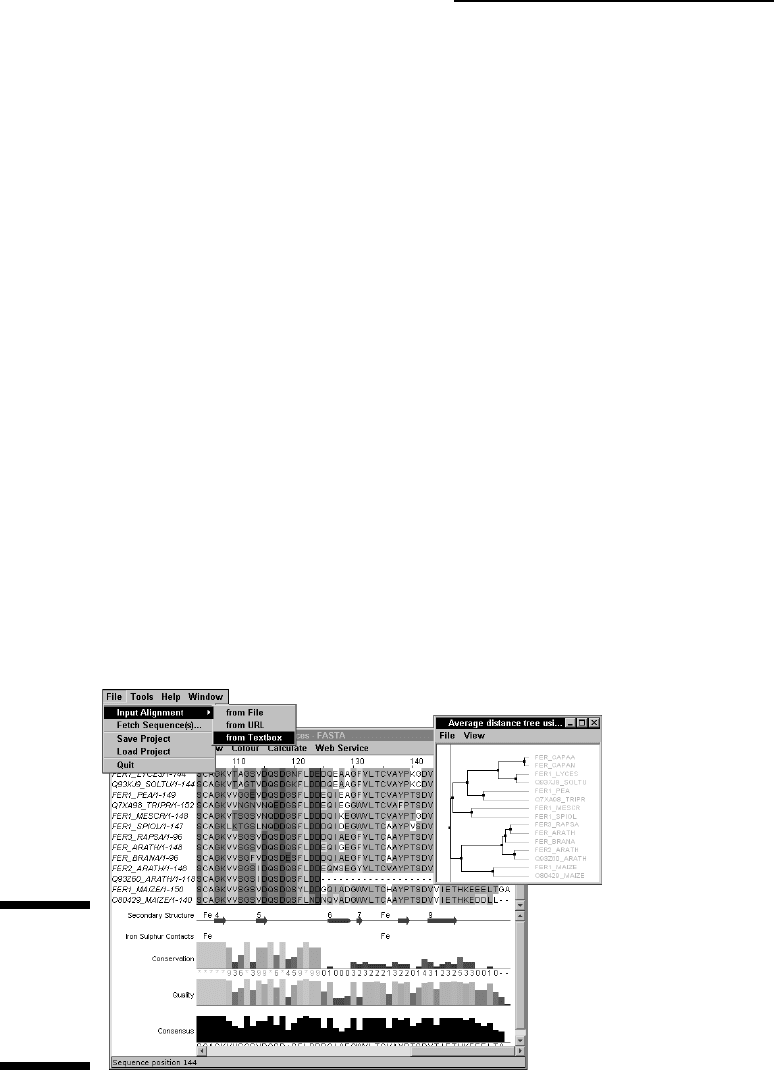
5. Select the File
➪Input Alignment➪From Textbox option, as shown in
Figure 10-6.
If your alignment is already in a file, you can upload it with the From File
option.
6. Cut and paste your multiple alignment into the text box that appears
(Figure 10-7) and click on the Accept box.
Figure 10-6:
Uploading a
multiple
sequence
alignment in
Jalview.
314
Part III: Becoming a Pro in Sequence Analysis
16_089857 ch10.qxp 11/6/06 4:01 PM Page 314
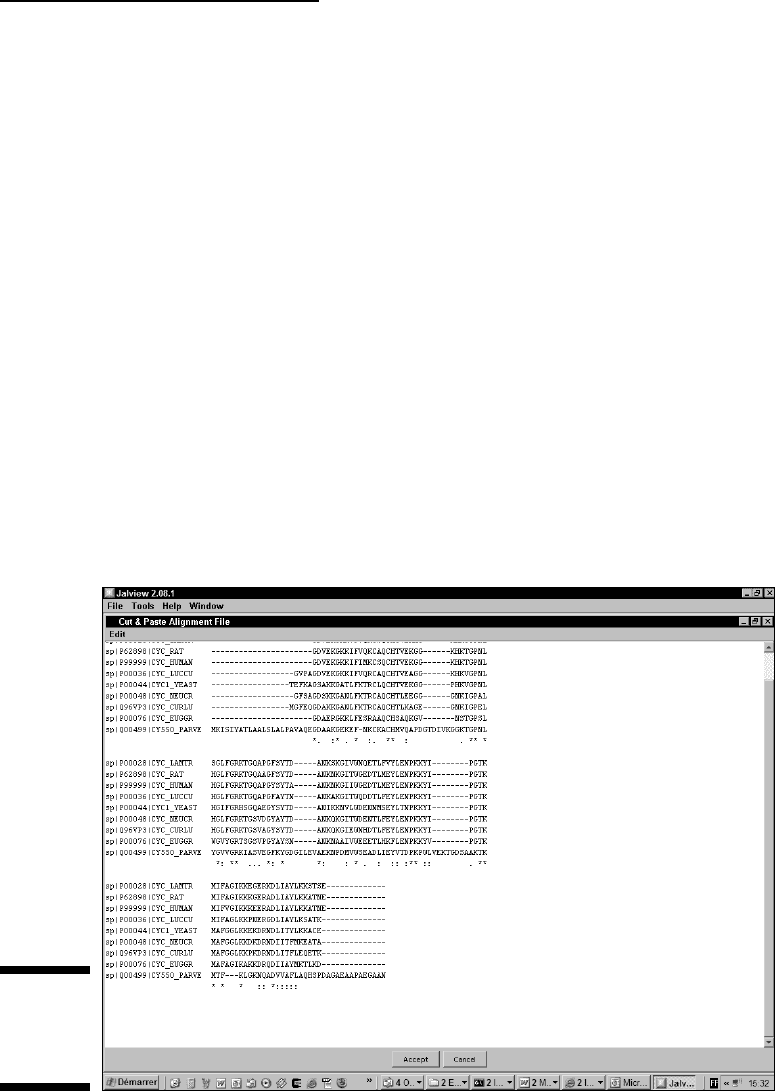
You can either cut and paste your own multiple sequence alignment or you
can pick up a dummy alignment at
www.tcoffee.org/dummy_aln.html.
When you click on the accept box, a new window appears that contains
your alignment, ready to be edited (Figure 10-8). This is the Cut & Paste
Input window, and it contains the alignment you have entered in the box.
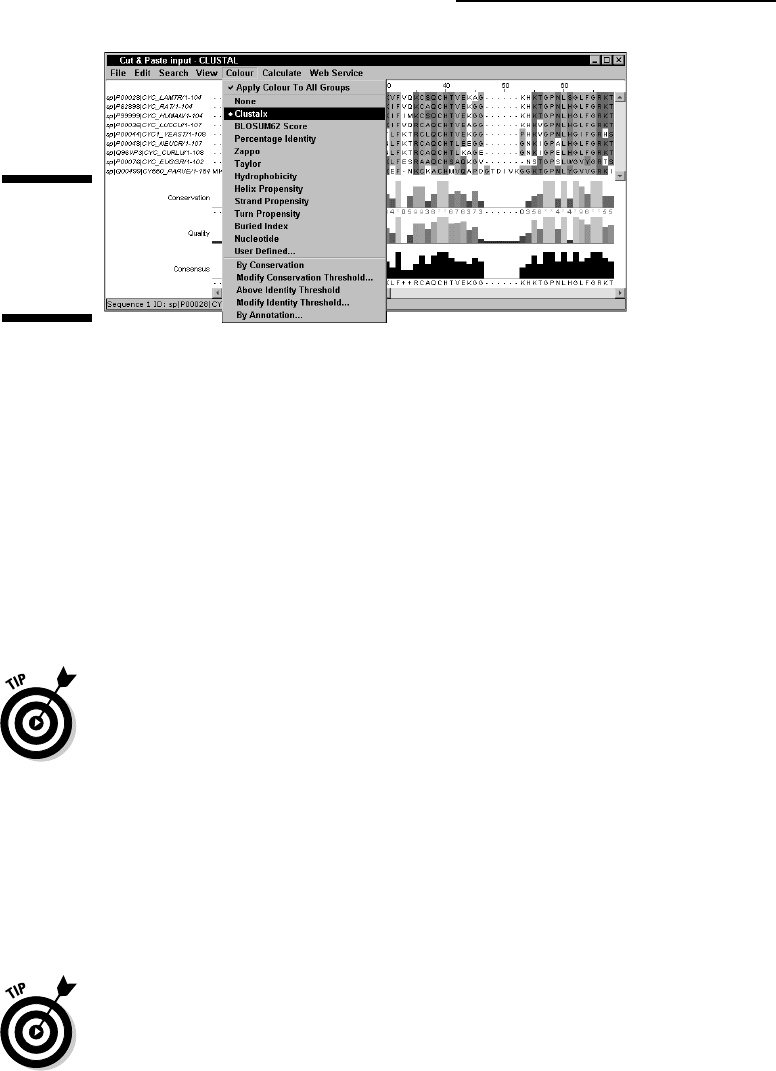
7. Select the ClustalX Color Scheme in the Color pull-down Menu
(Figure 10-8).
Choosing a color scheme is really a matter of taste; most multiple-
sequence-alignment specialists can spend hours explaining to you why
they prefer a special color scheme to every other alternative in the galaxy.
Whatever your choice, any time you show a color alignment, you must be
ready to answer the most common question in the world of biology:
“What is the color scheme in this alignment?”
To know more about the color schemes available in Jalview, read the
excellent online documentation for this program at
www.jalview.org/
help.html
; you’ll find an extensive section on color schemes there. In
Jalview, all the available color schemes are under the Colour menu (Figure
10-8). The ClustalX, initially designed by Tobby Gibson at the European
Molecular Biology Laboratory, is probably one of the most popular.
Figure 10-7:
The Jalview
Alignment
TextBox.
315
Chapter 10: Editing and Publishing Alignments
16_089857 ch10.qxp 11/6/06 4:01 PM Page 315
Editing a group of sequences
When you edit an alignment, you usually want to keep some of your
sequences aligned the way they are relative to one another. What you want to
do is collectively modify their alignment. To do this, you need to define them
as a group, as follows:
1. For the purposes of this example, input the dummy alignment we
describe in the previous section into Jalview.
You can grab the dummy alignment from
www.tcoffee.org/dummy_aln.html.
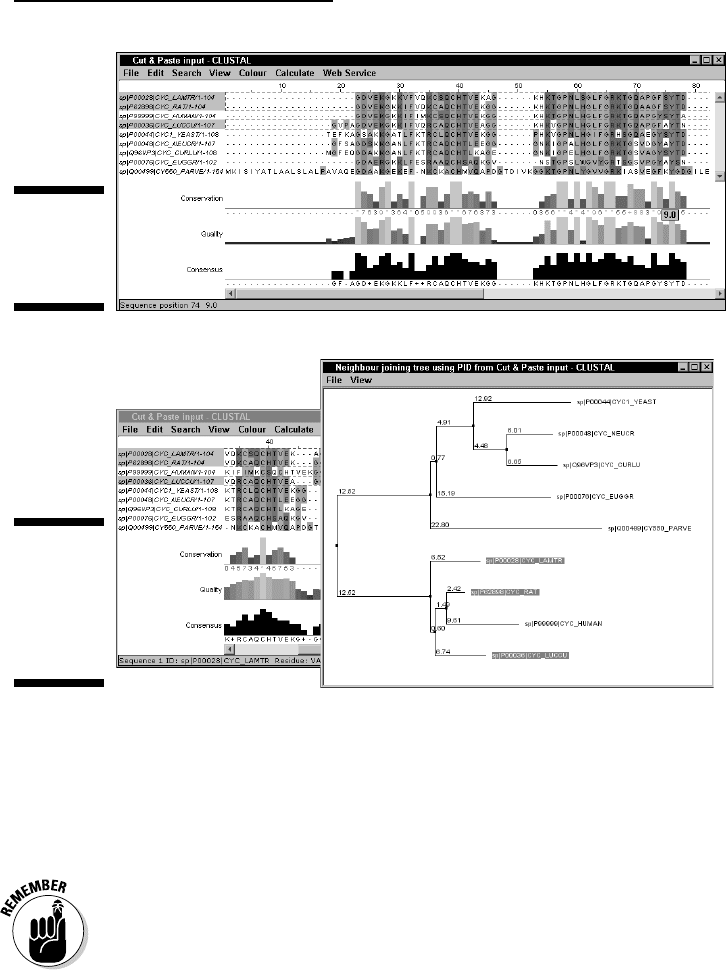
2. Keep the Ctrl key pressed while you click sequences 1, 2, and 4 to
select them, as shown in Figure 10-9.
Selecting the sequences on a phylogenetic tree is also possible:
a. Select Calculate
➪Calculate Tree ➪Neighbor Joining Tree Using PID.
b. On the tree that pops up, you can select sequences individually
(Figure 10-10).
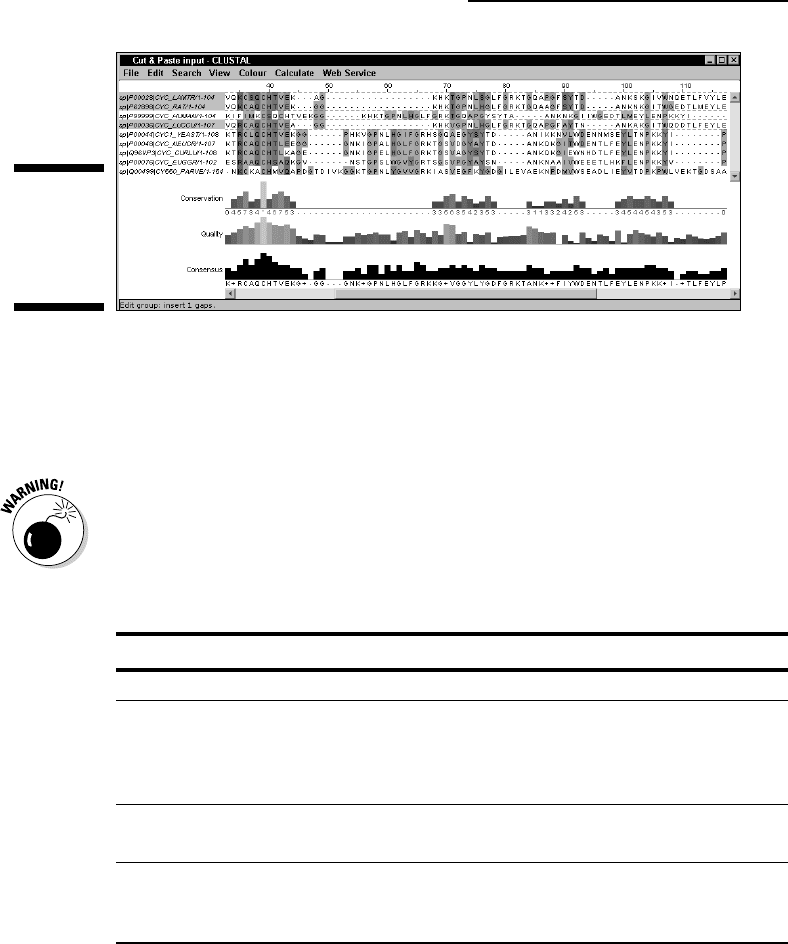
3. To insert/remove gaps:
a. Keep the Ctrl key pressed.
b. Put your mouse pointer right where you want to insert or
remove the gap.
c. Drag to the left or to the right to shift your sequences, as shown
in Figure 10-11.
You can edit one sequence at a time by pressing the Shift key instead
of Ctrl.
Figure 10-8:
Changing
the Jalview
Color
Scheme.
316
Part III: Becoming a Pro in Sequence Analysis
16_089857 ch10.qxp 11/6/06 4:01 PM Page 316
4. To remove empty columns, use Edit➪Remove empty columns.
Empty columns (containing only gaps) may appear while you edit. This
simple command gets rid of them for you.
5. Choose Edit➪Pad Gaps to ensure that no empty column appears at the
end of the multiple sequence alignment.
When you shift some sequences, you insert gaps. If you don’t then edit
the gaps at the end of the alignment, you will have problems using your
alignment in other applications, as your sequences will seem to be
unaligned.
6. To edit another alignment, go back to the main Jalview window.
The File menu in the main window and the File menu in the alignment
window do not display the same functionalities.
Figure 10-10:
Selecting
sequences
on a
phylogenetic
tree.
Figure 10-9:
Selecting
sequences
in Jalview.
317
Chapter 10: Editing and Publishing Alignments
16_089857 ch10.qxp 11/6/06 4:01 PM Page 317
Useful features of Jalview
Although explaining all the possibilities of Jalview is clearly beyond the scope
of this chapter, we encourage you to explore them. Jalview is like all the pro-
grams we introduce here: You can’t break anything, so experiment away!
That said, remember that it is easy to ruin a good alignment. Save intermedi-
ate results and do not hesitate to use the magic undo button (Ctrl+Z).
Table 10-4 lists some of the features we find especially useful.
Table 10-4 Some Useful Features of Jalview
Command Description
Calculate➪ Automatic update of the graph below the alignment. This
Autocalculate graph — looking like a city skyline — indicates the level of
Consensus conservation within the alignment. If you set this option, the
graph is updated automatically while you’re editing.
Edit
➪Remove Makes sure that no pair of sequences is more than
Redundancy
x
percent similar.
Calculate
➪Tree➪ Computes and displays a phylogenetic tree in graphic
Neighbor Joining format on which you can select sequences for group editing.
Tree Using PID
Saving your alignment in Jalview
The new Jalview makes it very easy to save either a colored version of your
alignment or a simple text version. We recommend you save both. The colored
Figure 10-11:
Effect of
dragging a
group to the
right.
318
Part III: Becoming a Pro in Sequence Analysis
16_089857 ch10.qxp 11/6/06 4:01 PM Page 318

version is useful for making illustrations while the text version is necessary if
you want to keep working with your alignment.
To save your multiple alignment in text and HTML (for all the pretty colors)
format, follow these steps:
1. From the Jalview Alignment Window, choose File➪Save Alignment AS.
2. In the dialog box that appears, select FASTA in the File Type pull-
down menu.
We recommend you either select the FASTA format (most portable) or
the CLUSTAL format (ALN), which is more easily read by us humans.
3. From the Jalview Alignment Window, choose File➪Export➪HTML.
Doing so saves a colorized version of your alignment that you can
visualize with any Web browser (Mozilla, Netscape).
Preparing Your Multiple Alignment
for Publication
Showtime has finally come: You have the multiple alignment you want, and
you’re determined to show the world! You want to show this alignment to
your colleagues, you want to include it in publications, on posters, in mails,
and maybe on T-shirts, mugs, and other merchandise — you’re even mulling
over the idea of a tattoo. In short, you need a high-impact picture to convince
people that your research is going gangbusters. In this section, we list a few
online utilities that you can use to beautify your multiple sequence align-
ments and make them look sharp as a tack.
Using Boxshade
Boxshade is a utility that allows you to put some life into your alignment. It
shades columns according to their level of conservation and produces files
that you can easily manipulate for inclusion in reports or articles. (We give
you other powerful tools of the same kind in Table 10-7.)
To get the ball rolling with Boxshade, do the following:
1. Point your browser to
www.ch.embnet.org/software/BOX_form.html.
The Boxshade page of ch.EMBnet.org appears, part of which you can
see in Figure 10-12.
319
Chapter 10: Editing and Publishing Alignments
16_089857 ch10.qxp 11/6/06 4:01 PM Page 319