
Coker A.K. Fortran Programs for Chemical Process Design, Analysis, and Simulation
Подождите немного. Документ загружается.

Acknowledgments
I wish to express my profound gratitude to Professor E.N. Bromhead
for his constructive criticism of Chapter Six. His enormous help and
directions in developing the screen handling software on the pressure
drop calculation for single-phase incompressible fluids are greatly
appreciated. It has been a privilege to have worked with him. I am grateful
to Dr. C.J. Mumford for his critical reviews of some chapters in the text.
His expertise, suggestions, and encouragement are greatly appreciated.
Sincere thanks to Dr. M.C. Jones for his valued comments and sugges-
tions of Chapter Four. Permissions have been obtained to reproduce the
works published by some organizations and companies. I acknowledge
and thank the American Institute of Chemical Engineers, the Institution
of Chemical Engineers (U.K.),
Chemical Engineering
(Mc-Graw Hill),
Oil & Gas Journal,
Tubular Exchanger Manufacturers' Association,
American Petroleum Institute, John Wiley & Sons, Nutter Engineering,
PROCEDE, and many other organizations that provided materials for
this book. Sincere gratitude to Joyce Alff for her directions and wonderful
editing of the book. Finally, very special thanks to Bill Lowe, Editor-in-
Chief (Book Division), Gulf Publishing Company.
A. Kayode Coker
viii
Preface
The increased use of personal computers by engineers has greatly revo-
lutionized and expedited the design of process plants and equipment in
the chemical process industries. In addition, the availability of expensive
flowsheeting packages has reduced to some extent the requirement of
programming languages. However, situations often occur where either
a package is not readily available, too expensive, or of a limited scope,
and the design problem lies beyond the boundary of the flowsheeting
packages. The designer is often required to review other alternatives or
develop his or her own specific program for the application. This require-
ment is even more necessary when personal computers are used. A text-
book analyzing the fundamental theory with equations, tables, and figures
is not readily available to the designer.
My aim in writing this text is to present fundamental theory, along
with computer programs, to solve a wide range of design problems.
This text will provide consultants, designers, technologists, and prac-
ticing process engineers with structured programs that can be used to
solve a wide range of process engineering problems and thus analyze
and optimize process equipment on a regular basis. This book will also
serve as a guide to practicing engineers and chemical engineering stu-
dents who are interested in applying mathematical modeling and com-
puter techniques to solve problems in process plant operations. This
book is unique in that adequate information (theory, equations, figures,
and tables) is provided to enable the reader to perform either hand calcu-
lations or to write alternative programs.
FORTRAN is still recognized as the most versatile programming
language, even forty years after its introduction. It is a powerful general
purpose language specially suited to complex, scientific, mathematical,
engineering, and financial algorithms. The earlier versions of the
/x
FORTRAN language (FORTRAN IV, F66) could only be used on large
mainframe systems that accepted programs in batch. Turnaround was
slow; interaction was nil. The availability of microcomputers (IBM
personal computers or compatible) has made it easier for numerical tech-
niques, simulation, and design problems to be developed. Computer
software can now be used interactively on such systems.
This book is unique in that to date no textbook on chemical process
deign and simulation using microcomputers and the FORTRAN pro-
gramming language has been published. FORTRAN 90 is a major devel-
opment of the FORTRAN language and includes all the computer
programs in this text as a subset. To assist the user and to demonstrate
the validity of the methods, worked examples of practical industrial rele-
vance are provided throughout the text.
A listing of all the programs is presented in the book, and source
codes for these programs are provided on a floppy diskette. A FORTRAN
compiler is required to compile and run these source codes. A menu
driven software program for calculating the pressure drop of incom-
pressible single-phase fluids (PIPECAL) is provided in Chapter 3.
Table of Contents
Acknowledgment
Preface
Ch. 1 Numerical Computation 1
Ch. 2 Physical Property of Liquids and Gases 103
Ch. 3 Fluid Flow 150
Ch. 4 Equipment Sizing 256
Ch. 5 Instrument Sizing 331
Ch. 6 Compressors 420
Ch. 7 Mass Transfer 469
Ch. 8 Heat Transfer 590
Ch. 9 Engineering Economics 721
Ch. 10
The International System of Units (SI) and Conversion
Tables
777
Bibliography 801
Appendix A: Tables of Selected Constants 806
Appendix B: Tables of Compressibility 822
Appendix C: Compiling the Fortran Source Code 848
Index 852
CHAPTER 1
Numerical
Computation
INTRODUCTION
Engineers, technologists, and scientists have employed numerical
methods of analysis to solve a wide range of steady and transient
problems. The fundamentals are essential in the basic operations of curve
fitting, approximation, interpolation, numerical solutions of simultaneous
linear and nonlinear equations, numerical differentiation and integra-
tion. These requirements are greater when new processes are designed.
Engineers also need theoretical information and data from published
works to construct mathematical models that simulate new processes.
Developing mathematical models with personal computers sometimes
involves experimental programs to obtain the required information for
the models. Developing an experimental program is strongly dependent
on the knowledge of the process with theory, where the whole modifi-
cation can be produced by some form of mathematical models or
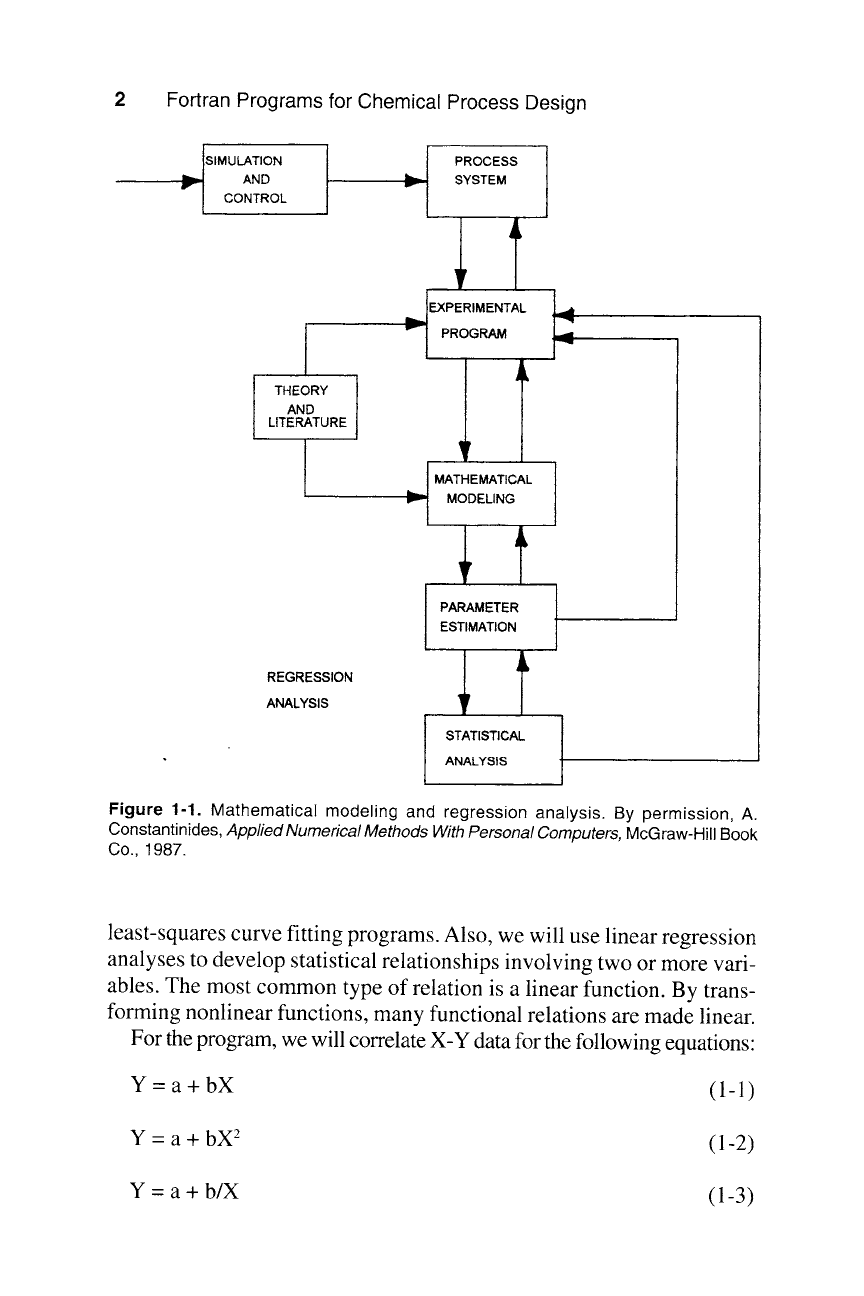
regression analyses. Figure 1-1 shows the relationship between math-
ematical modeling and regression analysis.
Texts [1-5] with computer programs and sometimes with supplied
software are now available for scientists and engineers. They must fit a
function or functions to measure data that fluctuate, which result from
random error of measurement. If the number of data points equals the
order of the polynomial plus one, we can exactly fit a polynomial to the
data points. Fitting a function to a set of data requires more data than
the order of a polynomial. The accuracy of the fitted curve depends on
the large number of experimental data. In this chapter, we will develop
Fortran Programs for Chemical Process Design
SIMULATION
AND
, CONTROL
THEORY
AND
LITERATURE
REGRESSION
ANALYSIS
i,._I PROCESS
SYSTEM
rl ......
~l PROGRAM
~...J MATHEMATICAL
~] MODELING
, t
PARAMETER
ESTIMATION
If
STATISTICAL
ANALYSIS
L
LC
C"
Figure
1-1. Mathematical modeling and regression analysis9 By permission, A.
Constantinides, Applied Numerical Methods With Personal Computers, McGraw-Hill Book
Co., 1987.
least-squares curve fitting programs. Also, we will use linear regression
analyses to develop statistical relationships involving two or more vari-
ables. The most common type of relation is a linear function. By trans-
forming nonlinear functions, many functional relations are made linear.
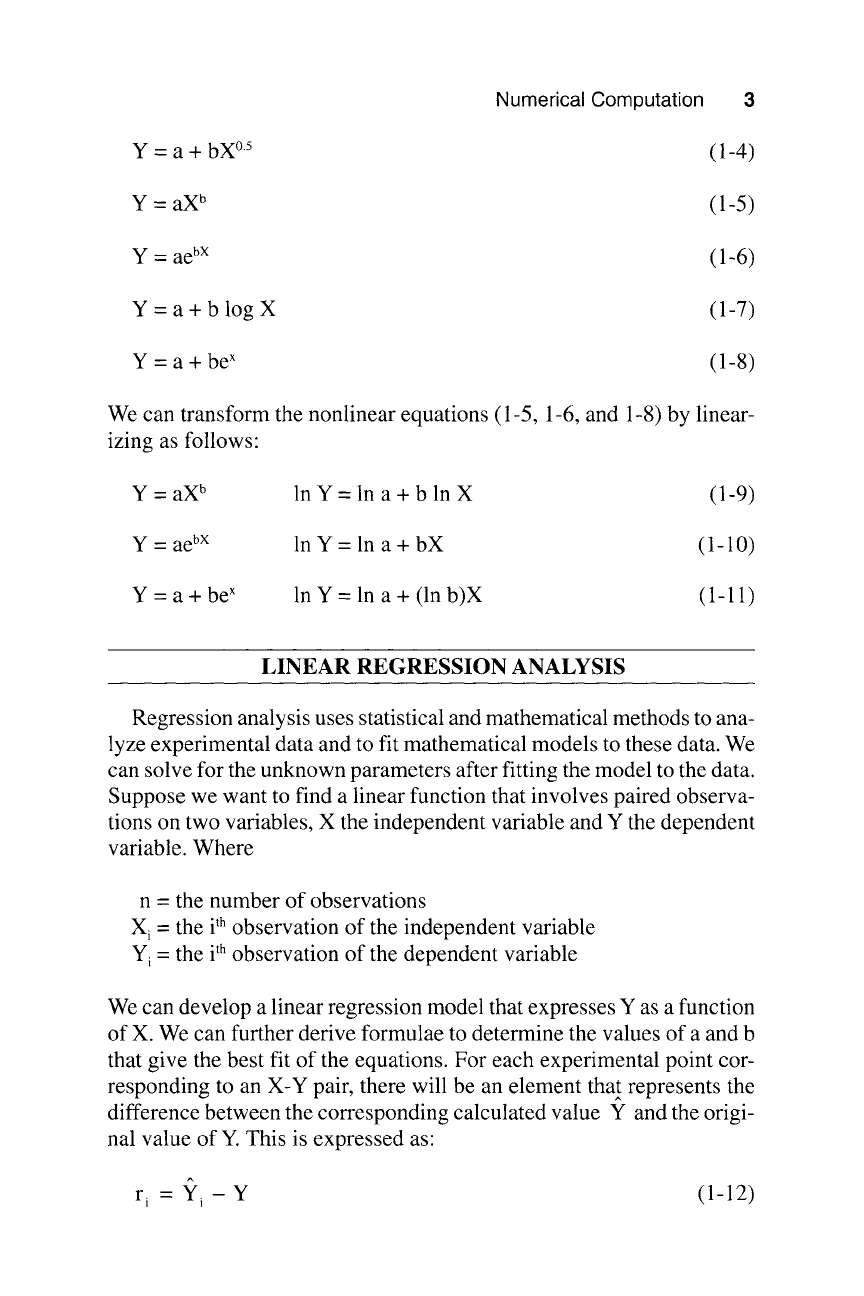
For the program, we will correlate X-Y data for the following equations:
Y - a + bX (l-l)
Y - a + bX 2
(1-2)
Y- a + b/X (1-3)
Numerical Computation 3
Y - a + bX ~ (1-4)
Y - aX b (1-5)
Y - ae bx (1-6)
Y - a + b log X (1-7)
Y-a + be x (1-8)
We can transform the nonlinear equations (1-5, 1-6, and 1-8) by linear-
izing as follows:
Y
- aX b
In Y- In a + b In X (1-9)
Y - ae bx In Y- In a + bX (1-10)
Y - a + be ~ In Y- In a + (In b)X (1-11)
LINEAR REGRESSION ANALYSIS
Regression analysis uses statistical and mathematical methods to ana-
lyze experimental data and to fit mathematical models to these data. We
can solve for the unknown parameters after fitting the model to the data.
Suppose we want to find a linear function that involves paired observa-
tions on two variables, X the independent variable and Y the dependent
variable. Where
n- the number of observations
Xi- the i ~" observation of the independent variable
Y~- the i th observation of the dependent variable
We can develop a linear regression model that expresses Y as a function
of X. We can further derive formulae to determine the values of a and b
that give the best fit of the equations. For each experimental point cor-
responding to an X-Y pair, there will be an element that represents the
difference between the corresponding calculated value Y and the origi-
nal value of Y. This is expressed as:
ri - "Y~- Y (1-12)
Fortran Programs for Chemical Process Design
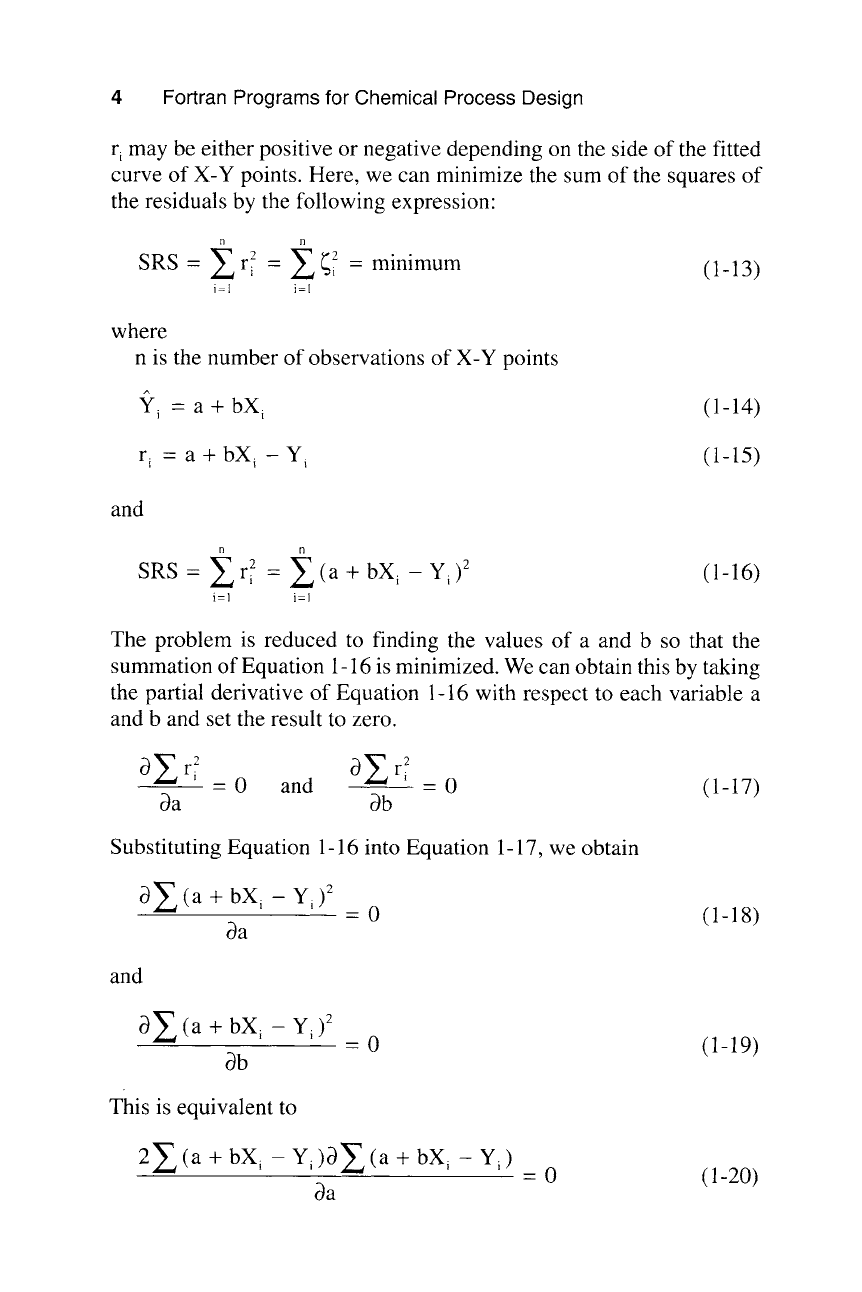
r~ may be either positive or negative depending on the side of the fitted
curve of X-Y points. Here, we can minimize the sum of the squares of
the residuals by the following expression"
SRS-
~ r~- ~~- minimum
i=l i=i
(1-13)
where
n is the number of observations of X-Y points
"Yi -
a + bX i
r i --
a + bX~
- Yi
(1-14)
(1-15)
and
SRS_ s 2 _s )2
i
(a + bXi
- Yi
i=l i=l
(1-16)
The problem is reduced to finding the values of a and b so that the
summation of Equation l-16 is minimized. We can obtain this by taking
the partial derivative of Equation 1-16 with respect to each variable a
and b and set the result to zero.
2 /)~ r 2
0Eri i
0a = 0 and = 0 (1-17)
0b
Substituting Equation 1-16 into Equation l- 17, we obtain
0~(a + bX i - Yi)2
0a
= 0 (1-18)
and
c3 E (a + bX i
- Yi )2
0b
= 0 (1-19)
This is equivalent to
2 E(a + bX i - Y~)0 E(a + bXi- Yi)
Oa
= o (1-2o)
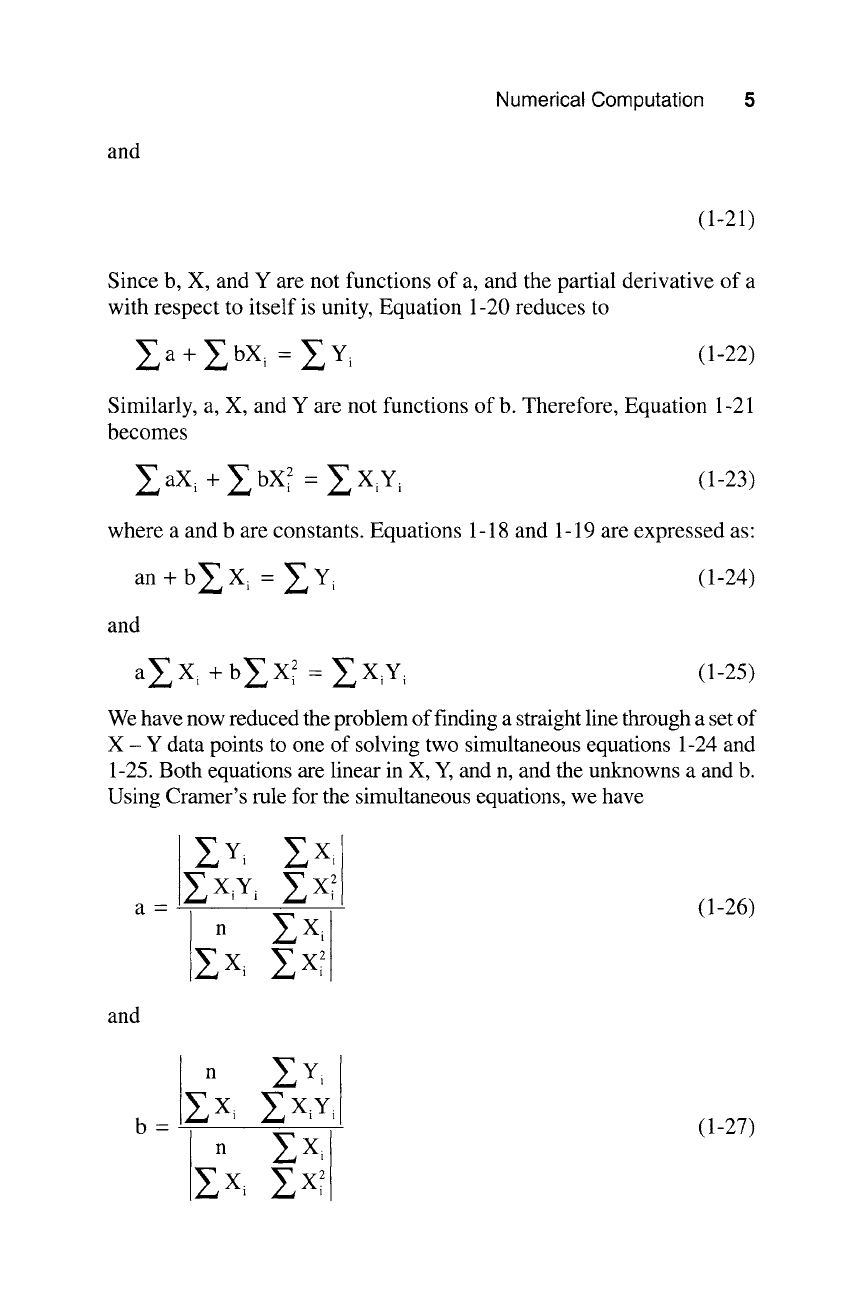
and
Numerical Computation
(1-21)
Since b, X, and Y are not functions of a, and the partial derivative of a
with respect to itself is unity, Equation 1-20 reduces to
~a + ~bXi-ZYi
(1-22)
Similarly, a, X, and Y are not functions of b. Therefore, Equation 1-21
becomes
Z"x, + Z bX~ - Z x,v,
(1-23)
where a and b are constants. Equations 1-18 and 1-19 are expressed as:
an + bZX i -ZY,
(1-24)
and
a Z X i + b Z X~ - Z XiYi (1-25)
We have now reduced the problem of finding a straight line through a set of
X - Y data points to one of solving two simultaneous equations 1-24 and
1-25. Both equations are linear in X, Y, and n, and the unknowns a and b.
Using Cramer's rule for the simultaneous equations, we have
ZYi
~aXi
Zx,Y, Zx ~
and
a = (1-26)
n zZXi]
Zx, x~
b
n ~Vi
Zx~ Zx,Y,
Zx, x~
(1-27)
6 Fortran Programs for Chemical Process Design
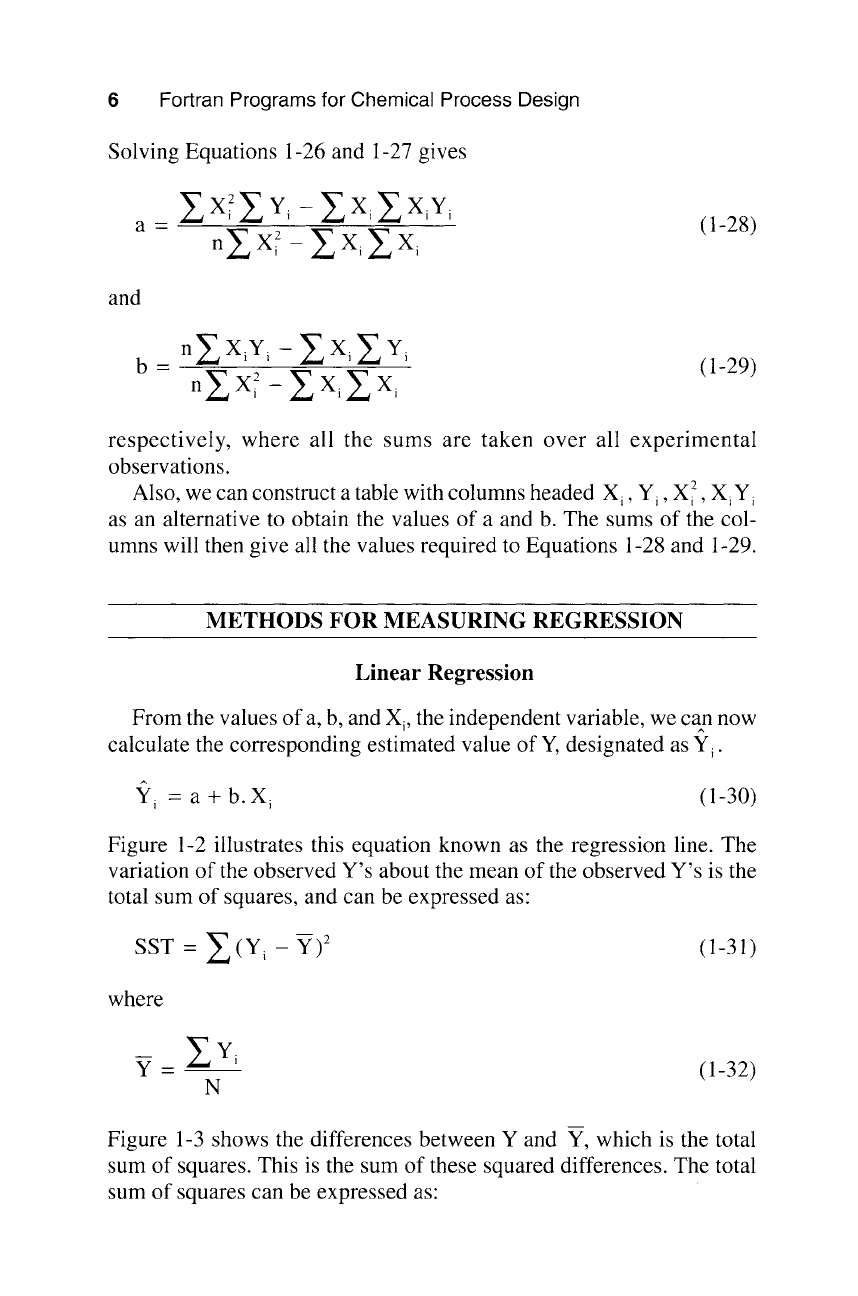
Solving Equations 1-26 and 1-27 gives
a -
ZX~ZYi- ZXiZXiVi
nZX~- ZxiZxi
(1-28)
and
n~z_~ X~Y~ - ~z~ X ~z_~ Y~
b - i (1-29)
nZX~- ExiZai
respectively, where all the sums are taken over all experimental
observations.
Also, we can construct a table with columns headed X i , Y~, X~, XiY i
as an alternative to obtain the values of a and b. The sums of the col-
umns will then give all the values required to Equations 1-28 and 1-29.
METHODS FOR MEASURING REGRESSION
Linear Regression
From the values of a, b, and X i, the independent variable, we can now
calculate the corresponding estimated value of Y, designated as Y i-
A
Y i - a + b. X i (1-30)
Figure 1-2 illustrates this equation known as the regression line. The
variation of the observed Y's about the mean of the observed Y's is the
total sum of squares, and can be expressed as:
SST - (Y, - (1-31)
where
~= E Yi
N (1-32)
m
Figure 1-3 shows the differences between Y and Y, which is the total
sum of squares. This is the sum of these squared differences. The total
sum of squares can be expressed as: