
Coker A.K. Fortran Programs for Chemical Process Design, Analysis, and Simulation
Подождите немного. Документ загружается.

Fluid Flow 187
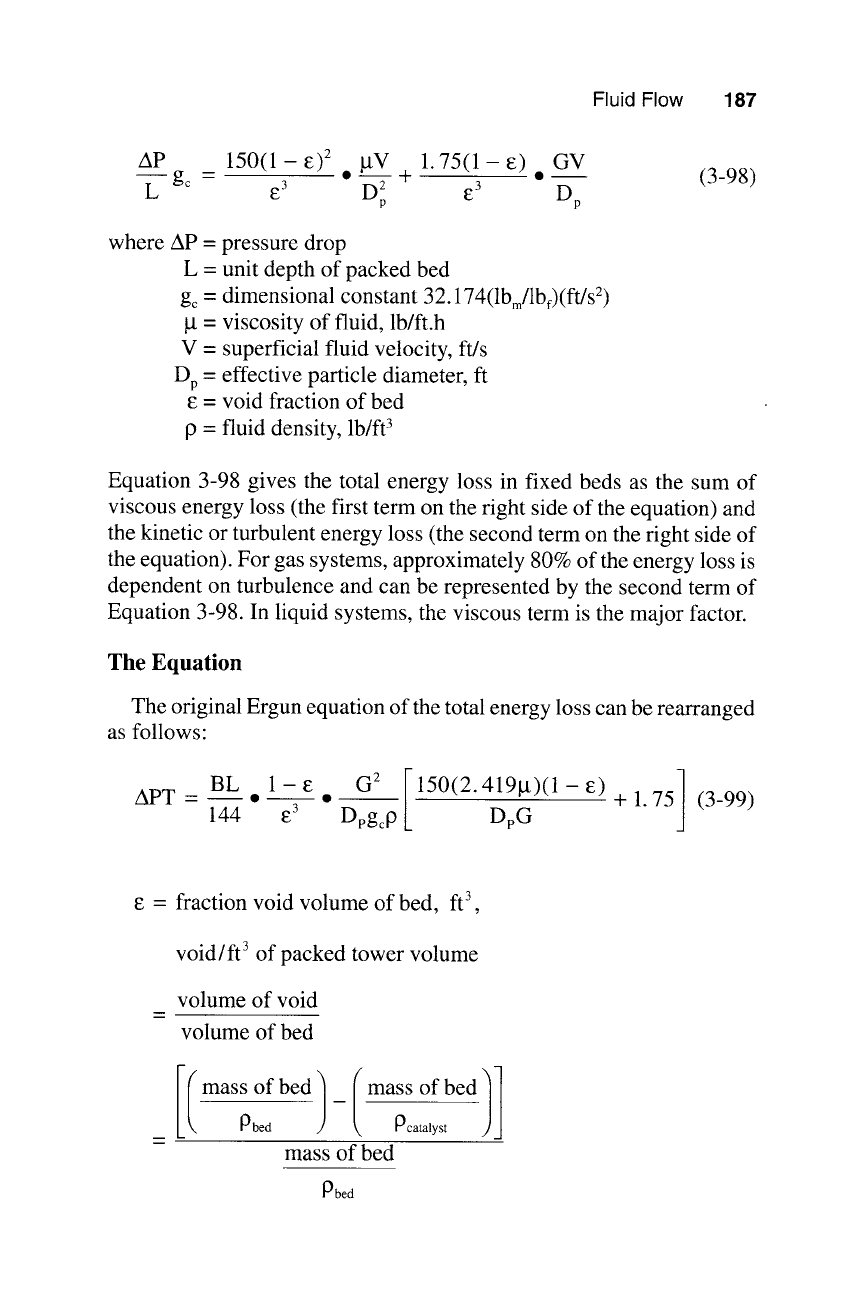
AP
L
150(1- ~)2 laV 1.75(1- ~) GV
gc - e3
" D 2 +
E 3 9
p Dp
where AP = pressure drop
L = unit depth of packed bed
gc = dimensional constant 32.174(lbm/lbf)(ft/s 2)
= viscosity of fluid, lb/ft.h
V = superficial fluid velocity, ft/s
Dp- effective particle diameter, ft
E = void fraction of bed
9 = fluid density, lb/ft 3
(3-98)
Equation 3-98 gives the total energy loss in fixed beds as the sum of
viscous energy loss (the first term on the right side of the equation) and
the kinetic or turbulent energy loss (the second term on the right side of
the equation). For gas systems, approximately 80% of the energy loss is
dependent on turbulence and can be represented by the second term of
Equation 3-98. In liquid systems, the viscous term is the major factor.
The Equation
The original Ergun equation of the total energy loss can be rearranged
as follows:
BL 1-E
APT = 9 9
144 ~3
G 2 [ 150(2. 419g)(1 - ~) + 1. 751 (3_99)
Dpgcp DpG
e = fraction void volume of bed,
ft 3 ,
void/ft 3 of packed tower volume
volume of void
volume of bed
I(mass ~ bed / - (mass ~ bed/1
~bed Pcatalyst
mass of bed
Pbed
188
Fortran Programs for Chemical Process Design
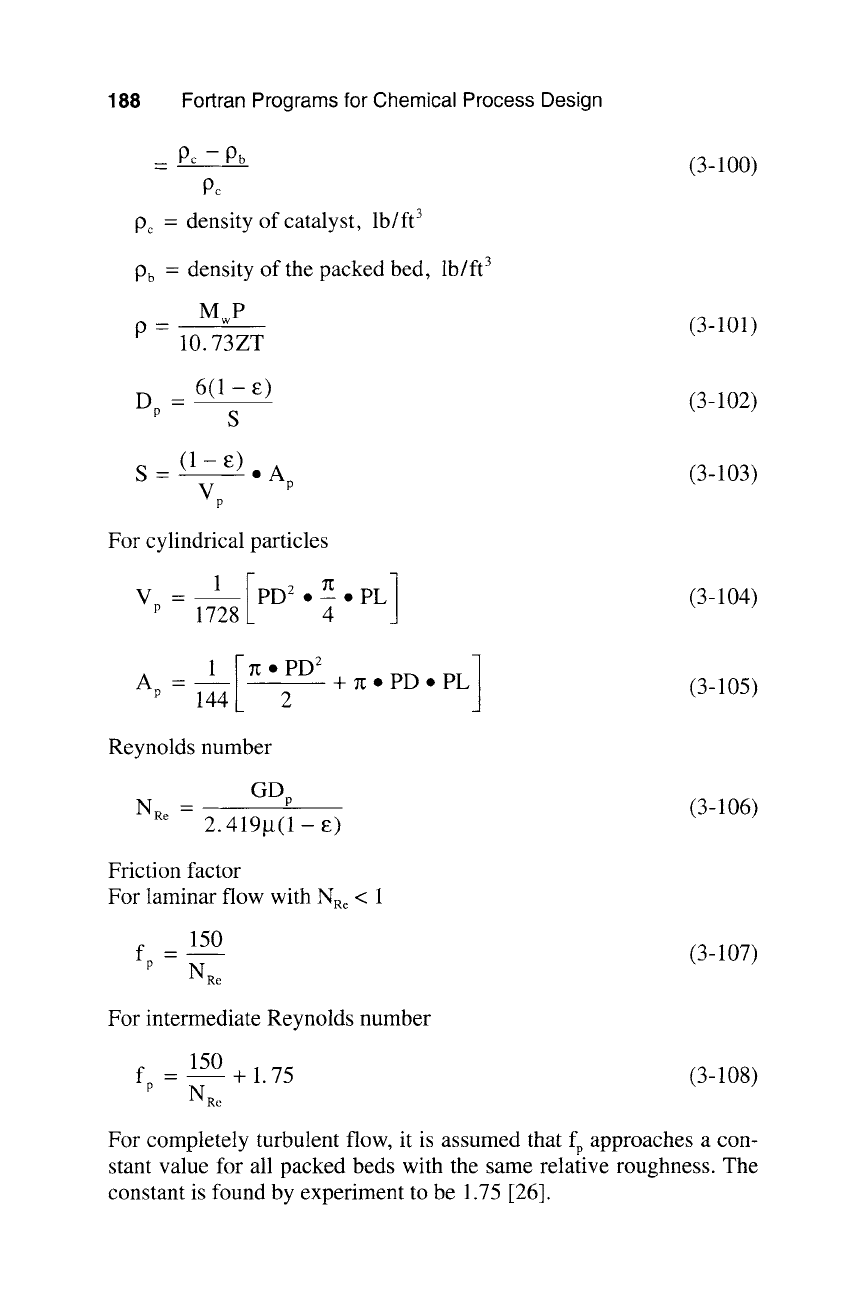
= Pc - 9b (3-100)
PC
9c - density of catalyst, lb/ft 3
9b --
density of the packed bed, lb/ft 3
MP
p _ w (3-101)
10.73ZT
6(1-
e)
(3-102)
Dp- S
s - (1-
e)
V 9 Ap
(3-103)
P
For cylindrical particles
1 pD 2 9 _ 9 PL (3-104)
Vp = 1728 4
1 I/tepD2 1
Ap = ~144 2 + rc 9 PD 9 PL (3-105)
Reynolds number
GDp
NRe = (3-106)
2.419g(1 -- ~)
Friction factor
For laminar flow with
NRe <
1
150 (3-107)
fp -- NR e
For intermediate Reynolds number
150
f = + 1.75 (3-108)
P NRe
For completely turbulent flow, it is assumed that fp approaches a con-
stant value for all packed beds with the same relative roughness. The
constant is found by experiment to be 1.75 [26].
Fluid Flow 189
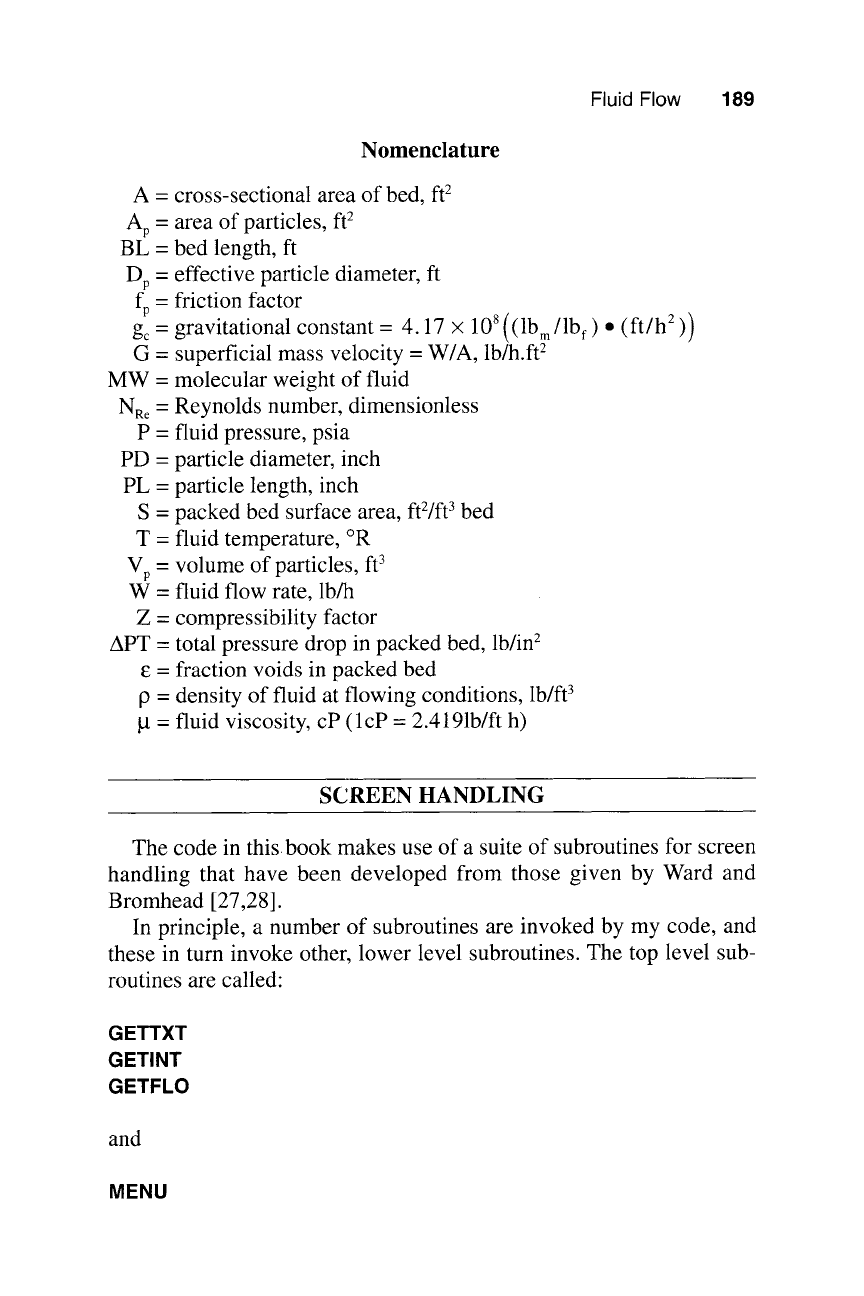
Nomenclature
A = cross-sectional area of bed,
ft 2
Ap
-
area of particles, ft 2
B L = bed length, ft
Dp- effective particle diameter, ft
fp- friction factor
gc - gravitational constant - 4.17 x 10⁸((lb m/lbf ) 9 (ft/h 2 ))
G = superficial mass velocity = W/A, lb/h.ft 2
MW = molecular weight of fluid
NRe = Reynolds number, dimensionless
P = fluid pressure, psia
PD - particle diameter, inch
PL = particle length, inch
S = packed bed surface area, ftz/ft 3 bed
T = fluid temperature, ~
Vp- volume of particles, ft 3
W = fluid flow rate, lb/h
Z = compressibility factor
APT = total pressure drop in packed bed, lb/in 2
= fraction voids in packed bed
9 = density of fluid at flowing conditions, lb/ft 3
= fluid viscosity, cP (1 cP = 2.4191b/ft h)
SCREEN HANDLING
The code in this book makes use of a suite of subroutines for screen
handling that have been developed from those given by Ward and
Bromhead [27,28].
In principle, a number of subroutines are invoked by my code, and
these in turn invoke other, lower level subroutines. The top level sub-
routines are called:
GETTXT
GETINT
GETFLO
and
MENU
190
Fortran Programs for Chemical Process Design
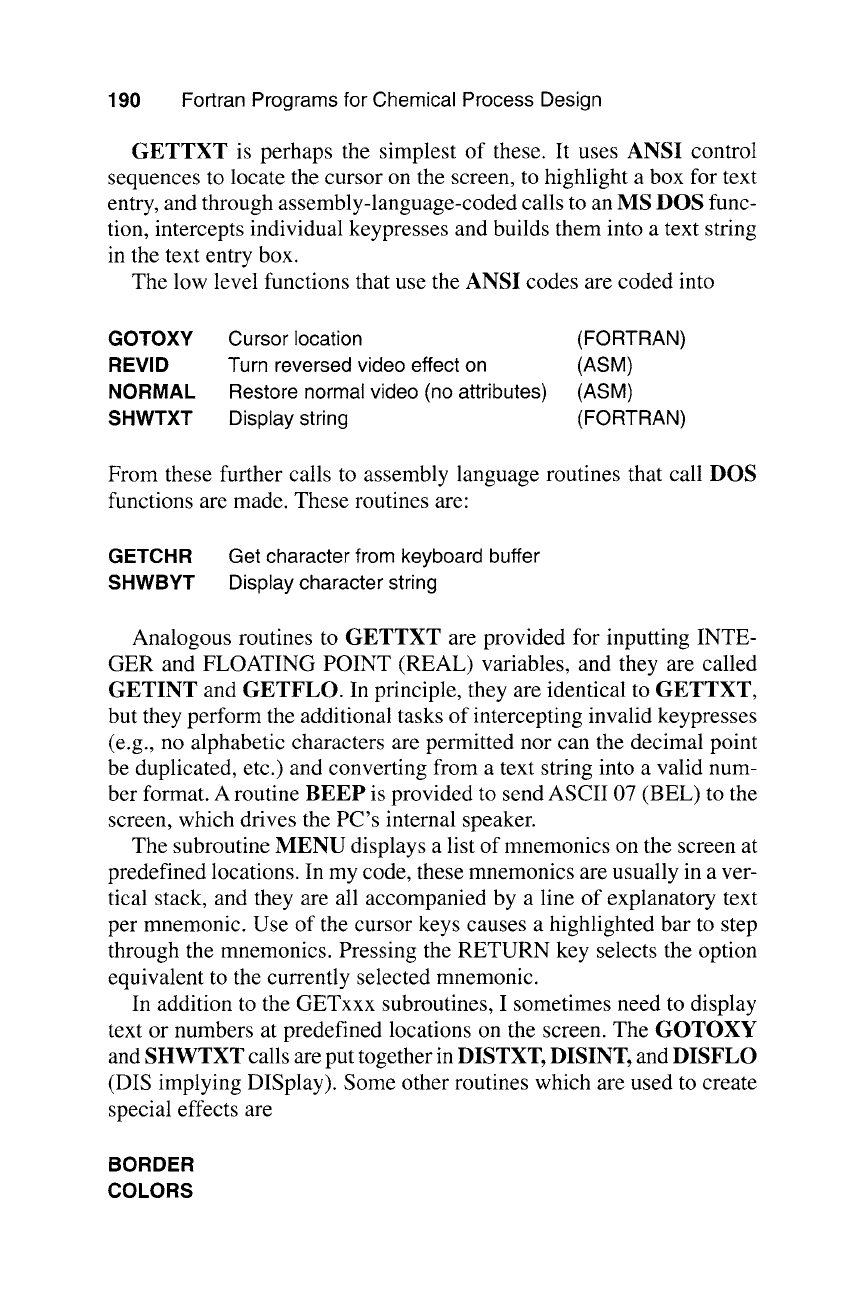
GETTXT is perhaps the simplest of these. It uses ANSI control
sequences to locate the cursor on the screen, to highlight a box for text
entry, and through assembly-language-coded calls to an MS DOS func-
tion, intercepts individual keypresses and builds them into a text string
in the text entry box.
The low level functions that use the ANSI codes are coded into
GOTOXY Cursor location (FORTRAN)
REVID
Turn reversed video effect on (ASM)
NORMAL Restore normal video (no attributes) (ASM)
SHWTXT Display string (FORTRAN)
From these further calls to assembly language routines that call DOS
functions are made. These routines are:
GETCHR
SHWBYT
Get character from keyboard buffer
Display character string
Analogous routines to GETTXT are provided for inputting INTE-
GER and FLOATING POINT (REAL) variables, and they are called
GETINT and GETFLO. In principle, they are identical to GETTXT,
but they perform the additional tasks of intercepting invalid keypresses
(e.g., no alphabetic characters are permitted nor can the decimal point
be duplicated, etc.) and converting from a text string into a valid num-
ber format. A routine BEEP is provided to send ASCII 07 (BEL) to the
screen, which drives the PC's internal speaker.
The subroutine MENU displays a list of mnemonics on the screen at
predefined locations. In my code, these mnemonics are usually in a ver-
tical stack, and they are all accompanied by a line of explanatory text
per mnemonic. Use of the cursor keys causes a highlighted bar to step
through the mnemonics. Pressing the RETURN key selects the option
equivalent to the currently selected mnemonic.
In addition to the GETxxx subroutines, I sometimes need to display
text or numbers at predefined locations on the screen. The GOTOXY
and SHWTXT calls are put together in DISTXT, DISINT, and DISFLO
(DIS implying DISplay). Some other routines which are used to create
special effects are
BORDER
COLORS
Fluid Flow 191
BORDER
permits me to draw rectangular boxes on the screen using
the extended character set line-drawing characters (both single and
double). COLORS uses the ANSI codes to set foreground and back-
ground colors. The advantage of using the ANSI screen control system
is that it makes many of the jobs involved in screen control simple for
the FORTRAN programmer, but at a cost: the computer on which the
software is run must have ANSI.SYS loaded. Under DOS 5 or DOS 6,
ANSI.SYS can be loaded "high," which prevents it from taking up valu-
able conventional DOS memory. There are various "enhanced
ANSI.SYS" utilities which are public domain or shareware, including
FANSI and NANSI. Another useful utility is ANSI.COM (PC Maga-
zine, Ziff Davies Publishing), which has the advantage of being
unloadable if the user wishes to reclaim the small amount of memory
that it consumes.
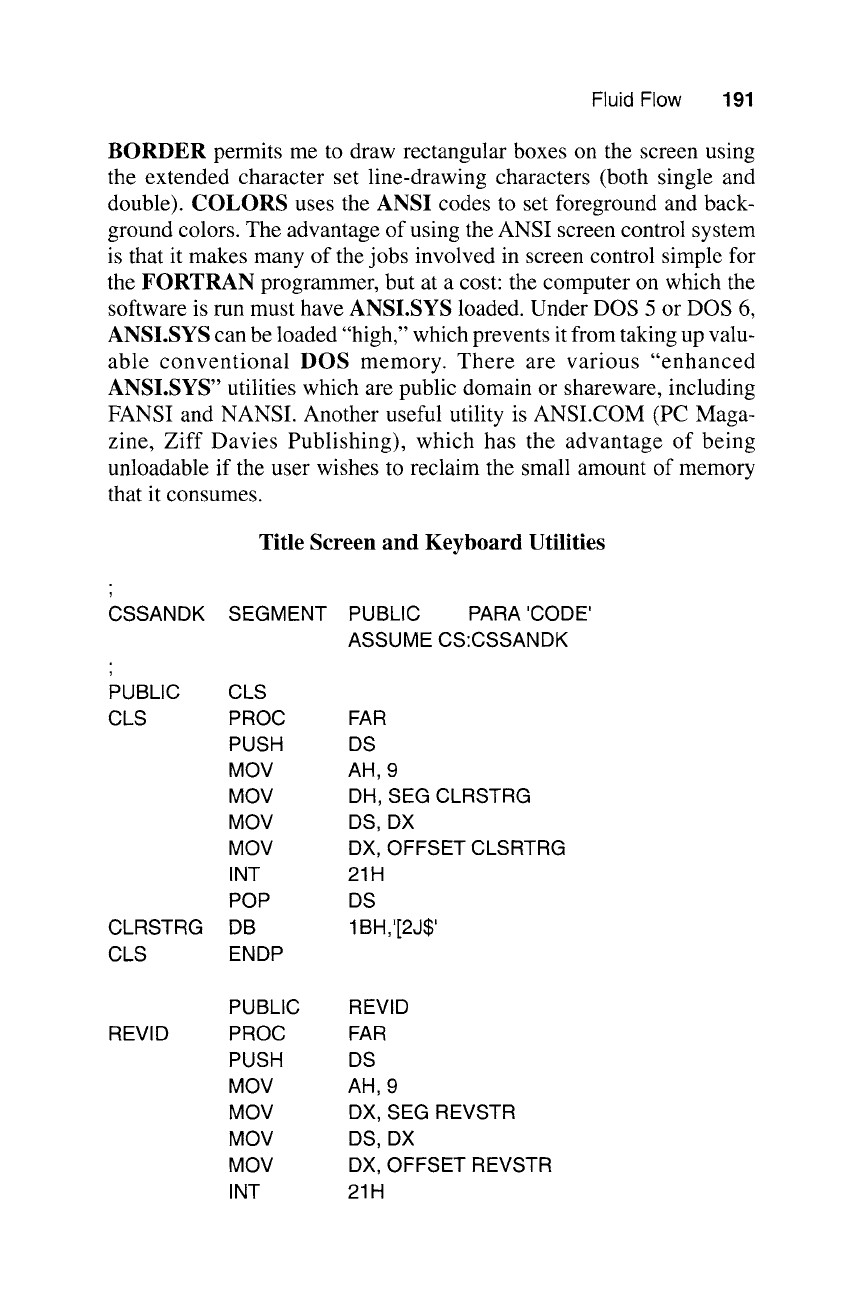
Title Screen and Keyboard Utilities
CSSANDK SEGMENT
PUBLIC
CLS
CLRSTRG
CLS
CLS
PROC
PUSH
MOV
MOV
MOV
MOV
INT
POP
DB
ENDP
PUBLIC PARA 'CODE'
ASSUME CS:CSSANDK
FAR
DS
AH, 9
DH, SEG CLRSTRG
DS, DX
DX, OFFSET CLSRTRG
21H
DS
1BH,'[2J$'
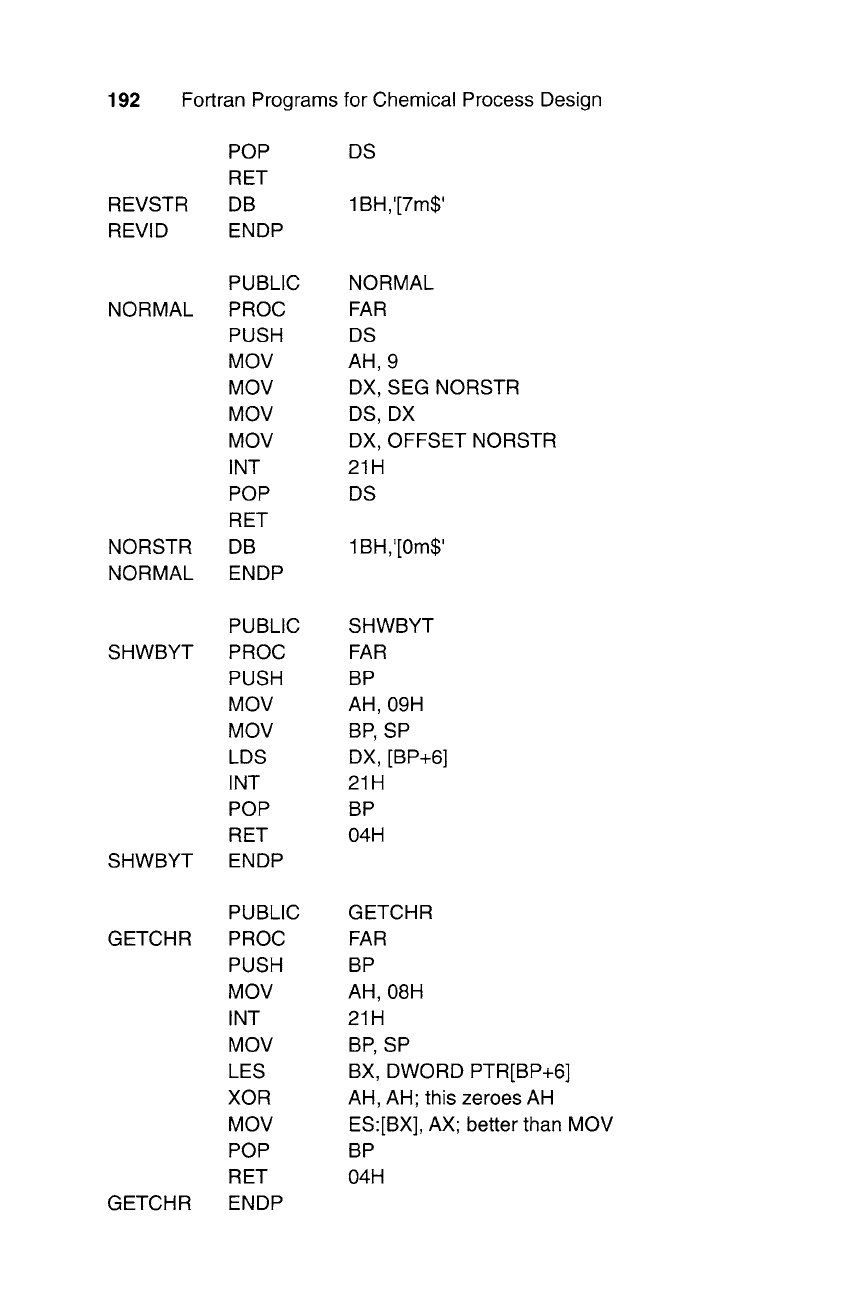
REVID
PUBLIC
PROC
PUSH
MOV
MOV
MOV
MOV
INT
REVID
FAR
DS
AH, 9
DX, SEG REVSTR
DS, DX
DX, OFFSET REVSTR
21H
192 Fortran Programs for Chemical Process Design
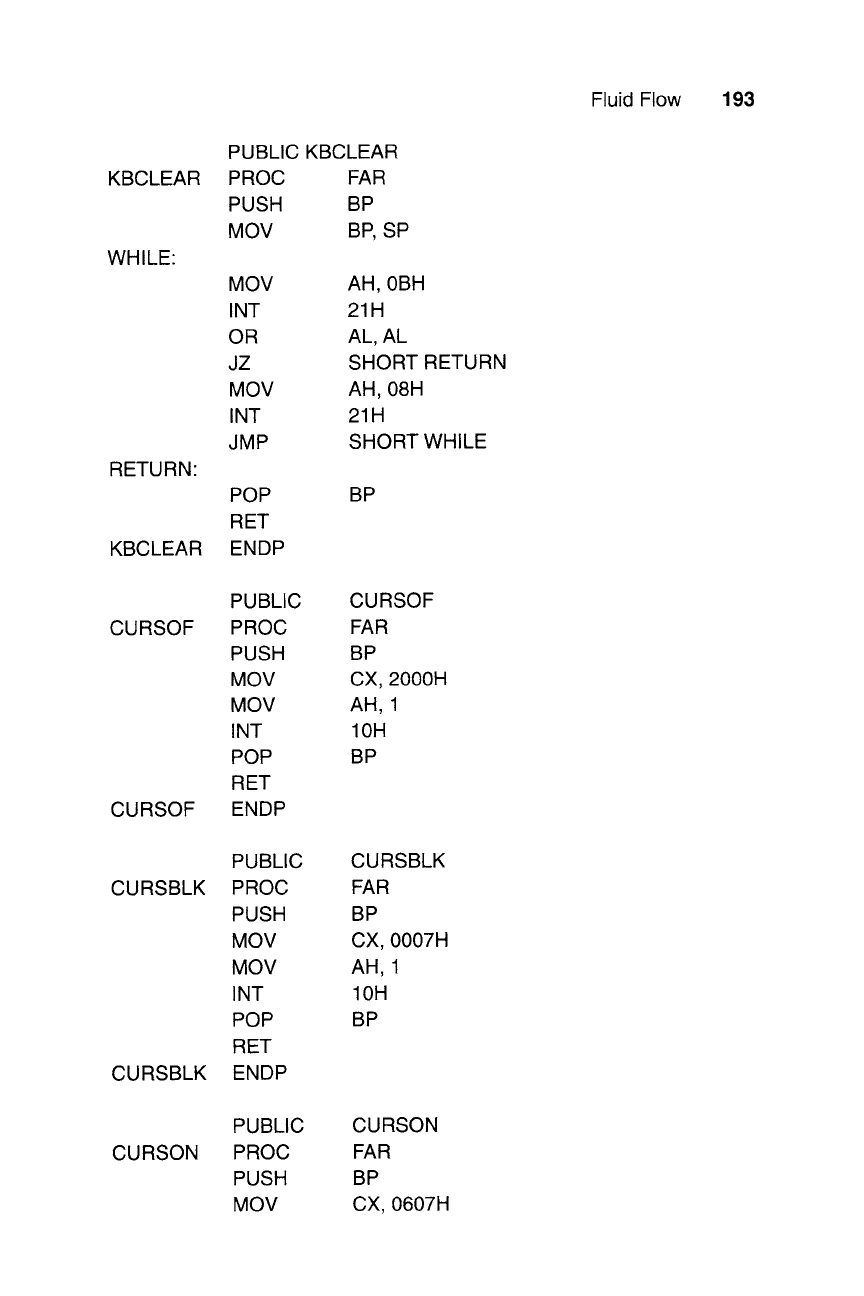
REVSTR
REVID
POP DS
RET
DB 1BH,'[7m$'
ENDP
NORMAL
NORSTR
NORMAL
PUBLIC
PROC
PUSH
MOV
MOV
MOV
MOV
INT
POP
RET
DB
ENDP
NORMAL
FAR
DS
AH, 9
DX, SEG NORSTR
DS, DX
DX, OFFSET NORSTR
21H
DS
1BH,'[0m$'
SHWBYT
SHWBYT
PUBLIC
PROC
PUSH
MOV
MOV
LDS
INT
POP
RET
ENDP
SHWBYT
FAR
BP
AH, 09H
BP, SP
DX, [BP+6]
21H
BP
04H
GETCHR
GETCHR
PUBLIC
PROC
PUSH
MOV
INT
MOV
LES
XOR
MOV
POP
RET
ENDP
GETCHR
FAR
BP
AH, 08H
21H
BP, SP
BX, DWORD PTR[BP+6]
AH, AH; this zeroes AH
ES:[BX], AX; better than MOV
BP
04H
Fluid Flow 193
KBCLEAR
WHILE:
RETURN:
KBCLEAR
PUBLIC KBCLEAR
PROC FAR
PUSH BP
MOV BP, SP
MOV
INT
OR
JZ
MOV
INT
JMP
AH, 0BH
21H
AL, AL
SHORT RETURN
AH, 08H
21H
SHORT WHILE
POP
RET
ENDP
BP
CURSOF
CURSOF
PUBLIC
PROC
PUSH
MOV
MOV
INT
POP
RET
ENDP
CURSOF
FAR
BP
CX, 2000H
AH, 1
10H
BP
CURSBLK
CURSBLK
PUBLIC
PROC
PUSH
MOV
MOV
INT
POP
RET
ENDP
CURSBLK
FAR
BP
CX, 0007H
AH, 1
10H
BP
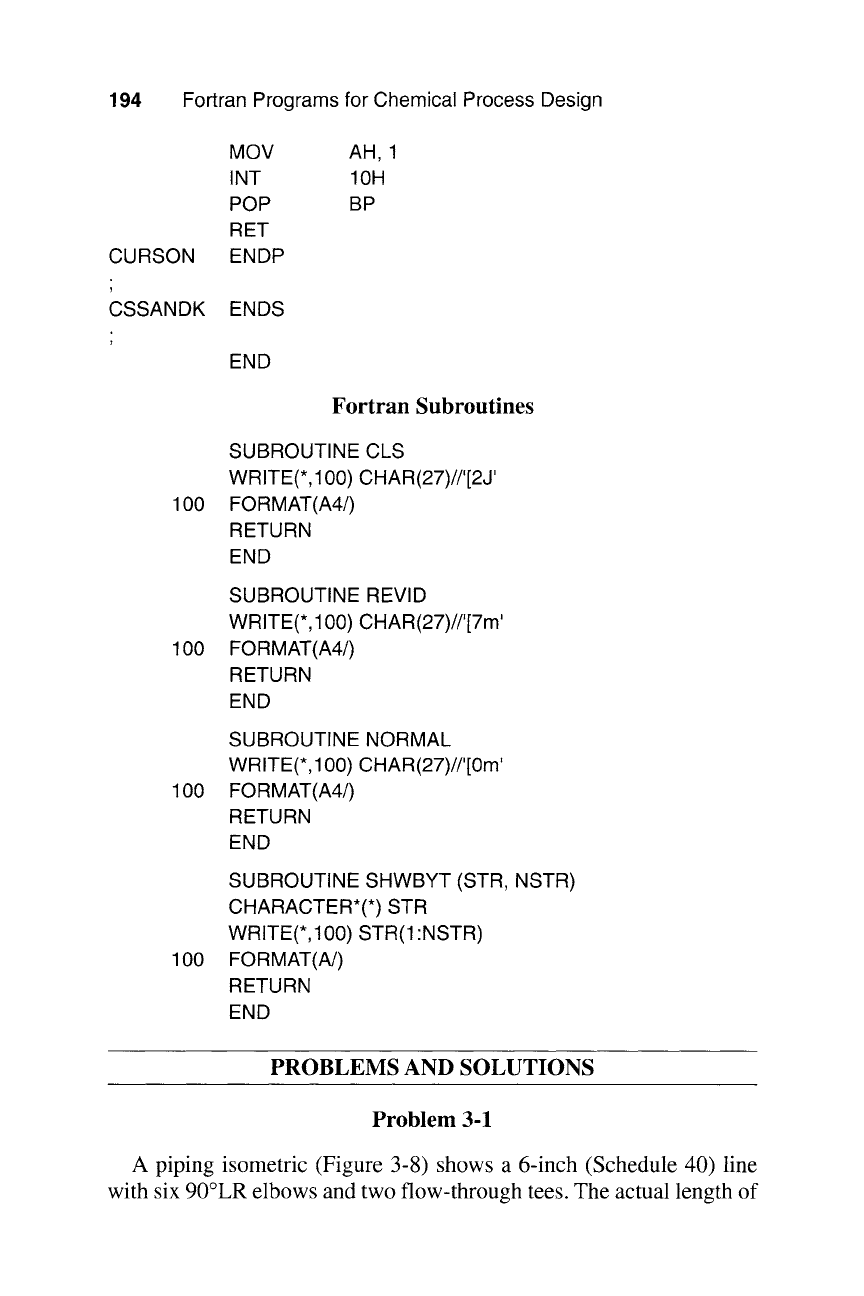
CURSON
PUBLIC
PROC
PUSH
MOV
CURSON
FAR
BP
CX, 0607H
194
Fortran Programs for Chemical Process Design
CURSON
CSSANDK
MOV
INT
POP
RET
ENDP
AH, 1
10H
BP
ENDS
END
Fortran Subroutines
SUBROUTINE CLS
WRITE(*, 100) CHAR(27)//'[2J'
100 FORMAT(A4/)
RETURN
END
SUBROUTINE REVlD
WRITE(*, 100) CHAR(27)//'[7m'
100 FORMAT(A4/)
RETURN
END
SUBROUTINE NORMAL
WRITE(*, 100) CHAR(27)//'[0m'
100 FORMAT(A4/)
RETURN
END
SUBROUTINE SHWBYT (STR, NSTR)
CHARACTER*(*) STR
WRITE(*, 100) STR(I:NSTR)
100 FORMAT(A/)
RETURN
END
PROBLEMS AND SOLUTIONS
Problem 3-1
A piping isometric (Figure 3-8) shows a 6-inch (Schedule 40) line
with six 90~ elbows and two flow-through tees. The actual length of
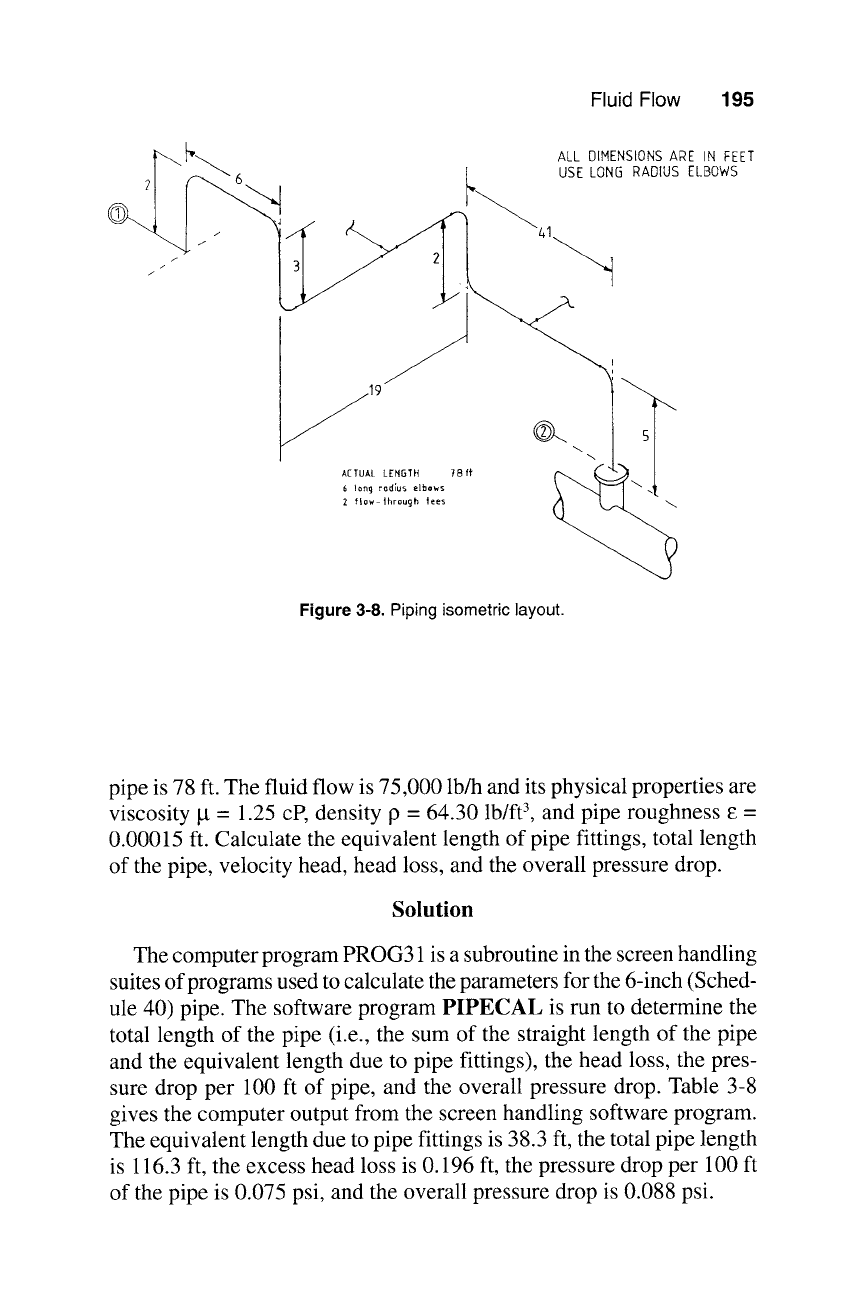
Fluid Flow 195
" ALL DIMENSIONS ARE IN FEET
~~ USE LONG RADIUS ELBOWS
~41~
ACTUAL LENGTH
6
long
rodius elbows
2 flow-ihrough lees
I
0-. s
78
ff
Figure 3-8. Piping isometric layout.
pipe is 78 ft. The fluid flow is 75,000 lb/h and its physical properties are
viscosity B = 1.25 cP, density P = 64.30 lb/ft 3, and pipe roughness e =
0.00015 ft. Calculate the equivalent length of pipe fittings, total length
of the pipe, velocity head, head loss, and the overall pressure drop.
Solution
The computer program PROG31 is a subroutine in the screen handling
suites of programs used to calculate the parameters for the 6-inch (Sched-
ule 40) pipe. The software program PIPECAL is run to determine the
total length of the pipe (i.e., the sum of the straight length of the pipe
and the equivalent length due to pipe fittings), the head loss, the pres-
sure drop per 100 ft of pipe, and the overall pressure drop. Table 3-8
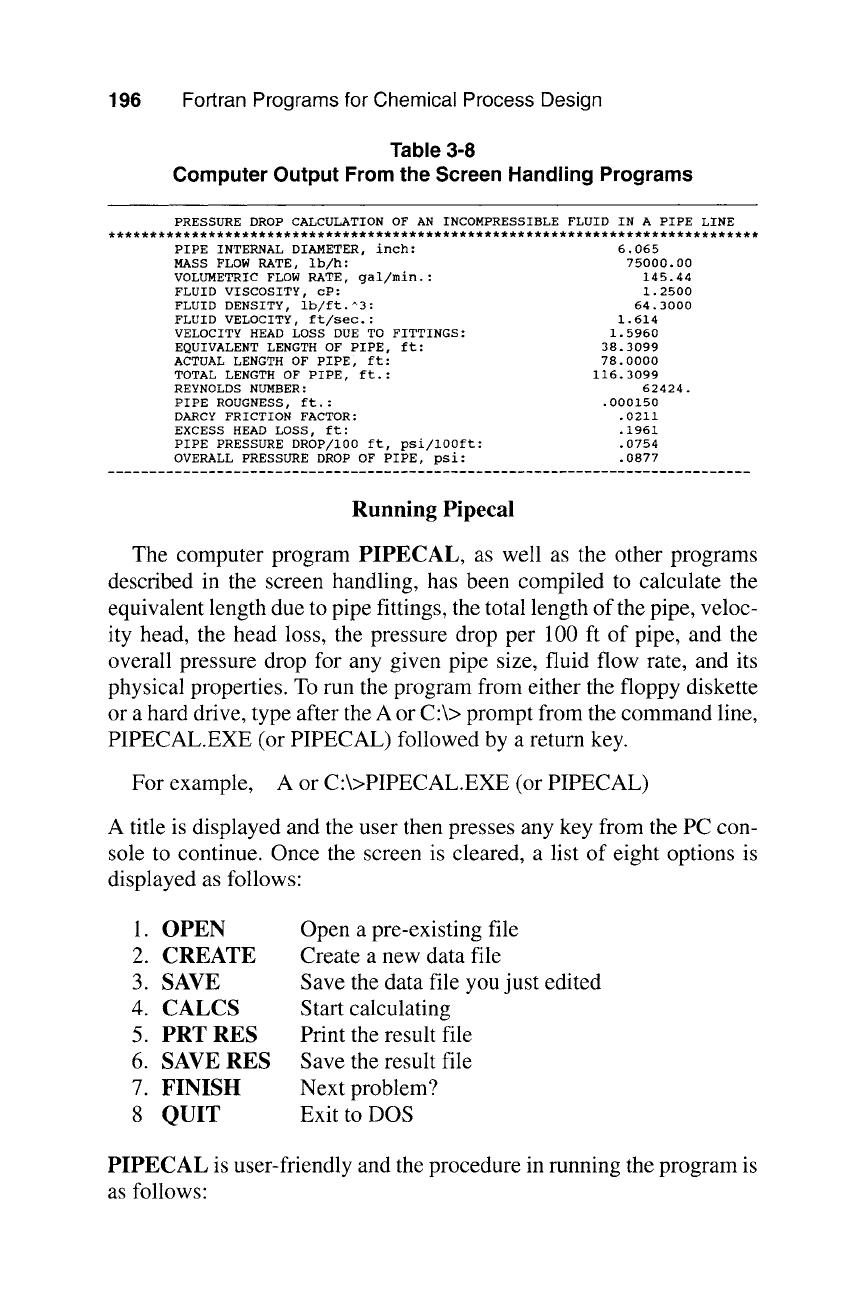
gives the computer output from the screen handling software program.
The equivalent length due to pipe fittings is 38.3 ft, the total pipe length
is 116.3 ft, the excess head loss is 0.196 ft, the pressure drop per 100 ft
of the pipe is 0.075 psi, and the overall pressure drop is 0.088 psi.
196 Fortran Programs for Chemical Process Design
Table 3-8
Computer Output From the Screen Handling Programs
PRESSURE DROP CALCULATION OF AN INCOMPRESSIBLE FLUID IN A PIPE LINE
PIPE INTERNAL DIAMETER,
inch:
MASS FLOW RATE,
ib/h:
VOLUMETRIC FLOW RATE,
gal/min.:
FLUID VISCOSITY,
cP:
FLUID DENSITY, Ib/ft.^3:
FLUID VELOCITY,
ft/sec.:
VELOCITY HEAD LOSS DUE TO FITTINGS:
EQUIVALENT LENGTH OF PIPE,
ft:
ACTUAL LENGTH OF PIPE,
ft:
TOTAL LENGTH OF PIPE, ft.:
REYNOLDS NUMBER:
PIPE ROUGNESS, ft.:
DARCY FRICTION FACTOR:
EXCESS HEAD LOSS,
ft:
PIPE PRESSURE DROP/100 ft, psi/100ft:
OVERALL PRESSURE DROP OF PIPE,
psi:
___
6.065
75000.00
145.44
1.2500
64.3000
1.614
1.5960
38.3099
78.0000
116.3099
62424.
.000150
.0211
.1961
.0754
.0877
Running Pipecal
The computer program PIPECAL, as well as the other programs
described in the screen handling, has been compiled to calculate the
equivalent length due to pipe fittings, the total length of the pipe, veloc-
ity head, the head loss, the pressure drop per 100 ft of pipe, and the
overall pressure drop for any given pipe size, fluid flow rate, and its
physical properties. To run the program from either the floppy diskette
or a hard drive, type after the A or C:\> prompt from the command line,
PIPECAL.EXE (or PIPECAL) followed by a return key.
For example, A or C:\>PIPECAL.EXE (or PIPECAL)
A title is displayed and the user then presses any key from the PC con-
sole to continue. Once the screen is cleared, a list of eight options is
displayed as follows:
1. OPEN
2. CREATE
3. SAVE
4. CALCS
5. PRT RES
6. SAVE RES
7. FINISH
8 QUIT
Open a pre-existing file
Create a new data file
Save the data file you just edited
Start calculating
Print the result file
Save the result file
Next problem?
Exit to DOS
PIPECAL is user-friendly and the procedure in running the program is
as follows: